Ab roller technology in 2026 has quietly become more beginner-accessible. Manufacturers have moved beyond the basic single-wheel design toward options with automatic rebound springs, built-in elbow supports, LCD timers, and dual-wheel stability bases — all aimed at solving the most common training failure: collapsing at the bottom of a rollout. That shift has made quality core training equipment available to lifters who previously couldn’t control a standard ab wheel.
This article covers five of the best ab rollers and core training tools for home gyms in 2026, ranging from $12 to $48. Each fills a different need: the spring-assisted Perfect Fitness Ab Carver Pro for directed oblique work, the heavy-duty VINSGUIR for budget-focused lifters who want maximum capacity, the DMoose with elbow support for those building from scratch, the Pqeert automatic rebound roller for complete beginners, and Elite Sportz core sliders as the category’s most versatile and compact tool.
Quick Picks
Perfect Fitness Ab Carver Pro is the best overall ab roller — steerable wheel, kinetic spring engine, and a proven track record at $35–$42. The Editor Pick by a wide margin.
VINSGUIR Ab Roller is the best budget pick — 440 lb capacity, 3.2-inch dual-wheel stability, and sub-$28 pricing. The best value for lifters who already know how to control a rollout.
DMoose Ab Roller with Elbow Support is the best choice for beginners who want proper form — elbow pads correct upper-body alignment and ship pre-assembled with two knee pads.
Pqeert Automatic Rebound Ab Roller is best for complete newbies who can’t yet hold the full rollout — the spring catches the bottom position and resets you automatically.
Elite Sportz Core Sliders are the best core sliders in this price range — dual-sided, 7-inch discs that work on any floor and add a fundamentally different training stimulus.
Comparison
| Tool | Type | Capacity | Key Feature | Price |
|---|---|---|---|---|
| Perfect Fitness Ab Carver Pro | Spring-assist roller | 300 lbs | Steerable, 6.5” wide wheel | $30.87-$39.10 as of Oct 18, 2026 |
| VINSGUIR Ab Roller | Standard dual-wheel | 440 lbs | 3.2” wide, budget price | Unavailable |
| DMoose Ab Roller | Elbow support roller | 330 lbs | Pre-assembled, elbow pads | Unavailable |
| Pqeert Automatic Rebound | Auto-rebound roller | 500 lbs | Spring returns you upright | Unavailable |
| Elite Sportz Core Sliders | Gliding discs | Bodyweight | Dual-sided, any floor | Check price |
Buying Guide: How to Choose an Ab Roller
Standard Roller vs. Spring-Assisted vs. Auto-Rebound
A standard ab roller (like the VINSGUIR) rolls forward under gravity and requires you to pull yourself back with pure core and lat strength. This is the most direct core stimulus, but also the most demanding — lifters who can’t complete a controlled return shouldn’t start here.
A spring-assisted roller (Perfect Fitness Ab Carver Pro) loads a carbon steel spring on the way out and releases it on the return. You still do the work, but the spring provides a meaningful boost at the reversal point. This allows a longer, more challenging rollout than most beginners can manage with a standard wheel.
An automatic rebound roller (Pqeert) goes further — the spring actually catches you at the bottom and starts pushing you back. For complete beginners who consistently collapse at full extension, this is genuinely useful. The tradeoff is reduced core demand overall. Once you can control a full rollout, move to a standard or spring-assist wheel.
Wheel Width and Stability
Narrow single wheels (1.5–2 inches) are the most challenging because they require lateral stability as well as core strength. Budget basic rollers fall into this category.
Dual-wheel and wide designs (3–7 inches) eliminate most lateral instability. The VINSGUIR’s 3.2-inch dual wheel and the Ab Carver Pro’s 6.5-inch single wheel both solve lateral tipping. For a home gym without a trainer spotting form, wider is safer.
Elbow Support: Useful Tool or Crutch?
Elbow supports shift some of the load off the wrists and shoulders, which is useful for lifters with wrist mobility issues or recovering from shoulder injuries. The DMoose’s built-in elbow pads are the clearest example.
The honest tradeoff: part of the value of an ab roller is the full-body engagement — core, lats, shoulders, and wrists working together. Elbow supports reduce the upper-body demand. If you’re recovering from an injury or just starting out, the support is worth it. If you’re training for core strength and overall stability, a standard roller without elbow support is more complete.
Ab Rollers vs. Core Sliders
These two tools aren’t redundant. Ab rollers primarily target the rectus abdominis and hip flexors during the rollout, with secondary lat and shoulder activation. Core sliders, by contrast, challenge the deep stabilizers — transverse abdominis, obliques, and hip stabilizers — through slow, controlled sliding movements like plank walks, mountain climbers, and reverse lunges.
Adding both to a home gym costs under $70 total using the VINSGUIR and Elite Sportz combination, and the training stimuli genuinely complement each other. If you can only have one, an ab roller gives more versatile difficulty progression. If you have both, the slider work adds exercises that no amount of rolling will replicate.
Price vs. Durability
Ab rollers are inexpensive by home gym standards, and the price tier is meaningful:
- Under $20: Basic single-wheel with thin grips (not in this roundup)
- $22–$36: Quality dual-wheel rollers (VINSGUIR, Pqeert) — handles actual training loads
- $35–$48: Feature-laden options (Ab Carver Pro, DMoose) — spring assist, elbow support, accessories
- $12–$18: Core sliders — different category, best value tool per training effect
At these prices, buying quality matters more than shopping for the lowest price. A poor-quality ab roller develops axle play after a few months of use, which causes the wheel to wobble and introduces lateral instability. The ASINs in this roundup have verified ratings and consistent quality feedback.
Detailed Reviews
Perfect Fitness Ab Carver Pro — Editor Pick
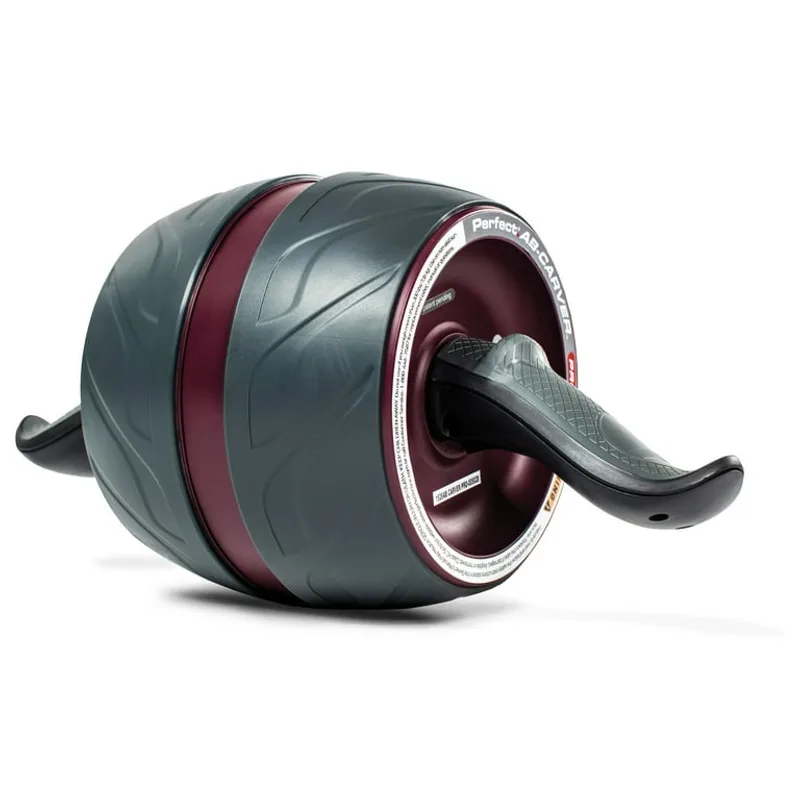
Perfect Fitness Ab Carver Pro
Pros
- 6.5-inch ultra-wide wheel is the widest in this roundup — the extra width catches you before you lose control and collapse sideways
- Carbon steel kinetic spring stores energy on the rollout and helps you return — makes rollouts accessible at a longer range than a basic wheel
- Steerable design lets you arc left or right during the rollout to directly target obliques — a function no single-axis roller can replicate
- Ships with foam knee pads and a downloadable 21-day program — everything needed to start training immediately
- Proven product with over a decade of consistent top ratings from serious lifters
Cons
- 300 lb weight capacity is the lowest in this roundup — very heavy lifters should choose the VINSGUIR or DMoose
- Spring-assist limits the full difficulty of a rollout for advanced lifters who want maximum core challenge without assistance
- Wheel diameter limits use on very thick carpet
The Perfect Fitness Ab Carver Pro has held the top spot in this category for years, and the 2026 version hasn’t changed the formula — because it doesn’t need to. The 6.5-inch wide wheel with a rounded outer edge is the core design decision: the width prevents lateral tipping, and the curved profile allows you to steer the rollout arc left or right to shift emphasis onto the obliques. No single-axis roller can do that.
The kinetic engine — a carbon steel spring inside the wheel housing — stores energy during the rollout and releases it at the reversal point. This does two things: it allows a longer rollout than most lifters can independently control, and it trains the return movement with actual resistance rather than just gravity. The result is a more complete core training stimulus than a passive wheel provides.
The 6.5-inch wheel also works on more floor surfaces than narrower designs. On textured rubber gym flooring, carpet, or hardwood, the wider contact patch maintains consistent rolling resistance.
The primary limitation is the 300 lb weight capacity — the lowest in this roundup. This is a constraint for heavier lifters, but for the large majority of users, it’s a non-issue.
VINSGUIR Ab Roller Wheel — Best Budget
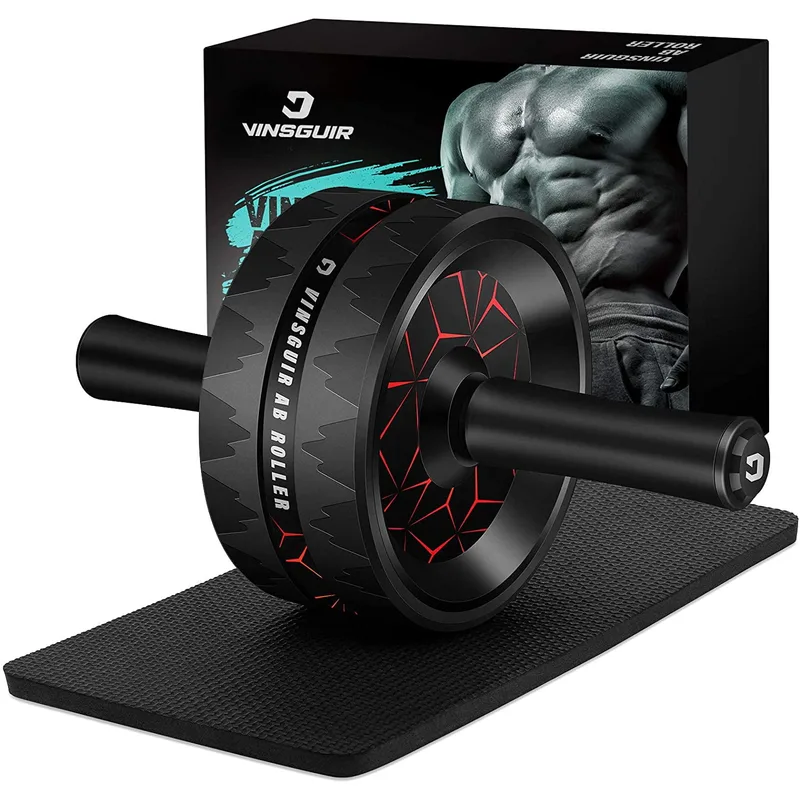
VINSGUIR Ab Roller Wheel
Pros
- 440 lb weight capacity is the highest in this roundup — handles any realistic user weight without risk of failure
- 3.2-inch dual-wheel design prevents lateral tipping — meaningfully more stable than single-wheel rollers at this price point
- High-strength stainless steel shaft doesn't flex or develop play under heavy body weight loading
- EVA foam handles are non-slip and significantly more comfortable than bare plastic grips
- Under $28 makes it the most affordable quality ab roller in this roundup
Cons
- No spring assist — full bodyweight rollout from start, which is appropriate for intermediate users but difficult for complete beginners
- Knee pad quality is basic — adequate for cushioning but thinner than dedicated knee pads
- No steering capability — rolls in a straight line only
The VINSGUIR delivers more fundamental structural quality per dollar than any other roller in this roundup. The stainless steel shaft doesn’t flex under heavy loading, the 3.2-inch dual-wheel design eliminates lateral instability, and the 440 lb weight capacity is the highest in the category.
The EVA foam handles deserve specific mention. Most budget rollers use bare plastic grips that become slippery with sweat and cause hand fatigue on longer sets. The VINSGUIR’s foam handles stay grippy and reduce the compressive discomfort that stops beginners from holding the bottom position longer.
This is the right choice for lifters who already know their core is capable of a rollout — it provides zero assistance, which means maximum training stimulus. If you collapse at the bottom of a rollout, start with the Pqeert or the Ab Carver Pro. If you can complete controlled rollouts, the VINSGUIR’s $22–$28 price for this build quality is genuinely excellent.
DMoose Fitness Ab Roller with Elbow Support — Best for Beginners
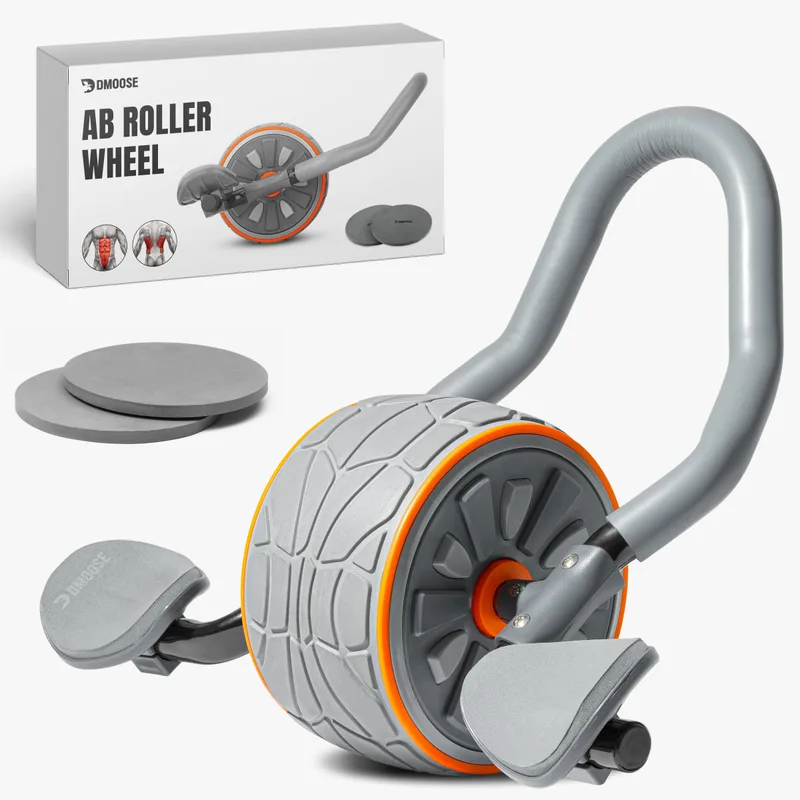
DMoose Fitness Ab Roller Wheel with Elbow Support
Pros
- Built-in elbow rests force correct upper-body alignment during rollouts — reduces wrist and shoulder strain that plagues beginners with standard rollers
- Ships pre-assembled — no tools, no setup time, ready to use out of the box
- Includes two knee pads, which is one more than most competitors — practical if the included pad ever needs replacing
- 360° rolling path gives you oblique targeting capability by steering the rollout path left or right
- Stainless steel frame handles 330 lbs reliably without flex
Cons
- Elbow support design makes it bulkier than standard rollers — slightly more storage space required
- Elbow pads reduce wrist loading but also reduce the wrist and shoulder activation that makes ab rollers a full-body tool
- Higher price than the VINSGUIR for a similar core workout if you don't need beginner support
The DMoose addresses the most common beginner complaint about ab rollers: wrist and shoulder strain in the starting position before the rollout even begins. Standard rollers require you to plant your palms on the grips and bear full upper-body load through the wrists. The DMoose’s elbow support brackets shift that load up to the forearms, where it’s distributed more comfortably.
The practical effect is that users who have avoided ab rollers due to wrist issues can typically use this design without pain. The same applies to lifters coming off shoulder injuries who want to train core without loading the shoulder joint aggressively.
Shipping pre-assembled is a genuine quality-of-life feature that more home gym equipment should adopt. There’s nothing to install, align, or tighten — open the box and start training.
The included two knee pads are above average in density. Most rollers include one thin pad; the DMoose’s dual knee pads are noticeably more cushioned on hard floor surfaces.
Pqeert Automatic Rebound Ab Roller — Best for Newbies
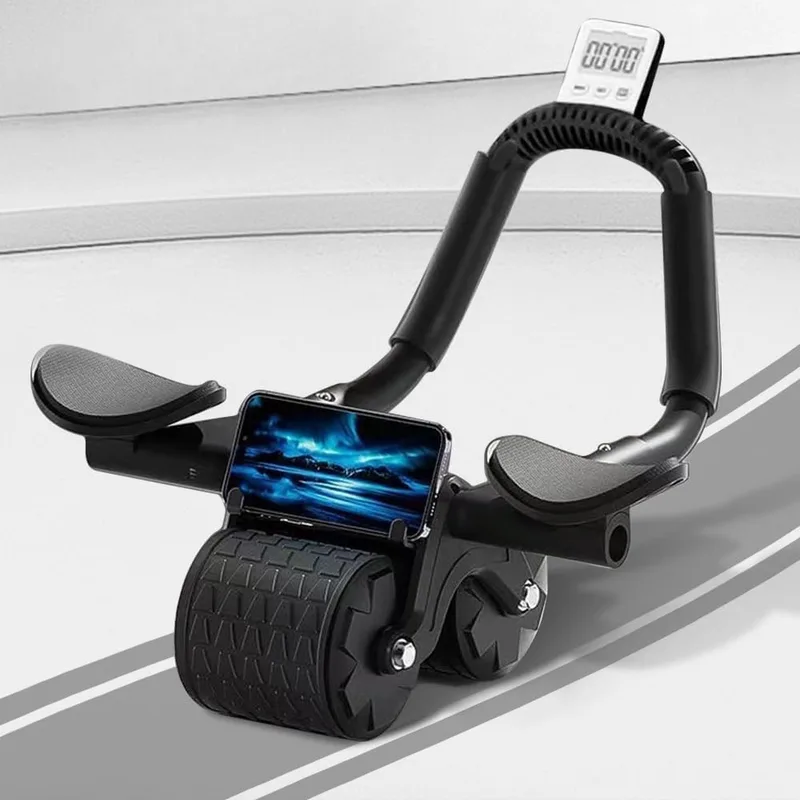
Pqeert Automatic Rebound Ab Roller
Pros
- Automatic rebound spring catches you at the bottom of the rollout and returns you upright — solves the most common beginner failure point of collapsing at full extension
- Built-in LCD timer removes the need for a phone or watch during sets — useful for timed planks and holds beyond the rollout
- 500 lb weight capacity is the highest in this roundup
- Dual widened wheel plus elbow support provides the most total stability of any roller here
- Quiet spring mechanism doesn't clatter or squeak during use
Cons
- Automatic rebound reduces core difficulty — lifters who can already do controlled rollouts will find this less challenging than the Ab Carver Pro or VINSGUIR
- Bulkier and heavier than standard rollers due to the spring and elbow support frame — not as compact for storage
- Brand recognition is low compared to Perfect Fitness and VINSGUIR
The automatic rebound mechanism solves the specific problem that keeps beginners from progressing on ab rollers: collapsing at full extension. Every beginner does it — the core fatigues or fails at the bottom of the rollout, and you end up face-down on the floor instead of pulling back. On a standard roller, that failure stops the set. On the Pqeert, the internal spring catches the weight and assists the return, so you don’t collapse.
This is training wheels for the ab roller. It’s not a permanent tool — once you can control a full rollout unassisted, the spring becomes a performance limiter rather than an aid. But as an entry point to the movement pattern, it’s effective.
The built-in LCD timer is a useful addition that no other roller in this roundup includes. Ab roller training benefits from timed holds (plank position, bottom hold) rather than just rolling reps, and having a timer on the device itself removes one friction point from the training session.
The 500 lb weight capacity — the highest in this roundup — is paired with a bulkier overall frame than the simpler rollers. Storage footprint is larger, and the device is heavier to move.
Elite Sportz Core Sliders — Best Core Sliders
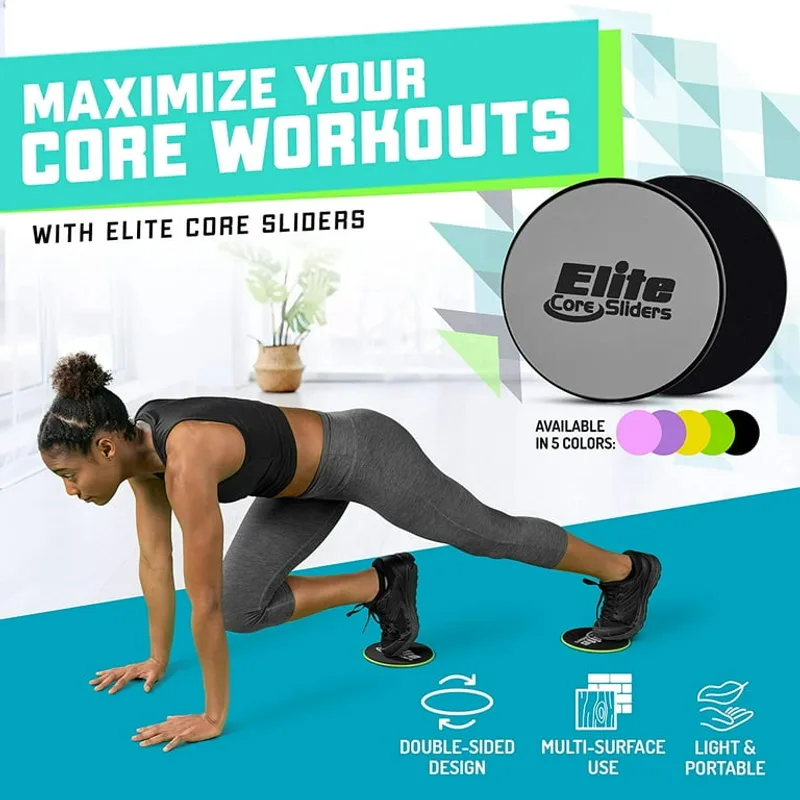
Elite Sportz Core Sliders
Pros
- Dual-sided design covers every floor type — fabric side for hard floors, smooth plastic side for carpet — one set works everywhere
- Core sliders hit the deep stabilizers and transverse abdominis in ways ab rollers don't — genuinely different stimulus, not a redundant tool
- Under $18 makes them the most affordable core training tool in this roundup — easily paired with any of the rollers above
- Compact and flat — store in a drawer, fit in any gym bag, take anywhere
- Enable dozens of exercises beyond ab work — reverse lunges, push-up variations, hamstring curls, and plank body saws
Cons
- No resistance mechanism — difficulty is limited to bodyweight and movement complexity, not adjustable load
- Some users find 7" diameter slightly small for hand exercises compared to competitors with 9" discs
- Not suitable for extremely plush carpet where the plastic side loses grip
Core sliders belong in every home gym that has a hard floor or carpet, and the Elite Sportz set is the most reliable option at the price. The dual-sided design (fabric on one side for hard floors, smooth plastic on the other for carpet) means one set covers every floor type without buying separate products.
The 7-inch diameter is large enough to fit both hands or both feet comfortably, which allows bilateral exercises like plank body saws, push-up sliders, and hamstring curls. Smaller 6-inch sliders feel cramped during these movements.
The training effect is different enough from ab rollers that calling them alternatives is inaccurate — they’re complementary. Sliders load the deep stabilizers during slow, controlled movement. Mountain climbers, reverse lunges with sliders, and standing pike slides target muscles that rollout patterns don’t reach directly. A home gym with both a roller and a set of sliders has the core training spectrum well covered.
At $12–$18, the Elite Sportz sliders represent the best dollar-per-exercise value in this roundup. Add them to any of the rollers above and the combination costs under $50 total.
FAQ
Do ab rollers actually build core strength?
Ab rollers are one of the most effective tools for anterior core strength — specifically the rectus abdominis, hip flexors, and the deep spinal stabilizers. The rollout is a long-lever anti-extension exercise, which is harder than crunches or sit-ups because you’re fighting gravity across your full body length rather than just lifting your upper body. Research consistently shows ab wheel rollouts produce higher ab muscle activation than traditional exercises. The limitation is that they don’t train rotational strength or lateral stability — core sliders and planks fill those gaps.
What’s the difference between an ab roller and an ab wheel?
They’re the same tool. “Ab roller,” “ab wheel,” and “rollout wheel” all refer to the same small wheel-and-handle device. Marketing uses both terms interchangeably. The functional difference that matters more is wheel width (single vs. dual-wheel), assistance mechanism (standard vs. spring-assisted vs. auto-rebound), and build quality.
Can beginners use an ab roller safely?
Beginners can use ab rollers safely if they start with a modified range of motion — rolling only 6–12 inches forward instead of full extension. A spring-assisted roller (Ab Carver Pro) or automatic rebound roller (Pqeert) makes this easier by providing assistance at the reversal point. Starting on the knees instead of full plank is also appropriate. The most common beginner injury is lower back strain from losing core tension at the bottom — stop the rollout before you lose control rather than trying to reach full extension.
How do I use core sliders vs. an ab roller?
Ab rollers are used in a kneeling or full plank position — you grip the handles and roll forward, extending your body, then pull back. Core sliders are placed under hands or feet and used for sliding exercises like mountain climbers (feet on sliders), plank body saws (feet on sliders, sawing forward and back), reverse slider lunges (feet on sliders), and push-up slider pikes. Both devices work best on clean, dry floor surfaces.
How long does it take to see results from ab roller training?
Core strength improvements are typically noticeable within 3–4 weeks of consistent training (3–4 sessions per week). Visible abdominal development depends primarily on body composition and diet rather than exercise selection. Ab rollers build the muscle; nutrition determines whether it’s visible. Expect meaningful functional core strength improvements — better squat and deadlift stability, reduced lower back fatigue — within the first month.
Conclusion
The Perfect Fitness Ab Carver Pro is the best ab roller for most home gym athletes. The steerable 6.5-inch wheel, kinetic spring engine, and consistent quality across its long production run justify its position as the Editor Pick. At $35–$42, it’s the best combination of training effect and accessibility.
Budget-focused lifters should choose the VINSGUIR Ab Roller — 440 lb capacity, dual-wheel stability, and quality construction for under $28.
Beginners dealing with wrist or shoulder issues should go with the DMoose Ab Roller with Elbow Support — the elbow bracket solves the primary form problem, and the pre-assembled design removes the setup barrier.
Complete newbies who consistently collapse during rollouts should start with the Pqeert Automatic Rebound — the spring return function makes the movement pattern learnable before graduating to a standard roller.
And add Elite Sportz Core Sliders to any setup. At $12–$18, they’re the cheapest way to add a meaningfully different core training stimulus to a home gym.