Adjustable weight benches under $300 have improved significantly. In 2026, the Flybird WB5 carries an ASTM certification at 800 lbs — independently verified structural testing that previously appeared only on commercial equipment. At the same price point a few years back, you were choosing between import benches with unverifiable capacity claims. That shift has raised the floor quality for the entire sub-$300 category.
The practical question isn’t whether these benches are good enough anymore — several clearly are. The question is which tradeoffs match your training. Foldable benches under 30 lbs are easy to store but shift under very heavy loads. Heavy commercial-style benches are rock solid but effectively permanent. True FID benches with decline cost more but cover every pressing angle in one purchase.
This roundup covers five benches from $130 to $299. The Flybird WB5 is the best choice for most home gym lifters. The REP Fitness AB-3100 is for serious lifters who prioritize stability and a 1,000 lb rated capacity. The Titan Performance Series is the 11-gauge mid-range option. The XMark OX Series is the premium pick at the $300 ceiling with true decline. The Marcy SB-670 is the budget entry point.
Quick Picks
Flybird WB5 is the right bench for most buyers. ASTM-certified at 800 lbs, eight back positions including true decline, foldable storage, and a 29 lb weight that makes solo handling practical — all for around $130. The stability limitation under maximum loads is real, but for the training most home gym lifters actually do, this bench delivers.
REP Fitness AB-3100 V3 is for buyers whose top priority is stability and capacity. The 70 lb commercial-style frame doesn’t move under heavy loads, and the 1,000 lb flat rating means you’ll never approach its structural limits. The tradeoff: no decline, and it’s not practical to fold or store between sessions.
Titan Performance Series is the 11-gauge mid-range pick for buyers who prioritize commercial steel specification and thicker pad cushioning. Seven back positions and 2.5” thick pads at $229 put it between the REP AB-3100 (more capacity, less money) and the XMark OX Series (true decline, same price tier).
XMark OX Series earns its spot as the best premium pick under $300. The 1,500 lb capacity, true −20° decline, and 3” pads represent the highest specification available in this price range. Verify current Amazon pricing — it sits at the ceiling and price movement matters here.
Marcy SB-670 is the budget foldable pick. Functional, foldable, and rated to 600 lbs. The 14-gauge steel and minimal decline angle are real limitations, but for someone starting out with lighter training loads, it works. Note: Marcy has retired this model; verify Amazon availability before ordering.
Comparison
| Bench | Price | Capacity | Back Positions | Decline | Steel | Best For |
|---|---|---|---|---|---|---|
| Flybird WB5 | $149.98 as of Oct 18, 2026 | 800 lbs | 8 | Yes (−30°) | — | Most buyers |
| REP AB-3100 V3 | $269.99 as of Oct 18, 2026 | 1,000 lbs flat | 6 | No | Heavy-duty | Heavy lifters |
| Titan Performance | $249.99 as of Oct 18, 2026 | 650 lbs | 7 | No | 11-gauge | Mid-range buyers |
| XMark OX Series | $315.00 as of Oct 18, 2026 | 1,500 lbs | 7 | Yes (−20°) | 11-gauge 2”×3” | Premium pick |
| Marcy SB-670 | Unavailable | 600 lbs | 6 | Slight (−5°) | 14-gauge | Budget |

Flybird WB5 Adjustable Weight Bench
Pros
- ASTM-certified 800 lb weight capacity provides independently verified structural safety at a $130 price point
- 8 back positions from −30° to 90° cover flat, all incline angles, and true decline in one bench
- 29 lbs is the most portable adjustable bench in this roundup — stores against a wall or in a closet
- Folds completely flat in seconds, making it practical for home gyms that double as living spaces
- Three adjustable seat positions prevent sliding during steep incline sets
Cons
- 29 lb frame shifts under very heavy loads — less stable than a 50–70 lb commercial-style bench
- Shorter backrest than heavier-duty benches — tall lifters may not get full back support during pressing
- Pad thickness is thinner than mid-range benches — noticeable under heavy overhead or pressing work
The Flybird WB5’s ASTM certification at 800 lbs changed how this bench should be evaluated. ASTM certification means independent third-party testing verified the structural load claim — not the brand’s internal marketing number. At a sub-$150 price point, that kind of verified capacity rating is rare and meaningful.
Eight back positions from −30° to 90° cover every useful pressing angle: flat for standard bench work, shallow to steep inclines for upper chest development, fully upright for shoulder pressing, and true −30° decline for lower chest targeting. Most benches in this price range skip decline entirely — the WB5 includes it without a premium.
The 29 lb weight is the defining characteristic. Based on owner reports across thousands of reviews, this bench is the default recommendation for home gyms where the bench must be moved between uses. It folds flat in seconds, stands upright against a wall, and can be carried solo without effort. For apartment gyms, spare bedrooms, or any space where the bench competes with other daily uses, that portability is a genuine advantage.
The stability limitation is worth understanding clearly. At lighter-to-moderate loads — the range where most home gym lifters actually train — the WB5 is stable. At maximum loads close to the rated capacity, the lighter frame moves more than a 70 lb commercial bench. If you’re regularly pressing 300+ lbs combined weight, the REP AB-3100’s heavier construction is the more appropriate choice. For the majority of home gym lifters working in the 100–250 lb combined range, the WB5 is more than sufficient.
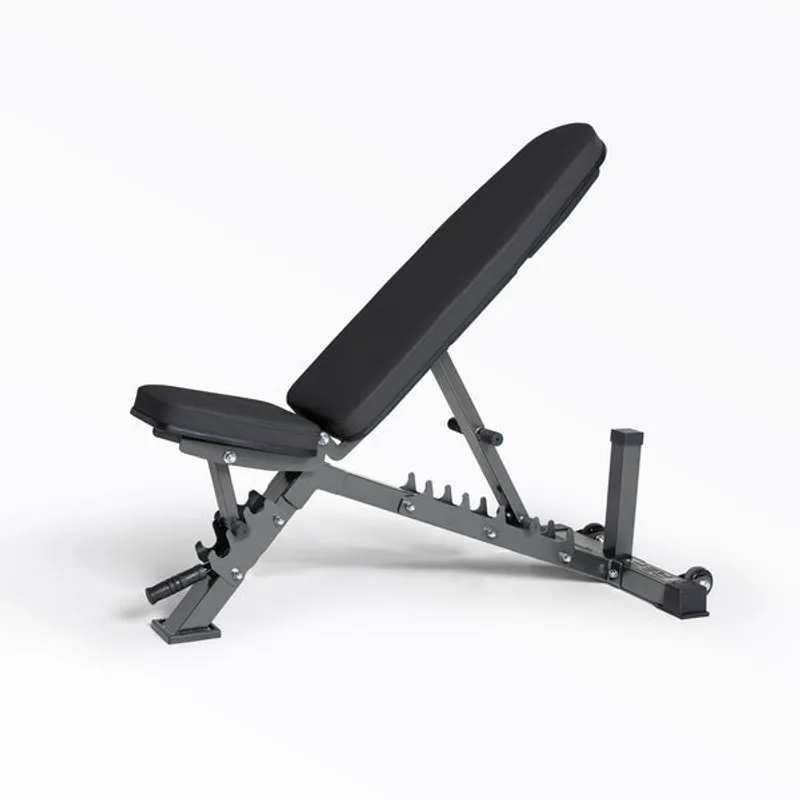
REP Fitness AB-3100 V3 Adjustable Bench
Pros
- 1,000 lb flat weight capacity is among the highest available at this price point — handles competitive-level loading
- 70 lb steel frame provides commercial-grade stability that foldable benches cannot match under heavy loads
- Three-post leg design keeps rear uprights out of your foot path during flat bench pressing
- 50.5" backrest fully supports tall lifters throughout flat and incline pressing movements
- Rear transport wheels allow solo repositioning of the 70 lb frame without lifting the whole unit
- Three seat positions at 0°, 10°, and 20° prevent slippage during steep incline sets
Cons
- No decline capability — limited to flat, incline, and upright positions (0°–90°)
- 70 lbs makes folding or storing between sessions impractical for most users
- Six back-position detents offers less angle precision than 7–8 position competitors
The REP Fitness AB-3100 V3 is available on Amazon (ASIN B07CJYL433), which often surprises buyers who assume REP Fitness only sells direct. The listing carries the same bench at pricing comparable to REP’s direct site — typically around $189.
The 1,000 lb flat / 700 lb incline rating is the highest capacity available in this price range. For powerlifters, competitive benchers, or anyone pushing serious training loads, this rating removes capacity from the equation entirely. At a 70 lb constructed weight, the AB-3100 doesn’t move during heavy pressing — the feel during maximum-effort sets is noticeably more solid than any foldable bench in this category.
The three-post leg design is a construction detail worth noting. Standard benches use a two-post front and rear layout that places legs directly in the path of your feet during flat pressing. The AB-3100’s three-post design keeps the rear support out of that zone — a small ergonomic improvement that matters during heavy foot-drive bench work.
One specification gap to understand clearly: no decline. The AB-3100 adjusts from flat (0°) to fully upright (90°), with stops at 30°, 45°, 60°, and 75°. Decline is not available on this bench. If decline pressing is part of your programming, the Flybird WB5 or XMark OX Series are the alternatives. If you don’t train decline, the AB-3100’s stability and capacity advantages make it the serious lifter’s pick under $300.
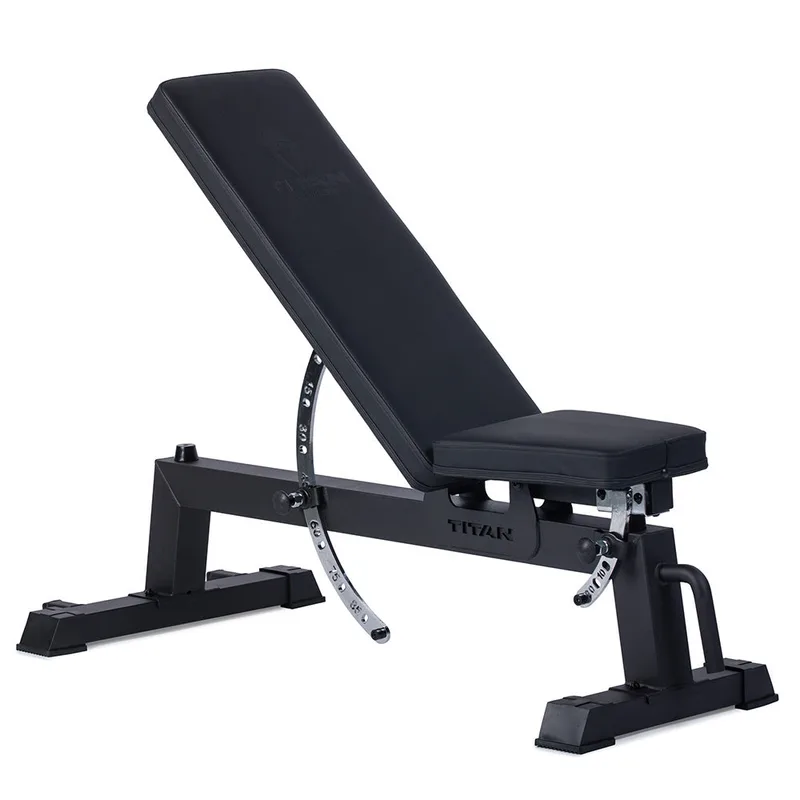
Titan Fitness Performance Series Adjustable Bench
Pros
- 11-gauge steel construction matches the specification found in commercial gym equipment
- 2.5" thick back and seat pads deliver noticeably better cushioning than budget-tier benches
- 52 lbs provides solid stability without the repositioning difficulty of a 70 lb bench
- Stores upright against a wall — saves floor space in tight home gym setups
- Seven back positions deliver more angle fine-tuning than the REP AB-3100's six-position system
Cons
- No decline — flat, incline, and upright positions only
- $40 more than the REP AB-3100 with 350 fewer pounds of weight capacity
- 56" total length is the longest bench in this roundup — requires the most dedicated floor space
The Titan Fitness Performance Series sits between the value-oriented REP AB-3100 and the premium XMark OX Series, positioned as the 11-gauge mid-range option with a focus on pad quality and steel construction.
Eleven-gauge steel is a meaningful material specification. Thinner gauge numbers mean thicker steel tubing — 14-gauge (used in the Marcy SB-670) is visibly and functionally less rigid than 11-gauge under load. The Performance Series frame has the rigidity characteristic of commercial gym equipment: no flex, no wobble, no lateral movement during heavy sets. Based on owner reports, the frame stability is one of the most consistently praised features across reviews.
The 2.5-inch back and seat padding is the thickest among the non-premium benches in this roundup. The difference is noticeable during longer sessions — particularly for dumbbell incline pressing where you’re in contact with the back pad for extended time under load. Budget benches compress noticeably with sustained use; the Titan’s pads maintain their shape better over time according to owner reports.
The honest trade-off at $229 is capacity versus price. The REP AB-3100 V3 at $189 carries a 1,000 lb flat rating versus the Titan’s 650 lbs — for $40 less. The Titan wins on pad thickness, 11-gauge specification, seven back positions (versus six), and upright storage. For buyers where pad comfort and steel gauge are the deciding factors, the Titan earns its premium. For pure capacity per dollar, the REP AB-3100 wins.
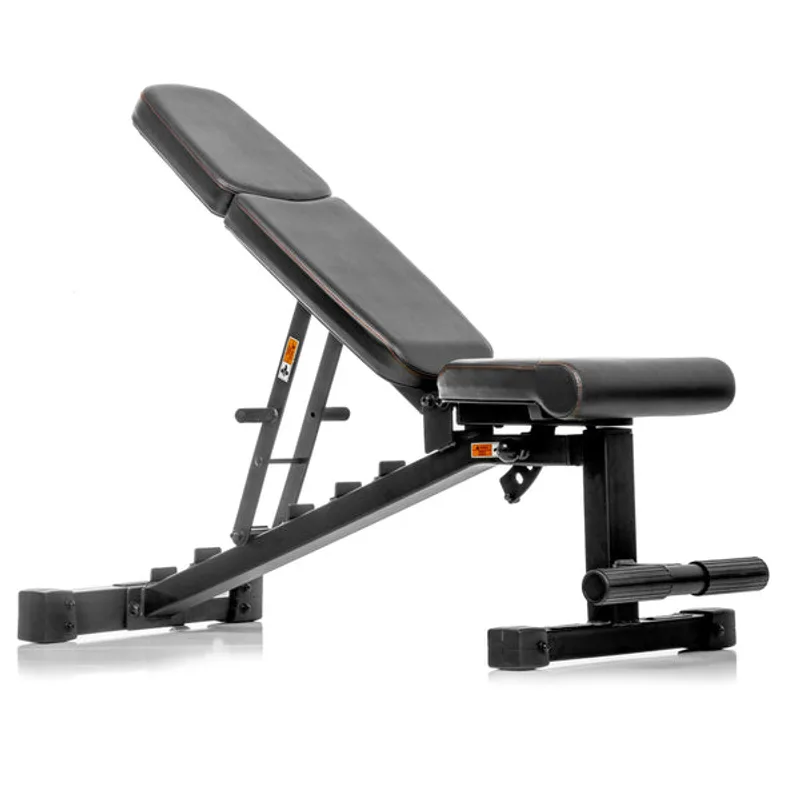
XMark OX Series Adjustable Bench (XM-9010)
Pros
- 1,500 lb weight capacity is overbuilt for any realistic home gym load — structural concern is permanently off the table
- True −20° decline at this price tier is rare — most sub-$300 benches skip decline entirely
- 3" high-density foam padding is the thickest in this roundup — meaningful comfort advantage during long sessions
- 2"×3" 11-gauge steel frame matches construction specifications found on benches priced well above $300
- Non-marking rubber feet protect gym flooring from scratches and dents under heavy loading
Cons
- Priced at the ceiling — verify current Amazon price before purchasing as fluctuation may push it above $300
- 70 lbs matches the REP AB-3100 in weight — repositioning requires effort or assistance
- Older ASIN suggests a long market tenure — confirm current availability before ordering
The XMark OX Series XM-9010 sits at the top of this price range for clear structural reasons. The 1,500 lb weight capacity is higher than many benches priced at $600–$800. The 2”×3” 11-gauge steel frame dimensions match commercial facility equipment. The 3” high-density foam padding is the thickest in this roundup by a meaningful margin.
The most significant spec for buyers who train full-body programs is the −20° decline. True FID capability at under $300 is rare — the Flybird WB5’s −30° decline is the only other option at this price tier, achieved in a 29 lb foldable frame versus the XMark’s 70 lb commercial-style build. For buyers who specifically want heavy-bench stability combined with decline pressing capability, the XMark OX Series is the only option under $300 that provides both.
One caveat requires honest emphasis: price at the ceiling. At $299, any upward Amazon price movement takes this bench above the $300 threshold. Amazon prices fluctuate — verify the current listing price before purchasing. If it’s above $300, the REP AB-3100 at $189 paired with a separate decline wedge delivers comparable core functionality at lower total cost.
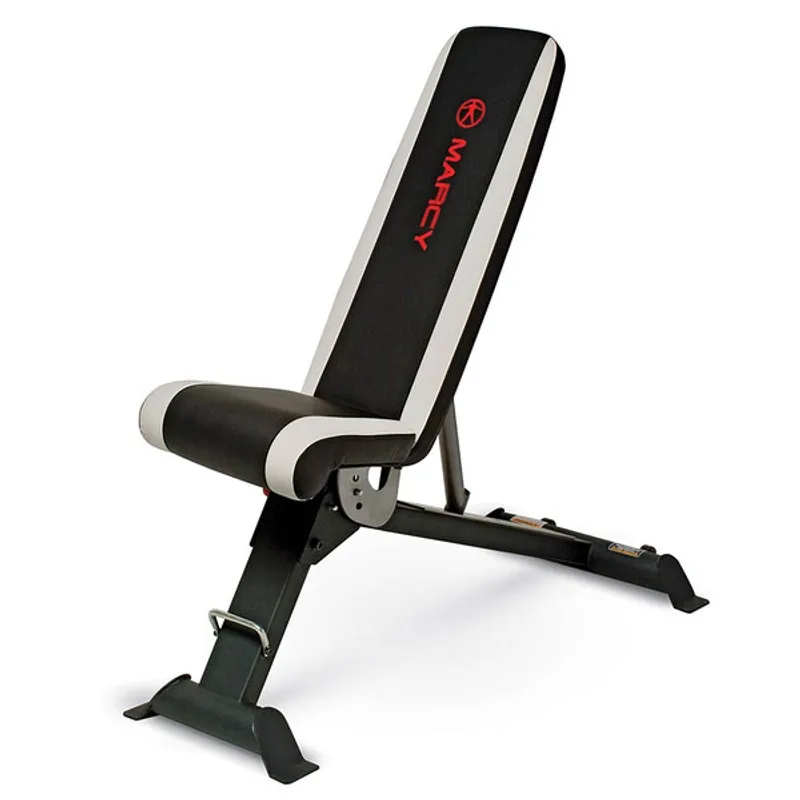
Marcy SB-670 Adjustable Utility Bench
Pros
- Sub-$120 price is the most accessible entry into adjustable bench territory
- 600 lb weight capacity covers the vast majority of home gym lifters at this price point
- Foldable design with transport wheels allows compact storage and solo repositioning
- Includes a slight decline angle — uncommon at this price tier
Cons
- 14-gauge steel is thinner than 11-gauge alternatives — noticeably less rigid under heavy loading
- 600 lb capacity is the lowest in this roundup
- Decline angle is minimal (approximately −5°) — too shallow for effective decline chest pressing
- Pad quality is noticeably inferior to mid-range benches
The Marcy SB-670 is a budget bench that delivers what budget benches are designed to provide: a functional, stable surface for fundamental pressing movements at the lowest practical price.
At around $119, the SB-670 delivers a 600 lb weight capacity, six back positions including a slight decline, and a 14-gauge steel foldable frame with transport wheels. Based on owner reports from long-term users, the bench holds up well under consistent moderate-load use. The construction won’t be confused with anything mid-range or above, but for someone building their first home gym and prioritizing budget toward a rack and barbell, the SB-670 allows deferring the bench upgrade without compromising basic functionality.
The 14-gauge steel is the most consistently cited limitation. It’s noticeably less rigid than 11-gauge alternatives — lifters moving from a commercial gym will feel the difference under heavy loading immediately. The decline angle at approximately −5° is technically present but too shallow for effective decline chest pressing. Think of the SB-670 as a flat-and-incline bench that happens to have a very slight decline option rather than a true FID bench.
For buyers with a hard limit under $120, the SB-670 is the sensible choice. For buyers who can stretch to $130, the Flybird WB5’s ASTM certification, 800 lb capacity, and functional decline represent a meaningful upgrade at minimal additional cost.
Buying Guide: What to Look for in an Adjustable Weight Bench Under $300
Weight capacity. Every bench in this roundup handles at least 600 lbs — more than enough for the vast majority of home gym lifters. Capacity becomes a meaningful differentiator above 250 lb combined body and barbell weight. If you’re consistently pressing close to or above 300 lbs combined, focus on the REP AB-3100 (1,000 lbs flat) or XMark OX Series (1,500 lbs). For the 100–250 lb range, any bench here covers you.
Steel gauge. Lower gauge numbers mean thicker, heavier steel tubing. The range here runs from 14-gauge (Marcy) to 11-gauge (Titan, XMark). Thicker steel provides more rigidity under load — the difference is noticeable during heavy sets. For home gym use under moderate loads, 14-gauge is functional. For heavy training sessions above 250 lb combined, 11-gauge is the appropriate minimum specification.
Decline capability. Most adjustable benches under $300 skip decline entirely. Of the five benches compared here, only the Flybird WB5 (−30°), XMark OX Series (−20°), and Marcy SB-670 (approximately −5°) include decline angles. The Marcy’s −5° is too shallow for effective decline pressing — for functional decline training, the Flybird WB5 or XMark OX Series are the correct choices.
Bench weight and storage. The 29-to-70 lb range here represents a significant practical difference. Foldable benches (Flybird WB5, Marcy SB-670) can be stored vertically or flat, making them practical for home gyms that serve multiple purposes. Heavy commercial-style benches (REP AB-3100 and XMark OX at 70 lbs each) stay where you put them — appropriate for dedicated training spaces, problematic if you need the floor for other uses daily.
Seat adjustability. Every bench in this roundup includes an adjustable seat, which is the correct specification for any FID bench. A fixed seat on a steep incline causes the body to slide toward the foot end during pressing. Adjustable seat angles prevent this by matching the seat angle to the back angle. Confirm this feature is present before purchasing.
Pad thickness. The range here runs from approximately 1.5–2” on budget benches to 3” on the XMark OX Series. Thicker pads provide more comfort during extended sessions and better surface stability for accessories. For most training use, 2–2.5” is adequate. Three-inch pads are noticeably more comfortable and represent a genuine upgrade for long pressing sessions.
Flat pad height. Most adjustable benches in this range sit 17–19 inches off the floor when flat — close to the 17” standard height used in powerlifting competition. The REP AB-3100 sits at 17.5” flat, which positions the bar at the correct height for standard rack use. Verify flat pad height if rack compatibility matters to your setup.
FAQ
What’s the difference between a flat bench, incline bench, and FID bench? A flat bench is fixed at 0° — no adjustment. An incline bench adjusts to incline angles only (typically 30°–80°). An FID (flat-incline-decline) bench covers all three: flat at 0°, incline from roughly 15°–85°, and decline from approximately −15° to −30°. For a home gym, an FID bench is almost always the right choice because it covers every pressing angle in one purchase without requiring multiple pieces of equipment.
How much weight capacity do I actually need? Add your body weight to the total weight of the barbell and plates you press. If you weigh 185 lbs and bench 185 lbs, you need at least 370 lbs of rated capacity — every bench in this roundup covers that comfortably. Manufacturer capacity ratings include a safety margin. Practically, 600 lbs is adequate for the vast majority of home gym lifters. 1,000+ lb ratings matter for competitive powerlifters working near maximum loads routinely.
Can I use an adjustable bench with a power rack or squat rack? Yes, but verify the bench dimensions against your rack’s internal width and J-hook height. Flat pad height should position the bar at a comfortable unrack height — most adjustable benches here sit 17–19” flat, which works with standard rack setups. Measure your rack’s internal width and compare it to the bench’s widest point (typically 22–26”) to confirm fit before purchasing.
Is a foldable bench stable enough for heavy training? At moderate loads under 200 lbs combined, foldable benches are stable enough for effective training. The Flybird WB5 at 800 lbs ASTM-certified handles loads well beyond what most home gym lifters press. Above 300 lbs combined weight, a heavy commercial-style bench like the REP AB-3100 provides meaningfully better stability. The appropriate choice depends on your actual training loads, not theoretical maximum capacity numbers.
How long does an adjustable weight bench last? Frame lifespan on steel benches is effectively indefinite under normal home gym use — steel frames rarely fail structurally. The components that wear out are the upholstery (vinyl cracking) and the foam padding (compression over time). Based on owner reports across all five benches here, padding typically shows meaningful compression after 3–5 years of daily use. Most manufacturers sell replacement pads. Wiping down the vinyl after each session significantly extends pad life by preventing sweat-related material degradation.
Conclusion
The Flybird WB5 at $130 is the right adjustable bench for most home gym lifters. ASTM-certified at 800 lbs, eight positions including true −30° decline, foldable for storage, and light enough to handle solo — it covers every angle most lifters train at the lowest price of any bench worth recommending in this category.
For buyers who train heavy and want commercial-level stability, the REP Fitness AB-3100 V3 at $189 is the correct upgrade. The 1,000 lb flat capacity, 70 lb construction, and three-post leg design are what serious home lifters need from a bench that won’t move under maximum effort. The only limitation is no decline — if decline training is part of your program, the Flybird WB5 is a better fit.
The Titan Performance Series at $229 is for buyers who prioritize 11-gauge steel construction and 2.5” pad thickness above all else. If material specification and pad comfort drive the purchasing decision, it earns its position.
The XMark OX Series at $299 is the premium buy if you need both heavy-duty stability and decline capability in one bench. Check the current Amazon price before purchasing — it sits at the ceiling of this category and price fluctuation matters.
The Marcy SB-670 at $119 is for buyers who need to stay under $120. It works for foundational lifting at moderate loads. For $11 more, the Flybird WB5 is the better long-term investment.