Air bikes had a quiet few years after the initial CrossFit-fueled boom. Then in early 2026, REP Fitness launched the Strive Air Bike with Variable Pitch Resistance — the first fan bike to offer mechanical resistance adjustment independent of your cadence. That launch reignited the category conversation. Belt drives, chain drives, and now adjustable-pitch fans: the air bike market in 2026 has more differentiation than it’s had in years.
This roundup covers five options from $249 to $1,299. The Rogue Echo Bike and Assault AirBike Classic are the established benchmarks. The Schwinn Airdyne AD7 is the quietest belt-drive in the mid-range. The REP Strive is the new entrant worth watching. The Sunny Health SF-B2916 is the option for buyers who need a functional air bike without a significant investment.
If you want a direct Rogue vs. Assault comparison, we have a detailed head-to-head breakdown. This roundup covers the full spectrum.
Quick Picks
Rogue Echo Bike V3.0 is the overall best for most home gym buyers. Belt drive, solid Bluetooth console, V3.0 refinements, and a track record no other air bike can match. Buy this if you want something that works perfectly and stays working.
Assault AirBike Classic is the better pick for CrossFit-style training. Built-in Tabata and interval programs make structured HIIT sessions plug-and-play. Chain drive is louder but proven — this bike has earned its reputation in commercial CrossFit boxes.
Schwinn Airdyne AD7 wins on warranty and quiet operation. The 10-year frame warranty is unmatched in this category, and the compact 42” × 20” footprint fits smaller gym spaces that can’t accommodate the wider Rogue or Assault.
REP Strive Air Bike is the pick for buyers who want genuine resistance control. The VPR system changes the game for slower, strength-focused intervals where you don’t want to sprint to get resistance. First-generation product, so expect the price to settle over time.
Sunny Health SF-B2916 is the budget entry point. Not a competition-grade machine, but it delivers air bike cardio for a fraction of the price. Right for buyers building a starter gym or testing air bike training before committing to a premium option.
Comparison
| Bike | Price | Drive | Capacity | Warranty | Best For |
|---|---|---|---|---|---|
| Rogue Echo Bike V3.0 | $795 | Belt | 330 lbs | 2-year | Overall best |
| Assault AirBike Classic | Unavailable | Chain | 350 lbs | 1-year | CrossFit/HIIT |
| Schwinn Airdyne AD7 | $999.00 as of Oct 18, 2026 | Belt | 350 lbs | 10-year frame | Quiet + warranty |
| REP Strive VPR | $1,299 | Dual belt | N/A | 5-year frame | Resistance control |
| Sunny Health SF-B2916 | Check price | Belt + chain | 265 lbs | 3-year frame | Budget |
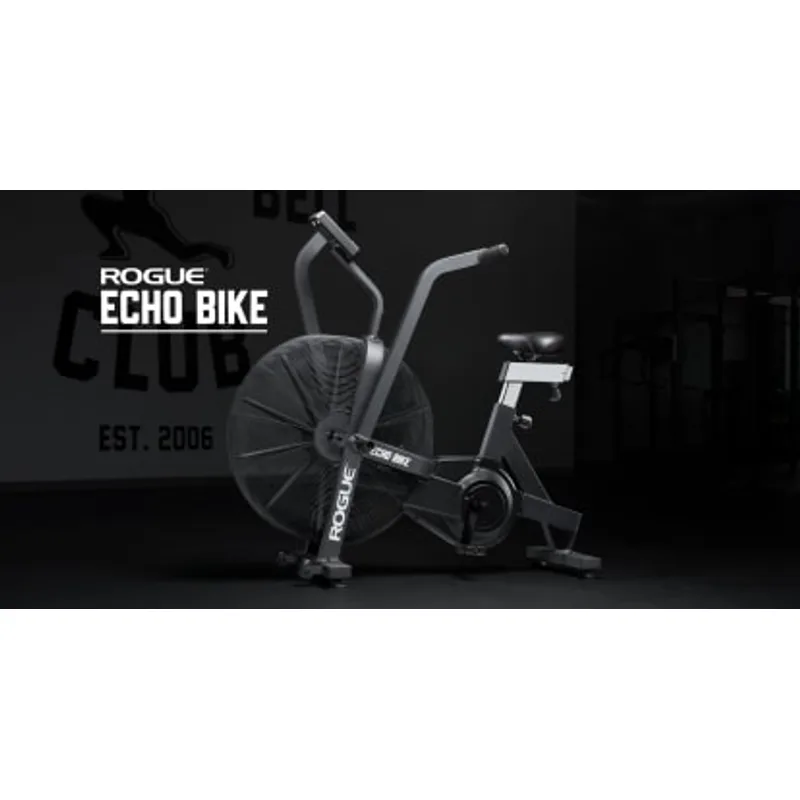
Rogue Echo Bike V3.0
Pros
- Belt drive runs quieter and requires zero maintenance compared to chain-driven competitors
- Bluetooth/ANT+ console connects to cycling apps for real-time performance tracking
- 11 seat height positions plus 5 fore/aft adjustments accommodate a wider rider range than most air bikes
- V3.0 console upgrade adds app connectivity while keeping the mechanical simplicity the Echo Bike is known for
- 123 lb steel frame is exceptionally stable — no rocking or shifting under all-out sprint efforts
- Rogue's manufacturing reputation and active rider community mean long-term parts support
Cons
- Only available direct from Rogue — no Amazon option, no Prime shipping
- 330 lb weight capacity is the lowest in this roundup
- $795 is a significant outlay for entry-level air bike buyers
The Rogue Echo Bike has been the default answer to “what air bike should I buy” for years, and V3.0 doesn’t change that — it strengthens it. The core machine is unchanged: heavy steel frame, belt-driven fan, no-frills conditioning tool. What V3.0 adds is a Bluetooth/ANT+ capable console that connects to cycling apps without breaking the simplicity that made the original Echo Bike popular.
The belt drive is the defining spec compared to the Assault AirBike Classic. It runs quieter — noticeably so — and requires no lubrication or chain tension maintenance. For a home gym, that’s a practical advantage. You’re not going to hear a belt-drive Echo Bike through two floors; a chain-drive bike under full sprint effort is audible in adjacent rooms.
The seat adjustment system (11 height positions, 5 fore/aft positions) accommodates a wider rider range than most competitors. This matters in a shared gym where multiple family members use the same equipment at different heights.
The limitation is weight capacity (330 lbs) versus the Assault’s 350 lbs. For most buyers this is irrelevant, but it’s the one spec where the Echo Bike trails the Assault. The other limitation is availability: Rogue doesn’t sell through Amazon, so there’s no Prime shipping or Amazon return window. Based on owner reports across multiple platforms, Rogue’s direct shipping is reliable, but it’s a consideration for buyers who prefer Amazon’s purchase experience.
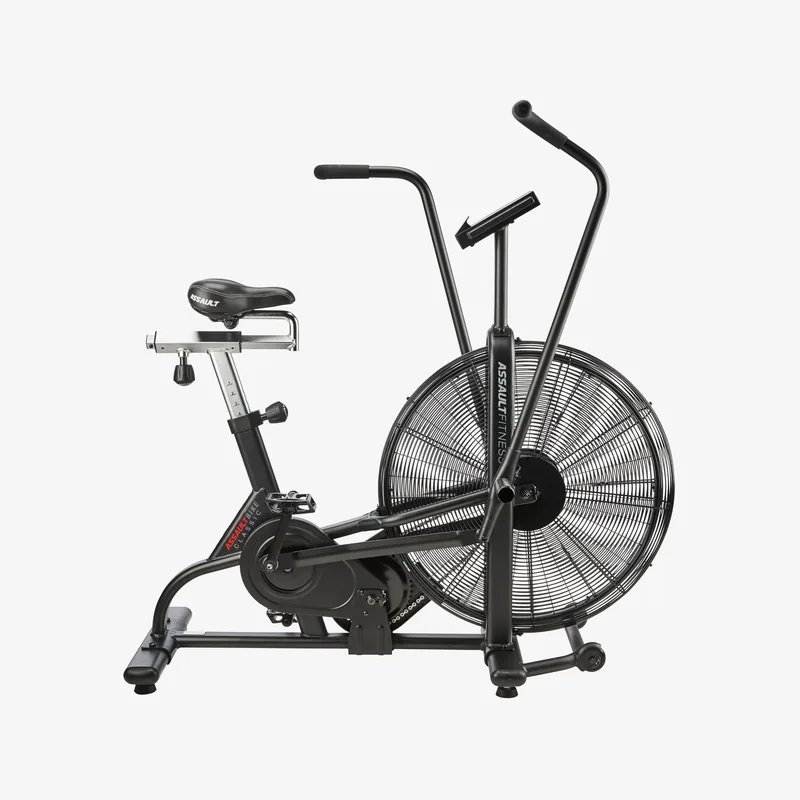
Assault AirBike Classic
Pros
- Built-in Tabata timer and custom interval programs on the LCD — no app required for structured HIIT
- 350 lb weight capacity handles more riders than the Rogue Echo Bike
- 6-way seat adjustment (including tilt) offers more fit customization than most competitors
- At 98 lbs it's the lightest frame in this roundup — easier to move between rooms
- Chain drive has a proven 10+ year durability record in CrossFit boxes worldwide
- Available on Amazon with Prime shipping
Cons
- Chain drive is louder than belt-driven alternatives and requires periodic lubrication
- Some owners report a rubber-like odor from the handlebars that takes time to dissipate
- 1-year warranty is the shortest in this roundup
The Assault AirBike Classic has been shipping to CrossFit gyms and garage gyms since 2014. The machine you’re buying in 2026 is functionally the same machine that earned the reputation — heavy-gauge steel frame, 25-blade steel fan, chain drive, LCD console with programmable workouts. That consistency is either reassuring or frustrating depending on how much you value evolution versus proven reliability.
The console is where the Assault differentiates itself in this roundup. Built-in Tabata timer, custom interval programs, and a clear LCD that shows watts, calories, heart rate, distance, time, and RPM — all without requiring a phone app or subscription. For buyers who run structured HIIT sessions and want everything on-screen without setup, this is the most functional console in this group.
The chain drive is the thing most buyers ask about. It’s louder than belt-driven competitors — particularly noticeable at high cadence. It also requires periodic lubrication (every few months with regular use). Neither of these is a dealbreaker, but they’re real maintenance considerations that the Rogue and Schwinn options don’t require. Based on owner reports from long-term users in commercial CrossFit settings, the Assault chain drive is durable — these machines accumulate thousands of hours of use with nothing more than occasional chain lubrication.
At $749, the Assault is $46 less than the Rogue Echo Bike. That difference isn’t why you’d choose one over the other. The decision comes down to drive type and console preference: belt drive plus app connectivity (Rogue) or chain drive plus built-in programming (Assault).
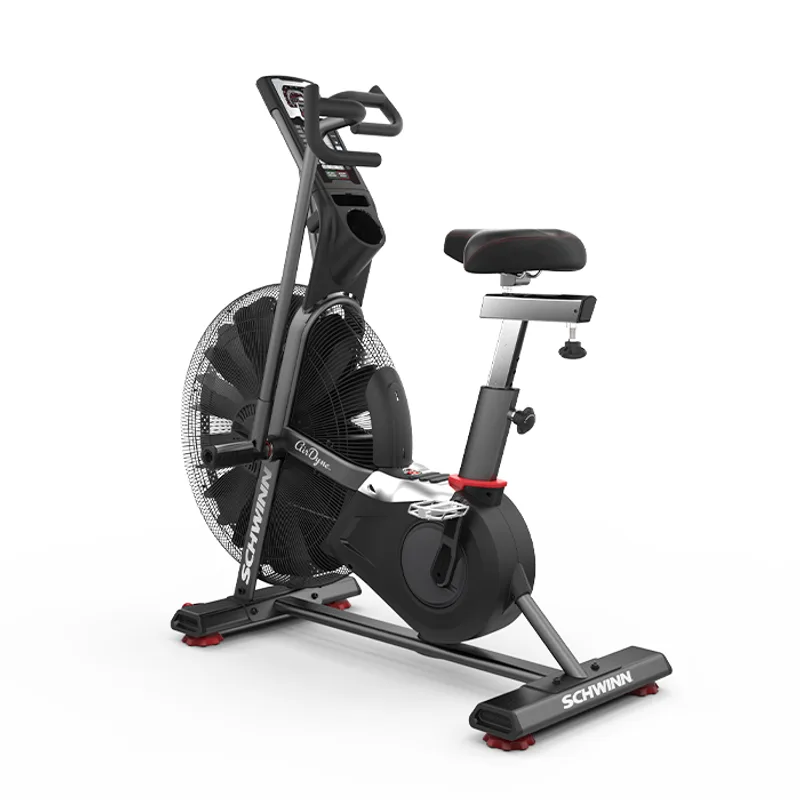
Schwinn Airdyne AD7
Pros
- 10-year frame warranty is the longest in this roundup by a wide margin
- Belt drive system is significantly quieter than chain-driven bikes
- 350 lb weight capacity — tied for highest in this roundup
- Smallest footprint at 42"L × 20"W — fits in tighter gym layouts than the Rogue or Assault
- Tracks heart rate, watts, RPM, and calories — the most comprehensive console data in this group
- 4-way seat adjustment accommodates most rider heights
Cons
- At $999, it's priced above the Rogue Echo Bike without offering a materially superior ride experience
- Schwinn brand reputation in the CrossFit/garage gym community is lower than Rogue or Assault
- Less programming flexibility on the console compared to the Assault AirBike Classic
The Schwinn Airdyne AD7 occupies a specific niche: belt-drive operation with the longest warranty in this category. The 10-year frame warranty is the headline spec, and it’s meaningful — no other air bike in this roundup comes close. If you want a machine you’re planning to keep for the long term and you want formal warranty coverage to back that up, the AD7 makes a strong case.
The belt drive is single-stage direct drive — smoother and quieter than the Assault’s chain system, and comparable to the Rogue Echo Bike. Based on owner reports, the AD7 runs noticeably quieter than chain-driven alternatives, which matters for basement gyms with family living above, or apartment setups with neighbors below.
The smallest footprint in this roundup (42”L × 20”W) is a practical advantage for space-constrained gyms. The Rogue Echo Bike’s 44.5” × 23.75” footprint and the Assault’s 50.9” × 23.3” length both take more floor space than the AD7. For gyms where every square foot is accounted for, the AD7 fits in configurations the others won’t.
The pricing at $999 is where the AD7 creates friction. You’re paying more than the Rogue ($795) and the Assault ($749) for a machine that doesn’t offer a meaningfully better ride experience than either. The 10-year warranty and quiet operation are the justifications. For buyers who plan to keep equipment for 10+ years and value long-term coverage over initial cost, the premium makes sense. For buyers optimizing for performance-per-dollar at the air bike category level, the Rogue Echo delivers more value at $795.
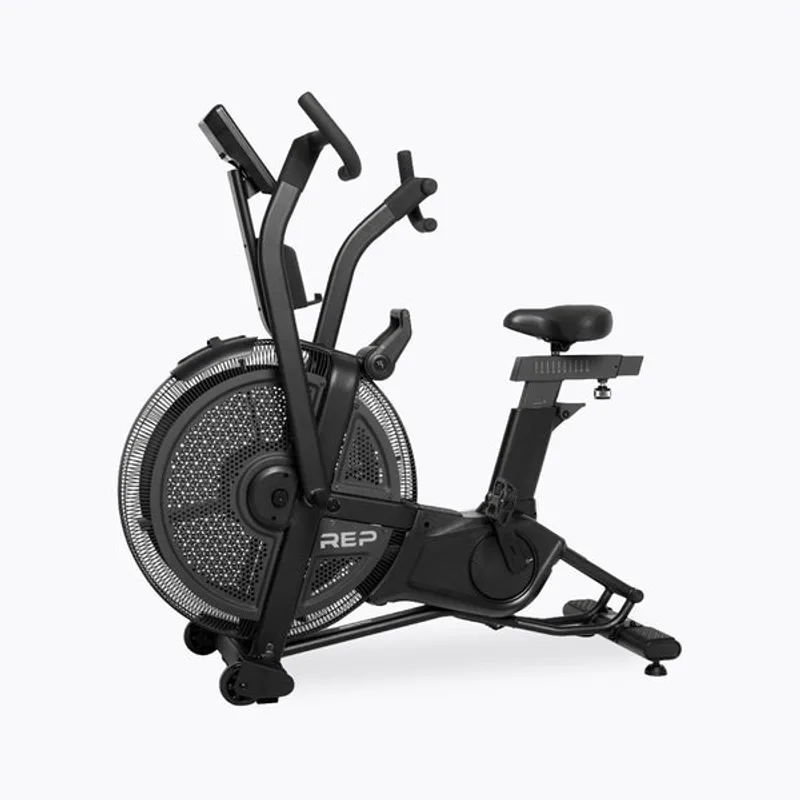
REP Strive Air Bike (VPR)
Pros
- Variable Pitch Resistance (VPR) lets you adjust fan blade angle — 8 discrete resistance levels independent of cadence
- First air bike to offer meaningful resistance control without changing speed, opening up strength-focused intervals
- Dual-stage belt drive is the quietest drive system in this roundup
- 5-year frame / 2-year parts warranty is the most comprehensive coverage offered here
- Reduced Q-factor (8.4") improves pedaling comfort for longer sessions
- Bluetooth/ANT+ connectivity for third-party app pairing
Cons
- $1,299 is the highest price in this roundup — a significant premium over proven options
- Only available direct from REP Fitness — no Amazon option
- Launched Q1 2026, so long-term durability data is still limited compared to established models
- Assembly takes 1–1.5 hours with two people — more involved than competitors
REP Fitness launched the Strive Air Bike in Q1 2026 with one differentiating feature that no other air bike offers: Variable Pitch Resistance. Standard air bikes deliver resistance proportional to effort — push harder, get more resistance. That’s the whole resistance model, and it’s limiting for programming. The VPR system uses a lever to mechanically adjust the pitch angle of the fan blades across 8 discrete positions. Set it to low VPR and the same pedaling effort produces less resistance. Set it to high VPR and you get maximum resistance even at moderate cadence.
That capability matters for specific training scenarios. Strength-biased intervals where you want high resistance at controlled speed. Warm-up protocols where you want to move without going all-out. Rehab or low-impact work where managing intensity without sprinting is important. Standard air bikes require you to pedal faster to get more resistance — the Strive lets you separate resistance from cadence.
The dual-stage belt drive runs quieter than any other bike in this roundup. The 5-year frame / 2-year parts warranty is the most comprehensive coverage available across this category. The reduced Q-factor (8.4 inches between pedals) improves comfort during longer sessions by narrowing the lateral stance compared to standard air bikes.
The constraints: $1,299 is $504 more than the Rogue Echo Bike. The Strive launched in early 2026, so long-term reliability data is limited — REP Fitness has a strong track record with their strength equipment, but air bikes are a new category for them. Assembly requires two people and takes 1–1.5 hours. And like the Rogue Echo, it’s only available direct from REP — no Amazon purchase option. For buyers who want proven durability over innovative features, the Rogue Echo is the safer call at $500 less.
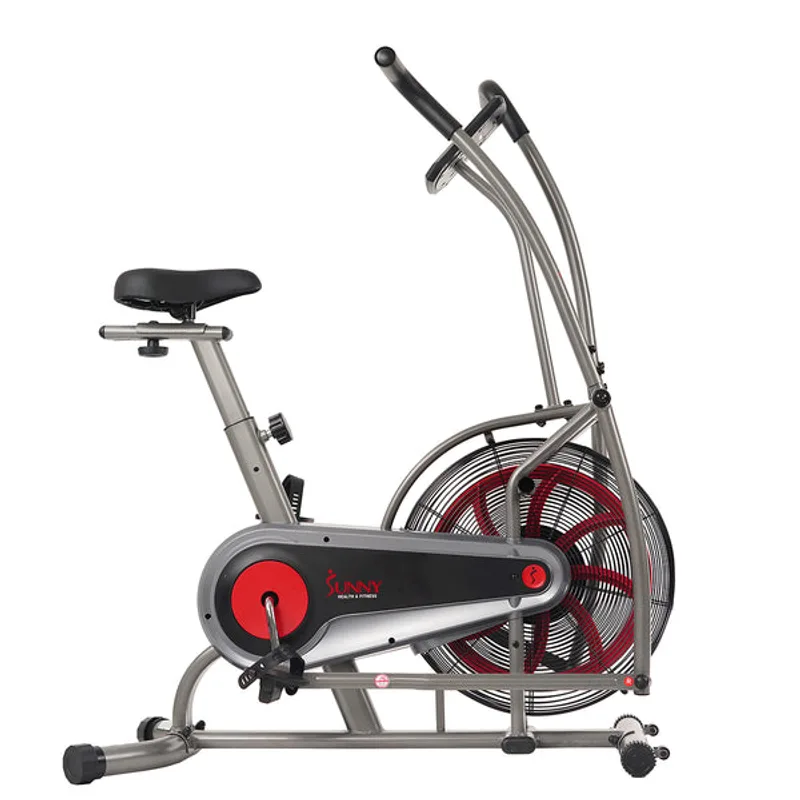
Sunny Health & Fitness SF-B2916
Pros
- Most affordable air bike in this roundup by a large margin
- Tablet holder included — useful for streaming workout videos
- Dual belt-and-chain transmission is smoother than pure chain drive bikes at this price
- 4-way seat adjustment fits a reasonable range of rider heights
- 3-year structural frame warranty is strong for the budget tier
- Available on Amazon with Prime shipping
Cons
- 265 lb weight capacity is the lowest in this roundup — a real limitation for heavier users
- No programmable intervals or Tabata timer on the console
- Dual transmission adds more maintenance touchpoints than a pure belt-drive design
- No Bluetooth or app connectivity
- Build quality is noticeably lighter than mid-range and premium options
The Sunny Health SF-B2916 is the air bike for buyers who aren’t ready to spend $750+ but want to start training on a fan bike. At $249, it’s a functional machine with the core air bike mechanics — unlimited resistance that scales with effort, dual-action arms, and a basic LCD display for tracking time, speed, distance, and calories.
The dual belt-and-chain transmission is a design compromise: the belt runs from the fan to a small pulley, the chain connects the pulley to the crank. It’s smoother than a pure chain drive and slightly more maintenance-involved than a pure belt drive. Based on owner reports, the combination delivers an acceptable pedaling feel for home use at this price point.
The 265 lb weight capacity is the real limitation. It’s the lowest weight rating in this roundup by a significant margin, and it excludes a meaningful portion of potential buyers. If you’re near or above that limit, this bike is not appropriate — move up to one of the mid-range options.
The tablet holder is a practical addition that the premium bikes don’t include. For buyers who want to follow along with YouTube HIIT videos or stream workout content, having a built-in holder on the console is genuinely useful.
The SF-B2916 is not a long-term machine for serious training. It’s a starting point. Based on how your training develops over the first year, you’ll have a much clearer picture of whether air bike training is a core part of your program — at which point the Rogue or Assault becomes the obvious upgrade.
Buying Guide: What to Look for in an Air Bike
Drive system. Belt drive (Rogue, Schwinn, REP) is quieter and maintenance-free. Chain drive (Assault) is louder and needs periodic lubrication but has a proven commercial durability record. For most home gym users, belt drive is the better day-to-day option. For CrossFit-style commercial use, chain drive’s durability track record is unmatched.
Weight capacity. Check the manufacturer’s rated capacity against your actual weight before purchasing. The range here goes from 265 lbs (Sunny Health) to 350 lbs (Assault, Schwinn). The Rogue sits at 330 lbs. If you’re close to or above those limits, capacity should drive your decision.
Footprint. Air bikes take more floor space than most people expect. The widest dimension is often the arm span at full extension, not the listed footprint. Plan for 3 feet of clearance on all sides. The Schwinn AD7’s 42”L × 20”W base is the most space-efficient in this roundup; the Rogue Echo Bike’s footprint is slightly larger at 44.5” × 23.75”.
Console and programming. Basic LCD screens (Sunny Health, Rogue baseline) track your core metrics. The Assault adds built-in Tabata and interval programs without needing an app. The Rogue and REP consoles add Bluetooth/ANT+ for app connectivity. Choose based on how you actually program your sessions — if you follow app-based workouts, Bluetooth matters; if you run Tabata intervals manually, the Assault’s on-board programming is more convenient.
Noise. Belt-drive bikes (Rogue, Schwinn, REP Strive) are significantly quieter than chain-drive bikes (Assault). If you train early mornings or evenings in a home with sleeping family members, or if your gym is below occupied living space, belt drive is worth the consideration.
Warranty. Frame warranty ranges from 1 year (Assault) to 10 years (Schwinn) to 5 years (REP Strive). Most air bike frames outlast their warranties, but longer coverage provides more protection against manufacturing defects. The Schwinn’s 10-year frame warranty is the standout in this category.
FAQ
What’s the difference between an air bike and a regular exercise bike? Air bikes use a large fan wheel as the resistance mechanism. As you pedal faster, the fan moves more air and creates more resistance — automatically. There are no resistance levels to manually adjust; the bike always pushes back proportionally to your effort. This makes air bikes exceptionally effective for high-intensity interval training. A regular stationary bike uses a friction brake, magnetic resistance, or electronic resistance system with fixed levels you dial in manually.
Are air bikes good for weight loss? Air bikes are among the most calorie-dense cardio tools available. Because you’re simultaneously driving the pedals and the push-pull arm handles, the whole-body involvement produces a higher caloric expenditure per unit of time than cycling-only or running-only cardio at similar perceived effort. Short, high-intensity intervals on an air bike — 10–20 seconds all-out, 40–50 seconds recovery, repeated for 20 minutes — are an effective fat-loss protocol that’s time-efficient for busy home gym schedules.
Is chain drive or belt drive better on an air bike? Belt drive runs quieter and is maintenance-free. Chain drive is louder and requires periodic lubrication, but has a longer proven durability track record in heavy commercial use. For home gym applications with regular-but-not-commercial use, belt drive is the practical choice. The Assault AirBike Classic’s chain drive has logged thousands of hours in commercial CrossFit boxes, which is a durability argument chain advocates will point to.
How much space does an air bike need? Plan for the bike’s footprint plus 3 feet of clearance on all sides. The fan and arm handles extend beyond the listed footprint dimensions — particularly the handle reach at full extension. A 6’ × 6’ floor space allocation is a safe minimum for comfortable use. The Schwinn Airdyne AD7 (42”L × 20”W) requires the least total space; the Assault AirBike Classic (50.9”L × 23.3”W) and the Rogue Echo Bike (55”L × 29.5”W) need more room.
Can beginners use an air bike? Air bikes are suitable for any fitness level. Because resistance is effort-controlled rather than preset, beginners naturally work at a lower intensity that produces appropriate resistance. The bikes don’t require class subscriptions, programming, or calibration to start using. The main learning curve is pacing: new users often go too hard in the first 20 seconds and redline before the session is halfway done. Start with a 1:3 work-to-rest ratio (10 seconds on, 30 seconds recovery) and build from there.
Conclusion
The Rogue Echo Bike V3.0 is the right choice for most buyers. Belt drive, Bluetooth console, proven construction, and a parts ecosystem that will keep the bike functional for years. The $795 price is the high end of what most home gym buyers plan to spend on a single cardio machine, but it’s justified by what you get.
For CrossFit-style training where built-in interval programming matters more than quiet operation, the Assault AirBike Classic at $749 is the alternative. The chain drive is louder but the Tabata console programming and 350 lb capacity give it a legitimate edge for that specific use case.
The REP Strive Air Bike is the most interesting development in 2026 if you’re building a gym for the long term. VPR is a genuinely novel feature, and REP Fitness has earned significant credibility with their racks and barbells. At $1,299 it asks a lot for a first-generation product, but the 5-year frame warranty mitigates some of that risk.
If budget is the primary constraint, the Sunny Health SF-B2916 gets you on an air bike for $249 and delivers the core conditioning experience without the premium price tag.