The budget rowing machine market improved significantly in 2026. MERACH’s Q1S reached the top of Amazon’s bestseller chart in the rowing category and crossed under the $200 mark — a development that would have been unusual even two years ago for a machine with 16 resistance levels, a 350 lb weight capacity, and app connectivity. That kind of feature density used to cost $350 or more. It’s now available for $199.
The result is a category with more legitimate options than buyers expect. A sub-$300 rowing machine no longer means compromising on smoothness, durability, or weight capacity — it means choosing the right machine for your specific situation. This guide covers five options that represent the best of what’s available at this price point in 2026.
Quick Picks
MERACH Q1S is the best overall at $199: 16 resistance levels, a 350 lb capacity, dual slide rails, and app connectivity make it the clear top pick for most buyers.
Fitness Reality 1000 Plus is the best Bluetooth pick at $249: built-in wireless tracking to the MyCloudFitness app, a nylon belt drive for quiet operation, and integrated arm resistance bands differentiate it from standard budget rowers.
Sunny Health SF-RW5515 earns the foldable badge at $229: the longest slide rail in this group (53.4 inches) and a fold-and-roll storage design suit apartment and small-space setups.
YOSUDA Magnetic Rowing Machine is the best heavy-duty value at $199: 350 lb weight capacity, foldable upright storage, and 16 resistance levels at the low end of the magnetic rower price range.
Sunny Health SF-RW1205 is the best under $100 at $99: hydraulic resistance, 12 adjustment levels, and a 3-year frame warranty for buyers who need the most affordable possible entry point.
Buying Guide: What to Know Before Spending Under $300
Magnetic vs. Hydraulic Resistance
This is the most important spec decision in the budget rowing category. Magnetic resistance uses an electromagnetic flywheel to generate load — resistance is controlled by a dial or knob that adjusts how close the magnets sit to the flywheel. The result is smooth, consistent pull throughout each stroke, quiet operation, and low maintenance. Four of the five machines on this list use magnetic resistance.
Hydraulic resistance uses fluid-filled pistons attached to the rowing arms. It’s quieter and more compact but produces a noticeably different feel: stiffer at the catch, less smooth through the drive, and inconsistent at high stroke rates because hydraulic resistance doesn’t respond linearly to rowing speed. For short sessions and beginners, the difference is minor. For consistent daily training, magnetic resistance is the better long-term investment even at a $100 premium.
Weight Capacity
Budget rowers vary significantly in rated weight capacity: from 220 lbs (Sunny SF-RW1205) to 350 lbs (MERACH Q1S and YOSUDA). For users near or above the lower limits, this is a genuine safety consideration — not a marketing detail. The MERACH Q1S and YOSUDA both accommodate heavier users without stepping up to a more expensive tier.
Rail Length and User Height
Slide rail length determines how fully you can extend at the catch. A shorter rail forces a compressed stroke that reduces power output and may cause knee discomfort in taller users. The Sunny SF-RW5515’s 53.4-inch rail explicitly accommodates users up to 6 feet 8 inches — longer than any other option here. Users above 6 feet should confirm rail length before purchasing any budget rower.
App Connectivity at This Price Point
Two machines on this list offer Bluetooth connectivity: the MERACH Q1S (Kinomap) and the Fitness Reality 1000 Plus (MyCloudFitness). Neither requires a subscription for basic tracking. For buyers who want structured workout programs, virtual rowing sessions, or passive data logging to a fitness platform, both machines deliver that capability without paying for a connected fitness subscription.
Noise Level
All four magnetic rowers on this list operate quietly enough for apartment use during reasonable hours. The hydraulic Sunny SF-RW1205 is also quiet. The primary noise sources on budget rowers are seat roller quality and frame resonance — not the resistance mechanism. The Fitness Reality 1000 Plus’s nylon belt drive ranks highest among owner reports for quiet operation; the MERACH Q1S and YOSUDA are comparably quiet.
Detailed Reviews
MERACH Q1S Magnetic Rowing Machine — Best Overall
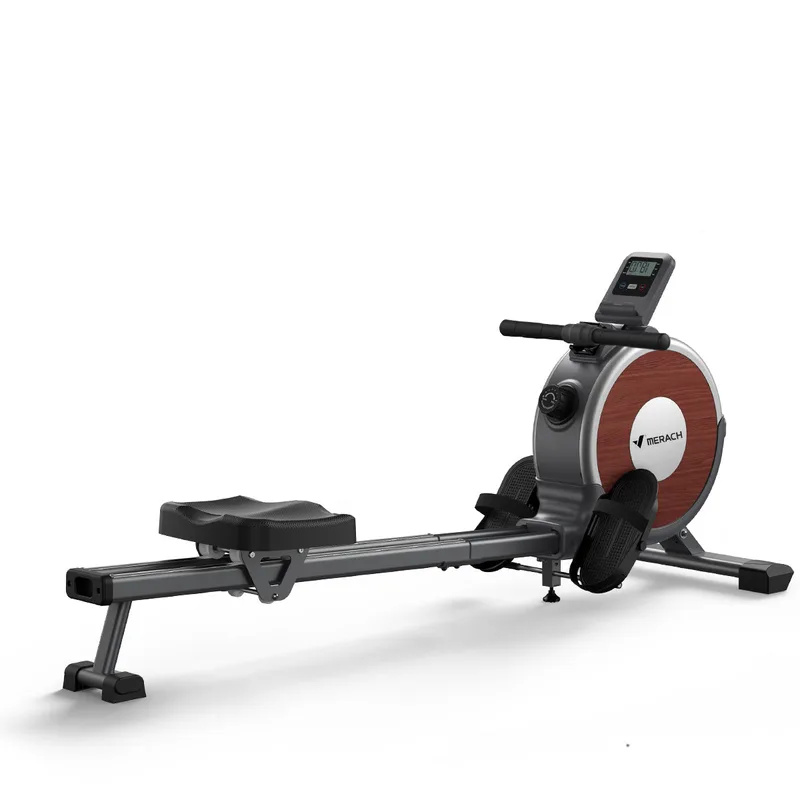
MERACH Q1S Magnetic Rowing Machine
Pros
- 16 magnetic resistance levels at $199 — more adjustment range than most budget rowers at twice the price
- 350 lb weight capacity is the highest on this list and among the highest in the entire budget rowing category
- Dual slide rail design delivers measurably more lateral stability than single-rail competitors, according to owner reports
- Compatible with MERACH fitness app and Kinomap for structured workouts and virtual rowing without a subscription paywall
Cons
- 8 resistance levels (levels 1–8) feel similarly light — the meaningful intensity jump begins around level 10
- MERACH app requires account creation; no anonymous offline-only mode
- Seat cushion thickness is on the thin side according to owner feedback — extended sessions may warrant an aftermarket cushion
The MERACH Q1S earns the top position based on the combination of specs it delivers at $199. Sixteen resistance levels, a 350 lb weight capacity, a dual slide rail, and Kinomap compatibility represent a feature set that most manufacturers charge $300–$400 to match. The fact that it became Amazon’s top-selling rowing machine in 2026 reflects genuine value recognition from buyers who comparison-shopped before purchasing.
The dual slide rail is the mechanical differentiator. Single-rail budget rowers allow the seat to shift laterally during the drive phase — a subtle instability that compounds into fatigue and form breakdown over longer sessions. The Q1S’s dual rail keeps the seat tracking straight regardless of foot placement variation or asymmetric power application. Owner reports consistently describe a noticeably more secure, controlled rowing motion compared to single-rail alternatives at the same price.
The 16-level resistance range is genuinely useful. Levels 1–8 cover light to moderate aerobic work; levels 9–16 provide meaningful progressive overload for interval training and strength-endurance development. Beginners won’t outgrow this machine quickly, and intermediate fitness levels won’t hit a ceiling in the first month. The one caveat from owner feedback: the lowest resistance settings (1–5) feel similar in load — the differentiation becomes more distinct above level 8. For high-intensity work, this isn’t an issue; for light active recovery rows, the granularity at the low end is limited.
Kinomap integration enables virtual rowing on mapped real-world routes with resistance adjustments synced to terrain changes. No subscription is required for basic app features. For buyers who want more structure than rowing to a timer, the Q1S is the only machine under $200 on this list that provides it.
Fitness Reality 1000 Plus Bluetooth Rowing Machine — Best Bluetooth Pick
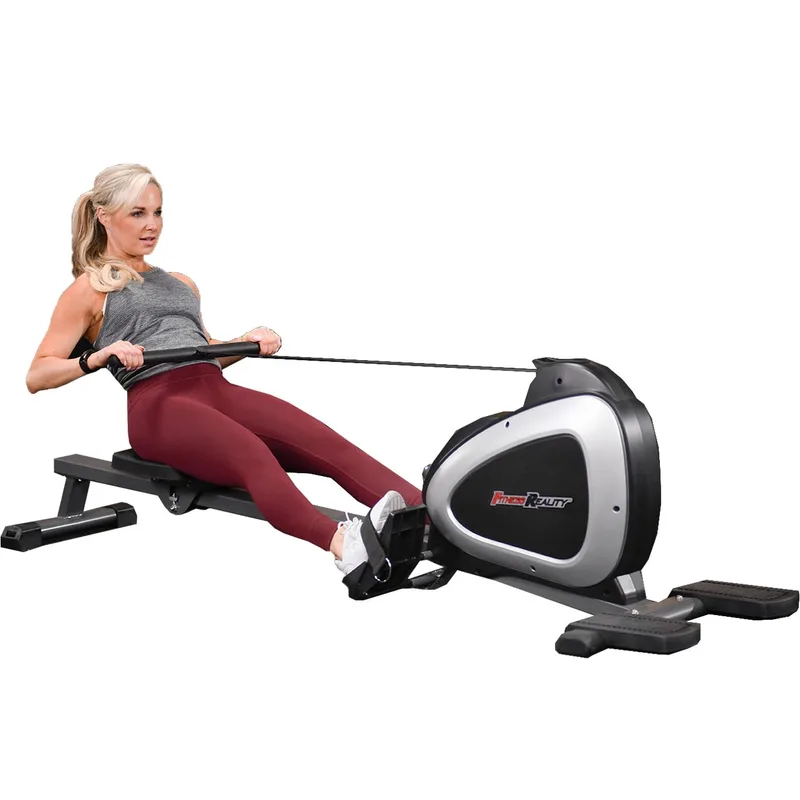
Fitness Reality 1000 Plus Bluetooth Rowing Machine
Pros
- Built-in Bluetooth syncs performance data (pace, watts, calories, RPM) to the MyCloudFitness app with no subscription required
- Integrated upper-body arm resistance adds push and pull exercises beyond standard rowing — useful for general fitness buyers who want more movement variety
- Nylon belt drive produces notably quiet operation — significantly less chain-rattle noise than comparably priced rowers
- Among the strongest Bluetooth feature sets available under $250 in the magnetic rowing category
Cons
- 250 lb weight capacity is the lowest on this list — heavier users should look at the MERACH Q1S or YOSUDA
- 14 resistance levels are adequate but the physical resistance feel at higher settings is lighter than the level numbers suggest
- MyCloudFitness app has a smaller user community than Kinomap or Concept2's ErgData, with fewer structured workout programs
The Fitness Reality 1000 Plus takes a different approach than the other machines on this list. Rather than maximizing a single spec like weight capacity or resistance range, it bundles several features that aren’t common at $249: built-in Bluetooth, nylon belt drive, and integrated upper-body arm resistance.
The nylon belt drive is audibly quieter than the typical chain-and-sprocket systems found in budget rowers. Multiple owner reviews reference using the machine in shared spaces — bedrooms adjacent to sleeping family members, apartments with downstairs neighbors — without generating complaints. For buyers in noise-sensitive environments, the Fitness Reality’s drive system is worth the additional cost over machines with louder mechanisms.
The integrated arm resistance bands extend the workout beyond standard rowing. The pull cables add bicep and lat engagement that conventional rowers can’t replicate. For general fitness buyers who want a single machine to address upper body conditioning beyond the rowing stroke, this is a practical differentiator. Competitive rowers or buyers focused on rowing-specific training won’t find it necessary.
Bluetooth sync connects to the MyCloudFitness app, which tracks pace, watts, RPM, calories, and mileage. No subscription is required for standard tracking. The app’s workout library is smaller than Kinomap’s, but the core data logging function works reliably without a paywall.
The 250 lb weight capacity is the primary limitation. Buyers near that limit should consider the MERACH Q1S or YOSUDA, both of which support higher load at a comparable price point.
Sunny Health & Fitness SF-RW5515 — Best Foldable
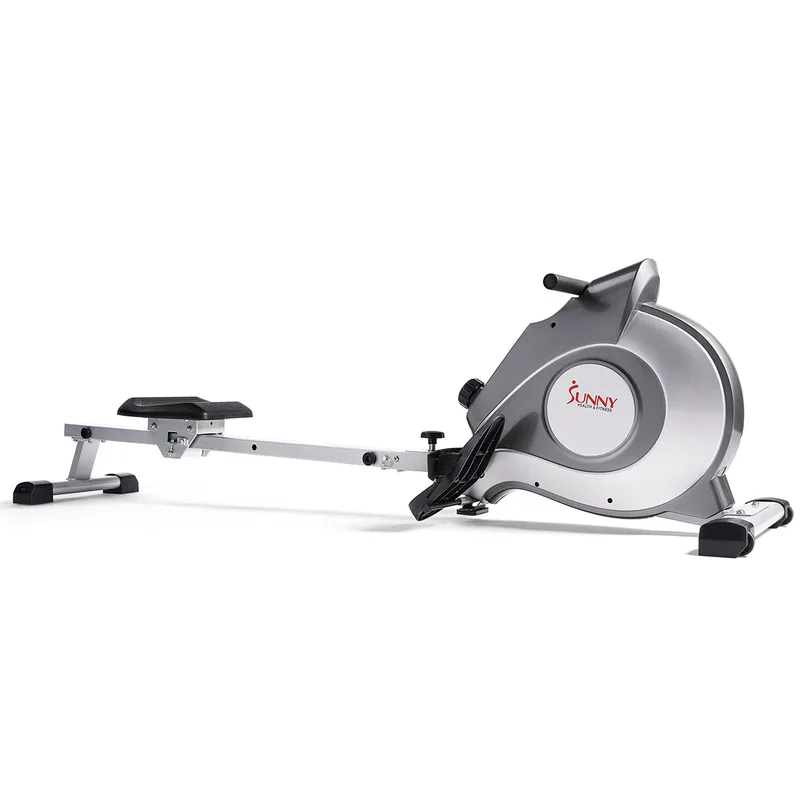
Sunny Health & Fitness SF-RW5515 Magnetic Rowing Machine
Pros
- Foldable design with built-in transport wheels makes storage and relocation practical for apartments and shared spaces
- 53.4-inch slide rail accommodates users up to 6 feet 8 inches — the longest rail in this group
- Sunny Health brand has a long track record in budget cardio equipment with reliable parts availability and customer support
- Non-slip footplates with adjustable straps secure foot position across a wide range of shoe sizes
Cons
- Only 8 resistance levels — intermediate users will reach the top setting within weeks and may want more headroom
- LCD display shows basic metrics only (time, count, calories, distance) — no Bluetooth, no watts, no pace per 500m
- Seat padding is minimal by owner reports; longer rows beyond 20 minutes frequently prompt aftermarket cushion purchases
The SF-RW5515 is the machine to buy when storage is the primary constraint. It folds vertically, has integrated transport wheels for repositioning on hard floors, and still manages to deliver a 53.4-inch slide rail — the longest in this group — that accommodates users up to 6 feet 8 inches. That combination is uncommon in the budget category, where most foldable rowers sacrifice rail length to achieve a smaller folded footprint.
Sunny Health has been producing this category of machine long enough to have worked out the quality issues that plague newer budget brands. The SF-RW5515 consistently receives strong owner feedback for build durability: specifically, frame weld quality and wheel/axle longevity beyond the first year of use. In a category where longevity concerns are common, the SF-RW5515’s track record across thousands of purchases is meaningful.
Eight resistance levels is the limiting factor. The spread from lightest to heaviest setting covers a reasonable aerobic range for beginners and moderately fit users. Intermediate and advanced users will reach the top setting quickly and find themselves without progressive overload headroom. The SF-RW5515 is most suited to buyers whose primary goal is regular low-to-moderate cardio rather than structured progressive training.
The LCD display shows time, count, calories, and distance — the essential metrics for session tracking. No Bluetooth, no pace data, no watts. For buyers who don’t need data beyond basic session duration and calorie estimates, this is sufficient. For buyers who track performance metrics seriously, the MERACH Q1S with Kinomap connectivity is the better choice at a lower price.
YOSUDA Magnetic Rowing Machine — Best Heavy-Duty Build

YOSUDA Magnetic Rowing Machine
Pros
- 350 lb weight capacity is the highest in this group — matches the MERACH Q1S on this spec while offering a distinct build alternative
- 16 magnetic resistance levels deliver a full training range from light recovery to high-intensity intervals at a price well under $200
- Foldable upright storage collapses the machine footprint by approximately 70% — practical for rooms where a full-length rower cannot stay on the floor permanently
- Built-in transport wheels allow rolling the machine between storage and use position without lifting
Cons
- No Bluetooth or app integration — LCD shows basic metrics only (time, count, calories)
- Rail length may constrain users above 6 feet — confirm rail spec before purchase if you are tall
- Seat cushion thickness receives mixed feedback for extended sessions beyond 30 minutes
The YOSUDA delivers the highest weight capacity in this roundup at 350 lbs — matching the MERACH Q1S on that spec — while coming in at $199 and offering a foldable upright storage design that reduces floor footprint by approximately 70% when not in use. For heavier users who want a budget magnetic rower without stepping up to $300+ machines, the YOSUDA covers both the weight requirement and the space constraint.
The 16-level resistance range is the standout spec for this price tier. At $199, most competitors offer 8–10 levels; 16 levels provides meaningful granularity through the full training range — light recovery work in the low single digits, aerobic base-building in the middle range, and genuine challenge at the upper levels. Beginners won’t outgrow the resistance ceiling quickly, and intermediate users have progressive overload headroom without hitting a hard cap in the first few months.
Foldable upright storage is the practical differentiator. Stand the rower on end and it occupies a fraction of its extended floor footprint — built-in transport wheels at the base allow rolling from storage position to use position without lifting the frame. For rooms where floor space is shared with other equipment, this reduces the friction of getting the rower out and putting it back after each session.
No app connectivity is the clear limitation. The LCD shows basic metrics — time, count, calories — with no Bluetooth and no virtual training support. Buyers who want structured programming or performance tracking linked to an app should choose the MERACH Q1S, which delivers Kinomap integration at the same $199 price point. The YOSUDA is the right pick when maximum weight capacity and upright storage are the primary requirements, not connectivity.
Sunny Health & Fitness SF-RW1205 — Best Under $100
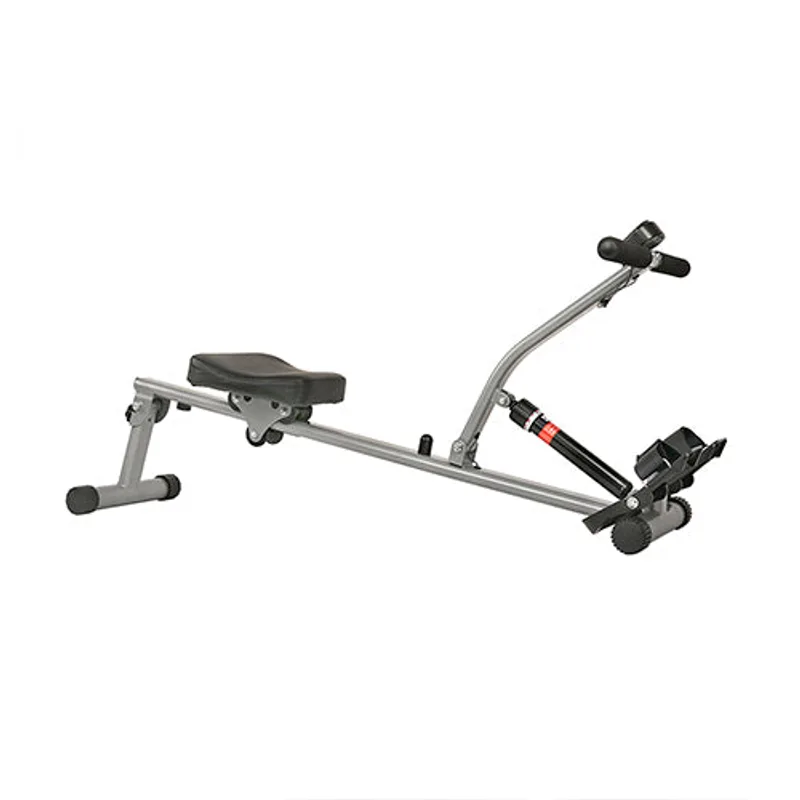
Sunny Health & Fitness SF-RW1205 Hydraulic Rowing Machine
Pros
- Under $100 makes this the most accessible entry point for rowing in any home gym setup
- 12 hydraulic resistance levels provide more adjustment points than many pricier machines despite the lower price
- Compact footprint works in spaces where even a budget magnetic rower is too large
- 3-year frame warranty provides above-average structural coverage for a sub-$100 machine
Cons
- Hydraulic resistance does not produce the same linear, natural rowing pull as magnetic or air resistance — motion feels stiffer and less fluid on each stroke
- 220 lb weight capacity is the lowest on this list
- Hydraulic pistons degrade over time and are not as durable as magnetic flywheel systems under heavy daily use
- No app integration, no Bluetooth, no pace metrics beyond basic calorie and count tracking
The SF-RW1205 is a hydraulic rowing machine, and it’s honest about what that means. The resistance mechanism — fluid-filled pistons connected to the rowing arms — produces a functional rowing motion but not the smooth, linear pull of a magnetic flywheel. The catch is stiffer, the drive less consistent at higher stroke rates, and the feel overall closer to a cable pulley than a rowing shell.
That distinction matters less for its actual use case. At $99, the SF-RW1205 targets buyers whose primary decision is whether to row at all — not which resistance system best optimizes their training adaptations. For beginners building a rowing habit, users with very limited space budgets, or home gyms adding a secondary cardio option at minimal cost, the hydraulic limitation is acceptable.
The 12 resistance levels provide more adjustment range than most people expect at this price. Twelve settings on a hydraulic system means adjusting the piston travel range rather than magnetic field strength, but the practical effect is a usable range of intensities from light recovery movement to a challenging aerobic effort. The 3-year frame warranty provides structural protection that budget rowing machines from less-established brands don’t match.
For buyers who start on the SF-RW1205 and develop a consistent rowing practice, upgrading to a magnetic machine after 12–18 months is a straightforward decision — the foundational rowing mechanics transfer directly. The SF-RW1205 functions well as a starting point.
Compare All 5 Machines
| Spec | MERACH Q1S Magnetic Rowing Machine | Fitness Reality 1000 Plus Bluetooth Rowing Machine | Sunny Health & Fitness SF-RW5515 Magnetic Rowing Machine | YOSUDA Magnetic Rowing Machine | Sunny Health & Fitness SF-RW1205 Hydraulic Rowing Machine |
|---|---|---|---|---|---|
| Rating | 9.0/10 | 8.7/10 | 8.5/10 | 8.4/10 | 7.5/10 |
| Price | Unavailable | $319.00as of Oct 18, 2026 | Unavailable | $189.99as of Oct 18, 2026 | $129.99as of Oct 18, 2026 |
| Resistance | Magnetic, 16 levels | Dual magnetic tension, 14 levels | Magnetic, 8 levels | Magnetic, 16 levels | Hydraulic (piston), 12 levels |
| Weight Capacity | 350 lbs | 250 lbs | 250 lbs | 350 lbs | 220 lbs |
| Rail System | Dual slide rail | — | — | — | — |
| App Compatibility | MERACH app, Kinomap | — | — | — | — |
| Display | LCD monitor | — | LCD (time, count, calories, distance) | LCD monitor with tablet holder | LCD (time, count, total count, calories) |
| Best For | Most buyers in the budget category | Buyers who want app tracking without a subscription | — | Heavier users needing maximum capacity at budget price | Absolute beginners, very tight budgets |
| Drive | — | Nylon belt | — | — | — |
| Connectivity | — | Bluetooth (MyCloudFitness app) | — | — | — |
| Extras | — | Extended upper-body arm resistance bands | — | — | — |
| Rail Length | — | — | 53.4 inches (fits users up to 6'8") | — | — |
| Machine Weight | — | — | 59 lbs | — | — |
| Storage | — | — | Foldable with transport wheels | Foldable, upright storage (saves ~70% floor space) | — |
| Flywheel | — | — | — | 12 lbs | — |
| Rail | — | — | — | — | Compact single rail |
| Warranty | — | — | — | — | 3-year frame / 180-day parts |
| Check Price → | Check Price → | Check Price → | Check Price → | Check Price → |
Prices change daily — tap Check Price for the current Amazon price. Numbers shown were verified on the "as of" date.
Frequently Asked Questions
What resistance type is better for a home gym: magnetic or hydraulic?
Magnetic resistance is better for most home gym use cases. Magnetic rowers produce a smoother, more natural rowing stroke, operate more quietly, and maintain consistent resistance across different rowing speeds. Hydraulic rowers are cheaper and more compact, but the resistance feel is stiffer and less linear, and the pistons degrade faster under heavy daily use. Unless budget is the absolute deciding factor (under $100), a magnetic rowing machine is the better long-term investment.
Can a budget rowing machine under $300 build real fitness?
Rowing is one of the most efficient full-body cardio formats regardless of machine price. A $199 magnetic rower develops the same cardiovascular adaptations and engages the same muscle groups (legs, core, back, arms) as machines costing five times more. The differences at higher price points are tracking sophistication, connected training content, and frame durability over years of heavy use — not fundamental fitness output. For most home gym users rowing 3–5 times per week, a sub-$300 machine fully supports meaningful conditioning progress.
How much space does a rowing machine require?
A full-size magnetic rowing machine typically requires approximately 8–9 feet of floor length when extended for use. The Sunny SF-RW5515 has the longest slide rail in this group at 53.4 inches, accommodating users up to 6 feet 8 inches. For storage, the SF-RW5515 and YOSUDA offer the most compact options — the SF-RW5515 folds horizontally, and the YOSUDA stores upright reducing its active floor footprint by approximately 70%. Budget at least 8 feet of clear floor space for active use regardless of model.
How loud are budget rowing machines?
All four magnetic rowers on this list are suitable for apartment use. The primary noise source is seat roller sound on the rail — a steady, low-frequency rolling sound that is audible in the same room but generally not through walls. The hydraulic Sunny SF-RW1205 is similarly quiet. The Fitness Reality 1000 Plus receives the most consistent “quiet operation” feedback due to its nylon belt drive. No machines in this price range match the near-silent operation of premium rowers, but all five are quiet enough for early morning or late evening use without disturbing other household members.
Is a budget rowing machine worth it if I’m a beginner?
For beginners, a sub-$300 rowing machine is the appropriate starting point. Learning proper rowing technique — leg drive sequence, hip hinge timing, arm pull position — requires practice on the machine itself, not sophisticated equipment. A $199 MERACH Q1S teaches and develops correct mechanics as effectively as a $1,000 machine. Once you’ve established a consistent rowing habit and want more training specificity (performance monitoring for racing, structured programming for competitive development, or commercial-grade durability for daily heavy use), upgrading becomes justified. Starting there doesn’t.
Conclusion
The sub-$300 rowing machine category is more capable than most buyers expect. The MERACH Q1S at $199 represents the best overall value: 16 resistance levels, a 350 lb weight capacity, dual slide rail stability, and app connectivity at a price that previously only delivered basic single-rail machines with limited resistance range.
Best Overall: MERACH Q1S — the highest feature-to-dollar ratio in this category in 2026. The top pick for most buyers.
Best Bluetooth: Fitness Reality 1000 Plus — nylon belt drive, built-in Bluetooth, and integrated arm resistance for buyers who want app tracking and training variety at $249.
Best Foldable: Sunny Health SF-RW5515 — the longest slide rail in this group combined with fold-and-roll storage. The right choice for small spaces and apartments.
Best Heavy-Duty: YOSUDA Magnetic Rowing Machine — 350 lb capacity and upright folding storage at $199. The best option for heavier users or buyers who need high capacity with a compact storage footprint.
Best Under $100: Sunny Health SF-RW1205 — a hydraulic machine for buyers who need the lowest possible entry price and have compact space constraints.