Smart cable machine technology arrived in 2026 with the VOLTRA I resistance system and Force USA’s C20 all-in-one rack combo drawing attention for connected features. The practical effect on the under-$1,000 bracket: established dual-stack functional trainers are holding their value well, and for most home gym builders, the traditional mechanical cable crossover still delivers better bang per dollar than any connected alternative at this price.
Cable crossovers split into two categories under $1,000: freestanding functional trainers with built-in weight stacks (XMark, Inspire, SPART) and wall-mounted cable stations with plate-loaded or selectorized resistance (Mikolo, Valor BD-62). The freestanding machines are complete standalone units that can anchor a gym. The wall-mounted options save floor space and cost less, but require solid stud or concrete wall mounting and offer a narrower range of cable crossover angles.
This roundup covers five machines — all confirmed on Amazon, all available for $1,000 or less for the base configuration.
Quick Picks
XMark XM-7626 is the best overall pick at $849 — dual 200 lb stacks, 19 adjustment positions, commercial-grade 11-gauge steel, and a complete accessory package. The benchmark against which everything else in this category is measured.
Inspire FTX is the best premium option at $999 — 30 swiveling pulleys with 180-degree rotation give it the most cable angle versatility in this roundup, and the compact 54-inch footprint fits spaces where the XMark won’t.
SPART Functional Trainer is the best value at $699 — dual 200 lb stacks with an adjustable weight bench included at a price $150 lower than the XMark.
Mikolo Cable Crossover is the best budget pick at $399 — plate-loaded, wall-mounted, 28 positions, and switchable 1:1/2:1 pulley ratios for home gyms where wall space is available but floor space isn’t.
Valor Fitness BD-62 is the best space saver at $349 — the lightest unit in this roundup at 62 lbs, with a 25-inch wall depth that keeps it from projecting into training space.
Comparison
| Spec | XMark XM-7626 Functional Trainer | Inspire Fitness FTX Functional Trainer | SPART Functional Trainer Cable Machine | Mikolo Cable Crossover Machine | Valor Fitness BD-62 Wall Mount Cable Station |
|---|---|---|---|---|---|
| Rating | 9.0/10 | 8.7/10 | 8.3/10 | 8.0/10 | 7.8/10 |
| Price | $849 | $999 | $699 | $399 | $349 |
| Weight Stacks | 2 × 200 lb | 2 × 165 lb | 2 × 200 lb | — | — |
| Effective Resistance | 100 lb per side (2:1 ratio) | 82.5 lb per side (2:1 ratio) | — | — | — |
| Pulley Positions | 19 adjustments (3.5" spacing) | 30 swiveling positions (180° rotation) | — | 28 adjustable positions | 16 height adjustment positions |
| Frame | 11-gauge 2" × 3" steel | Heavy-duty steel, matte black powder coat | — | 11-gauge steel | — |
| Dimensions | 65"W × 43.5"L × 83"H | 54"W × 40"L × 82"H | — | 27.2"D × 18.1"W × 81.9"H | 26"W × 25"D × 80"H |
| Machine Weight | 800+ lb assembled | 544 lb | — | — | — |
| Included | — | — | Adjustable weight bench + full body attachments | — | — |
| Configuration | — | — | Dual-stack cable crossover | — | — |
| Color | — | — | White | — | — |
| Stack Capacity | — | — | 200 lb per side | — | — |
| Accessories | — | — | Full body workout attachment set | — | — |
| Type | — | — | — | Plate-loaded (Olympic and standard sleeves included) | Wall-mounted dual pulley |
| Pulley Ratios | — | — | — | 1:1 and 2:1 switchable | — |
| Cable Rating | — | — | — | Nylon-coated, 2,200 lb tensile strength | — |
| Weight Ratio | — | — | — | — | 1:1 (direct cable resistance) |
| Max Load | — | — | — | — | 200 lb |
| Unit Weight | — | — | — | — | 62 lb |
Detailed Reviews
XMark XM-7626 Functional Trainer — Best Overall
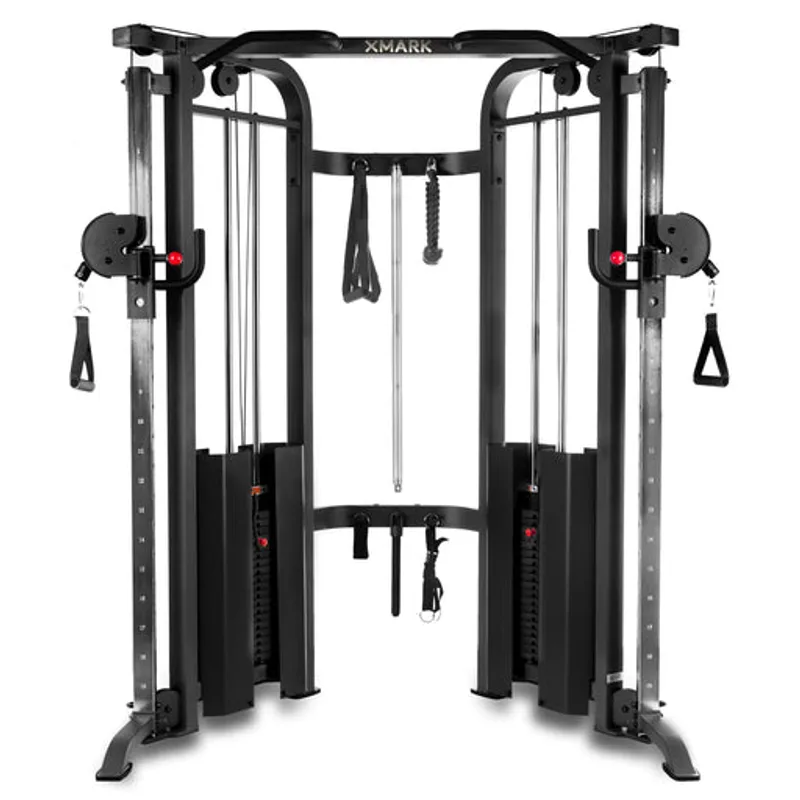
XMark XM-7626 Functional Trainer
Pros
- Dual 200 lb weight stacks deliver 100 lb effective resistance per side — enough for serious pressing, rows, and pulldowns
- 19 vertical adjustment positions at 3.5-inch spacing provides more cable angles than most machines at this price
- 11-gauge 2"×3" steel frame is commercial-grade construction at a home gym price
- Full accessory package included — handle grips, tricep rope, 42" long bar, and ankle strap out of the box
- Proven design with years of verified Amazon buyer feedback confirming real-world durability
Cons
- At 800+ lbs assembled, this machine stays where you put it — relocation requires significant effort or disassembly
- Wide frame at 65 inches requires planning for placement in smaller garage gyms
- Two-person assembly strongly recommended given the weight and number of components
The XM-7626 is the most common answer to “what cable machine should I buy for my home gym” across fitness forums, and the reasoning holds up. Dual 200 lb weight stacks with a 2:1 pulley ratio deliver 100 lb of effective resistance per side — enough for serious lat pulldowns, cable rows, face pulls, and pressing work without running into the ceiling. The 19 vertical adjustment positions at 3.5-inch spacing cover more cable angles than most home gym buyers will use.
The frame construction is where the XMark earns its reputation. The 11-gauge 2”×3” steel tubing is commercial grade — heavier wall thickness than most budget cable machines and noticeably more rigid during loaded cable work. Owner reports consistently describe the machine as stable with no racking or frame flex at full loading. The pulleys are sealed bearings, and the 81-inch cable extension from the pulleys accommodates tall users through a full range of motion.
The complete accessory package matters more than it sounds. Getting handle grips, a tricep rope, a 42-inch long bar, and an ankle strap out of the box means you can start training immediately without a separate attachment purchase. Most cable machines at this price ship with minimal or no accessories.
The limitations are straightforward: the machine weighs 800-plus pounds assembled and measures 65 inches wide. It stays where you place it, and it occupies real floor space in a garage gym. Placement needs to be planned before delivery, not after. Assembly is manageable but takes two people given the component weight.
For home gym builders who want a freestanding cable machine that will handle serious training for years, the XM-7626 is the clearest choice under $1,000.
Inspire Fitness FTX Functional Trainer — Best Premium
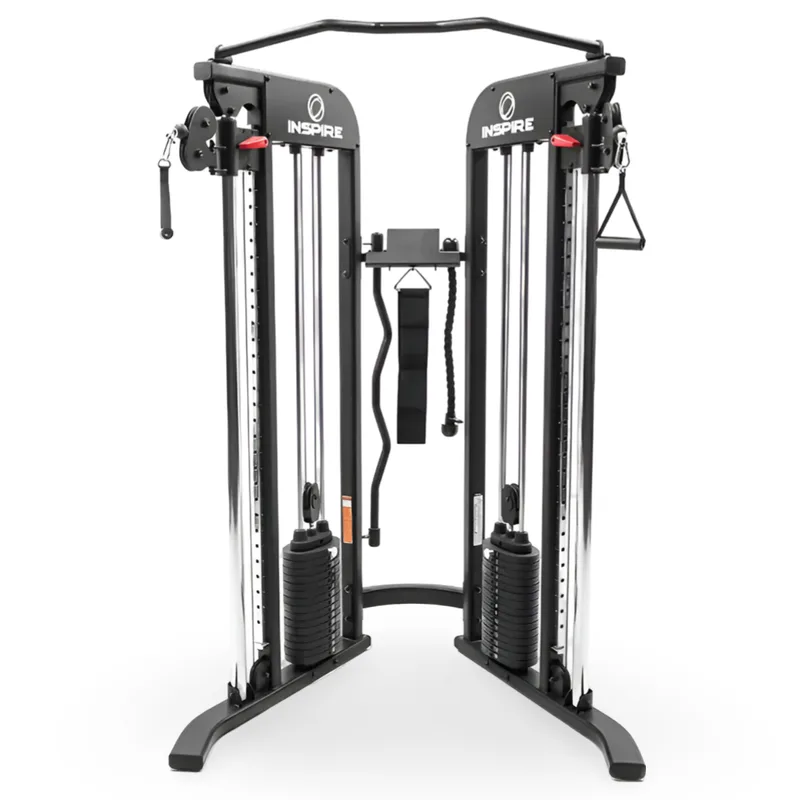
Inspire Fitness FTX Functional Trainer
Pros
- 30 swiveling pulleys with 180-degree rotation — the most cable angle versatility in this roundup
- Compact footprint at 54"W × 40"L fits tighter garage and basement spaces compared to wider competitors
- 544 lb assembled weight is lighter than the XMark, making initial placement more manageable
- Matte black powder coat finish with heavy-duty steel construction holds up to consistent heavy use
- Includes tricep rope and two deluxe D handles — no separate accessory purchase needed
Cons
- 82.5 lb effective resistance per side is the lowest in this roundup — advanced lifters will hit the ceiling on some movements
- Weight stacks on the FTX cannot be upgraded beyond the included 165 lb configuration
- At $999, it sits at the very top of this price category — any sales tax can push the total over $1,000
The Inspire FTX takes a different approach than the XMark: narrower footprint, lighter machine, and more cable angle options at the cost of lower per-side resistance. The 30 swiveling pulleys rotate through 180 degrees — an arc that lets you position cables for exercises that fixed-position machines can’t replicate. Pull from directly above, directly to the side, or anywhere in between without repositioning the machine.
The compact dimensions are the FTX’s signature advantage. At 54 inches wide and 40 inches deep, it fits in spaces where the XMark’s 65-inch frame won’t. The 544 lb assembled weight is lighter than the XMark but still substantial enough to stay stable during loaded cable work. According to owner reports, the pulley operation is consistently described as smooth, a function of the precision bearing system Inspire uses across their cable machine line.
The 82.5 lb effective resistance per side (165 lb stack on a 2:1 ratio) is the performance ceiling to understand before buying. For lat pulldowns, cable rows, face pulls, tricep work, and crossovers at moderate intensity, this is fully adequate. For advanced lifters who cable row or pulldown over 100 lbs regularly, the FTX runs out of stack weight. Unlike some functional trainers, the FTX weight stacks cannot be upgraded beyond the included 165 lb configuration.
At $999, the FTX is the priciest machine in this roundup. Factor in assembly and delivery, and the total commitment approaches or exceeds $1,000 depending on location. For buyers who specifically need a compact cable machine with the widest cable angle range at this price, the FTX justifies the premium. For buyers who prioritize maximum resistance headroom, the XMark’s 200 lb stacks at $150 less is the stronger value.
SPART Functional Trainer Cable Machine — Best Value
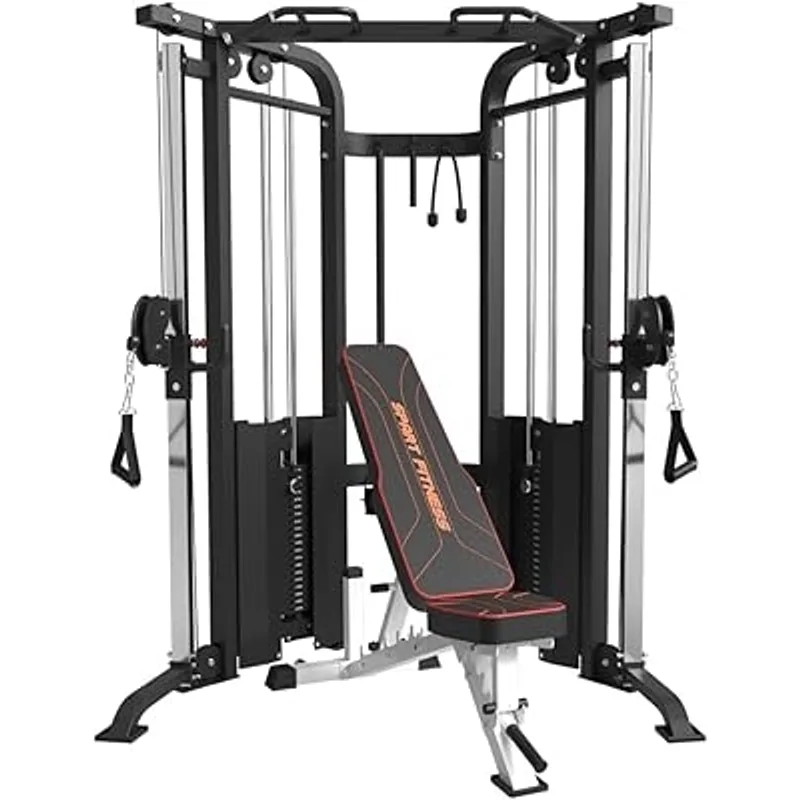
SPART Functional Trainer Cable Machine
Pros
- Dual 200 lb weight stacks with an adjustable weight bench included — two major purchases in one package
- 200 lb per side capacity matches the XMark at $150 less
- Full body workout attachment set comes standard, no separate accessory purchase needed
- Adjustable bench enables pressing work without a separate bench purchase
- Clean white finish stands out in home gym aesthetics if appearance matters to your setup
Cons
- Less established brand than XMark or Inspire — long-term parts availability not as well documented
- Fewer published independent reviews compared to the XMark XM-7626 at a similar price tier
- Assembly difficulty not widely reported — plan for a half-day build and have a second person available
The SPART earns its Best Value designation by including both a dual 200 lb weight stack machine and an adjustable weight bench for $699 — a package that would cost $900-plus if purchased as two separate items. The weight stack capacity matches the XMark at $150 lower, and the bench inclusion means home gym builders starting from scratch can begin pressing work without a separate bench purchase.
The full body workout attachment set included with the SPART avoids the separate accessory purchase that most cable machines at this price require. The dual 200 lb stacks deliver effective resistance consistent with the XMark configuration — adequate for serious cable training without hitting an early ceiling on pulling and pressing movements.
The honest trade-off is brand recognition. XMark has a multi-year track record of Amazon reviews, independent assessments, and documented long-term performance. SPART is a newer entrant to the U.S. market with a growing but smaller base of owner feedback. This doesn’t mean the machine underperforms — the specifications are solid — but it does mean fewer long-term data points on durability and parts availability compared to established brands.
For home gym builders prioritizing value and who need both a cable machine and an adjustable bench, the SPART bundle at $699 delivers more per dollar than any other option in this roundup.
Mikolo Cable Crossover Machine — Best Budget
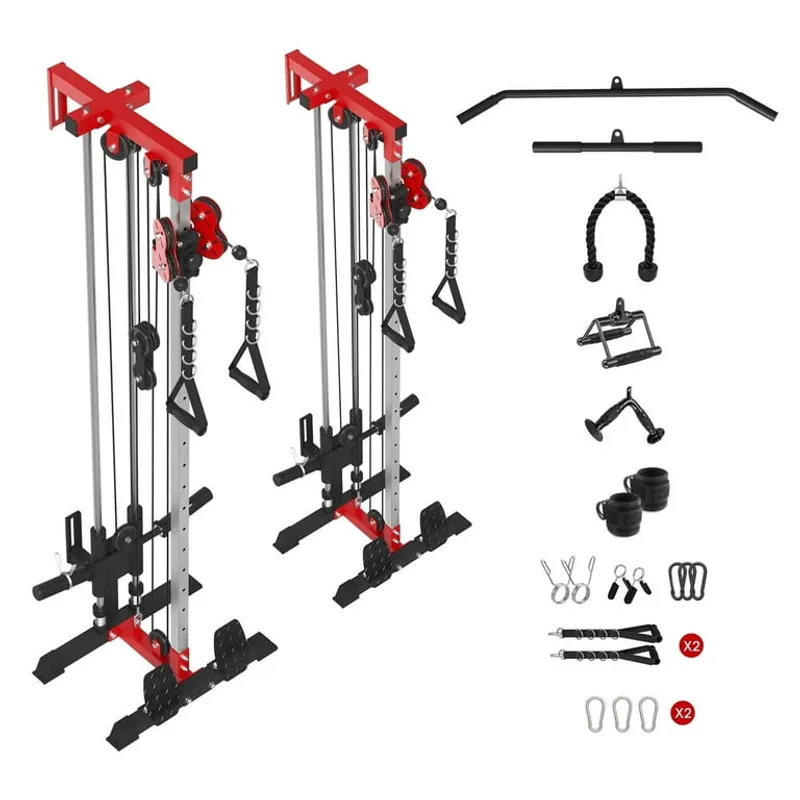
Mikolo Cable Crossover Machine
Pros
- Plate-loaded design means zero additional weight stack cost — use what you already own
- 28 adjustable positions is more cable height options than both wall-mounted competitors in this roundup
- Switchable 1:1 and 2:1 pulley ratios let you match resistance feel to the exercise
- 2,200 lb tensile strength cables and 11-gauge steel construction for a budget-tier machine
- LAT pulldown and low row system built in — no attachment swapping required
Cons
- Requires wall mounting — you need a suitable wall and the discipline to install it properly
- Plate-loaded means added setup time per set compared to pin-select weight stack machines
- Some buyers report slow customer service responses to shipping damage claims
The Mikolo is the budget answer for home gym builders who have wall space, existing weight plates, and want cable training capability without paying for a weight stack. The plate-loaded design eliminates the stack cost entirely — your existing Olympic or standard plates serve as the resistance. For anyone who already owns 100-plus pounds of plates, the effective cost of adding cable training drops dramatically.
The 28 adjustable positions cover more height options than both the Valor BD-62 and the XMark at twice the price. The switchable 1:1 and 2:1 pulley ratio lets you match resistance feel to the exercise: 1:1 for heavier compound pulls, 2:1 for lighter isolation work where smoother, lighter resistance is preferable. LAT pulldown and low row capabilities are built in, removing the attachment-swapping requirement common on simpler cable setups.
The compact wall-mount profile — 27 inches deep, 18 inches wide, 82 inches tall — means it projects minimally into workout space. For garage gyms where floor footprint is limited, this format makes practical sense. The 11-gauge steel frame and 2,200 lb rated cable tensile strength are heavy-duty specifications for a machine in this price bracket.
The wall mounting requirement is not optional. The machine needs to be anchored into wall studs or masonry — installation into drywall without structural backing is a safety hazard. Budget for proper wall anchors and verify stud placement before ordering. Cable crossover exercises (chest fly motion) also have a more limited arc on a wall-mounted unit compared to a freestanding dual-tower machine — the cables come from a single wall-mounted position rather than two separated towers.
For the price, the Mikolo delivers genuine cable training capability. It’s the most accessible entry point for adding cable exercises to a home gym that already has barbell and plate equipment.
Valor Fitness BD-62 Wall Mount Cable Station — Best Space Saver
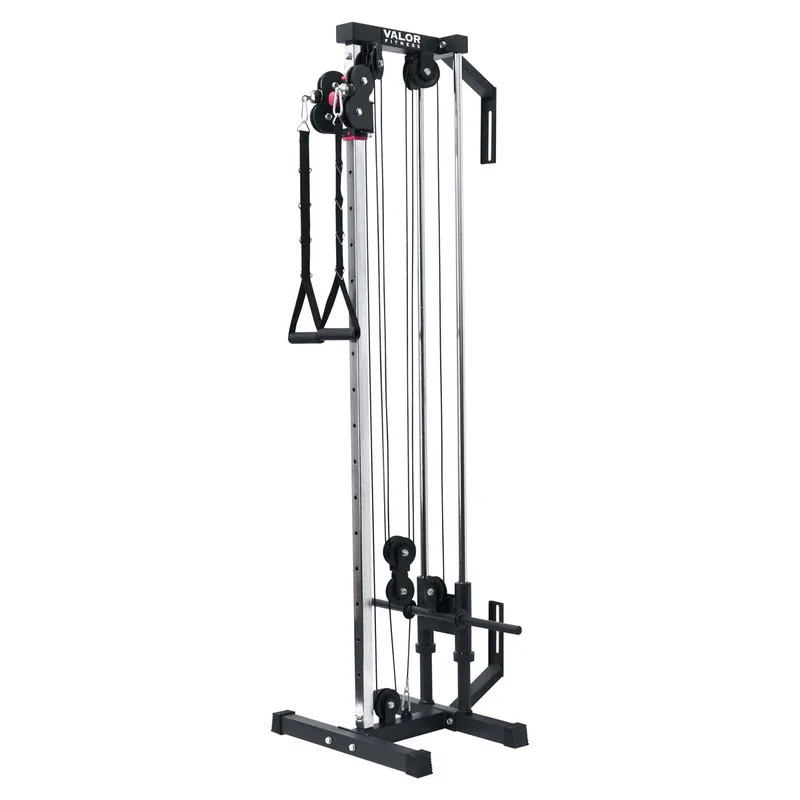
Valor Fitness BD-62 Wall Mount Cable Station
Pros
- 62 lb unit weight is the lightest in this roundup — wall installation is manageable for one person
- 1:1 cable ratio means the resistance you load is exactly the resistance you feel — no guesswork
- 25" depth from wall keeps the machine from projecting into workout space
- Valor Fitness brand carries a track record of functional home gym equipment at accessible prices
- Can supplement an existing rack or barbell setup without requiring dedicated floor space
Cons
- Requires solid wall mounting — drywall without stud backing is not sufficient for safe use
- 16 height positions is the fewest in this roundup, limiting certain cable angle variations
- Wall-mounted placement restricts natural cable crossover arc compared to freestanding dual-tower machines
The BD-62 is the most space-efficient cable solution in this roundup. At 62 lbs, it’s light enough for a single person to install. At 25 inches deep, it projects less than two feet from the wall. At $349, it’s the lowest-cost cable solution that delivers both high and low pulley positions from a single unit.
The 1:1 cable ratio is a functional advantage over 2:1 systems for lifters who prefer to work with known resistance. Load 90 lbs on the carriage and the cable delivers 90 lbs — no math required for programming. This directness works well for LAT pulldowns, cable rows, tricep pushdowns, curls, face pulls, and cable pull-throughs. Owner reports consistently describe the cable operation as smooth and the construction as solid for the price point.
The 16 height positions cover the essential cable angles: high pulley for lat pulldowns and tricep work, mid-range for cable rows, low pulley for curls and upright rows. The range is adequate for most cable training scenarios, though the Mikolo’s 28 positions provide more granular adjustments if precise cable height matters for specific movements.
The main constraint is the wall-mounting requirement and the narrower cable crossover arc. The BD-62 mounts as a single unit to the wall, meaning both cable attachment points are within the unit’s 26-inch width. Traditional cable chest flyes — where both arms need to cross from wide to narrow — work differently on a compact wall unit than on a freestanding 6-foot-wide cable crossover. The BD-62 handles the full cable training menu well for pulls, rows, and isolation work. Buyers who specifically need chest fly crossover capability should prioritize one of the freestanding options.
For home gym builders supplementing an existing rack or barbell setup with cable training on a tight budget, the BD-62 delivers genuine value.
Buying Guide
Freestanding Dual-Stack vs. Wall-Mounted Cable Station
The most important decision in this category isn’t price — it’s format.
Freestanding dual-stack machines (XMark, Inspire FTX, SPART) are complete standalone cable systems. They have built-in weight stacks, selectorized resistance (no plate loading), and typically span 5-6 feet wide. They function as the primary cable station in a home gym. Buy a freestanding machine if you want a dedicated cable crossover setup with full exercise versatility and don’t already have significant plate equipment.
Wall-mounted cable stations (Mikolo, Valor BD-62) attach to structural wall anchors, project minimally from the wall, and cost significantly less. They require an appropriate wall, deliver a narrower cable crossover arc, and depend on either plate loading (Mikolo) or a compact resistance mechanism (BD-62). Buy a wall-mounted option if floor space is genuinely limited, you already have plates, or cable training is supplemental rather than central to your program.
Weight Stack Capacity: How Much Resistance Do You Actually Need?
Most home gym cable training occurs in the 30-80 lb range for isolation exercises (tricep pushdowns, curls, face pulls) and 60-120 lb range for compound pulls (lat pulldowns, seated rows). Given 2:1 pulley ratios on most machines, a 100 lb effective resistance per side handles the vast majority of home gym cable programming.
The Inspire FTX’s 82.5 lb effective per side is adequate for all but the strongest lat pulldown performers. The XMark and SPART’s 100 lb effective per side adds headroom for heavier compound pulling. Advanced lifters who cable row or pulldown over 100 lbs regularly should prioritize machines with larger stacks or consider heavier-duty options outside this price range.
Pulley Positions: More Options vs. Enough Options
More pulley positions allow more precise cable angles for targeting specific muscle groups. The Inspire FTX’s 30 swiveling positions are the most flexible in this roundup. The XMark’s 19 positions at 3.5-inch spacing cover most practical angles. The Valor’s 16 positions cover the essentials.
For most training programs, the difference between 16 and 30 positions matters less than it sounds. The critical positions are high pulley (lat pulldowns, overhead tricep extensions), mid-pulley (cable rows, chest fly), and low pulley (curls, pull-throughs). Any machine in this roundup covers all three. The additional positions matter most for specialized programs or injury rehabilitation where precise cable angle affects joint stress.
Assembly and Installation Reality
Freestanding dual-stack machines are complex assemblies. The XMark weighs 800-plus pounds fully assembled — meaning the individual components need to be moved into position and bolted together in place. Most owners report 3-5 hours for two people. Read the assembly manual before delivery and confirm the machine’s placement plan before unboxing.
Wall-mounted options require structural wall mounting. Drywall alone is insufficient. Studs (16-24 inch centers in most residential construction) or masonry anchors are required. Confirm your wall construction before ordering a wall-mounted cable station.
Space Planning
Freestanding cable machines need both footprint space and training clearance. The machine occupies 25-35 sq ft in floor footprint. Add 6-8 feet of cable length in front of the machine for full extension during lat pulldowns and rows. In practice, a 10’ × 12’ dedicated space comfortably accommodates an XMark-class machine with room to train. The Inspire FTX’s narrower 54-inch frame fits in slightly tighter configurations.
Wall-mounted units project 25-30 inches from the wall and need the same training clearance in front. The usable floor area remains clear, which is their primary space advantage.
FAQ
What’s the difference between a cable crossover machine and a functional trainer?
In practice, the terms are used interchangeably for most home gym machines. Technically, a cable crossover refers to the classic dual-tower design where two separate cable columns face each other and allow cables to cross from both sides simultaneously. A functional trainer typically refers to a single-frame machine with two adjustable cable pulleys that allows functional movement patterns. Most machines in this roundup are functional trainers by design but support cable crossover exercises. The marketing terms overlap significantly — evaluate the product specifications rather than the naming.
How much weight resistance do I need in a home gym cable machine?
For most home gym cable training, 80-100 lb effective resistance per cable is sufficient. This covers lat pulldowns, seated rows, face pulls, cable rows, tricep pushdowns, curls, and crossovers at training intensities appropriate for hypertrophy and strength work. If your lat pulldown working sets regularly exceed 100 lbs of resistance, look for machines with larger weight stacks. The Inspire FTX’s 82.5 lb effective per side is the binding constraint for that machine — verify your actual training loads before purchasing.
Can you build a complete home gym around a cable crossover machine?
A cable machine paired with a power rack, barbell, and plates covers the full strength training spectrum. Cable machines handle the isolation and accessory work that barbells do inefficiently: lat pulldowns, cable rows, face pulls, curls, tricep extensions, cable flyes, and pull-throughs. The two complement each other rather than overlap. For bodybuilding-focused training, a cable machine is the single highest-value add after a barbell and rack setup.
Do freestanding cable machines need to be bolted to the floor?
Most freestanding dual-stack cable machines do not require floor anchoring under normal use. The weight of the stacks and frame provides sufficient stability for training loads within the machine’s rated capacity. Some manufacturers recommend floor anchoring for maximum stability or in commercial settings. Check the product manual for specific recommendations. Wall-mounted cable stations, by contrast, absolutely require structural wall anchoring as the primary safety mechanism.
What exercises can I do with a cable crossover machine?
A cable crossover machine handles: lat pulldowns (high pulley), seated cable rows (low pulley), cable face pulls (mid-high pulley), standing cable rows, tricep pushdowns, overhead tricep extensions, cable bicep curls, cable chest flyes, cable pull-throughs, core rotations, cable pull-aparts, ankle work with attachment, and single-arm variations of all of the above. With a functional trainer that adjusts through multiple positions, the exercise list expands further to unilateral pulling, rotational movements, and rehab-specific angles. A cable machine’s practical exercise library is significantly broader than a LAT pulldown-only machine.
Conclusion
The XMark XM-7626 at $849 is the clearest pick for most home gym builders — dual 200 lb stacks, 19 adjustment positions, commercial-grade steel, and a complete accessory package. It has a multi-year track record of owner satisfaction and the construction quality to justify the investment.
For buyers who need a more compact footprint and maximum cable angle versatility, the Inspire FTX at $999 delivers 30 swiveling pulleys in a 54-inch frame. The lower 82.5 lb effective resistance per side is the trade-off to accept.
Home gym builders who need both a cable machine and a weight bench should look at the SPART Functional Trainer at $699 — the bundle value is hard to match at this price.
For plate-loaded cable training on a budget, the Mikolo at $399 with its 28-position system and switchable pulley ratios is the most capable wall-mount option in this price range.
The Valor BD-62 at $349 earns its place as the most affordable and space-efficient cable solution — a logical first cable machine for home gyms supplementing an existing rack setup.