Peloton made headlines in March 2026 when it launched a dedicated commercial series — bikes and treadmills engineered for gym-floor use — signaling that the line between studio hardware and home hardware is nearly gone. The smart move for serious home gym builders isn’t waiting for trickle-down features. It’s buying the bikes that professional studios already trust, and setting one up at home.
Commercial-grade indoor cycles cost $2,500 to $3,500. That’s real money. But they solve problems entry-level bikes cannot: they handle 300–350 lb riders at maximum effort, run on magnetic or self-powered systems that require no maintenance, and hold calibration across thousands of hours of use. For a home gym that gets daily use over a decade, the math works.
These five bikes represent the top of the commercial indoor cycling market available to home buyers in 2026.
Quick Comparison
| Bike | Price | Resistance | Weight Cap | Power Meter | Screen |
|---|---|---|---|---|---|
| Keiser M3i Studio Plus | $3490.00 as of Oct 18, 2026 | Magnetic (72 gears) | 350 lbs | No (Bluetooth HR) | Studio Display |
| Life Fitness IC5 | $2,505 | Magnetic | 330 lbs | WattRate (watts) | WattRate LCD+ |
| SoulCycle At-Home | $2,500 | Magnetic | 350 lbs | Stages (±2%) | 21.5” HD Touch |
| Stages SC3 | $3,095 | Magnetic | 350 lbs | Stages (±2%) | EcoSCRN LCD |
| Schwinn AC Performance Plus | Unavailable | Friction belt | 300 lbs | No | None |
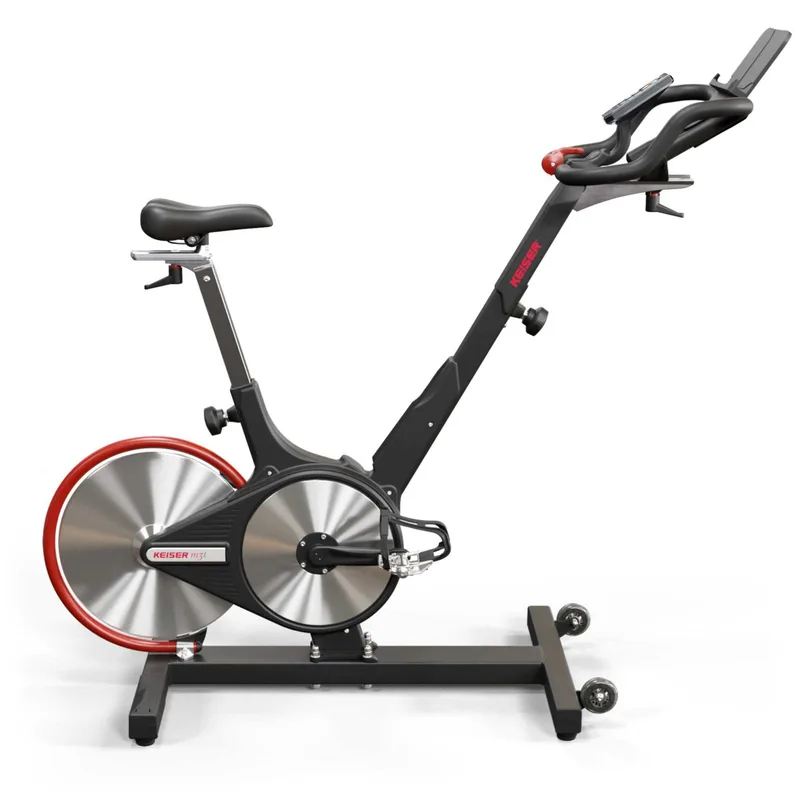
Keiser M3i Studio Plus
Pros
- Found in more commercial facilities worldwide than any other indoor cycle — proven durability at 8+ hours per day
- 72-gear magnetic resistance delivers the smoothest, most consistent pedal feel in any price range
- Pedal-powered generator eliminates cords entirely — no outlet needed, no battery replacement ever
- Studio Display with Ride by Color provides real-time intensity zones without requiring a subscription
- Bluetooth and ANT+ compatibility works natively with Zwift, Apple Fitness+, and any third-party app
- Lifetime access to The Ride (Keiser's streaming class library) included at purchase
Cons
- $3,490 is the highest price in this roundup — budget buyers will find capable options for $1,000 less
- Studio Display is proprietary; upgrading to a touchscreen third-party display requires additional cost
- No built-in class content beyond The Ride platform; heavy Zwift or Peloton app users pay separately
The Keiser M3i has been the indoor cycling industry’s reference standard for over two decades. The M3i Studio Plus adds a larger Studio Display with Ride by Color — a visual intensity guide that shows real-time effort zones without any subscription — and bundles lifetime access to The Ride, Keiser’s streaming class library.
What separates the M3i from every other bike in this list is the resistance mechanism. The eddy current magnetic system uses no contact between components, which means there’s nothing to wear, adjust, or replace. Owner reports on the M3i consistently cite 10+ year ownership with zero mechanical issues beyond normal wearables like pedals and saddles.
The pedal-powered generator is underrated for home gym use. No outlet is required. No batteries need replacement. The bike is functional from day one wherever you place it.
At $3,490, it’s the highest ask in the roundup. For buyers who want one bike that will never need replacement, it’s the pick.
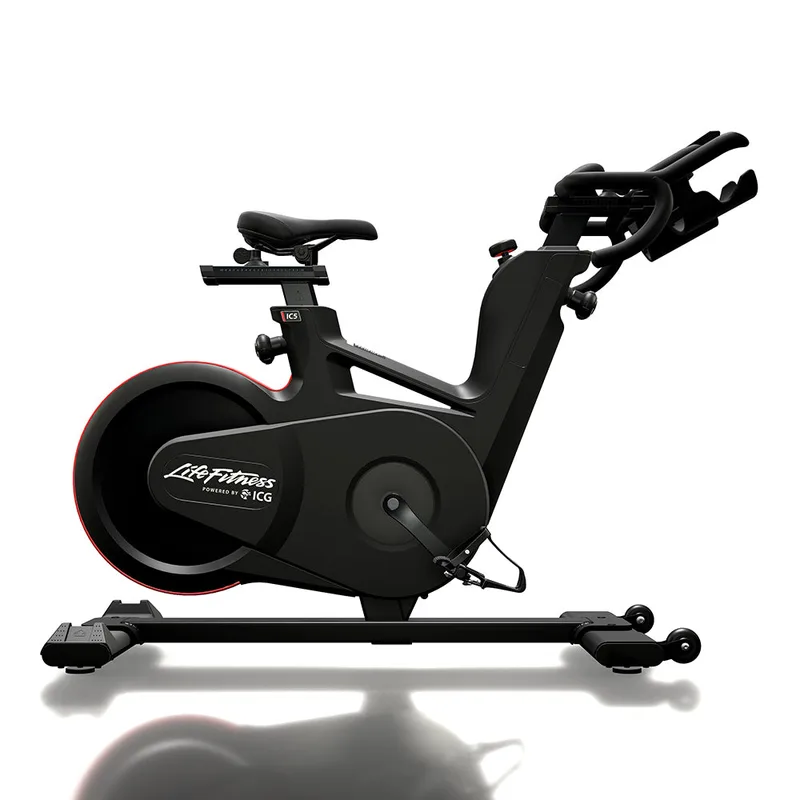
Life Fitness IC5
Pros
- WattRate LCD+ displays real power in watts — same metric used by competitive cyclists, at no subscription cost
- Coach by Color intensity system guides effort without a class or instructor; useful for solo interval sessions
- 300-degree resistance dial positioned directly under the handlebar — fastest resistance change in any commercial cycle
- Self-generating power means no extension cord hunting when setting up in a garage or basement
- Dual-sided SPD/toe cage pedals accommodate both cycling shoes and training shoes out of the box
- $2,505 is the most affordable commercial-grade option in this roundup by a meaningful margin
Cons
- 330 lb weight capacity is the lowest in this group — the Keiser, Stages, and SoulCycle all rate 350 lbs
- No touchscreen or interactive content built in; buyers who want on-demand classes need a separate tablet or device
- Only available through Life Fitness authorized dealers, not Amazon; delivery timelines vary by region
The Life Fitness IC5 is the strongest value play in commercial indoor cycling. At $2,505 — the lowest price in this roundup — it includes the same WattRate power measurement technology found in elite performance labs and the Coach by Color intensity system that guides effort without requiring any content subscription.
The 300-degree resistance dial is a detail worth noting. Most commercial bikes mount the resistance knob at the center of the frame. Life Fitness positions it directly under the handlebar, which means resistance changes happen without breaking form mid-interval. That’s a design choice that serious riders notice.
The dual-sided SPD/toe cage pedals are practical for a home gym setting. Buyers don’t need to invest in cycling shoes immediately — the bike works with standard training shoes until cleats are warranted.
The trade-off is weight capacity (330 lbs versus 350 lbs on most competitors) and the lack of any interactive content. The IC5 is a data-driven, performance-focused machine. Buyers who want Peloton-style on-demand classes need a tablet mount and a separate app subscription.
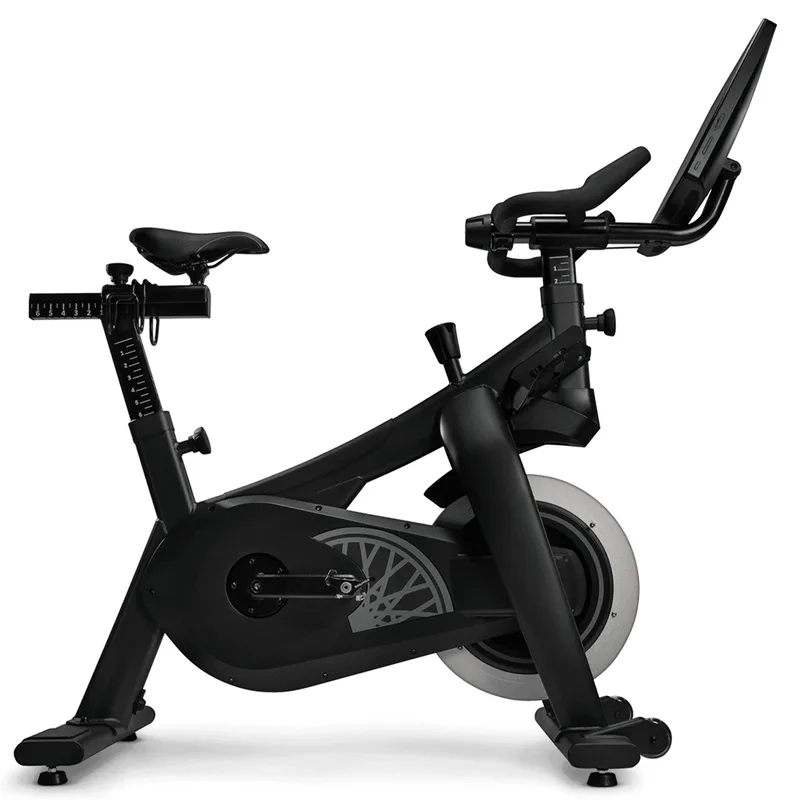
SoulCycle At-Home Bike
Pros
- 21.5" HD touchscreen delivers the most immersive ride-along experience of any commercial bike in this group
- Integrated Stages power meter provides the same ±2% accuracy found in the SC3 at a lower overall price point
- Carbon-fiber belt drive is nearly maintenance-free; no lubrication, no chain stretch, no wear adjustment needed
- 350 lb weight capacity matches the Keiser and Stages; handles out-of-saddle efforts without flex
- Delivered pre-assembled with packaging removal included — ready to ride same day
Cons
- $40/month Variis subscription is mandatory for full class access — adds $480/year to the ownership cost
- Requires LOOK Delta or SDP cleated shoes only — no toe cage option for regular sneakers
- Available direct from SoulCycle only; no authorized reseller network makes returns more complex
- 1-year warranty on components is short for a $2,500 investment
The SoulCycle At-Home Bike is the commercial option that bridges training performance and connected experience. It combines a genuine commercial steel frame with an integrated Stages power meter — the same ±2% accuracy used in the SC3 — and pairs it with a 21.5” HD touchscreen running the Variis app ecosystem.
The hardware itself is studio-grade. The carbon-fiber belt drive and magnetic resistance are entirely maintenance-free. The 350 lb weight capacity handles any rider. Delivery includes setup and packaging removal, which matters when the bike weighs 128 lbs.
The subscription dependency is the honest trade-off. Variis at $40/month requires a 12-month commitment, adding $480 in year one on top of the $2,500 purchase price. The platform includes SoulCycle classes plus other Equinox Media brands, but the class format is fixed — heavy rhythm-based cycling, not structured power training.
The shoe requirement also limits flexibility. LOOK Delta or SDP cleated cycling shoes are mandatory. There is no toe cage option, which means buyers need to budget for shoes if they don’t already own them.
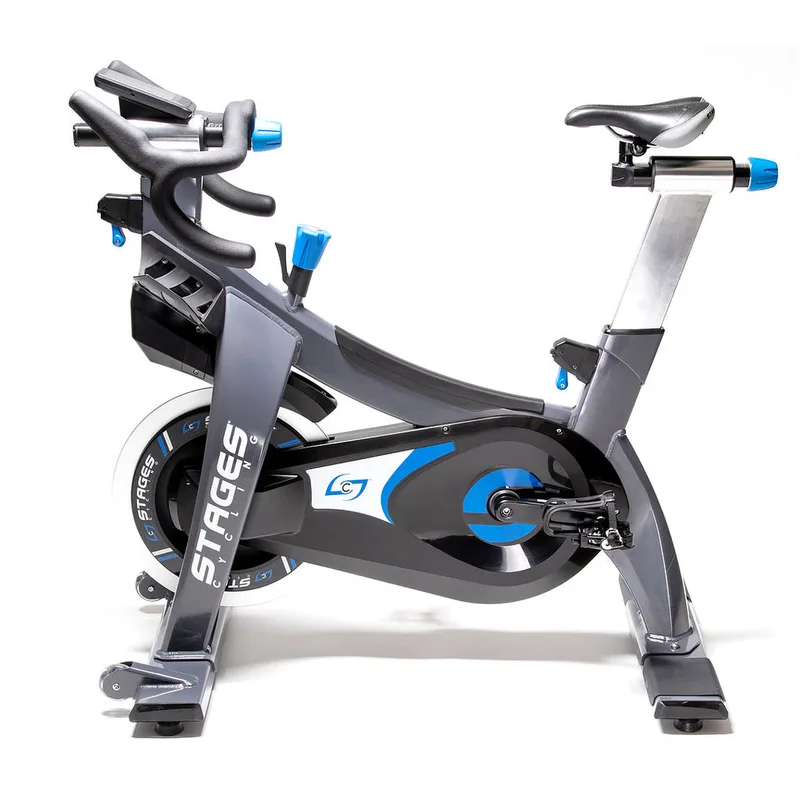
Stages SC3
Pros
- Integrated Stages Power meter at ±2% accuracy is the gold standard for indoor cycling data — same technology in elite training centers
- Aluminum alloy frame is measurably lighter than steel alternatives at 96 lbs while retaining commercial rigidity
- SprintShift lets riders change resistance mid-sprint without breaking form — critical for interval training protocols
- FitLoc micro-adjust system positions the saddle and bars with millimeter precision, matching outdoor bike geometry
- CarbonGlyde belt requires zero maintenance over the life of the bike; no lubrication schedule or stretch adjustment
- EcoSCRN display is self-powered from pedaling — no cords, no batteries, no setup friction
Cons
- $3,095 is a niche investment suited to cyclists who will actually use power data; general fitness riders will not recoup the premium
- No built-in screen or class content; the SC3 is entirely data-driven and requires self-directed programming
- Only available through Stages-authorized specialty dealers — not on Amazon, and delivery involves freight logistics
The Stages SC3 is the bike for cyclists who use data to train. The integrated Stages Power meter records power output at ±2% accuracy — the same standard used by professional road and track cyclists. For athletes following structured training plans with defined power zones (FTP tests, VO2max intervals, recovery rides by wattage), no other bike in this roundup delivers equivalent precision.
The 6061T-6 aluminum alloy frame is lighter than steel at 96 lbs while maintaining commercial rigidity. The FitLoc micro-adjust system positions the saddle and handlebar to millimeter accuracy, which allows indoor bike setup to mirror exact road bike geometry — critical for cyclists who split time between indoor and outdoor riding.
SprintShift is a Stages-specific feature that changes resistance without requiring the rider to reach down. During sprint efforts, the adjustment happens through a lever on the handlebar, keeping form intact.
The SC3 offers nothing for buyers who want classes, entertainment, or guided content. It is a pure performance tool for structured training, and buyers who fit that profile will find no better option at this price.
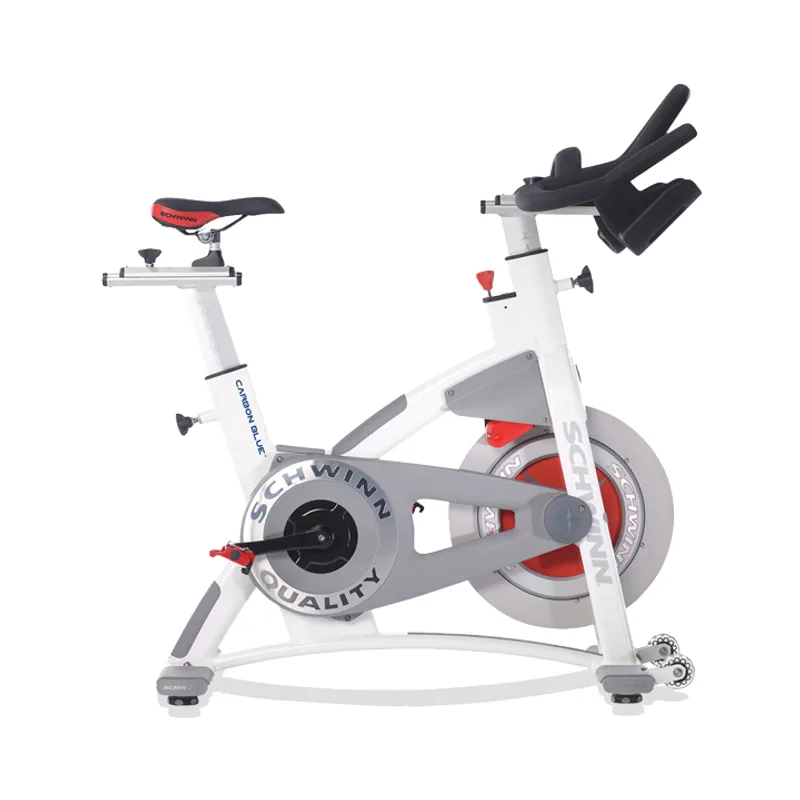
Schwinn AC Performance Plus
Pros
- Carbon Blue belt drive is polyurethane-reinforced with carbon fiber tensile cords — virtually indestructible and completely maintenance-free
- 36 lb perimeter-weighted aluminum flywheel delivers the heaviest momentum feel in this roundup
- Found in commercial YMCA, Gold's Gym, and fitness center installations — real-world proof of longevity
- ErgoLoop handlebars with aero bar position accommodate road cycling position for triathletes and endurance athletes
- Available on Amazon with Prime shipping — the only direct-to-door commercial option in this comparison
- 5-year frame warranty is the longest structural coverage in this group
Cons
- 300 lb weight capacity is the lowest here — below the 350 lb rating of four competitors
- No integrated display or power meter; cadence and effort are self-reported without additional accessories
- Friction-style resistance requires periodic brake pad inspection unlike fully magnetic systems
- At $3,299 on Amazon, it is the most expensive option in the roundup despite fewer tech features than the Keiser or SoulCycle
The Schwinn AC Performance Plus has a different argument from the other four bikes: pure durability. The Carbon Blue belt combines polyurethane construction with carbon fiber tensile cords — a material specification that requires zero maintenance and shows essentially no wear over commercial use cycles.
The 36 lb perimeter-weighted flywheel delivers the heaviest momentum feel in this comparison. Riders who prioritize a road-like, high-inertia pedal stroke will notice the difference immediately compared to lighter flywheels on more tech-forward competitors.
The Schwinn AC appears in YMCA, Gold’s Gym, and mid-tier commercial facilities at scale — a real-world durability proof that lab specs don’t provide. The 5-year frame warranty is the longest structural coverage in this group.
The limitations are significant for buyers who want features. There is no integrated power meter, no display, and no connectivity. At $3,299, buyers are paying for mechanical reliability, not technology. The 300 lb weight capacity is the lowest in the roundup. For general fitness riders who want data, the Life Fitness IC5 at $800 less is the better option.
What to Look for in a Commercial Indoor Cycle
Resistance mechanism
Magnetic resistance is the standard in modern commercial bikes. It uses electromagnetic force rather than physical contact, which means there are no brake pads to replace, no friction surfaces to wear, and consistent resistance across the full gear range. Friction-based systems like the Schwinn AC’s Carbon Blue are durable but require periodic inspection of contact surfaces.
Power measurement
Power meters measure effort in watts — the most objective training metric available. A 200-watt output means the same thing regardless of cadence or perceived effort. For structured training, power is more useful than heart rate or speed. The SoulCycle, Stages SC3, and Life Fitness IC5 all include some form of power measurement at purchase.
Weight capacity
Commercial bikes typically rate 300–350 lbs. For most riders this is not a functional concern, but the rating also reflects structural rigidity under dynamic load — out-of-saddle sprints at high RPM stress the frame significantly more than the rider’s body weight at rest.
Self-powered vs. corded
Self-generating bikes (Keiser, Life Fitness, Stages) require no outlet. For garage gyms or basement setups where electrical outlets are limited or far from the ideal bike placement, this is a meaningful advantage.
Subscription costs
The SoulCycle at-home bike requires $40/month for full content access. The Keiser M3i Studio Plus includes lifetime Ride access at purchase. The IC5 and SC3 have no subscription requirement — all data is displayed on-bike without any recurring cost.
Frame and footprint
Commercial indoor cycles are large and heavy. The smallest footprint here is the Keiser at 26”W × 49”L. The largest is the SoulCycle at 22.2”W × 62.2”L. Ceiling height is not a concern with any of these bikes — all fit under 8-foot ceilings.
Frequently Asked Questions
Are commercial exercise bikes worth it for a home gym? For buyers who ride daily or multiple times per week, yes. Commercial bikes are engineered for 8+ hours of daily use, which means home gym usage of 30–60 minutes per day represents minimal wear. The mechanical quality — consistent resistance, heavier flywheels, tighter tolerances — is noticeable in every ride. Entry-level bikes at $500–800 typically need replacement or significant service within 3–5 years of regular use.
Do commercial indoor cycles work with Peloton or Zwift? The Keiser M3i Studio Plus connects via Bluetooth and ANT+ to any compatible third-party app, including Zwift, Apple Fitness+, and fitness apps that accept power or cadence data. The SoulCycle at-home runs the Variis app exclusively on its own screen. The Stages SC3 transmits power data to any ANT+ or Bluetooth receiver. None of these bikes stream Peloton classes without adding a compatible device separately (Peloton’s app requires their hardware or a third-party solution).
Which commercial bike is best for beginners? The Life Fitness IC5 is the most accessible starting point: lowest price in the group, dual-sided pedals (no cycling shoes required), and an intuitive Coach by Color system that guides intensity without any additional setup. The Schwinn AC Performance Plus is durable but lacks display feedback, which makes it harder to structure progressive training for new riders.
What cycling shoes are required? Most commercial bikes in this group accept SPD (2-bolt) cleats. The Keiser M3i Studio Plus includes dual-sided pedals with SPD and toe cage. The Life Fitness IC5 also includes SPD/toe cage pedals. The Stages SC3 is SPD-compatible. The SoulCycle at-home bike requires LOOK Delta (3-bolt) or SDP cleats only — no toe cage — which is the most restrictive of the five.
How do I maintain a commercial indoor cycle? Magnetic and self-powered systems require minimal maintenance: wipe down the frame after each ride, check pedal tightness monthly, and inspect the saddle and handlebar bolts quarterly. The Carbon Blue belt on the Schwinn AC requires occasional inspection but no lubrication. All five bikes in this group will last a decade or more with basic care.
Bottom Line
The Keiser M3i Studio Plus earns the top spot. The combination of zero-maintenance magnetic resistance, a self-generating power system, industry-proven durability, and a built-in intensity display at no subscription cost makes it the most complete commercial indoor cycle for home use. At $3,490 it’s the most expensive here, but it is also the last bike most home gym owners will ever need to buy.
For buyers with a tighter budget, the Life Fitness IC5 at $2,505 is the strongest value in the category — real commercial-grade hardware, WattRate power tracking, and a resistance system that needs nothing but use.
Cyclists training with power zones should go straight to the Stages SC3.
If connected classes are the priority, the SoulCycle at-home bike delivers the most capable studio-style experience in this group, assuming the $40/month subscription fits the budget.