Calisthenics and bodyweight training have been climbing in popularity through early 2026, and dip bars are one of the few pieces of home gym equipment that earn their keep regardless of your training style. Bodyweight athletes need them for tricep dips, L-sits, and planche progressions. Powerlifters and barbell athletes use them for accessory pressing work. Anyone building a home gym eventually needs a dip station — the question is which type makes sense for your space, budget, and training goals.
The options break into four categories: rack attachments (best stability, requires existing rack), freestanding stations (no wall needed, takes floor space), wall-mounted bars (permanent install, maximum space efficiency), and parallettes (floor-level, calisthenics-focused). Each solves a different problem. This roundup covers one strong option from each category, plus a portable lightweight option for anyone training in limited space.
Quick Picks
Rogue Monster Lite Matador is the best dip bar for anyone who already owns a Monster Lite rack. Zero floor space, Rogue’s lifetime guarantee, and rigid stability that no freestanding option can match. If you have the rack, buy the Matador.
Titan Heavy Duty Dip Stand is the best freestanding dip station for home gyms without an existing rack. At 500 lb capacity and 51” handle height, it handles any dip variation including heavy weighted dips.
Fringe Sport Wall Mounted Dip Bar is the right call for permanent garage gyms where floor space matters. Six hundred pounds of capacity, folds to 4” from the wall, and installs in 10 minutes with a drill.
REP Fitness Parallette Bars are built for calisthenics and gymnastics-style training — L-sits, planche progressions, push-up depth work. They complement a full dip station; they don’t replace one.
Titan Adjustable Dip Bars solve the portability and apartment problem. Ten pounds, adjustable height, 15” footprint. Not built for heavy loading, but perfect for bodyweight-only training in tight spaces.
Comparison
| Bar | Type | Capacity | Price | Space Required |
|---|---|---|---|---|
| Rogue Matador | Rack attachment | Rack-rated | $110 | Zero (uses rack) |
| Titan Heavy Duty Stand | Freestanding | 500 lbs | $119.99 as of Oct 18, 2026 | 27” × 36” |
| Fringe Sport Wall Mount | Wall-mounted | 600 lbs | Unavailable | 23” × 25” (folded: 4”) |
| REP Parallettes | Parallettes | 500 lbs | $80-100 | Minimal |
| Titan Adjustable | Freestanding | 300 lbs | $114.99 as of Oct 18, 2026 | 26” × 15” |
Detailed Reviews
Rogue Monster Lite Matador — Editor Pick
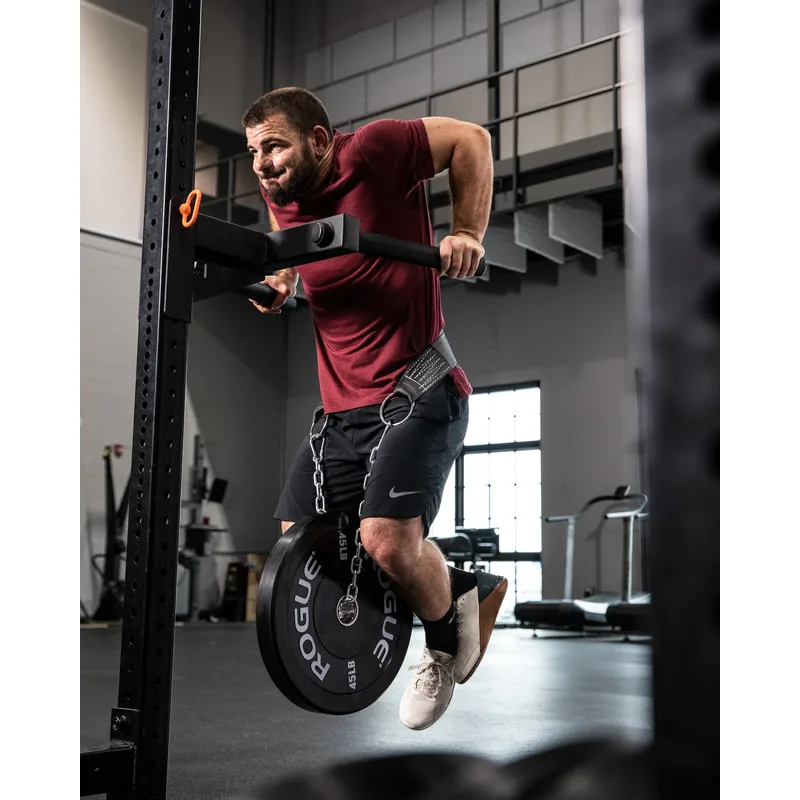
Rogue Monster Lite Matador Dip Bar
Pros
- Zero floor space used — mounts directly to existing Monster Lite rack
- 7-gauge steel construction is overbuilt for any bodyweight or weighted dip load
- Angled handles allow multiple grip widths for targeting chest vs. triceps
- Rogue's lifetime guarantee covers the hardware indefinitely
- Rigid, zero-wobble attachment — far more stable than any freestanding alternative
Cons
- Only compatible with Rogue Monster Lite racks — won't fit other brands without adapters
- Requires an existing Monster Lite rack to use — not a standalone solution
- Only available direct from Rogue — no Amazon Prime shipping
Rack-mounted dip bars are the correct solution for any home gym built around a power rack, and the Matador is the best execution of that concept. It mounts to Monster Lite uprights using the same pin-and-bracket system that connects all Rogue Monster Lite attachments — no bolts, no tools, no setup time. Pull the pin, slide the bracket onto the upright, replace the pin. The bars are rigid and stationary.
That rigidity is the key advantage over freestanding alternatives. Every freestanding dip station — including the Titan at 40 lbs — exhibits some movement under heavy loading, particularly with weighted dips. The Matador transfers all force directly into the rack uprights. At any dip load a home gym athlete will reasonably use, the station doesn’t move.
The angled handles are a genuine design benefit, not a marketing feature. The V-shape allows your grip to angle naturally outward from the narrow point, which reduces shoulder internal rotation stress compared to fixed-width parallel handles. Wider grip emphasizes the chest; narrower grip shifts the load to the triceps. That adjustability matters for athletes programming across multiple rep schemes.
At $110, the Matador is the lowest-cost dip option in this roundup for anyone who already owns the rack. The limitation is obvious: it only works with Monster Lite hardware. If you have a Rogue rack with Monster series uprights (1” hardware, not 5/8”), you need the $195 Monster Matador instead. If your rack is from Titan, REP, or another brand, the Matador won’t fit without an adapter.
Rogue’s lifetime guarantee covers the hardware permanently. One purchase, zero replacement planning.
Titan Fitness Heavy Duty Dip Stand — Best Freestanding
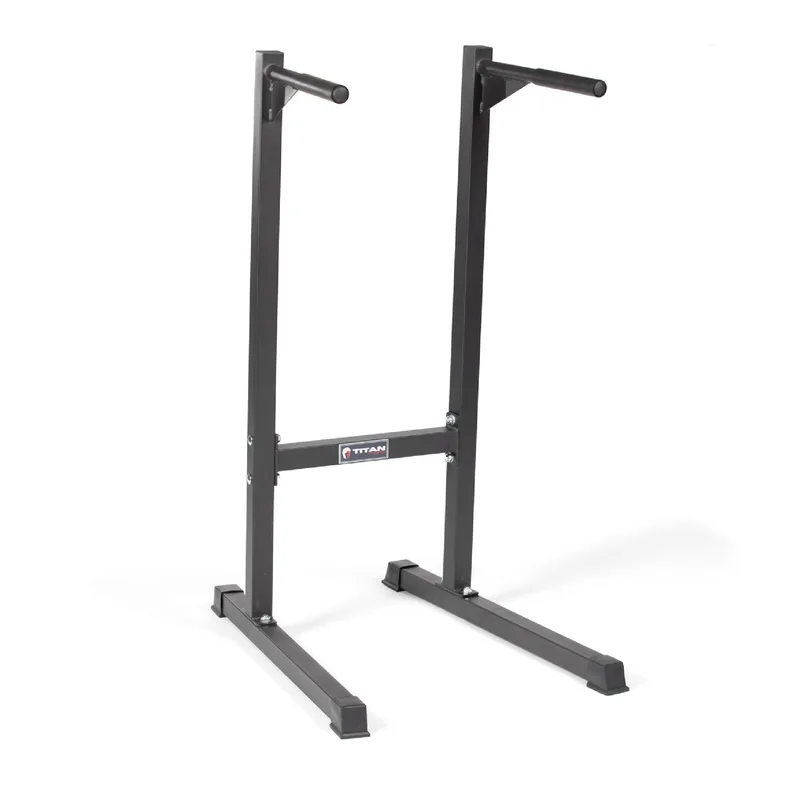
Titan Fitness Heavy Duty Dip Stand
Pros
- 500 lb weight capacity handles weighted dips, ring work, and heavier athletes
- 51" handle height gives full leg clearance for proper dip depth without bending knees
- 40 lb unit weight means the stand doesn't shift during heavy sets
- Foam-padded grips reduce hand fatigue during longer bodyweight sessions
- Wide 36" base depth keeps the unit stable under loading
Cons
- 36" depth footprint is substantial — takes up floor space even when not in use
- Non-adjustable height limits exercise variety for very short or very tall users
- Assembly requires time and moderate mechanical competence
The Titan Heavy Duty Dip Stand is the most straightforward solution for home gyms that don’t include a power rack — and it performs its function without complication. Four legs, two parallel handles at 51”, foam grips, 500 lb capacity. No adjustments, no moving parts, nothing to go wrong.
The 51” handle height is the correct spec for dip work. Shorter freestanding dip stations (often 36–42”) require taller athletes to bend their knees significantly during the dip movement, which shifts balance backward and changes the exercise mechanics. At 51”, most users get full leg clearance with just a slight forward lean — the natural dip position.
Five hundred pounds of rated capacity reflects the construction quality. The 40 lb unit weight keeps the station planted under loading; lightweight stations shift when you push off the handles hard during the top of each rep. Customer reports consistently note stability under weighted dips with dip belts loaded to 70 lbs — the stand doesn’t move.
The foam-padded grips are functional. They’re not ergonomic performance grips, but they reduce hand fatigue during higher-rep sets and keep your hands in position on sweatier sets.
The footprint is the real tradeoff. At 36” deep and 27” wide, the Titan stand occupies meaningful floor space in a garage gym. It can’t be folded or stowed — it lives wherever you put it. For larger spaces, this is a non-issue. For gyms under 200 square feet, the wall-mounted option is a better fit.
Assembly takes about 30 minutes. Instructions are straightforward. No specialty tools required.
Fringe Sport Wall Mounted Dip Bar — Best Space Saver
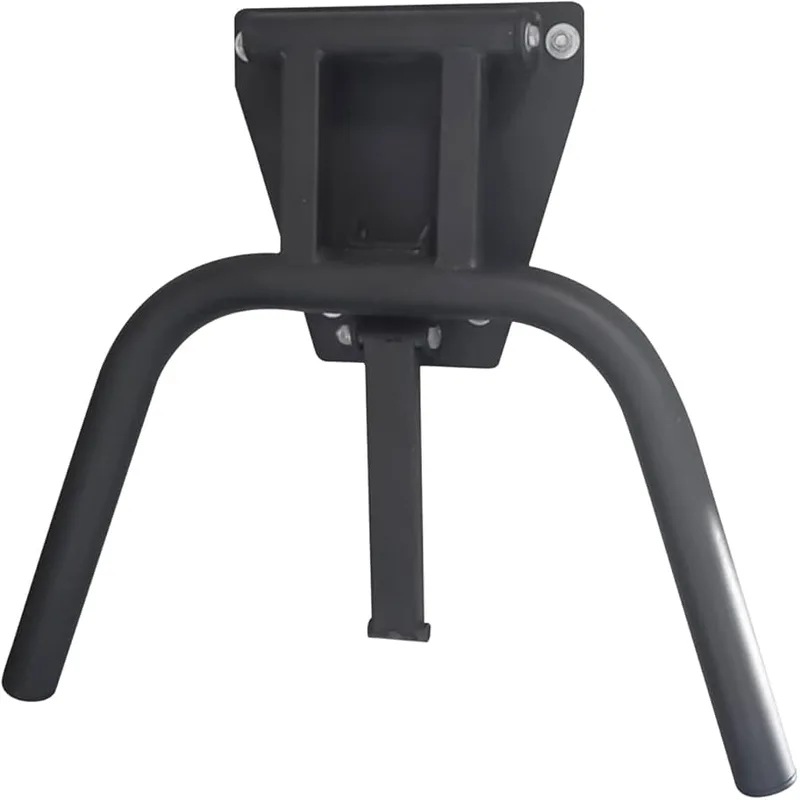
Fringe Sport Wall Mounted Dip Bar
Pros
- Folds to just 4" from the wall when stored — effectively zero floor space
- 600 lb capacity is the highest in this roundup — handles serious weighted dip loading
- V-shaped handles allow natural grip angle adjustments without repositioning
- Solid pin-lock mechanism eliminates any play or flex during use
- $115 price point delivers outsized value for a permanent installation
Cons
- Requires drilling into wall studs — not suitable for renters or temporary setups
- Fixed position once installed — can't be repositioned without re-mounting
- Wall-stud spacing must match installation requirements or blocking is needed
The Fringe Sport wall-mounted dip bar solves the space problem better than any freestanding option can. Fold it up and it extends 4” from the wall — visually invisible in a garage or home gym. Fold it down, lock the pin, and you have a rigid 600 lb dip station occupying 23” × 25” of floor space. The switch between positions takes about five seconds.
Six hundred pounds of rated capacity is the highest in this roundup. That number is intentionally overbuilt — for single-user bodyweight and weighted dip work, the practical ceiling is 300–350 lbs combined athlete plus belt weight. The excess capacity means the mount hardware operates well within its structural limits at any real-world load, which contributes to the rigidity and absence of flex during use.
The V-shaped handle design matches the Rogue Matador’s advantage: the angle allows natural grip positioning without forcing the wrists into a fixed orientation. Grip wider at the base for chest emphasis, tighter at the front for triceps focus. The handles don’t lock into multiple discrete positions — you find your natural spot and grip there, which works well for most users.
Installation requires drilling eight screws into wall studs. This is not optional — the mount must connect to studs to handle the load safely. For most standard stud layouts, the installation is straightforward. For walls with non-standard stud spacing or concrete/brick walls, additional hardware or a wood backing plate is needed.
At $115, this is the best value permanent solution in the roundup. The tradeoff is permanence — once installed, repositioning requires uninstalling and remounting. Buy it once, put it in the right place, and it lasts indefinitely.
REP Fitness Parallette Bars — Best Parallettes
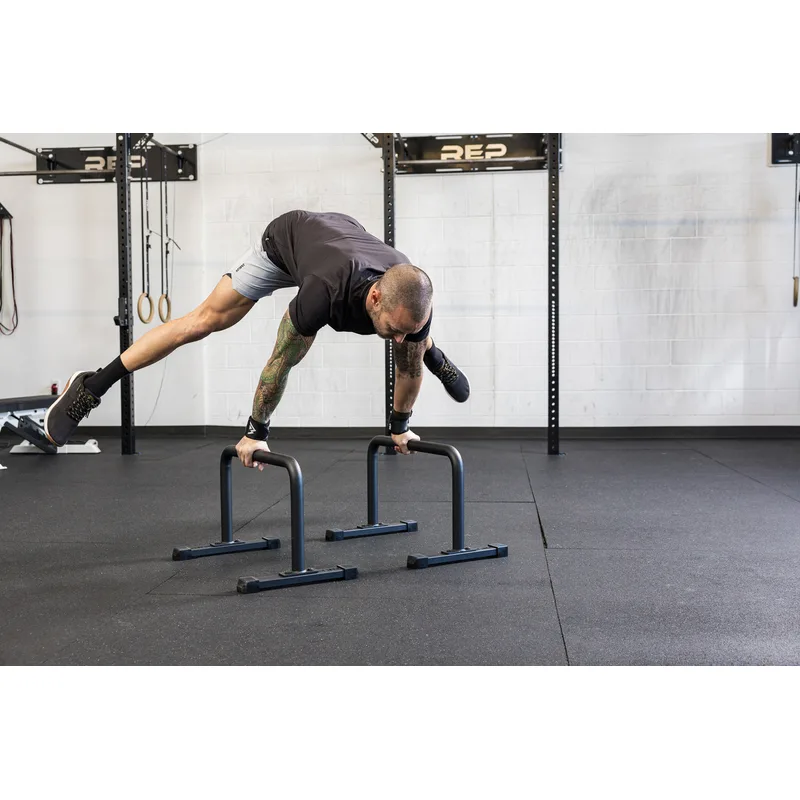
REP Fitness Parallette Bars
Pros
- 40mm grip diameter is larger than standard push-up bars — reduces hand fatigue
- Tested to 1,000 lbs structurally — significantly overbuilt for any single-user load
- Minimal base keeps movements clean for planche progressions and dynamic transitions
- Rubber feet stay planted on hard floors without damaging surfaces
- Compact and lightweight — stores in a closet or under a bench
Cons
- Low-profile design limits leg clearance — not suitable as a primary dip station for taller users
- Floor-level height means these supplement rather than replace full-height dip bars
- No height adjustment — static design only
REP’s Parallette Bars are not a dip station replacement — they’re a specialized calisthenics tool that fills a training gap that full-height dip bars can’t cover. For L-sits, low planche work, push-up depth training, handstand balance work, and ring-style transitions, low-profile parallel bars at floor level are the correct tool. A 51” dip stand can’t replicate the exercise mechanics these enable.
The 40mm (1.57”) grip diameter is meaningfully larger than standard 35mm push-up bars. The thicker grip distributes pressure more evenly across the palm and reduces the concentrated loading that causes hand fatigue during longer L-sit holds. For calisthenics athletes building toward planche or advanced static holds, that grip quality matters during high-volume sessions.
Structural specs are overbuilt in the best way: 500 lb rating, tested to 1,000 lbs. These bars won’t flex, shift, or deform under any single-user load. The rubber feet stay planted on hardwood, tile, and rubber flooring without requiring additional grip pads.
The minimal base design is specific to calisthenics application. Unlike parallettes with a wide lateral base, REP’s design keeps the footprint tight to allow natural leg positioning for planche leans and front lever progressions without the base interfering with body position.
The limitation is clear: these are low-profile floor bars. Leg clearance for standard dips is limited, and taller users won’t get full range of motion for upright dip work. They’re a second piece of equipment alongside a dip station — not a substitute for one.
For calisthenics-focused training, no other option in this roundup serves these specific exercise patterns.
Titan Fitness Adjustable Dip Bars — Best Portable
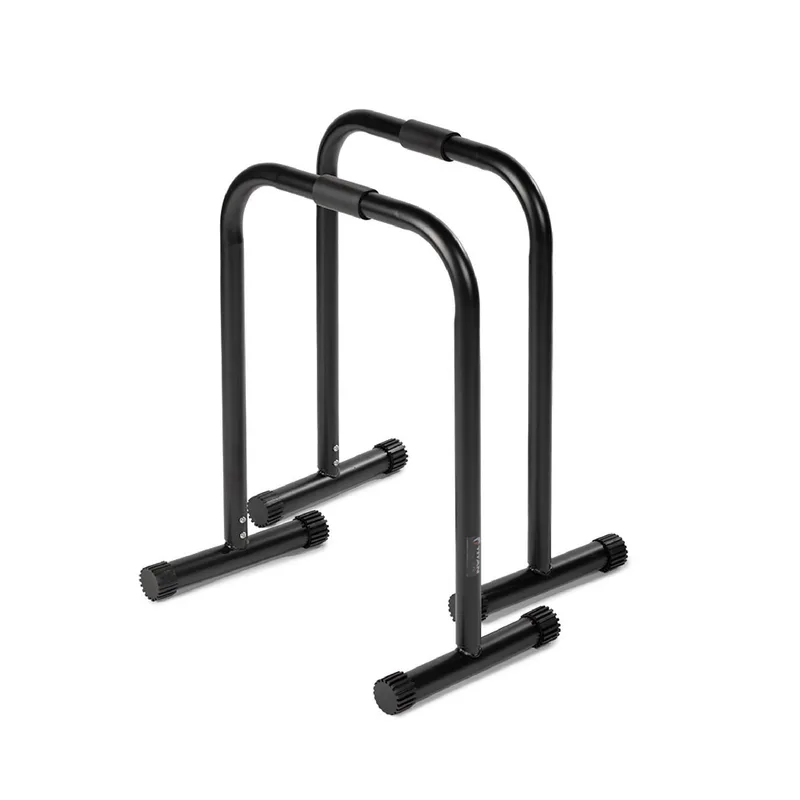
Titan Fitness Adjustable Dip Bars
Pros
- 10 lb unit weight makes these genuinely portable — move between rooms or take to a field
- Adjustable height 31-35" accommodates different leg lengths and training positions
- 15" footprint is the smallest in this roundup — works in tight apartments
- Can be set parallel or staggered for exercise variety
- No tools required for height adjustment
Cons
- 300 lb weight capacity is the lowest in this roundup — not suitable for heavy weighted dips
- Lighter construction means more movement during explosive or loaded exercises
- Short grip pad length (9.25") limits hand placement options compared to longer bars
The Titan Adjustable Dip Bars are the right answer for a specific use case: bodyweight training in spaces where a full dip station is impractical. At 10 lbs per bar and a 15” depth footprint, these genuinely move. Park them in a closet between sessions, bring them to a backyard workout, use them in an apartment where a 40 lb stand isn’t practical. The use case is real and these execute it well.
Adjustable height from 31-35” handles a range of athlete sizes without tools. The adjustment mechanism is simple — set the height, lock it, train. The 9.25” grip length is shorter than full dip station handles but sufficient for standard grip positioning during dips and tricep work.
The 42.5mm steel tubing grip is comfortable for bodyweight dip work. No foam padding, but the diameter keeps wrist load distributed rather than concentrated.
The 300 lb weight capacity is the limiting factor. For bodyweight-only training and modest resistance band work, that ceiling is never approached. For weighted dips with a dip belt, the capacity is more restrictive — athletes over 200 lbs loading 50–70 lbs on a dip belt are approaching or exceeding the rating. These are bodyweight bars, not heavy-loading bars.
The 10 lb unit weight also means more movement than heavier stations. Under heavy explosive reps or weighted loading, the bars shift. Placing them on rubber flooring reduces movement; smooth tile will require repositioning between sets.
For the target use case — apartment gyms, portable setups, light bodyweight training — these are the best option in this price range.
Buying Guide: Choosing the Right Dip Bars
Rack Attachment vs. Freestanding vs. Wall-Mounted
Rack attachments are the right choice if you already own a compatible power rack. They cost less than a full dip station, use zero floor space, and are more rigid than any freestanding alternative. The limitation is compatibility — each brand’s attachment typically fits only their own rack system.
Freestanding stations are the universal answer. No rack, no wall mounting, no installation. Place them anywhere with adequate ceiling clearance and start training. The tradeoff is floor space and, in cheaper models, stability under load. The Titan HD stand at 40 lbs and 500 lb capacity represents the correct spec level for a permanent freestanding setup.
Wall-mounted bars are the best long-term option for permanent garage gyms where floor space is at a premium. The installation requirement is the only barrier. If you own the space and have wall studs to mount to, a quality wall-mounted dip bar outperforms freestanding alternatives in stability and space efficiency.
Height Matters More Than People Realize
Dip bar handle height affects exercise mechanics significantly. Standard dip work requires enough clearance to lower until the upper arms are at least parallel to the floor — roughly an 18-24” drop from the handle height. For a 5’10” athlete, that means handles at 48” or higher allow full depth without touching the floor.
Handles below 42” force most athletes to bend their knees sharply, which shifts the center of gravity backward and changes the muscle recruitment pattern. If you’re prioritizing full-depth dip mechanics, verify handle height before purchasing any freestanding station.
Weight Capacity and Stability
Dip work creates significant horizontal force on the bar handles — particularly at the bottom of the movement and during weighted dips. Unlike vertical loading (a barbell), dip bar loading pushes the handles forward and outward.
Minimum 400 lb capacity for serious training. Lighter-rated bars are appropriate for bodyweight work under 200 lbs but become unstable and potentially unsafe with additional loading. The 500 lb Titan HD and 600 lb Fringe Sport wall mount both operate well within their structural limits for any realistic home gym use.
Parallettes vs. Full-Height Bars: Different Tools
Parallettes and full-height dip bars are different tools for different exercises. Full-height bars are for dips, ring-style tricep work, and L-sit variations with full leg extension room. Parallettes — typically 4-8” tall — are for push-up depth training, planche work, L-sits near the floor, and gymnastics skill development.
Serious calisthenics athletes often own both. For most home gym builders prioritizing basic strength work, full-height bars are the correct starting point.
FAQ
Do I need a power rack to use a dip bar?
No. Freestanding dip stations and wall-mounted bars work without any other equipment. Rack-attached options like the Rogue Matador require a compatible rack. If you already own a quality power rack, the rack attachment is usually the best value — it’s cheaper than a full freestanding station and more stable. If you don’t have a rack, freestanding or wall-mounted options give you a complete setup independently.
What’s the difference between dip bars and parallettes?
Height and application. Full-height dip bars (typically 46-54” handles) provide clearance for standard tricep dips and leg-raise variations with straight or bent legs. Parallettes (typically 4-12” off the floor) are designed for floor-level calisthenics: L-sits, planche progressions, push-up depth, handstand balance work. You can perform limited dip movements on parallettes, but leg clearance is restricted for taller athletes. They’re complementary tools — most serious calisthenics athletes use both.
How much weight capacity do I actually need in a dip bar?
For bodyweight-only training, 300 lbs is the practical floor — it covers most athletes comfortably. For weighted dips with a dip belt, add your body weight plus the maximum load you’d use. A 220 lb athlete loading 60 lbs on a belt needs 280 lbs minimum, with margin factored in. For long-term versatility, 400-500 lb capacity is the right target regardless of your current weight or load. The Titan HD (500 lb) and Fringe Sport wall mount (600 lb) both clear that threshold comfortably.
Can I mount any dip bar to my existing rack?
Only if the attachment is explicitly compatible with your rack’s upright dimensions and hardware. The Rogue Matador fits Rogue Monster Lite racks (3x3” uprights, 5/8” holes). Titan’s rack-mounted dip attachments fit Titan T-2, T-3, and X-3 series racks. Cross-brand compatibility is rare without modification. Check your rack’s specifications against the attachment’s compatibility list before buying. REP Fitness and Titan both offer their own dip attachments designed for their respective rack lines.
Are wall-mounted dip bars safe for home gym installation?
Yes, with proper installation into wall studs or structural backing. The key requirement is mounting to structural framing — not just drywall. Most standard framing has studs at 16” or 24” centers. If your stud spacing doesn’t match the mount’s hole pattern, a 2×6 or 2×8 wood backing plate spanning multiple studs provides a solid anchor point. Follow the manufacturer’s installation instructions, use the specified hardware, and have a second person assist with alignment during installation.
Conclusion
For most home gym setups, the Titan Fitness Heavy Duty Dip Stand is the practical first choice — no installation required, 500 lb capacity, 51” handles, and Amazon availability. It handles standard and weighted dip work without limitation.
If you own a Rogue Monster Lite rack, buy the Matador instead. More stable, less money, zero floor space. That’s the better solution for rack-equipped gyms.
For garage gyms where floor space is the primary constraint, the Fringe Sport Wall Mounted Dip Bar earns the permanent installation. Fold it flat against the wall when you’re not training. Six hundred pounds of capacity means you’ll never outgrow it.
Add the REP Fitness Parallettes to any setup if calisthenics skills — L-sits, planche progressions, push-up depth — are part of your training. They don’t replace a dip station, but they fill the floor-level training gap that full-height bars can’t cover.