SOLE Fitness expanded its elliptical lineup in 2026 with new sub-$2,000 models featuring heavier flywheels, power incline systems, and lifetime warranties — a direct response to growing demand for commercial-grade elliptical performance in home gym settings at accessible price points. The under-$1,000 tier specifically has improved: the current E25 now includes a 20 lb flywheel and 20-level power incline, specs that were either unavailable or priced above $1,000 in this category just two years ago.
Ellipticals under $1,000 occupy a different reality than the $1,500–$3,000 connected fitness machines dominating review coverage. No touchscreen. No auto-adjusting terrain programs. No monthly subscription built into the price. What this tier delivers is a solid low-impact cardio platform — flywheel inertia, stride geometry, and frame durability — without the tech markup. For athletes who want consistent daily cardio and aren’t paying for streamed classes, the under-$1,000 tier is where the value lives.
This roundup covers five machines from $649 to $1,099. The Sole E25 leads at $1,099 — strongest flywheel, power incline, and best long-term warranty in the class. The Schwinn 430 at $999 offers more preset programs and a wider resistance range. The ProForm Carbon EL at $799 brings iFIT connectivity for athletes who want trainer-led programming without buying a $1,600 connected machine. The Horizon EX-59 at $649 leads on frame warranty and portability. The Niceday at $649 carries the highest weight capacity in the category.
Quick Picks
Sole E25 is the best overall at $1,099 — 20 lb flywheel, 20-level power incline, 350 lb capacity, and a lifetime frame/flywheel warranty are not matched by any other machine in this price tier.
Schwinn 430 is the best feature set at $999 — 26 resistance levels, 22 preset programs, 3-speed fan, USB charging, and dual LCD make it the most feature-packed option at this price.
ProForm Carbon EL is the best iFIT value at $799 — connects to live and on-demand trainer-led workouts with auto-resistance adjustment at $200 less than the top picks.
Horizon EX-59 is the best budget pick at $649 — lifetime frame warranty, manageable 145 lb weight, dual handlebars, and a clean-riding 14.3 lb flywheel.
Niceday is the best for heavy users at $649 — 400 lb weight capacity and under 20 dB noise level at a price where most machines rate to 300 lbs and run noticeably louder.
Comparison
| Spec | Sole E25 Elliptical | Schwinn 430 Elliptical | ProForm Carbon EL Elliptical | Horizon Fitness EX-59 Elliptical | Niceday Elliptical Machine |
|---|---|---|---|---|---|
| Rating | 9.0/10 | 8.5/10 | 8.1/10 | 7.9/10 | 7.5/10 |
| Price | Check price | Check price | $799 | Unavailable | $659.99as of Oct 18, 2026 |
| Stride Length | 20 inches | 20 inches | 18 inches | 18 inches | 15.5 inches |
| Flywheel | 20 lbs | 13.2 lbs | — | 14.3 lbs | 16 lbs |
| Resistance Levels | 20 levels (magnetic ECB) | 26 levels | 18 levels | 10 levels (magnetic) | 16 levels (magnetic) |
| Power Incline | 20 levels | — | — | — | — |
| Weight Capacity | 350 lbs | 300 lbs | 275 lbs | 300 lbs | 400 lbs |
| Display | 4-window LED | Dual LCD | 5-inch high-contrast multi-color | — | LCD with tablet shelf |
| Footprint | 71"L × 24"W × 67"H | 71"L × 25"W × 64"H | Approx. 70"L × 24"W | — | — |
| Machine Weight | 207 lbs | — | — | 145 lbs | — |
| Warranty | Lifetime frame and flywheel / 5-yr electronics / 2-yr labor | 10-yr frame / 2-yr mechanical and electrical | 5-yr frame / 2-yr parts / 1-yr labor | Lifetime frame / 3-yr parts / 1-yr labor | — |
| Incline | — | 6 levels (manual) | — | — | — |
| Programs | — | 22 preset workouts | — | 10 preset workouts | — |
| iFIT Compatible | — | — | Yes (subscription sold separately) | — | — |
| Dimensions | — | — | — | 74"L × 25"W × 64.5"H | — |
| Noise Level | — | — | — | — | Under 20 dB |
| Frame | — | — | — | — | Double-thickened steel tubing |
| Check Price → | Check Price → | Check Price at ProForm → | Check Price → | Check Price → |
Prices change daily — tap Check Price for the current Amazon price. Numbers shown were verified on the "as of" date.
Detailed Reviews
Sole E25 Elliptical — Editor Pick
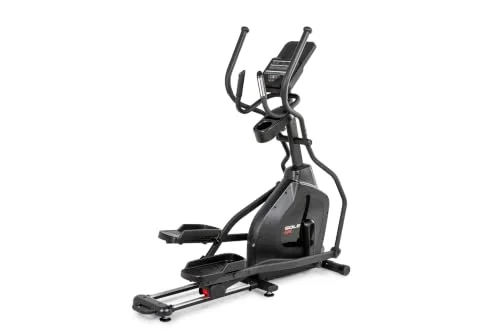
Sole E25 Elliptical
Pros
- 20 lb flywheel is the heaviest in this price bracket — produces a smooth, consistent stride that outperforms every competitor under $1,000 in stride feel and inertia
- Power incline adjusts electronically across 20 levels mid-workout without stopping — a feature most competitors in this price range eliminate or replace with manual adjustment
- Lifetime frame and flywheel warranty is the strongest coverage available under $1,000 — Sole backs it because the machine is built to last, not because the warranty is a marketing footnote
- 350 lb weight capacity at this price handles a wider range of users than most competitors in this tier (typically 300 lb)
- 20" stride length is long enough for a full, natural elliptical motion for users up to approximately 6'2" — short strides (under 18") feel choppy for taller athletes
Cons
- At 207 lbs assembled, requires at least two people for initial positioning — not practical to move alone
- LED display is functional but basic — no touchscreen, no built-in streaming, no app-connected training content
- Sole direct delivery can run 1–2 weeks for freight shipment, unlike standard Amazon Prime delivery timelines
The Sole E25 is the benchmark for ellipticals under $1,000 in 2026. The 20 lb flywheel is the defining difference: every competitor in this price range uses a lighter flywheel (13.2–16 lbs), and the gap in stride feel is noticeable on the first workout. A heavier flywheel stores more rotational momentum, which smooths out the pedal arc between foot strikes and eliminates the choppy, inconsistent feel that characterizes lighter-flywheel budget machines. Based on widespread owner reports in home gym communities, the E25 rides closer to a mid-range commercial gym elliptical than anything else under $1,000.
The 20-level power incline is the second differentiator. On competing machines in this price range, incline either doesn’t exist or requires manually stopping the workout to adjust a physical lever. On the E25, the incline adjusts electronically from the console mid-stride — the same behavior as a commercial gym machine. Users can ramp incline during a session to add lower body loading or drop it for recovery intervals without breaking rhythm. This is a significant usability advantage over static or manual-adjust alternatives.
The lifetime frame and flywheel warranty is not a small detail at $999. Sole backs this warranty because the machine is built with commercial-grade component longevity in mind. The frame welds, flywheel bearings, and mechanical drive system are designed for daily use over years, not a 2–3 year useful life followed by a parts-availability cliff. Owners who have run Sole ellipticals for five to eight years without mechanical failure are not uncommon in long-running home gym forums.
The E25 ships via freight, not standard parcel delivery. Plan for a delivery window of 1–2 weeks from order and arrange for two people to handle positioning at home — 207 lbs assembled on a heavy freight pallet is not manageable solo. That’s a minor inconvenience for a machine built to anchor a cardio program for a decade.
Schwinn 430 Elliptical — Best Feature Set
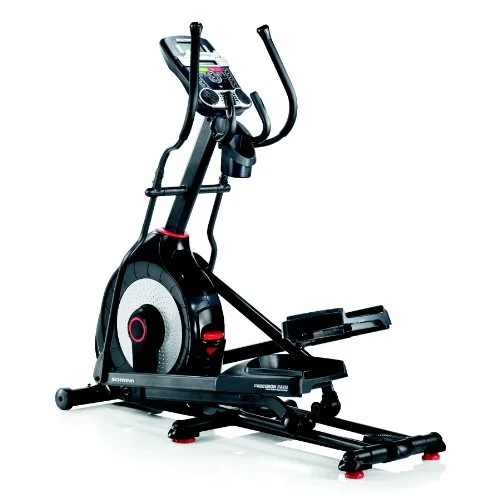
Schwinn 430 Elliptical
Pros
- 26 resistance levels is the most in this price range — more fine-grained control than any other machine under $1,000 for interval and progressive cardio training
- 22 preset workout programs cover target heart rate, interval, and time-based training without needing a subscription or app
- Built-in 3-speed fan, MP3 input, media shelf, and USB charging port are convenience features that home gym machines under $1,000 rarely bundle together
- Dual LCD display shows multiple stats simultaneously without toggling — cadence, calories, speed, distance, heart rate, and program graphic on screen at the same time
- 20" stride matches the Sole E25's stride length at the same price — competitive on the most important ergonomic spec
Cons
- 13.2 lb flywheel is noticeably lighter than the Sole E25's 20 lb flywheel — stride feels less smooth at higher cadences, and the machine is more sensitive to stride inconsistency
- Manual incline requires stopping to adjust — six levels cover the range but the friction of manual adjustment discourages using incline variation within a workout
- At 300 lb capacity, lighter than the Sole E25 (350 lb) at the same price
The Schwinn 430 matches the E25 on stride length (20”) at $999 while taking a different engineering approach: lighter flywheel, more resistance levels, more preset programs, and more console amenities. For athletes who prioritize structured program variety over raw flywheel smoothness, the 430 is the stronger choice.
The 26 resistance levels is the highest available in this roundup. In practical terms, more resistance levels allow finer-grained interval programming — the difference between a 20-level and 26-level machine is meaningful if you’re doing structured tempo work where small resistance changes across stages matter. At 10 or even 20 levels, the jumps between settings can feel abrupt during intervals; at 26 levels, the transitions are smaller and more precise.
The 22 preset workout programs cover a wider range of goal types than the Horizon EX-59’s 10 programs or the Niceday’s manual-only operation. Programs include interval, target heart rate, custom, and hill-simulation options. For athletes who prefer following a structured program over self-directing every session, having the workouts built into the machine’s console removes one variable from session setup.
The 3-speed fan is a practical amenity that home gym builders frequently undervalue until a summer training session in a hot garage makes the point. The MP3 input and media shelf let athletes run audio or video content without phone bracket add-ons. The USB charging port keeps devices powered during long sessions. These details won’t drive a purchase decision on their own, but they accumulate into a more functional training experience compared to machines that ship without them.
The 13.2 lb flywheel is the tradeoff. Against the E25’s 20 lb flywheel, the stride feel is noticeably lighter and less consistent at higher cadences. For moderate-intensity steady-state cardio, this isn’t a deal-breaker. For high-cadence interval training where flywheel inertia determines how smooth the sprint feels, the Sole E25 holds an edge.
ProForm Carbon EL Elliptical — Best iFIT Value
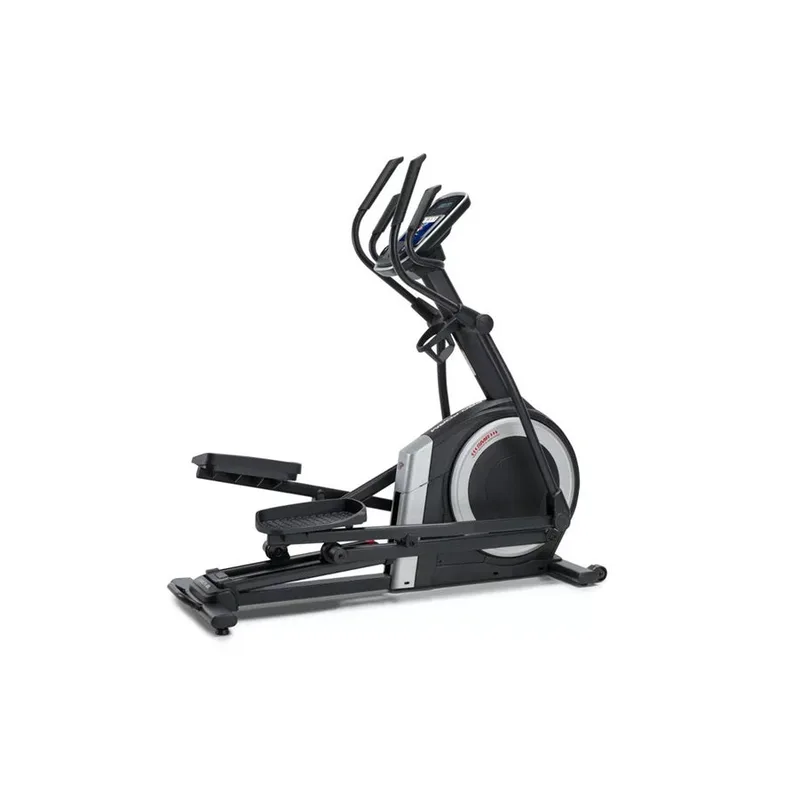
ProForm Carbon EL Elliptical
Pros
- iFIT compatibility connects to live and on-demand trainer-led elliptical workouts — the platform auto-adjusts resistance to match the trainer's programming, which removes the need to manually change settings mid-workout
- $799 is $200 less than the Sole E25 and Schwinn 430 — meaningful savings at this tier for athletes who want iFIT integration without paying for a premium-tier machine
- 5" multi-color display is the most visually clear console in this roundup — easier to read stats at a glance compared to standard single-color LED displays
- 18 resistance levels provides adequate progression range for beginner through intermediate cardio training goals
Cons
- iFIT interactive features require a subscription ($39/month or $396/year) — full-featured use of the machine's connected capabilities carries an ongoing cost beyond purchase price
- 275 lb weight capacity is the lowest in this roundup — limits the usable audience compared to competitors at the same or lower price
- 18" stride is shorter than the Sole E25 and Schwinn 430's 20" stride — taller athletes (6'0"+) may notice a restricted stride arc
- ProForm sells primarily direct and through select retailers, not through Amazon — standard Prime shipping and return processes do not apply
The ProForm Carbon EL is the entry point for iFIT-connected elliptical training without the $1,600–$2,500 price tag of premium connected machines. At $799, it delivers the core of the iFIT experience — on-demand trainer-led workouts with auto-resistance adjustment — on a budget-tier machine frame.
iFIT integration changes how the machine functions during a workout. Instead of manually selecting a resistance level and monitoring stats, the trainer’s program controls the machine: resistance auto-adjusts to match what the trainer is prescribing in real time, and the athlete focuses on effort and output rather than console management. For home gym athletes who find self-directed elliptical workouts monotonous or who aren’t confident building their own cardio programming, this removes the primary friction point.
At $799, the Carbon EL is $300 below the Sole E25 and $200 below the Schwinn 430. That savings is real, but so are the tradeoffs: 275 lb weight capacity (lowest in this roundup), 18” stride (versus 20” on the top two picks), and a 5-year frame warranty (versus Sole’s lifetime or Schwinn’s 10-year coverage). ProForm also sells primarily direct through proform.com and select retailers rather than Amazon, so the standard Prime shipping and return process doesn’t apply.
The iFIT subscription itself runs $39/month or $396/year after the complimentary trial period. Buyers who already subscribe to iFIT through NordicTrack or ProForm equipment get full platform access with the Carbon EL — the sub-$800 machine cost then becomes a secondary elliptical addition rather than a primary platform investment. For athletes new to iFIT, factor the subscription cost into the total annual price before comparing it against a non-connected alternative.
The 5” multi-color display is the clearest console screen in this roundup for reading stats mid-workout. Most of the competitors use single-color LED displays that require more focus to read at a glance.
Horizon Fitness EX-59 Elliptical — Best Budget
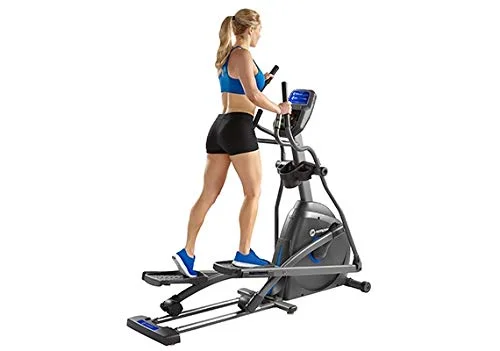
Horizon Fitness EX-59 Elliptical
Pros
- Lifetime frame warranty at $649 is exceptional — Horizon stands behind the structural durability of the EX-59 at a price point where most competitors offer 10-year coverage at best
- 14.3 lb flywheel delivers more momentum than the Niceday's 16 lb alternative when comparing stride feel — adequate for steady-state and moderate interval training without the choppy feel of lighter flywheel budget machines
- 145 lb assembled weight is the most manageable in this roundup — easier for one person to reposition with the built-in transport wheels
- Dual handlebar design provides both moving handlebars and fixed handlebars with pulse sensors — athletes can switch between upper body engagement and stationary grip based on their training focus
- 10 preset programs are sufficient for beginners through intermediate athletes covering standard cardio goal types
Cons
- 10 resistance levels is the fewest in this roundup — experienced cardio athletes may find the progression ceiling too low for serious interval or high-output training
- 18" stride limits comfort for taller users (6'0"+) compared to the 20" stride on the Sole E25 and Schwinn 430
- No power incline — flat stride only, which reduces workout variety for athletes who rely on grade variation for progressive overload
The Horizon EX-59 is the best-built machine at the $649 price point. The lifetime frame warranty is the headline: Horizon offers structural coverage that most competitors at twice this price don’t match. The EX-59’s frame is welded and finished to the standard that earns a lifetime warranty — Horizon’s warranty terms include the frame and welds indefinitely under the original owner.
At 145 lbs, the EX-59 is the most manageable elliptical in this roundup. For home gym operators who need to reposition equipment regularly — shared family spaces, garage gyms that double as parking spots — the transport wheels and manageable weight matter. Moving a 207 lb elliptical alone is not practical; the EX-59 can be repositioned with reasonable effort by one person using the built-in wheels.
The dual handlebar design gives the EX-59 more training versatility than single-handlebar budget machines. The moving handlebars engage the upper body in the elliptical motion — arms drive forward and back in coordination with the stride, which increases total calorie expenditure and engages the lats, chest, and shoulders alongside the lower body. The fixed handlebars with integrated heart rate sensors let athletes drop to a lower-body-focused stride while monitoring heart rate at the console, which is useful during recovery intervals or steady-state aerobic work.
The 14.3 lb flywheel is middle-of-the-pack for this category — lighter than the Sole E25 (20 lb) and heavier than the Schwinn 430 (13.2 lb). Stride feel is smooth enough for moderate-intensity training without the premium inertia of heavier flywheels. Owner reports consistently describe the EX-59 as quiet and stable for a machine at this price.
The 10 resistance levels is the main practical limitation for athletes who want to progress beyond beginner and intermediate cardio intensities. At 10 levels, the steps between settings are larger, which makes fine-grained interval programming less precise.
Niceday Elliptical Machine — Best for Heavy Users
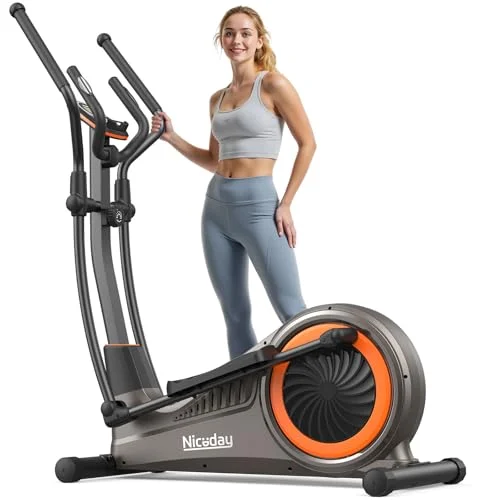
Niceday Elliptical Machine
Pros
- 400 lb weight capacity is the highest in this roundup by a significant margin — the only machine at this price tier that comfortably accommodates heavier athletes without approaching structural limits
- Under 20 dB noise level is the quietest machine in this roundup — meaningful for apartment dwellers or shared spaces where standard elliptical motor noise (40–50 dB) creates issues
- 16 resistance levels at $649 matches machines priced $150–200 higher — adequate range for progressive training across fitness levels
- Compact, straightforward design is easy to assemble (typically under 45 minutes per owner reports) and requires no app, subscription, or Bluetooth pairing to operate
- Double-thickened steel frame construction is designed to handle higher load distribution from heavier users — not simply rated higher without structural backing
Cons
- 15.5" stride is the shortest in this roundup — noticeably restricted for users over 5'8" and will feel choppy compared to 18"–20" stride machines
- 16 lb flywheel produces adequate momentum for steady-state but lacks the inertia of the Sole E25's 20 lb flywheel — stride feel at higher cadences is less smooth
- Basic LCD display with no app integration, no preset workout programs, and no heart rate monitor wireless capability — the machine is manual-only
- Reported squeaking development after several weeks of use in owner feedback — requires periodic check and lubrication of moving components
The Niceday is the only elliptical under $1,000 that seriously addresses the needs of heavier athletes. At 400 lb rated capacity — 50–100 lbs above every other machine in this roundup — it’s engineered with double-thickened steel tubing and a heavy-duty base specifically to handle higher distributed loads without developing the lateral flex and frame noise that lighter-rated machines exhibit when used near their capacity limits.
The under 20 dB noise specification is the second standout detail. Standard ellipticals at this price level run 40–50 dB under load — audible in adjacent rooms and problematic in apartment settings or shared home spaces. The Niceday’s hyper-quiet magnetic drive produces noise comparable to a library environment during use. Owner reports consistently confirm the quiet operation as a primary reason for purchase among apartment gym users and people training in proximity to sleeping family members.
The 16 resistance levels at $649 is a genuinely competitive spec. Budget competitors at this price often limit resistance to 10 levels; the Niceday’s 16 levels provide a wider training range without paying more for it. The magnetic resistance system is non-contact, which contributes to both the quiet operation and the long-term durability of the resistance mechanism — no friction pads to wear down over time.
The 15.5” stride is the significant limitation. For users under 5’8”, the stride is adequate for comfortable elliptical motion. For taller users, the shorter stride produces a noticeably restricted foot arc that changes the feel from a natural running-motion elliptical to a more compact, stair-stepper-adjacent movement. If the primary user is 6’0” or taller, the Horizon EX-59 or either of the $999 machines at 18”–20” stride is a better ergonomic fit.
The LCD display is basic — it shows distance, time, speed, calories, and resistance level without wireless heart rate, app connectivity, or preset programs. For athletes who want to self-direct their cardio without dealing with app pairing or program menus, this simplicity is a feature. For athletes accustomed to program-guided workouts, the manual-only operation will feel limiting after the first few sessions.
Buying Guide: What to Look for in an Elliptical Under $1,000
Stride Length: Why 18–20 Inches Matters
Stride length determines whether the elliptical motion feels natural or constrained. For users under 5’6”, 16–18” strides work without discomfort. For users between 5’6” and 6’0”, 18” is the practical minimum. For users 6’0” and taller, 20” is the target — shorter strides force the feet to complete their arc before the body weight is fully transferred, which produces the choppy, tiring motion that makes budget ellipticals feel inferior to gym machines.
The Sole E25 and Schwinn 430 both hit 20” at $999. The ProForm Carbon EL and Horizon EX-59 provide 18” at $649–$799. The Niceday’s 15.5” is the exception — appropriate only for shorter users or athletes who prioritize capacity and quiet operation over stride length.
Flywheel Weight: The Biggest Differentiator
Flywheel weight correlates directly with stride smoothness. A heavier flywheel stores more rotational energy, which carries the pedals through the transition points in the stride arc without relying on the athlete’s muscle effort to maintain momentum. Lighter flywheels create a “dead spot” at the top and bottom of each revolution that experienced elliptical users notice immediately.
In this roundup:
- 20 lbs (Sole E25): Best stride smoothness in the category
- 16 lbs (Niceday): Adequate for steady-state, less smooth at high cadence
- 14.3 lbs (Horizon EX-59): Solid for moderate intensity
- 13.2 lbs (Schwinn 430): Lightest in the roundup — compensates with 26 resistance levels and program features
Resistance Range vs. Program Count
These are separate features that serve different training approaches. Resistance range (the number of resistance levels) determines how precisely you can scale effort across a workout. More levels mean finer-grained interval programming. Program count determines how many structured workouts the machine can guide you through without external input.
If you self-direct your cardio (building your own intervals based on perceived effort), prioritize resistance levels. The Schwinn 430’s 26 levels is best in class for this. If you prefer following structured on-machine programs, look at preset count — Schwinn’s 22 programs offer the most variety. If you want trainer-led workouts with auto-adjusting resistance, the ProForm Carbon EL’s iFIT integration replaces both features with a subscription platform.
Weight Capacity and Frame Durability
Most ellipticals under $1,000 are rated to 300 lbs. The Sole E25 pushes to 350 lbs; the Niceday to 400 lbs. For users who are at or above 250 lbs, using a machine rated to 300 lbs means operating near the structural limit — this accelerates wear on joints, bearings, and frame welds over time. Building in headroom (30–50 lbs above body weight) is the practical guideline.
Frame warranty is the signal: lifetime warranties on the Sole E25 and Horizon EX-59 indicate the manufacturers stand behind the structural durability. The Schwinn 430’s 10-year frame warranty is solid. Shorter warranties (2–5 years) on budget machines signal lower confidence in long-term structural performance.
FAQ
How long do ellipticals under $1,000 typically last with daily use?
With proper maintenance (lubricating pivot points and drive systems every 6 months, keeping the frame clean), well-built machines in this category regularly last 7–10 years with daily use. The Sole E25 and Horizon EX-59 — both backed by lifetime frame warranties — are specifically designed for this longevity. Budget machines without strong warranty backing typically develop mechanical noise, resistance inconsistency, or frame play within 3–5 years of daily use.
Do I need a subscription to use any of these ellipticals?
Four of the five machines are subscription-free. The Sole E25, Schwinn 430, Horizon EX-59, and Niceday operate fully without any app or service subscription — resistance, programs, and display functions work standalone. The ProForm Carbon EL’s basic resistance and console functions work without iFIT, but the interactive trainer-led workout experience that justifies the purchase requires an iFIT subscription ($39/month or $396/year after the trial period).
Which elliptical is best for a small apartment or shared space?
The Niceday is the clear pick for noise-sensitive environments — under 20 dB operation is substantially quieter than every other machine in this roundup. The Horizon EX-59 at 145 lbs is the easiest to reposition. Neither requires a large footprint by elliptical standards. If both noise level and weight capacity matter, the Niceday covers both; if stride length and quiet operation are the priority, the Niceday remains the recommendation.
What’s the difference between ellipticals under $1,000 and the $1,500–$2,000 category?
The key differences are flywheel weight, incline mechanism, and connected content. Machines above $1,500 typically start with 25–32 lb flywheels, motorized incline as standard, and touchscreen displays capable of streaming workouts natively. Under $1,000, only the Sole E25 offers power incline, and no machine in this tier has a built-in touchscreen. The stride feel gap between a 32 lb flywheel at $2,000 and a 20 lb flywheel at $999 is real — but for steady-state cardio training without live class streaming, the $999 machine delivers most of the physiological benefit at roughly half the cost.
Is a $649 elliptical worth buying, or should I stretch to $999?
The $649 Horizon EX-59 and Niceday are worth buying if they fit your specific use case — the Horizon for its lifetime frame warranty and manageable weight, the Niceday for its 400 lb capacity and quiet operation. The Sole E25 at $1,099 is worth the $450 premium over the $649 machines if stride smoothness and long-term build quality are priorities. The 20 lb flywheel and power incline on the E25 are not available on any $649 machine — they require paying the price difference. The Schwinn 430 at $999 is worth considering over the Sole E25 if you specifically value program variety and resistance range more than stride smoothness.
Conclusion
The Sole E25 is the best elliptical in this tier for most home gym athletes. The 20 lb flywheel, 20-level power incline, 350 lb capacity, and lifetime frame/flywheel warranty represent a combination of specs that no competitor matches. At $1,099 it sits just above the article’s $1,000 threshold — for athletes prioritizing stride smoothness and long-term durability, the E25 is still the clear choice.
For athletes who want more structured program variety and don’t prioritize flywheel weight over feature count, the Schwinn 430 is the alternative at $999 — 26 resistance levels, 22 programs, and a built-in fan make it the most feature-packed machine in the roundup.
If iFIT-connected training is the goal and budget is a factor, the ProForm Carbon EL at $799 is the practical entry point into trainer-led elliptical workouts without paying $1,600+ for a premium connected machine.
For straight budget value, the Horizon EX-59 at $649 with its lifetime frame warranty is more machine than the price suggests. And for heavier athletes or noise-sensitive environments, the Niceday at $649 solves both the capacity and decibel problems at a price where alternatives run 300 lbs rated and noticeably louder.