The global home fitness equipment market is on track to nearly double by the mid-2030s, and functional, WOD-style training is a big part of why — buyers increasingly want gear that supports varied, high-intensity movement rather than single-purpose machines. Reassuringly, a check of current recall records turns up nothing on rigs, kettlebells, rowers, barbells, rings, or wall balls this year — the category has stayed clean while some adjacent equipment (a few adjustable dumbbell lines, for example) has had a rockier stretch.
A CrossFit-style home gym doesn’t need forty pieces of equipment. It needs the right eight. This roundup covers a rig with a pull-up bar, an adjustable kettlebell, a jump rope built for double-unders, a rowing machine, a barbell, a plyo box, gymnastic rings, and a wall ball — the combination that lets you scale most WODs you’d see programmed at an affiliate gym, in your garage.
| Spec | OneFitWonder Squat Rack with Pull-Up Bar | Titan Fitness Adjustable Competition Kettlebell, 12-32 KG | Buddy Lee Aero Speed Jump Rope 2.0 | Concept2 RowErg with PM5 Monitor | Titan Fitness Performance Series 20 KG Olympic Bar, 28mm | Yes4All 3-in-1 Wooden Plyo Box | Vulken Wooden Gymnastic Rings | Titan Fitness 20 LB Composite Wall Ball |
|---|---|---|---|---|---|---|---|---|
| Rating | 8.9/10 | 8.7/10 | 8.6/10 | 9.3/10 | 8.8/10 | 8.5/10 | 8.4/10 | 8.3/10 |
| Price | Unavailable | Unavailable | Check price | $990.00as of Oct 11, 2026 | $177.99as of Oct 11, 2026 | $69.99as of Oct 11, 2026 | $31.59-$39.99as of Oct 11, 2026 | $103.99as of Oct 11, 2026 |
| Footprint | 5 ft x 4 ft | — | — | — | — | — | — | — |
| Weight Capacity | 1,000 lb | — | — | — | — | — | — | — |
| Pull-Up Bar | Kipping-rated, multi-grip | — | — | — | — | — | — | — |
| Steel Gauge | 11-gauge uprights | — | — | — | — | — | — | — |
| Includes | J-cups and spotter arms | — | — | — | — | — | — | — |
| Weight Range | — | 12-32 kg (26-70 lb) | — | — | — | — | — | — |
| Plates | — | 6 cast-iron plates on a 12 kg shell | — | — | — | — | — | — |
| Handle | — | Powder-coated | — | — | — | — | — | — |
| Base | — | Flat bottom | — | — | — | — | — | — |
| Bearing | — | — | Sonic Rocket speed swivel bearing | — | — | — | — | — |
| Handles | — | — | 6.2 in polished aluminum | — | — | — | — | — |
| Grip | — | — | Adjustable silicone sleeves | — | — | — | — | — |
| Cable | — | — | Tangle-resistant, adjustable length | — | — | — | — | — |
| Resistance | — | — | — | Air, adjustable damper 1-10 | — | — | — | — |
| Monitor | — | — | — | PM5 performance computer | — | — | — | — |
| Storage | — | — | — | Folds upright on built-in casters | — | — | — | — |
| Warranty | — | — | — | 5-year frame, 2-year monitor | — | — | — | — |
| Weight | — | — | — | — | 20 kg (44 lb) | About 35 lb assembled | — | 20 lb (men's Rx WOD standard) |
| Shaft | — | — | — | — | 28mm, chrome finish | — | — | — |
| Capacity | — | — | — | — | 700 lb | — | 1,600 lb rated | — |
| Knurl | — | — | — | — | Bronze bushings, medium volcanic | — | — | — |
| Dimensions | — | — | — | — | — | 30 x 24 x 20 in (3 heights in one box) | — | — |
| Construction | — | — | — | — | — | Plywood with smooth edges and built-in handles | — | — |
| Static Capacity | — | — | — | — | — | 450 lb | — | — |
| Ring Diameter | — | — | — | — | — | — | 1.1 in (competition standard) | — |
| Straps | — | — | — | — | — | — | Adjustable, numbered for repeatable height | — |
| Mount | — | — | — | — | — | — | Door anchor included; rig mount sold separately | — |
| Diameter | — | — | — | — | — | — | — | 13 in |
| Shell | — | — | — | — | — | — | — | Poly-composite laminate, cross-texture grip |
| Fill | — | — | — | — | — | — | — | PP fiberfill interior |
| Check Price → | Check Price → | Check Price → | Check Price → | Check Price → | Check Price → | Check Price → | Check Price → |
Prices change daily — tap Check Price for the current Amazon price. Numbers shown were verified on the "as of" date.
Quick Picks
OneFitWonder Squat Rack with Pull-Up Bar anchors the setup — squats, presses, and kipping pull-ups from one footprint.
Titan Adjustable Competition Kettlebell replaces a full kettlebell rack with one bell that adjusts from 26 to 70 lb.
Buddy Lee Aero Speed Rope is the rope actual competitive CrossFit athletes train double-unders with.
Concept2 RowErg is the non-negotiable pick if your WODs include rowing — it’s the machine used at the CrossFit Games.
Titan Performance 20 KG Barbell loads WOD prescriptions accurately because it’s a true competition weight, not an approximation.
Yes4All 3-in-1 Plyo Box covers three box heights — and therefore three training levels — in one purchase.
Vulken Gymnastic Rings bring muscle-ups, ring dips, and ring rows into a home gym for well under $50.
Titan 20 LB Wall Ball hits the exact men’s Rx weight for wall-ball shots without gouging your garage wall.
Detailed Reviews
OneFitWonder Squat Rack with Pull-Up Bar — Best Rig for WODs
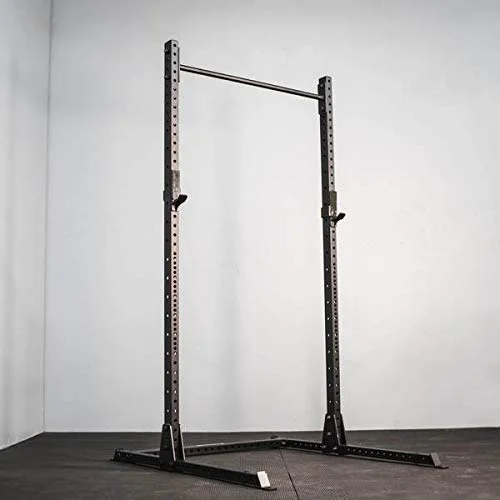
OneFitWonder Squat Rack with Pull-Up Bar
Pros
- Combines a full squat rack and a kipping-capable pull-up bar in one footprint, covering two WOD staples with a single purchase
- 11-gauge steel and a 1,000 lb rated capacity match commercial-rack durability at a fraction of premium-brand pricing
- Multi-grip pull-up bar accommodates wide, narrow, and neutral grip work for both strict and kipping pull-ups
- Included J-cups and spotter arms support back squats, front squats, and rack pulls in the same unit
Cons
- Freestanding design needs a cleared 5x4 ft footprint rather than bolting flush to a wall like a rig
- Assembly involves multiple steel uprights and cross-members — plan for a couple hours with a second set of hands
- No cable pulley or landmine attachment included, so those remain separate purchases if you want to expand
Most CrossFit WODs lean on two pieces of gear more than anything else: a barbell rack and a pull-up bar. The OneFitWonder handles both from a single 5x4 ft footprint, which matters a lot in a garage where floor space is the scarcest resource.
The pull-up bar itself is rated for kipping, not just strict dead hangs — a real distinction, since kipping generates lateral and downward force that a lightweight door-frame bar isn’t built to handle. Multiple grip positions across the bar support wide, narrow, and neutral-grip variations, so a single WOD calling for “50 pull-ups, any style” doesn’t require swapping equipment mid-workout.
For barbell work, the included J-cups and spotter arms cover back squats, front squats, and rack pulls, and the 1,000 lb rated capacity leaves headroom well beyond what most home athletes will ever load. Based on owner reports, the 11-gauge steel construction feels closer to a commercial rig than the price suggests. The tradeoff is assembly — this isn’t a five-minute unboxing. Budget a couple of hours and a second person for the uprights and cross-bracing.
Titan Fitness Adjustable Competition Kettlebell — Best Kettlebell
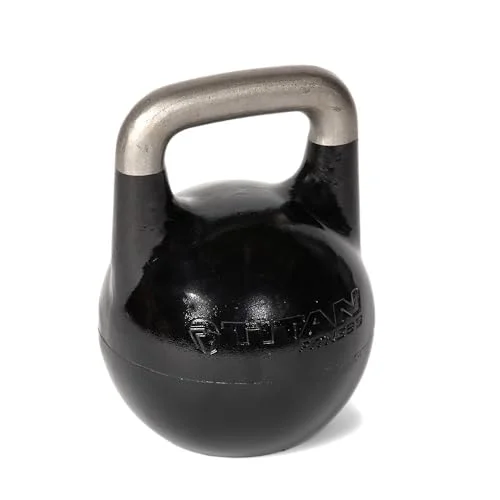
Titan Fitness Adjustable Competition Kettlebell, 12-32 KG
Pros
- One kettlebell covers a 26-70 lb range that would otherwise require five or six separate fixed-weight bells
- Competition-style dimensions stay consistent as plates are added, so swing and clean mechanics don't change with load
- Flat base doubles as a stable platform for renegade rows, push-ups, and planks
- Powder-coated handle keeps grip secure through sweaty high-rep WOD sets
Cons
- Swapping plates mid-WOD takes longer than grabbing a second fixed kettlebell, which matters in for-time workouts
- Bigger upfront cost than a single fixed 35 lb kettlebell
- Adjustable mechanism adds moving parts that a solid cast-iron kettlebell doesn't need to maintain
Kettlebell WODs (think “21-15-9 KB swings and burpees”) usually call for one weight, done for time, at high volume. The Titan adjustable bell handles that use case well because it keeps its shape and balance point across the full 12-32 kg range — swapping plates changes the load without changing how the bell feels in your hand, which matters for swing and clean technique.
The flat base is a small but genuinely useful detail. Set the bell down and it stands upright rather than rolling, which means it doubles as a stable platform for renegade rows and hand-release push-ups. For a garage gym replacing what would otherwise be five or six fixed kettlebells taking up floor space, one adjustable bell at $260 is a real space and cost trade.
The honest downside is workout-to-workout speed. Changing weight mid-session by locking and unlocking plates takes longer than grabbing a second kettlebell off a rack. For single-weight WODs it’s a non-issue; for workouts that ladder weight up or down between rounds, a pair of fixed bells at the two target weights is still faster.
Buddy Lee Aero Speed Jump Rope 2.0 — Best Jump Rope
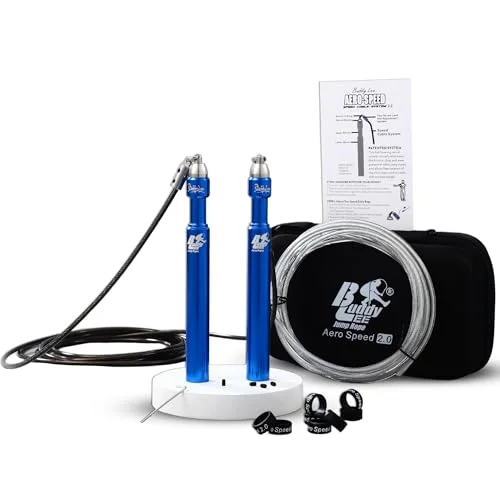
Buddy Lee Aero Speed Jump Rope 2.0
Pros
- Swivel bearing spins fast enough to support high-volume double-under work without the cable twisting
- Adjustable cable length fits nearly any height without needing a second rope
- Lightweight aluminum handles reduce forearm fatigue during long WOD rounds
- The rope most competitive CrossFit athletes actually train with, so the design is proven at the sport's highest level
Cons
- Costs several times more than a basic PVC speed rope
- Thin cable is easy to whip yourself with until double-under technique is dialed in
- Bearing and cable are wear items that eventually need replacement under heavy daily use
Double-unders show up in enough WODs that rope quality genuinely affects training volume. The Buddy Lee’s swivel bearing is the differentiator — it lets the cable spin independently of the handle, which is what allows the rope to keep pace with fast double-under reps without the cable winding up and catching your feet.
At $40, it costs several times more than a $10 PVC rope from a big-box store, and for beginners still learning the timing of a double-under, that premium isn’t obviously worth it yet. But for anyone doing regular WOD volume — 50, 100, or more double-unders in a single workout — the reduced tangling directly translates to fewer stopped reps and more consistent conditioning work.
The adjustable cable length is worth setting up correctly on day one: stand on the center of the rope and the handles should reach roughly armpit height. Get that right and the rope requires almost no further adjustment.
Concept2 RowErg with PM5 Monitor — Best Rower
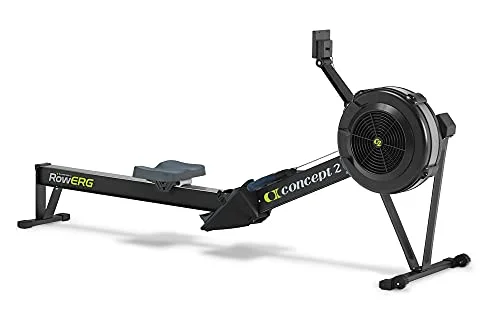
Concept2 RowErg with PM5 Monitor
Pros
- The same rowing machine used at the CrossFit Games and in most affiliate gyms, so WOD times translate directly to competition training
- Air resistance scales automatically with pull force — no dial to adjust between an easy warmup and an all-out 500m sprint
- PM5 monitor tracks splits, watts, and calories with the accuracy competitive rowers rely on
- Frame and parts are supported for decades; Concept2 machines from the 1990s are still in service
Cons
- The highest-ticket item in this roundup by a wide margin
- Needs roughly 8 ft of clear floor space when extended for use
- Air resistance runs louder than magnetic rowers, which matters in shared or upstairs living spaces
If a home gym is going to include one piece of cardio equipment for CrossFit-style training, this is the one to prioritize. The RowErg isn’t just a good rowing machine — it’s specifically the machine that shows up at the CrossFit Games and in the vast majority of affiliate gyms, which means the pace and calorie numbers on your PM5 monitor mean the same thing they would on the competition floor.
Air resistance is the other reason it belongs in a CrossFit-focused setup over a magnetic alternative: pull harder and the resistance increases automatically, matching the feel of an all-out interval without touching a dial. For WODs that mix rowing with other movements — a classic “row 500m, then thrusters” couplet — that auto-scaling resistance keeps the stimulus honest at every pace.
At $990, it’s by far the most expensive item on this list, and it needs roughly 8 ft of clear floor space to use. It’s also louder than a magnetic rower, which is worth considering in a shared living space or an apartment with neighbors below. For a serious CrossFit-style training setup, though, most owners consider it the one piece of cardio equipment worth not compromising on.
Titan Fitness Performance Series 20 KG Olympic Bar — Best Barbell
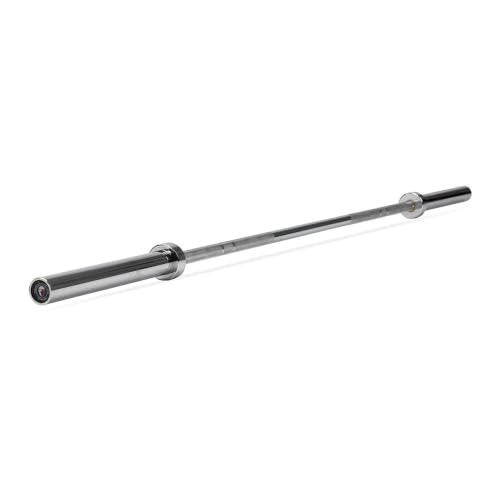
Titan Fitness Performance Series 20 KG Olympic Bar, 28mm
Pros
- True 20 kg competition weight means WOD prescriptions load accurately without guesswork
- Chrome finish resists the rust that humid garages are hardest on
- Medium volcanic knurl gives secure grip on cleans and snatches without shredding hands on high-rep days
- 700 lb capacity handles bumper plate loading for Olympic lifts and heavy conditioning work alike
Cons
- Bushings spin less freely than bearing bars, which matters more for max-effort Olympic lifting than general WOD use
- Chrome finish shows fingerprints and chalk residue more visibly than a Cerakote or black oxide bar
- A generalist bar built for mixed-modal training, not a specialty powerlifting or weightlifting bar
CrossFit programming is written in specific loads — “95/65 lb,” “135/95 lb” — and those numbers only make sense on a bar that’s an accurate 20 kg (44 lb) to start. A bar that’s off by a few pounds throws off every percentage-based or Rx-weight WOD you try to follow.
The 28mm shaft with medium volcanic knurling sits in a useful middle ground: aggressive enough to hold a grip through sweaty high-rep cleans and snatches, not so sharp that it tears up hands the way a competition powerlifting knurl can. Bronze bushings (rather than needle bearings) mean the sleeves don’t spin as freely as a dedicated Olympic lifting bar, which matters for max-effort snatches and clean and jerks but is a non-issue for the WOD-style loading most home athletes are doing.
Chrome finish resists rust well in a garage that sees humidity swings, though it does show chalk and fingerprint marks more visibly than a matte or Cerakote finish — purely cosmetic, but worth knowing before you order.
Yes4All 3-in-1 Wooden Plyo Box — Best Plyo Box
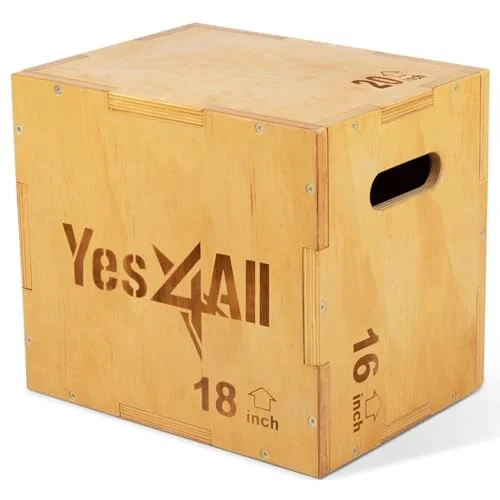
Yes4All 3-in-1 Wooden Plyo Box
Pros
- Three jump heights in a single box covers box jumps, step-ups, and dip support without buying separate boxes
- Smooth edges and built-in handles make it safer to move and reposition between heights than a raw plywood box
- Compact enough to stand upright against a garage wall when not in use
- Priced well below a padded competition plyo box while covering the same core movements
Cons
- Hard wooden edges carry real risk of shin scrapes on a missed jump — a foam-topped box is safer for beginners
- At about 35 lb, moving it between heights or storage isn't a one-hand job
- No padding on the landing surface, so foot placement matters more than on a soft-top box
Box jumps and step-ups are programmed at different heights depending on the athlete and the workout, and the Yes4All box solves that by giving you three heights in a single 30 x 24 x 20 in box — rotate it onto a different face and the jump height changes. That’s a meaningfully better solution than buying a single fixed-height box and hoping it fits every WOD.
The plywood construction with smoothed edges and built-in carry handles is the reason this specific box shows up repeatedly as a top seller in its category — the handles make it realistic to reposition between the three heights mid-workout instead of dreading the switch.
The tradeoff of a wood box versus a padded or foam-covered one is real: a missed jump means real edges, and shin-bark is a common complaint in the box-jump world regardless of brand. Step-ups largely sidestep that risk, so newer athletes might lean toward step-ups on this box before progressing to jumps.
Vulken Wooden Gymnastic Rings — Best Rings
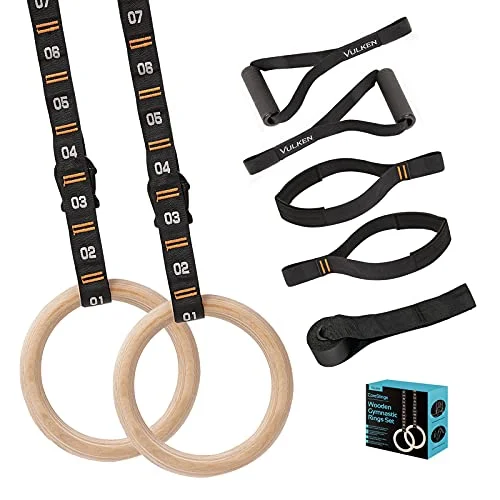
Vulken Wooden Gymnastic Rings
Pros
- Numbered straps let you set both rings to the exact same height every session without re-measuring
- True 1.1 in competition diameter matches what's used in CrossFit ring events
- 1,600 lb rating leaves plenty of margin for muscle-ups and weighted dip work
- Wood surface offers a more secure grip than plastic rings once chalk is applied
Cons
- No permanent ceiling or rig mounting hardware included — most home users hang them from a pull-up bar, rig, or squat rack
- Wood can get slick if chalk builds up without periodic cleaning
- Ring-specific movements like muscle-ups have a steeper learning curve than fixed-bar equivalents
Rings unlock an entire category of CrossFit movement — ring rows, ring dips, muscle-ups — that no other piece of equipment on this list replicates. At roughly $43, they’re also one of the least expensive ways to add meaningful training variety to a home gym.
The numbered adjustable straps are the standout feature. Instead of eyeballing ring height every session, the numbers let you return to an identical setup every time, which matters for consistency in dip depth and muscle-up transition height. The 1.1 in ring diameter matches competition specification, so grip and turnout mechanics carry over directly to gym or competition rings.
Rings need somewhere to hang from — a rig, a pull-up bar, or a squat rack with a pull-up attachment all work, which is one more reason to pair this pick with the OneFitWonder rack above. Wood can get slick with chalk buildup over time, so a periodic wipe-down keeps grip consistent.
Titan Fitness 20 LB Composite Wall Ball — Best Wall Ball
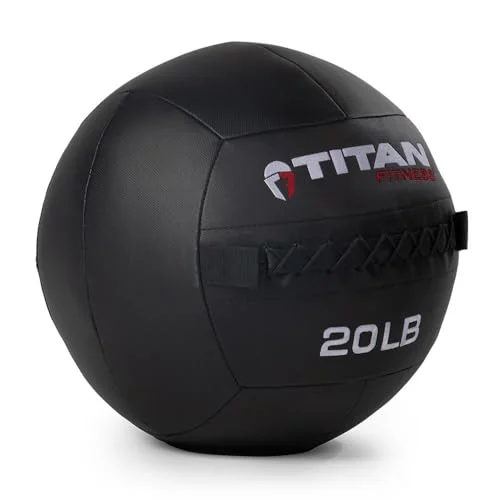
Titan Fitness 20 LB Composite Wall Ball
Pros
- 20 lb matches the exact men's Rx weight prescribed in CrossFit wall-ball WODs
- Soft composite shell won't gouge drywall or concrete the way a harder slam ball can
- Textured grip stays catchable even with sweaty hands during high-rep sets
- Priced well below leather wall balls at a comparable durability level based on owner reports
Cons
- Composite shell shows wear faster than leather under daily wall-ball-shot abuse
- Fixed 20 lb weight means you'd need a second ball (14 lb) to train the women's Rx standard
- No handle or ergonomic grip aid, which is standard for wall balls but a small adjustment for first-time users
Wall-ball shots are a WOD fixture, and the prescribed men’s Rx weight is 20 lb — exactly what this ball weighs. Matching Rx weight matters more for wall balls than for most equipment, since the movement itself (squat to throw, catch, repeat) changes noticeably at different loads.
The composite shell’s main advantage over a harder slam ball is that it’s built to be thrown into a wall repeatedly without gouging drywall, block, or plaster — a slam ball, dropped on the ground, isn’t designed for that kind of repeated wall contact. The cross-texture grip pattern also holds up well once hands get sweaty deep into a WOD.
The main limitation is that the weight is fixed. Training partners or a mixed-Rx household will eventually want the companion 14 lb ball for the women’s Rx standard, which is a separate purchase.
Buying Guide: Building a CrossFit Home Gym in Priority Order
Start With What Unlocks the Most Movements
Not all eight pieces need to be bought at once. If budget forces a sequence, prioritize by how many different WOD movements each piece unlocks:
- Rig with pull-up bar ($579) — squats, presses, pull-ups, and a mount point for rings later
- Barbell ($220) — the single most-used implement across CrossFit programming
- Kettlebell ($260) — swings, cleans, snatches, goblet squats, carries
- Jump rope ($40) — cheapest way to add serious conditioning volume
- Wall ball ($75) and plyo box ($109) — round out conditioning and plyometric work
- Gymnastic rings ($43) — highest movement-variety-per-dollar once you have something to hang them from
- Rowing machine ($990) — the biggest single investment, worth adding once the fundamentals are covered
What You’ll Still Need
This roundup covers the equipment that’s specific to CrossFit-style training. Bumper plates and a squat mat aren’t included here but are necessary companions to the barbell and rig — most home athletes budget for them separately once the core equipment above is in place.
Space Planning
The rig and rower are the two footprint-heavy items. Between them, plan for roughly a 10 x 10 ft cleared area at minimum, with the rower’s 8 ft rowing stroke and the rig’s 5x4 ft base able to share space if arranged along adjacent walls rather than end to end.
Total Cost for the Complete Setup
All eight pieces together run approximately $2,316. That’s a genuine investment, but it replaces what would otherwise require a CrossFit affiliate membership indefinitely — most athletes recover the cost within one to two years compared to typical monthly affiliate dues.
Frequently Asked Questions
Do I need all eight pieces to start CrossFit-style training at home?
No. The rig, barbell, and kettlebell alone cover the majority of strength and gymnastics movements in typical WOD programming. Add the jump rope and wall ball next for conditioning variety, then the plyo box and rings, and treat the rower as the final, highest-cost addition once the fundamentals are in place.
Is a Concept2 RowErg worth it if I already have a different cardio machine?
If your WODs follow standard CrossFit programming, yes — pace and calorie targets in published workouts are calibrated to the RowErg specifically, since it’s the machine used in competition and at most affiliate gyms. A different rowing machine or an air bike will still provide a solid cardio stimulus, but the numbers won’t translate directly to Rx-prescribed row splits.
What’s the difference between this equipment and a standard home gym roundup?
A general home gym roundup optimizes for hypertrophy and strength training with machines and fixed equipment. This list is built around the specific movement patterns CrossFit WODs actually program — kipping pull-ups, Olympic lifting variations, box jumps, ring work, and metabolic conditioning — which favors free-standing, multi-use equipment over machines.
Can I substitute a cheaper kettlebell or barbell and still follow CrossFit programming?
Yes, with one caveat: WODs are written around specific prescribed weights (a barbell close to 20 kg, kettlebells at common competition weights). A budget bar or bell that’s noticeably off-spec on weight will throw off Rx-weight comparisons, though it won’t stop you from training — you’ll just need to mentally adjust the prescribed loads to match your actual equipment.
How much floor space does a full CrossFit home gym setup need?
Budget roughly 150-200 square feet for all eight pieces used comfortably, with the rig and rower as the two space anchors. A two-car garage comfortably fits this setup with room left over for floor-based conditioning work like burpees and rowing intervals.
The Verdict
A CrossFit-style home gym comes down to covering strength, gymnastics, and conditioning without needing a dozen redundant pieces of equipment. The OneFitWonder Squat Rack with Pull-Up Bar and Titan Performance 20 KG Barbell form the strength foundation. The Titan Adjustable Kettlebell, Vulken Rings, and Yes4All Plyo Box add the gymnastics and plyometric variety that separates CrossFit training from standard strength work. The Buddy Lee Jump Rope and Titan Wall Ball round out conditioning at low cost.
The Concept2 RowErg is the one piece worth saving up for rather than skipping — it’s not just a good rower, it’s the specific machine CrossFit programming is calibrated around. Buy the first seven pieces first, add the rower when budget allows, and you’ll have a garage gym that scales real WOD programming, not an approximation of it.