Home gym equipment is getting smaller by design in 2026. As more lifters train out of apartments and shared garages, manufacturers have leaned hard into fold-flat frames, wall-mounted cable towers, and stack gyms with tighter footprints instead of the sprawling multi-station machines that dominated the last decade. The tradeoff question hasn’t changed: how much workout can a piece of equipment pack in before it stops actually folding away when you need the floor back.
After comparing specs, footprints, and owner feedback across board-style trainers, wall-mounted cable stations, and compact stack gyms, these seven stand out for small spaces in 2026.
| Spec | Total Gym XLS | Total Gym FIT | Mikolo Folding Squat Rack with Cable Crossover | Marcy MWM-988 Multifunction Steel Home Gym | Mikolo Cable Crossover Machine | Goplus Multifunction Home Gym |
|---|---|---|---|---|---|---|
| Rating | 9.0/10 | 8.8/10 | 8.7/10 | 8.5/10 | 8.3/10 | 7.8/10 |
| Price | $599.00-$750.00as of Oct 18, 2026 | $699.00-$999.00as of Oct 18, 2026 | $539.99-$669.99as of Oct 18, 2026 | $450.22as of Oct 18, 2026 | $379.99as of Oct 18, 2026 | $299.99as of Oct 18, 2026 |
| Resistance | 6 levels, 6%-54% of bodyweight | 12 levels | — | — | — | — |
| Weight Capacity | 400 lb | 450 lb | — | 300 lb user | 350 lb | 243 lb user |
| Open Footprint | 90"L x 19"W x 43"H | About 8 ft L x 18"W x 44"H | 9.5 sq ft | — | — | — |
| Folded Footprint | 51"L x 19"W x 9"H | About 4 ft L x 1 ft H | 3 sq ft against the wall | — | — | — |
| Assembly | None required | — | Hard | — | — | — |
| Warranty | — | Lifetime frame, 2-year parts | — | — | — | — |
| Frame | — | — | 2"x2" 14-gauge steel, 1000 lb rated | 14-gauge steel tubing | 50mm x 50mm 16-gauge steel | — |
| Pulley | — | — | 28-position single-hand adjust, 1:1 ratio | — | 17 positions per side, high/low | — |
| Weight Stack | — | — | — | 150 lb | — | 100 lb |
| Footprint | — | — | — | 68"L x 36"W x 79"H | About 20 sq ft wall-mounted | 50"L x 39"W x 82"H |
| Stations | — | — | — | 6 stations, 36+ exercises | — | — |
| Frame Weight | — | — | — | — | — | 180 lb |
| Check Price → | Check Price → | Check Price → | Check Price → | Check Price → | Check Price → |
Prices change daily — tap Check Price for the current Amazon price. Numbers shown were verified on the "as of" date.
Quick Picks
Total Gym XLS is the top pick for most small spaces. It folds to 51”x19”x9”, rolls away on its own wheels, and covers 80+ exercises without a weight stack or wall mount to plan around.
Total Gym FIT folds down to roughly a foot tall, the smallest stored size in this roundup, and adds 12 resistance levels for finer control than the XLS.
Mikolo Folding Squat Rack is the pick for anyone who wants rack-style training — squats, pull-ups, and a cable crossover — in a frame that folds flat against the wall to just 3 sq ft.
Buying Guide: What to Look For
Folded footprint vs. footprint in use
A machine’s “compact” claim only matters if the folded or stored size fits your actual space. Board-style trainers like the Total Gym line fold to under a foot tall and roll into a closet. Wall-mounted cable stations like the Mikolo units stay bolted up permanently but only project a couple feet off the wall. Stack gyms like the Marcy MWM-988 and Goplus unit don’t fold at all — their compact footprint is the whole story, so measure the fixed dimensions against your room before buying.
Resistance type
Board-style trainers use bodyweight against an adjustable incline, typically maxing out around half your bodyweight even at the steepest setting. Stack gyms and cable stations use a traditional weight stack or plate-loaded pulley, which scales further for stronger lifters. If you’re already benching or rowing serious weight, a cable system with a 1:1 pulley ratio will out-scale a glide board.
Wall mounting requirements
Wall-mounted cable stations need to anchor into studs, not just drywall anchors — this is a hard requirement, not a suggestion, given the pulling force a loaded cable puts on the mount points. Confirm stud spacing in your intended spot before ordering, and budget assembly time; several of the machines in this list are reported by owners as a multi-hour, two-person job.
User height and range of motion
Board-style trainers have a published max user height (commonly around 6’4”), and stack gyms with fixed press arms can shorten range of motion for taller users. Check the manufacturer’s height guidance against your own before committing, especially for the taller end of the market.
Detailed Reviews
Total Gym XLS — Editor’s Pick
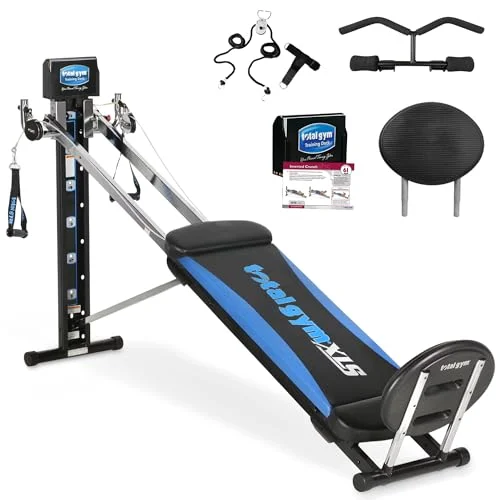
Total Gym XLS
Pros
- 80+ exercises for the full body off a single glide board and cable pulley
- Folds to 51"x19"x9" and rolls away on built-in wheels
- Arrives fully assembled, no tools or hardware needed
- Three-decade track record with widely available replacement parts and accessories
Cons
- 6 resistance levels top out around half bodyweight, thin for advanced lifters chasing progressive overload
- Glide board vinyl and pulley cable wear out after years of daily use and need replacing
- At $750 it's the most expensive board-style trainer in this roundup
The XLS is the model most people picture when they hear “Total Gym,” and it earns that reputation. A single glide board rides an inclined rail, with your own bodyweight providing resistance across 6 adjustable levels — the steepest setting loads roughly half your bodyweight. The included squat stand, leg pull accessory, and wing attachment extend the exercise list past 80 movements covering the full body from one machine.
The fold is the real selling point for small spaces. At 51”x19”x9” folded, it slides under a bed or against a wall, and built-in wheels make moving it a one-person job despite the 92 lb frame weight. It ships fully assembled — no tools needed out of the box.
The 6-level resistance range is the main limitation. Advanced lifters who can already move more than half their bodyweight on presses or rows will outgrow the top setting. The vinyl glide board and pulley cable are wear items that eventually need replacing after years of regular use, though replacement parts are easy to find given how long this model has been on the market.
Total Gym FIT — Most Compact Fold
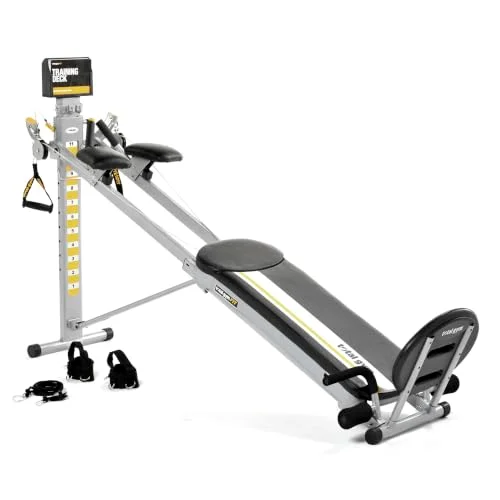
Total Gym FIT
Pros
- 12 resistance levels give finer control than the XLS's 6 steps
- Folds down to about 4 feet long and roughly a foot tall, the smallest stored size in this roundup
- At 66 lb the frame is light enough for one person to fold and move solo
- Ships fully assembled with a 30-day trial and lifetime frame warranty
Cons
- Best suited to users 6'4" and under; taller lifters run out of glide board
- The 8-foot working length needs more clear floor space in use than the shorter XLS
- $699 base price includes fewer bundled accessories than the XLS package
The FIT is Total Gym’s newer, more refined take on the same board-and-pulley concept, and it wins on storage size. Folded, it drops to about 4 feet long and roughly a foot tall — smaller than the XLS and small enough to lean in a closet corner. At 66 lb it’s also lighter, which matters if you’re folding and unfolding it daily in a studio apartment.
Where it improves on the XLS is resistance granularity: 12 levels instead of 6, giving more room to progress gradually rather than jumping straight from one setting to the next. The frame carries a lifetime warranty, and Total Gym backs it with a 30-day trial period.
The tradeoff is length in use — at roughly 8 feet fully extended, it needs more clear floor space during a workout than the XLS, even though it folds smaller afterward. Total Gym’s own height guidance tops out around 6’4”; taller lifters should check the glide board length before buying.
Mikolo Folding Squat Rack with Cable Crossover — Best Wall-Mounted Folding
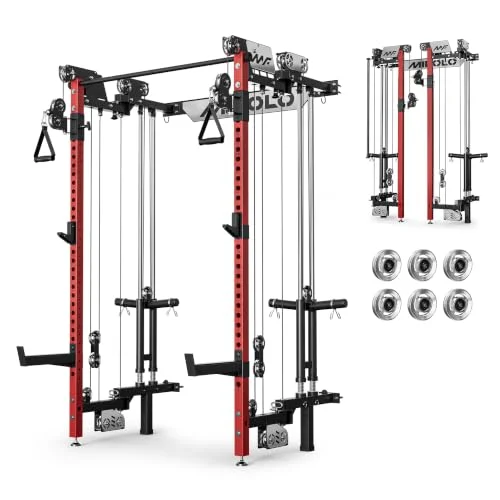
Mikolo Folding Squat Rack with Cable Crossover
Pros
- Folds flat against the wall to just 3 sq ft, the smallest stored footprint of any rack-style pick here
- 1:1 pulley ratio means the plate weight loaded is the weight actually moved
- Doubles as a squat rack with J-hooks and a pull-up bar, not just a cable station
- 14-gauge steel frame rated to 1000 lb feels overbuilt for home use
Cons
- Reinforced wall mounting is required and needs to hit wall studs, not drywall alone
- Owners report hard assembly that can take a full afternoon
- No weight stack included; it runs on user-supplied plates
This is the pick for anyone who wants a squat rack and a cable machine without giving up permanent floor space to either. Built from 2”x2”, 14-gauge steel rated to 1000 lb, it opens to 9.5 sq ft for training and folds flat against the wall to just 3 sq ft when you’re done — smaller than most closet doors.
The cable system uses a 28-position, single-hand adjustable pulley with a 1:1 ratio, so the plates you load are the resistance you actually move. J-hooks and a pull-up bar mean it covers squats and pull-ups in addition to the 80+ cable exercises Mikolo lists for the crossover function.
The catch is installation: this needs a real stud-mounted wall anchor, not a drywall-only install, and owners consistently describe assembly as a hard, multi-hour project. There’s also no weight stack included — you’ll need your own Olympic or standard plates to load it.
Marcy MWM-988 Multifunction Steel Home Gym — Best Value Stack Gym
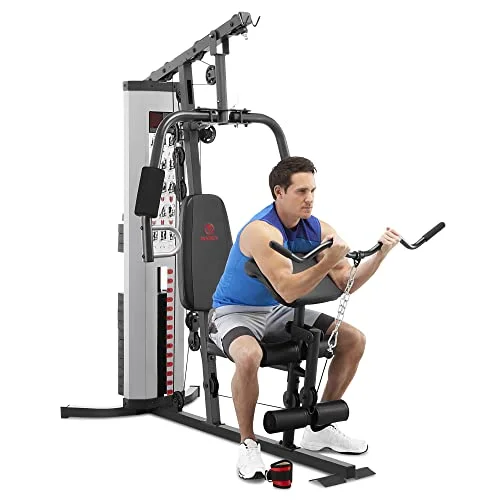
Marcy MWM-988 Multifunction Steel Home Gym
Pros
- 150 lb selectorized stack needs no plate loading, just pin-select and go
- Dual-action press arm covers chest press and pec fly in one station
- Cushioned handles and seat stay comfortable through high-rep sets
- Owner reports describe the cables and stack pulling smoothly with consistent resistance
Cons
- Users taller than 6'0"-6'1" report a shortened range of motion on some stations
- Fixed 68"x36" footprint is the largest in this roundup and does not fold
- Some buyers note minor cosmetic shipping damage and slow customer support response
The MWM-988 skips folding entirely and instead wins on footprint efficiency for a stack-based machine. A 150 lb selectorized weight stack means no plate loading — just pin the weight and go — across 6 stations covering more than 36 exercises. The dual-action press arm handles both chest press and pec fly from one seat, and the leg station adds curls and extensions.
Owner reports consistently point to smooth cable pull and consistent resistance for the price, plus comfortable, cushioned contact points through higher-rep sets. At roughly $500, it undercuts most stack gyms with a comparable feature set.
The 68”x36”x79” footprint is fixed and the largest in this roundup — there’s no folding it away between sessions, so it needs a dedicated spot. Users taller than about 6’1” report some stations feel cramped on range of motion, and a handful of buyers mention cosmetic shipping damage or slow support responses.
Mikolo Cable Crossover Machine — Best Dedicated Cable Trainer
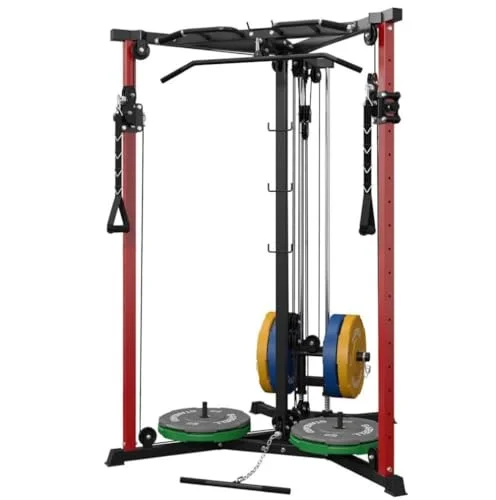
Mikolo Cable Crossover Machine
Pros
- 17-position high/low pulleys on each side cover lat pulldowns, rows, and cable flyes in one frame
- Budget price for a true dual-pulley cable station
- Owners describe the steel frame as durable and straightforward to assemble
- Wall-anchored footprint is smaller than most stack-based multi-gyms
Cons
- Some owners report the pulley wheels developing friction against nearby hardware over time
- Weight plates have no printed load markings, making it hard to track progress at a glance
- Requires user-supplied Olympic or standard plates; none included
For lifters who mainly want cable work — lat pulldowns, seated rows, flyes — without the squat rack functionality of Mikolo’s other model, this dedicated crossover machine is the more budget-friendly option. The 50mm steel frame is rated to 350 lb, and each side offers 17 pulley height positions for a high/low system that covers most cable-based exercises.
Owners describe it as durable for the price and straightforward to assemble relative to full power racks. The wall-anchored footprint of roughly 20 sq ft is smaller than a stack-based multi-gym occupies.
A recurring complaint in owner feedback is pulley wheels developing friction against surrounding hardware after extended use, and the weight plates have no printed load markings — you’ll want to label them yourself to track progress. Like the folding rack version, it needs your own plates.
Goplus Multifunction Home Gym — Best Ultra-Budget
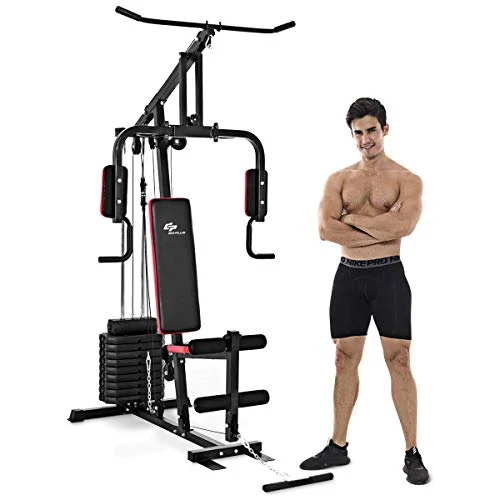
Goplus Multifunction Home Gym
Pros
- Lowest price of any complete stack-based home gym in this roundup
- Dual-function press arm and 4-roll leg developer cover chest, back, and legs in one frame
- Steel tubing frame holds up to regular use according to owner reports
- High/low pulley system supports lat pulldowns through leg extensions
Cons
- 100 lb vinyl-and-cement stack isn't expandable, and the pulley ratio means real resistance feels closer to 80 lb
- Assembly reported to take a full afternoon and goes faster with two people
- Vinyl weight plates carry a noticeable rubber odor that needs ventilation to dissipate
At under $300, the Goplus is the entry point for anyone who wants a complete stack-based home gym without spending Marcy or Total Gym money. The 100 lb weight stack pairs with a dual-function press arm and 4-roll leg developer to cover chest, back, and leg work in one 50”x39”x82” frame.
Owner reports describe the steel tubing frame as holding up to regular home use, and the high/low pulley setup handles everything from lat pulldowns to leg extensions.
The compromises show up under closer use: the 100 lb stack isn’t expandable, and the pulley arrangement means the top setting feels closer to 80 lb of real resistance. Assembly is reported as a full-afternoon project, easier with a second set of hands, and the vinyl-and-cement weight plates carry a rubber smell that needs some ventilation to clear.
Frequently Asked Questions
Do folding home gyms sacrifice workout quality compared to full-size machines?
Not for most home training goals. Board-style trainers like the Total Gym XLS and FIT cover 80+ exercises using bodyweight resistance, and wall-mounted cable stations with a 1:1 pulley ratio load exactly what you plate. The main tradeoff is resistance ceiling — board trainers max out around half bodyweight — not exercise variety.
How much wall space does a wall-mounted cable machine actually need?
The compact options in this roundup need about 3-9.5 sq ft of wall and floor space bolted up (Mikolo’s two cable units), plus clearance in front for the exercise itself, typically 4-6 feet. All wall-mounted units here require anchoring into studs, not drywall alone.
Can I use a folding home gym in an apartment with thin walls or floors?
Board-style trainers like the Total Gym line are freestanding and don’t require wall anchoring, making them the better fit for apartments where drilling into studs isn’t an option or isn’t allowed by a lease. Wall-mounted cable stations need permanent anchor points and are better suited to a garage or a home you own.
What’s the difference between a folding gym and a compact gym?
Folding gyms — the Total Gym XLS, Total Gym FIT, and Mikolo Folding Squat Rack — physically collapse to a smaller stored size after use. Compact gyms — the Marcy MWM-988 and Goplus multifunction unit — have a small footprint by design but stay assembled in one spot permanently.
Is a 100 lb or 150 lb weight stack enough for strength training?
For most upper-body accessory work and beginner-to-intermediate lower body training, yes. Advanced lifters working toward heavier compound lifts will outgrow a 100-150 lb stack faster on leg-focused movements than on isolation work like curls or pushdowns, where the pulley ratio effectively reduces the real resistance further.
The Verdict
The Total Gym XLS earns the top spot for pairing the widest exercise range with a genuinely tiny folded footprint and zero wall-mounting requirements. Anyone tighter on storage space should look at the Total Gym FIT, which folds down even smaller at the cost of needing more room to actually use it. For lifters who want rack-style training — squats and pull-ups, not just cables — in a space that folds away completely, the Mikolo Folding Squat Rack is the strongest pick in this roundup.