Folding squat racks have shifted from niche solution to mainstream home gym equipment in 2026. Apartment living, smaller suburban homes, and multi-use garages have created real demand for a rack that gives you full strength training capability and then gets out of the way. A standard power cage occupies 12–25 square feet permanently. A quality folding rack deploys to 3–14 square feet during training and collapses to under 2 square feet against the wall when you’re done.
GarageGymLab named the PRx Profile Pro the top folding squat rack of 2026 — a position it’s held based on its patented hydraulic gas shock fold system and 3×3 steel that matches premium non-folding racks. But the PRx isn’t the only strong option. REP Fitness and Rogue both offer direct-only racks that compete on steel spec at lower price points, while Titan Fitness and Major Fitness provide solid Amazon-available alternatives.
This roundup covers five wall-mounted folding racks across the full price spectrum from $499 to $895. All five are currently available and appropriate for serious home gym use.
Quick Picks
PRx Performance Profile Pro is the top choice for lifters who want premium construction and the easiest fold mechanism available. The hydraulic gas shocks are genuinely different from the manual-pin approach every other rack uses — you fold with one hand in seconds. The 3×3 steel and 1,000 lb capacity mean you’re not making structural compromises for the folding design.
REP Fitness PR-4100 delivers the best price-to-steel-spec ratio. Three-by-three 11-gauge steel, 1,000 lb capacity, and 1” hole spacing for $499 direct. At $111 less than Rogue and $396 less than PRx, it’s the strongest value in this category.
Rogue RML-3W is the choice for buyers who want the tightest hardware tolerances and the Rogue lifetime warranty. The 43” inside width and 5/8” SAE grade 5 bolt hardware put it ahead of every other option on build quality details.
Titan Fitness T-3 is the pick for buyers who need Amazon availability and want 11-gauge folding capability under $525. The 1,100 lb capacity and 91” upright height are better-than-expected specs at this price point.
Major Fitness F35 is the right call for small space lifters who want more than a straight squat/bench/pull-up platform. The integrated cable pulley system adds 80+ exercises without requiring a separate cable machine.
Comparison
| Rack | Price | Steel | Capacity | Folded Depth | Amazon | Warranty |
|---|---|---|---|---|---|---|
| PRx Profile Pro | Check price | 3×3” 11-ga | 1,000 lb | 9”+ | Yes | Manufacturer |
| REP PR-4100 | $499 | 3×3” 11-ga | 1,000 lb | 6” | No (direct) | REP Standard |
| Rogue RML-3W | $610 | 3×3” 11-ga | 1,000+ lb | 5” | No (direct) | Lifetime |
| Titan T-3 | $449.99 as of Oct 18, 2026 | 2×3” 11-ga | 1,100 lb | 5” | Yes | 1-year |
| Major Fitness F35 | Unavailable | 2×3” 14-ga | 660 lb | Flat | Yes | Manufacturer |
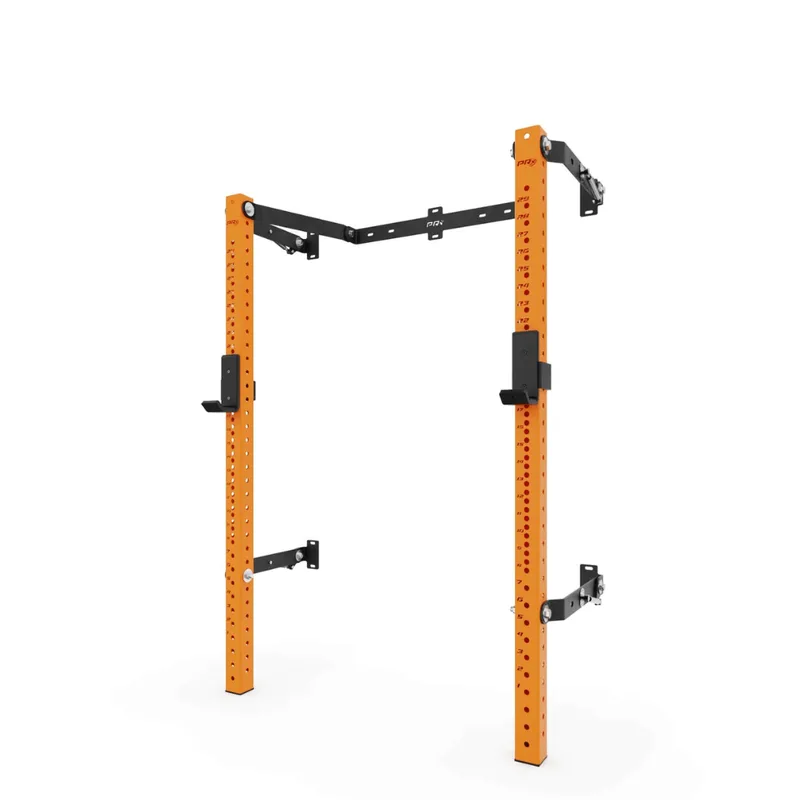
PRx Performance Profile Pro Squat Rack
Pros
- Hydraulic gas shocks let you fold the rack one-handed in seconds — no manual pin wrestling after a heavy session
- 3×3" 11-gauge steel matches the construction spec of premium non-folding racks, not a compromise for the folding design
- Folds to as little as 4" from the wall (base version) — the most compact folded profile of any 3×3 rack in this roundup
- Multiple pull-up bar configurations (straight, kipping, multi-grip) let you build the rack around your training style
- 89" and 95" upright options accommodate both standard 8' ceilings and taller installations
- GarageGymLab named it the top-performing folding squat rack in their 2026 roundup
Cons
- $895 with pull-up bar is the highest entry price in this roundup
- Multi-grip bar configuration pushes the total above $1,100
- Requires proper stud or backing wall — slab walls need added backing structure before install
- The kipping/multi-grip bar variants protrude 12"–22.5" when folded, not the 4" minimum
The PRx Profile Pro has been on the market since its Shark Tank appearance, but the 2026 version is the most refined iteration the company has produced. The core differentiator is the hydraulic gas shock fold system. Every other rack in this roundup — and essentially every other folding rack on the market — uses a manual detent pin approach: you lift the rack arm, pull the pin, lower the arm against the wall, and lock it in place. The PRx uses two gas shocks (top and bottom) to control the fold motion. You release a single handle and the rack arms descend smoothly against the wall under spring tension, no lifting required. It’s a faster, more repeatable process that matters after every training session for the life of the rack.
The 3×3” 11-gauge steel uprights match what REP and Rogue use — the same spec as their non-folding premium racks. The uprights don’t flex under load, the J-cup attachment points don’t develop slop over time, and the overall rigidity is comparable to a floor-based rack of similar steel spec.
The configuration options are the other notable aspect. The base rack starts without a pull-up bar and comes in 89” or 95” upright heights. You add the pull-up bar separately: straight, kipping, or multi-grip. This lets buyers avoid paying for features they don’t use. The kipping and multi-grip bars protrude further from the wall when folded (12”–22.5” vs the base rack’s 4”), so buyers in very tight spaces should consider whether the bar configuration fits their fold clearance needs.
The Amazon ASIN covers the versions with kipping or multi-grip pull-up bar. If you want the straight bar version or no bar, purchase directly through PRx Performance’s website where more configuration options are available.
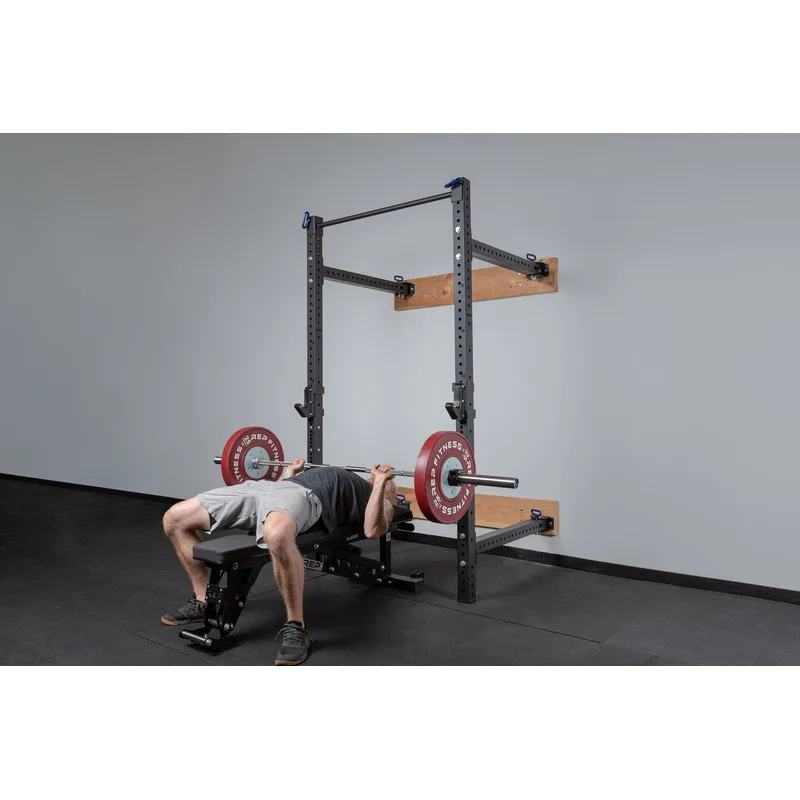
REP Fitness PR-4100 Folding Squat Rack
Pros
- 3×3" 11-gauge steel at $499 is the best steel spec per dollar in this roundup — matches Rogue at $111 less
- 1" hole spacing in the bench and squat zone gives finer height adjustment than 2" spacing on most competitors
- Two depth options let you choose between ultra-compact (21.5", folds to 6") and full spotter clearance (41")
- 1,000 lb capacity on properly mounted 3×3 steel handles any realistic home gym load
- Pull-up bar, J-cups, and mounting hardware all included at the base price
- REP's direct pricing model eliminates the retail markup that makes comparable racks cost more elsewhere
Cons
- Direct-only — no Amazon availability means no Prime shipping or standard Amazon returns
- 21.5" depth is functional but tight for a spotter or for wide-stance movements
- No fold-assist mechanism — manual pull-pin setup like the Rogue and Titan
- Available only in black at this price tier — no color options
The REP PR-4100 answers a straightforward question: can you get 3×3” 11-gauge steel in a wall-mounted folding rack for under $500? Yes, from REP Fitness at $499 for the 21.5” depth version.
The steel spec is the story. Most racks in the $500 range use 2×3” uprights. REP built the PR-4100 with the same 3×3” tubing used in their PR-4000 and PR-5000 power cages — serious structural uprights, not a cost-optimized folding version. The 1,000 lb capacity reflects that construction spec rather than theoretical marketing numbers.
The 1” hole spacing through the bench and squat zone is the tightest in this roundup. PRx uses 2” spacing; Titan uses 2”. One-inch spacing means half the height increments between J-cup positions, which matters for lifters who dial in exact bar heights for bench press starting position or squat safety pin setup. It’s a feature you don’t notice until you compare racks side by side and realize you’re stuck between two heights you’d prefer to split.
The 21.5” depth model is the value configuration and folds to 6” from the wall. For most training — squats, bench press, overhead press, pull-ups — 21.5” is adequate. If you do sumo deadlifts, need spotter clearance, or perform movements requiring more horizontal space, REP also sells the 41” depth version. Both fold inward toward the wall via pull-pin, not sideways.
The direct-only purchase is the main friction point. No Amazon means no Prime shipping and REP’s standard return process rather than Amazon’s. For most buyers, this is a one-time purchase that won’t be returned, so it’s a reasonable trade-off for the price.
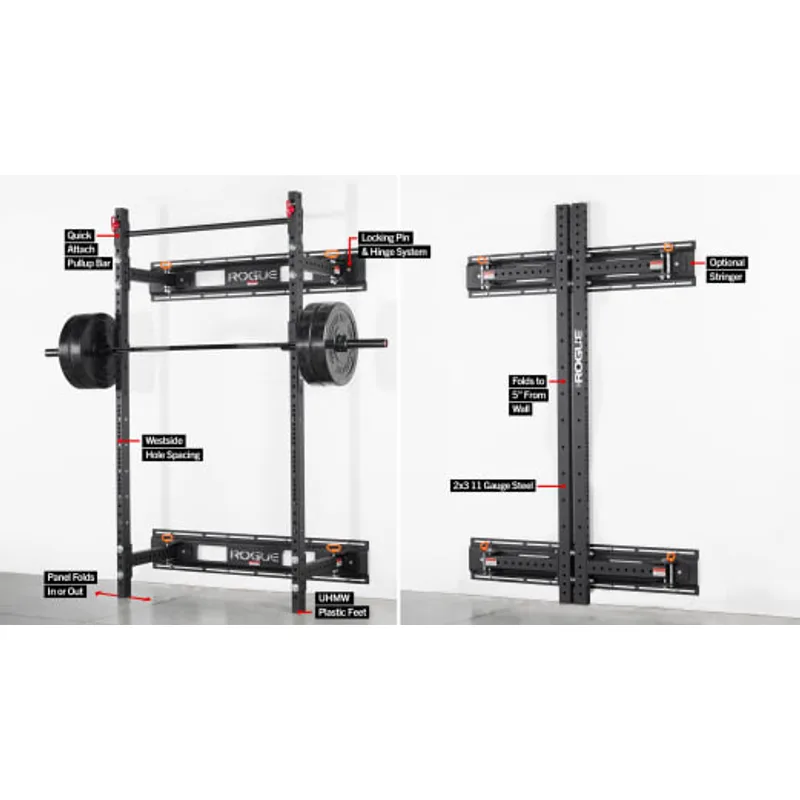
Rogue RML-3W Fold Back Wall Mount Rack
Pros
- Rogue's lifetime warranty is the strongest coverage offered by any product in this roundup — no other folding rack matches it
- 5/8" SAE grade 5 bolt hardware delivers the tightest manufacturing tolerances in this group based on owner reports
- 43" inside width is the widest in this roundup — accommodates standard Olympic bar knurl marks without crowding
- Quick-Attach Pull-Up Bar installs and removes without tools, making pull-up bar removal before folding fast
- Folds to 5" from wall — tight profile for a full 90" upright rack
- Made in the USA with Rogue's in-house quality control
Cons
- $610 starting price (21.5" depth) makes it the second most expensive option behind PRx
- Direct-only — no Amazon availability
- No gas shock or fold-assist mechanism — manual detent pin fold requires more effort than the PRx
- No cable pulley integration available as a rack add-on
Rogue’s approach to the RML-3W is consistent with their overall philosophy: build it once, build it right, and back it for life. The rack uses 3×3” 11-gauge steel uprights with 5/8” SAE grade 5 bolt hardware — the same hardware spec Rogue uses throughout their Monster Lite line. The bolt tolerances are tighter than what you get from Titan or most other brands, which translates to less rack movement under heavy loading and hardware that stays torqued over years of use.
The 43” inside width is the widest in this roundup. REP’s PR-4100 and Titan’s T-3 both provide 42” inside clearance. The extra inch matters for wide-grip bench press and for lifters whose bar setup puts the collar close to the upright at narrower widths. It’s a detail that’s invisible until you’re setting up a heavy bench and realize the collar is rubbing the upright.
The Quick-Attach Pull-Up Bar is included and connects without tools. Before folding the rack, you pull the pull-up bar out of its mounting brackets in under five seconds — important because the bar protrudes from the wall when the rack is folded and needs to be removed first. Rogue’s mount design makes this less of a chore than competing designs that require hardware manipulation.
The lifetime “Rogue for Life” warranty covers the rack against manufacturing defects indefinitely. No other folding rack in this roundup offers comparable coverage — Titan’s 1-year warranty, PRx’s standard manufacturer warranty, and REP’s warranty all fall short on duration. For a rack that lives permanently on your wall and carries heavy loads for decades, the warranty backing matters.
At $610, the RML-3W sits above the REP PR-4100 at $499 by $111. The Rogue hardware quality and lifetime warranty justify the premium for buyers who want the best-built folding rack available without moving to PRx territory.
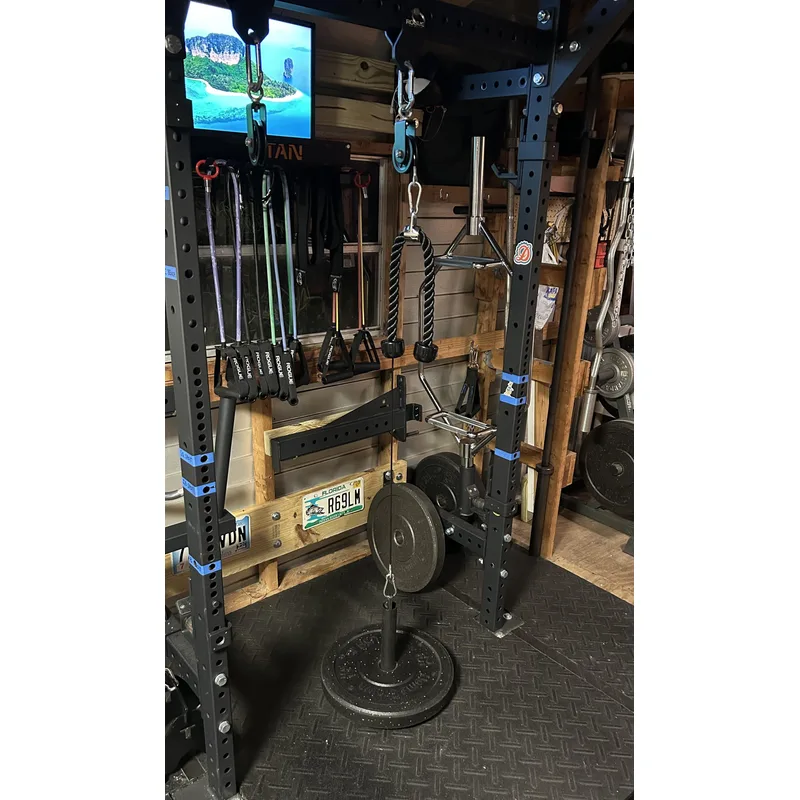
Titan Fitness T-3 Series Folding Power Rack
Pros
- 1,100 lb stated capacity is the highest in this roundup — Titan overbuilt the frame relative to what any home gym user will load
- Available on Amazon with Prime shipping — the only 11-gauge folding rack with standard Amazon purchasing and returns
- $520 delivers 91" of squat rack height, 42" inside width, and 5" folded profile — the strongest Amazon value in the category
- 91" height clears a standard 8-foot garage ceiling with enough overhead margin for pull-ups
- 5" folded depth matches the Rogue and REP profiles despite the lower price point
- Ships with J-hooks and pull-up bar — no additional purchases required for basic training
Cons
- 2×3" uprights are a step down from the 3×3" steel on the PRx, REP, and Rogue options
- 1-year warranty is significantly shorter than Rogue's lifetime coverage or REP's standard warranty
- Build finish tolerances show more variance in owner reports compared to Rogue hardware
- No fold-assist mechanism and no cable system option
The Titan T-3 Folding Rack stands out in this roundup for one specific reason: it’s the only 11-gauge folding power rack with full Amazon availability and Prime shipping. If you need the option to return, if you want the purchase on Amazon for financing or points, or if Prime speed matters, the T-3 is the only rack here that delivers that.
The specs are stronger than the price suggests. The 1,100 lb stated capacity is the highest in this roundup — not because Titan over-engineers their budget line, but because 2×3” 11-gauge steel is still a substantial construction when properly wall-mounted. The 91” upright height is genuinely useful: most entry-level wall-mounted folding racks max out at 82”–84”, which pushes the pull-up bar uncomfortably close to the ceiling in standard 8-foot garages. The T-3’s 91” puts the pull-up bar at a height where full-range pull-ups work without a bent-knee-only workaround.
The 2×3” upright is the spec concession relative to REP and Rogue. Both the width and thickness of the tubing are smaller, which means more upright flex under maximum load compared to 3×3” steel. For home gym use — squats, bench, overhead press, and pull-ups in the 200–400 lb range — the 2×3” construction is adequate. For heavy powerlifting loads or users who push toward the stated capacity ceiling regularly, the 3×3” options are more appropriate.
The 1-year warranty is the other gap. Titan has been in the home gym market long enough that their products have demonstrated reasonably long service lives, but the warranty coverage itself doesn’t reflect that. If the rack develops issues after year one, you’re out of warranty coverage — compare that to Rogue’s lifetime guarantee.
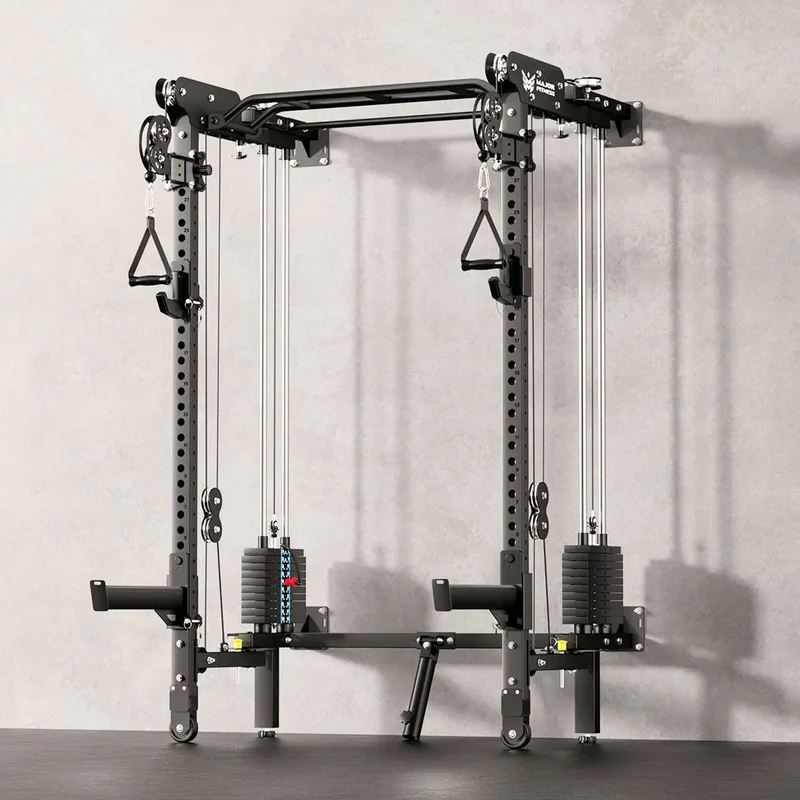
Major Fitness F35 Folding Power Rack
The Major Fitness F35 is a different product category than the other four racks in this roundup. It’s not a squat rack with folding capability — it’s a complete functional training system that happens to fold flat against the wall. The integrated cable pulley adds lat pulldowns, cable rows, tricep pushdowns, face pulls, cable curls, and dozens of other movements to the standard squat/bench/pull-up platform. According to Major Fitness, the system supports 80+ exercises.
At $849, the F35 costs $330 more than the Titan T-3. A standalone cable machine for home use starts around $400–$600 for a basic single-stack unit. The F35’s value case is that you get the folding rack and cable integration in one wall-mounted footprint for less than buying both separately and twice the floor space.
The integrated landmine attachment is included and adds rotational movements — single-arm rows, landmine presses, meadows rows, and T-bar rows — that a straight rack and cable machine can’t cover without a separate landmine unit.
The structural tradeoff is real. The 2×3” 14-gauge steel is lighter construction than the 11-gauge used by Titan, Rogue, and REP. The J-hook capacity of 660 lb and safety arm capacity of 280 lb are the lowest stated limits in this roundup. For lifters working within normal home gym loads (sub-400 lb squats and bench), the capacity spec is fine. Serious powerlifters loading near the capacity ceiling should look at the structural-focused options.
Assembly is more complex than a standard folding rack. Owner reports indicate 2+ hours for installation, compared to 45–90 minutes for the straightforward racks. The wall mounting process requires more precise alignment because the cable system anchors add additional attachment points. Budget the install time accordingly.
Buying Guide: What to Look for in a Folding Squat Rack
Steel gauge and upright size. Three-by-three 11-gauge steel (PRx, REP, Rogue) is the premium spec for folding racks and matches what’s used in serious non-folding power cages. Two-by-three 11-gauge (Titan) is the next tier — adequate for home gym loads but with less rigidity under maximum loading. Two-by-three 14-gauge (Major Fitness F35) is lighter construction, appropriate for the load ranges supported by its integrated cable system.
Folded depth. The whole point of a folding rack is space recovery. Measure your wall clearance before buying. Bare racks (Rogue, Titan, REP 21.5”) fold to 5”–6” from the wall — effectively flush. Pull-up bar extensions increase the folded profile. The PRx with straight pull-up bar is 9” folded; multi-grip bar is 22.5”. Make sure your folded footprint leaves useful floor clearance.
Deployed depth. The 21”–21.5” depth options (Titan, REP 21.5”, Rogue 21.5”) are workable for most training but tight for spotters and wide-stance movements. The 41”–41.5” options (REP 41”, Rogue 41.5”) provide normal power cage clearance but take up more wall protrusion when deployed. Choose based on how you train and whether you need spotter clearance.
Wall structure. All wall-mounted folding racks require proper anchor points. Wood studs at 16” spacing are the standard install surface. Concrete block walls need masonry anchors and typically require a professional install. Drywall-only walls cannot support a loaded rack — you need to add a plywood backing board secured to studs behind the drywall. Verify your wall structure before purchasing.
Fold mechanism. The PRx gas shock system is the only fold assist in this roundup — you lower the rack arms with one hand and they descend under gas spring tension. All other racks use manual pull-pin fold: lift the arm, pull the pin, lower manually, re-pin. The gas shock saves about 30–45 seconds per fold and removes the need to support the arm weight while manipulating the pin. For lifters who fold the rack after every session, it adds up.
Warranty. Rogue’s lifetime guarantee is in a different class than everything else here. PRx, REP, and Major Fitness offer standard manufacturer warranties. Titan offers 1 year. For a rack that will carry thousands of pounds over a decade, warranty depth reflects the manufacturer’s confidence in their product.
Cable integration. If your training program includes cable movements — lat pulldowns, cable rows, face pulls, tricep pushdowns — and you don’t already own a cable machine, the Major Fitness F35’s all-in-one design is worth the premium. If you purely squat, bench, and do pull-ups, a straight rack from REP, Rogue, or PRx is the more structurally sound choice.
Frequently Asked Questions
How much wall space do I need to install a folding squat rack?
The rack itself typically mounts in a 48”–56” wide footprint. The uprights attach to two wall mount brackets spaced to match the rack’s outside width. You also need clear vertical space from floor to ceiling — most racks are 82”–95” tall and need about 6”–12” of clearance above the top bracket for the pull-up bar hardware. Standard garage walls with 8’ ceilings accommodate most racks but check your specific model’s installation height requirements before purchasing.
Can I use a folding squat rack for heavy powerlifting?
Yes, for most powerlifting loads. The 3×3” 11-gauge racks (PRx, REP, Rogue) are rated at 1,000 lb+ and handle serious competition-level training. The key constraint is the wall mounting — the load transfers to the wall studs and anchors, so the installation quality matters as much as the rack’s stated capacity. Racks mounted directly to studs with correct hardware handle heavy powerlifting loads reliably based on owner reports from competitive home gym lifters.
Do folding squat racks work for bench press?
Yes, all five racks in this roundup support bench press. You position a bench underneath the rack and set the J-cups at the correct bar height. The 21”–21.5” depth racks are tight for bench press since you can’t position the bench at a full arms-length from the uprights, but it’s workable. The 41”–41.5” depth models offer more natural bench positioning. A spotter’s clearance is limited on the shallow depth models; plan accordingly for heavy max-effort bench attempts.
Are folding squat racks as stable as standard power cages?
Based on owner reports from multiple platforms, properly installed wall-mounted folding racks from PRx, REP, Rogue, and Titan are comparably stable to non-folding racks at equivalent steel specs. The wall mounting actually distributes load into the wall structure rather than relying on the floor-contact feet that can shift on smooth garage floors. The fold pivot point is the only potential weak link — all five racks in this roundup use heavy-duty hinge hardware that owner reports don’t flag as a stability concern under normal loading.
What’s the difference between the 21.5” and 41” depth options on the REP PR-4100 and Rogue RML-3W?
Depth refers to the deployed distance from the wall to the front face of the uprights. The 21.5” depth gives you roughly 21 inches of usable space inside the rack — functional for squats and bench press but tight for movement around the bar and for spotters. The 41” depth matches standard power cage depth and allows full spotter positioning and more comfortable movement patterns. The 41” models also protrude more from the wall when deployed (taking up more floor space during use) and fold slightly differently — the REP 41” version folds sideways rather than straight back.
Conclusion
The PRx Performance Profile Pro is the best folding squat rack available in 2026 for buyers who want premium construction and the most efficient fold mechanism on the market. The gas shock fold system, 3×3” steel, and multiple configuration options justify the $895 entry price for serious home gym athletes.
For the best value, the REP Fitness PR-4100 at $499 delivers the same 3×3” 11-gauge spec as racks costing $100–$400 more. If direct purchasing and no Amazon return process are acceptable, the PR-4100 is the strongest spec-per-dollar in the category.
If long-term warranty coverage and build quality details matter most, the Rogue RML-3W at $610 is the call. The lifetime guarantee and Rogue’s manufacturing standards are unmatched at any price in the folding rack market.
For buyers who need Amazon availability, the Titan T-3 at $520 is the right choice — 11-gauge steel, 1,100 lb capacity, and Prime shipping in one package.
And for space-constrained lifters who want a complete functional training system, the Major Fitness F35 replaces both a rack and a cable machine in a single wall-mounted footprint.