Hybrid vinyl and SPC (stone polymer composite) flooring dominated basement renovation headlines in early 2026, with home improvement retailers reporting record tile sales for finished basement projects. For general living spaces, that trend makes sense — click-lock vinyl handles moisture and looks good underfoot. For a basement gym where 300 lb barbells are being dropped and power racks are bolted in place, rubber flooring over concrete is still the only material that actually holds up.
Concrete basements add a layer of complexity that garage gyms don’t face: moisture vapor migration from below, temperature swings that cause materials to expand and contract, and the practical challenge of flooring that can’t be glued down without forfeiting your security deposit. The flooring options that work in a garage often fail in a basement. This guide covers five rubber and foam options specifically evaluated for concrete basement conditions.
Quick Picks
IncStores 3/4” Extreme Mega Mat is the best pick for anyone doing heavy barbell work — thick enough to handle deadlift drops, non-porous so moisture from the concrete slab doesn’t create a mold problem, and the anti-slip waffle bottom grips bare concrete without adhesive.
IncStores 8mm Roll is the best choice for covering a full basement gym zone without seams — 60 sq ft per roll, cut to fit any shape, and solid enough for power racks and cardio equipment.
American Floor Mats Fit-Lock Tiles is the best modular option — commercial-grade recycled rubber in a tile format you can expand over time as the gym grows, without tearing up existing flooring.
Greatmats 6-Pack Tiles is the best value per square foot for spot coverage and expandable layouts, with 2×2 tiles light enough to handle solo.
BalanceFrom EVA Tiles is the budget pick for low-impact zones — 96 sq ft of foam coverage for stretching, yoga, and cardio equipment at the lowest price in this roundup. Not for barbell drops.
Comparison
| Spec | IncStores 3/4" Extreme Mega Rubber Mat 4'x6' | IncStores 8mm Strong Rubber Flooring Roll 4'x15' | American Floor Mats Fit-Lock 3/8" Rubber Tiles 4'x6' Set | Greatmats Interlocking Rubber Tile 2x2 Ft 3/8" (6-Pack) | BalanceFrom 3/4" EVA Foam Interlocking Tiles 96 sq ft |
|---|---|---|---|---|---|
| Rating | 9.2/10 | 8.8/10 | 8.5/10 | 8.3/10 | 7.5/10 |
| Price | Check price | Unavailable | $128.60as of Oct 18, 2026 | Unavailable | Unavailable |
| Thickness | 3/4 inch | 8 mm (5/16 inch) | 3/8 inch | 3/8 inch | 3/4 inch |
| Size | 4 ft × 6 ft (24 sq ft) | 4 ft × 15 ft (60 sq ft per roll) | — | — | — |
| Material | Recycled rubber | Recycled rubber with EPDM color flecks | Commercial-grade recycled rubber | Recycled rubber | EVA foam |
| Weight | ~105 lb per mat | — | — | — | — |
| Surface | Smooth top, anti-slip waffle bottom | — | — | — | Textured non-slip |
| Warranty | 5-year | 5-year | — | — | 2-year |
| Color | — | Black | Solid Black | Black | — |
| Backing | — | Non-slip texture | — | — | — |
| Tile Size | — | — | 24 in × 24 in (4 sq ft each) | 2 ft × 2 ft (4 sq ft each) | 24 in × 24 in |
| Set Coverage | — | — | 24 sq ft (6 tiles) | — | — |
| Made In | — | — | USA | — | — |
| Pack Coverage | — | — | — | 24 sq ft (6 tiles) | — |
| Connection | — | — | — | Interlocking tab system | — |
| Coverage | — | — | — | — | 96 sq ft (24 tiles + 48 borders) |
| Check Price → | Check Price → | Check Price → | Check Price → | Check Price → |
Prices change daily — tap Check Price for the current Amazon price. Numbers shown were verified on the "as of" date.
Detailed Reviews
IncStores 3/4” Extreme Mega Rubber Mat — Editor’s Pick
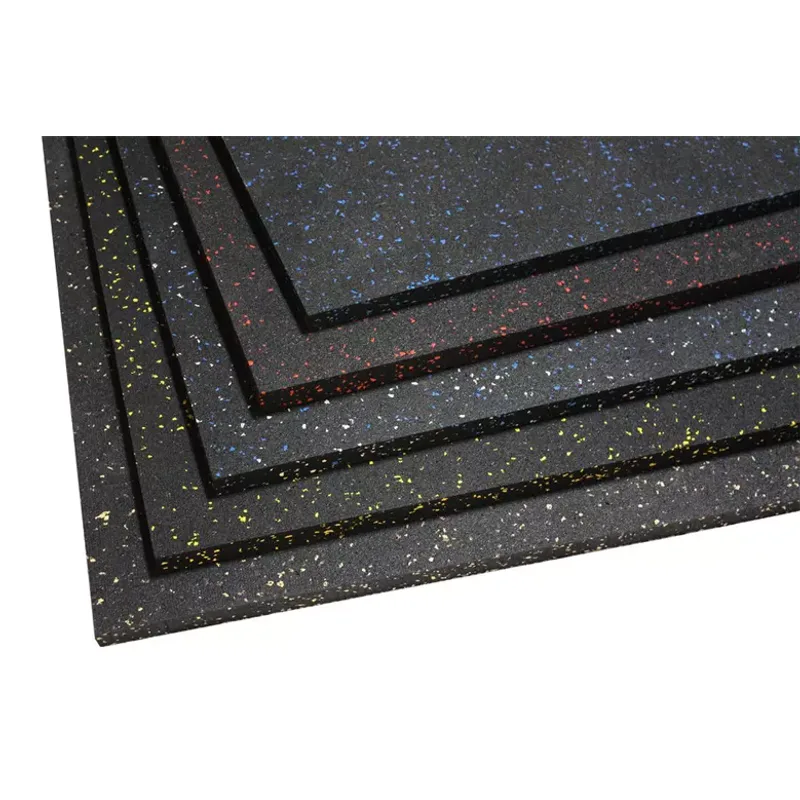
IncStores 3/4" Extreme Mega Rubber Mat 4'x6'
Pros
- 3/4-inch thickness handles heavy deadlifts, squat racks, and Olympic barbell drops on concrete without bottoming out
- Non-porous rubber surface blocks moisture migration from concrete — no mold or mildew buildup underneath
- Anti-slip waffle bottom grips concrete directly; no adhesive or anchoring needed
- Vulcanized rubber construction is significantly denser than EVA foam alternatives at this thickness
- 5-year warranty covers defects; recycled rubber content certified for indoor air quality
Cons
- Each mat weighs ~105 lb — repositioning requires two people or a mat mover
- Strong rubber odor for the first week or two; ventilate before workout sessions in enclosed basements
- Grey colorway only on this listing; black variants are separate listings at potentially different pricing
The 3/4-inch thickness is what sets this mat apart from the rest of this roundup. At 105 lbs per 4×6 mat, it’s dense enough to absorb barbell drops without transmitting full impact to the concrete below. Owners report using stacked mats directly under deadlift stations with no cracking or substrate damage after years of use. The non-porous rubber surface also matters specifically in basements: moisture vapor migrates upward through concrete slabs, and a non-porous material means that moisture can’t penetrate the mat and create a mildew environment underneath.
The anti-slip waffle pattern on the bottom grips concrete directly. Unlike foam tiles that slide under heavy equipment loads, this mat stays anchored once positioned — even without tape or adhesive. The waffle texture also allows minor air circulation at the concrete interface, which helps with condensation management in humid basements.
Assembly is straightforward: position, trim as needed with a sharp utility knife, and done. The 5-year warranty covers manufacturing defects. The main practical limitation is weight — repositioning requires two people, so plan your layout before moving heavy equipment onto the mats.
Owner reports note a rubber odor that can be strong for the first week in an enclosed basement space. Air the mats outside for a day or two before installing, or run a box fan during the initial days of use.
IncStores 8mm Strong Rubber Flooring Roll — Best for Full Coverage
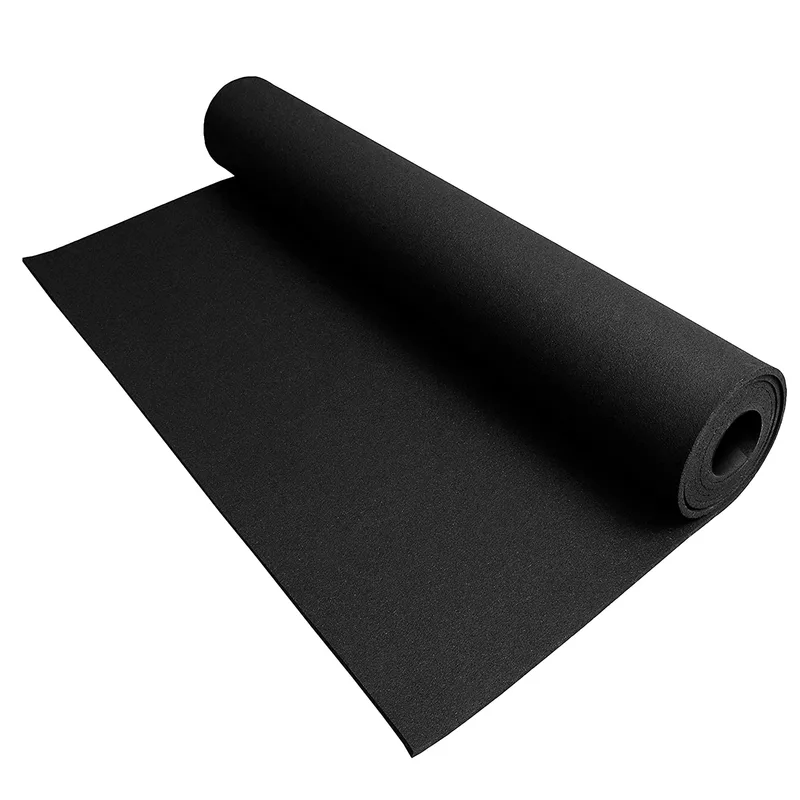
IncStores 8mm Strong Rubber Flooring Roll 4'x15'
Pros
- Seamless coverage eliminates the gaps and seams that catch weight plate edges and equipment feet
- 60 sq ft per roll covers most compact basement gym footprints in a single purchase
- Rolls out flat without adhesive — cut to exact room dimensions with a utility knife and straight edge
- USA-made recycled rubber with certified EPDM content; consistent thickness across the full roll
- 8mm is sufficient for cardio equipment, power racks, and moderate barbell work
Cons
- 5/16-inch thickness is not deep enough for repeated barbell drops from overhead — use platform bumpers or add a second layer under the drop zone
- Rolls are heavy and bulky to ship and maneuver; two people needed to position properly
- Edge curl is common for the first few days until the rubber fully relaxes at room temperature
A 4×15 roll covers 60 sq ft in one piece — enough for most dedicated basement gym footprints without stitching together multiple mats or managing tiles in an L-shaped layout. The seamless surface is a real advantage: seams between tiles or mats can catch equipment feet, barbell collars, and weight plate edges during training. A single roll eliminates that problem across the entire covered area.
The 8mm (5/16”) thickness handles most home gym uses comfortably — treadmills, ellipticals, power racks, adjustable dumbbells, and cable machines all perform well on this surface. It’s not the right pick for a dedicated Olympic weightlifting platform where barbells are dropped from overhead repeatedly; for that application, the 3/4” mat is the correct choice. For everything short of heavy drops, 8mm is adequate protection for concrete and comfortable underfoot.
Cutting to fit is manageable with a long straight edge and a quality utility knife — a single pass per cut works on the 8mm material. Rolls tend to curl at edges for the first few days until the rubber fully relaxes at room temperature. Rolling the mat backward and weighting the edges overnight typically solves this.
The 5-year warranty and USA-made construction back up the durability claims. Owner feedback on Amazon consistently highlights that the material lies flat after the initial settling period and doesn’t shift under equipment use.
American Floor Mats Fit-Lock 3/8” Tiles — Best Interlocking Tiles
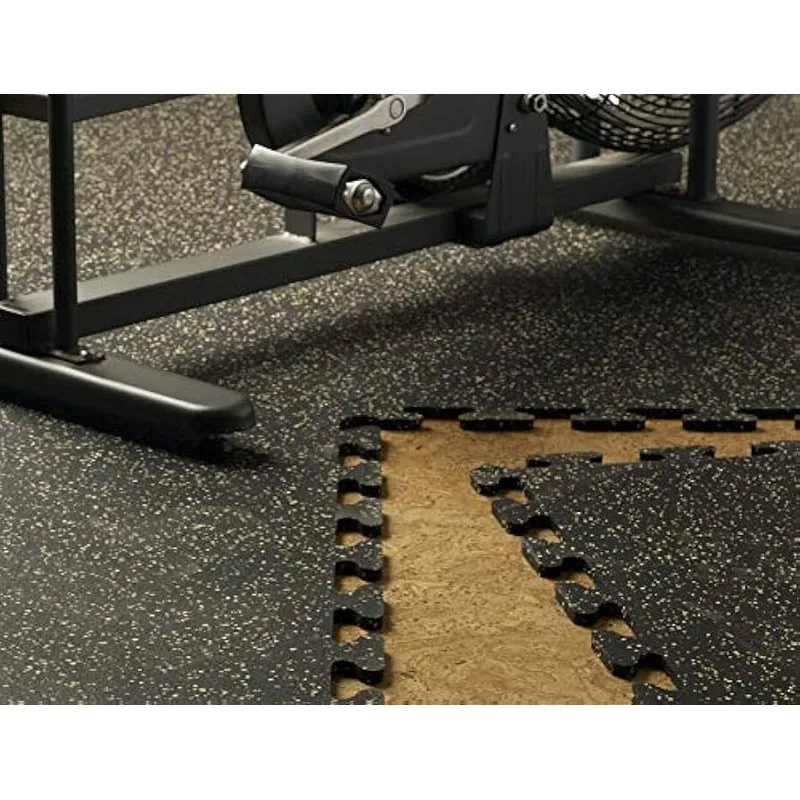
American Floor Mats Fit-Lock 3/8" Rubber Tiles 4'x6' Set
Pros
- Commercial-grade recycled rubber compresses minimally under heavy equipment compared to foam alternatives
- Modular design — buy additional tiles to expand coverage without replacing existing flooring
- Interlocking seam system creates near-invisible joints that resist separation under moving equipment
- Tiles lay flat on concrete without adhesive; can be removed and reconfigured if gym layout changes
- Made in USA with recycled content; tiles are non-porous and easy to clean with a mop or damp cloth
Cons
- 3/8-inch thickness is better for equipment placement than heavy barbell drops; pair with a 3/4-inch platform for Olympic lifting
- Seams between tiles can accumulate dust and chalk over time; periodic cleaning required
- 24 sq ft covers one lifting zone — full basement coverage requires multiple set purchases
Fit-Lock tiles solve the most common complaint about interlocking rubber tiles: visible and separating seams. The commercial-grade interlock system creates joints tight enough that the surface reads as continuous rather than tiled — owner reports describe seams as barely noticeable once the tiles are installed. This matters practically because tight seams don’t trap chalk, don’t separate when equipment rolls over them, and don’t create trip hazards.
Commercial-grade recycled rubber compresses less than EVA foam under equipment load. Rack feet, dumbbell rack legs, and treadmill corners all rest on a stable, firm surface rather than slowly sinking into soft foam. The 24-inch tile size covers 4 sq ft per tile, with 6 tiles providing 24 sq ft per set — enough for a lifting platform, a dumbbell area, or a single rack station.
The modular format is genuinely useful for basement gyms that expand in phases. Start with 24 sq ft for the squat rack area, add another set when the cable machine arrives, expand again for the cardio corner — each expansion snaps into the existing floor without gaps or awkward transitions.
Made in the USA and non-porous. Tiles wipe clean with a damp mop or rubber flooring cleaner, and the solid black color hides chalk dust between deep cleans.
Greatmats Interlocking Rubber Tile 6-Pack — Best Value
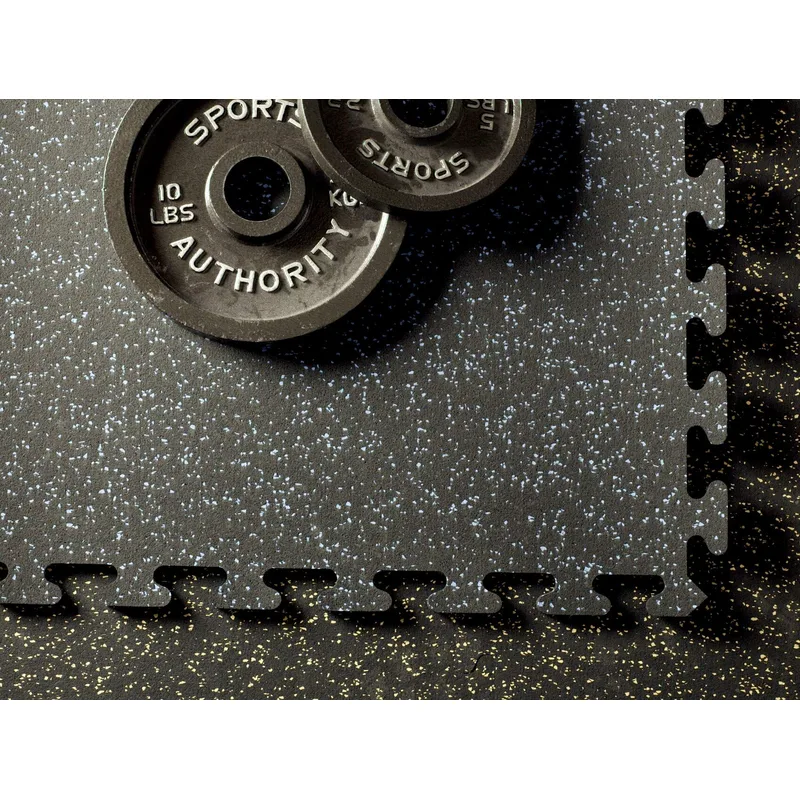
Greatmats Interlocking Rubber Tile 2x2 Ft 3/8" (6-Pack)
Pros
- Each tile sold individually or in packs — buy only what you need and add tiles as the gym grows
- 2×2 tiles are light enough to carry and position solo; no two-person lift required
- Tab-style interlocking system resists tile walk even under heavy treadmill and elliptical use
- Non-porous rubber resists moisture and cleans up with standard gym cleaner
- Consistent 3/8-inch thickness across the pack; no variation that creates uneven surfaces
Cons
- More tiles per square foot means more seams than larger 4×6 mats or rolls
- 3/8-inch depth suited to cardio zones and equipment parking; not ideal for dedicated barbell drop zones
- Full 200 sq ft basement coverage requires multiple 6-pack purchases — bulk ordering can add up
At 2 ft × 2 ft per tile, the Greatmats tiles are the lightest and easiest to position individually in this roundup. Solo installation of a full basement gym layout is feasible — no partner needed to drag heavy rolls into position or carry stiff 4×6 mats down a narrow staircase. Each tile weighs a fraction of what a roll or thick mat weighs, which matters in practical basement gym setups where the flooring has to navigate basement stairs and doorways.
The tab-style interlocking system resists tile walk under dynamic loading better than simple puzzle-piece interlocks. Owner reports note the tiles haven’t separated during treadmill use, which creates lateral forces at the equipment feet. The 3/8-inch recycled rubber is firm without being rigid — equipment rests solidly and the surface doesn’t shift.
Pricing is based on Greatmats’ own listed tile price of approximately $13 per tile for the black 3/8” option. At that rate, a 6-pack covering 24 sq ft comes in just under $79 — competitive with larger-format tile sets for the same coverage. Buying by the 6-pack allows right-sized purchases for each phase of a basement gym build rather than committing to a large roll or large set upfront.
Non-porous rubber resists moisture from below, cleans easily, and doesn’t absorb gym odors over time.
BalanceFrom 3/4” EVA Foam Tiles — Best Budget Light Use
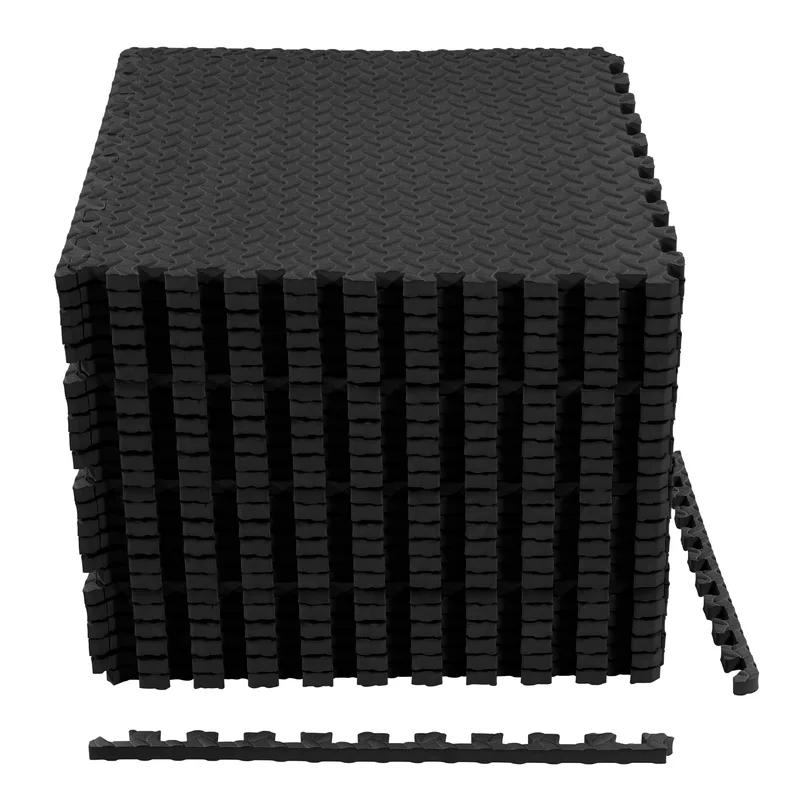
BalanceFrom 3/4" EVA Foam Interlocking Tiles 96 sq ft
Pros
- 96 sq ft in one purchase covers most basement gym layouts at well under $1.50 per square foot
- 3/4-inch EVA foam provides good cushioning for stretching, yoga, and bodyweight work
- Waterproof surface layer resists sweat and spills; wipes clean quickly between sessions
- Lightweight tiles are easy to install alone — no heavy lifting or special tools needed
- Border pieces included for clean, finished edges around the perimeter
Cons
- EVA foam is NOT suitable for dropping barbells or Olympic lifts — foam compresses and eventually tears under repeated impact
- Will indent permanently under heavy equipment legs over time; use rubber mats under rack feet
- Less moisture-resistant than solid rubber at the seams; not recommended as the only flooring in a high-humidity basement without a vapor barrier
Before purchasing: EVA foam is not rubber. This distinction matters specifically in basement gym flooring because most of the heavy-use cases — barbell drops, rack feet, plate storage — require rubber’s density and resistance. EVA foam will compress permanently under rack legs and tear under repeated barbell impacts. Use rubber flooring for those zones.
That said, 96 sq ft of foam coverage at $109 is a genuine value for what EVA foam does well. Stretching areas, yoga mats, bodyweight training zones, and light cardio machine placement all work well on 3/4” EVA foam. The cushioning for floor-based work is better than rubber at the same thickness — EVA foam absorbs impact more softly underfoot, which is the point for mobility and recovery work.
The 24-tile kit plus 48 border pieces provides a complete floor installation including finished edges — no raw-cut edges visible around the perimeter. The waterproof surface wipes down quickly, and the tiles install in under an hour without tools.
For a mixed-use basement gym, the practical approach is rubber mats under lifting and equipment zones ($75-$99 range) and these EVA tiles in the open-floor workout area. That hybrid covers the full space at lower total cost than rubber everywhere, without compromising performance where it matters.
Buying Guide: Concrete Basement Gym Flooring
Check for Moisture Before Installing Anything
Concrete slabs push moisture vapor upward — this is normal and doesn’t require a wet basement to be a problem. Before installing any flooring, tape a 2×2 ft piece of plastic sheeting to the concrete and seal all four edges with tape. Leave it for 48 hours. If you find condensation under the plastic, your slab has active vapor transmission. In that case, install a dimple mat or vapor barrier before the gym flooring goes down. Skipping this step can trap moisture under rubber mats and create odor and deterioration over time.
Thickness Recommendations by Use Case
3/4” rubber (18-20 mm): Deadlifts, squat racks, Olympic barbell work, any exercise involving dropped weights or heavy equipment.
8mm-10mm rubber: Power racks (no drops), cardio machines (treadmill, bike, rower), dumbbell racks, weight benches.
3/8” rubber tiles: Light dumbbell use, cable machines, cardio equipment, multi-use floor areas.
3/4” EVA foam: Stretching zones, yoga areas, bodyweight training, light cardio equipment with low impact.
Off-Gassing in Enclosed Spaces
New rubber flooring releases VOCs (volatile organic compounds) — the same smell you notice in a new car or tire shop. In an enclosed basement, this can be strong for several days. Best practice: air mats out outdoors for 1-2 days before installation, then ventilate the basement aggressively for the first week of use. The odor dissipates fully over time and poses no long-term air quality concern for typical rubber gym flooring.
Adhesive vs. Floating Installation
Most basement gym flooring should be installed floating (no adhesive). Reasons: adhesive traps moisture between the mat and concrete, creates a removal nightmare when you move out or reorganize, and most high-density rubber mats stay in place by weight and anti-slip backing alone. The only exception is seamed rolled rubber installations covering large continuous areas where edge curl is a persistent problem — in that case, perimeter tape or partial adhesive is appropriate.
Rubber vs. EVA Foam: The Critical Distinction
The search results for basement gym flooring surface a lot of EVA foam recommendations because foam tiles are cheap, widely available, and look similar to rubber tiles in product photos. For light use, EVA foam is fine. For anything involving weights over 20 lb or equipment like power racks and treadmills, solid rubber (vulcanized recycled rubber, not rubber-coated foam) is the correct material. The distinction is in density: rubber is approximately 1.2-1.8 g/cm³; EVA foam is approximately 0.10-0.20 g/cm³. The density difference is what makes rubber suitable for heavy gym use and foam unsuitable.
FAQ
What thickness of rubber do I need for a basement gym? For equipment placement and light barbell work, 8mm (5/16”) is the minimum practical thickness. For regular deadlifts, squat drops, or any exercise where a loaded barbell contacts the floor, 3/4” (19mm) is the standard. Most basement gyms use 3/4” mats in the primary lifting zone and thinner rubber or foam in secondary zones.
Can I put gym mats directly on concrete without a vapor barrier? You can, and most people do. The practical concern is moisture migration: if your concrete slab actively sweats (confirmed by the plastic sheet test), you need a dimple mat or vapor barrier layer first. If the slab is dry, most rubber gym mats can go directly on the concrete. Non-porous rubber surfaces handle incidental moisture from below without damage.
Do horse stall mats work for basement gyms? Yes — 3/4” horse stall mats are one of the most common basement gym flooring choices precisely because they’re dense enough for heavy lifting and available at local farm supply stores without shipping costs. The IncStores Extreme Mega Mat in this roundup is the Amazon equivalent: same vulcanized rubber construction, same 3/4” thickness, same intended use case. Tractor Supply stall mats are often slightly less expensive per mat ($55-$65 range) but require transport in a truck or van.
How do I deal with the rubber smell in a basement gym? Air rubber mats outside for 24-48 hours before installation. After installation, ventilate the basement actively for the first week — open windows, run a box fan, use a dehumidifier if humidity is high. The off-gassing period is temporary; owner reports consistently describe the smell as fully dissipated within 2-3 weeks of regular ventilation. Choose mats certified to GREENGUARD or similar indoor air quality standards to minimize initial off-gassing intensity.
What’s the best way to cover a full 200+ sq ft basement gym? Most 200 sq ft basement gym floors are covered with a combination of 3/4” mats in the rack and deadlift area (typically 80-100 sq ft) and rolled rubber or foam for the remaining space. A practical approach: two IncStores 3/4” mats cover the primary lifting zone (~48 sq ft), two IncStores 8mm rolls cover the rest (120 sq ft), for approximately $450-$550 total — well under the cost of purpose-built gym flooring at specialty retailers.
Conclusion
For a concrete basement gym, rubber flooring is not optional — it’s the material the application requires. Concrete transmits moisture, transmits cold, and transmits every impact from a dropped barbell to whatever is below. Rubber absorbs that impact, blocks moisture migration at the surface, and stays in place on concrete without adhesive.
The IncStores 3/4” Extreme Mega Rubber Mat is the top pick for any basement gym with a barbell: it’s thick enough to handle drops, dense enough to protect the slab, and the anti-slip base grips concrete as well as anything at this price. If full-room coverage is the priority and your lifting involves more equipment placement than barbell drops, the IncStores 8mm Roll covers 60 sq ft in one continuous piece at a lower cost per square foot.
For modular tile layouts that can grow with the gym, the American Floor Mats Fit-Lock tiles offer commercial-grade rubber in an expandable format. And for the cardio and mobility zones where cushioning matters more than density, the BalanceFrom EVA tiles get you 96 sq ft of foam coverage at a fraction of the rubber cost — just keep the rubber under the heavy stuff.