The wall-mount folding rack and space-saving half rack categories have grown substantially in 2026, driven by apartment dwellers and small-garage gym builders who need functional training setups in under 100 square feet. That shift has made the choice between a squat stand, a half rack, and a full power cage more relevant than ever — because picking the wrong type means either a rack that doesn’t fit your ceiling or one that you outgrow after six months.
This guide covers six specific racks across the full spectrum: two squat stand options, two budget power cages, and two premium full cages. The Rogue RML-390F is the pick for most serious home gym builders who want to buy once. The REP PR-1100 is the best complete setup under $400. The SML-2 is the right call for small spaces where every square foot matters. Read the buying guide section below if you’re unsure which type fits your situation.
Half Rack vs Full Rack: The Core Difference
Squat stands have two independent uprights with no crossbar connection at the rear. You lift in front of or beside the uprights. The SML-2 is the example here — minimal footprint, open floor space, but no enclosed cage to protect you if a lift goes wrong.
Full power racks (power cages) have four uprights forming a complete enclosed frame. You lift inside the cage. Safety pins or straps catch the bar if you fail. These are the T-2, T-3, PR-1100, RML-390F, and PR-5000 — and they’re what most home gym builders should buy.
The term “half rack” is often used interchangeably with “squat stand” in the fitness equipment market, which creates confusion. For this guide, the meaningful distinction is: can you safely fail inside the rack? With a full power cage, yes. With a squat stand, you depend on spotter arms positioned correctly — and they must be set before each set.
Quick Picks
Rogue RML-390F ($695) is the best overall power rack for serious home gym builders. The 3x3 11-gauge steel, Monster Lite attachment compatibility, and flat-foot no-bolt design justify every dollar over the T-3.
REP PR-1100 ($379) is the best value full cage in 2026. Under $400 with safeties and a multi-grip pull-up bar already included, it beats every competitor at its price point for feature completeness.
Rogue SML-2 ($500) is the right pick if you have a tight footprint, lift with a trained spotter, or specifically want the open-design squat stand format for Olympic weightlifting movements.
Titan T-3 ($520) is the best budget upgrade from the T-2. The step from 14-gauge 2x2 to 11-gauge 2x3 steel matters over years of heavy use, and the 1,100 lb capacity removes any practical weight limit.
REP PR-5000 ($1,195) is for builders who want a rack they will never outgrow. The 1,500 lb capacity, 1” hole spacing, and Ares cable system compatibility make it the most expandable setup in this roundup.
Titan T-2 ($399) is the budget fallback. It’s a complete enclosed cage with pin safeties at the lowest price in the roundup — and it ships via Amazon Prime.
Comparison
| Rack | Price | Steel | Capacity | Height | Type | Best For |
|---|---|---|---|---|---|---|
| Rogue RML-390F | $695 | 3x3” 11-ga | 1,000 lbs | 92” | Full cage | Serious builders |
| REP PR-1100 | $379 | 2x2” 14-ga | 700 lbs | 82” | Full cage | Best value |
| Rogue SML-2 | $500 | 3x3” 11-ga | 1,000 lbs | 90” | Squat stand | Small spaces |
| Titan T-3 | $520 | 2x3” 11-ga | 1,100 lbs | 82”/91” | Full cage | Mid-range |
| REP PR-5000 | $1,195 | 3x3” 11-ga | 1,500 lbs | Configurable | Full cage | Premium |
| Titan T-2 | Check price | 2x2” 14-ga | 850 lbs | 71”/83” | Full cage | Budget |
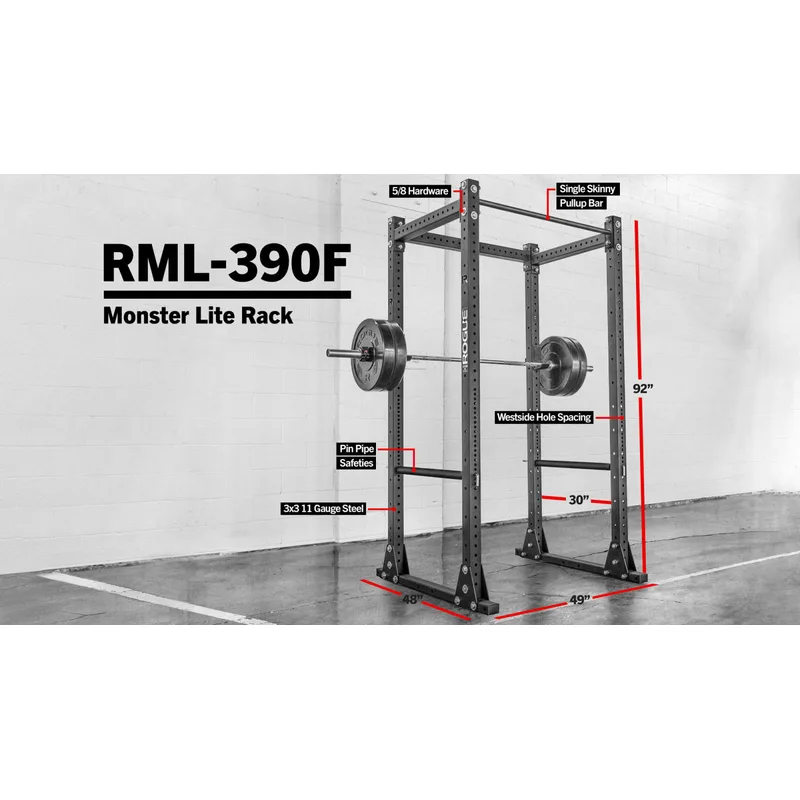
Rogue RML-390F Flat Foot Monster Lite Rack
Pros
- 3x3" 11-gauge steel uprights match commercial facility rack spec at a residential price
- Monster Lite ecosystem covers lat pulldowns, cable arms, dip bars, and belt squat attachments
- Flat-foot base is self-stabilizing — no floor anchoring required before first use
- Westside hole spacing allows J-hook and safety bar adjustments in 1" increments throughout the lift zone
- Made in Columbus, OH — documented quality control from one of the most respected equipment manufacturers
Cons
- $695 base price before attachments — meaningful budget commitment compared to T-3 or PR-1100
- 30" interior depth is shallower than the REP PR-5000's 41" maximum configuration
- Monster Lite attachments add significantly to total cost if building out a full setup
- Direct-only from Rogue; no Amazon Prime shipping option
The RML-390F earns its position as the top pick in this roundup through a combination of specs that are simply not available at this price from any other manufacturer. The 3x3 11-gauge uprights are the same structural spec as racks you’d find in commercial facilities charging $60 a month to use. The Westside hole spacing at 5/8” diameter provides precise barbell positioning throughout the entire lift path — from the lowest safety bar setting to full lockout — without the coarse 2” jump between holes found on budget racks.
The flat-foot base is a practically important feature. Most power racks require floor anchoring before use to prevent tipping under lateral force. The RML-390F’s flat-foot design distributes weight through the base plates without bolts — you can position the rack, load it, and train the same day. For garage gym builders working with concrete floors where drilling creates complications, this matters significantly.
Monster Lite compatibility opens access to the largest aftermarket attachment ecosystem in the power rack market. REP and Titan have their own attachment lines, but the Monster Lite system has been built out over years with more manufacturers than any competitor. Adding a lat pulldown, cable crossover arms, or belt squat attachment down the line involves bolt-on components, not rack replacement.
Based on owner reports across the fitness community, the RML-390F’s most cited advantage over time is resale value. Rogue racks hold secondary market pricing exceptionally well — a well-maintained RML-390F sells for 60–70% of retail after years of use. That effective cost of ownership makes the $695 premium over the T-3 less significant than it appears at initial purchase.
The 30” interior depth is genuinely shallower than the PR-5000’s 41” maximum option, and it is worth mentioning for taller lifters. A 6’4”+ powerlifter with a wider squat stance may find 30” limiting; most home gym users will not.
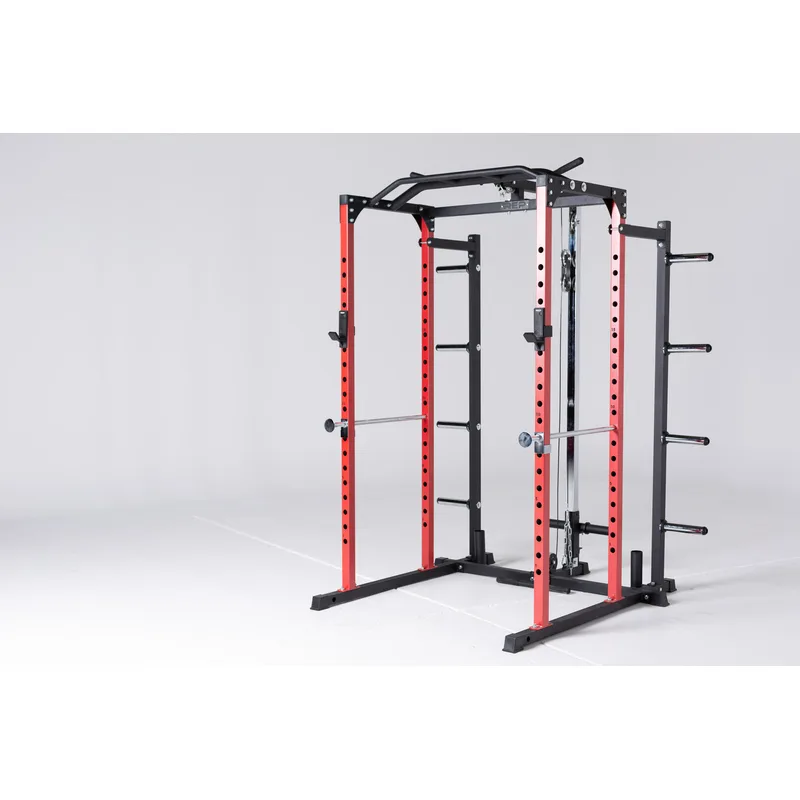
REP Fitness PR-1100 Power Rack
Pros
- Under $400 with safety arms, j-cups, and multi-grip pull-up bar already included — competitors charge extra for these
- Four pull-up grip positions (traditional, neutral, close, wide) plus a 2" fat bar
- 82" height accommodates overhead pressing and pull-up variations without ceiling clearance issues
- Solid build quality for the price; REP's fit and finish exceeds most sub-$400 racks
- Compatible with REP's affordable attachment lineup for future upgrades
Cons
- 700 lb weight limit is the lowest rackable capacity in this roundup — constrains heavy powerlifting
- 14-gauge 2x2 uprights have narrower attachment compatibility vs 2x3 or 3x3 racks
- Direct-only from REP Fitness; shipping times vary and no Amazon Prime option
The PR-1100 is the budget benchmark for home gym power racks in 2026. Under $400 shipped from REP, it arrives with safety arms, j-cups, and a four-position multi-grip pull-up bar — items that competing brands in this price range either exclude or sell separately. The multi-grip bar in particular represents real value: four grip positions (traditional, neutral, close, wide) plus a 1.25” standard bar and a 2” fat grip bar provide training variety without additional hardware.
The 14-gauge 2x2 steel construction is honest about what the PR-1100 is: a capable beginner and intermediate rack, not a forever rack for a serious powerlifter. The 700 lb rackable capacity covers any realistic training load for most home gym users — the gap between 700 and 850 lb capacity is irrelevant unless you are genuinely approaching those numbers, which represents a small fraction of home gym users.
Where the PR-1100 earns its Best Value designation is in day-one usability. Unbox it, assemble it, and you have a complete training environment — safeties, pull-up bar, j-cups — for $379. Adding comparable functionality to a competing rack at that price often requires $50–100 in additional accessory purchases.
REP’s attachment compatibility is worth noting for buyers thinking about upgrades. While the 2x2 uprights restrict which attachments fit, REP offers a lat pulldown and various weight storage options designed specifically for the PR-1100. The rack’s longevity depends on training intensity and progression pace — a lifter adding 20 lbs to their squat monthly will eventually want to upgrade; a recreational lifter doing moderate loads may never need to.
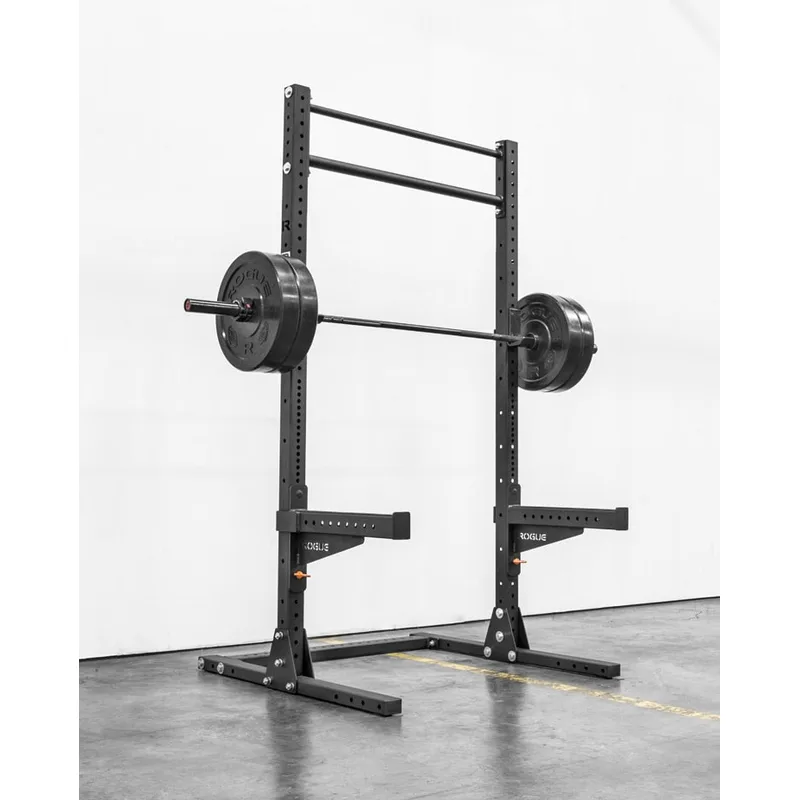
Rogue SML-2 Monster Lite Squat Stand
Pros
- 3x3" 11-gauge steel uprights are the same spec as Rogue's full power racks — no quality compromise for the open design
- Smallest footprint in this roundup at 49"×48" — fits in tight garage gym corners or shared spaces
- Monster Lite attachment compatible — can add a lat pulldown, band pegs, or pull-up bar accessories
- 1,000 lb rated capacity from a 2-post stand is a genuine achievement in structural engineering
- Made in USA with Rogue's track record for durability and resale value
Cons
- No enclosed cage — the barbell path is outside the uprights, requiring more lateral clearance around the stand
- Safety spotter arms are not included at base price and must be purchased separately
- 2-post open design provides less psychological security for max-effort lifts vs a full cage
- Direct-only from Rogue Fitness; no Amazon Prime shipping option
The SML-2 occupies a specific niche that full power racks do not serve well: small space, high steel quality, and training movements that benefit from an open platform rather than an enclosed cage. Olympic lifting movements — hang cleans, power cleans, push press — are performed with a barbell that moves forward off the rack rather than straight up, and open squat stands accommodate that pathway more naturally.
The 3x3 11-gauge steel construction is the SML-2’s defining characteristic at $500. You are paying Rogue money and receiving Rogue metal — the same upright steel spec as the RML-390F full cage for $195 less. The tradeoff is the absence of an enclosed safety frame. The SML-2 includes Monster Lite j-cups and can be equipped with spotter arms, but you are positioning safety equipment yourself rather than having fixed crossmembers.
For experienced lifters who understand how to set up safety equipment correctly, the SML-2 is a technically excellent rack. For newer lifters, or anyone who trains alone at max effort, the absence of an enclosed cage is a real safety consideration that the full power racks in this roundup address by design.
The 49”×48” footprint is the smallest in this roundup. A full power rack typically requires 8×8 feet of working space including clearance. The SML-2 allows a functional barbell setup in spaces where a full cage simply would not fit — converted bedroom corners, narrow garage bays, or shared storage areas where a fixed 4-post structure would block access.
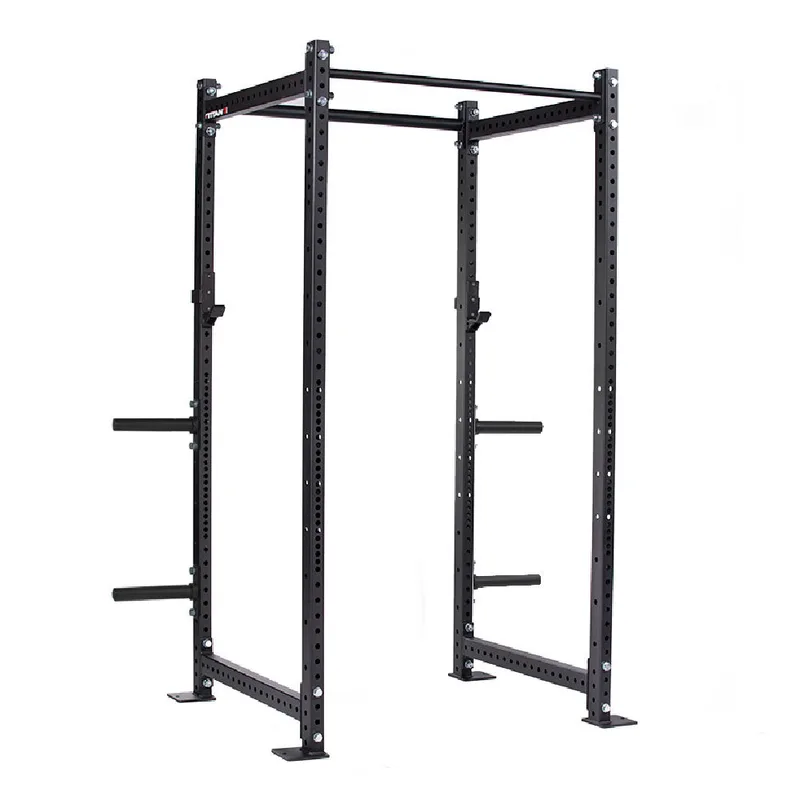
Titan Fitness T-3 Power Rack
Pros
- 11-gauge 2x3 steel is a meaningful step up from the T-2's 14-gauge 2x2 construction
- 1,100 lb rackable capacity handles even competitive-level powerlifting loads
- Four configuration options (82"/91" height × 24"/36" depth) let you match the rack to your ceiling and training style
- Dual pull-up bars included at base price — both 1.25" standard and 2" fat grip
- Westside hole spacing provides precise safety bar and J-hook positioning throughout the lift zone
Cons
- Safety arms and spotters not included in base price — add-on cost increases total investment
- 2x3 uprights limit compatibility to Titan-specific attachments, less universal than 3x3 racks
- Available direct from Titan only; no Amazon Prime fulfillment for the T-3
- At $520, you are within $175 of the Rogue RML-390F — worth considering the upgrade
The T-3 sits at the logical upgrade point from the T-2, and the construction difference is substantial enough to matter over years of hard use. Moving from 14-gauge 2x2 to 11-gauge 2x3 steel changes both strength and stiffness — the uprights flex measurably less under heavy loads, and the welds hold integrity longer under repeated stress cycling. For a lifter who plans to squat above 400 lbs regularly, the T-3’s construction spec is meaningful; for a lifter capping out at 185 lbs, it is less important.
The four configuration options — 82” and 91” heights with 24” and 36” interior depths — provide genuine flexibility. The 24” depth option suits garages with limited floor space; the 36” depth is appropriate for powerlifters who need rear bar storage or wider movement clearance. The 91” height variant addresses home gym ceilings above standard 8-foot residential height.
The T-3’s omission of safeties at base price is a legitimate issue at $520. Adding pin and pipe safeties or safety straps adds to the total cost and should be factored into the purchase decision. The RML-390F includes the flat-foot base and comes ready for use with its included Monster Lite j-cups; the T-3 requires accessory investment to reach the same operational state.
At $520, the T-3 is $175 less than the RML-390F. That gap is worth evaluating explicitly: the RML-390F provides 3x3 steel vs 2x3, Monster Lite compatibility vs Titan-specific, and US manufacturing vs Titan’s overseas production. For builders who are certain they won’t want the Monster Lite ecosystem, the T-3 is a solid full cage at a fair price. For builders who anticipate wanting a lat pulldown, cable system, or advanced attachments in the future, the RML-390F investment makes more long-term sense.
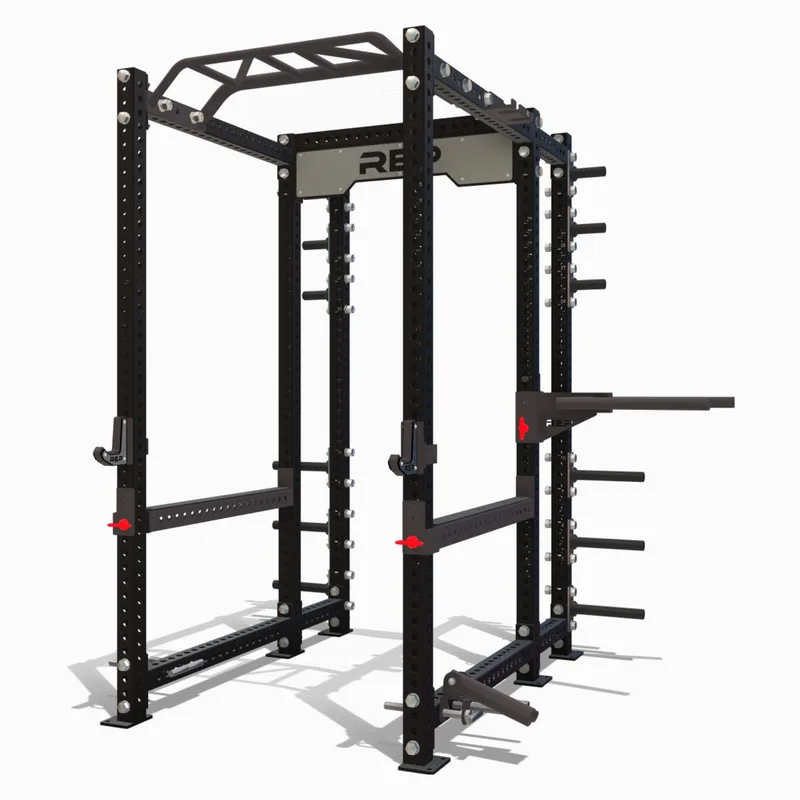
REP Fitness PR-5000 Power Rack
Pros
- 1,500 lb weight capacity is the highest in this roundup — no ceiling on how heavy you can train
- 1" hole spacing throughout provides the most precise J-hook and safety arm placement of any rack here
- 30" or 41" interior depth options accommodate both standard and sumo-wide training stances
- Compatible with REP's Ares and Athena cable systems — converts the rack into a full cable machine
- Lifetime frame warranty is the longest coverage offered by any brand in this roundup
Cons
- $1,195 base price before attachments is the highest in this roundup — significant financial commitment
- Build-your-own configuration can lead to overspending on features you may not use
- Direct-only from REP Fitness; shipping lead times on custom configurations can run several weeks
- Lifetime warranty requires retaining purchase documentation for claims
The PR-5000 is the rack for builders who want to configure a full training system rather than just a barbell cage. The 1” hole spacing throughout the uprights — not just in the bench zone, as many racks offer — provides adjustment precision that 2” hole spacing racks cannot match. The difference between 1” and 2” spacing is most noticeable when fine-tuning safety bar height for bench press: a 2” gap between holes can mean the difference between a safety position that catches a failed rep cleanly and one where the bar contacts the safety at an awkward height.
The Ares and Athena cable attachment systems are REP’s most compelling reason to choose the PR-5000 over the RML-390F at the premium tier. These bolt-on systems convert the existing rack uprights into a functional cable machine with adjustable pulleys, eliminating the need to purchase a separate cable machine. For home gym builders working with 400–500 square feet who want both barbell training and cable movements, the PR-5000-plus-Ares package accomplishes that with one footprint.
The 1,500 lb rackable capacity is genuinely overkill for recreational lifting and appropriate for competitive powerlifters. The lifetime frame warranty is the strongest structural coverage offered by any brand reviewed here. Both specs reflect REP’s intent: this is a rack designed to sit in the same spot for decades.
The $1,195 base price does not include the Ares or Athena systems, additional weight storage, or the premium attachments that make the rack fully functional as a cable system. A complete PR-5000 setup with cable arms and attachments represents a $1,800–2,500 investment depending on configuration. That context is important for budget planning.
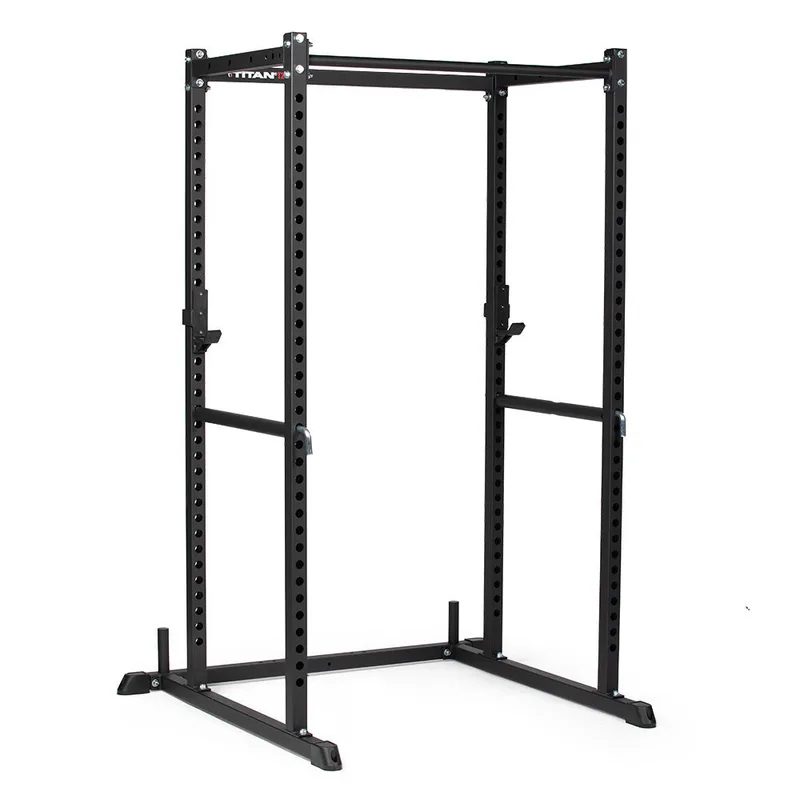
Titan Fitness T-2 Power Rack
Pros
- Full enclosed 4-post power cage with safeties under $400 — the lowest price point for a complete cage in this roundup
- Pin and pipe safeties included at base price — no separate accessory purchase needed
- Available via Amazon Prime for faster domestic shipping
- 850 lb rackable capacity covers the full range of intermediate home gym lifting
- Two height options (71" and 83") address low-ceiling garage gym installations
Cons
- 14-gauge 2x2 steel is lighter-duty construction than the T-3's 11-gauge 2x3
- 2x2 uprights limit attachment compatibility vs 2x3 or 3x3 racks
- Older rack design with fewer add-on attachment options vs T-3 or REP racks
- 1.25" pull-up bar only; no fat grip bar included at base price
The T-2 is the only full power cage in this roundup available via Amazon Prime, and that single characteristic makes it the best option for buyers who need a rack quickly, can’t wait for direct-from-manufacturer shipping, or want the consumer protections of Amazon’s return policy. At $399 for a complete 4-post cage with pin and pipe safeties and j-hooks included, the T-2 covers the core safety and functionality requirements of a home gym rack.
The 14-gauge 2x2 steel construction is lighter than everything else here except the PR-1100. Under loads up to 500–600 lbs, the T-2 performs without noticeable flex issues reported by the fitness community. As loads increase above that range, the structural difference between 14-gauge and 11-gauge steel becomes perceptible. The T-2 is appropriate for beginners and intermediate lifters; it is not the right choice for an advanced powerlifter who intends to squat 500+ lbs from day one.
The 71” short height option addresses a real problem in basement and low-ceiling garage gyms. Full-height racks (83”–92”) require at least 8’ ceilings for comfortable pull-up training. The T-2’s 71” variant fits 7’–7.5’ ceilings and is the only option in this roundup with that clearance configuration.
Which Should You Buy? Half Rack vs Full Rack Guide
Buy a squat stand (SML-2 or similar) if:
- Your training space is under 100 square feet
- You perform Olympic lifting movements (clean and jerk, snatch) where the open pathway matters
- You train with a dedicated spotter present during heavy sets
- You specifically want Monster Lite attachment compatibility at the lowest possible entry price
Buy a full power cage if:
- You train alone without a spotter
- You plan to max out on squat, bench, or overhead press
- Your training will include heavy singles and near-miss attempts
- You want to add a lat pulldown or cable attachment system later
Under $400: REP PR-1100 is the better value than the Titan T-2 for most buyers — more features included, and 82” height works in standard rooms. Get the T-2 if you need Amazon Prime shipping or have a low ceiling that requires the 71” height option.
$400–$700: The Titan T-3 and Rogue RML-390F are the real decision. The $175 price gap closes considerably when you add safeties to the T-3’s base price. If you have any intention of building out a home gym with a cable system or advanced attachments, the RML-390F pays for itself within the first year of avoided upgrade costs.
Over $700: The REP PR-5000 is for buyers building a long-term training system, not just a barbell cage. The 1,500 lb capacity, 1” hole spacing, and Ares cable compatibility justify the price for dedicated lifters. For anyone not planning to use a cable attachment system, the RML-390F covers 95% of use cases at $500 less.
FAQ
What is the difference between a half rack and a power rack?
A half rack (or squat stand) has two uprights at the front with adjustable j-hooks and safety bars, but no rear uprights to form an enclosed cage. A power rack (power cage) has four uprights forming a full enclosed cage you lift inside. Full power cages offer passive safety — if you fail a lift, the bar stays inside the cage. Half racks and squat stands require active safety setup — you must position spotter arms correctly before each set.
Do I need to bolt a power rack to the floor?
Most power racks recommend floor anchoring for stability under heavy loads. The Rogue RML-390F uses a flat-foot base that is self-stabilizing without anchoring for normal training use. Titan T-2 and T-3 racks technically can be used without anchoring at lower loads, but bolt-down is recommended for heavy work. The REP PR-1100 and PR-5000 similarly recommend anchoring for heavy training, though the PR-5000’s mass provides significant inherent stability.
What ceiling height do I need for a power rack?
For an 82”–84” tall rack: 8-foot ceilings are the minimum — pull-up bars will sit at ceiling height or slightly below, limiting range of motion. 9-foot ceilings allow full pull-up training. For the 71” Titan T-2 short version: 7.5-foot ceilings accommodate it comfortably. The Rogue SML-2 and RML-390F (90”–92”) require 9+ foot ceilings for comfortable pull-ups.
Can I use Rogue attachments on a REP or Titan rack?
Generally, no — attachment systems are not universally cross-compatible. Rogue Monster Lite attachments fit Rogue Monster Lite uprights (3x3 with 5/8” holes). REP’s Ares system fits REP 3x3 uprights with their bolt pattern. Titan T-3 attachments are designed for Titan 2x3 uprights. Some third-party brands produce cross-compatible attachments, but you should verify compatibility before purchasing.
Is a squat stand safe for solo training?
A squat stand can be safe for solo training when spotter arms are set at the correct fail height before each set. The risk is that lifters sometimes skip this step — particularly on sets they expect to complete easily. For beginners, or anyone training near true maximum effort, a full power cage provides passive fail protection that a squat stand does not. The practical recommendation: if you train alone and expect to attempt max-effort singles, use a full power cage.
Conclusion
For most home gym builders, the Rogue RML-390F is the rack worth buying if budget allows. The 3x3 11-gauge steel, Monster Lite compatibility, and flat-foot design create a training setup that doesn’t need to be replaced as your gym expands. The REP PR-1100 is the best complete sub-$400 full cage available — it covers all the basics with safeties and pull-up bar included.
Only buy a squat stand if you have genuine space constraints or specific programming reasons that favor the open platform. For most people, the enclosed safety of a full power cage is worth the extra floor footprint.