The hip thrust machine category has expanded rapidly in home gyms. Three years ago, the only way to do barbell hip thrusts at home was a barbell, plates, and a standard bench — a setup that slides, shifts, and requires significant space. In 2026, dedicated hip thrust machines have entered every price tier, from $90 entry-level resistance band rigs to $600 plate-loaded commercial-grade units. Garage gym builders searching for this equipment now have real options.
This roundup covers five machines across five different approaches to hip thrust training — from compact resistance band setups to heavy-duty plate-loaded machines. No barbell required for four of the five.
Quick Picks
GMWD Hip Thrust Machine is the top pick for lifters who want to train heavy. 800 lb capacity, commercial-grade steel, dual pivot bearings, and 4-position footboard adjustment. If you’re serious about progressive glute work, this is the machine to get.
BootySprout is the best value at $179. Folds flat for storage, comes with 135 lbs of resistance included, and handles up to 400+ lbs with extra bands. No barbell, no plates, no setup hassle.
Core Home Fitness Glute Drive Plus earns the multi-function pick. It converts to a flat bench, includes a long back pad that positions your upper back correctly, and works well as both a hip thrust station and a secondary bench.
Lifepro GluteBlast is the best option under $150. Foldable, includes resistance band pegs, doubles as a sissy squat machine, and stores flat.
Yes4All Hip Thrust Machine is the entry point. 350 lb capacity, five height positions, two 60 lb resistance bands included, and ships 70% assembled. A solid first hip thrust machine for under $90.
Comparison
| Machine | Price | Resistance Type | Max Load | Foldable | Converts |
|---|---|---|---|---|---|
| GMWD Hip Thrust Machine | $499.99-$599.99 as of Oct 18, 2026 | Plate-loaded | 800 lbs | No | No |
| Core Home Fitness Glute Drive Plus | Unavailable | Band-based | ~180 lbs | No | Yes (flat bench) |
| BootySprout | $169.99 as of Oct 18, 2026 | Resistance bands | 400+ lbs | Yes | No |
| Lifepro GluteBlast | $149.99 as of Oct 18, 2026 | Band-based | Limited | Yes | No |
| Yes4All Hip Thrust Machine | Unavailable | Band-based | 350 lbs | No | No |
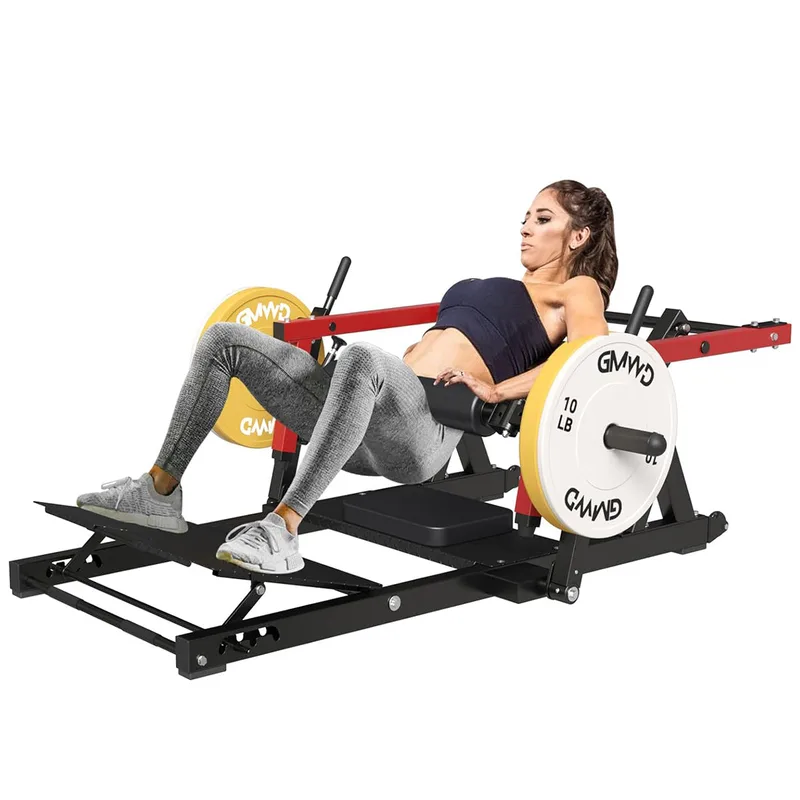
GMWD Hip Thrust Machine
Pros
- 800 lb rated weight capacity handles elite-level loading without any frame flex
- 14-gauge steel construction is the same spec used in commercial gym equipment
- Dual pivot bearings deliver smooth, consistent motion under maximum loads
- 4-position footboard adjustment covers varied user heights and hip thrust stance preferences
- Built-in weight holders store plates on the machine and keep the floor clear
- Transport wheels allow repositioning without fully unloading the weight horns
- Safety limiter system with grip handles provides emergency stops during heavy sets
Cons
- $599.99 is a significant investment — this is the premium option in this roundup
- 192 lb unit weight makes permanent placement a near-necessity; not a machine you move daily
- 71" length footprint is substantial — measure your space before ordering
The GMWD is built around one principle: let you load as much weight as you want and move it smoothly. The 14-gauge steel frame — the same gauge used in commercial gym equipment — produces zero flex under load. The dual pivot bearings are the critical spec here. Budget hip thrust machines use fixed pivot points that create friction and binding as weight increases. Dual pivot bearings allow the lap pad to track your hip path through the full range of motion, which matters more as you add weight.
The footboard spans 21.8” × 31.1” and adjusts to 4 positions. Taller users can position the board lower to maintain the 90-degree shin angle that maximizes glute activation at the top of the movement. Shorter users move it higher. Based on owner reports, the adjustment covers users from approximately 5’3” to 6’4” without compromise.
The weight holders on each side load up to 500 lbs total. At 800 lb rated capacity, you’re unlikely to exhaust that. The front transport wheels and vertical storage capability address the one real complaint about this machine: it weighs 192 lbs and takes up 71 linear inches of floor space. The wheels let you roll it into a corner when not in use. Vertical storage against a wall works, but requires unloading the weight horns first.
At $599.99, this is not an impulse purchase. It’s a long-term investment in a machine that won’t need to be replaced.
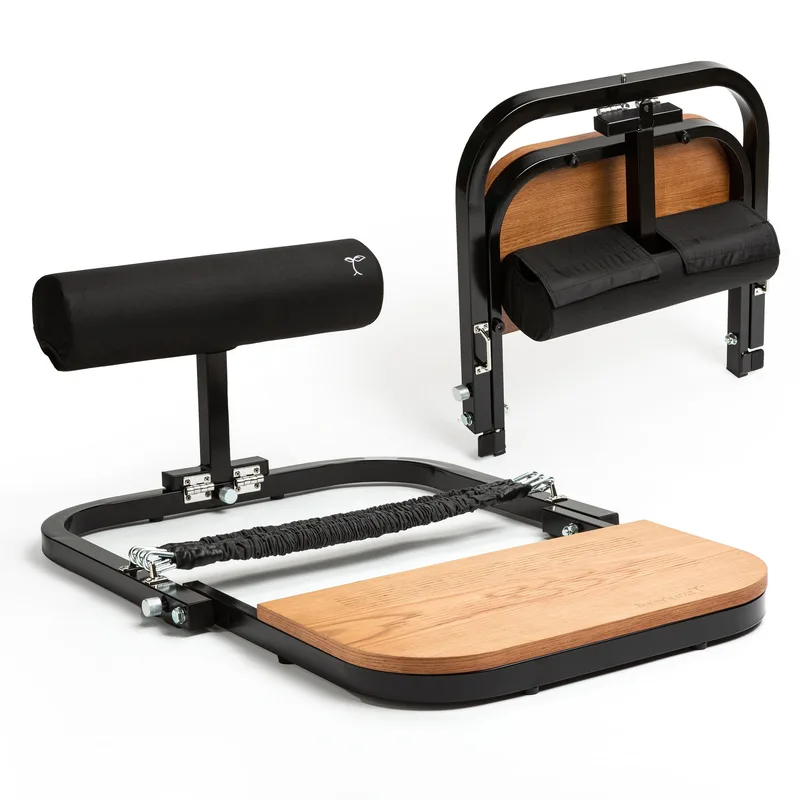
BootySprout Hip Thrust Machine
Pros
- $179 is the sharpest price point for a purpose-built hip thrust machine with serious resistance
- Resistance band system eliminates barbell loading — setup and breakdown takes seconds
- Folds to 8" height for storage flat under a bed or against a wall
- 25 lb unit weight means one person can carry and position it without help
- 400+ lb resistance potential with additional bands — enough for most intermediate to advanced lifters
- No barbell, plates, or collars needed to use at full intensity
Cons
- Particle board foot platform shows wear faster than metal alternatives based on owner reports
- Band resistance is variable — strongest at lockout, lightest at the bottom of the movement
- Resistance increments require purchasing additional bands to progress between 45 lb jumps
- Not ideal for users under 5'2" or over 6'3" based on fit feedback from owners
The BootySprout solves the biggest problem with home hip thrusts: setup time. A standard barbell hip thrust setup requires pulling the bar off the rack, loading plates, positioning a bench, getting under the bar, and repositioning everything when you’re done. The BootySprout requires none of that. You unfold it, sit in front of it, hook the bands, and go.
The resistance band system works by anchoring the bands to the foot platform and looping them through the lap pad mechanism. Three 45 lb bands are included, giving 135 lbs of starting resistance. Owner reports confirm this challenges most intermediate lifters immediately. Additional bands are available from BootySprout and bring the total to 400+ lbs — adequate for advanced users who are strong enough to approach that on barbell hip thrusts.
The 8” folded height is the standout spec for storage. It slides under a standard bed frame (typically 10-14” clearance) and disappears until you need it. At 25 lbs, you can carry it one-handed. The compact foot platform (25.5” wide × 14” long) provides stable footing for most users.
The main limitation is the foot platform material. Owner reviews note that the particle board underside shows wear after repeated assembly and storage cycles, particularly in humid environments. For a machine at $179, this is a known trade-off. The resistance band design means zero plate loading is possible — if you progress beyond 400 lbs of resistance, you’ve outgrown the machine.
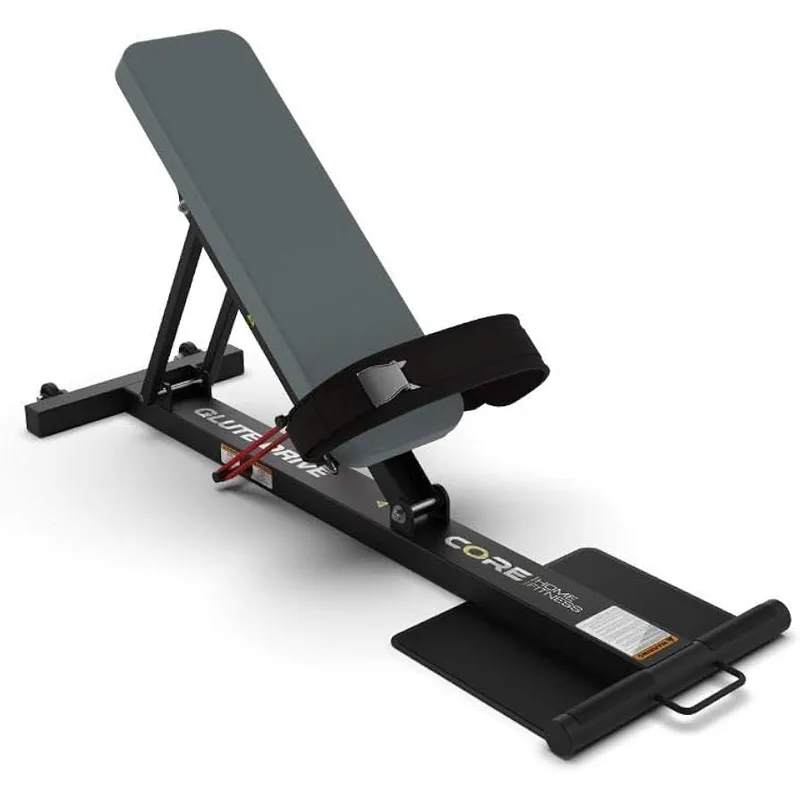
Core Home Fitness Glute Drive Plus
Pros
- Converts to a flat bench for chest press, dumbbell rows, and other upper body work
- Band-based resistance system removes barbell entirely from the hip thrust setup
- Extended back pad positions the upper back correctly without slipping mid-set
- Adjustable waist belt accommodates different hip widths and torso lengths
- Transport wheels make moving it within a home gym straightforward
- Long design gives more shoulder contact than short-pad alternatives
Cons
- ~180 lb band resistance is significantly lower than plate-loaded alternatives
- Heavier than BootySprout at 60+ lbs — not as easy to carry by one person
- Flat bench conversion is useful but not a replacement for a dedicated adjustable bench
- At $229.99, it costs more than the BootySprout for lower maximum resistance
The Core Home Fitness Glute Drive Plus addresses something the other machines in this roundup don’t: what do you do with the space and the machine when you’re not doing hip thrusts? The answer is a flat bench. The Glute Drive Plus converts to a flat pressing surface for dumbbell chest press, rows, and arm work, which means it earns its floor space across multiple training days.
The long back pad — running 59.5” total length — is the functional design choice that separates this from shorter alternatives. Hip thrust machines with short back pads require precise positioning to avoid the shoulder blades rolling off the top. The extended pad keeps the upper back and shoulder contact points stable throughout the set, which reduces distraction and allows you to focus on the hip drive itself.
The adjustable waist belt is made to fit different hip widths. A secure waist belt is more important than it sounds on a glute drive — if the belt shifts or slips during a set, the loading point changes and the glutes partially disengage. Owner reports on this machine are consistent about the belt staying put.
The band-based resistance tops out around 180 lbs, which is the main limitation versus the GMWD and BootySprout. For intermediate home gym users who haven’t built to maximal hip thrust loads, this covers the necessary range. For stronger lifters, the 180 lb ceiling becomes a sticking point.
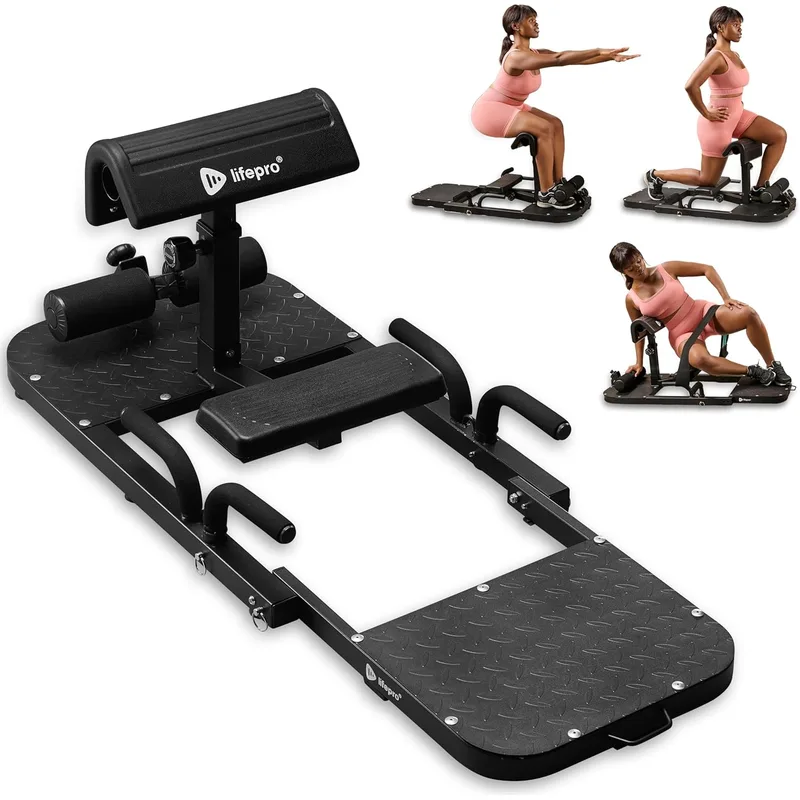
Lifepro GluteBlast Hip Thrust Machine
Pros
- Most affordable complete hip thrust setup in this roundup at $149.99
- Foldable frame with transport wheels for quick storage between sessions
- Adjustable lap bar delivers consistent direct load to the hips without hip pad drift
- Doubles as a sissy squat machine — two training tools in one unit
- PU leather padding resists sweat and is easier to wipe down than fabric
- Ships with resistance band pegs for variable resistance setup
Cons
- Lower weight capacity than plate-loaded options — not suitable for very heavy loading
- PU leather may show cracking over time with heavy daily use
- Sissy squat position can be cramped for users over 6'2" based on reviewer feedback
- Band resistance only — no path to plate loading if you progress beyond band options
The Lifepro GluteBlast is the most practical option for users who need compact storage above all else. The foldable powder-coated steel frame closes into a flat form that can be stored vertically against a wall, horizontally behind a door, or in a closet. The transport wheels let you roll it out for use and put it away between sessions without planning around it.
The adjustable lap bar is a design distinction from the BootySprout. Instead of a padded cylindrical back pad, the GluteBlast uses a direct lap bar that contacts the hip crease. This removes any pad drift during the movement — the load stays exactly where it contacts. Owner feedback from review sites describes the contact point as precise for hip thrust mechanics, particularly for B-stance hip thrusts where single-leg loading requires a stable anchor.
The sissy squat functionality adds a useful secondary movement. Sissy squats load the rectus femoris (the upper quad) through a deep knee flexion — a movement most home gyms can’t replicate because it requires a fixed foot anchor. The GluteBlast provides that anchor.
At $149.99, the trade-off is weight capacity. This machine is designed for resistance band loading, not plate loading. Lifters who are currently doing 200+ lbs on barbell hip thrusts will find the capacity insufficient. For beginners and intermediate lifters building toward that range, it covers the training load without over-investing in equipment.
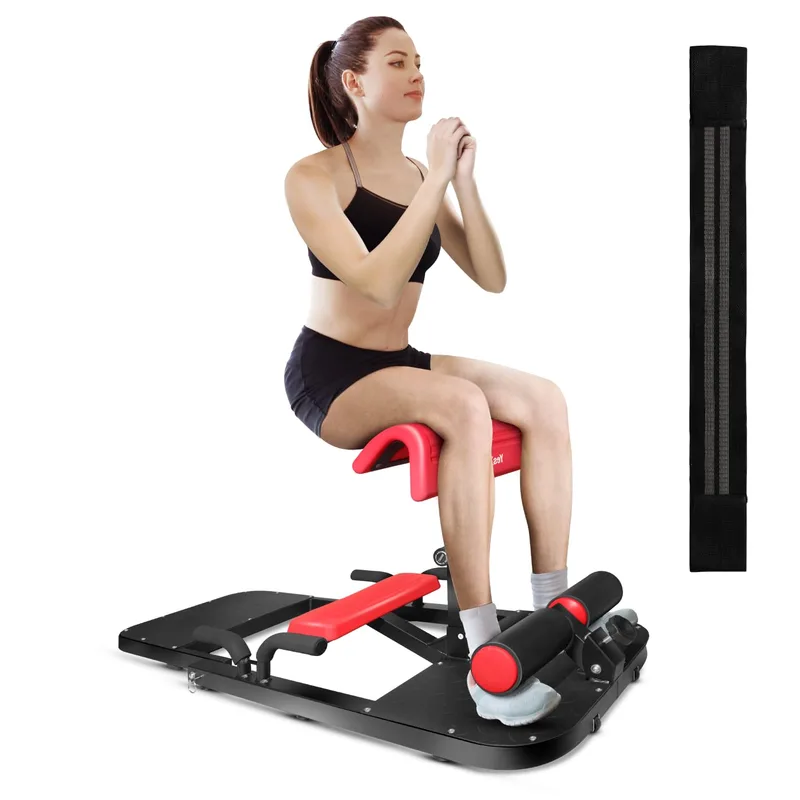
Yes4All Hip Thrust Machine
Pros
- Most affordable dedicated hip thrust machine in this roundup at under $90
- Two 60 lb resistance bands included — ready to use immediately out of the box
- 350 lb load capacity covers most beginner and intermediate training loads
- Five height adjustment positions accommodate users of different heights
- 70% pre-assembled reduces setup time significantly compared to flat-pack alternatives
- Multi-function design covers sissy squat, hack squat, and glute bridge in one unit
Cons
- Lighter frame construction than commercial-grade alternatives
- Multi-function design means no movement is optimized — a compromise on all fronts
- Band resistance has limited progression beyond included bands without purchasing extras
- 350 lb ceiling is lower than both BootySprout (400+ lbs) and GMWD (800 lbs)
The Yes4All is the entry point to dedicated hip thrust training. At $89.99 with two 60 lb resistance bands included and 70% pre-assembled out of the box, the setup barrier is minimal. The 350 lb load capacity handles most beginners and many intermediate lifters. Five height adjustment positions (15.7” to 20.5”) allow users of different heights to find the correct shin angle for maximum glute activation.
The multi-function design covers sissy squats, hack squat variations, glute bridges, and hip thrusts from the same chassis. This is useful for home gym setups that need equipment to serve multiple purposes. The trade-off is that a machine optimized for five different movements isn’t the ideal tool for any single one.
The NBR foam handles and cushioned footrest bar are small practical features that distinguish this from barbell substitutes. The transport wheels allow repositioning within a home gym without significant effort.
For someone who has never owned a dedicated hip thrust machine and wants to assess whether the movement produces results before spending $179-$600, the Yes4All at $89.99 makes a reasonable first purchase.
What to Look For
Resistance Type
Plate-loaded machines (like the GMWD) offer unlimited progressive overload — add more plates as you get stronger. The ceiling is effectively your own strength. Resistance band machines cap out at the band system’s maximum, usually 180-400 lbs. For beginning and intermediate training, bands are adequate. For advanced lifters who hip thrust over 250 lbs regularly, plate loading becomes necessary.
Footboard Adjustability
The footboard position determines your shin angle at the top of the hip thrust. Correct shin angle (90 degrees at lockout) maximizes glute activation. Users on both ends of the height spectrum — under 5’3” and over 6’2” — need adjustable footboards to achieve this. Fixed footboard machines force a compromise.
Storage Footprint
Hip thrust machines range from 8” folded height (BootySprout) to 71” deployed length (GMWD). Measure your available floor space before purchasing. A machine that stays deployed takes up permanent real estate; a machine that folds takes time to set up each session. Neither option is wrong — know which trade-off you prefer.
Pad Quality
The hip pad on a dedicated machine should be long enough (at least 20”) to accommodate most users without the shoulder blades hanging off the top. Thickness matters on long sets — inadequate padding concentrates pressure on the thoracic vertebrae. Machines under $150 often use thinner foam; the more expensive options use denser, more durable padding that maintains its shape under repeated loading.
Safety Features
Plate-loaded machines should have a limiter or safety stop that prevents the bar from dropping beyond a safe range. The GMWD’s grip handles serve this function. For resistance band machines, the risk is different — if a band snaps, it releases suddenly. Inspect bands before each session and replace them if you see fraying.
FAQ
Do I need a dedicated hip thrust machine or can I use a weight bench?
You can perform hip thrusts with a standard flat bench and a barbell, but the setup has consistent problems: benches slide on smooth floors, the bench height is usually too high for most users to achieve a 90-degree shin angle, and the barbell has to be loaded on the floor and rolled into position. A dedicated machine eliminates these problems and makes the movement more consistent to replicate session to session.
Are resistance band hip thrust machines as effective as plate-loaded versions?
For building the glutes, what matters is progressive overload — the gradual increase of load over time. Resistance band machines (BootySprout, Lifepro GluteBlast, Yes4All) achieve this up to their capacity ceiling. For most home gym users who aren’t competitive powerlifters, 135-400 lbs of band resistance is sufficient for years of progressive glute training. Plate-loaded machines allow heavier loads and more precise weight increments.
What weight capacity do I need?
A practical rule: you should be able to hip thrust 1.5 to 2x your body weight for a complete range of strength development. A 170 lb person should target 255-340 lbs over time. At 350 lb capacity (Yes4All), most users have room to grow. At 800 lbs (GMWD), you won’t outgrow the machine regardless of how strong you get.
Can these machines be used for single-leg and B-stance hip thrusts?
Yes — all five machines in this roundup allow B-stance and single-leg variations. The footboard width on the plate-loaded GMWD (31.1”) provides enough space for single-leg work without restricting the stance. On resistance band machines, B-stance simply involves shifting one foot back while keeping both on the platform.
How much space do I need for a hip thrust machine?
Budget an area at least 6 feet long and 3 feet wide for most models when deployed. The GMWD at 71” (just under 6 feet) long is the largest option. Foldable options like the Lifepro GluteBlast store in a fraction of that space but require setup before each session.
Conclusion
The GMWD Hip Thrust Machine is the best option for lifters who train seriously and want to load progressively without a ceiling. It costs more than everything else in this roundup combined, but the quality is proportional.
For most home gym users, the BootySprout at $179 is the practical first choice. It stores flat, costs a fraction of the GMWD, and delivers enough resistance to challenge intermediate to advanced glute training without a barbell.
The Core Home Fitness Glute Drive Plus earns its place if you want the machine to double as a flat bench. The Lifepro GluteBlast earns its place if storage space is the primary constraint. The Yes4All earns its place if $90 is the budget and you want to try the movement category before committing further.
Regardless of which machine you choose, consistent progressive loading on hip thrusts produces measurable results for glute development. The machine matters less than the training.