Smith machine development reached a new milestone in late 2025 when RitFit launched what it called the industry’s first 3D Smith Machine — a system allowing forward, backward, and vertical bar movement simultaneously. That kind of commercial R&D investment in a home gym product signals how much the smith machine market has grown. The practical effect on the under-$800 segment: established linear smith machines now compete directly with feature-loaded all-in-one combos at prices that would have been inconceivable five years ago.
The under-$800 smith machine category splits into two distinct types. Dedicated machines like the Body-Solid PSM200 and Valor BE-11 focus entirely on bar path quality, safety, and longevity. All-in-one combos like the Mikolo and RitFit M1 pack smith machine functionality alongside cable crossovers and LAT pulldowns into a single unit. Both approaches have merit depending on what your home gym already has and what it still needs.
This roundup covers five machines across both categories — all available on Amazon, all confirmed under $800 for the base configuration.
Quick Picks
Body-Solid PSM200 is the best dedicated smith machine at this price — 7-degree reverse pitch, 400 lb capacity, and a dual-function design that works as a half rack when the smith bar isn’t in use. At $749, it’s the most capable pure smith machine in this roundup.
Valor Fitness BE-11 is the best value at $599 — linear bearings, 1,000 lb rated capacity, and Olympic plate storage at the lowest price for a linear bearing system here.
Mikolo Smith Machine is the best all-in-one pick — LAT pulldown, cable crossover, and smith machine combined at $749 for home gyms that don’t have a cable station.
Body-Solid PSM144X is the most proven budget option at $695 — nylon bushing system, 14 lockout points, and a long track record of reliable home gym use.
RitFit M1 is the best budget all-in-one at $549 — linear bearing smith system with a 2:1 cable crossover at a price that undercuts everything else in the all-in-one category.
Comparison
| Spec | Body-Solid Powerline PSM200 Smith Machine | Valor Fitness BE-11 Smith Machine | Mikolo Smith Machine Home Gym | Body-Solid Powerline PSM144X Smith Machine | RitFit M1 Smith Machine |
|---|---|---|---|---|---|
| Rating | 9.0/10 | 8.5/10 | 8.0/10 | 7.8/10 | 8.2/10 |
| Price | $749 | $599 | $749 | $695 | $549 |
| Bar Path | 7-degree reverse pitch | 3-degree pitch | Vertical (linear) | — | — |
| Weight Capacity | 400 lb | 1,000 lb | — | — | — |
| Frame | 2" × 2" 12-gauge steel | — | 14-gauge 2" × 2" steel | 2" × 2" 12-gauge steel, 4-pillar design | — |
| Bar Carriage Weight | 25 lb | — | — | — | — |
| Lockout Points | 12 | — | — | 14 | — |
| Machine Weight | 157 lb | — | — | — | — |
| Bar Weight | — | 36 lb | — | — | — |
| Dimensions | — | 53"L × 73.25"W × 80.5"H | — | — | — |
| Bearings | — | Linear bearings | — | Nylon Super-Glide bushings | Linear bearing Smith system |
| Plate Storage | — | 4 Olympic pegs included | — | — | — |
| Frame Capacity | — | — | 2,200 lb | — | 1,600 lb |
| Included Stations | — | — | Smith bar, LAT pulldown, cable crossover, band pegs | — | — |
| Weight Holders | — | — | 600 lb capacity per side | — | — |
| Assembly Time | — | — | 8-10 hours | — | — |
| Bar Diameter | — | — | — | 1-inch standard | — |
| Safety | — | — | — | Dual-lock Safety Spotter Catch System | — |
| Warranty | — | — | — | Limited Body-Solid warranty | — |
| Height | — | — | — | — | 85.3 inches |
| Footprint | — | — | — | — | 20.9 sq ft |
| Cable System | — | — | — | — | 2:1 pulley ratio |
| Pull-Up Bar | — | — | — | — | 28mm diameter |
Detailed Reviews
Body-Solid Powerline PSM200 — Best Overall
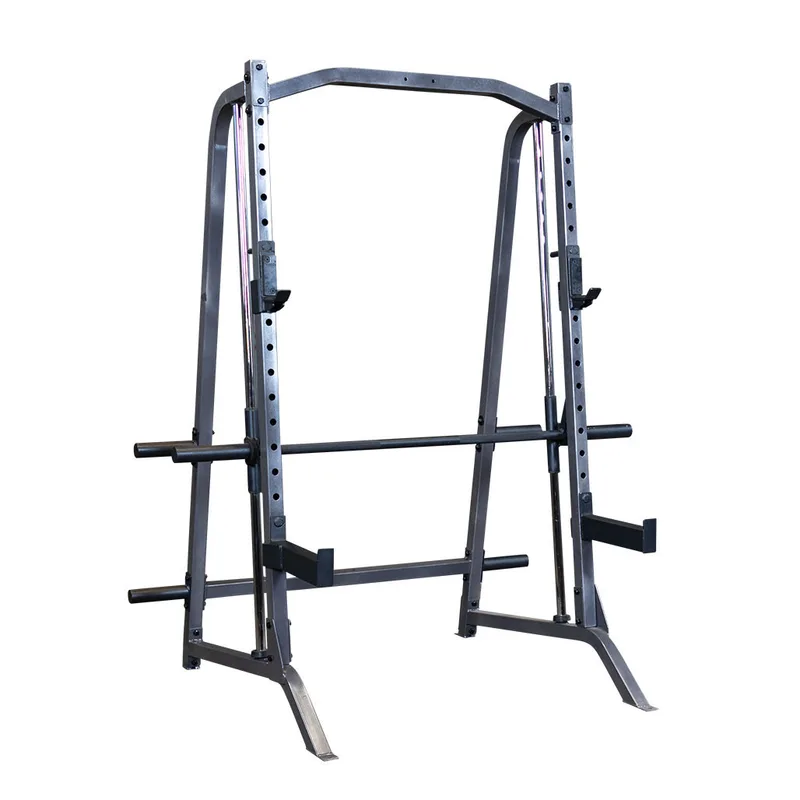
Body-Solid Powerline PSM200 Smith Machine
Pros
- 7-degree reverse pitch mirrors the natural bar path of free-weight pressing — bar tracks with your body, not against it
- Dual function as a half rack and smith machine — remove the bar carriage for free-weight squats and presses
- 12 lockout points provide precise safety catch placement anywhere in the range of motion
- 2x2 12-gauge steel construction matches the build standard of mid-tier power racks
- 400 lb rated capacity handles serious loading without structural concern
- Optional LAT pulldown attachment (PLT200) available for purchase to expand training options
Cons
- No cables, bench, or accessories included — dedicated smith machine only
- 25 lb bar carriage weight is always in play — no counterbalancing standard
- At $749, it's the highest price in this roundup
The PSM200 is the machine that answers the most common complaint about entry-level smith machines: straight vertical bar paths that don’t match human pressing biomechanics. The 7-degree reverse pitch angles the rail so the bar travels at a slight incline — closer to how a free-weight barbell actually moves during squats and bench press. Owner reports consistently note that the angled path feels more natural than vertical alternatives, particularly during squat work where forward lean requires the bar to move slightly forward as you descend.
The half rack function is a genuine secondary benefit. Remove the smith bar carriage and the PSM200’s uprights and safety arms function as a standard half rack for free-weight squats, presses, and rack pulls. For home gym builders who want a smith machine but don’t want to permanently sacrifice free-weight capability, this dual-function design makes the PSM200 a smarter long-term investment than a dedicated smith-only machine.
The 2x2 12-gauge steel construction matches the frame standard of Body-Solid’s Powerline power rack line. The 12 lockout points cover the full range of motion from just above the floor to full overhead extension. The optional PLT200 LAT attachment can be purchased separately to add cable pulldown capability without buying a second machine.
The main limitation is the lack of counterbalancing. The 25 lb bar carriage weight is always active, which affects lifters starting with lighter loads or those working around shoulder injuries where unloaded bar movement matters. At $749 it’s the most expensive machine here, but the 7-degree pitch, half rack function, and Body-Solid build quality justify the price for serious home gym builders.
Valor Fitness BE-11 — Best Value
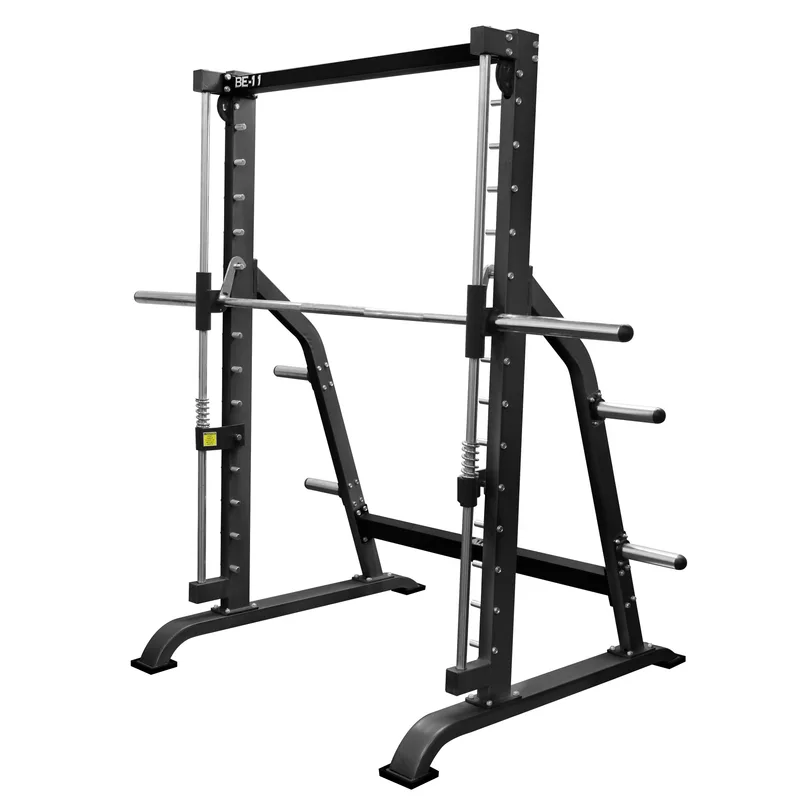
Valor Fitness BE-11 Smith Machine
Pros
- Linear bearings deliver genuinely smooth bar travel — a real upgrade over nylon bushing systems at this price
- 1,000 lb rated capacity is the highest in this roundup — completely future-proof for home use
- Four Olympic plate storage pegs keep plates organized and at arm's reach during training sessions
- Compact footprint at 53"L × 73.25"W fits garage and basement gyms without monopolizing floor space
- Counterbalanced upgrade (BE-11CB kit) available separately to offset the 36 lb bar weight if preferred
Cons
- No cables, bench, or dip station included — bare-bones smith machine only
- Counterbalance requires a separate purchase of the BE-11CB kit, adding to the total cost
- 3-degree pitch is near-vertical — less biomechanical tilt than the PSM200's 7-degree angle
The BE-11 punches above its $599 price by delivering linear bearings — the specification that separates budget smith machines from machines that actually feel good to use. Linear bearings run on precision steel rods rather than nylon on square tube, which eliminates the friction and sticking points common on budget machines. The difference in bar feel is immediate and consistent: the carriage moves smoothly from any position without manual adjustment or warming up.
The 1,000 lb rated capacity is the most generous in this roundup. Compared to the PSM200’s 400 lb rating, the BE-11 provides significantly more loading headroom — practically speaking, this is more than any home gym user will ever need, but it does reflect the heavier-gauge construction underlying the BE-11’s frame. The machine weighs approximately 258-300 lb assembled, indicating the steel density backing that capacity claim.
The four Olympic plate storage pegs are an often-overlooked feature. Storage pegs mounted directly on the machine mean plates stay within reach and don’t occupy floor space on a separate plate tree. During training, this makes loading and unloading between sets faster and more efficient.
The near-vertical 3-degree pitch is the notable compromise versus the PSM200. The bar path is essentially straight up and down, which is adequate for most exercises but doesn’t offer the biomechanical tilt that makes angled machines feel more natural for squats and presses. Lifters who’ve trained on angled smith machines will notice the difference. For buyers new to smith training, the 3-degree pitch is unlikely to feel limiting.
The optional BE-11CB counterbalance kit adds counterweights to offset the 36 lb bar — a worthwhile addition for rehabilitation work, warm-up sets, or anyone who finds the standard bar weight too heavy to start with. Factor that into the total budget if counterbalancing is a priority.
Mikolo Smith Machine Home Gym — Best All-in-One
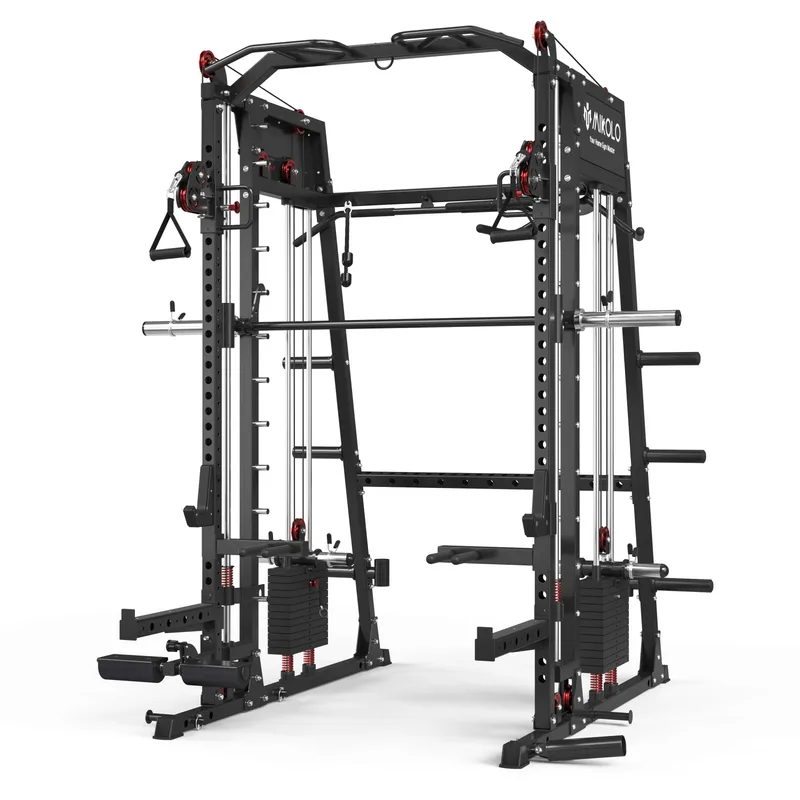
Mikolo Smith Machine Home Gym
Pros
- LAT pulldown, cable crossover, and smith machine in one unit at $749 — no separate cable machine needed
- 2,200 lb frame capacity and 600 lb per-side weight holders provide serious loading headroom
- Band pegs included for resistance band training as a supplement or warm-up option
- Amazon availability with verified buyer ratings confirms real-world product performance
- All-in-one design saves significant floor space compared to separate smith machine plus cable station
Cons
- 14-gauge steel is lighter gauge than the Body-Solid and Valor options — expect some flex at maximum loading
- 8-10 hour assembly is a significant time investment; two people strongly recommended
- No weight bench included — a separate bench purchase is required for pressing exercises
The Mikolo makes a compelling case for the all-in-one category: LAT pulldown system, cable crossover, band pegs, and smith machine in a single purchase for $749. For home gym builders who don’t already own a cable station, this eliminates a second machine purchase that would easily cost $400-700 additional. The total training capability per dollar is higher here than any dedicated smith machine at this price.
The cable crossover integration is the key feature. Most dedicated smith machines in this price range require a separate cable machine purchase to perform lat pulldowns, seated cable rows, cable flyes, and tricep pushdowns. The Mikolo delivers all of these natively. According to Amazon buyer feedback, the cable systems function smoothly and the overall construction holds up under consistent use.
The 2,200 lb frame capacity and 600 lb per-side weight holders reflect a heavy frame build. The 14-gauge 2” × 2” steel is lighter than the 12-gauge Body-Solid and Valor frames, but at the loading levels realistic for home gym use, this distinction is unlikely to matter in practice.
The assembly requirement is the genuine drawback. The Mikolo takes 8-10 hours for two people — a full weekend project rather than an afternoon build. Budget that time before ordering. The no-bench situation also requires a separate purchase for any pressing work, which adds to the total cost.
For home gym builders starting from scratch who want smith machine plus cable training in a single footprint under $750, the Mikolo is the most practical option in this roundup.
Body-Solid Powerline PSM144X — Most Proven Budget Pick
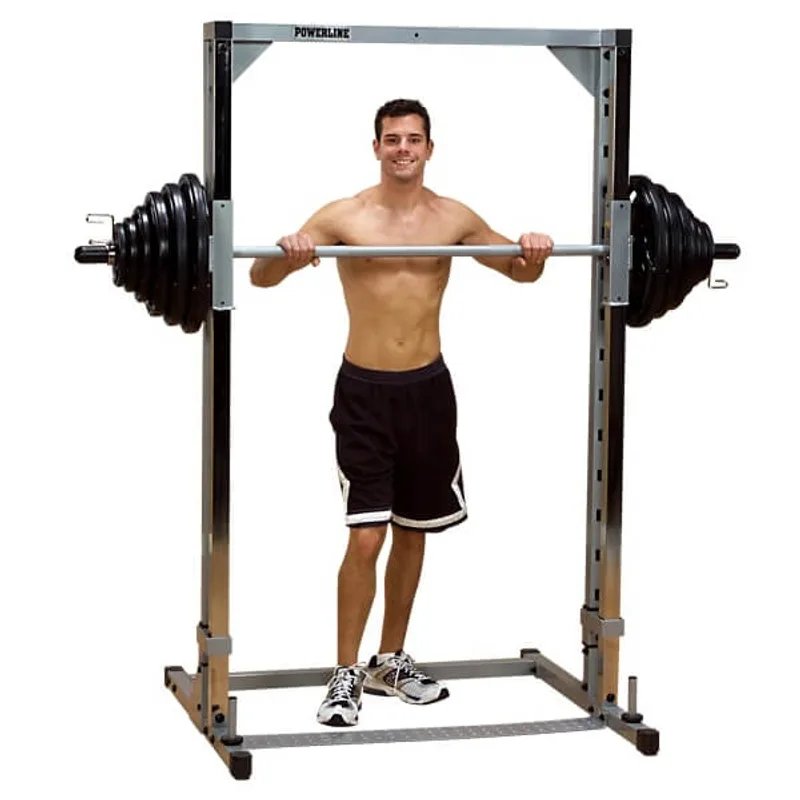
Body-Solid Powerline PSM144X Smith Machine
Pros
- 14 lockout positions — more catch points than any other machine in this roundup
- Dual-lock Safety Spotter Catch System locks the bar with a 15-degree sleeve rotation, fast and reliable
- Decades of real-world ownership data — a machine with a proven track record in home gyms
- Four-pillar 2x2 12-gauge steel frame provides solid rigidity throughout the full range of motion
- Body-Solid brand reliability and parts availability for long-term ownership
Cons
- Standard 1-inch bar diameter requires standard-hole plates — incompatible with Olympic 2-inch plate collections without a separate adapter
- Nylon Super-Glide bushings, while durable, don't match the smoothness of linear bearing systems
- Near-vertical bar path offers no biomechanical tilt — the bar tracks straight up and down only
The PSM144X has been a home gym staple for over a decade. It doesn’t offer the linear bearings of the BE-11 or the angled pitch of the PSM200, but it does offer something no newer machine can claim: years of proven performance in real home gym environments and a manufacturer with a track record of honoring warranties and providing replacement parts.
The 14 lockout positions — more than any other machine in this roundup — provide maximum flexibility in catch placement. The dual-lock Safety Spotter Catch System operates by rotating the pivot sleeve 15 degrees, a fast and reliable mechanism that stops the bar instantly during failed reps. This safety system has been one of the consistently praised features in owner reviews over the machine’s production run.
The critical limitation is the standard 1-inch bar diameter. If your existing plate collection uses 2-inch Olympic holes (which applies to most home gyms built in the last decade), the PSM144X’s bar requires either purchasing standard plates separately or buying an adapter sleeve. This incompatibility with existing Olympic equipment is the most common complaint from PSM144X buyers and should be confirmed before purchase.
The nylon Super-Glide bushing system is functional and durable — Body-Solid has refined this design over years of production — but it doesn’t provide the frictionless feel of linear bearings. For lifters who’ve never used a linear bearing smith machine, the difference may not register. For those who have, the bushing feel will seem noticeably stiffer by comparison.
At $695, the PSM144X costs almost as much as the BE-11. The BE-11’s linear bearings, higher capacity, and Olympic bar compatibility make it a stronger value proposition unless you specifically prioritize the Body-Solid track record and 14-point lockout system.
RitFit M1 Smith Machine — Best Budget All-in-One
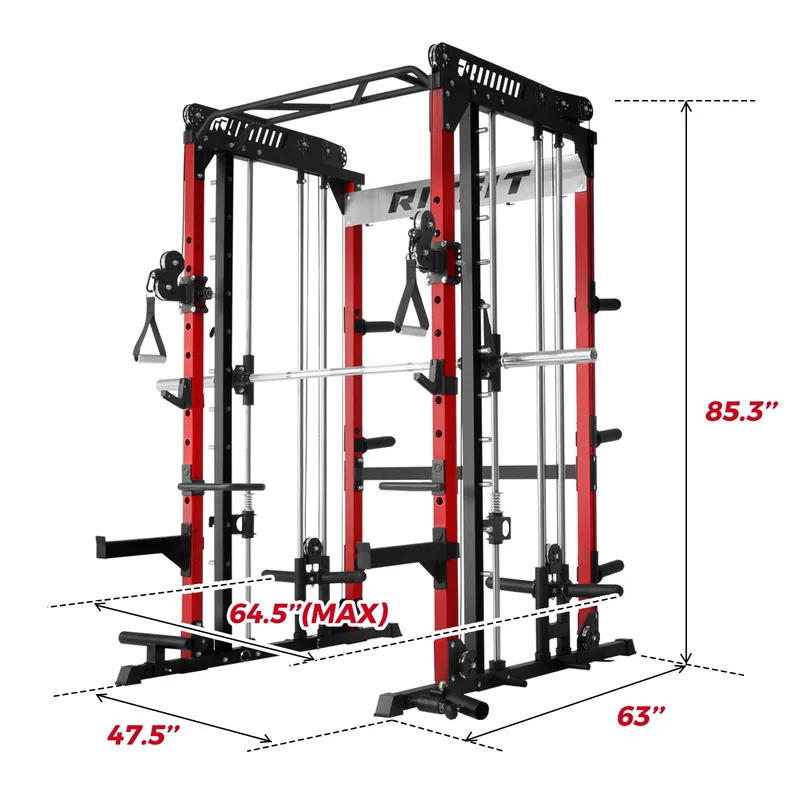
RitFit M1 Smith Machine
Pros
- Linear bearing smith system under $600 — a level of smoothness normally found on $1,000+ machines
- Cable crossover with 2:1 pulley ratio included — lat pulldowns, cable rows, and crossovers all possible
- 20.9 sq ft footprint is one of the more compact all-in-one options available
- Pull-up bar, cable system, and smith machine in a single purchase under $600
- 4.9/5 average Amazon rating from verified buyers confirms build quality holds up in real use
Cons
- Weight plates sold separately — the base price does not include any resistance loading
- Power rack and smith functions share the same uprights — cannot use both simultaneously for different exercises
- Cable attachment selection is more limited than the Mikolo at a higher price point
The RitFit M1 is the standout choice for buyers who want an all-in-one smith machine with cable functionality at the lowest possible price. At $549, the M1 includes a linear bearing smith system, a 2:1 cable pulley setup for lat pulldowns and cable crossovers, a 28mm pull-up bar, and a power rack frame — a complete home gym in 20.9 square feet.
The linear bearing smith system at this price is the defining feature. Linear bearings are typically found on machines in the $700-1,000 range. Getting that bar smoothness in an all-in-one package under $600 is the M1’s strongest selling point, and the 4.9/5 Amazon rating from verified buyers confirms the bar path quality holds up in real ownership.
The 2:1 cable pulley ratio means the cable resistance feels lighter than the actual plate load — a 45 lb plate applies 22.5 lb of tension through the cable. This is standard for home gym cable systems and appropriate for pulldown and crossover exercises where lighter, higher-rep protocols are typical. The 1,600 lb frame capacity confirms that the underlying structure is built for serious use despite the accessible price.
The 20.9 sq ft footprint is notably compact for a machine with this many functions. Direct competitors with comparable feature sets tend to occupy 25-30 sq ft. For home gym owners working within a specific floor space constraint, the M1’s relatively small footprint can be the deciding factor.
The cable attachment selection is the main limitation versus the Mikolo. The M1 ships with fewer attachment options, and the power rack and smith machine functions share the same uprights, meaning you can’t use both simultaneously. Weight plates are not included at any price point — a separate plate purchase is required.
Buying Guide
Dedicated Smith Machine vs. All-in-One Combo
The core decision in this category is whether to buy a focused smith machine or an all-in-one combo.
Dedicated smith machines (PSM200, BE-11, PSM144X) prioritize bar path quality, build weight, and safety system precision. They do one thing and do it well. Buy a dedicated machine if you already own a cable station or if smith machine training is the specific gap in your current setup.
All-in-one combos (Mikolo, RitFit M1) pair a smith machine with cable systems in a single footprint. They’re better for home gym builders starting from scratch or those with limited space who can only justify one large machine purchase. The trade-off is typically lighter steel gauge and longer assembly times.
Bar Path: Angled vs. Vertical
Smith machines use either a vertical (straight up and down) or angled bar path. A 7-degree angled rail, like the PSM200, tilts the bar path forward slightly to match the natural arc of a loaded squat or press. Most commercial gym smith machines use some degree of angling.
Vertical smith machines (BE-11, Mikolo, RitFit M1) are mechanically simpler and work well for most exercises. The lack of angle is more noticeable during squats and incline presses than during rows or machine curls.
Bearings: Linear vs. Nylon Bushings
Linear bearings are precision steel balls or rollers running in a channel — the bar carriage moves frictionlessly and doesn’t require warming up. Nylon bushing systems slide the carriage against square steel pillars with lubricating nylon — functional and durable, but with more friction than linear bearings.
All five machines in this roundup are functional training tools. But if bar smoothness is a priority — especially for higher-rep programs or exercises where smooth deceleration matters — linear bearing machines (BE-11, RitFit M1) are the better choice.
Counterbalanced vs. Standard Bar
A counterbalanced smith machine uses a pulley-and-weight system to offset the bar carriage weight, making the bar feel close to zero pounds. Standard machines have a bar carriage weight of 25-36 lb depending on the model.
Most intermediate and advanced lifters train above carriage weight and find the distinction irrelevant. Counterbalancing becomes meaningful for beginners working very light loads, rehabilitation contexts where unloaded bar movement is required, or lifters who want to use the smith machine as a bodyweight training tool.
The BE-11 offers an optional counterbalance kit (BE-11CB) as an add-on. None of the other machines in this roundup offer counterbalancing at the base price.
Space and Assembly Reality
Budget and mid-tier smith machines require 50-100 sq ft of floor space when accounting for the machine footprint plus safe training clearance around it. The machine itself typically occupies 25-40 sq ft; training approach, plate loading access, and exit paths from failed reps add the remainder.
Assembly time ranges from 3-4 hours (dedicated machines like the PSM200 and BE-11) to 8-10 hours (all-in-one combos). Budget assembly time honestly before purchase — a machine that takes a weekend to build is a different commitment than one assembled in an afternoon.
Weight Capacity for Long-Term Use
All five machines in this roundup have capacity ratings that exceed typical home gym loading. The practical question is how much the capacity number reflects overall build quality. The BE-11’s 1,000 lb rating and the Mikolo’s 2,200 lb frame capacity indicate heavier steel construction relative to stated limits. The PSM200’s 400 lb rating is more conservative but comes with a build-quality spec (2x2 12-gauge Body-Solid steel) that is well-established.
FAQ
Is a smith machine a substitute for a squat rack?
A smith machine handles the same exercises — squats, bench press, overhead press, rack pulls — but the fixed bar path means each exercise follows the rail angle rather than your body’s natural arc. Most serious lifters use both: a smith machine for controlled strength work, accessory training, and exercises that benefit from a fixed path, and a power rack for free-weight compound lifts. The PSM200 addresses this by functioning as both a half rack and a smith machine.
Do I need a counterbalanced smith machine?
Not unless you have a specific need for it. Most home gym training starts at 45-90 lb total load, well above the 25-36 lb carriage weights in this roundup. Counterbalancing is most useful for physical therapy work, beginner training with very light loads, or bodyweight programs where the empty smith bar is too heavy to begin with. If you think you’ll want counterbalancing, the Valor BE-11 with its optional BE-11CB kit is the most affordable path to that feature.
How much floor space does a home smith machine require?
The machines in this roundup occupy between 20-40 sq ft in assembled footprint. Add 2-3 feet of clearance on all sides for safe training access. A typical garage bay (10’ × 20’) can accommodate a smith machine with room for a bench and weight storage. Measure the machine’s assembled dimensions — not just the listed footprint — before purchase, as some machines are taller or wider than their floor footprint suggests.
What’s the difference between the Body-Solid PSM200 and PSM144X?
The PSM200 is the more capable machine: 7-degree angled bar path, Olympic bar compatibility, half rack functionality, and a more modern design. The PSM144X is the legacy model: vertical bar path, 1-inch standard bar, 14 lockout points, and a longer production track record. The PSM144X costs slightly less but requires standard plates rather than Olympic plates. For most buyers building a new home gym, the PSM200’s Olympic compatibility and angled rail make it the better long-term choice despite the higher price.
Can I use a smith machine for every barbell exercise?
Most barbell exercises — squats, bench press, overhead press, rows, deadlifts, rack pulls, lunges, and shrugs — can be performed on a smith machine. The fixed bar path changes the movement pattern for exercises like squats and bench press compared to free weights. Smith machine rows and shrugs, on the other hand, often feel more natural than their free-weight counterparts because the fixed path removes the stabilization demand. Use the smith machine for what it does well; keep a free-weight option for movements where the natural arc matters most.
Conclusion
The Body-Solid PSM200 at $749 is the best dedicated smith machine under $800 — 7-degree angled bar path, half rack functionality, and Body-Solid build quality deliver performance that scales with serious long-term training.
For buyers prioritizing value on a dedicated machine, the Valor Fitness BE-11 at $599 offers linear bearings, 1,000 lb capacity, and Olympic plate storage at a price that undercuts the competition.
Home gym builders who need cable training alongside smith machine work should look at the Mikolo at $749 or the RitFit M1 at $549. The M1 wins on price and linear bearing quality; the Mikolo wins on cable system comprehensiveness and overall feature count.
The PSM144X earns its place for buyers who want a proven Body-Solid machine at a moderate price, understanding the standard bar limitation upfront.