The lower back is the most commonly neglected muscle group in home gym training — until it becomes a problem. Deadlifts, squats, and rows all load the posterior chain under tension, but direct lower back work on a hyperextension bench develops the spinal erectors and multifidus through a full range of motion that compound lifts can’t replicate. In 2026, the hyperextension bench category has expanded well beyond the basic 45-degree roman chair, with new adjustable GHD options and multi-function designs entering the market alongside the long-established commercial brands.
This roundup covers five options from basic foldable benches to full glute ham developers — enough range to match any budget or training goal.
Quick Picks
Body-Solid GHYP345B is the top pick for serious home gym users who want a fixed 45-degree bench that performs identically to what you’d find in a commercial gym. Lifetime frame warranty. Built for the long haul.
XMark XM-7609 is the best-built option under $250. Eleven-gauge commercial steel, 300 lb capacity, integrated dip handles, and a horseshoe base that doesn’t move. Solid performer for the money.
Valor Fitness CB-13 covers the adjustable roman chair segment. Nine height positions, tripod base, dual-layer pads — and at $179 it’s the easiest recommendation for most home gym setups.
Valor Fitness CB-29 GHD is for lifters who want to do actual glute ham raises, not just back extensions. The full GHD movement recruits the hamstrings eccentrically in a way the 45-degree bench doesn’t touch. At $449, it’s a specialty purchase.
Sunny Health SF-BH6629 handles the budget. Under $90, foldable, adjustable, and does the job for basic lower back and glute work.
Comparison
| Bench | Price | Capacity | Frame | Type | Adjustable |
|---|---|---|---|---|---|
| Body-Solid GHYP345B | $255.00-$295.00 as of Oct 18, 2026 | 250 lbs | 2”x3” heavy-gauge | 45° fixed | Pad height |
| XMark XM-7609 | Unavailable | 300 lbs | 11-ga 2”x3” | 45° fixed | Pad height |
| Valor CB-13 | Unavailable | 250 lbs | 2”x2” 12-ga | Roman chair | 9 positions |
| Valor CB-29 GHD | $625.98 as of Oct 18, 2026 | 400 lbs | Heavy-duty | GHD | 6H x 4V |
| Sunny SF-BH6629 | $57.67-$61.35 as of Oct 18, 2026 | 250 lbs | Steel | 45° foldable | Height |
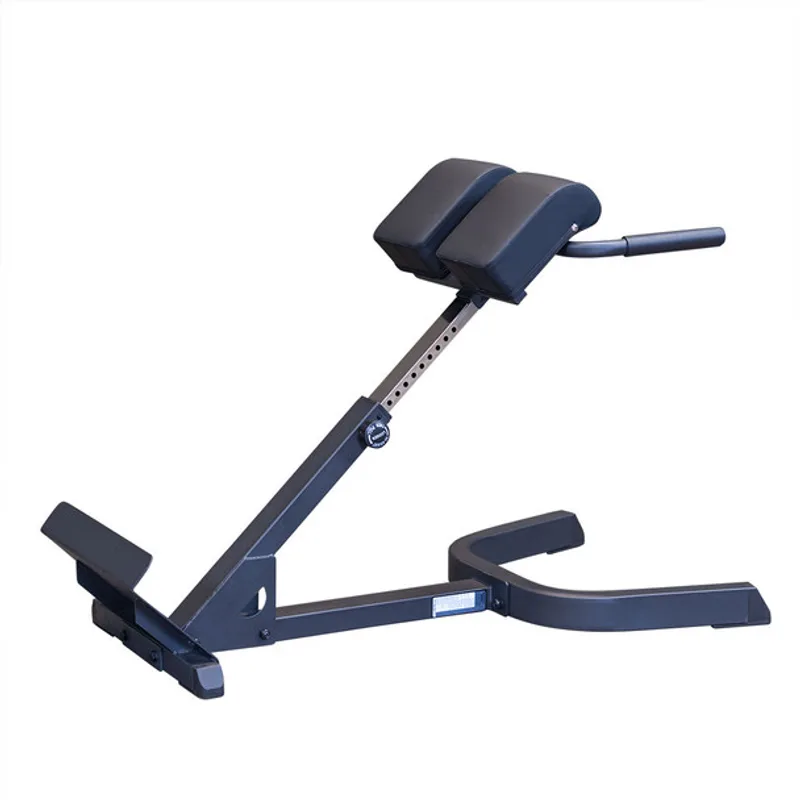
Body-Solid GHYP345B 45-Degree Hyperextension
Pros
- 2"x3" heavy-gauge steel construction designed for both home and light commercial use
- 3" DuraFirm split cushion pads reduce hip pressure during full range of motion sets
- Adjustable pad height accommodates users of different trunk lengths without tools
- Oversized double roller pads distribute load evenly across the thighs, no pinch points
- Fixed 45-degree angle delivers consistent mechanics set after set — no angle drift
- Lifetime frame warranty from Body-Solid, one of the longest in this category
Cons
- 250 lb user weight limit is lower than XMark (300 lbs) and Valor CB-29 (400 lbs)
- No foldable design — this bench has a fixed footprint in your gym
- Higher price than budget options; step up from the competition is noticeable
The Body-Solid GHYP345B has been in production long enough to have accumulated a clear reputation among commercial gym buyers — and that reputation is durable construction that doesn’t require thinking about. The 2”x3” heavy-gauge steel frame uses the same material spec as Body-Solid’s plate-loaded machines, which means it’s overbuilt for home gym use by design.
The 3” DuraFirm split cushion on the hip pad is the single most important feature on a 45-degree hyperextension bench. Split pads allow your pelvis to flex during the movement rather than being locked into a flat surface — which directly affects how much of the range of motion you can access. Cheaper pads with a solid foam construction compress and bottom out under load, creating a hard surface that digs into the hip flexors on deep hyperextension reps. Body-Solid’s DuraFirm material avoids this.
Adjustable pad height is done via a pull-pin on the support arm, with multiple position slots. Based on owner reports, this adjustment covers users from about 5’5” to 6’2” without issue, with taller users sometimes finding the top-of-range position necessary. Assembly is straightforward — most owners complete it in under 30 minutes.
At $349, the GHYP345B is positioned as a one-time purchase. If you’re building a garage gym that you intend to use for a decade, this is the right foundation piece for posterior chain work.
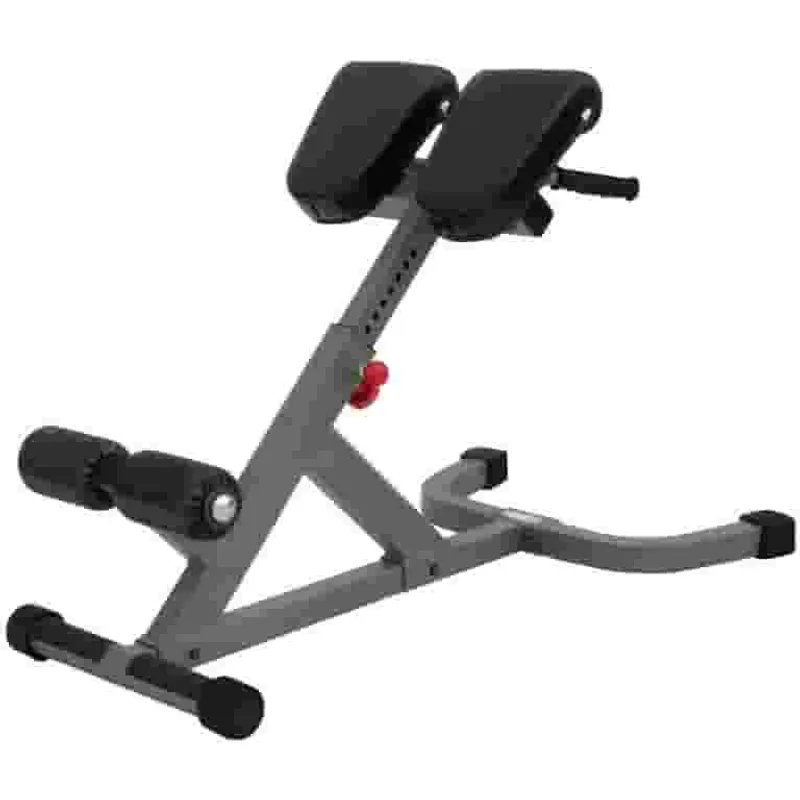
XMark XM-7609 45-Degree Back Hyperextension
Pros
- 11-gauge commercial steel construction is noticeably heavier and more rigid than budget options
- 300 lb weight capacity gives more headroom than most 45-degree benches in this price range
- Integrated tricep dip handles add a second exercise to the bench without taking up extra space
- Wide horseshoe-shaped base provides lateral stability during max-effort sets
- Transport wheels make moving the bench to clean under it straightforward
- Baked powder coat finish resists chips and corrosion better than standard paint
Cons
- Fixed 45-degree angle means no adjustment for different movement patterns
- Heavier unit weight than foldable competitors — not ideal if you need to store it regularly
- Tricep dip handles are a secondary feature; dedicated dip bars perform better for chest dips
The XMark XM-7609 is built to a commercial specification that’s unusual under $250. Eleven-gauge 2”x3” steel is the same frame material you’ll find in club-grade benches that cost two to three times more. The difference between 11-gauge and the lighter 14-gauge or 16-gauge frames found in budget hyperextension benches is immediate when you sit on it — there’s no flex, no creak, no movement.
The horseshoe-shaped base is a practical design choice. Wide-leg bases on hyperextension benches create stability during the movement but create a tripping hazard in tight spaces. XMark’s horseshoe keeps the floor contact points wide at the rear (for stability) while keeping the front footprint cleaner. The transport wheels at the front make rolling it out of position easier.
The integrated tricep dip handles are worth mentioning. They position correctly for close-grip tricep dips, which adds a legitimate upper body exercise to a bench that would otherwise be used exclusively for posterior chain work. The handles are welded on — not an afterthought.
Based on owner feedback, the dual 8”x4.33” vinyl roller pads get specific praise for their width. Narrower roller pads compress a thin line across the thighs during hyperextension sets; the XMark’s wider pads distribute that pressure across more surface area. Less discomfort on the legs means longer, more focused sets.
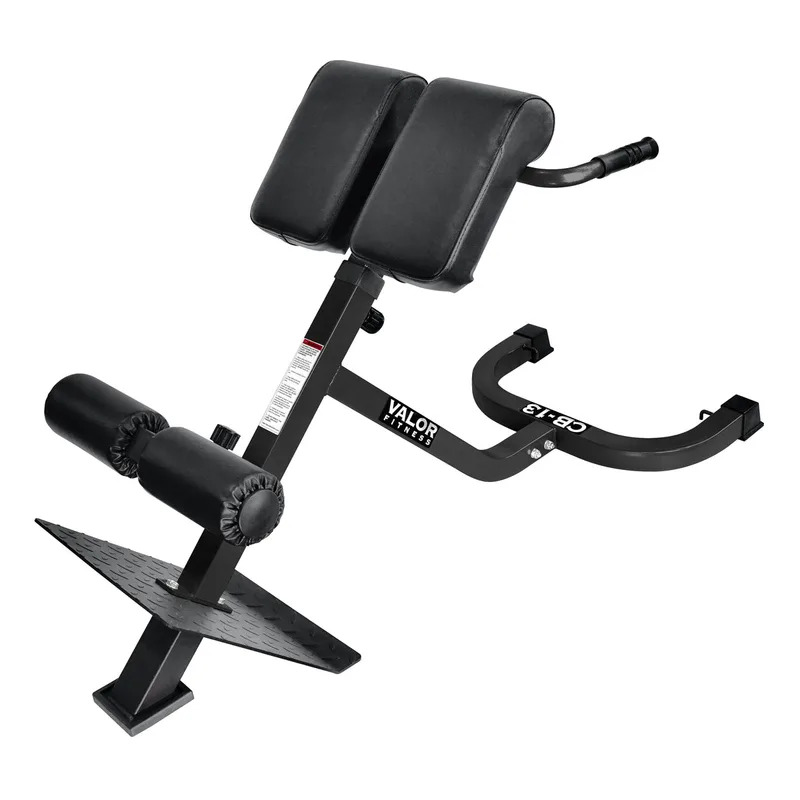
Valor Fitness CB-13 Adjustable Roman Chair
Pros
- 9-position height adjustment accommodates users from about 5' to 6'4" without resorting to workarounds
- Tripod base design provides solid three-point contact on uneven garage or basement flooring
- Dual-layer contoured hip pads reduce the discomfort that plagues flat-pad designs during long sets
- Multi-angle functionality allows sit-up variations in addition to hyperextensions
- 3-year frame warranty covers a realistic home gym lifespan
- Consistent owner feedback on pad durability — no common complaints about foam collapse
Cons
- 2"x2" 12-gauge frame is lighter than the XMark and Body-Solid options; more flex under heavy users
- 250 lb weight capacity matches Body-Solid at the low end for this category
- Tripod base requires all three contact points to be level — minor stability issues on sloped floors
The Valor Fitness CB-13 represents the adjustable roman chair segment — a slightly different movement pattern than the fixed 45-degree bench. On a standard 45-degree hyperextension, your trunk hangs at an angle to the floor, creating a specific lever arm loading the spinal erectors. On a roman chair configuration (where the hip pad is higher and the body hangs more vertically), the lever arm changes and the glutes become more involved at the top of the movement.
The CB-13’s nine position adjustment allows you to shift between these configurations. Lower pad positions emphasize the lower back and erectors in the classic 45-degree pattern. Higher pad positions shift toward a more vertical hang and increase glute involvement. Owners who alternate between lower back and glute-focused work find this adjustment useful enough to warrant the extra cost over a fixed-angle bench.
The tripod base trades some visual mass for function. Three contact points on a potentially uneven garage or basement floor are easier to stabilize than a four-point design — two of three legs will always contact the surface. The dual-layer contoured hip pads are a step up from single-foam designs; the outer layer provides structure while the inner layer conforms to the hip during movement.
At $179, the CB-13 sits in the practical middle of this roundup. Not the cheapest option, not the most expensive, and it covers more use cases than a fixed 45-degree bench.
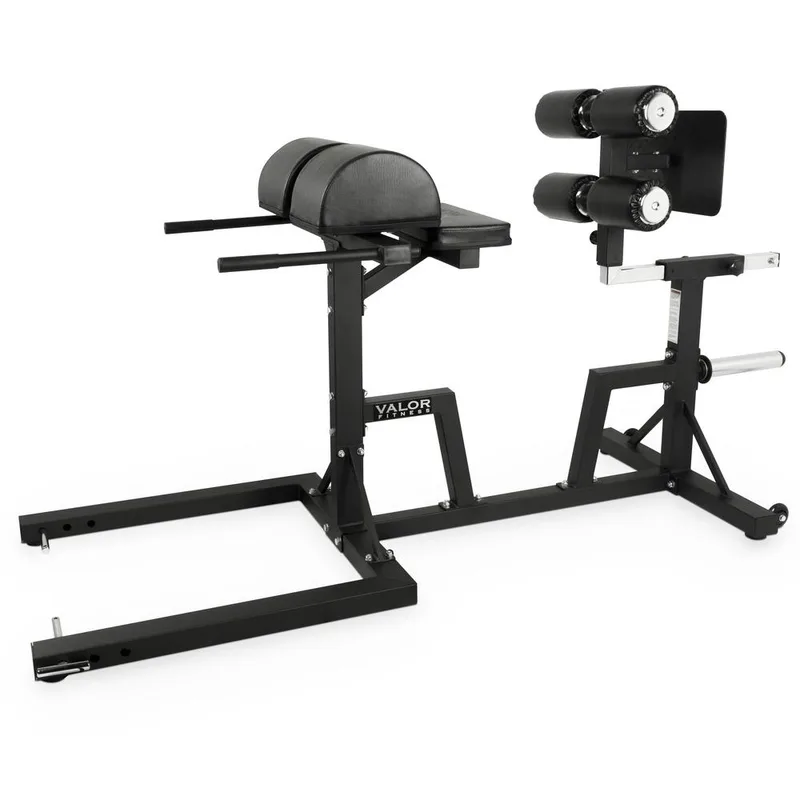
Valor Fitness CB-29 Adjustable Glute Ham Developer
Pros
- 400 lb weight capacity is the highest in this roundup — built for serious lifters
- Full GHD movement allows true glute ham raises, which no 45-degree bench can replicate
- Band pegs and plate storage add utility beyond the primary GHD movement pattern
- 6 horizontal and 4 vertical adjustment positions cover a wide range of user heights and proportions
- GHD sit-ups work the hip flexors and abs through a deeper range than a standard decline bench
Cons
- Highest price in this roundup at $449
- GHD movements require coaching to perform safely — not recommended for beginners without instruction
- Larger footprint than a standard 45-degree bench; takes up more floor space in smaller home gyms
- Heavier and harder to reposition than a standard hyperextension bench
The Valor Fitness CB-29 is a different category of equipment from the other four benches in this roundup. A proper GHD (Glute Ham Developer) allows a movement called the glute ham raise, where you anchor the feet, hang the body off the back of the pad, and use the hamstrings to pull yourself up from a nearly-inverted position. This eccentric hamstring loading is not replicable on a 45-degree hyperextension bench — the body mechanics are completely different.
The practical addition of a GHD to a home gym setup depends on your training goals. For powerlifters, Olympic lifters, and CrossFit athletes, the GHD is a standard accessory movement for posterior chain development and hip flexor strength. For general fitness training, the 45-degree hyperextension covers the lower back and glute work needed without the additional complexity.
The CB-29’s 6 horizontal and 4 vertical adjustment positions allow most users to dial in a position that places the hip crease at the pad edge — the correct setup for both hyperextension reps and GHD sit-ups. The 400 lb weight capacity reflects a heavy-duty frame spec appropriate for loaded GHD sit-ups with a plate held at the chest.
The main limitation of the CB-29 for home gym use is footprint. GHD machines are longer than standard hyperextension benches, and the CB-29 requires floor space similar to a flat weight bench when positioned for use. For smaller garage gyms, measuring before purchasing is essential.
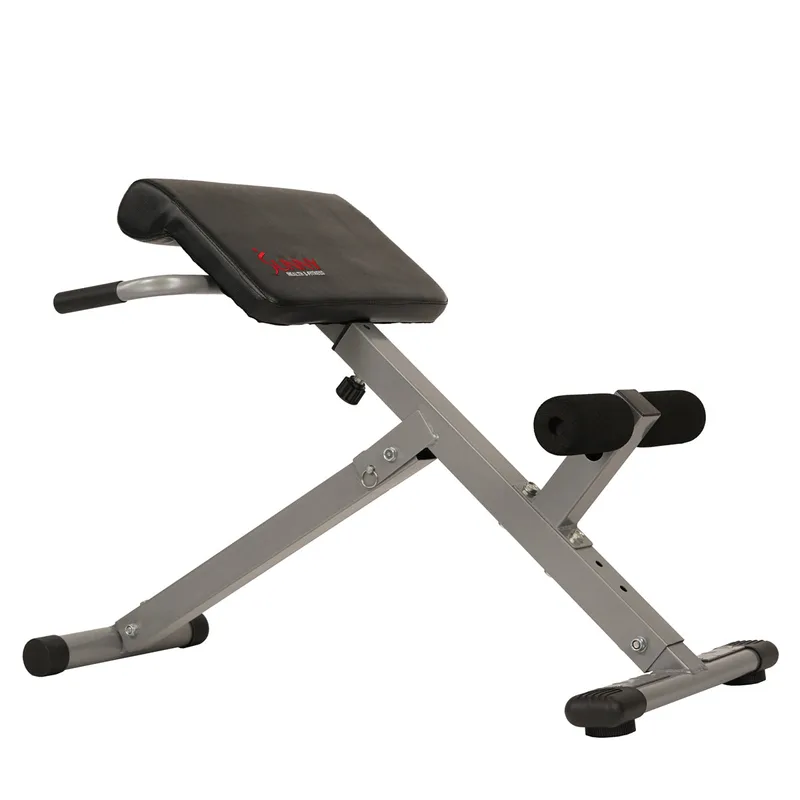
Sunny Health & Fitness SF-BH6629 Roman Chair
Pros
- Under $90 on Amazon with Prime shipping — the most accessible entry point in this category
- Foldable design allows upright storage against a wall; useful in apartments or small gym spaces
- Adjustable height handles users of different sizes without requiring additional hardware
- Strong sales history with consistent availability on Amazon
Cons
- Lighter steel frame construction compared to commercial-grade options
- 250 lb weight capacity is fine for most users but leaves no margin for larger lifters
- Pad thickness is thinner than Body-Solid's 3" DuraFirm — longer sets can get uncomfortable
- Some owner reports note minor wobble under heavier users; stabilizer feet help but don't fully resolve
The Sunny Health & Fitness SF-BH6629 is the starting point for home gym users who want to add basic hyperextension work without allocating significant budget to the category. At under $90 with Prime shipping, it’s the most common recommendation for beginners setting up a first home gym.
The foldable design is the SF-BH6629’s most practical feature. Standing upright against a wall, it takes approximately 12-14 inches of depth — manageable in apartments or shared spaces where equipment visibility matters. The trade-off is that the lighter frame required for folding functionality results in more movement under heavier users than a fixed-frame bench.
Based on owner reports, the SF-BH6629 performs adequately for users under 180 lbs doing moderate-intensity back extension work. For heavier users or those doing weighted hyperextensions with a plate held at the chest, the frame flex becomes noticeable enough to affect confidence during the movement. In that case, stepping up to the XMark or Body-Solid is the right call.
For its intended use case — adding basic lower back and glute work to a home gym on a budget — the SF-BH6629 does the job.
Buying Guide: What to Look for in a Hyperextension Bench
Fixed 45-Degree vs Adjustable Roman Chair
A fixed 45-degree hyperextension bench locks your body at a 45-degree angle to the floor. This creates a consistent lever arm that loads the spinal erectors and upper glutes throughout the movement. It’s the standard configuration found in commercial gyms and is appropriate for most home gym users.
An adjustable roman chair allows the pad height to change, which shifts the angle of your body relative to the floor. Higher positions place more load on the glutes at the top of the movement; lower positions emphasize the lower back. If you want to use one piece of equipment for both lower back and glute-focused work, an adjustable roman chair (like the Valor CB-13) gives you more flexibility.
Frame Gauge and Steel Spec
Frame gauge determines how rigid the bench feels under load. Lower gauge numbers mean thicker steel:
- 11-gauge (XMark XM-7609): Commercial standard, very rigid, minimal flex
- 12-gauge (Valor CB-13): Home gym standard, adequate for most users
- 14-gauge and above: Budget construction, noticeable flex under heavier users
For users over 180 lbs or anyone planning to do weighted hyperextensions, 11 or 12-gauge steel is the right minimum.
Pad Quality
The hip pad is where most hyperextension benches fail in long-term ownership. Pads that use thin foam or poor-quality vinyl compress quickly and create pressure points that distract from training. Look for:
- Thickness: 3 inches or more of foam
- Split pad design: Allows the pelvis to flex during the movement
- Density: High-density foam that doesn’t bottom out under load
- Vinyl quality: Double-stitched vinyl resists tearing at seams
Weight Capacity
Weight capacity on a hyperextension bench accounts for both user bodyweight and any added load (plate held at chest, weight vest). For most users:
- Under 180 lbs bodyweight, no added load: 250 lb capacity is sufficient
- Over 180 lbs or plan to add weight: Look for 300+ lb capacity
- Loaded GHD work: 400 lb capacity (Valor CB-29) covers any realistic load
GHD vs Standard Hyperextension
A GHD machine allows the glute ham raise — a true posterior chain exercise that eccentrically loads the hamstrings through a full range of motion. Standard 45-degree benches do not allow this movement; the foot pad geometry prevents it.
If glute ham raises are a training priority (common in strength sports and CrossFit), a GHD machine is the right purchase. If the goal is lower back strengthening and general posterior chain accessory work, a quality 45-degree bench covers the need at a lower cost and smaller footprint.
Stability Features
Hyperextension benches fail on stability through two common mechanisms: base tip and pad slide. Look for:
- Wide base geometry: Horseshoe or wide-leg designs (XMark) resist forward tip during the hang position
- Rubber floor feet: Prevent the bench from sliding on concrete or rubber gym flooring
- Secure pad adjustment: Pull-pin or bolt systems that don’t allow the pad to shift under load
FAQ
What muscles does a hyperextension bench work?
The primary target is the spinal erectors (lower back), which extend the spine against gravity during the movement. Secondary muscles include the glutes and upper hamstrings, which contribute to hip extension at the top of the range of motion. The reverse hyperextension (done lying face down, lifting the legs) targets the glutes and hamstrings differently, but requires a different piece of equipment — a reverse hyper machine — rather than a standard hyperextension bench.
Can I do weighted hyperextensions on these benches?
Yes, but weight capacity limits apply. Holding a 25 lb plate at your chest adds that load to your bodyweight — a 200 lb user holding a 25 lb plate is generating 225 lbs of load. Body-Solid GHYP345B and Valor CB-13 are rated at 250 lbs total; XMark XM-7609 at 300 lbs. Add weight accordingly and don’t exceed rated capacity. Most home gym users find 25-45 lbs of added load sufficient for lower back development.
How is a hyperextension bench different from a roman chair?
The terms are often used interchangeably, but technically: a 45-degree hyperextension bench positions you at a fixed 45-degree angle to the floor, with the hip pad below the chest pad. A roman chair typically refers to a bench where you’re positioned more vertically, with the hip pad higher, allowing a greater range of motion through the hips. The Valor CB-13 in this roundup functions as both — its adjustable pad height shifts between these two configurations.
How do I set the pad height correctly?
The hip pad should contact the top of your hip (the iliac crest) — not your stomach and not mid-thigh. If the pad is too high, you’ll feel it in your stomach rather than your hip, and the range of motion will be restricted. Too low and you’ll be hyperextending from the thighs rather than the hips, reducing the effective load on the spinal erectors. Most bench manufacturers provide a setup guide; dial in the position before loading.
How often should I do hyperextensions?
For lower back development, 2-3 sessions per week is a reasonable starting point, using 3-4 sets of 10-15 reps. The spinal erectors are an endurance-oriented muscle group and respond well to moderate rep ranges. Avoid training to failure on hyperextension sets — maintaining form through full range of motion matters more than total volume. If you’re doing heavy deadlifts and squats, treat hyperextensions as an accessory movement on non-heavy days rather than training them directly after compound lower back work.
Conclusion
The Body-Solid GHYP345B is the top pick for most home gym setups. The 2”x3” commercial frame, 3” DuraFirm split pads, and lifetime frame warranty make it a bench you buy once. At $349, it’s not cheap — but the build quality justifies the price for anyone training seriously.
For buyers who want the best steel at a lower price, the XMark XM-7609 at $199 delivers 11-gauge commercial construction, a 300 lb capacity, and practical extras like dip handles and transport wheels. It’s the most capable option in the $150–250 range.
The Valor CB-13 at $179 is the right call if you want adjustability — shifting between lower back and glute-focused positions is a genuine advantage over a fixed 45-degree bench for general training.
The Valor CB-29 GHD is a specialty purchase for lifters who need the glute ham raise. Know why you’re buying it before you do.
The Sunny Health SF-BH6629 gets the job done under $90. It’s the right starting point — upgrade to XMark or Body-Solid when the budget allows.