The functional trainer market reached a clear inflection point in 2026. REP Fitness launched the Arcadia Max with 36 cable positions and dual 220 lb weight stacks — a spec sheet that would have required a $5,000+ commercial machine three years ago. Force USA evolved the G9 into the G10 Pro with updated cable geometry and improved attachments. And the Inspire FTX, now appearing under the Centr brand at major retailers, continues attracting intermediate home gym owners who want genuine dual-cable training in a compact footprint.
This roundup covers five machines across three price tiers — from a $1,087 plate-loaded budget option up to a $2,999 eight-function all-in-one system. These machines don’t just add cable work to a home gym; they replace multiple pieces of single-function equipment, making them particularly valuable for intermediate builders who want to expand training variety without expanding floor space.
Quick Picks
Inspire FTX is the best overall choice for most home gym owners moving into cable training: compact, dual 165 lb stacks, 30 swivel positions, and an integrated pull-up bar, available on Amazon around $1,999.
REP Fitness Arcadia Max is the best pure functional trainer at the premium level — 36 cable positions, 93.4” cable travel, and upgradeable 270 lb stacks built by REP’s Colorado engineering team.
Force USA G10 Pro is the pick for anyone who wants to replace an entire commercial gym with a single plate-loaded all-in-one system in their garage.
Bells of Steel Functional Trainer (Plate-Loaded) is the best value at $1,086.99 — genuine dual-cable training at the lowest entry point in this roundup.
Body-Solid GDCC210 is the best option for buyers who want commercial-grade cable construction with Amazon Prime delivery and no freight logistics.
Comparison
| Spec | Inspire Fitness FTX Functional Trainer | REP Fitness Arcadia Max Functional Trainer | Force USA G10 Pro All-In-One Trainer | Bells of Steel Functional Trainer (Plate-Loaded) | Body-Solid GDCC210 Compact Functional Trainer |
|---|---|---|---|---|---|
| Rating | 9.2/10 | 9.0/10 | 8.8/10 | 8.5/10 | 8.2/10 |
| Price | $2099.00as of Oct 18, 2026 | $2,699 | $2,999 | $1,087 | $1875.00as of Oct 18, 2026 |
| Weight Stacks | Dual 165 lb (2:1 ratio) | Dual 220 lb standard (270 lb upgrade available) | — | — | Dual 160 lb (upgradeable to 220 or 330 lb) |
| Max Effective Load | 82.5 lb per side | — | — | — | — |
| Pulley Positions | 30 swivel | — | — | — | — |
| Dimensions | 54" W × 40" D × 82" H | — | — | 30" D × 53" W × 81" H | — |
| Machine Weight | 544 lb | — | — | — | — |
| Included Accessories | Triceps rope, 2× D-handles, curl bar, chin/dip belt | — | — | — | — |
| Cable Positions | — | 36 | — | 16 | — |
| Cable Travel | — | 93.4 in | — | — | — |
| Frame Width | — | 75.5 in | — | — | — |
| Pulley Ratio | — | 2:1 | — | — | — |
| Shipping | — | Freight (single crate) | — | — | — |
| Functions | — | — | 8-in-1 (power rack, smith machine, cables, chin-up, dip, leg press, low row, core) | — | — |
| Loading | — | — | Plate-loaded (no weights included) | Plate-loaded | — |
| Minimum Ceiling Height | — | — | 8 ft 3 in | — | — |
| Cable Ratios | — | — | 1:1 and 2:1 | — | — |
| Steel Gauge | — | — | 11-gauge | — | — |
| Warranty | — | — | Lifetime frame | Lifetime | Body-Solid limited lifetime |
| Steel | — | — | — | 14-gauge rails | — |
| Weight Stack Version | — | — | — | $2,144.99 (dual 160 lb stacks) | — |
| Design | — | — | — | — | Compact freestanding dual-stack |
| Weight Adjustment | — | — | — | — | 5 lb increments |
| Pulley System | — | — | — | — | Dual independent cables |
| Frame | — | — | — | — | Heavy commercial-gauge steel |
| Check Price → | Check Price at REP Fitness → | Check Price at Force USA → | Check Price at Bells of Steel → | Check Price → |
Prices change daily — tap Check Price for the current Amazon price. Numbers shown were verified on the "as of" date.
Detailed Reviews
Inspire Fitness FTX Functional Trainer — Best Overall
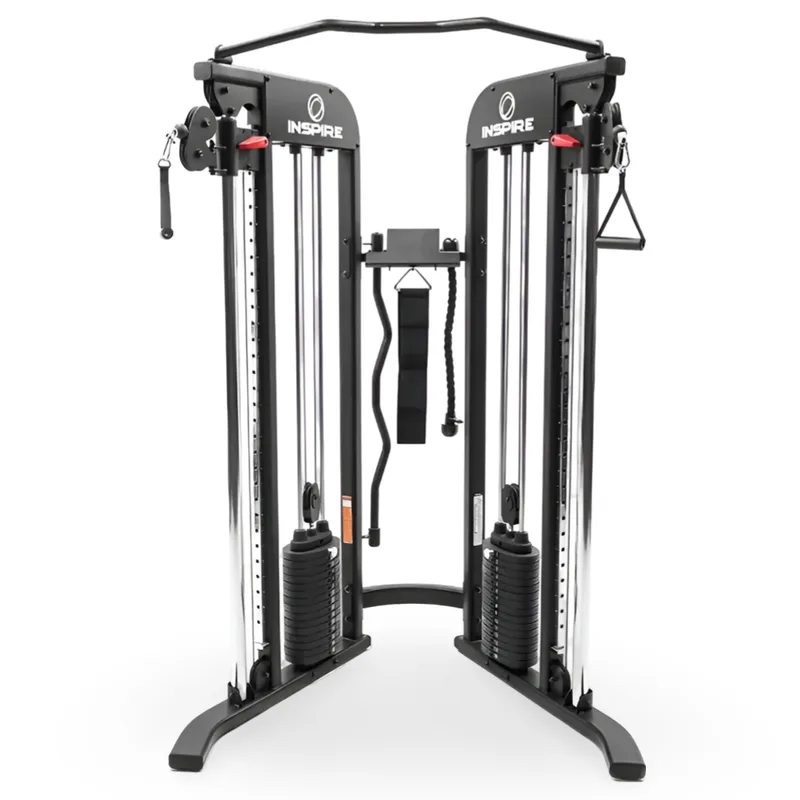
Inspire Fitness FTX Functional Trainer
Pros
- Compact 54" × 40" footprint fits tight garage gym layouts without dominating the room
- 30 swivel pulley positions allow precise cable angle targeting across hundreds of exercises
- Integrated pull-up bar adds upper-body volume without a separate station
- Five accessories included out of the box — training starts immediately after assembly
- 544 lb machine weight keeps the frame planted under heavy loading without anchoring
Cons
- 82.5 lb max effective load per side limits advanced lifters on heavy cable rows and presses
- No smith machine, leg press, or power rack function compared to all-in-one systems
- Weight cannot be easily upgraded beyond the dual 165 lb stacks
The Inspire FTX has been on the market long enough to build a real track record, and in 2026 it still represents the most complete package at this price tier. Dual 165 lb weight stacks with 30 independent swivel positions give enough configuration variety for cable flyes, lat pulldowns, cable rows, triceps pushdowns, face pulls, and rotational core work — without rearranging the machine between exercises.
The 2:1 pulley ratio caps effective max load at 82.5 lb per side. That covers most cable accessory movements for the majority of lifters. Advanced trainees who want to cable row 100+ lb or perform heavy cable presses will approach the limit. The Arcadia Max’s 110 lb effective load (137.5 lb with the weight stack upgrade) is the next step up.
The 54” × 40” floor footprint is genuinely compact by dual-stack standards. Integrated chin-up bar adds a bodyweight upper-body option without a separate pull-up station. At 544 lbs, the machine stays planted — no anchoring to the wall or floor required. Owner feedback consistently highlights frame stability during heavy loading as one of the FTX’s standout qualities.
The five included accessories — triceps rope, two D-handles, curl bar, chin/dip belt — cover the standard cable attachment toolkit. Most committed cable users eventually add specialty attachments (ankle straps, v-bar, seated row attachment), but the included kit gets training started on day one.
REP Fitness Arcadia Max Functional Trainer — Editor Pick
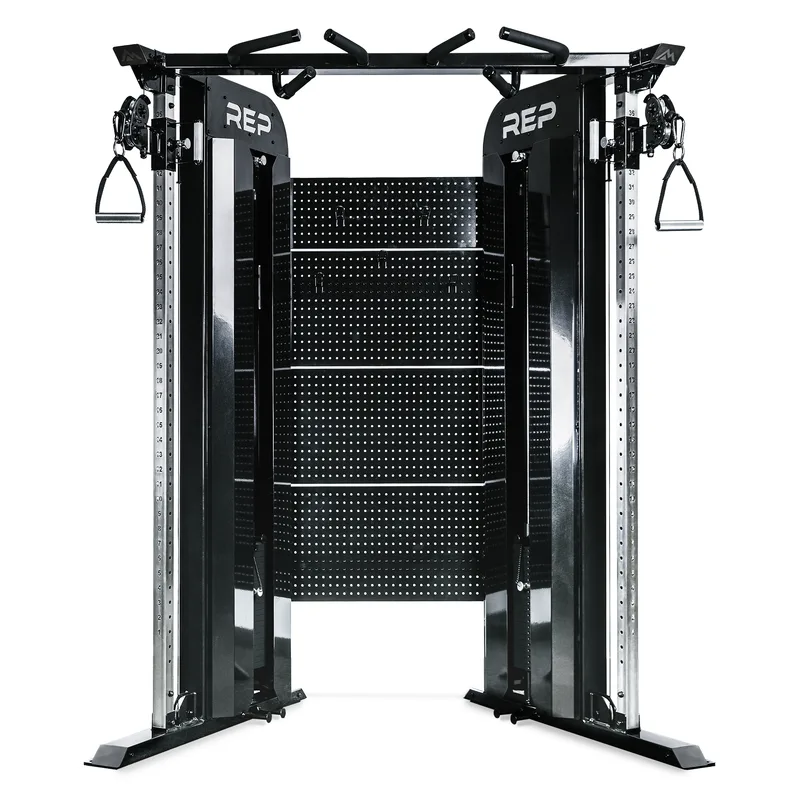
REP Fitness Arcadia Max Functional Trainer
Pros
- 36 cable height positions — more than nearly every competitor in this price range
- 93.4" cable travel length handles full overhead pulls for users up to 6'4"+
- 220 lb stacks upgradeable to 270 lb per side for advanced progressive loading
- Colorado-engineered with commercial build quality and REP's lifetime structural warranty
- Dual independent columns allow simultaneous asymmetric training configurations
Cons
- Direct purchase only — no Amazon, no Prime shipping, freight delivery required
- 75.5" frame width demands significant floor space in smaller home gyms
- Premium pricing puts it out of reach for budget-focused home gym builders
The Arcadia Max is REP’s first functional trainer engineered by their Colorado team, and it’s built to specifications that make competing products in the $2,000–$3,000 range look underpowered. The 36 cable height positions are the headline figure — most competitors offer 20–24 positions, which creates gaps in cable angle coverage between hip height and shoulder height that can affect exercise targeting precision.
The 93.4” cable travel length enables full overhead cable pulls without running out of cable at extension. Tall users performing standing rows, cable woodchops, and overhead triceps extensions have consistent cable range across the full movement. The standard Arcadia (non-Max) has 81” cable travel — a meaningful difference for users over 6’2” or those focused on overhead patterns.
Dual 220 lb stacks deliver 110 lb effective load per side at a 2:1 ratio. That covers virtually all cable accessory work, including heavy cable rows and pressing movements, for advanced lifters. The optional weight stack upgrade brings per-stack capacity to 270 lbs — territory typically reserved for commercial machines. REP ships the Arcadia Max in a single freight crate; plan for delivery scheduling and clear the path from your driveway to the gym space before the order arrives.
At 75.5” wide, the Arcadia Max occupies a dominant position in smaller gym configurations. In a 10×10 garage gym, it becomes the anchoring piece around which everything else is organized. For lifters who want the most functional trainer performance per dollar at the premium level, nothing else in this roundup matches it.
Force USA G10 Pro All-In-One Trainer — Best All-In-One
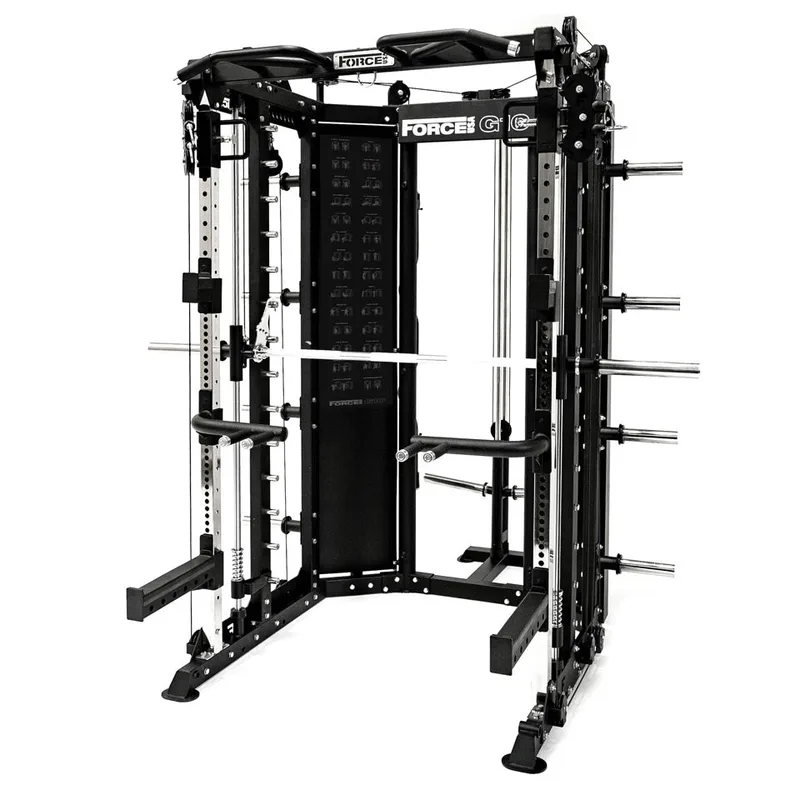
Force USA G10 Pro All-In-One Trainer
Pros
- Eight training machines in one unit — replaces a power rack, smith machine, cable system, leg press, and more
- Plate-loaded design means no weight stack ceiling — load it as heavy as your plate collection allows
- 11-gauge steel construction matches commercial gym equipment standards
- Dual cable ratio options (1:1 and 2:1) accommodate both heavy loading and isolation accessory work
- Lifetime frame warranty from Force USA covers structural failures long-term
Cons
- Plate-loaded requires purchasing Olympic plates separately — significant added cost for new home gym builders
- 8'3" minimum ceiling height eliminates most basement and low-garage setups
- Complex assembly — professional install service is recommended and adds to total cost
The G10 Pro is Force USA’s evolved plate-loaded all-in-one system. Eight training functions integrated into a single unit: power rack with spotter arms, smith machine on Olympic plate loading, dual cable pulley system with 1:1 and 2:1 ratio options, chin-up and dip stations, vertical leg press, low row attachment, and core trainer. That’s a power rack, a cable machine, a smith machine, and a leg press combined.
The critical distinction from functional trainers like the Inspire FTX and Arcadia Max: the G10 Pro is plate-loaded, not weight-stack-loaded. There’s no stack ceiling. Load the cable system with Olympic plates and the effective weight is constrained only by how many plates you own. For lifters who already have a full plate collection, that means cable loads well beyond what any selectorized stack machine can deliver. For buyers starting from scratch, add the cost of an Olympic plate set — typically $300–$800 for a serviceable collection — on top of the $2,999 machine price.
The 8’3” minimum ceiling requirement is the hard filter for this machine. Standard residential basements typically clear 7’–8’. Single-car garage conversions with 8’ ceilings also fall short. Measure ceiling height before ordering — freight returns on equipment this size are logistically complex. Force USA’s 11-gauge steel construction and lifetime frame warranty reflect the premium positioning.
Based on owner reports from the G9 predecessor — which the G10 Pro replaces — long-term durability is a consistent strength. The all-in-one format means the machine is a major presence in any gym space, but for lifters who want barbell training and cable training and smith machine work in a single footprint, it’s the most efficient solution in this roundup.
Bells of Steel Functional Trainer (Plate-Loaded) — Best Value
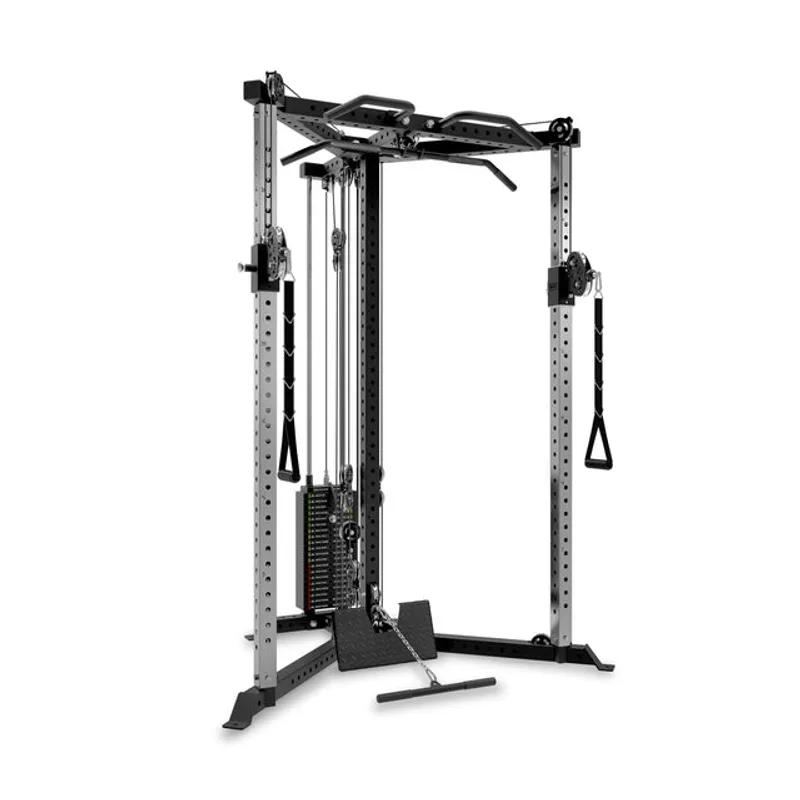
Bells of Steel Functional Trainer (Plate-Loaded)
Pros
- Most affordable entry into dual-cable functional training in this roundup at $1,086.99
- Compact 30" × 53" footprint fits garage gym configurations where wider machines cannot
- 14-gauge steel build quality surpasses most cable machines at this price point
- Lifetime warranty backs the long-term durability claim
- Plate-loaded design scales with your existing plate collection without a stack ceiling
Cons
- 16 cable height positions is fewer than mid-range and premium competitors (30–36 positions)
- Plate-loaded requires purchasing Olympic plates separately if not already owned
- Direct-only — no Amazon listing or Prime shipping
At $1,086.99, the Bells of Steel Functional Trainer plate-loaded version is the most affordable path to real dual-cable training. The machine uses 14-gauge steel rails and a dual-pulley layout that delivers the core functional trainer exercises — cable rows, cable presses, lat pulldowns, core rotations — without the premium markup of a selectorized weight stack system.
The 30” depth × 53” width footprint works in garage gym configurations where a 75” wide Arcadia Max won’t fit. The 81” height clears standard 8’ ceilings comfortably. For buyers with space constraints and a solid plate collection already in place, the plate-loaded version offers strong value.
The practical limitation is cable positions. At 16 positions, coverage spans the essential low, mid, and high cable zones for most exercises. Users who rely on very specific intermediate angles — particular cable fly positions, precise face-pull heights, targeted core rotation angles — will feel the coverage gap compared to machines with 30–36 positions.
Bells of Steel also offers a weight stack version of the same machine at $2,144.99, with dual 160 lb stacks and 30 swivel positions — comparable to the Inspire FTX configuration at a slightly higher price point. For buyers uncertain about the plate-loaded model, the weight stack upgrade makes the step-up comparison clear. Both versions carry Bells of Steel’s lifetime warranty. Direct purchase only, no Amazon listing.
Body-Solid GDCC210 Compact Functional Trainer — Best Commercial-Grade
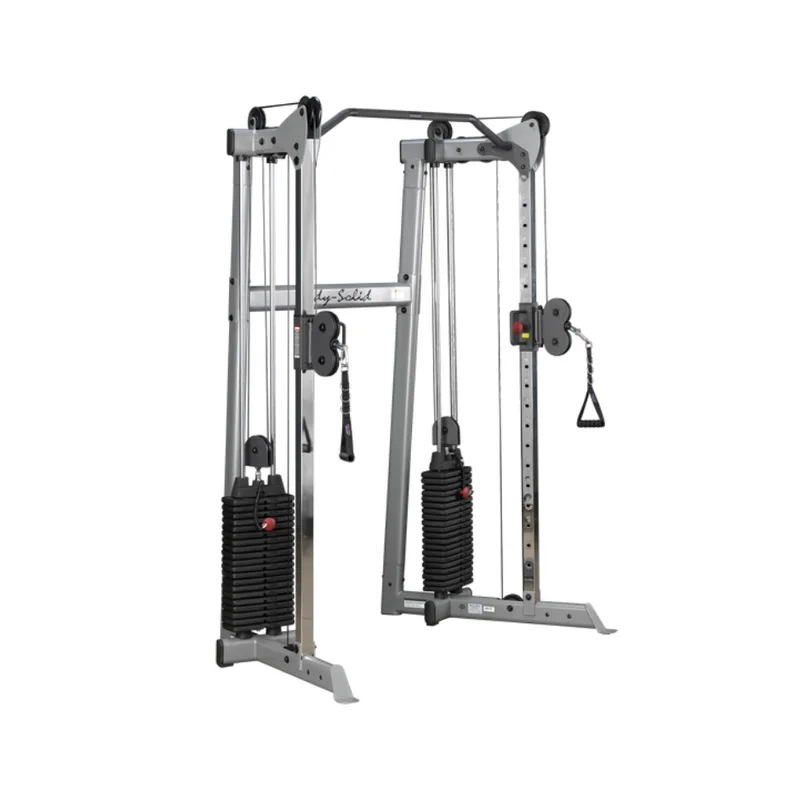
Body-Solid GDCC210 Compact Functional Trainer
Pros
- Commercial-grade steel construction at a home gym price — built to the same spec as Body-Solid's institutional products
- Available on Amazon with Prime shipping — no freight scheduling required
- Dual independent weight stacks adjustable in 5 lb increments for precise progressive overload
- Upgradeable to 220 or 330 lb stacks for heavier loading as training advances
- Body-Solid's limited lifetime warranty is among the strongest in the cable machine category
Cons
- 160 lb base stacks limit peak output compared to the Arcadia Max or Inspire FTX
- Compact design prioritizes footprint reduction over cable position range and modern refinements
- Older design — lacks integrated media mounts and organized cable routing found in newer machines
The Body-Solid GDCC210 occupies a specific niche: commercial-grade dual-stack cable construction, available on Amazon, without freight-only logistics. That combination is rarer than it sounds. Most Amazon-available cable machines at this price point use lighter-gauge steel, cheaper pulley assemblies, and tighter manufacturing tolerances. The GDCC210 is built to the same standard as equipment Body-Solid ships to commercial facilities — heavier steel, stronger pulleys, tighter spec tolerances.
The dual independent weight stacks start at 160 lbs each and are upgradeable to 220 or 330 lb configurations, available separately. Weight adjustment runs in 5 lb increments for precise load selection across accessory exercises. Prime shipping eliminates the freight scheduling and delivery coordination that comes with REP, Force USA, and Bells of Steel purchases.
The design shows its age in one area: the GDCC210 predates integrated media mounts, organized cable routing, and the refined aesthetics that newer functional trainers prioritize. It’s a workmanlike machine — functional and durable, without modern polish. For buyers who prioritize build quality and cable performance over aesthetics, that trade-off is entirely acceptable.
Based on owner reports, the GDCC210 handles consistent daily training loads without frame flex or pulley degradation over extended periods. Body-Solid’s limited lifetime warranty aligns with their commercial design standards and backs the long-term durability claims.
Buying Guide: What to Look For
Weight Stack vs. Plate-Loaded
Weight stack machines (Inspire FTX, Arcadia Max, GDCC210) use selectorized stacks — drop a pin and adjust in seconds between sets. Plate-loaded systems (Force USA G10 Pro, Bells of Steel plate-loaded) use Olympic plates, which take longer to change but have no stack ceiling.
For cable accessory work — isolation exercises, core training, rehab movements — stack machines are more practical. Fast weight changes between sets fit naturally into higher-volume accessory training. For lifters who want maximum loading potential and already own a full Olympic plate collection, plate-loaded systems offer better long-term scalability without paying for an upgrade.
Cable Positions and Travel Length
Position count determines how many discrete exercise angles are available. At 16 positions (Bells of Steel plate-loaded), low, mid, and high cable zones are covered. At 30 positions (Inspire FTX), angle coverage is precise enough to target different muscle portions across their full range of motion. At 36 positions (Arcadia Max), coverage reaches commercial machine standards.
Cable travel length matters most for tall users and overhead work. At 81” travel, overhead pulling exercises work for most users up to 6’0”–6’2”. At 93.4” (Arcadia Max), taller athletes have full overhead range without running out of cable at the extension point.
Footprint and Ceiling Requirements
Dual-stack functional trainers are not small pieces of equipment. The Inspire FTX at 54” × 40” is compact for its feature set. The Arcadia Max at 75.5” wide needs significant wall clearance. The Force USA G10 Pro’s width and 8’3” ceiling requirement are hard constraints that disqualify most basement and standard-ceiling garage setups.
Measure available wall space and ceiling height precisely before ordering any machine in this category. Ceiling incompatibilities discovered post-purchase are logistically expensive to resolve on freight equipment.
Total Cost of Ownership
Factor in the full cost beyond the machine price:
- Plate-loaded systems require Olympic plates — add $300–$800 depending on total weight needed
- Direct-only machines require freight delivery coordination and longer lead times
- Additional cable attachments (ankle straps, v-bar, rope extensions, lat pulldown bar) add $50–$200
- Professional assembly services add $150–$400 for complex all-in-one systems
FAQ
What’s the difference between a functional trainer and a cable crossover machine?
A functional trainer has two independently adjustable cable columns that move up and down across many height positions, enabling a wide range of cable angles. A traditional cable crossover has fixed high-pulley and low-pulley stations with less positional variety. Functional trainers offer more exercise flexibility; fixed cable crossovers can sometimes handle heavier peak loads on fixed-height exercises. Most modern machines blur this distinction with multi-position adjustable pulleys.
Do I need a functional trainer if I already have a power rack?
Not necessarily — they serve different purposes. A power rack handles free-bar barbell movements: squat, bench, overhead press, deadlift. A functional trainer handles cable-based movements that require constant tension through a full range of motion: rows, cable presses, pulldowns, isolation work, core training. Most intermediate-to-advanced lifters eventually want both. The Force USA G10 Pro integrates both functions into one unit.
What weight stack size do I actually need?
For most cable accessory work — triceps pushdowns, face pulls, cable curls, cable flyes — 80–100 lb of effective resistance per side covers the practical training range for most lifters. At a 2:1 pulley ratio, that requires a 160–200 lb stack per side. Strength athletes using cable rows and presses as primary movements with heavier progressive loading benefit from the Arcadia Max’s 220–270 lb stacks.
How long does it take to assemble a functional trainer?
Most dual-stack functional trainers require 2–4 hours for one person, or 1–2 hours with two people working together. The Force USA G10 Pro is more complex given its multi-function design — owner reports suggest 4–8 hours without professional assistance. All machines in this roundup ship with assembly instructions; Force USA also offers a professional assembly add-on service.
Are functional trainers worth it for home gyms?
For intermediate-to-advanced lifters who have already built out a barbell and plate foundation and want to add cable training variety, functional trainers deliver significant exercise range in a manageable footprint. They’re not a starting point — they’re an upgrade. Home gym builders still in the early phase should prioritize rack, barbell, and plates before committing to a $1,000–$2,700 cable machine.
Conclusion
The Inspire Fitness FTX is the right call for most home gym owners taking the first step into cable training. Compact, reliable, and available on Amazon, it delivers the core functional trainer experience — dual stacks, 30 positions, integrated pull-up bar — without freight logistics or direct-only purchasing.
For buyers who want the highest-performing pure functional trainer at the premium level, the REP Fitness Arcadia Max sets the benchmark — more cable positions, longer travel, and heavier stack capacity than any other machine in this roundup.
If your goal is replacing every machine in a commercial gym with a single all-in-one system and you have the ceiling height to match, the Force USA G10 Pro is the most space-efficient way to get there.
And if budget is the hard constraint, the Bells of Steel Functional Trainer Plate-Loaded at $1,086.99 delivers real dual-cable training at the lowest entry point covered here.