Plate-loaded machines are having a genuine moment in 2026. Major Fitness just announced the F35PRO functional trainer with built-in plate-loaded stacks — shipping June 17 — and the wave of interest has pushed the broader category into focus. While weight-stack machines dominate commercial gyms, serious home gym builders increasingly prefer plate-loaded lever equipment: no weight stacks to service, no weight plates to replace, and the same steel stays functional for decades.
The tradeoff is space and cost. Plate-loaded lever machines are large and heavy, and the best ones are not cheap. But for athletes who have already invested in a rack, a barbell, and a set of Olympic plates, they represent the most efficient upgrade path — you already own the weights, the machine just gives you a new way to use them.
This roundup covers five plate-loaded machines that work for real home gyms: a 2-in-1 leg press and hack squat, a chest-supported T-bar row, a plate-loaded chest press, a plate-loaded seated row, and a dual-pulley lat pulldown/low row system. All five are currently available, all have verifiable Amazon listings, and none require buying a separate weight stack.
Quick Comparison
| Machine | Primary Function | Capacity | Steel Gauge | Price |
|---|---|---|---|---|
| Body-Solid GLPH1100 | Leg Press + Hack Squat | 1,000 lb | 11-gauge | $1735.00 as of Oct 18, 2026 |
| Titan Chest-Supported T-Bar Row | Upper Back Rowing | 400 lb | Heavy | $365.99 as of Oct 18, 2026 |
| Body-Solid LVBP | Leverage Chest Press | Olympic plates | 11-gauge | $1095.00 as of Oct 18, 2026 |
| Valor Fitness CB-14 | Plate-Loaded Seated Row | 400 lb | 12-gauge | $338.97 as of Oct 18, 2026 |
| Valor Fitness CB-12 | Lat Pulldown + Low Row | 200 lb | 12-gauge | Unavailable |
1. Body-Solid GLPH1100 Leg Press & Hack Squat — Editor Pick
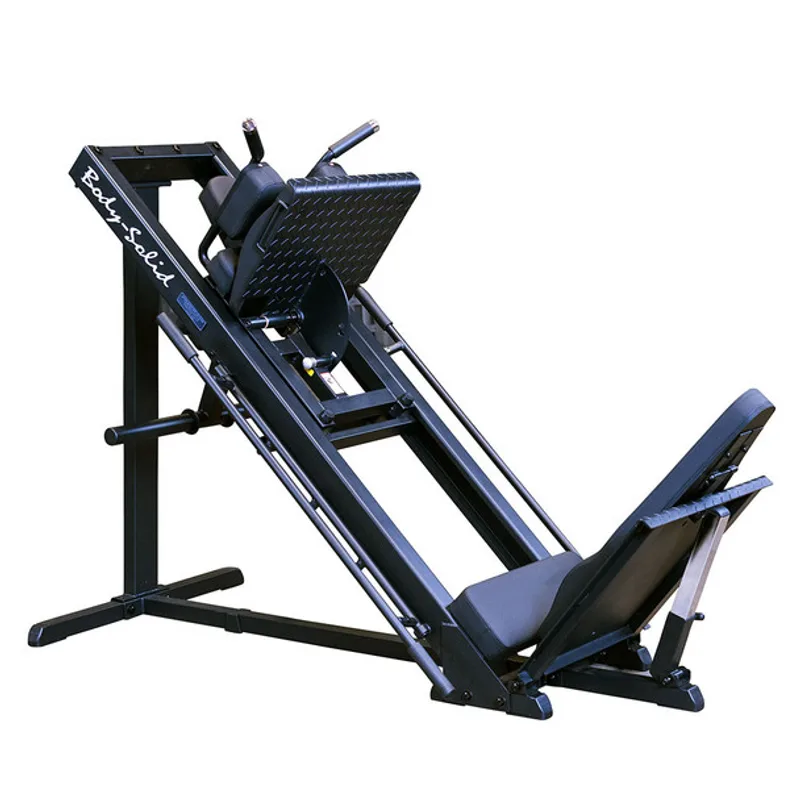
Body-Solid GLPH1100 Leg Press & Hack Squat
Pros
- 2-in-1 flip-and-lock design switches from leg press to hack squat without tools
- 1,000 lb rated capacity exceeds anything home gym athletes will load
- 11-gauge 2" × 4" steel mainframe eliminates torsional flex under heavy loads
- 4" thick contoured shoulder and back pads absorb pressing forces correctly
- Body-Solid Lifetime Warranty covers the full frame in commercial or home use
Cons
- At $1,735, it is the most expensive machine in this roundup
- Heavy shipping weight — curbside delivery often required, not white-glove
- Large footprint demands dedicated floor space; not suited to compact garage setups
- Assembly is physically demanding — two people strongly recommended
The GLPH1100 is the most purchased plate-loaded leg machine among dedicated home gym builders, and it earns that position through build quality rather than price. The 2” × 4” 11-gauge mainframe is the same steel specification used in commercial installations — the kind of frame that accumulates decades of use without warping or wobbling.
The defining feature is the flip-and-lock conversion system. The back pad locks into leg press position (45-degree sled angle), then physically flips to convert the machine into a traditional 45-degree hack squat with shoulder pads engaging instead. The transition is mechanical and secure — there is no looseness in the locked positions according to owner feedback across multiple retailers.
For lower body development, having both movements on one footprint is significant. The leg press emphasizes quad, hamstring, and glute loading with the back supported and removed from the equation. The hack squat shifts the torso angle and increases the knee travel range, creating a different quad-emphasis stimulus. Athletes who compare notes on home gym forums consistently report that the dual functionality justifies the premium over a single-function leg press.
The 4” thick contoured shoulder and back pads are notably dense — the design absorbs pressing forces across a wide surface area and does not bottom out under heavier loads based on long-term owner reports. Assembly is the primary complaint: the machine ships heavy, the parts are large, and two people are genuinely necessary for safe installation.
2. Titan Fitness Chest-Supported T-Bar Row — Best T-Bar Row
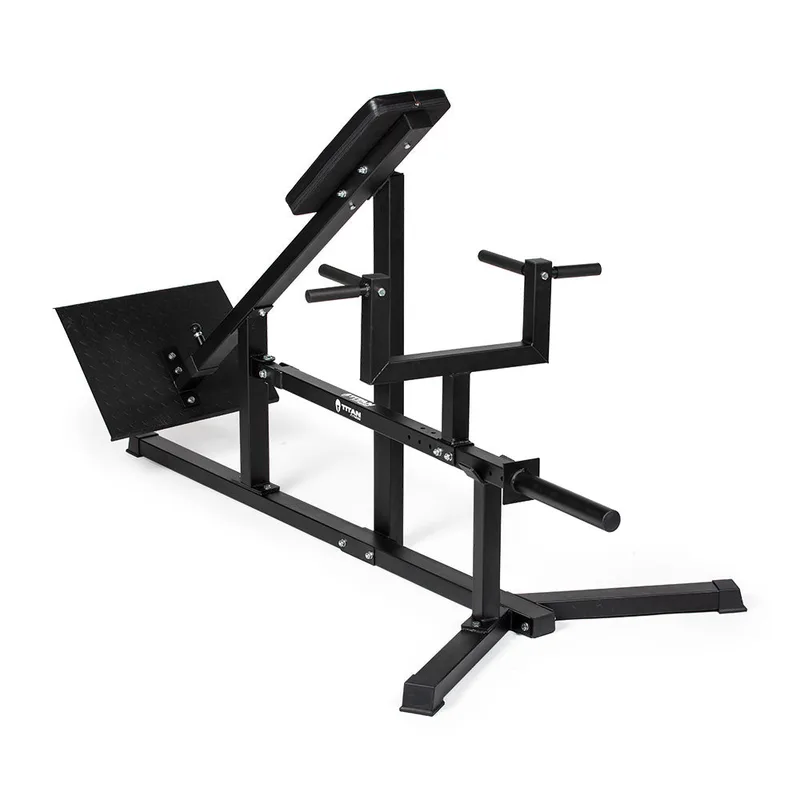
Titan Fitness Chest-Supported T-Bar Row
Pros
- Chest support eliminates lower back compensation — all pulling force goes into the lats and rhomboids
- Five multi-grip handle positions hit mid-back, upper back, and rear delts from different angles
- 400 lb capacity is more than enough for any realistic T-bar rowing load
- Diamond-textured footplate grips firmly and adjusts for taller or shorter users
- Powder-coated steel holds up to daily use without peeling or rusting prematurely
Cons
- 84" depth requires serious floor space — verify your gym layout before ordering
- Plate loading is rear-heavy; loading and unloading plates in position requires some care
- Does not fold or disassemble for storage
- Some owner reports mention the chest pad height could accommodate taller users better
A T-bar row without chest support is an effective exercise — but it also loads the lower back heavily as a stabilizer, which means your back fatigues before your lats do on heavy sets. The Titan chest-supported version removes that limitation entirely. The chest pad takes the stabilization load, so every bit of pulling force goes directly into the mid-back, lats, and rear delts.
Titan equipped this machine with five multi-grip handle positions. Each grip position changes the hand width and pronation angle, shifting emphasis between the rhomboids, lats, and mid-trap. Owners who compare this to gym-quality equipment consistently note the range of stimulus available from a single machine. The adjustable diamond-textured footplate accommodates height differences without compromising posture at the hip hinge.
The 400 lb plate capacity is not the limiting factor for almost any home gym athlete — it’s well above the realistic loading range for horizontal pulling exercises. At $366, the Titan chest-supported model is the most accessible route into premium-quality lever row training. The footprint (43” W × 84” D) is substantial and needs advance planning, but for back development per dollar, nothing else in this roundup comes close.
3. Body-Solid LVBP Leverage Bench Press — Best Chest Press
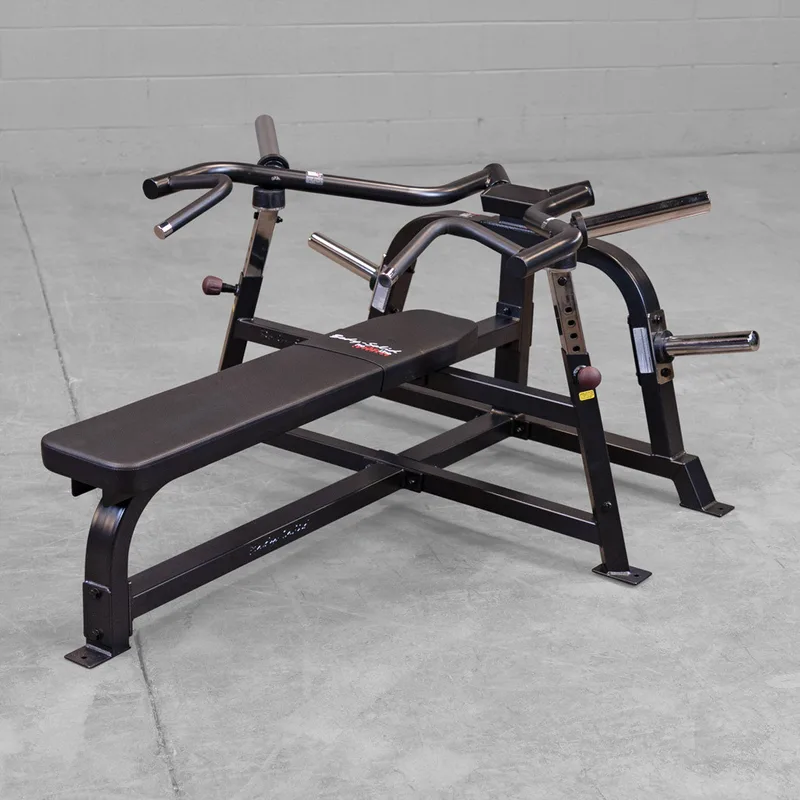
Body-Solid LVBP Leverage Bench Press
Pros
- Gas-assisted start positions set the bar at chest height automatically — no dangerous unrack from a dead stop
- Sealed bearing pivot points provide smooth, friction-free pressing arc through the full range of motion
- Converging arm path mimics the natural arc of a barbell bench press more closely than fixed-bar machines
- 11-gauge steel construction matches the durability standard of commercial gym equipment
- Lifetime warranty from Body-Solid is transferable — the machine holds resale value well
Cons
- $1,095 price point is not budget territory — best suited for serious home gym builds
- Heavier than expected at 154 lb; repositioning the machine requires help
- No incline or decline adjustment — dedicated flat press only
- Footprint of 53" wide requires a cleared wall section with room to load plates on both sides
The case for the LVBP comes down to one feature: the gas-assisted start position. With a free-weight barbell, unracking from a dead-stopped position at chest height creates a moment of vulnerability — especially training alone. The LVBP lifts the handles to the starting chest-height position automatically, so the first rep begins from a controlled position rather than a dangerous unrack.
Beyond safety, the sealed-bearing pivot points deliver a pressing arc that holds smooth and friction-free through the full range of motion. The converging arm path mimics a barbell’s natural arc more accurately than a Smith machine’s fixed vertical track — so the chest activation pattern feels mechanical and natural rather than forced.
The 2” × 3” 11-gauge steel construction and 154 lb machine weight signal that Body-Solid built this to stay in place permanently. This is not a machine you reconfigure or move seasonally. The Lifetime Warranty from Body-Solid (transferable) reflects that expectation. At $1,095, it represents a meaningful investment for a chest-specific lever machine — but for home gym athletes who want a pressing option that does not require a spotter, the value is clear.
4. Valor Fitness CB-14 Plate-Loaded Seated Row — Best Seated Row
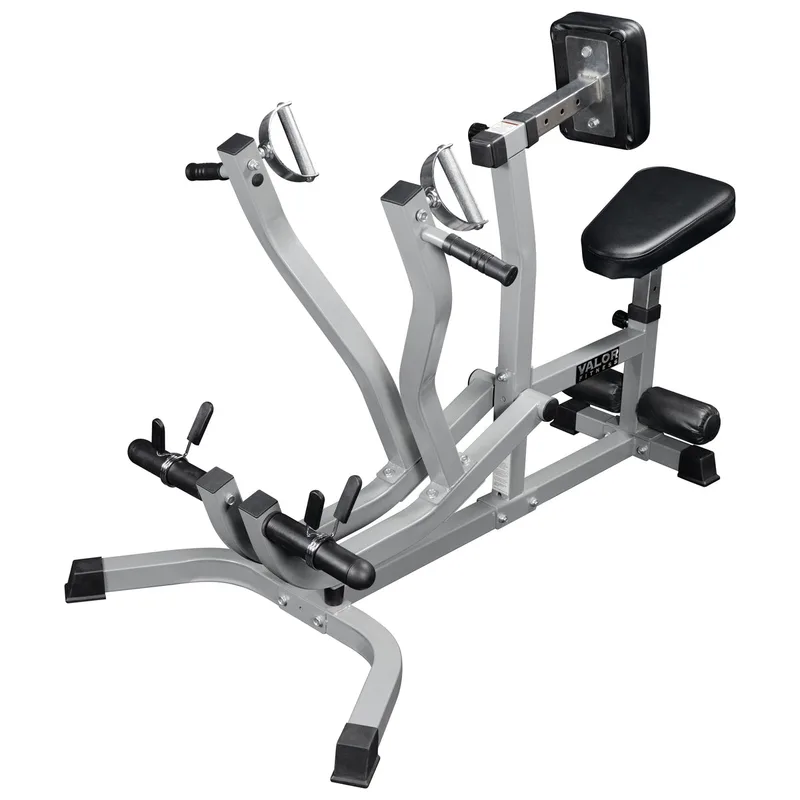
Valor Fitness CB-14 Plate-Loaded Seated Row
Pros
- Independent converging arms allow unilateral rows — load and train each side separately to correct imbalances
- 400 lb total capacity (200 per arm) accommodates intermediate and advanced loading
- Both seat and chest pad are independently adjustable — accommodates a wide range of user heights
- Includes both a stationary T-grip handle and a rotating grip handle for varied hand position
- Olympic sleeve adapters come in the box — works with 1" standard plates you may already own
Cons
- 12-gauge steel frame is lighter-duty than the 11-gauge machines in this roundup
- The converging arm path is fixed; advanced users wanting strict parallel rows will need a different machine
- Some owner feedback notes the chest pad foam compresses over time with heavy use
- Not the most compact machine — account for full arm extension depth when planning your layout
What separates the CB-14 from a standard seated cable row is the independent converging arm design. Each arm operates fully independently, which allows unilateral training: load one arm at a time to address strength imbalances, or train both sides simultaneously with the path naturally converging toward center. This is a meaningful functional advantage over fixed bilateral row machines.
The adjustment range is practical: four seat height positions and five chest pad positions cover most user heights without compromise. Valor includes Olympic sleeve adapters in the box, so if you have a mix of standard 1” plates and 2” Olympic plates, both load properly without additional purchases.
The 12-gauge steel frame is the main area where the CB-14 gives up ground to the Body-Solid machines in this roundup — it is lighter construction, and advanced lifters loading toward the 200 lb per arm ceiling will notice slightly more flex at the heaviest loads. For the majority of home gym athletes training in the 60–150 lb per arm range, it performs without issue. At $399, it fills the plate-loaded row category for a fraction of what commercial-grade alternatives cost.
5. Valor Fitness CB-12 Plate-Loaded Lat Pulldown & Low Row — Best Lat Pulldown
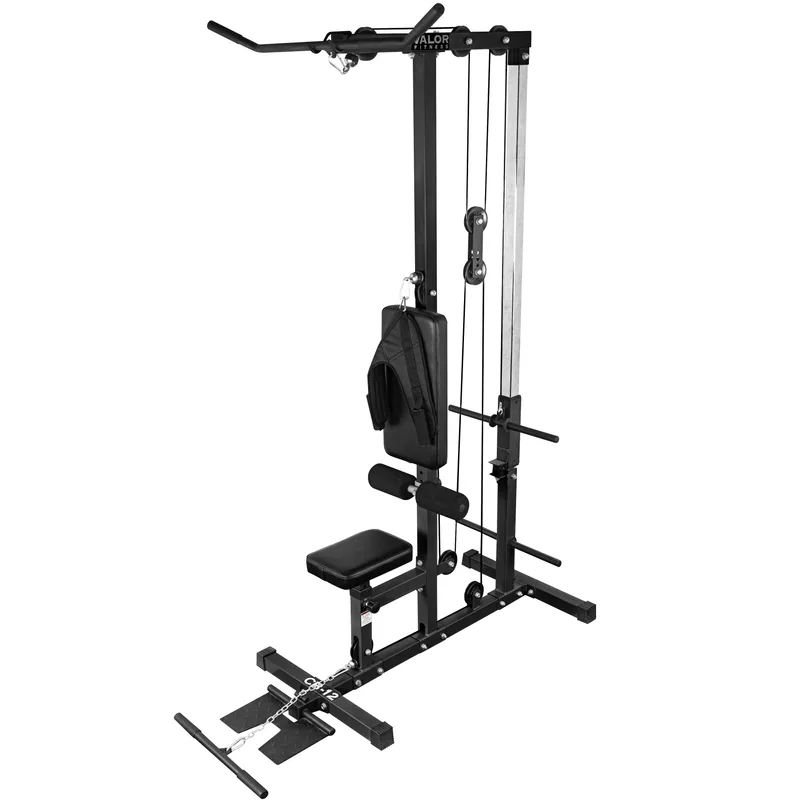
Valor Fitness CB-12 Plate-Loaded Lat Pulldown & Low Row
Pros
- Plate-loaded dual-pulley system provides both lat pulldown and low row from one machine
- Comes with three attachments (lat bar, T-bar, ab harness) — no separate purchases required
- 12-gauge steel frame handles typical lat pulldown and cable row loads without issue
- Adjustable seat accommodates different heights for both pulldown and row positions
- Most affordable machine in this roundup — accessible entry point for intermediate home gym builders
Cons
- 200 lb weight capacity limits advanced lifters who row heavy
- Cable feel lacks the smoothness of selectorized or commercial-grade machines
- 12-gauge steel is the lightest frame gauge in this roundup
- Owner reports note the ab crunch harness attachment is functional but not frequently used
The CB-12 solves a common home gym problem: lat pulldown machines almost always use weight stacks, which adds cost, complexity, and eventual maintenance needs. The CB-12 substitutes a plate-loading system — load the same Olympic plates from your barbell collection — with a dual-pulley design that functions as both a standard lat pulldown station and a cable low row.
Three attachments come included (lat bar, T-bar for low rows, ab crunch harness), which covers the primary use cases without additional accessory purchases. The dual-pulley setup means you can alternate between vertical pulling (lat bar) and horizontal pulling (T-bar low row) in the same session without reconfiguring the machine significantly.
The 200 lb weight capacity is the honest limitation here. Intermediate lifters pulling their bodyweight or above in lat pulldowns will hit the ceiling. This machine is best suited for athletes in the 120–180 lb lat pulldown range — a wide window that covers most home gym users. At $389, it is the most affordable entry point into plate-loaded back training in this roundup.
Buying Guide: Plate-Loaded Machines for Home Gyms
Why Plate-Loaded Instead of Weight Stack?
Weight stack machines are convenient but carry long-term costs: the stacks wear, cables fray, and replacement parts require manufacturer sourcing. Plate-loaded machines have one moving system — the lever or pulley — and use Olympic plates you already own. For a home gym intended to last 10–20 years, the simplicity is an advantage.
Steel Gauge Matters More Than You Think
11-gauge steel (thicker wall, stronger) versus 12-gauge (lighter, more flex under load) is not marketing language — it affects how the machine feels under heavy loading. The Body-Solid machines in this roundup use 11-gauge for the mainframe. Valor’s machines use 12-gauge. For athletes training under 200 lb per arm or 400 lb total sled, 12-gauge performs reliably. For heavier users or athletes pushing toward maximum rated loads, 11-gauge construction provides more stability.
Capacity vs. What You’ll Actually Load
A 1,000 lb leg press rating sounds impressive, but the realistic working range for most home gym athletes is 200–500 lb. A 400 lb T-bar row capacity is effectively unlimited for horizontal pulling. Focus less on maximum capacity and more on whether the machine handles your working load smoothly — that is where steel quality and bearing quality show their value.
Footprint Planning
Plate-loaded machines are large and do not fold. Before ordering:
- Measure the machine footprint plus 18–24” of clearance on each side for plate loading
- Account for the full range of motion (the pressing arc extends beyond the machine frame)
- The Titan T-Bar Row at 84” deep needs nearly 7 feet of floor depth alone
Budget Framework
| Budget | Best Option |
|---|---|
| Under $400 | Valor CB-12 (lats) or CB-14 (rows) |
| $350–$400 | Titan Chest-Supported T-Bar Row |
| $1,000–$1,200 | Body-Solid LVBP Leverage Bench Press |
| $1,500–$2,000 | Body-Solid GLPH1100 Leg Press/Hack Squat |
FAQ
Are plate-loaded machines better than weight stack machines for home gyms?
For long-term home gym ownership, plate-loaded machines have a maintenance advantage. Weight stacks require functional cables, pulleys, and selectors — any of which can degrade or fail over years of use. Plate-loaded lever machines have fewer mechanical components to service. The tradeoff is convenience: loading plates takes slightly longer than selecting a pin position, but for most home gym athletes the simplicity outweighs that.
How much space do I need for a plate-loaded leg press like the GLPH1100?
The GLPH1100 requires approximately 78” of length and 43” of width for the machine itself. Add 18–24” on each side to load plates while the sled is in position. In practical terms, plan for a dedicated 10-foot section of your gym floor. That is non-negotiable — the machine does not compact or fold.
Can I use standard 1” plates on these machines?
The Body-Solid GLPH1100 and LVBP are designed for Olympic 2” plates. The Valor CB-14 and CB-12 include adapters that allow both standard 1” and Olympic 2” plates. The Titan T-Bar Row uses standard 2” Olympic plate sleeves. If you have a mix of plate types, verify adapter compatibility before purchasing — most modern plate-loaded machines accommodate both with the right sleeves.
Is plate-loaded equipment suitable for beginners?
Plate-loaded lever machines are mechanically guided, which makes them generally more accessible to beginners than free weights for isolation movements (leg press, lat pulldown). The fixed path reduces the coordination demand. That said, heavy plate-loaded machines like the GLPH1100 involve significant plate loading and unloading — beginners should start with modest weights and learn the loading positions before progressively adding load.
What is the difference between a T-bar row and a seated row machine?
A T-bar row (like the Titan model) positions the athlete in a hip-hinge stance with the chest supported, pulling weight toward the torso in a horizontal arc. A seated row machine (like the Valor CB-14) positions the athlete seated upright, pulling independently from each arm. Both train horizontal pulling strength, but the seated row emphasizes mid-back and rhomboids with less lower back involvement. Athletes with lower back issues often find seated rows more sustainable for consistent heavy training.
Conclusion
For complete lower body machine training, the Body-Solid GLPH1100 is the best plate-loaded machine for home gyms — the 2-in-1 hack squat and leg press functionality, combined with 1,000 lb capacity and 11-gauge construction, justifies the $1,735 price for athletes who train legs seriously.
For back development specifically, the Titan Chest-Supported T-Bar Row at $366 is the strongest value in this roundup. The chest support turns a good exercise into an excellent one by removing lower back fatigue from the equation, and the multi-grip versatility means one machine covers a wide range of upper back training angles.
If your priority is pressing with plate-loaded equipment, the Body-Solid LVBP provides the gas-assisted start mechanism and sealed-bearing smooth arc that distinguish commercial-quality plate-loaded pressing from budget alternatives.
The Valor CB-14 and Valor CB-12 round out the roundup as accessible entry points into plate-loaded row and lat training — both under $400, both functional for intermediate home gym athletes, and both using Olympic plates you likely own.
Start with the machine that fills the biggest gap in your current training setup. If you lack direct leg press work, the GLPH1100. If your back training relies entirely on cable rows from a functional trainer, the Titan T-Bar Row. Add second and third machines as your gym expands.