The pull-up remains one of the most effective upper-body exercises — it builds lats, biceps, rear delts, and core simultaneously with zero equipment cost beyond a bar. The challenge has always been finding one that fits your space. In 2026, that problem is largely solved: doorframe bars, wall-mounted rigs, and freestanding platforms now cover every scenario from a studio apartment to a dedicated garage gym.
The freestanding pull-up market has gotten notably more interesting this year. The Bullbar 2.0 gained traction in early 2026 as a genuinely portable solution — it folds flat for under-bed storage, sets up in under a minute, and holds 400 lbs of load. For lifters who rent, move frequently, or simply refuse to drill into walls, it changes the calculus significantly.
Here are the five best pull-up bars for home use in 2026, covering every setup scenario.
Quick Picks
REP Fitness Wall-Mounted Multi-Grip Pull-Up Bar is the best wall-mounted pull-up bar overall — 700 lb capacity, five grip positions, a 2-inch rear bar for grip work, and the ability to invert for low-ceiling installations.
Titan Fitness HD Multi-Grip 48” is the best value among wall-mounted bars — 600 lb rated, 12-gauge welded steel, and a 48-inch wide bar for extra-wide grip training at under $100.
Iron Gym Total Upper Body Workout Bar remains the best budget option for renters or anyone who needs a pull-up bar without any installation.
Bullbar 2.0 is the answer for lifters who can’t or won’t mount anything to a wall but need more stability and capacity than a doorframe bar provides.
Comparison
| Bar | Type | Capacity | Grips | Price |
|---|---|---|---|---|
| Iron Gym Total Upper Body | Doorframe | 300 lbs | 3 | $47.99 as of Oct 18, 2026 |
| ProsourceFit Multi-Grip | Doorframe | 300 lbs | 12 | $28.56-$35.99 as of Oct 18, 2026 |
| Titan Fitness HD 48” | Wall-mounted | 600 lbs | 4 | Unavailable |
| REP Fitness Multi-Grip | Wall-mounted | 700 lbs | 5 | $169 |
| Bullbar 2.0 | Freestanding | 400 lbs | 1 | $399 |
Buying Guide: Which Pull-Up Bar Fits Your Setup?
Doorframe Bars
Doorframe bars rest on door trim — no screws, no drilling. The trade-off is a 24–36 inch bar width limit (dictated by the door), 300 lb weight capacity, and a slight bounce during explosive movements. They’re ideal for renters, apartment gyms, and anyone who wants pull-up access in multiple rooms.
The biggest upgrade between budget doorframe bars is grip variety. Basic bars offer three positions (wide, neutral, close). Multi-grip bars like the ProsourceFit add hammer grips and additional width settings that more closely mimic a pull-up station.
What to check: Door trim integrity. Hollow-core doors and non-standard trim can flex under load. Check that your door frame is solid wood before loading a doorframe bar beyond bodyweight.
Wall-Mounted Bars
Wall-mounted bars eliminate every limitation of doorframe bars. A 48-inch Titan or REP Fitness bar gives full wide-grip pull-ups, higher weight limits, and a stable base for gymnastics rings and suspension trainers. The cost is drilling into studs — a 30-minute job that’s permanent.
Wall-mounted bars deliver the best pull-up training experience per dollar spent. The Titan HD 48” at $99 is arguably the highest-value piece of pulling equipment available for home gyms.
What to check: Stud location and spacing. Standard 16-inch stud spacing works for most wall-mounted bars. Confirm that your mounting wall has solid studs — not just drywall — before purchasing.
Freestanding Bars and Power Towers
Freestanding pull-up bars require no installation but need floor space. Traditional power towers (4–6 sq ft footprint) are fixed height and can’t be stored. The Bullbar 2.0 addresses this with a folding design that collapses to briefcase dimensions.
Freestanding bars typically cost more than wall-mounted bars for equivalent capacity, but they move with you, require no installation permission, and can be repositioned for different exercises.
What to check: Base stability. Freestanding bars that rely on a wide base can tip during kipping movements or if bodyweight is applied unevenly. The Bullbar 2.0’s design cycle-tested at 400 lbs for 12,000 continuous reps, which addresses this concern.
Weight Capacity
Most lifters focus on weight capacity the wrong way. A 300 lb doorframe bar is not “safe for anyone under 300 lbs” — dynamic pull-up movements generate more than bodyweight in force. A 250 lb person doing kipping pull-ups or explosive negatives can exceed the static rating. Plan for at least 2x your bodyweight in capacity if you train dynamically.
Bar Diameter and Grip Training
Standard pull-up bars are 1.25 inches in diameter. This is the optimal size for grip development and the most common diameter across all pull-up bar categories. Fat bars (2 inches) appear on the REP Fitness rear grip bar — these dramatically increase grip training demand and are worth incorporating if grip strength is a priority.
Detailed Reviews
Iron Gym Total Upper Body Workout Bar — Best Budget
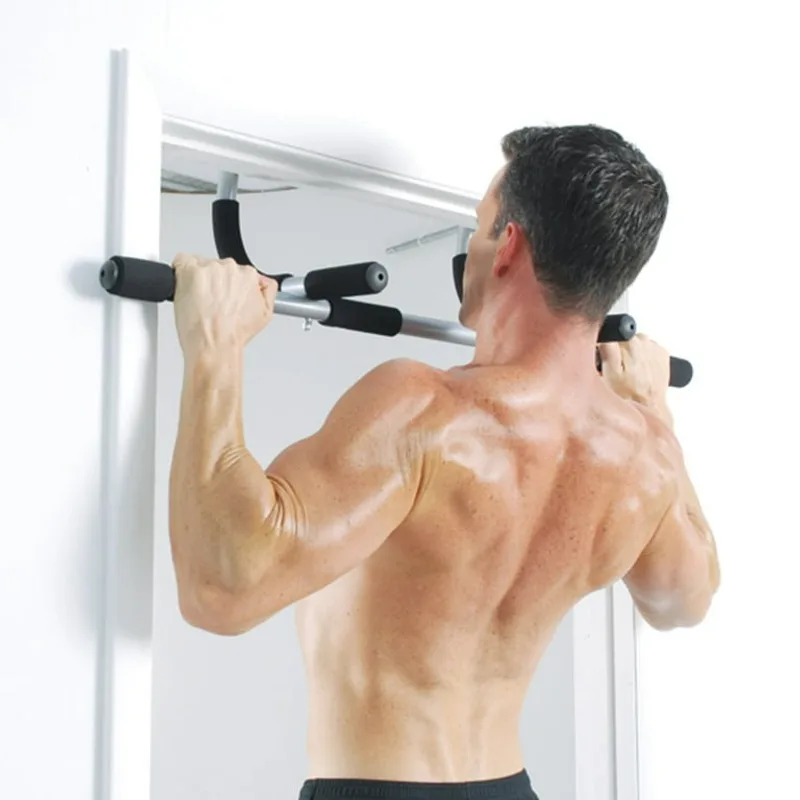
Iron Gym Total Upper Body Workout Bar
Pros
- No screws or drilling required — installs in seconds
- Fits standard 24–32 inch door frames out of the box
- 300 lb weight capacity handles most lifters
- Folds flat for compact storage when not in use
Cons
- Limited to three grip positions versus multi-grip alternatives
- Not suitable for doors with hollow cores or non-standard trim
- No dip station or leg raise capability
The Iron Gym doorframe bar has been a staple of home training for over a decade, and the updated model holds up. The adjustable-width locking mechanism fits doors from 24 to 32 inches without any tools or hardware. Setup is straightforward: hook the arms over the door trim, hang the bar, and start pulling.
The three grip positions — wide, neutral, and close — cover the basic pull-up variations. Wide overhand for lat width, neutral hammer grip for reduced shoulder strain, close underhand for bicep-dominant chin-ups. For $30, the grip options are adequate.
The 300 lb weight capacity is workable for most home gym users performing strict pull-ups. The bar handles daily use without flex or creaking. For renters who want a no-commitment pull-up bar, this is the starting point.
ProsourceFit Multi-Grip Chin-Up Bar — Best Value
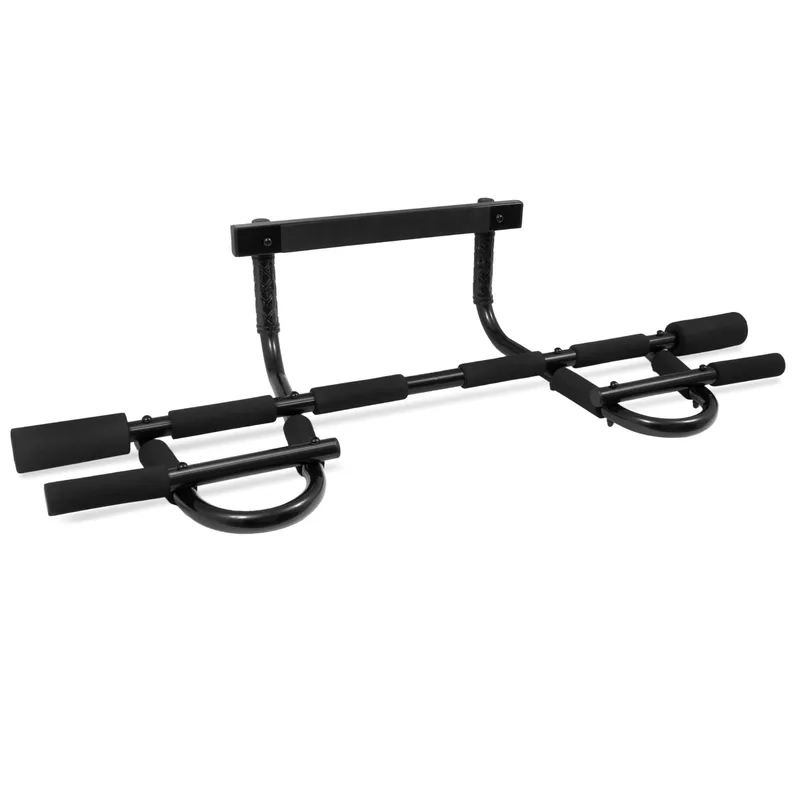
ProsourceFit Multi-Grip Chin-Up Bar
Pros
- 12 grip positions cover wide, close, neutral, and hammer grips
- Fits doors from 24 to 36 inches — wider range than most doorframe bars
- High-grade steel construction with foam-padded handles
- Optional mounting hardware included for permanent installation
Cons
- Foam grips wear down faster than bare steel or knurled grips
- Slightly heavier than simpler doorframe bars
- Still limited to bodyweight pulling — no dip or leg raise station
The ProsourceFit Multi-Grip bar takes the doorframe concept further. The wider 24–36 inch door compatibility solves the main frustration with narrower bars, and the 12 grip positions add meaningful training variety: wide pronated, medium pronated, close pronated, neutral hammer, and close supinated chinning position.
The high-grade steel frame and optional screw-mounting hardware give this bar flexibility between doorframe use and semi-permanent installation. For lifters who want to grow into wall mounting later, the hardware is included — no second purchase necessary.
At the same price as the Iron Gym, the ProsourceFit consistently earns the recommendation for lifters who care about grip variety beyond the basics. The foam grips are the main quality trade-off compared to bare or knurled metal, but they’re replaceable and comfortable for high-rep training.
Titan Fitness HD Multi-Grip Wall Mounted Pull-Up Bar — Editor Pick
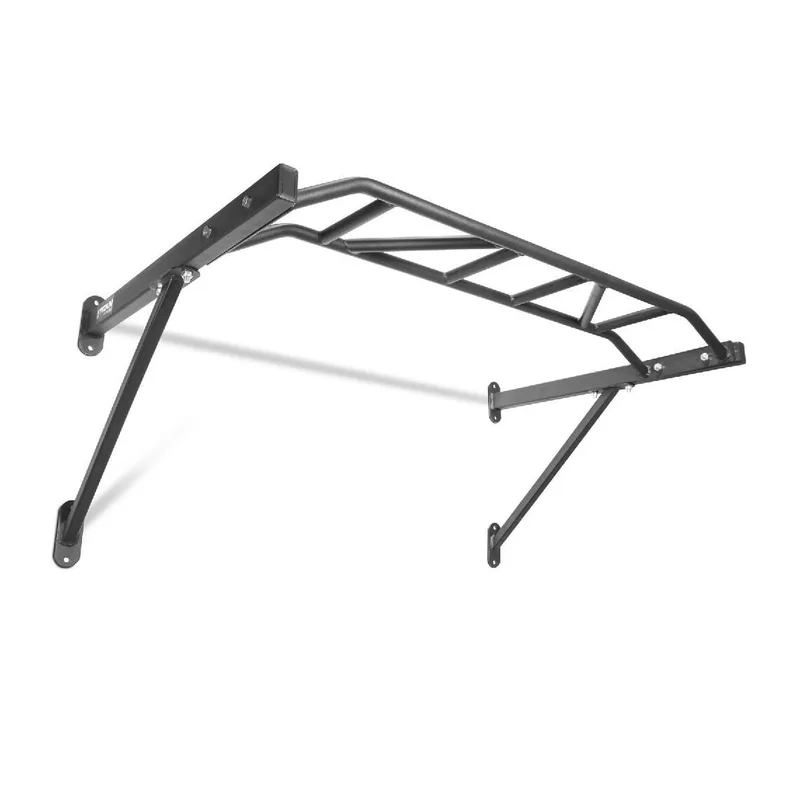
Titan Fitness HD Multi-Grip Wall Mounted Pull-Up Bar
Pros
- 600 lb weight capacity and 12-gauge welded steel built to last decades
- 48-inch width enables extra-wide grip pull-ups not possible on doorframe bars
- Center bars support gymnastics rings, suspension trainers, and straps
- Angled ends provide comfortable natural wrist alignment on wide-grip sets
Cons
- Requires wall stud access and moderate installation effort
- Permanent installation — not portable between rooms or homes
- No close-grip neutral option; grip positions are fixed at manufacture
The Titan HD 48” is the best purchase in this roundup on a cost-per-capability basis. Twelve-gauge welded steel, 600 lb weight capacity, 48-inch width, and multiple grip positions at under $100 is exceptional value. No doorframe bar gets close to this combination.
The extra-wide 48-inch span enables true wide-grip pull-ups that put maximum stretch on the lats — something a 24-inch doorframe bar physically cannot deliver. The angled ends reduce wrist strain at wide grip positions by allowing a more natural pronation angle. Center anchor bars support gymnastic rings, TRX straps, and suspension trainers without additional hardware.
Installation requires mounting into wall studs. The bar ships with hardware; standard 16-inch stud spacing accommodates the mount points. The powder-coated steel resists moisture in garage and basement gym environments.
If you have a wall to mount to, the Titan HD 48” is the first thing worth buying for upper body pulling work. It will outlast every other piece of equipment in your gym.
REP Fitness Wall-Mounted Multi-Grip Pull-Up Bar — Best Premium
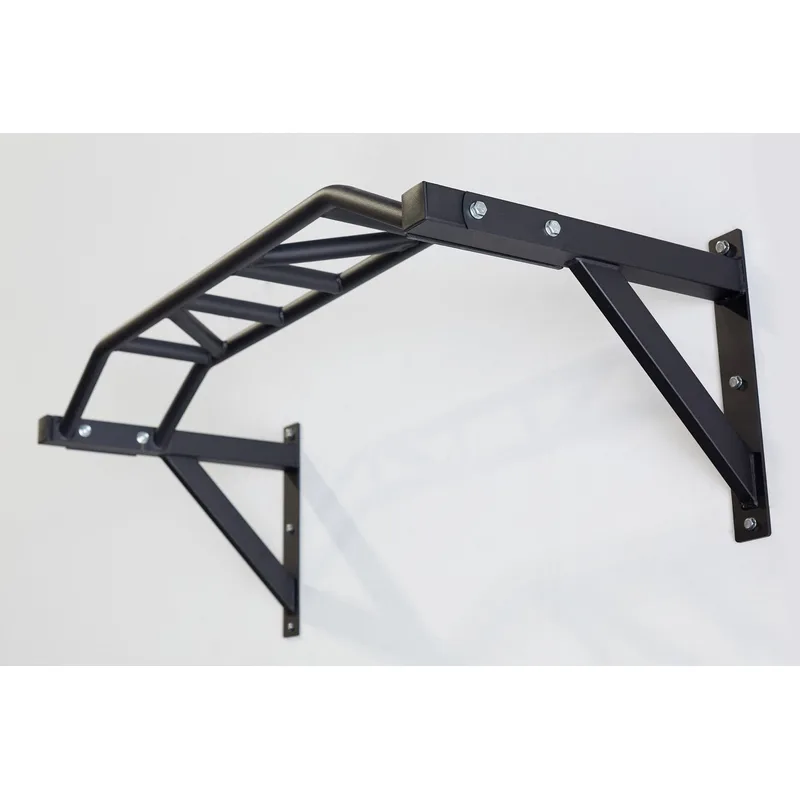
REP Fitness Wall-Mounted Multi-Grip Pull-Up Bar
Pros
- 700 lb weight capacity — the highest in this roundup
- 2-inch thick rear bar trains grip strength for barbell work
- Five distinct grip positions in a single bar
- Can be inverted for lower ceiling or shorter athlete installations
Cons
- Only available direct from REP Fitness, not on Amazon
- Higher price point than the Titan option
- Requires drilling into studs — same install effort as any wall-mounted bar
The REP Fitness wall-mounted bar is the most thoughtfully designed pull-up bar in this roundup. The standard bars are 1.25 inches, but the rear-facing bar is 2 inches in diameter — a dedicated grip-training feature that turns every dead hang into accessory work for barbell grip strength.
Five distinct grip positions — traditional wide, angled wide, neutral close, traditional close, and rear — eliminate any need to reposition or adjust between exercises. The 700 lb weight capacity is the highest in this roundup, and the inverted mounting option (bar below the mounting bracket rather than above) solves low-ceiling installations where standard orientation would limit head clearance.
The premium price reflects premium construction: this bar is built to commercial standards for a home gym environment. For garage gym owners who want a once-and-done pulling solution that supports rings, straps, and band work, the REP Fitness bar delivers.
Bullbar 2.0 Portable Pull-Up Bar — Best Freestanding
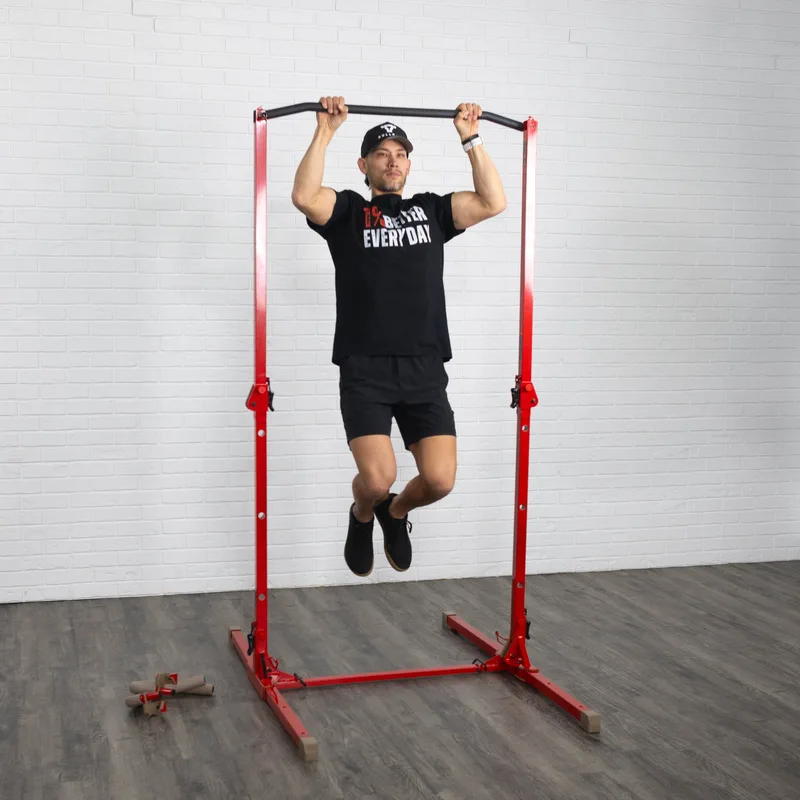
Bullbar 2.0 Portable Pull-Up Bar
Pros
- No wall, ceiling, or door required — truly standalone setup
- Folds flat in under a minute with no tools for storage under a bed
- 400 lb weight capacity with 16-gauge steel construction
- Doubles as a dip station with three adjustable dip bar height settings
Cons
- $399 is significantly more expensive than wall-mounted alternatives
- 46 lb weight means portability requires some effort
- 36-inch bar width is narrower than the 48-inch Titan wall-mounted bar
The Bullbar 2.0 emerged in 2026 as one of the most genuinely original products in the home gym accessory category. The concept: a full-height pull-up and dip station that folds flat enough to slide under a standard bed. The execution is solid — 16-gauge industrial steel, a toggle-latch fold system that requires no tools, and 400 lb weight capacity verified at 12,000 continuous reps during cycle testing.
Setup takes under a minute. At 81 inches tall it clears the ceiling of most standard-height rooms. The 36-inch bar width is narrower than a 48-inch wall-mounted bar but comparable to what most doorframe bars offer. Three adjustable dip bar positions convert the unit into a full upper-body station for dips, push-ups, and leg raises.
At $399, the Bullbar 2.0 is expensive compared to wall-mounted alternatives. But for renters, frequent movers, or lifters who want a portable pull-up station for outdoor use, the freestanding design justifies the premium. It also carries in a car trunk — something no wall-mounted bar can claim.
FAQ
Can doorframe pull-up bars damage door frames?
Yes, if used incorrectly. Bars rest on door trim — over time, repeated loading can compress or crack painted wood trim. Higher-weight or kipping-style pull-ups accelerate this. Check your door trim for solid construction before loading a doorframe bar, and inspect the trim periodically for compression or cracking. Wall-mounted bars eliminate this concern entirely.
Do I need to find studs to mount a wall-mounted pull-up bar?
Yes. Pull-up bars mounted into drywall without studs will fail. Locate wall studs using a stud finder before purchasing a wall-mounted bar — standard spacing is 16 inches in most residential construction. All wall-mounted bars in this roundup include mounting hardware designed for stud installation. Concrete wall mounting requires anchor hardware not typically included and is recommended for commercial gym applications.
What’s the minimum ceiling height for a pull-up bar?
For comfortable full-range pull-ups, you want at least 10–12 inches of clearance above the bar at full hang position. The Bullbar 2.0 at 81 inches tall requires roughly 8 feet of ceiling height for comfortable use. Wall-mounted bars can be positioned at any height, so ceiling clearance depends on mounting position — mount high enough to allow a full dead hang with feet off the floor.
Can I use a pull-up bar for exercises other than pull-ups?
Wall-mounted and freestanding bars support chin-ups, neutral grip pull-ups, hanging knee raises, leg raises, L-sits, and gymnastics ring work. Doorframe bars can handle hanging exercises but are less stable for dynamic movements. The REP Fitness and Titan bars include center supports specifically for anchoring rings and suspension trainers. The Bullbar 2.0 adds dip station positions for pushing work alongside pulling work.
How much weight capacity do I actually need?
For strict pull-ups, a bar rated at 1.5x your bodyweight provides adequate safety margin. For kipping pull-ups, explosive negatives, or dynamic movements, 2–3x bodyweight is the appropriate minimum. A 200 lb lifter performing kipping pull-ups should use a bar rated for at least 400 lbs. The Titan HD (600 lbs) and REP Fitness (700 lbs) wall-mounted bars cover all dynamic pulling work for the vast majority of home gym athletes.
Conclusion
The best pull-up bar for most home gym owners with a dedicated wall is the Titan Fitness HD Multi-Grip 48”. It’s $99, 12-gauge welded steel, 600 lb rated, and built to last indefinitely. Nothing in the price range competes with it for wall-mounted pulling value.
For renters or anyone unwilling to drill: start with the ProsourceFit Multi-Grip at $30. It covers more grip positions than the Iron Gym and fits a wider range of door widths. If the doorframe limitations frustrate you — stability, capacity, width — the Bullbar 2.0 is the freestanding upgrade that solves all of them.
The REP Fitness Wall-Mounted Multi-Grip earns its premium for lifters who want the highest-capacity, most grip-versatile wall-mounted bar available, plus the 2-inch rear bar for dedicated grip training.
Pull-up training doesn’t require expensive equipment. The hardest part is having a bar in a convenient spot. Put one where you’ll actually use it.