Recumbent bikes have spent years being marketed primarily to seniors and rehab patients. In 2026, that framing is outdated. The top recumbent bikes now come equipped with 14” HD touchscreens, automatic resistance adjustment via app integration, and flywheel weights that rival upright commercial bikes. The category has caught up with connected fitness — it just does it from a position that’s easier on your knees, hips, and lower back.
That shift matters for home gym builders. If you’re recovering from an injury, managing joint pain, or simply want sustainable low-impact cardio you’ll actually use consistently, a recumbent bike makes more sense than a treadmill or upright bike. The supported seating position removes the pressure points that cause most riders to cut sessions short.
This roundup covers five options from $185 to $1,499. The Schwinn 270 is the best choice for most buyers. The Nautilus R618 is the upgrade pick for heavier users and better warranty coverage. The NordicTrack R35 is the premium connected option. The Sunny Health SF-RB4850SMART delivers app connectivity without a subscription. The Marcy ME-709 is the budget entry point.
Quick Picks
Schwinn 270 is the right bike for most home gym buyers. Twenty-five resistance levels, 29 programs, a 10-year frame warranty, and Bluetooth connectivity at $499 represents the strongest value proposition in this category.
Nautilus R618 is the upgrade pick for serious cardio athletes and heavier users. The 15-year frame warranty, 325 lb capacity, and 13 lb flywheel justify the $250 premium over the Schwinn 270 for buyers who plan to ride daily.
NordicTrack Commercial R35 is for buyers who want the connected fitness experience in a recumbent format. The 14” touchscreen and iFIT integration are genuinely useful — if you’re willing to pay the ongoing subscription after the included first year.
Sunny Health SF-RB4850SMART is the best choice if you want Bluetooth and app connectivity without spending $499+. The SunnyFit app is free and functional. The flywheel is light, but the overall package at $299 punches above its price.
Marcy ME-709 is for buyers with a firm budget under $200. You get 8 resistance levels, a basic LCD, and a functional recumbent bike. No frills, no apps, no subscription — just reliable low-impact cardio.
Comparison
| Bike | Price | Resistance | Capacity | Warranty | Best For |
|---|---|---|---|---|---|
| Schwinn 270 | Unavailable | 25 levels | 300 lbs | 10-yr frame | Most buyers |
| Nautilus R618 | Unavailable | 25 levels | 325 lbs | 15-yr frame | Daily serious use |
| NordicTrack R35 | Unavailable | 26 levels | 350 lbs | 10-yr frame | Connected fitness |
| Sunny Health SF-RB4850SMART | Unavailable | 16 levels | 300 lbs | Limited | Budget + app |
| Marcy ME-709 | $159.99 as of Oct 18, 2026 | 8 levels | 300 lbs | Limited | Budget |
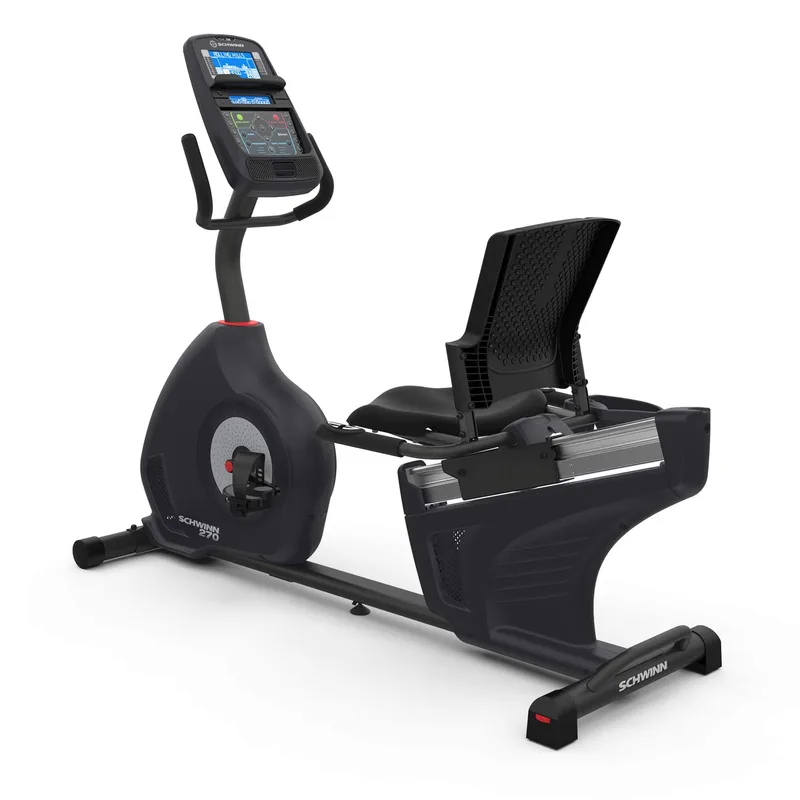
Schwinn 270 Recumbent Bike
Pros
- 25 resistance levels give fine-grained intensity control for interval training and progressive cardio
- 29 built-in workout programs cover more structured variety than most mid-range competitors offer
- 10-year frame warranty is exceptional for this price tier — Schwinn backs this bike for the long haul
- 3-speed cooling fan is a practical comfort feature that mid-range competitors consistently skip
- USB charging port keeps your phone topped up during longer sessions without reaching for a power strip
- Bluetooth connects to the Schwinn Trainer app and RideSocial for virtual route riding
Cons
- 300 lb weight capacity doesn't improve over the Nautilus R618's 325 lbs despite similar program count
- No touchscreen display — screen quality is basic LCD compared to premium options
- 90-day labor warranty is short relative to the rest of the warranty package
The Schwinn 270 has been the default recommendation for mid-range recumbent bikes for years. In 2026 it holds that position. The combination of 25 resistance levels, 29 built-in programs, and a 10-year frame warranty at $499 is hard to beat at this price point.
The 25 resistance levels give you enough granularity to run structured interval sessions — not just cruise at a fixed effort. Based on owner reports across multiple platforms, the resistance progression is linear and predictable, which matters for progressive cardio programming. The 29 programs include interval, hill, and heart rate-controlled workouts that don’t require any app or phone to access.
The 3-speed cooling fan is the detail that separates the 270 from similarly-priced competitors. It’s a small addition that makes 45-minute sessions significantly more comfortable, especially in a garage or basement gym without air conditioning. Most bikes in this price range skip it entirely.
Bluetooth connectivity integrates with the Schwinn Trainer app and the RideSocial virtual cycling platform. These aren’t best-in-class apps, but they add structure and variety beyond the on-board programs. The USB charging port is a practical daily-use convenience — your phone stays charged throughout a session without needing a nearby outlet.
The main limitation is the 300 lb weight capacity, which matches the budget Marcy ME-709. The Nautilus R618 handles 25 additional pounds for $250 more. If weight capacity is a consideration, the choice between the 270 and R618 becomes straightforward. Otherwise, the Schwinn 270 at $499 is the right call for most buyers.
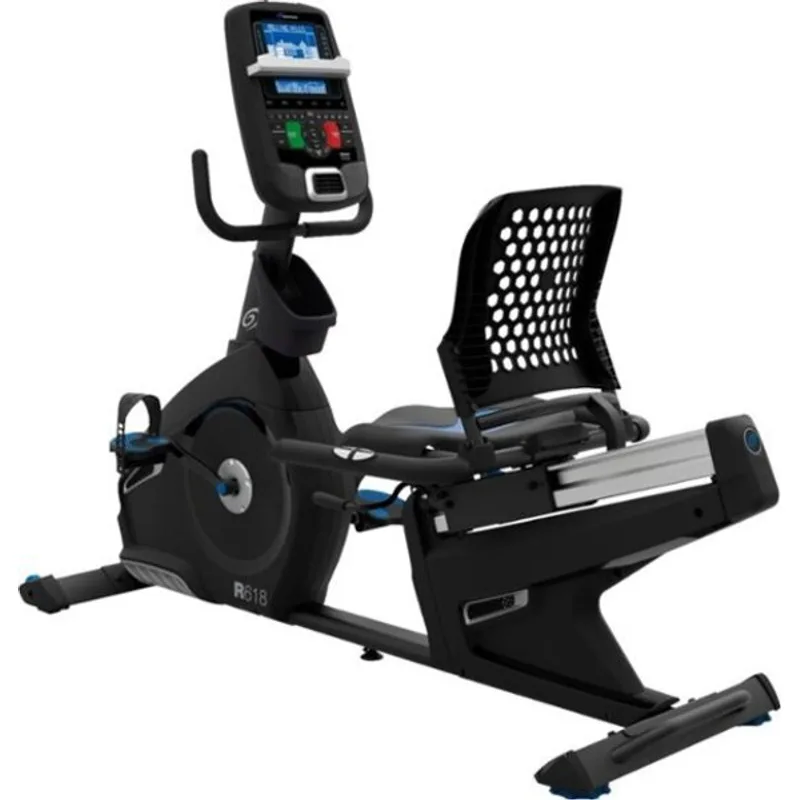
Nautilus R618 Recumbent Bike
Pros
- 15-year frame warranty is the strongest structural coverage in this entire roundup
- 325 lb weight capacity accommodates more users than the Schwinn 270 or budget options
- 13 lb flywheel delivers noticeably smoother pedaling motion than lighter-flywheel alternatives
- 3-year parts and electronics warranty improves meaningfully on Schwinn's 2-year parts coverage
- 29 programs match the Schwinn 270 for structured workout variety at the mid-range level
- Two-angle adjustable LCD display improves readability for riders of different heights
Cons
- $250 more than the Schwinn 270 for similar resistance levels and program count
- No Bluetooth or app connectivity — display is LCD-only without phone integration
- 107 lb assembled weight makes repositioning difficult without a second person
The Nautilus R618’s headline spec is the 15-year frame warranty — the strongest structural coverage in this roundup and among the best offered on any residential recumbent bike. Combined with the 3-year parts and electronics warranty, Nautilus is essentially guaranteeing this bike’s components for three years longer than Schwinn’s 2-year parts coverage.
The 13 lb flywheel is the mechanical upgrade that matters most for day-to-day riding. Compared to the 6.6 lb flywheel in the Sunny Health SF-RB4850SMART, and lighter flywheels in budget options, the R618’s heavier flywheel maintains momentum more consistently through each pedal stroke. Based on owner reports, the pedaling feel is described as smoother and more “commercial gym-like” than mid-range alternatives — which is the right comparison since the R618’s flywheel weight approaches entry-level commercial equipment.
The 325 lb weight capacity accommodates more riders than the Schwinn 270’s 300 lb limit. For users at or near that threshold, the R618 is the more appropriate choice — and the heavier flywheel construction that provides the higher capacity also contributes to the better ride quality.
The gap between the R618 and the Schwinn 270 is narrow on paper: both offer 25 resistance levels and 29 programs. The R618 wins on flywheel weight, weight capacity, and warranty. The Schwinn wins on Bluetooth connectivity and the cooling fan — neither of which the R618 offers. If you don’t care about app integration and you plan to ride this bike hard and often for years, the R618 is worth the $250 premium.
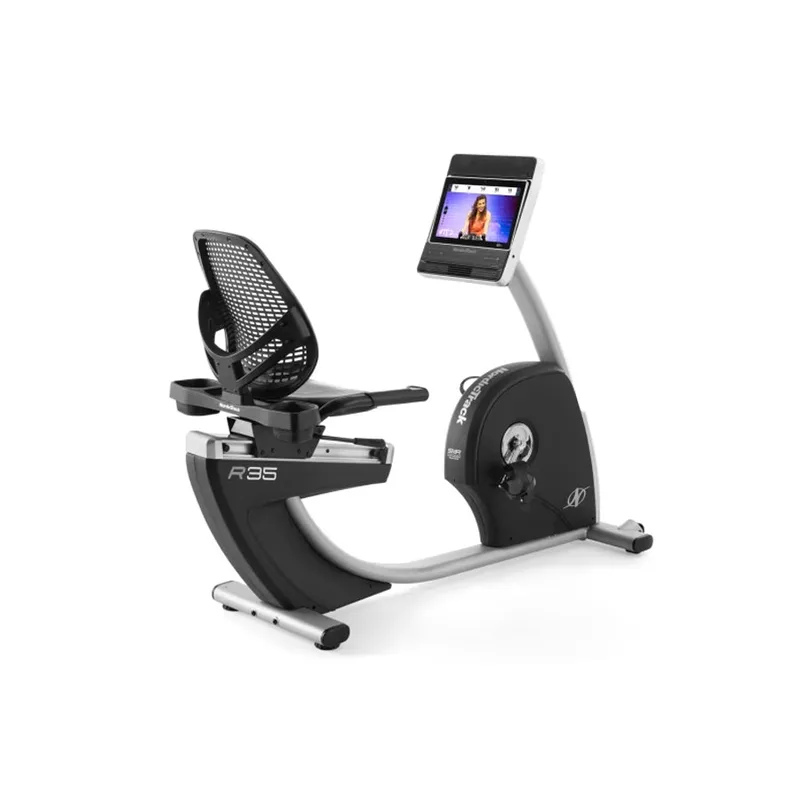
NordicTrack Commercial R35
Pros
- 14" HD full-color touchscreen is the most advanced display in this roundup — rivals commercial gym equipment
- 25 lb flywheel produces the smoothest, most natural pedaling feel of any bike compared here
- 350 lb weight capacity is the highest in this roundup
- Step-Thru frame design makes mounting and dismounting significantly easier than standard frames
- iFIT integration adjusts resistance automatically to match trainer-led workouts and Google Maps routes
- 26 silent magnetic resistance levels with automatic trainer override during iFIT sessions
Cons
- $1,499 is nearly 3x the price of the Schwinn 270 for training outcomes most users will find similar
- iFIT subscription required for premium features ($396/year after the included first year)
- 192 lb assembled weight makes this effectively a permanent placement — moving it requires two people
- Once the included iFIT year ends, the touchscreen display is largely underutilized without renewal
The NordicTrack Commercial R35 is what happens when you take the connected fitness approach pioneered by upright bikes and apply it to a recumbent format. The 14” HD touchscreen puts the R35 in a different category from LCD-display bikes — the interface is comparable to what you’d find in a commercial gym facility, not what you’d expect from a home unit.
The iFIT integration is the feature that defines the R35’s value proposition. Automatic resistance adjustment — where the bike’s resistance changes to match the trainer’s instructions during a class — eliminates the manual adjustments that break the flow of structured sessions. Google Maps integration for outdoor route simulation is also functional in a recumbent format in ways it isn’t on an air bike or rowing machine: you can pedal a route of the French Riviera while maintaining perfect posture without wrist or shoulder strain.
The Step-Thru frame design is a practical consideration that gets overlooked in spec comparisons. Getting on and off a recumbent bike with a lower-back issue or limited mobility is genuinely difficult on standard frame designs. The R35’s step-through access removes that barrier completely.
The pricing requires honest assessment. At $1,499, the R35 is nearly 3x the Schwinn 270. For most cardio training goals — sustained steady-state, interval work, calorie burn — the Schwinn 270 delivers comparable physiological outcomes at a third of the cost. The R35 justifies its price for buyers who will actively use the iFIT platform and who want commercial-grade feel and display quality in their home gym. For buyers who will ignore the touchscreen and just pedal, the $1,000 difference is hard to defend. The iFIT subscription also resets at $396/year after the included first year — a recurring cost that affects the total ownership calculation.
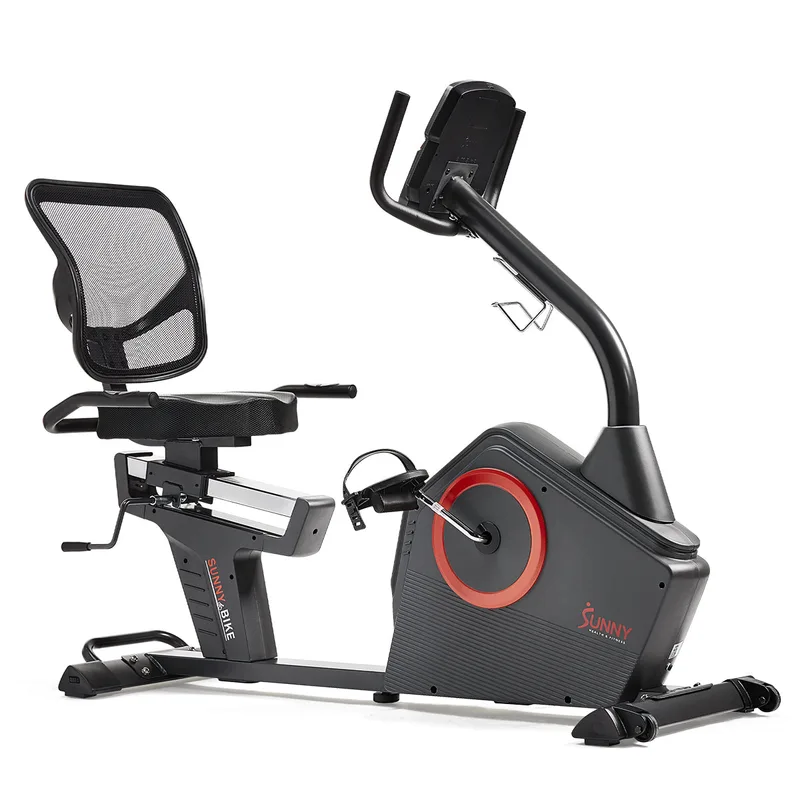
Sunny Health & Fitness SF-RB4850SMART
Pros
- 16 electro-magnetic resistance levels double the adjustment range of budget-tier options
- SunnyFit app provides trainer-guided workouts at no additional subscription cost
- Bluetooth connectivity enables real-time workout tracking from your phone
- Belt-drive mechanism runs quietly — based on owner reports, noise level is minimal for home use
- 24 pre-built programs add structure for riders who don't want to program their own sessions
Cons
- 6.6 lb flywheel is the lightest in this roundup — pedaling feel is noticeably less smooth than mid-range options
- SunnyFit app library is smaller than iFIT and has no live class options
- 300 lb weight capacity doesn't improve over the budget Marcy despite the higher price
- Console display is basic compared to bikes in the next price tier
The Sunny Health SF-RB4850SMART fills the gap between budget hardware (Marcy ME-709) and true mid-range bikes (Schwinn 270). At $299, it offers Bluetooth connectivity, a free app with trainer-guided workouts, 16 resistance levels, and a belt-drive mechanism — none of which exist on the Marcy at $185.
The SunnyFit app is the differentiating factor. Unlike NordicTrack’s iFIT, SunnyFit is free — no subscription, no expiration, no renewal cost. The catalog includes trainer-guided rides, cardio programs, and connected tracking. It’s smaller than iFIT and lacks live classes, but for home gym use it covers the fundamentals. Based on owner reports, the Bluetooth pairing is straightforward and the app stays connected reliably during sessions.
The 6.6 lb flywheel is the honest limitation. Put back-to-back with the Schwinn 270 or Nautilus R618, the pedaling feel is noticeably less smooth — the lighter flywheel doesn’t carry momentum the same way a heavier unit does. For light-to-moderate cardio work, this is an acceptable tradeoff at $299. For riders who prioritize ride quality above all else, it pushes toward the Schwinn 270.
The SF-RB4850SMART is also 300 lb capacity — same as the Marcy ME-709 — which means heavier users don’t gain any additional margin by choosing this over the budget option. The value case is about resistance levels, app connectivity, and belt drive quality, not capacity.
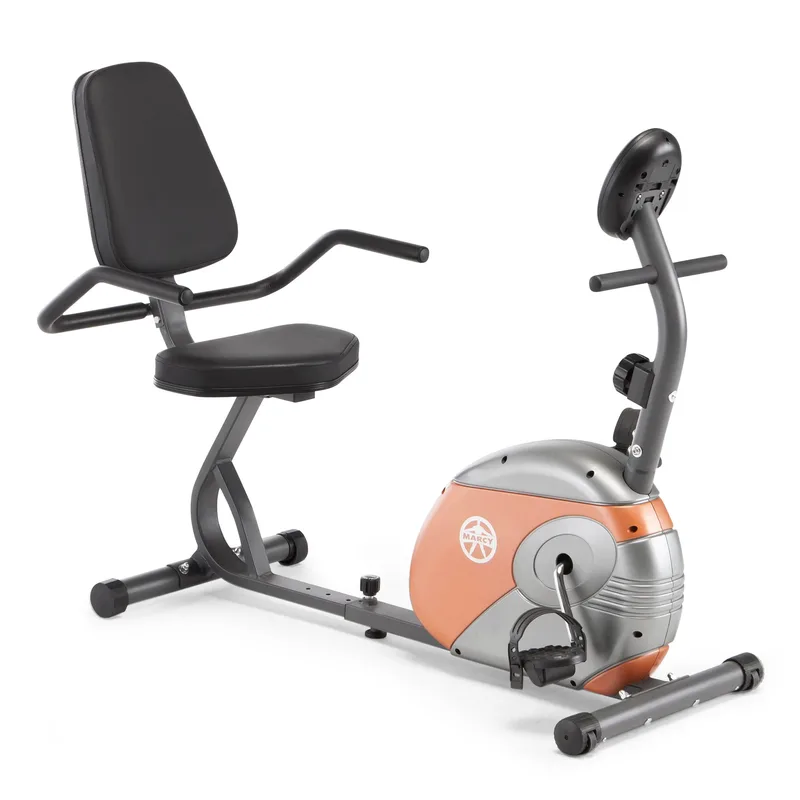
Marcy ME-709 Recumbent Bike
Pros
- Most affordable recumbent bike in this roundup — delivers core low-impact cardio for under $200
- 300 lb weight capacity handles a wide range of users at this price point
- 53 lb assembled weight makes it the easiest to move or reposition in a small space
- Tool-free seat adjustment lets multiple users at different heights share the bike without setup time
Cons
- 8 resistance levels is the fewest in this roundup — limited progression room as fitness improves
- No Bluetooth, app connectivity, or built-in workout programs
- Light flywheel produces a less smooth pedaling motion than mid-range alternatives
- Minimal warranty coverage compared to every other option in this roundup
The Marcy ME-709 is the simplest recumbent bike in this roundup. Eight magnetic resistance levels, an LCD display showing time, speed, distance, calories, and odometer — no programs, no Bluetooth, no apps. It weighs 53 lbs assembled, is straightforward to put together solo, and retails for under $200.
The use case is narrow but real: buyers who want a functional recumbent bike for light daily cardio, don’t care about programming or app integration, and have a firm budget under $200. For that buyer — often someone in rehabilitation, a senior looking for daily movement, or a gym builder in the very early stages — the ME-709 delivers what it promises.
Based on owner reports from long-term users, the ME-709 is durable for light-to-moderate use. The 8 resistance levels feel close together at the low end and further apart at the high end, which limits fine-grained intensity control. The pedaling feel is functional rather than smooth. The LCD display is readable, not elegant.
The main constraint for fitness-focused buyers is progression. Eight resistance levels means you’ll exhaust the range faster than a 25-level bike, and with no structured programs, workouts require self-direction. If you’re using this bike for rehab-level movement rather than serious cardio training, that’s not a problem. If you’re using it for progressive cardio improvement, you’ll want more resistance range within 6–12 months.
Buying Guide: What to Look for in a Recumbent Exercise Bike
Resistance levels. Entry-level bikes offer 8 levels; mid-range and above offer 16–26. More resistance levels give you finer control over intensity, which matters for progressive training and structured intervals. If you’re serious about improving over time, 16 levels is the minimum — 25 is better. Electro-magnetic resistance (Sunny Health, NordicTrack) responds faster than passive magnetic designs, making automatic iFIT adjustments possible.
Flywheel weight. This is the spec most buyers overlook. Flywheel weight determines how smoothly the pedals turn — a heavier flywheel maintains momentum through each stroke. The range here goes from 6.6 lbs (Sunny Health) to 25 lbs (NordicTrack R35). For daily serious training, aim for at least 10 lbs. The Nautilus R618’s 13 lb flywheel is the sweet spot for mid-range buyers.
Weight capacity. All five bikes in this roundup handle at least 300 lbs. The Nautilus R618 handles 325 lbs; the NordicTrack R35 handles 350 lbs. Check the rated capacity against your weight before purchasing. Manufacturer ratings are typically conservative, but operating a bike near its rated limit regularly accelerates wear.
Display and connectivity. Basic LCD screens (Marcy, Nautilus) show core metrics but require manual program selection. Bluetooth-enabled bikes (Schwinn 270, Sunny Health, NordicTrack R35) connect to apps for tracking and virtual content. Touchscreen displays (NordicTrack R35) add interface quality and iFIT integration but come with subscription costs. Match the display feature to how you actually train — if you follow guided workouts, Bluetooth and app integration add real value; if you prefer self-directed cardio, a simple LCD is fine.
Frame design. Standard recumbent bike frames require stepping over the top tube to reach the seat. Step-Thru designs (NordicTrack R35) eliminate that — you walk in from the side. If you have limited mobility, hip pain, or balance concerns, the step-through design is worth seeking out specifically.
Space and weight. Recumbent bikes are longer than upright bikes — plan for 5–6 feet of length plus clearance at both ends. The lightest option here (Marcy ME-709 at 53 lbs) can be moved solo; the NordicTrack R35 at 192 lbs is effectively a permanent installation. Measure your available floor space before purchasing, and account for the bike’s length plus 2 feet of clearance at each end.
Warranty. Frame warranties range from minimal (Marcy, Sunny Health) to 10 years (Schwinn, NordicTrack) to 15 years (Nautilus). A longer frame warranty signals manufacturing confidence and provides real protection against structural failures. For a machine you plan to use daily for years, a 10–15 year frame warranty is a meaningful purchase consideration.
FAQ
Are recumbent bikes good for weight loss? Recumbent bikes burn fewer calories per hour than upright bikes or treadmills at the same perceived effort, because the supported position limits full-body muscle recruitment. That said, the supported position means most riders can sustain longer sessions without joint pain or discomfort — and total session duration drives caloric expenditure more than peak intensity for many users. For weight loss, 45–60 minute moderate-intensity sessions on a recumbent bike are more sustainable long-term than 20-minute high-intensity sessions on equipment that causes pain or discomfort after a few weeks.
Who should use a recumbent bike instead of an upright bike? Recumbent bikes are worth considering if you have lower back pain or injury, hip pain, knee pain, or balance concerns. The reclined seating position takes pressure off the lumbar spine compared to an upright bike, and the forward pedal position reduces knee stress compared to cycling with the pedals directly beneath you. Recumbent bikes are also appropriate for post-surgical rehabilitation and older users who prioritize comfort and joint protection over maximum caloric output.
Do recumbent bikes build muscle? Recumbent bikes primarily train the quadriceps, hamstrings, and glutes at moderate resistance. Sustained moderate-resistance work produces muscular endurance rather than hypertrophy. For muscle building, you’d need to add targeted resistance training. That said, higher resistance levels on a quality recumbent bike (25 levels, 13+ lb flywheel) can provide meaningful lower-body conditioning for users who aren’t already strength training.
How loud is a recumbent exercise bike? Belt-drive recumbent bikes (all five options in this roundup use belt or magnetic drive) are quiet — significantly quieter than air bikes or treadmills. Based on owner reports, quiet operation is a consistent positive across all price tiers here. At moderate resistance, these bikes produce minimal noise — you can hold a conversation or watch TV without raising the volume. At maximum resistance, there’s some mechanical noise, but nothing approaching the level of a treadmill or chain-drive bike.
What’s a good daily workout duration on a recumbent bike? For general cardiovascular health, 30 minutes at moderate intensity (you can speak in short sentences but not hold a full conversation) three to five times per week is a solid baseline. For weight loss, 45–60 minutes at that same moderate intensity is more effective. For interval training on a recumbent bike — particularly useful for riders with joint limitations who can’t do high-impact cardio — try 20–30 seconds at maximum effort, 60–90 seconds at easy recovery pace, repeated 8–12 times after a 5-minute warm-up.
Conclusion
The Schwinn 270 is the right recumbent bike for most home gym buyers. Twenty-five resistance levels, 29 programs, a 10-year frame warranty, Bluetooth connectivity, and a built-in cooling fan at $499 covers everything the majority of users need. It’s the bike to buy if you want reliable daily-use low-impact cardio without overthinking the purchase.
If you ride daily and want the best warranty coverage and smoothest pedaling feel in the mid-range, the Nautilus R618 at $749 is the upgrade. The 15-year frame warranty, 325 lb capacity, and 13 lb flywheel are meaningfully better than the Schwinn 270 — and for a machine you’re planning to use for a decade, the $250 premium makes sense.
The NordicTrack R35 earns its price if you actively use iFIT. The 14” touchscreen, automatic resistance, and Step-Thru frame are real advantages for the right buyer. For everyone else, the Schwinn 270 delivers 80% of the training value at a third of the cost.
On a strict budget, the Sunny Health SF-RB4850SMART at $299 is the pick over the Marcy ME-709 — you get Bluetooth, a free app, 16 resistance levels, and belt drive for $114 more. The Marcy ME-709 at $185 is for buyers who need functional low-impact cardio and nothing else.