The smart exercise bike market has matured substantially by mid-2026. Peloton reports that connected bike subscribers average 55+ minutes of workout time per week versus roughly 25 minutes for traditional gym members — a data point that reflects a broader shift in how home gym athletes approach cardio. The practical result: exercise bikes are no longer passive machines you sit on while watching TV. They’re platforms that deliver structured programming, real-time coaching, and measurable progress tracking in a format that actually gets used consistently.
The category has also fragmented usefully. You can buy a multi-platform Bluetooth bike that pairs with Peloton, Zwift, or Apple Fitness+ for around $1,000. You can buy a dedicated connected bike with a built-in screen at every price point between $999 and $2,495. Or you can go commercial-grade with an app-agnostic precision cycle that performs for 15+ years without maintenance. Five bikes make up this roundup — different price points, different philosophies, all worth serious consideration.
Quick Picks
Schwinn IC4 is the Editor Pick at $799 — 40 lb flywheel, 100 resistance levels, multi-platform Bluetooth compatibility, and dual-sided pedals. Works with Peloton, Zwift, Apple Fitness+, and more without ecosystem lock-in.
Peloton Bike+ is the premium pick at $2,495 — best-in-class class library, 23.8” rotating screen, Auto-Follow resistance, and GymKit integration. The standard for connected fitness if budget isn’t the primary constraint.
Echelon EX-5 is the best mid-range connected bike at $999 — 4-way adjustability, 32 resistance levels, and Echelon Fit app access at a price that doesn’t require a Peloton-level commitment.
Bowflex VeloCore 16 is the most innovative at $1,499 — 16” built-in screen, 100 resistance levels, and a leaning frame that engages core muscles in a way standard stationary bikes can’t.
Keiser M3i is the best performance pick at $1,999 — non-contact magnetic resistance, open Bluetooth platform, commercial-grade build, and a lifetime frame warranty for serious cyclists.
Comparison
| Spec | Schwinn IC4 Indoor Cycling Bike | Peloton Bike+ | Echelon EX-5 Smart Connect Fitness Bike | Bowflex VeloCore 16 Indoor Cycling Bike | Keiser M3i Indoor Cycle |
|---|---|---|---|---|---|
| Rating | 9.1/10 | 9.0/10 | 8.5/10 | 8.3/10 | 8.2/10 |
| Price | $679.18-$795.99as of Oct 18, 2026 | $2,495 | Check price | Unavailable | Unavailable |
| Flywheel Weight | 40 lbs | — | 28 lbs | — | — |
| Resistance Levels | 100 magnetic | — | 32 magnetic | 100 magnetic | — |
| Max User Weight | 330 lbs | — | — | — | 350 lbs |
| Dimensions | 54.6" L × 30.7" W × 51.8" H | 59" L × 22" W × 59" H | 58" L × 20" W × 54" H | 60" L × 24" W × 54" H | 43" L × 23.5" W × 48" H |
| Machine Weight | 106 lbs | 135 lbs | 124 lbs | 119 lbs | — |
| App Compatibility | Peloton, Zwift, Explore the World, and more | — | — | — | — |
| Frame Warranty | 10 years | — | — | — | — |
| Screen | — | 23.8" HD rotating touchscreen | — | 16" HD touchscreen | — |
| Resistance | — | Auto-Follow (automatic + manual) | — | — | — |
| App Subscription | — | $44/month (required for full access) | — | — | — |
| GymKit | — | Apple Watch integration | — | — | — |
| Class Library | — | 14,000+ live and on-demand | — | — | — |
| App | — | — | Echelon Fit (subscription required) | — | — |
| Seat Adjustment | — | — | 4-way | — | — |
| Handlebar Adjustment | — | — | 4-way | — | — |
| Leaning Mode | — | — | — | Side-to-side sway (active engagement) | — |
| JRNY Subscription | — | — | — | 2-month trial included | — |
| Accessories Included | — | — | — | 3 lb dumbbells, heart rate armband | — |
| Resistance System | — | — | — | — | Magnetic (non-contact, frictionless) |
| Gear Ratios | — | — | — | — | 24 simulated gears |
| Flywheel | — | — | — | — | Rear-mounted, 8.5 lbs (magnetic amplification) |
| Bluetooth | — | — | — | — | Dual ANT+ and Bluetooth 4.0 |
| Warranty | — | — | — | — | Lifetime frame |
| Check Price → | Check Price at Peloton → | Check Price → | Check Price → | Check Price → |
Prices change daily — tap Check Price for the current Amazon price. Numbers shown were verified on the "as of" date.
Detailed Reviews
Schwinn IC4 — Editor Pick
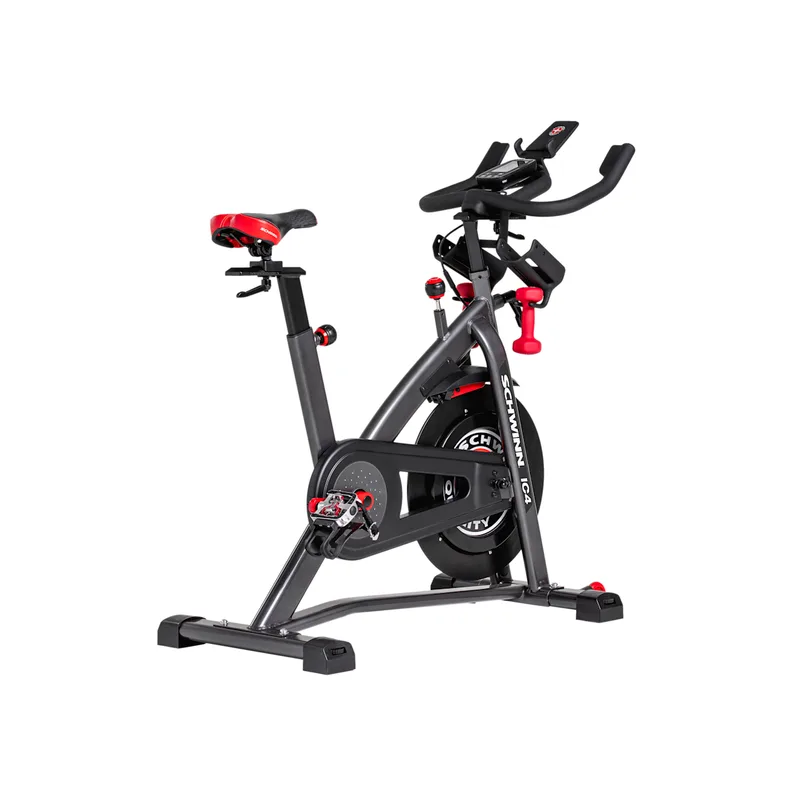
Schwinn IC4 Indoor Cycling Bike
Pros
- Works with virtually every major fitness app via Bluetooth — Peloton, Zwift, Explore the World, Apple Fitness+, and more — no ecosystem lock-in means you keep your options open as platforms evolve
- 40 lb flywheel delivers a genuinely smooth, momentum-driven pedal stroke that budget bikes with 14–18 lb flywheels can't replicate — the difference is immediately noticeable on sprints and standing climbs
- 100 magnetic resistance levels give finer progression than the 8–32 levels on most competitors — useful for structured interval training and gradual load increases across workout programs
- Dual-sided pedals accept both SPD cleats and standard athletic shoes without adapter purchase — cyclists with clip-in shoes use them immediately; beginners ride in regular sneakers
- Includes Bluetooth heart rate monitor, 3 lb dumbbells, and a bike mat in the box — meaningful accessories that add real value at the $799 price point
Cons
- No built-in touchscreen — you supply your own tablet or phone and mount it to the device holder, which works but requires additional hardware if you want a true all-in-one setup
- Console display is basic by current standards — speed, distance, RPM, and calories are visible but the monitor is minimal compared to the embedded screens on Peloton and Echelon
- At 106 lbs, the IC4 is not particularly light — moving it between rooms requires effort, though the integrated transport wheels help
The Schwinn IC4 earns the top position in this roundup because it solves the fundamental problem with connected bikes — platform lock-in — while delivering hardware quality that legitimately competes with bikes at twice the price. The 40 lb flywheel is the key differentiator against other bikes in the sub-$1,000 range. Heavier flywheels create more rotational inertia, which translates to a smoother, more consistent pedal stroke during high-cadence riding and sprints. Budget bikes at $300–400 use 14–18 lb flywheels that feel choppy by comparison. The IC4’s flywheel is substantially heavier than the Echelon EX-5’s 28 lb flywheel and comparable to what you’d find on commercial spin bikes.
The 100 magnetic resistance levels provide genuinely fine-grained progression. Most connected bikes offer 8–32 levels. 100 levels let you make smaller incremental adjustments during structured interval training without large jumps in perceived effort — useful for cadence-based programs and heart-rate zone training where precise effort control matters.
The multi-platform Bluetooth compatibility is the feature that differentiates the IC4 most clearly from competitors in the same price tier. Based on owner reports and review coverage, the IC4 pairs reliably with Peloton (app, not bike), Zwift, Explore the World, Apple Fitness+, Kinomap, and others. You’re not buying into Schwinn’s ecosystem — you’re buying a high-quality hardware platform that works with whichever app you prefer, now and in the future. If Peloton raises subscription prices in 2027 or Zwift adds a better feature, you switch apps without buying new hardware.
Dual-sided pedals and the included accessories (heart rate monitor, dumbbells, mat) mean the IC4 is ready for a structured training program the day it arrives. For home gym athletes who want a premium connected cycling experience without committing to a single subscription ecosystem, the IC4 is the most sensible choice in 2026.
Peloton Bike+ — Premium Pick
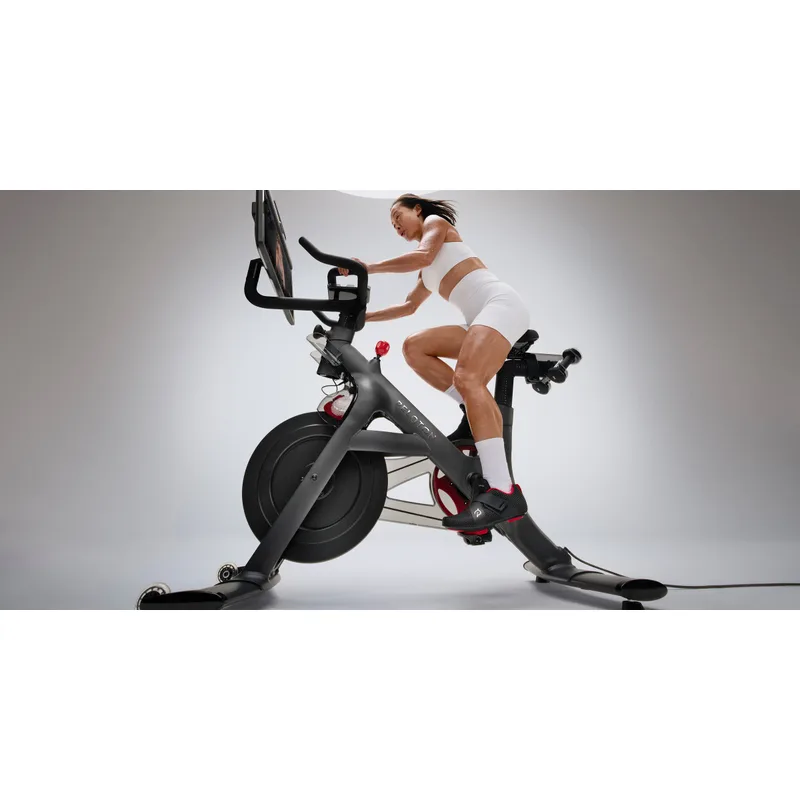
Peloton Bike+
Pros
- Auto-Follow resistance adjusts automatically during classes — the bike matches instructor cues without requiring manual dial adjustments mid-set, which fundamentally changes how immersive the workout feels
- 23.8" HD rotating screen pivots 360 degrees for off-bike workouts — yoga, strength, stretching, and HIIT floor classes use the same screen rather than requiring a separate TV or phone
- The Peloton class library is the largest in connected fitness: 14,000+ on-demand rides plus daily live classes across multiple formats — beginner cycling, HIIT, low-impact, and advanced climbs
- Apple GymKit integration syncs real-time heart rate data directly from Apple Watch without Bluetooth pairing steps — accurate data without chest strap equipment
- Near-silent magnetic resistance makes the Bike+ usable in apartments and shared living spaces where mechanical friction bikes would cause noise complaints
Cons
- $2,495 is the highest hardware price in this roundup, and the $44/month subscription required for full library access adds $528/year in ongoing costs — factor both into the 3-year ownership cost
- Only sold directly from Peloton — no Amazon purchase, no local retail pickup, and delivery and setup require scheduling with Peloton's delivery partners
- Peloton's subscription model creates long-term platform dependency — if Peloton raises pricing or you cancel the membership, the hardware utility decreases significantly compared to app-agnostic bikes
The Peloton Bike+ is only sold through Peloton’s website, not through Amazon, and that fact matters for the buyer evaluation. You’re not just buying a bike — you’re buying into a platform. The hardware is excellent: the 23.8” rotating screen is genuinely large and sharp, Auto-Follow resistance that adjusts automatically during classes removes the distraction of manual dial adjustment mid-workout, and Apple GymKit integration is the cleanest real-time heart rate solution available on any home bike.
What Peloton has built is the largest on-demand workout library in connected fitness — 14,000+ rides across every format, from 20-minute low-impact recovery spins to 90-minute HIIT climbing sessions. Live classes run throughout the day with real instructors. The social features (leaderboard, high-five system) create a community engagement that no competing platform currently replicates at scale. Based on Peloton’s own usage data, the average subscriber rides considerably more per week than gym members — the class format drives consistency in a way that riding aimlessly does not.
The rotating screen matters beyond cycling. The Bike+ functions as a home fitness studio: the screen pivots fully for strength, yoga, stretching, and floor-based HIIT workouts. That functionality makes the $2,495 hardware cost more defensible — you’re buying one device that covers cycling and a broader training program.
The honest constraints: $44/month subscription is mandatory for full library access. Over three years, that’s $1,584 in additional cost beyond the hardware — total ownership cost exceeds $4,000. Buyers who will ride 4–5 times per week for years will extract that value. Buyers who cycle intermittently may find the IC4 at $799 with a lower-cost app subscription is more appropriate.
Echelon EX-5 — Best Mid-Range
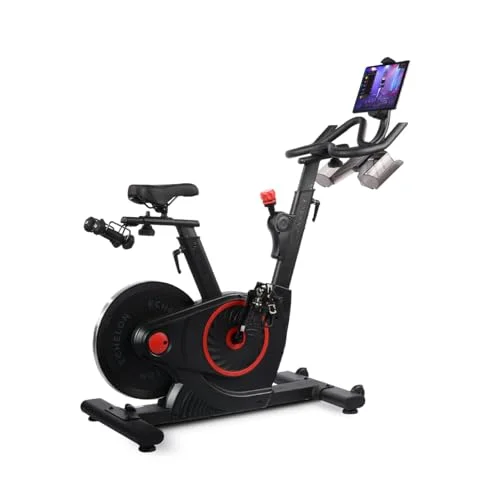
Echelon EX-5 Smart Connect Fitness Bike
Pros
- 4-way seat and 4-way handlebar adjustment covers a wide range of rider sizes — taller and shorter riders can both achieve proper fit geometry rather than compromising to whatever the bike forces
- 32 magnetic resistance levels provide enough granularity for structured interval and endurance training — more than adequate for home cardio users who aren't running competitive power-based programs
- Device holder accommodates phones and tablets from 5.5" to 12.5" — flips 180 degrees so you can follow the screen during off-bike floor segments without moving the device
- 124 lb frame weight with 20" width is narrower than most competitors — fits in tighter gym layouts and against walls more easily than the IC4 or VeloCore
- Echelon Fit app offers live and on-demand classes at a lower subscription cost than Peloton — compatible with third-party apps via Bluetooth as well
Cons
- No built-in touchscreen — the Echelon EX-5 depends on a user-supplied device; upgrading to the EX-5S-22 adds a built-in 22" screen at a meaningfully higher price
- Echelon app subscription is required to access most of the platform's content — the free tier is limited and doesn't represent what the bike is actually capable of with full access
- 28 lb flywheel is lighter than the Schwinn IC4's 40 lb flywheel — the momentum-based smoothness during sprints and high-cadence intervals is noticeably less refined
The Echelon EX-5 occupies a competitive price point in connected cycling — $999, where it competes against the Schwinn IC4 ($799) and where buyers need to decide whether a Bluetooth-first or subscription-first approach better matches how they actually train. The EX-5’s advantage over the IC4 is its 4-way seat and 4-way handlebar adjustability, which accommodates a wider physical range of riders and makes proper bike fit easier to achieve. Correct fit matters for both performance and injury prevention — a bike that forces you into a suboptimal position limits how hard you can push and how long you can sustain effort comfortably.
The Echelon Fit app provides live and on-demand classes, and owner feedback consistently notes that the instruction quality is solid — the platform has improved meaningfully from its earlier iterations. The app subscription costs less than Peloton’s, which factors into multi-year total cost comparisons. Third-party Bluetooth app compatibility means you can also use the EX-5 with Zwift or other platforms if Echelon’s library doesn’t match your preferences.
The EX-5’s limitation relative to the IC4 is its lighter 28 lb flywheel. For steady-state cardio and moderate interval training, 28 lbs is perfectly adequate. For athletes doing structured power-based training with frequent high-cadence sprints, the IC4’s 40 lb flywheel delivers a noticeably smoother experience. If your primary training style is class-based cycling rather than structured power training, the EX-5 at $999 is a competitive choice. Riders who want a built-in screen should look at the EX-5S-22, which adds a 22” rotating touchscreen at a higher price point.
Bowflex VeloCore 16 — Most Innovative
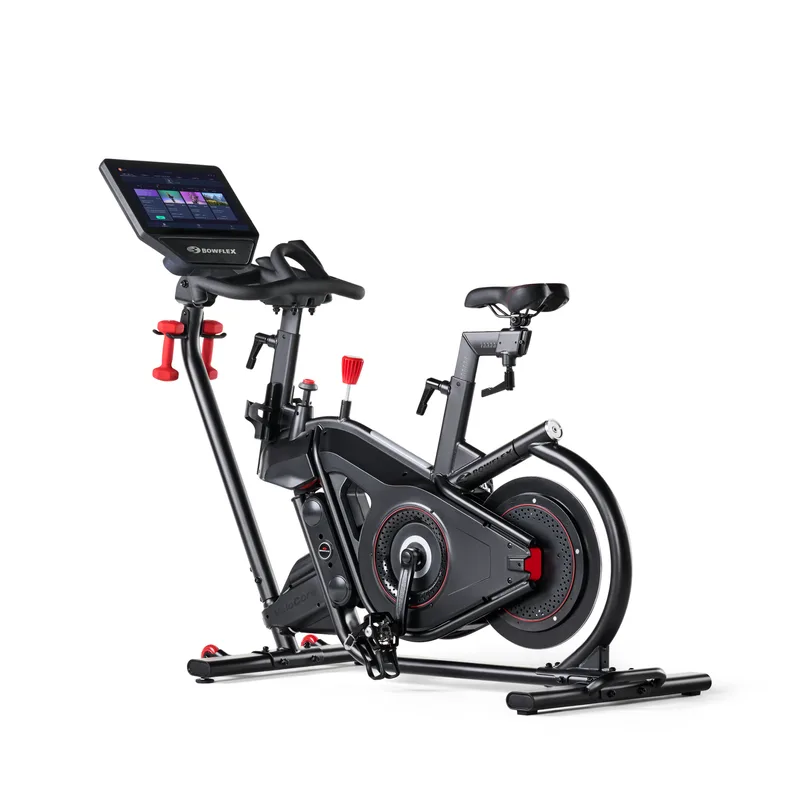
Bowflex VeloCore 16 Indoor Cycling Bike
Pros
- Leaning mode activates core engagement during rides by allowing the bike frame to sway side-to-side — addresses a real limitation of standard stationary bikes where lateral stability work is absent
- 100 magnetic resistance levels match the Schwinn IC4 for the finest resistance progression available in this roundup — structured training programs and power-zone workouts benefit from this precision
- 16" built-in HD touchscreen means no phone or tablet is required for streaming JRNY classes — a true all-in-one setup at a price point well below Peloton's entry
- Includes 3 lb dumbbells and a Bluetooth heart rate armband in the box — lets you begin upper-body and cardio combination classes immediately without additional purchases
- JRNY platform provides auto-personalization based on workout history — adjusts suggested resistance levels and programming recommendations as you progress
Cons
- Leaning mode is a compelling differentiator but not for everyone — riders who prefer a stable, locked platform for high-power efforts may find the sway distracting rather than beneficial
- JRNY app library is smaller than Peloton's by a significant margin — live class variety and on-demand depth are more limited, particularly for cycling-specific programming
- $1,499 puts the VeloCore in direct competition with superior-value options; the leaning feature needs to align with your training style to justify the price premium over the Schwinn IC4
The VeloCore’s defining feature is its leaning mode — the bike frame pivots side-to-side during riding, engaging lateral core stabilization muscles in a way that a fixed stationary bike cannot. In standard mode, the VeloCore rides identically to any other stationary bike. Engage leaning mode, and the frame can swing up to 16 degrees to either side while you pedal, requiring continuous balance input throughout the workout. Based on Bowflex’s research and owner feedback, this activates glutes, obliques, and hip stabilizers beyond what straight-line cycling develops.
Whether leaning mode matters to you depends entirely on your training goals. For home gym athletes whose primary lower-body work is already covered by squats, deadlifts, and lunges, the lateral activation the VeloCore adds is genuinely complementary. For athletes who primarily want high-intensity cardio output, the sway can feel like an unwanted variable during maximum-effort intervals. The mode is switchable — you can lock the frame flat for focused power output sessions and activate leaning for longer, technique-focused rides.
The 16” built-in JRNY touchscreen removes the need for a device mount and separate subscription decision — JRNY is the platform, and two months of access are included. The 100 resistance levels match the IC4’s finest progression available in this price tier. Accessories (dumbbells, heart rate armband) are included. At $1,499, the VeloCore is priced as a mid-premium option, and the leaning feature is the primary differentiator that justifies choosing it over the IC4 at $799 or the Echelon at $999.
Keiser M3i — Best Performance
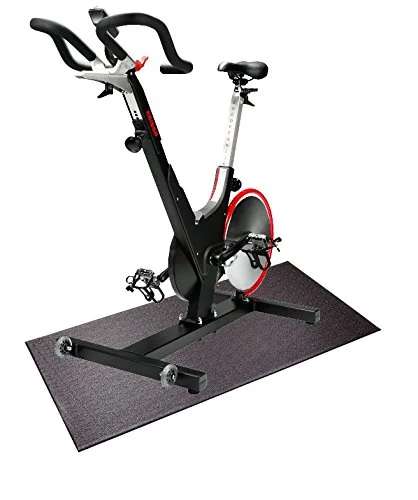
Keiser M3i Indoor Cycle
Pros
- Non-contact magnetic resistance means zero friction wear — the resistance mechanism does not degrade over time the way belt-and-pad systems do, which is why Keiser bikes are standard in commercial gyms and last 15+ years of daily use
- Open Bluetooth platform transmits power, cadence, and heart rate data to any compatible app — Zwift, TrainingPeaks, Wahoo, and others receive full data without proprietary subscriptions or hardware requirements
- 24 simulated gear ratios provide finely incremental resistance steps that cyclists using structured power-zone training find more accurate than percentage-based systems
- 350 lb maximum user capacity combined with lifetime frame warranty signals genuine commercial-grade construction — the structural durability is not a marketing claim
- Compact 43" length footprint is shorter than all other bikes in this roundup — fits in gym layouts where longer bikes like the IC4 (54.6") require more floor depth
Cons
- $1,999 is the second-highest price in this roundup — appropriate for serious cyclists and commercial-quality buyers; harder to justify for casual home cardio users who won't extract value from the performance precision
- No built-in display — real-time data goes directly to your paired app or device; riders who prefer a standalone console need an external monitor or device mount
- 8.5 lb rear flywheel is much lighter than the Schwinn IC4's 40 lb front flywheel — Keiser's magnetic resistance system creates a different feel than heavy-flywheel inertia bikes; some riders prefer the momentum sensation of a heavy flywheel
The Keiser M3i is a commercial-grade indoor cycle used in fitness studios, physical therapy clinics, and serious home cycling setups. Its positioning in a home gym roundup requires context: at $1,999 it’s priced above the Echelon and VeloCore, and the lack of a built-in screen means it’s not a beginner-friendly all-in-one solution. What the M3i provides instead is engineering longevity and precision that justifies the investment for a specific type of buyer.
The non-contact magnetic resistance system is the M3i’s core advantage. Standard belt-and-pad resistance systems create friction wear over time — cables stretch, pads wear down, mechanisms require periodic adjustment and replacement. The M3i’s rear-mounted magnetic system creates resistance through electromagnetic interaction without any contact between moving parts. Zero friction wear means zero degradation of resistance feel or smoothness over the bike’s operational life. Based on the M3i’s commercial track record, units in fitness studios endure years of multiple-session daily use with the same smooth resistance that left the factory.
The open Bluetooth platform transmits ANT+ and Bluetooth 4.0 data — power, cadence, heart rate — to any compatible app without proprietary hardware or subscription requirements. Zwift, TrainingPeaks, Wahoo Fitness, and others receive full data. For cyclists who use structured power-based training, this is the ideal setup: commercial hardware precision feeding your preferred training software. The 350 lb capacity and lifetime frame warranty complete the commercial-grade argument.
The M3i is the right choice for serious cyclists who value hardware longevity, data precision, and platform freedom over built-in screens or class libraries. For everyone else, the Schwinn IC4 delivers the multi-platform flexibility at a fraction of the price.
What to Look for in a Smart Exercise Bike
Flywheel Weight and Ride Feel
Flywheel weight determines how smooth the pedal stroke feels, especially at high cadence. Heavier flywheels (35–50 lbs) create more rotational inertia that smooths out the stroke between pedal pushes. Lighter flywheels (14–28 lbs) feel more staccato during sprints. For structured interval training and high-intensity cycling, a heavier flywheel delivers a noticeably better experience. The Schwinn IC4’s 40 lb flywheel is the heaviest in this roundup.
Resistance System and Levels
Magnetic resistance systems (used by all five bikes in this roundup) are quieter and require less maintenance than friction resistance systems. The number of levels matters for structured training: 8–12 levels forces large jumps in effort; 32–100 levels allows precise incremental adjustments. Power-zone training protocols work best with fine-grained resistance progression.
App Ecosystem and Platform Costs
Factor subscription costs into the total ownership calculation:
- Peloton: $44/month ($528/year)
- Echelon: $39.99/month ($480/year)
- JRNY (Bowflex): $19.99/month ($240/year)
- Schwinn IC4 / Keiser M3i: use any app — Zwift ($19.99/month), Apple Fitness+ ($9.99/month), or free apps
Multi-platform bikes (IC4, Keiser M3i) let you optimize subscription cost independently of hardware choice.
Screen vs. Device Mount
Built-in screens (Peloton, VeloCore 16, and the Echelon EX-5S-22 upgrade) provide an integrated experience without managing a separate device. Device-mount bikes (IC4, EX-5, Keiser M3i) offer more flexibility — use a larger iPad for a bigger display, or use your existing phone. If you already own an iPad, the device-mount approach costs nothing extra. If you don’t, a good mount setup adds $20–50.
Adjustability and Fit
Correct bike fit prevents knee, hip, and lower back strain during longer sessions. Look for 4-way seat adjustment (up/down + forward/back) and at least 2-way handlebar adjustment. Riders outside average height ranges (under 5’3” or over 6’2”) should verify the bike’s specific fit range against their measurements before purchasing.
FAQ
Do smart exercise bikes require a subscription to work? All five bikes in this roundup are functional without a subscription — resistance, manual cadence tracking, and Bluetooth connectivity work regardless of subscription status. Subscriptions unlock class libraries and coaching features. The Schwinn IC4 and Keiser M3i are the most subscription-flexible, pairing with multiple free and paid apps so you control ongoing costs.
Can the Schwinn IC4 really replace a Peloton? The IC4 works with the Peloton app — you can access Peloton’s class library on any Bluetooth-capable bike. The IC4’s resistance levels aren’t precisely calibrated to Peloton’s power zones (that requires a Peloton bike), but for class-based guided cycling and indoor rides, the app experience is the same. At $799 plus a Peloton app subscription ($12.99/month), the total cost is significantly less than the Peloton Bike+ hardware alone.
How much space does a smart exercise bike need? Budget at minimum 6 feet long by 3 feet wide for the bike footprint, plus 2–3 feet on each side and behind for safety clearance. The Keiser M3i has the shortest frame at 43”, while the Schwinn IC4 extends to 54.6”. Ceiling height isn’t a concern for seated cycling; standing out-of-saddle climbs on taller riders need to clear the handlebars, which is typically fine with 7+ foot ceilings.
Is leaning mode on the Bowflex VeloCore actually useful? Based on owner feedback, leaning mode adds meaningful lateral core engagement that straight-line bikes don’t provide — it’s a genuine differentiator, not a gimmick. Whether it matches your training goals is the question. Athletes who want a traditional high-power spin bike experience may find it distracting; athletes looking for more functional fitness and core activation from their cardio find it valuable. The mode is switchable, so you’re not forced to use it on every ride.
What’s the actual difference between a $799 and a $2,495 smart bike? Three things: class library size and quality (Peloton’s 14,000+ rides versus smaller or app-dependent libraries), hardware integration quality (Auto-Follow resistance, GymKit, rotating screen on the Bike+), and build refinement. A Schwinn IC4 is genuinely well-built and will last years of consistent use. The Peloton Bike+ adds a premium experience layer — smoother screen interaction, deeper class variety, more polished instructor production. Both are durable. The Peloton delivers a better class experience if you ride Peloton content specifically; the IC4 delivers better platform flexibility.
Conclusion
The Schwinn IC4 is the strongest overall recommendation for home gym cyclists in 2026. The 40 lb flywheel, 100 resistance levels, multi-platform Bluetooth compatibility, and $799 price point combine in a way that’s difficult to beat. It works with whatever app you prefer, delivers a genuinely smooth ride, and doesn’t create long-term platform dependency.
If you want the best connected fitness ecosystem and are comfortable with the subscription commitment, the Peloton Bike+ is the clear premium choice — no bike in this roundup matches its class library depth or Auto-Follow integration. For $999, the Echelon EX-5 is the strongest mid-range connected option. The Bowflex VeloCore 16’s leaning mode is the most distinctive feature in the roundup for core-focused training. And the Keiser M3i is the right call for serious cyclists who value commercial-grade hardware precision and long-term durability above all else.