Squat wedges surged in 2026 as ankle mobility training moved from niche physical therapy clinics to mainstream home gym programming. The “knees over toes” methodology — popularized by trainers focusing on knee health and quad development — requires a degree of ankle dorsiflexion that most sedentary adults simply don’t have. A wedge under the heel compensates for limited mobility and lets you hit full depth, upright torso, without dumping forward or collapsing the arch. Reddit’s r/homegym community reported heel blocks as one of the most frequently recommended “forgot to buy this when I set up” accessories through early 2026.
The products below range from sub-$45 steel blocks to adjustable rubber sets. All five were researched through owner reports, manufacturer specs, and community forum feedback.
Quick Picks
HarderWill 3-Height Adjustable is the best all-around choice. Three stackable angles, 2,000 lb capacity, storage bag included — everything most home gym owners need in one set.
Valor Fitness Squat Wedge is the best option if you want calf stretching and mobility work built into the same tool. The three-angle system (10°/15°/25°) handles strength training and recovery equally well.
Yes4All Steel Squat Wedge is the best pick for lifters who want maximum durability at minimum cost. Steel construction and non-slip base at under $45.
Actomall One-Piece Slant Board wins on platform size. The 27-inch length fits wide-stance movements that paired blocks can’t fully support.
Rogue 13” Resin Pair is the premium portable option. Rogue’s ABS resin construction and USA manufacturing put these in a different material tier from generic rubber blocks, at a price that remains competitive.
Detailed Reviews
HarderWill 3-Height Adjustable — Best Overall
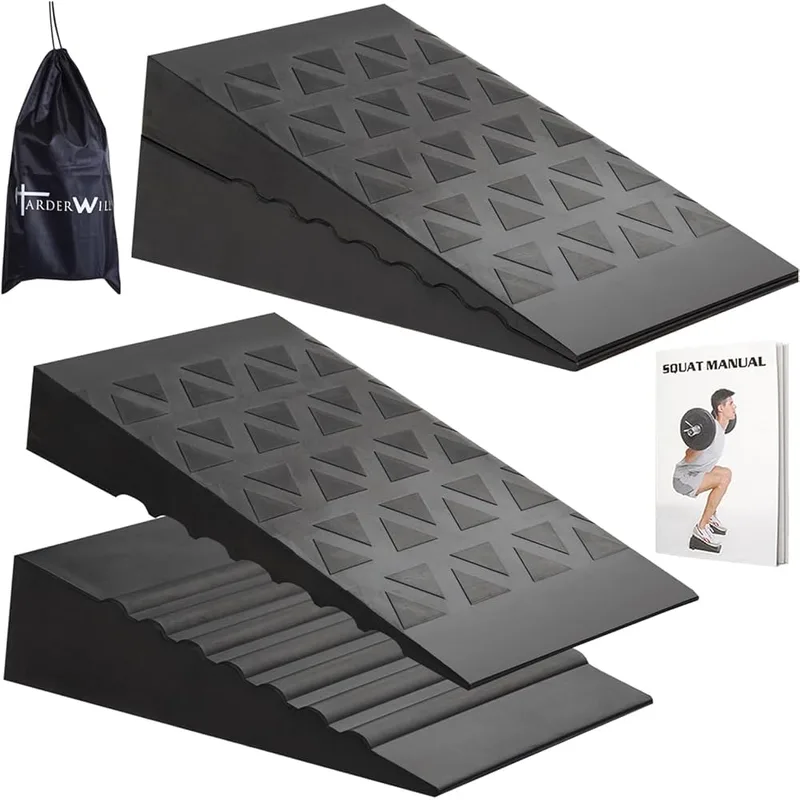
HarderWill 3-Height Adjustable Squat Wedge
Pros
- Three stackable heights dial in the exact heel lift for your ankle mobility level — most competitors offer one fixed angle
- 2,000 lb capacity handles heavy barbell squats, goblet squats, and any loaded movement without flex or wobble
- Odorless high-density rubber stays grippy on gym floor surfaces without sliding under load
- Storage bag keeps all four blocks together between sessions — no hunting for misplaced wedges
- Training poster included covers seven key exercises that benefit from heel elevation
Cons
- Four-piece set requires stacking correctly — takes a few sessions to become second nature
- Rubber blocks are heavier than foam alternatives, adding to travel weight
- No angle markings on the blocks themselves; degree reference only available in documentation
The HarderWill adjustable wedge solves the core problem with most squat wedges: one fixed angle rarely fits everyone. If you’re working around tight ankles, 24° of heel elevation gets you into a deep squat. If you’re warming up, 9° is a reasonable pre-workout mobility ramp. The HarderWill set ships as four rubber blocks — two large (15°) and two smaller (9°) — that stack to create three distinct height options: 1.3”, 2.2”, and 3.3”.
Owner feedback across multiple retail platforms consistently notes the rubber density as a standout characteristic. The silicone compound is odorless (a notable improvement over some competitor products that off-gas for weeks post-delivery), and the base texture grips smooth concrete without slipping under load. The 2,000 lb capacity exceeds anything a home gym athlete is realistically going to apply — even with a 500 lb squat, the loading on two wedges is well within range.
The training poster in the box covers seven exercises — heel elevated goblet squats, calf raises, split squats, and mobility work — which is genuinely useful for athletes new to heel elevation training. The storage bag keeps all four blocks together between sessions rather than scattering across a gym floor.
The main learning curve is stacking correctly to achieve each angle. Once you’ve done it a few times, it’s automatic, but the first session or two requires checking the configuration. Angle markings on the blocks themselves (rather than only in documentation) would eliminate this friction.
Valor Fitness Squat Wedge Slant Board — Best for Mobility Work
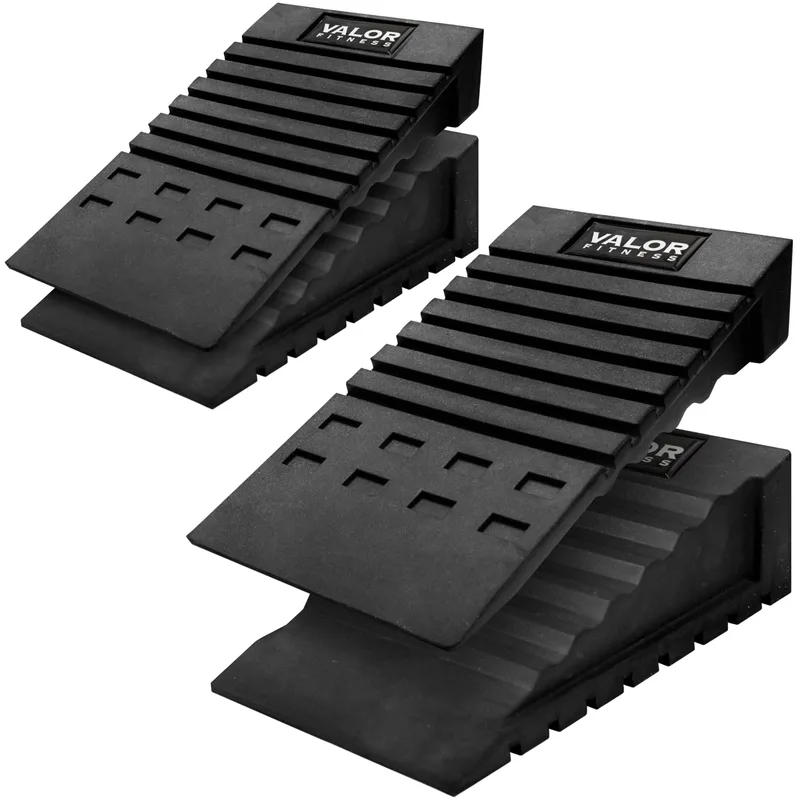
Valor Fitness Squat Wedge Slant Board
Pros
- Three distinct incline options (10°/15°/25°) cover beginner mobility work through advanced quad-focused training
- Double-duty as a calf stretcher and mobility slant board — adds recovery utility between lifting sessions
- Rubber construction stays stable on smooth garage concrete under loaded movement
- Well-documented Valor Fitness brand with responsive customer support and clear return policy
Cons
- At $64 it prices slightly above comparable adjustable rubber sets with similar specs
- Individual blocks are not as compact as paired-only wedge designs — requires more storage space
- Heavier rubber construction makes travel portability a secondary consideration
Valor Fitness positions this wedge as a dual-use tool for strength and mobility, and based on the spec sheet, the angle range backs that claim. At 10°, the block functions as a warm-up calf stretcher and light ankle mobility ramp. At 25°, it’s aggressive enough for quad-biased heel elevated squats, Bulgarian split squats, and deep goblet work. The 15° setting sits between those poles for most training-weight squat sessions.
The rubber construction matches or exceeds comparable blocks in the $60-70 range. Owner reports note consistent stability on both rubber gym flooring and smooth concrete — no sliding under 300+ lb loaded squats. The texture on both the foot surface and base functions as intended.
Where the Valor differentiates is the calf stretch utility. Stand on the 25° wedge facing the wall, lean forward with straight knees, and you have a solid calf and Achilles stretch that mirrors what you’d find on a dedicated slant board. For home gym athletes who run or jump rope as part of their programming, adding this into the post-session stretching routine requires no additional equipment.
At $64 it’s $4 more than the HarderWill set. The difference is minimal. If you prioritize the brand name and direct Valor Fitness support, it’s worth it. If you want the same adjustability at a slight discount, the HarderWill performs comparably.
Yes4All Steel Squat Wedge — Best Budget Steel
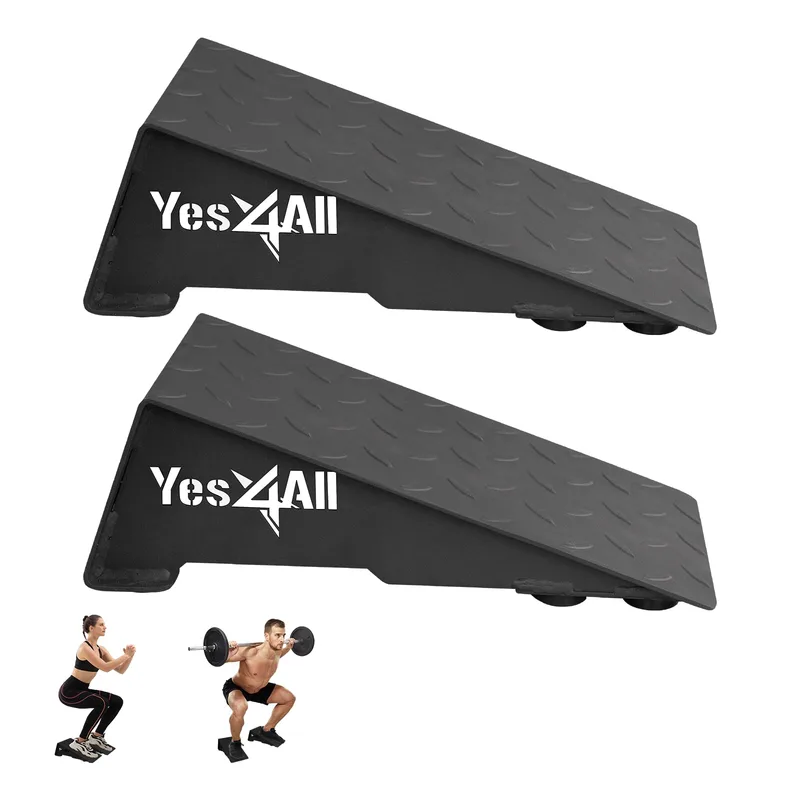
Yes4All Steel Squat Wedge
Pros
- Steel construction at under $45 is the best durability value in this category — rubber competitors at the same price flex more under heavy load
- Six rubber bumpers on the base prevent sliding on smooth surfaces without leaving marks on gym flooring
- Resistance band slot adds a second function for banded squats and hip mobility drills without extra equipment
- Recessed hand grip makes single-hand transport between stations simple
Cons
- Fixed angle only — no adjustability for different mobility levels or training phases
- At 1,000 lb rated capacity, it trails the 2,000 lb rubber options above for extreme loading scenarios
- Steel can feel cold underfoot in unheated garage gyms during winter months
Steel squat wedges occupy a different category than rubber. The tradeoff is fixed angle (no adjustment) versus significantly higher rigidity and ground contact stability. The Yes4All Steel Squat Wedge hits both criteria: the reinforced steel weld construction shows zero flex under load, and the six rubber bumpers on the base provide grip without any block movement during heavy squats.
The 13.5” x 7” foot space fits most adult shoe sizes in a standard squat stance. Owner feedback mentions the anti-slip texture on the upper surface is more aggressive than rubber alternatives — useful during chalk-heavy sessions where a smooth surface would get slippery. The recessed hand grip on the underside makes moving the blocks between stations a one-handed carry.
The resistance band slot is a useful bonus feature. Band-resisted squats, pull-aparts, and hip rotations can all use this slot without a rack or separate anchor. For apartment gyms or minimalist setups, the additional functionality per dollar of equipment is worth noting.
The limitation is fixed angle. Based on manufacturer specs, the angle appears to be in the 15°-17° range — suitable for most training purposes but not adjustable for advanced heel elevation work. Lifters with severe ankle dorsiflexion restrictions may need the 24° setting that the HarderWill set provides.
| Spec | HarderWill 3-Height Adjustable Squat Wedge | Valor Fitness Squat Wedge Slant Board | Yes4All Steel Squat Wedge | Actomall Large One-Piece Slant Board | Rogue 13" Resin Squat Wedge Pair |
|---|---|---|---|---|---|
| Rating | 9.2/10 | 8.8/10 | 8.5/10 | 8.3/10 | 8.7/10 |
| Price | Check price | Unavailable | Unavailable | $39.99as of Oct 18, 2026 | $45.00 |
| Angles | 9°, 15°, 24° (stackable) | 10°, 15°, 25° | — | — | — |
| Heights | 1.3", 2.2", 3.3" | — | — | — | — |
| Weight Capacity | 2,000 lbs | — | 1,000 lbs | 4,000 lbs | — |
| Material | High-density rubber/silicone | Heavy-duty rubber | Heavy-duty steel with reinforced welds | Crosslinked EVA polyethylene foam | High-strength ABS resin (microcellular injection molding) |
| Includes | 4 blocks, storage bag, training poster | — | — | — | — |
| Non-Slip | Anti-slip textured surface + base | Textured grip surface | — | — | — |
| Use Cases | — | Squats, deadlifts, calf stretches, split squats | — | — | — |
| Design | — | Stackable adjustable blocks | — | One-piece, no assembly required | — |
| Brand Origin | — | USA-based fitness equipment brand | — | — | — |
| Foot Space | — | — | 13.5" × 7" | — | — |
| Anti-Slip | — | — | Textured surface + 6 rubber bumpers on base | — | — |
| Extra Feature | — | — | Resistance band attachment slot | — | — |
| Carry | — | — | Recessed hand grip built-in | — | — |
| Dimensions | — | — | — | 27" L × 10" W | — |
| Angle | — | — | — | 15° | 10° |
| Weight | — | — | — | 1.65 lbs | — |
| Length | — | — | — | — | 13" per wedge |
| Weight per Pair | — | — | — | — | 1.6 lbs |
| Sold As | — | — | — | — | Pair |
| Made In | — | — | — | — | USA |
| Check Price → | Check Price → | Check Price → | Check Price → | Check Price at Rogue → |
Prices change daily — tap Check Price for the current Amazon price. Numbers shown were verified on the "as of" date.
Actomall Large One-Piece Slant Board — Best Large Platform
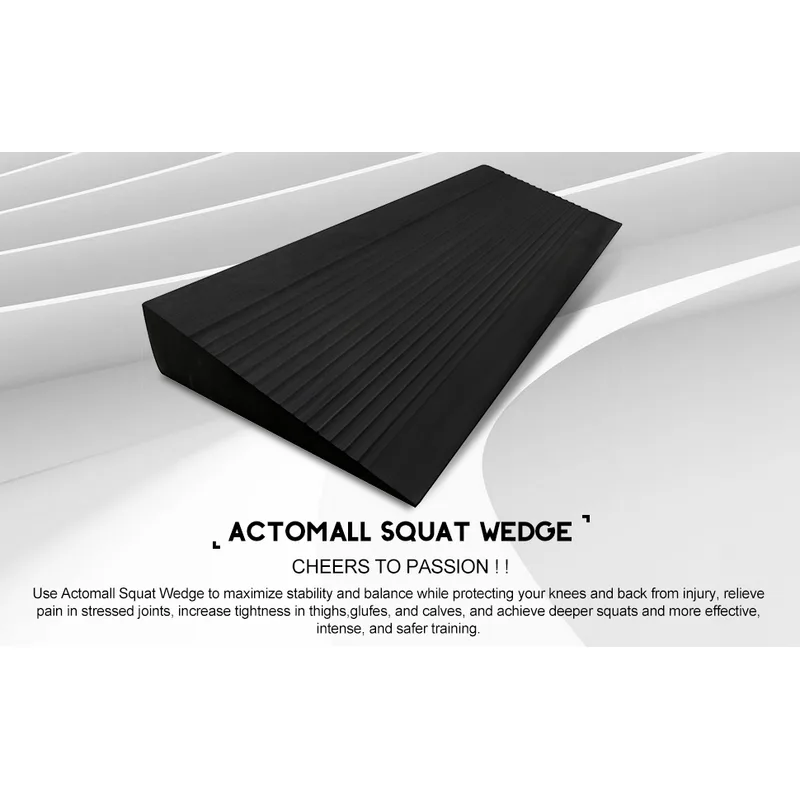
Actomall Large One-Piece Slant Board
Pros
- 27-inch length accommodates wider stances — Bulgarian split squats and sumo squat positions both fit comfortably on one platform
- 4,000 lb capacity far exceeds any home gym loading scenario, ensuring zero compression or deformation under use
- One-piece construction eliminates block alignment issues; just place it and squat
- At 1.65 lbs it's the lightest option in this comparison — easy to store under a bench or leaned against a wall
Cons
- Fixed 15° angle only — cannot adjust for different heel lift requirements
- EVA foam shows surface wear faster than rubber or steel under consistent heavy use
- Wide platform is less portable for gym bag carry compared to paired rubber blocks
Most squat wedge sets consist of two small paired blocks — one under each foot. This works for standard squats, but fails for wide stance work. A sumo squat with shoulder-width or wider foot placement puts each foot beyond the outer edge of a 7-inch block. The Actomall one-piece solves this with a single 27-inch by 10-inch platform that handles both feet regardless of stance width.
The crosslinked EVA foam construction is counterintuitive at first for a product rated to 4,000 lbs. EVA is a lightweight, closed-cell material that resists compression under sustained loading better than standard open-cell foam. At 1.65 lbs, it’s the lightest option in this roundup — a meaningful advantage for home gyms where space is tight and equipment gets moved frequently.
The 15° fixed angle covers most training applications for heel elevated squats. Based on community reports from r/powerlifting and r/homegym, 15° is the most commonly recommended starting angle for lifters working around ankle mobility limitations, placing the Actomall in the right range for the broadest use case.
The practical limitation is surface wear. EVA foam shows scuff marks and edge compression faster than rubber or steel under consistent heavy use. For a product used daily for heavy squat sessions over multiple years, the rubber alternatives will outlast the EVA by a meaningful margin. For lifters who train 3-4 times per week at moderate loads, durability is a non-issue within any reasonable product lifespan.
Rogue 13” Resin Squat Wedge Pair — Best Premium Resin
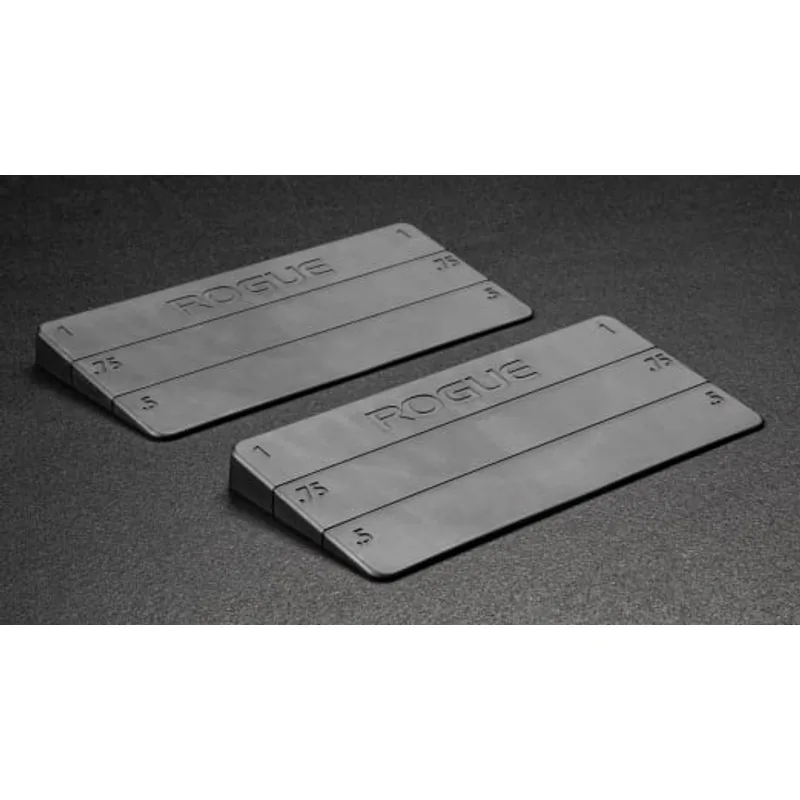
Rogue 13" Resin Squat Wedge Pair
Pros
- ABS resin construction uses the same microcellular injection process as premium sports equipment — impact resistant without adding weight
- At 1.6 lbs per pair, the lightest option reviewed — fits in any gym bag with room to spare
- 10° incline is the ideal starting angle for most lifters with moderate ankle mobility limitations
- Rogue manufacturing quality and USA construction mean this pair will outlast most rubber alternatives
Cons
- Only available direct from Rogue Fitness — no Amazon Prime shipping option
- Fixed 10° angle only — advanced lifters seeking 20°+ elevation need the steel or adjustable rubber options
- Higher shipping cost when ordering alone; most Rogue buyers bundle with a larger order
Rogue’s squat wedge is the only product in this roundup manufactured in the USA. The ABS resin construction uses microcellular injection molding — a process that creates a high-strength, impact-resistant structure by introducing controlled microbubbles into the material matrix. The result is a wedge that weighs 1.6 lbs per pair while maintaining the rigidity you’d expect from a heavier material.
The 10° angle is fixed and targets the most common use case: correcting modest ankle mobility restrictions for standard squat and split squat training. Based on owner feedback from the Rogue Fitness community forums, the 13” length fits most adult foot sizes comfortably without overhang on the front or heel edge.
The primary consideration with Rogue is the purchase process. These are available exclusively through roguefitness.com — not on Amazon, and not through third-party retailers. Shipping costs from Rogue are reasonable when bundled with other equipment, but ordering a single $45 pair with shipping makes the effective cost higher than it appears. Most Rogue buyers who purchase the squat wedge pair add it to a barbell, collar, or plate order to offset the shipping cost.
For lifters already in the Rogue ecosystem — own a bar, a rack, or Rogue collars — the resin wedge is the natural addition. The quality is above any rubber block at a similar price point, and the portability makes these the best travel or away-gym option in this comparison.
Buying Guide: How to Choose a Squat Wedge
Angle: Fixed vs. Adjustable
Most single-block wedges sit between 10° and 17°. This range covers typical training use for moderate ankle restriction. Adjustable sets add a second and third height option, reaching 24° or higher for severe restriction or advanced quad-focused training protocols.
If you’re new to heel elevation training, start with a fixed 10°-15° block. If you know your dorsiflexion restriction is significant, or if you want one set that adapts as your mobility improves over months, spend the extra $15-20 for an adjustable set.
Material: Rubber vs. Steel vs. Resin vs. EVA
Rubber is the most common material. High-density rubber provides good non-slip contact on both surfaces, handles heavy loads without flex, and absorbs minor impact from barefoot or shoe sole contact. The main variable is density — cheaper rubber blocks compress noticeably under load, premium blocks show zero deformation.
Steel offers maximum rigidity with no flex, regardless of load. The tradeoff is fixed angle and a cold underfoot feel in unheated spaces. Best for lifters who squat heavy and don’t need adjustability.
ABS Resin (as used by Rogue) gives a lightweight, rigid structure with good impact resistance. The portable option for gym travel.
EVA Foam in one-piece platforms offers the largest surface area at the lowest weight. Best for wide-stance work. Durability under sustained heavy use is lower than rubber or steel over multi-year timelines.
Platform Size
Standard paired blocks (7”-8” wide) work for shoulder-width and narrower stance squat variations. For sumo squats, wide-stance variations, or Bulgarian split squats with significant forward knee travel, a larger platform prevents foot overhang and provides a more stable base.
If wide-stance or powerlifting-style squatting is a regular part of your programming, the Actomall one-piece 27” platform is worth prioritizing over adjustability.
Weight Capacity
All five products reviewed handle any realistic home gym load. Even 2,000 lb rated capacity blocks are being used for 400 lb squats — the 5x safety margin is the norm, not the exception. Don’t make capacity the deciding factor; focus on angle and material instead.
FAQ
Do squat wedges actually help with ankle mobility long-term?
Heel elevation compensates for limited dorsiflexion in the short term. It doesn’t improve mobility on its own. If the goal is long-term mobility improvement, combine wedge use with daily ankle stretching, mobility drills, and progressive range of motion work. Owner reports from physical therapy communities suggest using wedges during training while working on mobility separately, then gradually reducing heel elevation as dorsiflexion improves.
What degree of heel elevation should I start with?
Most training resources and physical therapists recommend 10°-15° for general use. If you find depth and torso position improve significantly at 10° but you’re still struggling with torso angle, try 15°. If 15° isn’t enough to resolve forward lean during the squat, a 20°+ setting (available with the HarderWill adjustable set) may be necessary while ankle mobility is developed separately.
Can squat wedges replace squat shoes?
For most home gym training purposes, yes. Olympic lifting shoes with raised heels provide a rigid, fixed heel lift similar to a wedge. The functional outcome — more upright torso, deeper squat — is the same. Squat shoes are preferable for competition use where equipment consistency matters. For home training, wedge blocks at $45-65 cover the same mechanical benefit without the $100-200+ shoe cost.
Are squat wedges safe for heavy barbell squats?
Based on manufacturer specs and owner feedback, all five products reviewed here handle standard home gym loading safely. The 1,000-4,000 lb weight capacities stated by manufacturers far exceed typical home gym barbell loads. The critical variable is base stability — ensure the wedge sits flat on a clean, dry floor surface and that the non-slip base is making full contact before loading.
Can I use squat wedges for exercises other than squats?
Yes. Calf raises, calf stretching, split squats, lunges, deadlifts (for ankle mobility work), and banded hip mobility drills all benefit from heel elevation. The Valor Fitness blocks and HarderWill set both include specific guidance for multi-exercise use in their product documentation.
Conclusion
The HarderWill 3-Height Adjustable Squat Wedge is the right call for most home gym athletes. Three stackable angles, 2,000 lb capacity, storage bag, and a sub-$60 price make it the most practical and adaptable option in the category.
If portability is the priority, the Rogue 13” Resin Pair packs into any gym bag at 1.6 lbs and holds up to Rogue’s manufacturing standards over years of use.
For wide-stance training or programming with sumo squats and wide-split movements, the Actomall One-Piece Slant Board is the only option reviewed that provides a platform wide enough for both feet at maximum stance width.
Start with heel elevation if ankle mobility is limiting your squat depth or causing forward lean. The investment is under $65 — less than one month of a gym membership — and the improvement to squat mechanics based on consistent owner feedback is immediate and noticeable.