Home gym storage became a genuine priority in 2026. Review sites across the fitness space updated their plate tree roundups this year, and the GarageGymLab editors noted a clear shift: buyers are spending more intentionally on storage infrastructure, not just equipment. Plates stacked on the floor create tripping hazards, damage rubber coating, and slow down training by making weight selection a physical excavation rather than a quick grab.
A weight plate tree solves the problem cleanly. It organizes plates by size, keeps bars accessible, and reclaims floor space that would otherwise disappear under a stack of 45s. The right tree depends on how much plate weight you own, whether your setup gets rearranged, and how tightly you need to pack it into your available gym space.
This roundup covers five trees from budget through premium — enough range to match any combination of plate inventory, floor space, and price sensitivity.
Quick Picks
REP Fitness Bar and Weight Plate Tree earns the top spot for most home gym builders. Chrome-coated posts, 850 lb capacity, two barbell holders, and a 24x24” footprint at $144 direct from REP — hard to beat for the combination of function and price.
Titan Fitness Portable Weight Tree is the pick for anyone who rearranges their gym or wants to sweep under storage racks. Locking caster wheels are standard equipment, not an add-on. At $199, it’s the only tree here that ships from Amazon and includes wheels out of the box.
Body-Solid OWT24 is the compact option. The 27x16x24” footprint makes it the smallest tree in this roundup — it fits in tight corners that a full-height tree won’t. At $99 with 1,000 lb capacity, it’s the best value for smaller plate collections.
Rogue Vertical Plate Tree 2.0 is the long-sleeve, heavy-capacity option for serious plate collections. Twelve-inch loadable sleeves fit more plates per post than anything else in this category, and the optional add-ons (wheels, barbell holders) allow a fully custom configuration. At $270 it’s a genuine purchase decision, not an impulse buy.
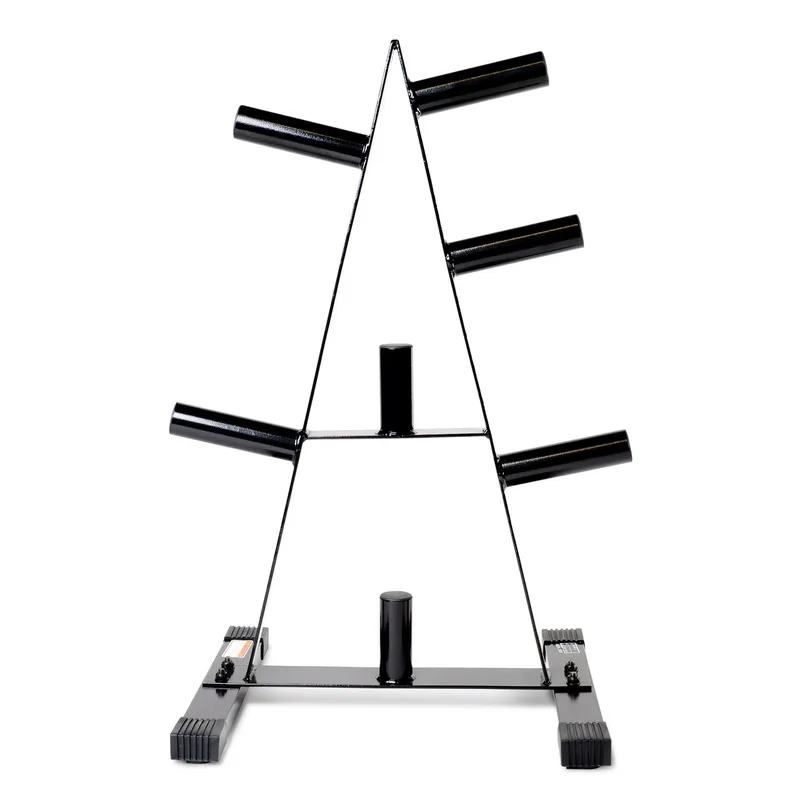
CAP Barbell Olympic 2-Inch Plate Rack is for the bare-minimum budget. Under $50 on Amazon, it stores plates, takes up 22x19 inches, and does nothing else. No wheels, no barbell storage, limited capacity — but for a first plate tree or a secondary storage point, it’s hard to argue with the price.
Comparison
| Tree | Price | Capacity | Sleeves | Wheels | Barbell Storage |
|---|---|---|---|---|---|
| REP Fitness Plate Tree | $144 | 850 lbs | 8” chrome | No | 2 holders |
| Titan Portable Tree | $239.99 as of Oct 18, 2026 | 1,000 lbs | 8.25” | Yes (locking) | 2 vertical |
| Body-Solid OWT24 | $80.00 as of Oct 18, 2026 | 1,000 lbs | Standard | No | No |
| Rogue Plate Tree 2.0 | $270 | 1,000+ lbs | 12” | Optional | Optional |
| CAP Olympic Rack | $45.49-$49.99 as of Oct 18, 2026 | 500 lbs | 7” | No | No |
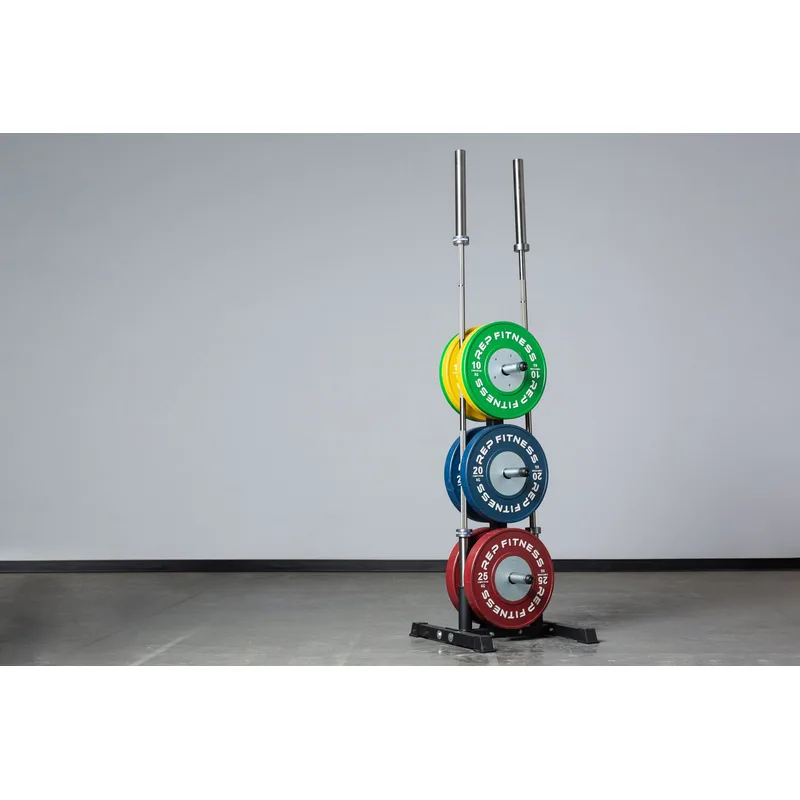
REP Fitness Bar and Weight Plate Tree
Pros
- Chrome-coated posts let plates slide on and off without scratching or flaking
- Two barbell holders (front and rear) keep bars accessible alongside plates
- 850 lb capacity handles a substantial iron plate collection without risk
- 24x24" compact footprint fits tight garage or basement corner spots
- Free shipping direct from REP keeps the total cost low
- Solid build quality — no wobble or flex under load per owner reports
Cons
- No wheels — repositioning requires lifting
- Only available direct from REP Fitness, not Amazon
- 850 lb cap trails the 1,000 lb options if you have a very large plate inventory
REP’s Bar and Weight Plate Tree has one feature that sets it apart from similarly priced options: chrome-coated posts. Most trees at this price point use plain powder-coat steel on the plate posts. Over time, sliding 45 lb iron plates on and off bare steel posts chips the coating and leaves fine rust powder on plate faces. Chrome posts resist this — plates slide cleanly and the coating stays intact after years of use. Based on owner reports from the REP community, this detail comes up repeatedly as a reason for choosing REP over competitors at the same price tier.
The two barbell holders (front and rear) are the other standout spec. Most trees store plates or bars — not both. REP integrates both into a 24x24” footprint, meaning one unit handles all your heavy storage in a single square of floor space. The front holder is accessible without moving around the tree; the rear holder works for a spare or lighter bar.
At 850 lb capacity, the REP tree handles more than enough for most home gyms. A full set of iron bumper plates — say, a pair each of 10, 25, 35, and 45s — loads at around 340 lbs total. Even a well-equipped garage gym would need an unusually large plate collection to approach 850 lbs.
The one gap is wheels. REP doesn’t include them, and there’s no add-on option. If your setup gets rearranged frequently, that’s a real limitation. For a permanent corner installation, it doesn’t matter.
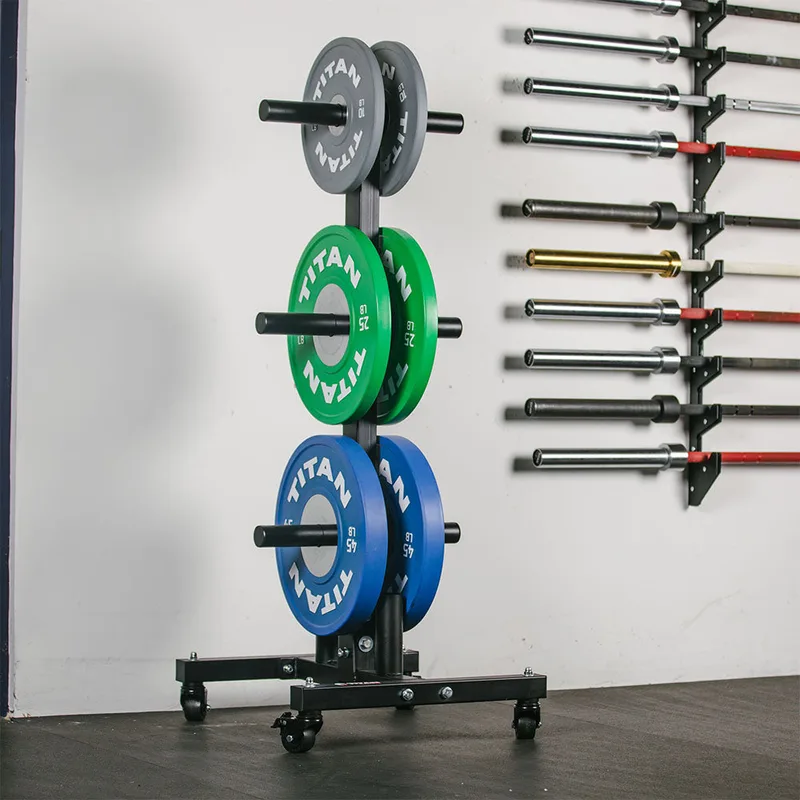
Titan Fitness Portable Weight Tree
Pros
- Locking caster wheels are included standard — easy to reposition for cleaning or layout changes
- 1,000 lb capacity and 11-gauge steel construction justify the mid-range price
- Holds two full-size Olympic barbells in vertical sleeves at the base
- 6 plate posts with 8.25" sleeves accommodate large plate collections per tier
- Locking wheel mechanism stays locked under load and releases cleanly
- Available on Amazon with straightforward delivery
Cons
- 8.25" sleeve length is shorter than premium options — fewer 45 lb plates per post vs. 12" sleeves
- Taller profile (57.6") may be awkward in rooms with low ceilings
- Heavier unit — wheels are essential for practical repositioning
The Titan Fitness Portable Weight Tree stands out in this category because it ships with locking caster wheels as standard equipment, not an upgrade. On most plate trees, wheels cost extra. On trees from Rogue, they’re an add-on that adds meaningful cost to the base price. Titan just includes them. For a home gym where you sweep the floor, rotate equipment positions, or occasionally need to access the wall behind your storage, this practical decision matters.
The 11-gauge, 2x2 steel frame and 1,000 lb capacity put the Titan well above what most home gyms need, and the construction quality reflects it. Six plate posts with 8.25” loadable sleeves hold a solid volume of Olympic plates per tier. The two vertical barbell sleeves at the base fit full-size Olympic bars and keep them secured upright alongside the plate storage.
The main limitation compared to the Rogue is sleeve length. At 8.25 inches, the Titan’s posts hold fewer 45 lb plates per post than the Rogue’s 12” sleeves. For most home gyms, this doesn’t matter — few lifters have enough 45s to overflow an 8.25” sleeve. For large bumper plate collections or commercial-adjacent setups, the shorter sleeves become a constraint faster.
Availability on Amazon makes the Titan convenient for buyers who prefer consolidated ordering, tracked delivery, and standard return policies without needing to coordinate with a specialty fitness retailer.
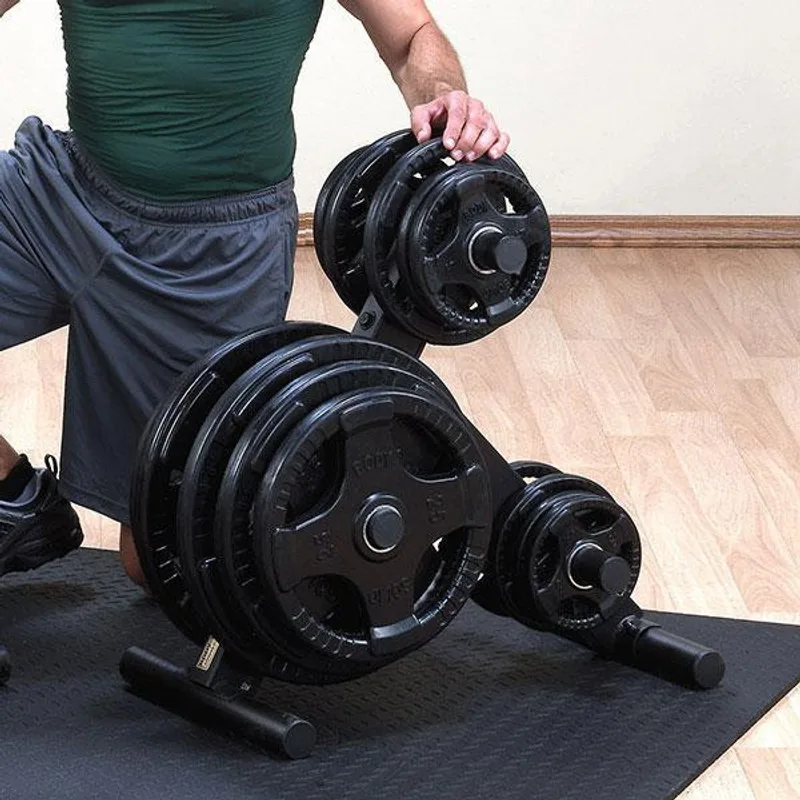
Body-Solid OWT24 Olympic Weight Tree
Pros
- 27x16x24" footprint is the smallest in this roundup by a wide margin
- Chrome posts protect plate faces and allow smooth loading and unloading
- 1,000 lb capacity for a sub-$100 price is exceptional value
- EZ-Load design centers the weight load to reduce tipping risk
- Light enough (25 lbs) to move by hand without significant effort
- Solid Amazon availability with consistent stock and easy returns
Cons
- No barbell storage — plates only
- Low profile (24"H) limits stacking with very large 45 lb plate collections
- No wheels included
- Compact size means shorter sleeves that may fill up quickly with large plates
The Body-Solid OWT24 is the answer to a specific problem: a plate tree that fits in a spot where nothing else will. At 27x16x24”, it’s dimensionally smaller than every other tree in this roundup by a significant margin — closer to a compact filing cabinet than a full-height storage unit. For a tight basement corner, a garage alcove, or a training space where every square foot is accounted for, the OWT24’s footprint changes the equation.
The EZ-Load design directs the weight load toward the center of the base, which reduces the tipping risk that affects some tall trees under heavy asymmetric loading. Chrome posts, like the REP’s, protect plate faces from the flaking and rust contamination that bare powder-coat posts develop over time.
The 1,000 lb capacity is particularly impressive for a $99 unit. The OWT24 isn’t making compromises on capacity despite the compact dimensions — it’s making them on height and sleeve volume. For a plate collection of moderate size (a few pairs of 25s, 35s, and 45s), the OWT24 holds everything cleanly without wasting floor space.
Lifters with very large plate inventories — multiple pairs of 45s per weight increment — will fill the OWT24 quickly due to its low profile. In that case, step up to the REP or Titan. For a standard home gym plate collection, the OWT24 handles everything at a price that leaves budget for the plates themselves.
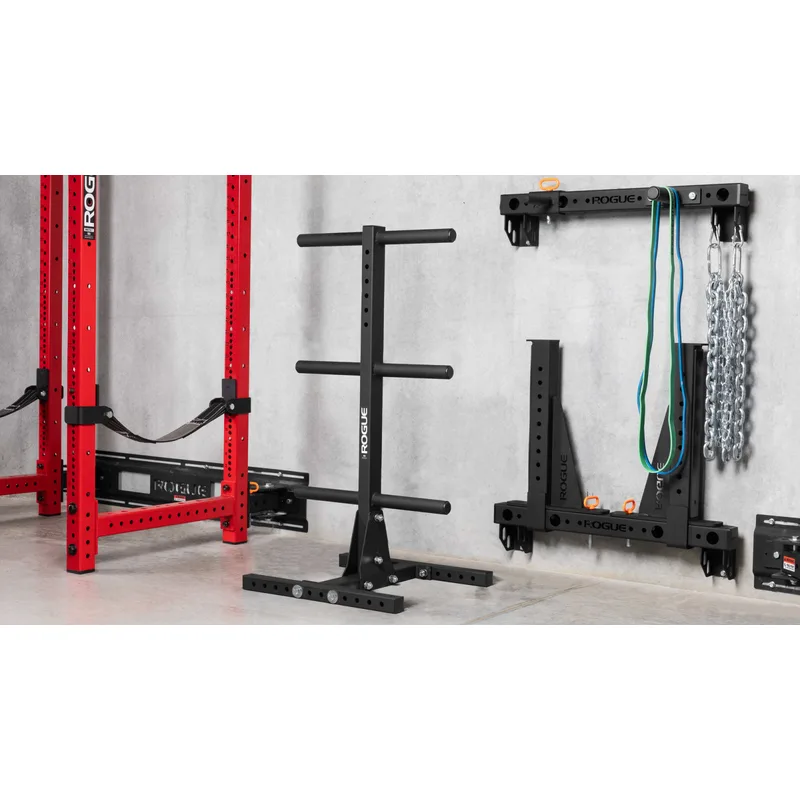
Rogue Vertical Plate Tree 2.0
Pros
- 12" loadable sleeves are the longest in this roundup — maximum plates per post
- USA-made with reinforced base construction rated to 1,000+ lbs
- Bolt-together design reduces shipping cost while maintaining structural rigidity
- Optional wheels and barbell holders allow a fully custom configuration
- 337 reviews with consistent 5-star rating on Rogue's own site
- Lifetime warranty from a brand known for standing behind their products
Cons
- Wheels and barbell holders cost extra — base price of $270 gets the tree only
- Powder-coat sleeves can show imperfections where plates contact the post
- Premium price requires a clear need for the extra sleeve length and capacity
- Direct from Rogue only — no Amazon option
The Rogue Vertical Plate Tree 2.0 makes one argument: 12-inch loadable sleeves. Everything else in this roundup has 7–8.25-inch sleeves. Rogue goes to 12. That extra sleeve length means more 45 lb plates per post, which matters when you’re loading a serious iron collection — multiple pairs of 45s, 35s, 25s — and want every plate accessible without stacking onto multiple trees.
The reinforced triangle-plate base distributes load effectively and eliminates the instability that affects trees with narrower base geometry under asymmetric loading. USA manufacture, lifetime warranty, and 337+ reviews with consistent positive ratings confirm the build quality over time. Rogue products are built to outlast their buyers’ home gym phases, and the plate tree is no exception.
The optional wheel and barbell holder add-ons give buyers flexibility to configure exactly what they need. If wheels aren’t important, skip them and save $40–60. If barbell storage matters, add holders. The modular approach means the $270 base price covers the core function — long-sleeve, high-capacity plate storage — and buyers can customize from there.
The primary limitation is cost relative to what most home gym users actually need. For a standard plate collection of 4–6 pairs, the Rogue’s 12” sleeves provide capacity that won’t be fully used. The REP or Titan handles that use case at lower cost. The Rogue earns its price for large plate inventories, commercial-adjacent setups, or buyers who want the long-term peace of mind that comes with Rogue’s construction and warranty.
CAP Barbell Olympic 2-Inch Plate Rack
Pros
- Under $50 on Amazon — by far the lowest price in this roundup
- 22x19" footprint barely takes up any floor space
- Adequate 500 lb capacity for a standard home gym plate collection
- Rubber floor caps protect flooring and prevent sliding
- Fast and simple assembly — minimal hardware involved
Cons
- 7" sleeves are the shortest here — limits how many plates per post
- 500 lb capacity is the lowest in this roundup — not suited for heavy plate collections
- No barbell storage
- No wheels
- Not ideal for bumper plates — best matched to iron Olympic plates
The CAP Barbell Olympic 2-Inch Plate Rack exists for one reason: it costs $45. For a first plate tree, a secondary storage unit, or a setup where budget is the binding constraint, the CAP delivers the core function — plates off the floor, organized by type — at a price that doesn’t require a second thought.
The 22x19” footprint is the smallest in this roundup, and the 37” height keeps the profile low. For a beginner’s plate collection — a pair each of 10s, 25s, and 45s — the CAP handles it without complaint. Rubber floor caps at the base prevent sliding on hard flooring and protect the floor surface itself.
The limitations are real. Seven-inch sleeves fill up faster than 8.25” or 12” options, 500 lb capacity won’t accommodate large plate inventories, and there’s no barbell storage. Buyers who start with this rack and grow past it will need to upgrade. But for the entry-level use case — a small plate collection, a tight budget, and the need to get plates off the floor — the CAP does the job at a price that nothing else in this category can match.
What to Look For
Sleeve length determines how many plates you can store per post. Seven-inch sleeves on the CAP hold fewer 45 lb plates than the 8.25” on the Titan or the 12” on the Rogue. If your plate collection is large or growing, longer sleeves matter. If you have a modest starter collection, shorter sleeves are perfectly adequate.
Weight capacity matters less than you’d think for most home gyms. A 500 lb capacity handles most residential plate collections. The difference between 500 and 1,000 lb capacity becomes relevant only with very large iron collections — multiple pairs of every common weight increment. Prioritize sleeve length and footprint over raw capacity for most home gym use cases.
Wheels are worth paying for if you rearrange. Many gyms get cleaned, rearranged seasonally, or reconfigured when new equipment arrives. A tree without wheels requires manual lifting — awkward with a full plate load. The Titan includes wheels at $199. The Rogue charges extra. REP, Body-Solid, and CAP don’t offer them at all.
Barbell storage is a meaningful upgrade. Bars stored horizontally on a gun rack or leaned against a wall are harder to access than bars stored vertically in a dedicated tube. Trees with vertical barbell sleeves (Titan) or barbell holders (REP) consolidate your plate and bar storage into one footprint.
Chrome vs powder-coat posts. Chrome posts allow plates to slide on and off without scratching or leaving powder on plate faces. Powder-coat posts gradually show wear from repeated plate loading. Both REP and Body-Solid use chrome. Titan and CAP use powder-coat. For frequent use, chrome extends the aesthetic life of both the tree and your plate collection.
Footprint vs. height trade-off. Compact trees (Body-Solid OWT24) sacrifice sleeve capacity for a smaller floor footprint. Taller trees (Titan, Rogue) access more vertical space. Measure your available floor space and ceiling height before ordering.
FAQ
How many plates can a standard plate tree hold? It depends on sleeve length and plate thickness. A 7” sleeve typically holds 2–3 pairs of 45 lb iron plates. An 8.25” sleeve holds 3–4 pairs. A 12” sleeve can hold 4–5+ pairs. Bumper plates are thicker than iron, so they fill sleeves faster — typically 2–3 pairs per 8” sleeve.
Do I need a plate tree if my squat rack has plate pegs? Rack plate pegs handle light duty plate storage, but most racks offer only 2–4 pegs with limited depth. A dedicated tree provides substantially more storage and keeps plates accessible during exercises that don’t involve the rack. For larger plate collections, both are useful — pegs for the weights loaded during training, tree for everything else.
What is the difference between an A-frame plate tree and a vertical plate tree? An A-frame tree has posts that angle outward from a central spine — plates load from both sides of the frame. A vertical tree has posts arranged around or on a central vertical column. Vertical trees typically have longer sleeves and greater capacity per post. A-frame designs tend to have smaller footprints at the same plate count.
Are plate trees suitable for bumper plates? Yes, with a caveat. Bumper plates are significantly thicker than iron plates of the same weight, so they fill sleeves faster. A tree sized for iron plates will hold fewer bumper plates per post. Look for trees with 8”+ sleeves and prioritize models from brands (REP, Rogue) that cater specifically to bumper plate storage.
Do plate trees tip over when loaded unevenly? This is a real concern with cheap or narrow-base designs. The Body-Solid OWT24’s EZ-Load design addresses this by centering the weight toward the base. The Rogue’s reinforced triangle base prevents tipping under asymmetric loads. Load your tree evenly (heavier plates lower, lighter plates higher) regardless of the model to minimize tipping risk.
Conclusion
REP Fitness Bar and Weight Plate Tree is the top pick for most home gym builders — chrome posts, 850 lb capacity, two barbell holders, and a compact footprint at $144 direct from REP. It covers the core use case cleanly and at a price that leaves room for additional plate purchases.
If mobility matters, choose the Titan Fitness Portable Weight Tree. Locking wheels are included, capacity hits 1,000 lbs, and it’s available on Amazon for straightforward delivery. At $199, it’s a reasonable step up from the REP for setups that get rearranged.
Space-constrained gyms should look at the Body-Solid OWT24 — 27x16x24” is a remarkably small footprint for 1,000 lb capacity, and the $99 price makes it the easiest decision in the roundup for compact setups.
Large plate collections belong on the Rogue Vertical Plate Tree 2.0 — 12” sleeves outclass everything else in this category, and Rogue’s construction and warranty back it for long-term use.
Budget-constrained buyers who need plates off the floor can start with the CAP Barbell Olympic Plate Rack at $45 and upgrade when the plate collection outgrows the capacity.