Bowflex kicked off 2026 by expanding its cardio lineup — the Max Total 16 and T6 Treadmill both launched in early 2026, a signal that all-in-one home fitness systems are still central to both brands’ strategies. But their home gym machines, the cable-and-pulley systems people actually do strength training on, operate on completely different mechanical principles. And that difference determines which one is right for your training.
Bowflex uses resistance rods or SpiraFlex plates that push back against every rep with a defined weight. Total Gym uses incline bodyweight — you’re pressing a percentage of your own weight based on the glideboard’s angle. Both machines deliver full-body training in a single compact system. But they’re suited for different athletes, different goals, and different spaces.
This comparison covers four machines across both brands: the Total Gym APEX ($400–$600) and XLS ($1,200–$1,400), and the Bowflex PR3000 ($1,000–$1,200) and Revolution ($2,800–$3,300). Each represents a different price point and training philosophy.
Quick Comparison
| Machine | System | Resistance | Exercises | Capacity | Price |
|---|---|---|---|---|---|
| Total Gym APEX | Incline bodyweight | 12 incline levels | 80+ | 300 lbs | $929.99 as of Oct 18, 2026 |
| Bowflex PR3000 | Power Rod | 210–310 lbs | 50+ | 300 lbs | Unavailable |
| Total Gym XLS | Incline bodyweight | 6 incline levels | 80+ | 400 lbs | $599.00-$750.00 as of Oct 18, 2026 |
| Bowflex Revolution | SpiraFlex | 220–300 lbs + 600 lb leg press | 100+ | N/A | Unavailable |
How Each System Works
Bowflex: Power Rod vs SpiraFlex
Both Bowflex systems use spring-based resistance, but they behave differently under load. Power Rods (used in the PR3000) increase tension as the rods flex — resistance builds as you push through the movement rather than staying constant throughout. SpiraFlex plates (used in the Revolution) were originally developed for NASA’s resistance training equipment for astronauts in zero gravity. SpiraFlex delivers consistent resistance throughout the full range of motion — the feel is closer to a cable stack than to bands or rods.
For beginners, Power Rod resistance is sufficient and predictable. The 210 to 310 lb progression covers beginner to intermediate strength development. For experienced athletes who want resistance texture that feels more like free weights, the SpiraFlex in the Revolution is the more advanced technology.
Total Gym: Incline Bodyweight Resistance
Total Gym machines carry no external weight stack. Resistance comes from the angle of the glideboard — steeper inclines force you to move a larger percentage of your own body weight. At the lowest incline, you’re pressing roughly 40–45% of your body weight. At the steepest incline, that rises to approximately 62–65%.
The resistance ceiling is therefore your own body weight. A 200 lb person has a different absolute maximum than a 150 lb person. This makes Total Gym machines well-suited to beginners, seniors, and rehabilitation-focused training. It also means experienced strength athletes will plateau faster than on a fixed-weight or rod system.
Product Reviews
Total Gym APEX — Best Budget
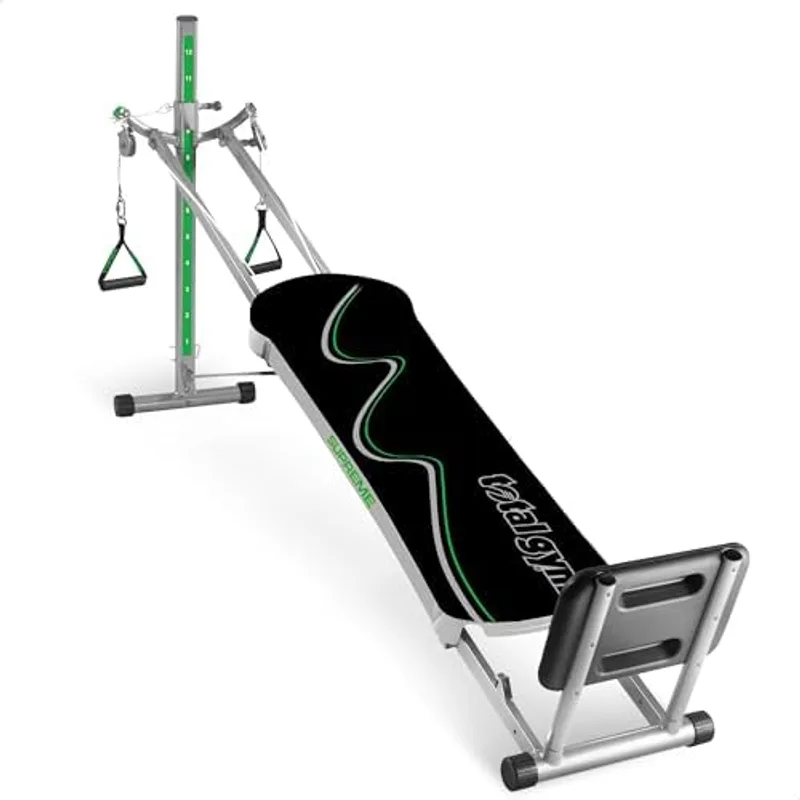
Total Gym APEX
Pros
- 12 resistance levels provide more fine-grained progression than the XLS at a significantly lower price point
- Folds to 50" × 19" × 8" for storage behind a door or upright against a wall — no dedicated floor space required
- No tools or complicated assembly — unfolds and sets up in under two minutes from the box
- Incline bodyweight system puts minimal stress on joints — suitable for beginners, seniors, and anyone returning from injury
- Includes AbCrunch accessory for direct core work beyond glide-board exercises
Cons
- 300 lb user weight capacity limits heavier athletes, particularly at the steeper incline settings
- Resistance ceiling is a percentage of your body weight — strong athletes will outgrow the system faster than a rod or weight stack machine
- No dedicated lat pulldown or cable row configuration without purchasing additional accessories
The Total Gym APEX is the entry point for incline bodyweight training. Twelve resistance levels provide more granular progression than the more expensive XLS, which matters for beginners who improve quickly and want smaller intensity jumps between sessions.
The space efficiency is a genuine standout. The machine folds to 50 inches long and 8 inches thick — it stores behind most bedroom doors or leans flat against a wall without claiming permanent floor space. Setup requires no tools and takes under two minutes following Total Gym’s own instructions.
The included accessories — leg pull, two ankle cuffs, and AbCrunch attachment — provide enough variety for upper-body pulls, leg work, and core training without additional purchases. The clear limitation is the 300 lb user weight capacity. Heavier athletes hit the steepest incline levels quickly, and there’s no way to add resistance beyond that ceiling. For users under 250 lbs building general fitness, the APEX covers the basics at the lowest cost in this comparison.
Bowflex PR3000 — Best Bowflex Value
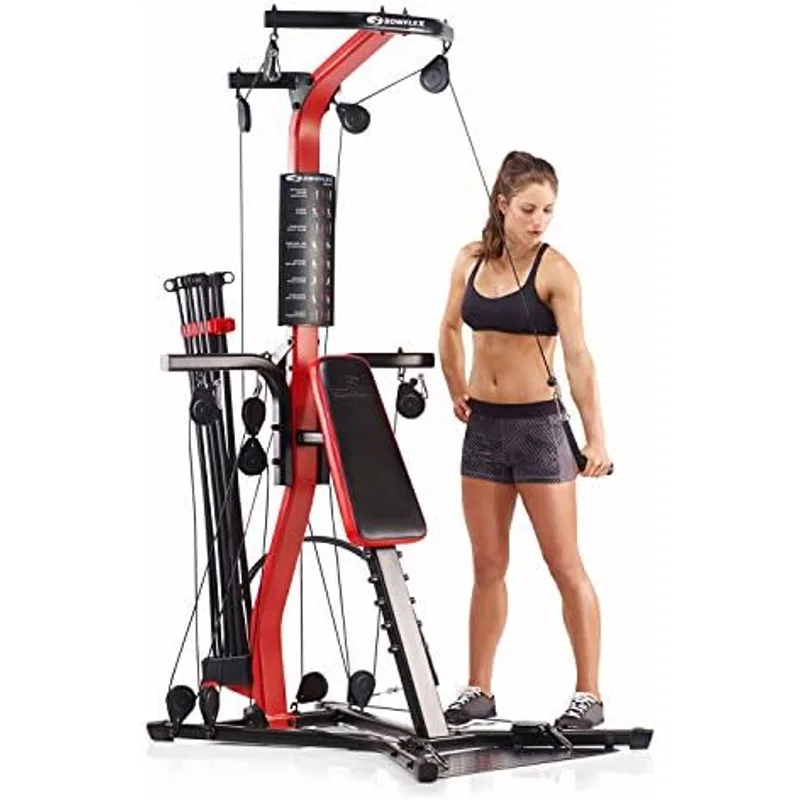
Bowflex PR3000
Pros
- Power Rod resistance upgradeable from 210 lbs to 310 lbs — buy more rods instead of replacing the whole machine as strength increases
- No cable changes between exercises — move from lat pulldown to chest press to shoulder raises without reconfiguring the cable path
- 7-year Power Rod warranty is longer than most competing all-in-one home gym machines
- 154 lb machine weight is manageable for repositioning compared to heavier competition
- 4-inch upholstered roller cushions for leg extension and curl station
Cons
- Primarily upper-body oriented — no barbell squat or deadlift equivalent, limited compound lower-body movements
- 50+ exercise count is lower than either Total Gym model despite the higher price
- No folding capability — the PR3000 requires a permanent dedicated footprint of 76" × 86"
The PR3000 is Bowflex’s most accessible Power Rod home gym. The 210 lb starting resistance is upgradeable to 310 lbs by purchasing additional rod packs — you extend the machine’s useful life without replacing it. The no-cable-change design allows transitions between lat pulldown, chest press, and shoulder exercises without reconfiguring the pulley path between sets.
The PR3000 focuses primarily on upper body and core. Leg extension and curl work is handled by the roller cushion station, but the machine lacks the compound lower-body capability of a squat rack or leg press. Athletes who also need significant lower-body strength development will need a separate solution alongside the PR3000.
The 154 lb machine weight is a practical advantage for home gym users who may need to reposition equipment. The 76” × 86” footprint is fixed — the PR3000 doesn’t fold — so it requires a permanent dedicated corner of your training space.
Total Gym XLS — Editor Pick
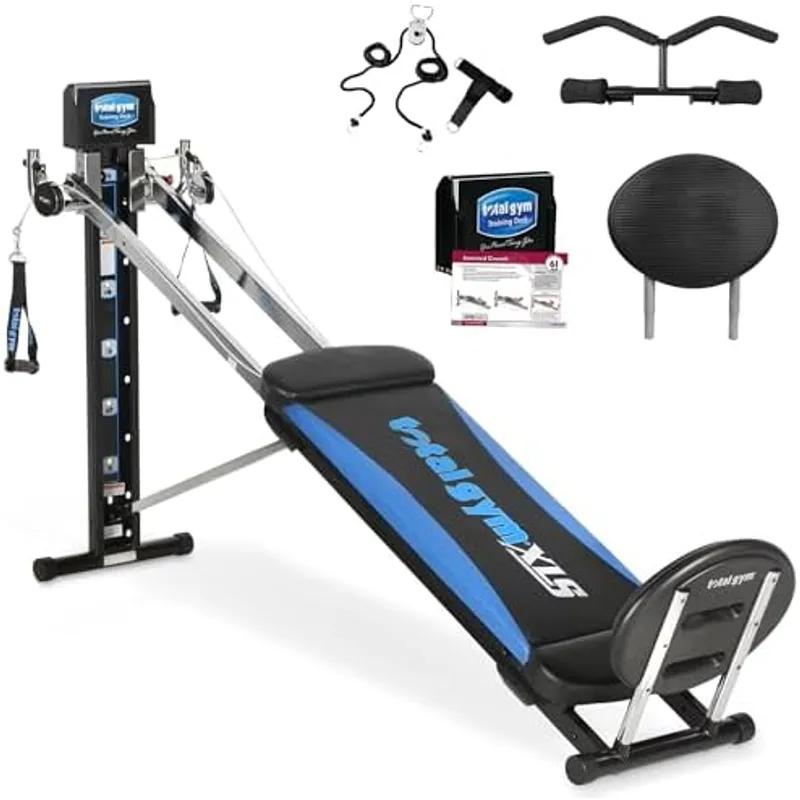
Total Gym XLS
Pros
- 400 lb user weight capacity is among the highest in the incline bodyweight category — accommodates a broader athlete range
- Folds to under 9 inches thick and stores flat against a wall without consuming floor space
- Squat stand attachment adds compound lower-body work not available on the APEX
- Commercial-grade build reflects Total Gym's history supplying physical therapy offices and rehabilitation centers
- 80+ exercises cover full-body programming with minimal equipment swaps between movements
Cons
- Only 6 incline resistance levels compared to 12 on the APEX — coarser progression steps make fine-tuning intensity harder
- Resistance ceiling remains body-weight dependent — strong athletes will plateau faster than on a rod or stack machine
- $1,200–$1,400 is a premium price for a system where progression relies entirely on incline adjustments
The XLS is Total Gym’s flagship consumer model. The 400 lb user weight capacity expands the athlete range significantly beyond the APEX’s 300 lb ceiling, and the commercial-grade build reflects Total Gym’s history supplying physical therapy offices and rehabilitation centers where machine durability under daily multi-user load matters.
The squat stand accessory sets the XLS apart from the APEX. It allows squat and leg press variations using the incline system — the angle loads the glutes and quads effectively without the spinal compression of a barbell squat. For beginners and anyone with lower-back concerns, this is a meaningful functional advantage not available on the budget APEX model.
The XLS folds to under nine inches thick, comparable to the APEX, so the storage efficiency is preserved despite the higher price point. The six incline levels is fewer than the APEX’s twelve, but the 400 lb capacity means the effective resistance range is wider for heavier athletes despite fewer adjustment steps.
Bowflex Revolution — Best Premium
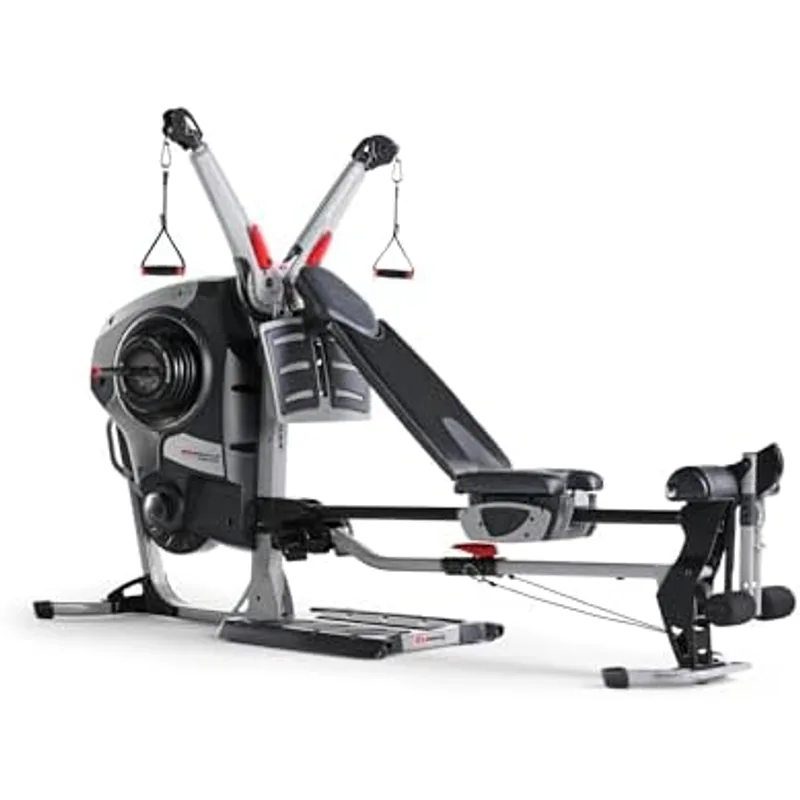
Bowflex Revolution
Pros
- SpiraFlex technology maintains consistent resistance throughout the full range of motion — closer to the feel of free weights or cables than rod-based systems
- Freedom Arms with 10 positions and 170-degree range unlock cable fly variations, chest press angles, and functional patterns impossible on fixed-pulley home gyms
- 100+ exercises and 400+ variations is the highest count in this comparison — comprehensive enough for advanced programming
- Leg press station supports up to 600 lbs of resistance
- Folds to a refrigerator-sized footprint despite requiring a large workout space in use
Cons
- $2,800–$3,300 entry price — comparable to commercial gym cable stations, which requires serious commitment
- Arrives in 9 boxes and weighs 336 lbs — Bowflex's in-home professional assembly ($299 add-on) is the practical choice for most buyers
- Requires a clear 120" × 84" workout space — eliminates most apartment and small-room installations
The Revolution is Bowflex’s most versatile home gym and the most exercise-capable machine in this comparison. The Freedom Arms — dual independently adjustable arms that move across 10 positions and 170 degrees — are the defining feature. They allow cable fly variations, functional pulling and pushing patterns, and shoulder work that’s mechanically impossible on a fixed single-pulley home gym.
SpiraFlex resistance is the second major differentiator. Where Power Rods increase tension as they flex, SpiraFlex plates maintain constant resistance throughout the full movement arc. Pressing 100 lbs on the Revolution behaves more like pressing 100 lbs on a cable stack than pressing with bands — the resistance is honest from start to finish of the rep.
The practical barriers are real. The machine ships in nine boxes and weighs 336 lbs fully assembled. Bowflex sells in-home professional assembly for $299, and that’s a worthwhile investment given the machine’s size and complexity. The workout space requirement of 120” × 84” (10 feet × 7 feet) also eliminates most apartment installations. The Revolution is the right machine for serious home gym athletes with the dedicated space and budget to match.
Buying Guide: Which Machine Is Right for You?
Choose Total Gym APEX if:
- Your budget is under $600
- You prioritize low-impact training, general fitness, or returning from injury
- You need a machine that folds completely out of the way after sessions
- You’re under 250 lbs and want a beginner-appropriate resistance range
Choose Bowflex PR3000 if:
- You want fixed resistance that can grow from 210 to 310 lbs without replacing the machine
- Your training emphasis is upper-body strength development
- You have a permanent corner of your training space for a fixed-footprint machine
- You want a proven resistance system with a 7-year warranty on the core components
Choose Total Gym XLS if:
- You need a weight capacity over 300 lbs
- You want incline bodyweight training at a commercial-grade build level
- Compound lower-body work via the squat stand attachment is part of your programming
- Storage efficiency matters and you want fold-flat capability at a premium build level
Choose Bowflex Revolution if:
- You want the most exercise variety available in a home gym machine
- You have at least 10 × 7 feet of dedicated training space
- Your budget covers $2,800–$3,300 plus potential assembly cost
- SpiraFlex resistance and Freedom Arms versatility represent genuine training value for your goals
Head-to-Head Verdict
Best budget pick: Total Gym APEX. At $400–$600, it covers 80+ exercises, folds flat for storage, and gets out of the box in minutes. The resistance ceiling limits long-term progression for strong athletes, but for someone building a habit, it’s the most accessible starting point.
Best mid-range value: Bowflex PR3000. Upgradeable Power Rod resistance at $1,000–$1,200 provides a longer useful lifespan than the Total Gym XLS at a similar price point, with a 7-year warranty and no cable changes between exercises.
Best overall: Total Gym XLS. The 400 lb capacity, fold-flat storage, 80+ exercises, and commercial build quality make it the most broadly useful machine in this comparison for the widest range of home gym athletes.
Best for advanced training: Bowflex Revolution. Nothing else here covers as many movement patterns in a single footprint. The price and space requirements are real barriers, but so is the performance gap over everything else in this list.
FAQ
Can you build real muscle on a Bowflex or Total Gym?
Yes, with appropriate resistance and consistent progressive overload. Bowflex’s Power Rod system on the PR3000 caps at 310 lbs and the Revolution’s SpiraFlex goes to 300 lbs with a 600 lb leg press option — enough resistance for meaningful muscle development at beginner to intermediate levels. Total Gym’s incline system provides sufficient mechanical load for muscle development, though the ceiling depends on body weight and becomes a limiting factor for advanced athletes over time.
Is Total Gym better than Bowflex for seniors or rehab?
Total Gym generally suits low-impact and rehabilitation contexts better. The incline bodyweight system naturally scales to user body weight and can’t be loaded beyond your capacity without deliberately adjusting the angle. Bowflex’s rod systems require deliberate weight selection. Both are joint-friendlier than free weights, but Total Gym’s self-limiting resistance structure makes it the safer default for rehab and senior fitness programming.
How much space does each machine require?
The Total Gym APEX and XLS are the most space-efficient — both fold to roughly 50” × 19” × 9” and store flat against a wall. The Bowflex PR3000 occupies 76” × 86” permanently with no folding option. The Bowflex Revolution requires a 120” × 84” clear workout space during use (approximately 10 × 7 feet), folding to about 55” × 38” × 73” when stored.
Which machine is better for weight loss?
Both support weight loss as part of a caloric deficit program. Circuit training on either machine — moving quickly between upper- and lower-body exercises — raises heart rate enough for metabolic conditioning benefit. Neither replaces dedicated cardio equipment if weight loss is the primary goal, but both contribute when used consistently for resistance training across full-body sessions.
Are these machines worth buying used?
Total Gym machines hold up well used — the glideboard and frame are simple mechanical systems with minimal wear points. Inspect the rail condition and roller wheels. Used Bowflex machines require inspection of the Power Rods (check for cracks at the base where rods flex) and cable integrity. Bowflex sells replacement rod packs, so worn rods aren’t a dealbreaker if the frame is sound. The Revolution’s SpiraFlex plates should also be inspected for any cracking, as replacing them individually is more complex.
Conclusion
The Total Gym XLS is the best machine in this comparison for most home gym users. At $1,200–$1,400, it provides 80+ exercises, 400 lb capacity, fold-flat storage, and the commercial-grade build of Total Gym’s institutional line — without tools, without complicated assembly, and without a permanent fixed footprint.
Beginners and budget-focused athletes should start with the Total Gym APEX. The $400–$600 price point, 12 resistance levels, and fold-flat design provide everything needed to build a consistent training habit without over-committing on equipment before you know what you actually need.
Athletes who prioritize upper-body strength development and want upgradeable resistance should get the Bowflex PR3000 — the 7-year warranty and rod upgrade path make it the most future-proof mid-range option here.
Serious home gym athletes with the space and budget for it should get the Bowflex Revolution. Nothing else in this comparison delivers 100+ exercises, SpiraFlex constant-load resistance, and Freedom Arms versatility in a single machine.