The Concept2 RowErg dominated the 2026 World Rowing Virtual Indoor Championships in February — every athlete competing in those events rowed on the same machine you can buy for your garage. The question isn’t whether to buy a Concept2. For most buyers researching indoor rowers seriously, that decision is already made. The real question is which version: the Standard Legs (formerly Model D) or Tall Legs (formerly Model E)?
The answer comes down to one number: your seat height preference. Every other difference is secondary. Same air resistance. Same PM5 monitor. Same 500 lb weight capacity. Same 96” footprint. Same warranty. Same workout. The $165 price gap buys you 6 inches of seat height, a fully enclosed chain, a more durable finish, and a fixed monitor arm.
Here’s the complete breakdown.
Quick Comparison
| Spec | Concept2 RowErg Standard Legs (Model D) | Concept2 RowErg Tall Legs (Model E) |
|---|---|---|
| Rating | 9.2/10 | 9.0/10 |
| Price | Check price | Check price |
| Resistance | Air (adjustable flywheel damper 1–10) | Air (adjustable flywheel damper 1–10) |
| Seat Height | 14 in (36 cm) | 20 in (51 cm) |
| Dimensions | 96" L × 24" W | 96" L × 24" W |
| Machine Weight | 57 lbs (26 kg) | 68 lbs (31 kg) |
| Weight Capacity | 500 lbs (227 kg) | 500 lbs (227 kg) |
| Monitor | PM5 (Bluetooth + ANT+) | PM5 (Bluetooth + ANT+) |
| Monitor Arm | Flexible — adjusts height and angle | Fixed extended arm — angle adjustable only |
| Chain | Nickel-plated steel, partial enclosure | Nickel-plated steel, full enclosure |
| Finish | Single powder coat (matte) | Double powder coat + clear top coat (gloss) |
| Storage | Separates into two pieces, stores vertically | Separates into two pieces, stores vertically |
| Warranty | 5-year frame / 2-year parts and electronics | 5-year frame / 2-year parts and electronics |
| Check Price → | Check Price → |
Prices change daily — tap Check Price for the current Amazon price. Numbers shown were verified on the "as of" date.
Concept2 RowErg Standard Legs (Model D)
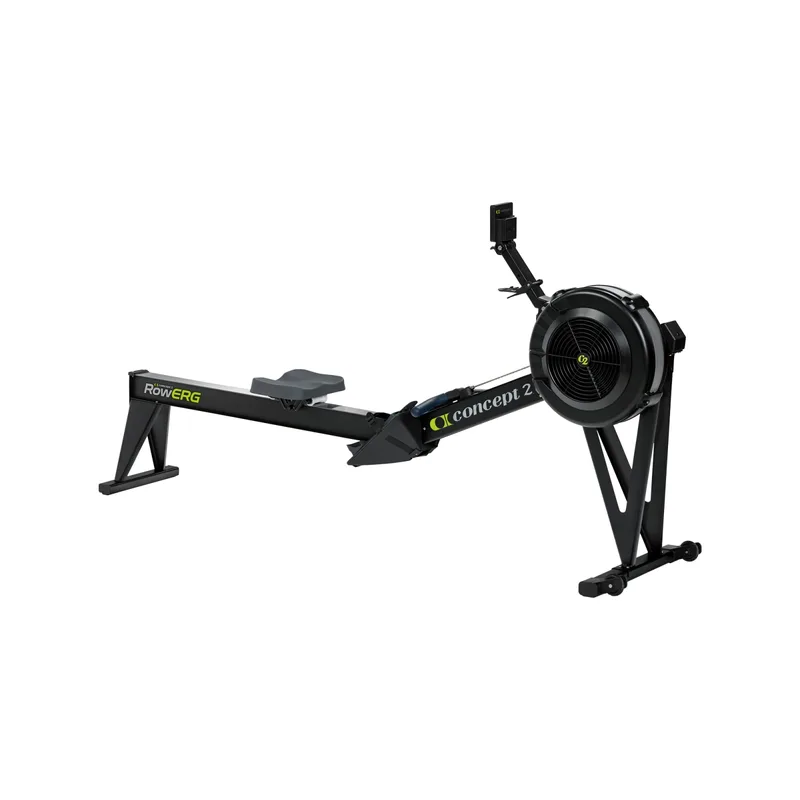
Concept2 RowErg Standard Legs (Model D)
Pros
- $165 less than the Model E for identical workout output — the saved money buys a quality seat cushion and more
- 14" seat height is standard ergonomic rowing position — matches every gym, boathouse, and competition setup in the world
- 11 lbs lighter than the Model E, making storage and transport slightly easier in multi-use spaces
- Flexible monitor arm adjusts both height and angle — more viewing position options than the fixed Model E arm
- Separates into two pieces without tools in about 30 seconds for compact vertical storage
- Used by competitive rowers, CrossFit athletes, and HYROX competitors worldwide — train on the competition standard
- PM5 connects free to ErgData, Zwift, Strava, and 30+ fitness apps with no subscription required
Cons
- 14" seat is lower than a standard chair — users with knee, hip, or mobility issues may find mounting and dismounting uncomfortable
- Partial chain enclosure requires periodic chain maintenance (lubrication every 50 hours of use)
- Seat cushion is adequate but not plush — sessions over 30 minutes benefit from an aftermarket pad
The Standard Legs version — the machine the world still calls “Model D” — is what 90% of buyers should purchase. The 14” seat height is the standard rowing position used at every competitive venue, every CrossFit affiliate with a RowErg, and every university rowing program. If your knees and hips don’t present obstacles, this is the right machine.
Air resistance is the core reason the Concept2 dominates indoor rowing. There’s no motor, no preset resistance level, no dial to adjust mid-session. Pull harder and the flywheel spins faster, generating proportionally more resistance. Every stroke is self-regulating. This is the same dynamic as rowing on water, which is why the Concept2 remains the machine used in HYROX, CrossFit competitions, and elite training facilities — and why training on it directly transfers to competitive performance.
The PM5 monitor is functional and comprehensive without being flashy. Split time per 500 meters, watts, strokes per minute, heart rate (with a paired chest strap or compatible optical monitor), distance, and calories are all tracked in real time. ErgData — Concept2’s free app — logs every session automatically and uploads to the Concept2 online logbook, where you can benchmark your 2000m split against millions of rowers globally. Zwift, Kinomap, Regatta, Dark Horse Rowing, and 30+ other apps connect via Bluetooth and ANT+ at no cost. No subscription required for any of this.
The flexible monitor arm is a small but real advantage over the Model E. It adjusts both height and viewing angle, letting you dial in the exact position that works for your rowing posture and seat-to-monitor distance. Taller athletes and those with longer torso proportions particularly benefit from this flexibility.
Storage is a genuine competitive advantage of the RowErg platform over every connected rower on the market. The machine separates into two pieces without tools in about 30 seconds using the framelock mechanism, rolls on caster wheels, and stands vertically against a wall — stored footprint drops from a 96” × 24” floor machine to roughly 25” × 33” × 54” of vertical space. For a garage that doubles as a parking space or a basement with competing equipment, this matters.
The chain requires periodic lubrication — Concept2 recommends every 50 hours of use with a light oil. It takes five minutes. The partial enclosure on the standard legs means a bit more dust exposure than the fully enclosed Model E chain. Not a meaningful disadvantage for most buyers, but the Model E has a slight maintenance edge.
Concept2 RowErg Tall Legs (Model E)
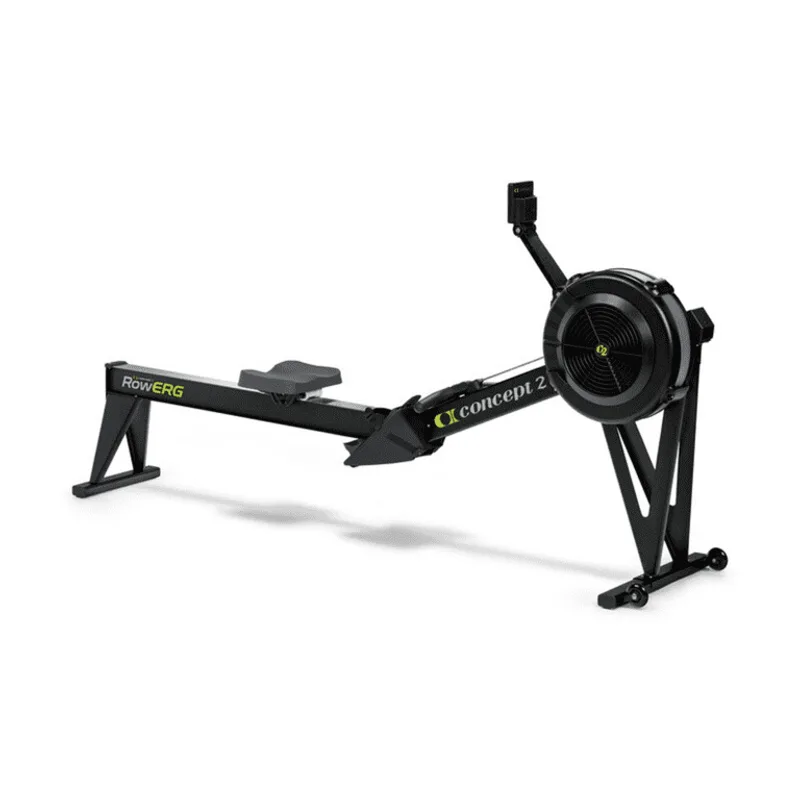
Concept2 RowErg Tall Legs (Model E)
Pros
- 20" seat height matches standard chair height — significantly easier mounting and dismounting for users with knee or hip limitations
- Full chain enclosure reduces maintenance requirements and protects the drive chain from dust and debris
- Double powder coat plus clear top coat finish is more durable and weather-resistant than the standard legs version
- Welded steel throughout (vs. mixed aluminum and steel) adds structural rigidity
- Ideal for wheelchair transfers — seat height allows direct side transfers without a large height gap
- Same PM5 monitor and air resistance performance as the Model D — no workout compromise for the accessibility upgrade
Cons
- $165 more than the Model D for no difference in rowing performance or monitor capability
- Fixed monitor arm limits viewing angle adjustments — can only tilt, not raise or lower, unlike the flexible Model D arm
- 11 lbs heavier than the Model D — slightly less convenient for two-piece storage and repositioning
- Taller storage footprint (27 × 47 × 54") is bulkier against a wall than the standard legs version (25 × 33 × 54")
The Tall Legs version — still universally referenced as the “Model E” — exists for one clear purpose: making the machine accessible for users who struggle with the 14” seat height. At 20”, the seat is at standard chair height. Sitting down and standing up requires no deep knee bend. For users with arthritic knees, hip replacements, limited mobility, or chronic lower body pain, this isn’t a comfort upgrade — it’s the difference between being able to use the machine regularly or not.
The same accessibility logic applies to wheelchair users. A 20” seat height allows direct side transfers from a standard wheelchair without a significant height differential. Rowing is an exceptional low-impact full-body workout that remains accessible to many adaptive athletes, and the Model E makes it far easier to access.
Beyond seat height, the Model E offers two genuine build upgrades: the fully enclosed chain and the upgraded finish. The full enclosure shields the nickel-plated steel chain from dust, pet hair, and gym chalk — extending chain life and reducing how often you’ll need to lubricate. The double powder coat plus clear top coat finish is more durable against moisture, humidity, and the kind of sweat exposure a garage or basement machine receives over years of use. If you’re in a humid environment, the Model E’s finish is the right call.
The welded steel leg construction (versus the aluminum front legs on the standard model) adds structural rigidity that some owners notice as a slightly more planted feel during hard intervals. The difference is subtle during normal rowing but noticeable during max-effort pieces where the machine can shift slightly on an uneven surface.
The tradeoff on the monitor arm is real but minor. The Model E’s extended arm is fixed — it can tilt angle but cannot be raised or lowered. The standard legs model’s flexible arm adjusts both height and angle. For most users the fixed arm works fine, but very tall rowers or those with specific ergonomic preferences may miss the full adjustability.
At 68 lbs, the Model E is 11 lbs heavier than the standard version. Both separate for storage the same way. The Model E’s vertical storage footprint is slightly bulkier (27 × 47 × 54”) versus the standard legs (25 × 33 × 54”) — a meaningful but not dramatic difference.
Head-to-Head Breakdown
Seat Height — The Decision Driver
This is the only factor that should determine which model you buy.
14” Standard Legs: The universal rowing position. If you can get up from a standard gym floor or low chair without pain, the standard legs model is ergonomically fine. The lower position keeps your stroke mechanics aligned with competitive standards.
20” Tall Legs: Chair-height rowing. If you have knee pain, hip limitations, balance concerns, or are recovering from lower body surgery, the extra 6 inches changes whether daily rowing is comfortable or becomes a pain management event.
Price
$990 vs. $1,155 — a $165 difference. The Standard Legs saves that money. The Tall Legs spends it on seat height, full chain enclosure, upgraded finish, and welded steel construction. Neither is a better value in isolation — it depends entirely on whether the accessibility features are worth the premium to your specific situation.
Performance and Workout Quality
Zero difference. Air resistance scales identically. PM5 monitors are identical. Damper settings 1–10 function the same. Weight capacity is 500 lbs on both. If you row a 2:05/500m split on the Standard Legs today and then row the same piece on Tall Legs tomorrow, you’ll see the same number.
Maintenance
The Model E’s full chain enclosure has a practical edge. Less dust and debris reaching the chain means longer intervals between lubrication sessions. Not a major factor for most buyers, but for anyone who forgets maintenance or keeps the machine in a dusty garage, the fully enclosed chain is worth noting.
Monitor Arm
The Standard Legs wins here. Flexible arm adjustability — height and angle — gives more viewing position options than the Model E’s fixed arm (angle only). Meaningful for very tall rowers or anyone with specific ergonomic requirements.
Finish and Build
Model E wins. Double powder coat plus clear top coat is more durable than the matte single coat on the Standard Legs. Welded steel legs versus mixed aluminum and steel adds structural rigidity. If you’re in a humid environment like a coastal garage or an unheated basement that sees temperature swings, the upgraded finish is relevant.
Who Should Buy Which
Buy the Standard Legs (Model D) if:
- You can sit down and stand up from a 14” surface without pain or difficulty
- You’re training for HYROX, CrossFit, or competitive indoor rowing
- Budget is a consideration and you want the full Concept2 experience for less
- You want the monitor arm flexibility for ergonomic positioning
- Your storage situation benefits from the slightly smaller vertical footprint
Buy the Tall Legs (Model E) if:
- You have knee pain, hip limitations, arthritis, or a lower body injury that makes mounting a 14” seat uncomfortable
- You use a wheelchair and need chair-height side transfers
- You’re in a dusty or humid environment where the full chain enclosure and upgraded finish add longevity
- The $165 premium is within budget and the maintenance advantages appeal to you
- You’re buying for a shared family gym where multiple users have varying mobility levels
Buying Guide: What to Consider
Don’t overthink the performance question. Both machines deliver identical workouts. The RowErg’s air resistance, PM5 monitor, and overall training quality are the same regardless of which leg configuration you choose. If you’re debating between Standard and Tall Legs based on training intensity or data quality, stop — they’re the same machine.
Try sitting down from a 14” surface before committing. Most standard gym benches and box jump platforms are in this range. If getting up from 14” is uncomfortable or requires significant effort, the Model E is worth the extra $165. If it’s fine, save the money.
Factor in your floor situation. The Concept2 can shift slightly on smooth concrete during max-effort pieces. Many owners use a mat under the machine — a standard horse stall mat or rubber gym tile works well. This applies to both models equally.
Noise is real. The RowErg flywheel and chain produce audible sound — comparable to a box fan at medium speed. Both Standard and Tall Legs are equally loud. This isn’t a problem in garages and basements, but it can be a concern in apartments or shared living situations. If noise is a constraint, magnetic rowing machines (quieter) are worth comparing.
Resale value holds strong across both models. Concept2 machines consistently sell used for $600–$800 in good condition on Craigslist and Facebook Marketplace. Both Standard and Tall Legs hold similar resale value. The machine’s longevity — 20+ year lifespans are common in commercial settings — makes the purchase price an investment, not an expense.
Frequently Asked Questions
Are the Concept2 Model D and Model E the same machine? In terms of workout performance, yes. Both use the same air resistance flywheel, the same PM5 performance monitor, the same nickel-plated steel chain, and the same 500 lb weight capacity. Concept2 now calls them “RowErg Standard Legs” and “RowErg Tall Legs.” The Model D and E names remain in common use because of their long history in the rowing community.
What is the seat height difference between the Model D and Model E? The Model D has a 14” (36cm) seat height. The Model E has a 20” (51cm) seat height — 6 inches higher. The Model E’s 20” matches the height of a standard dining or office chair, making it significantly easier to mount and dismount without deep knee flexion.
Do both models come with the same PM5 monitor? Yes. Both the Standard Legs and Tall Legs RowErg include the identical PM5 performance monitor. The PM5 tracks split time, watts, strokes per minute, heart rate (with compatible monitor), distance, and calories. Both connect to ErgData, Zwift, and 30+ apps via Bluetooth and ANT+ at no cost.
Is the Model E worth the extra $165? Only if the higher seat height or upgraded build features matter to you. If your knees and hips allow comfortable use of a 14” seat, the Standard Legs delivers the same workout for less money. If accessibility is a real concern, the $165 for chair-height access, full chain enclosure, and upgraded finish is reasonable.
How loud is the Concept2 RowErg? Both Standard and Tall Legs produce the same sound level — roughly comparable to a box fan at medium speed. The flywheel and chain are audible but not disruptive in a closed room. Both models are appropriate for garages and basements. Neither is ideal for apartments with shared walls or floors without additional acoustic mitigation.
Can I use the Concept2 RowErg without any subscription? Yes, completely. The PM5 monitor and ErgData app (free) handle all tracking and logging. The Concept2 online logbook is free. Zwift and other compatible apps have their own subscription structures, but the Concept2 itself requires no recurring fees. This is a major advantage over connected rowing machines that restrict features behind mandatory subscriptions.
Conclusion
The Concept2 RowErg is the right indoor rowing machine for most serious buyers. The choice between Standard Legs (Model D) and Tall Legs (Model E) is simpler than the marketing makes it seem.
Get the Standard Legs ($990) if you have no mobility limitations that make a 14” seat uncomfortable. You get the full Concept2 experience, the more flexible monitor arm, and a lighter machine for $165 less.
Get the Tall Legs ($1,155) if you have knee pain, hip limitations, or any condition that makes mounting a 14” seat difficult. The chair-height accessibility is the reason this version exists, and if that’s your situation, the $165 is worth every dollar.
Either way, you’re buying the same machine that elite athletes train on, competitive rowers use for race preparation, and serious home gym builders keep for 20+ years. The leg configuration doesn’t change any of that.