A 2026 study published in the Journal of Functional Morphology and Kinesiology (PMC) examined whether foam rollers or massage guns produce greater performance improvements during warm-up protocols in trained athletes. The conclusion: both tools reduced perceived muscle stiffness and improved short-term range of motion, but neither significantly outperformed the other on objective performance metrics. What actually separated the tools was when and where each worked best — not which one won a head-to-head ranking.
That nuance is the whole point of this comparison. Foam rollers and massage guns aren’t direct competitors — they’re complementary tools that serve different moments in a training session. The real question is which one belongs in your recovery toolkit first, and which to add later.
Quick Comparison
| Spec | Amazon Basics High-Density Foam Roller 18" | TriggerPoint GRID Foam Roller | RENPHO Massage Gun | Theragun Mini (3rd Gen) |
|---|---|---|---|---|
| Rating | 7.0/10 | 8.5/10 | 7.5/10 | 9.0/10 |
| Price | $14.14-$15.29as of Oct 18, 2026 | Unavailable | Unavailable | $219.99as of Oct 18, 2026 |
| Length | 18 inches | 13 inches | — | — |
| Diameter | 6 inches | 5.5 inches | — | — |
| Material | High-density EVA foam | EVA foam over hollow ABS core | — | — |
| Weight | 1.1 lbs | 0.75 lbs | 2.47 lbs | 1.1 lbs |
| Surface | Smooth solid foam | GRID pattern (3 zones — flat, tubular, nodule) | — | — |
| Best For | Beginners, IT band, upper back | — | — | — |
| Holds | — | Up to 500 lbs | — | — |
| Speeds | — | — | 5 (up to 3200 RPM) | 3 (1750, 2100, 2400 PPM) |
| Amplitude | — | — | 10mm | 12mm |
| Attachments | — | — | 5 heads | 3 (Dampener, Standard Ball, Thumb) |
| Battery | — | — | 2500mAh (up to 6 hours) | 150 minutes |
| Charging | — | — | USB-C | USB-C |
| Noise | — | — | — | QuietForce Technology |
| Connectivity | — | — | — | Bluetooth (Coach by Therabody app) |
| Check Price → | Check Price → | Check Price → | Check Price → |
Prices change daily — tap Check Price for the current Amazon price. Numbers shown were verified on the "as of" date.
Foam Rollers
Amazon Basics High-Density Foam Roller
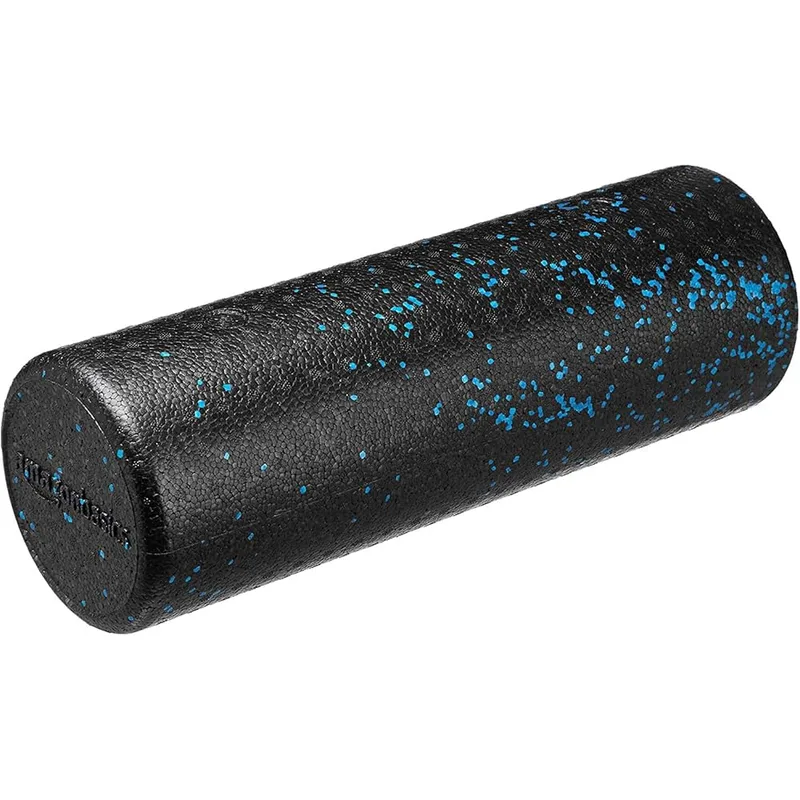
Amazon Basics High-Density Foam Roller 18"
Pros
- Lowest price point in the category — under $20 puts recovery within any budget
- 18-inch length covers the full back, IT band, quads, and calves in one pass
- Solid EVA foam holds shape well under regular use with bodyweight
- Zero learning curve — just roll over the target muscle and apply pressure
Cons
- Smooth, uniform surface delivers one pressure level with no variation
- May compress and lose firmness faster than structured or hollow-core designs
- No instructional content or tutorials included
Every serious discussion about foam rolling starts here, because this is where most home gym owners should start. The Amazon Basics 18” foam roller costs less than a post-workout protein shake subscription and covers every major muscle group you’d actually want to roll — IT band, quads, hamstrings, glutes, calves, upper back.
The smooth solid EVA foam applies even, consistent pressure across the full contact area. There’s no textured surface to navigate, no hollow core to account for, no technique required beyond rolling slowly over the target muscle and pausing on tender spots. For someone new to foam rolling, this simplicity is an asset.
The 18-inch length is the practical sweet spot. Short enough to maneuver on a mat but long enough to cover the full length of most muscle groups in one pass. Basic foam rollers in this size range typically run between $10–$25 from various brands; the Amazon Basics version delivers solid construction at the low end of that range.
The limitation is pressure control. A smooth, uniform cylinder delivers one level of intensity. You can increase it by shifting more bodyweight onto the roller or reducing contact area, but you’re working with a blunt instrument compared to a textured design. For users who find foam rolling too aggressive on tender muscles, this is actually a feature. For advanced users wanting targeted myofascial work, the GRID below offers more precision.
TriggerPoint GRID Foam Roller
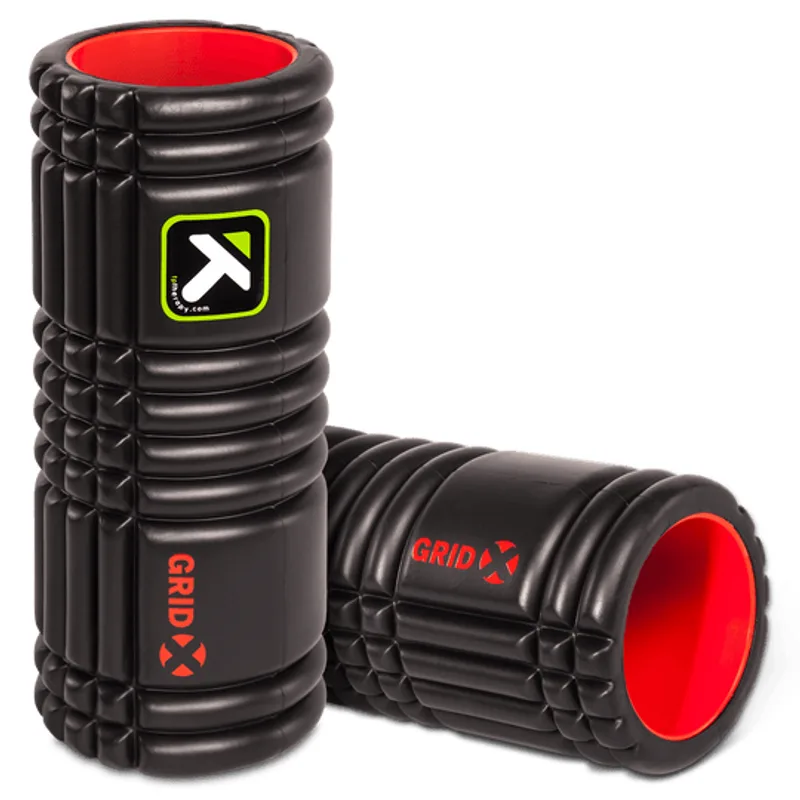
TriggerPoint GRID Foam Roller
Pros
- Patented GRID pattern replicates three massage hand positions in one tool
- Hollow ABS core maintains firmness over time — won't pancake like basic foam
- Water-resistant and sweat-proof EVA surface is easy to wipe clean
- 13-inch compact size travels easily to the gym, hotel, or outdoor training
- Free online instructional video library with purchase
Cons
- 13-inch length is shorter than some users prefer for upper-back coverage
- Costs nearly twice a basic foam roller for a marginal pressure improvement
- Textured surface requires an adjustment period — can feel intense at first
The GRID is the foam roller physical therapists and athletic trainers most commonly recommend, and the reason is the surface design. Three distinct zones — flat panels, raised tubular ridges, and dense nodules — replicate the varying pressure of a massage therapist’s hand positions: the palm for broad, general pressure; the fingers for deeper linear work; the fingertips for targeted spot pressure.
In practice, this means rotating your body relative to the roller changes the stimulus without changing tools. A quarter turn shifts from a broad compression on the IT band to a more targeted ridge pressure. This versatility exceeds what any smooth-surface roller can deliver, and it’s why experienced home gym athletes tend to graduate to the GRID after starting on a basic foam roller.
The hollow ABS core is the structural improvement that justifies the step up in price. Standard solid foam eventually compresses under repeated bodyweight loading and loses firmness. The GRID’s rigid hollow core doesn’t deform — the surface EVA foam cushions the pressure while the core maintains consistent depth. Based on owner reports, these rollers stay firm for years of daily use without noticeable change in firmness.
At 13 inches, the GRID is shorter than the Amazon Basics 18” option. This makes it more portable — fits in most gym bags and overhead bins — but means you may need to reposition more often when rolling longer muscle groups like the upper back or IT band. The 13” length is TriggerPoint’s standard; a 26” version exists for those who prioritize length over portability.
Massage Guns
RENPHO Massage Gun
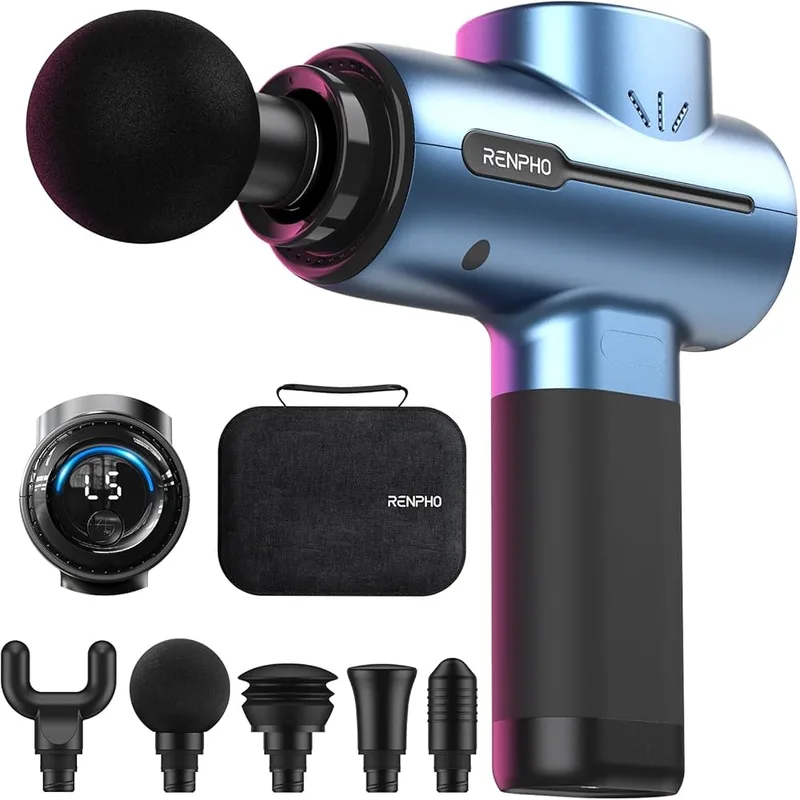
RENPHO Massage Gun
Pros
- Budget entry into percussion therapy — under $50 with carry case included
- 5 speeds and 5 interchangeable heads cover everything from light warm-up to deep tissue
- USB-C charging works with the same cables as most phones and laptops
- Quiet at lower speed settings — suitable for home or office use
- Runs up to 6 hours on a single charge at moderate speed
Cons
- 10mm amplitude is notably shorter than premium devices (12–16mm) — less depth per stroke
- At 2.47 lbs, heavier than compact massage guns like the Theragun Mini
- No Bluetooth or app connectivity for guided recovery sessions
- Performance at max speed (3200 RPM) can generate noticeable vibration in the handle
The RENPHO is the entry point for percussion therapy, and at under $50 with a carry case and five attachments included, it makes a strong case for that position. The five interchangeable heads — round ball, flat head, bullet point, fork, and wedge — let you target different muscle groups and tissue types without purchasing additional accessories.
Amplitude — the depth each percussion stroke penetrates into tissue — is where budget massage guns make their trade-off. The RENPHO’s 10mm amplitude is functional for surface-level muscle tension, light warm-up, and general circulation but doesn’t reach the deeper tissue layers that a 12mm or 16mm device can access. For the majority of home gym users, this depth is adequate. For athletes dealing with chronic deep knots or targeting dense muscle groups like the glutes and lats, the shorter amplitude is a real limitation.
The USB-C charging is a practical win over older micro-USB designs. At moderate speeds, the 2500mAh battery runs for several hours, making it a reliable companion without daily charging. Noise at the lower three speeds is manageable; at maximum speed, there’s noticeable handle vibration that can be tiring over extended sessions.
The 2.47-lb weight is the ergonomic trade-off. Budget massage guns tend to use heavier motors. Holding it at awkward angles — across the upper back, behind the shoulder, reaching the glutes — becomes fatiguing faster than with lighter compact devices. This is the primary reason to upgrade if you use a massage gun more than a few minutes per session.
Theragun Mini (3rd Gen)
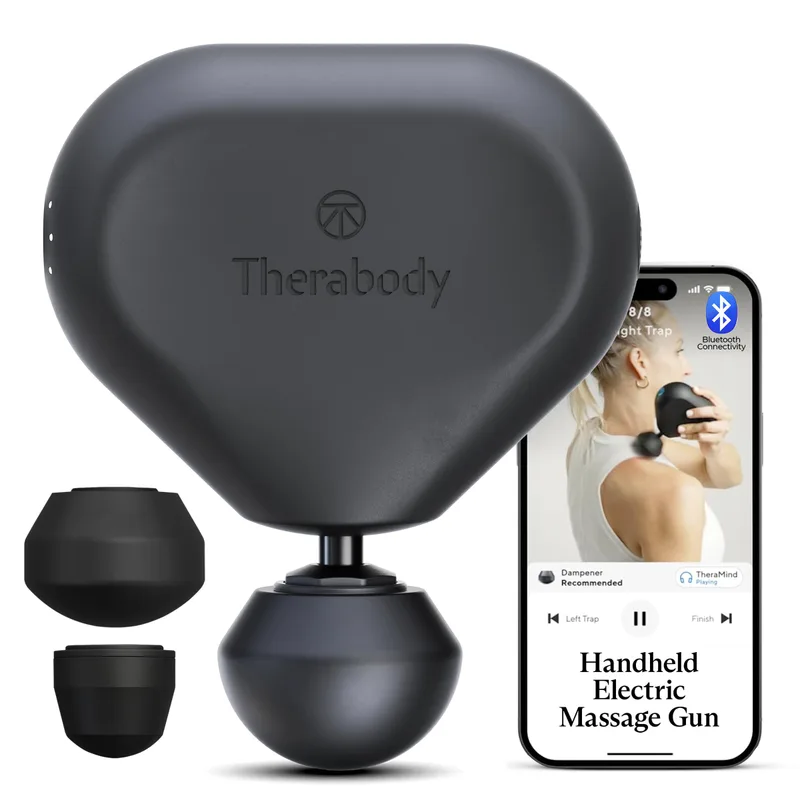
Theragun Mini (3rd Gen)
The Theragun Mini 3rd Gen is the benchmark for compact percussion therapy. At 1.1 lbs — less than half the RENPHO’s weight — it’s the first massage gun that doesn’t cause arm fatigue during use, which is the core reason it outperforms cheaper, heavier alternatives in practical daily use.
The 12mm amplitude exceeds the RENPHO’s 10mm, and the 3rd Gen’s redesign made it 30% smaller than its predecessor without reducing power output. QuietForce Technology — Therabody’s proprietary noise-dampening system — keeps operation at a level where you can use it in an office, living room, or gym without disturbing others. Owner reports consistently describe the noise level as comparable to a fan on a low setting.
Three speeds (1750, 2100, and 2400 PPM) cover light activation, standard recovery, and deep tissue work. The Coach by Therabody app connects via Bluetooth and provides guided recovery protocols organized by muscle group, workout type, and recovery goal — a feature set that’s absent on every sub-$100 massage gun on the market. Three attachments cover most use cases: the Dampener handles sensitive areas like the spine and shin, the Standard Ball addresses large muscle groups, and the Thumb targets lower back and trigger points.
At $199, the Theragun Mini 3rd Gen is a real investment. The case for it: if you actually use a massage gun daily (pre-training activation, intra-session spot work, post-training recovery), the difference in portability and noise reduction compared to budget alternatives changes how often and how consistently you use it. A tool you reach for every day beats a better-spec’d tool that stays in the drawer.
Head-to-Head Breakdown
Recovery Mechanism
Foam rollers work through self-myofascial release — applying sustained compression to soft tissue over a broad area to reduce adhesions, improve circulation, and temporarily increase range of motion. The user controls depth through bodyweight positioning.
Massage guns deliver percussive therapy — rapid, repetitive impacts into muscle tissue at a set amplitude and frequency. This is more targeted, reaching a specific point rather than a broad area, and can penetrate deeper tissue layers (especially at 12mm+ amplitude) more effectively than bodyweight foam rolling.
The 2026 PMC study found both approaches improved range of motion and reduced perceived stiffness in trained athletes. The primary difference was application: foam rollers were more effective at addressing larger surface areas efficiently, while percussion therapy was better for spot-treating specific knots and hard-to-reach areas.
Portability
| Amazon Basics Foam Roller | TriggerPoint GRID | RENPHO Massage Gun | Theragun Mini 3rd Gen | |
|---|---|---|---|---|
| Weight | 1.1 lbs | 0.75 lbs | 2.47 lbs | 1.1 lbs |
| Bag-friendly | Borderline (18”) | Yes (13”) | Yes | Yes |
| TSA carry-on | No | Yes | No | Yes |
The Theragun Mini is the clear portability winner — TSA approved, 1.1 lbs, fits in any bag. The TriggerPoint GRID travels well in gym bags. The Amazon Basics roller is awkward due to length. The RENPHO is bag-friendly but heavier than ideal.
Price Comparison
| Tool | Price | Category |
|---|---|---|
| Amazon Basics Foam Roller | $14.14-$15.29 as of Oct 18, 2026 | Budget foam roller |
| TriggerPoint GRID | Unavailable | Premium foam roller |
| RENPHO Massage Gun | Unavailable | Budget massage gun |
| Theragun Mini 3rd Gen | $219.99 as of Oct 18, 2026 | Premium massage gun |
The budget foam roller ($18) delivers the best recovery value per dollar spent. The RENPHO ($45) is the lowest-cost entry into percussion therapy. The TriggerPoint GRID ($35) upgrades the foam rolling experience meaningfully. The Theragun Mini ($199) is a significant investment that earns its price through daily portability and use frequency.
Best Use Cases
Foam rollers excel at:
- Pre-workout mobility and warm-up (quads, IT band, thoracic spine)
- Post-workout full-body flush after leg or compound movement sessions
- Consistent daily mobility maintenance for under $35
- Beginner recovery routines with no learning curve
Massage guns excel at:
- Targeting specific deep knots that foam rolling can’t address
- Post-workout spot treatment on a single muscle group (one side of the upper traps, a specific glute knot)
- Pre-workout muscle activation — brief percussion work activates the nervous system for the muscles you’re about to train
- Travel recovery where carrying an 18” foam roller isn’t practical
Who Should Buy Which
Start with a foam roller if:
- You’re new to structured recovery and want an affordable entry point
- Your primary goal is post-workout soreness reduction and general mobility
- You train at home with plenty of floor space
- Budget is the primary constraint
Buy a massage gun if:
- You have recurring localized tension (upper traps, a single hip flexor, glute trigger points)
- You travel frequently and need compact recovery tools
- You want pre-workout muscle activation alongside post-workout recovery
- You’re already foam rolling consistently and want to add a targeted tool
Buy both if:
- You train more than 4 days per week with heavy compound lifts
- Recovery is a genuine training priority, not an afterthought
- You have the budget for the full toolkit (~$50 for foam roller + RENPHO, or ~$230 for GRID + Theragun Mini)
Buying Guide
Amplitude matters for massage guns. At 10mm (RENPHO), percussion therapy addresses surface tissue and provides the stimulation feeling but doesn’t reach the deeper layers effectively. At 12mm (Theragun Mini), you’re genuinely treating mid-depth muscle tissue. Full-size guns at 16mm (Theragun Pro Plus) are for serious deep-tissue work. For general home gym recovery, 12mm is the sweet spot.
Foam roller firmness is a real variable. Standard-density smooth foam (Amazon Basics) is appropriate for beginners and anyone with sensitive areas. High-density textured foam (TriggerPoint GRID) applies more pressure and is better for experienced users who want targeted work. Extra-firm options like the TriggerPoint GRID X go further and are primarily for those with dense, experienced muscle tissue that doesn’t respond to medium pressure.
Weight dictates daily use for massage guns. A heavy massage gun that takes two hands to position above shoulder height gets used less. The Theragun Mini’s 1.1 lbs is the practical threshold for solo use on all muscle groups, including upper back and behind-the-shoulder work.
Duration and timing. For foam rolling: 30–60 seconds per muscle group is standard. For massage guns: 15–30 seconds per site pre-workout (activation), 30–60 seconds per site post-workout (recovery). Neither tool requires extended sessions to be effective — brief, consistent use beats infrequent marathon sessions.
Frequently Asked Questions
Can I use both a foam roller and a massage gun in the same session? Yes — and this is actually the most effective approach. Many physical therapists recommend foam rolling first (broader myofascial release across the full muscle), then using a massage gun for targeted spot treatment on specific areas of tension. Pre-workout: brief foam roll (30 sec/muscle) followed by activation percussion. Post-workout: extended foam rolling for full-body flush, then massage gun on tight spots.
Is foam rolling actually effective or is it placebo? The research is mixed but consistent on a few points: foam rolling reliably provides short-term improvements in range of motion (typically measured at 10 minutes post-rolling) and reduces perceived muscle soreness after training. These effects are temporary — measured in minutes to hours, not days. The practical value is in consistently using it as part of a warm-up and cool-down routine rather than expecting long-term structural change from rolling alone.
Do massage guns actually break up scar tissue? Percussion therapy doesn’t mechanically break up scar tissue. What massage guns do: increase local blood flow and tissue temperature, reduce neural sensitivity in the treated area, and temporarily decrease perceived stiffness. These effects can make scar tissue feel less restrictive and improve local range of motion without physically restructuring the tissue. For actual scar tissue remodeling, work with a physical therapist.
How many RPM or PPM should I look for in a massage gun? RPM (rotations per minute) and PPM (percussions per minute) refer to speed, not power. A 3200 RPM budget gun with 10mm amplitude delivers less tissue-penetrating force than a 2400 PPM premium device with 16mm amplitude. Prioritize amplitude over raw speed numbers when comparing massage guns — depth of stroke matters more than strokes per second for most recovery applications.
Can a foam roller replace stretching? No — and neither can a massage gun. Foam rolling and percussion therapy address tissue quality (circulation, adhesions, neural sensitivity). Stretching and mobility work address joint range of motion and muscle lengthening through neurological adaptation. Both serve distinct functions. Foam rolling before stretching can make stretching more effective by reducing tissue resistance, but it doesn’t replace the adaptation that comes from consistent loaded or passive stretching.
Conclusion
For home gym athletes choosing a first recovery tool, the answer is clear: start with the TriggerPoint GRID Foam Roller. At $35, it covers every major muscle group, holds up to years of daily use, and provides more utility per dollar than any massage gun at the same price point.
The Theragun Mini 3rd Gen earns its place as the recovery tool upgrade for athletes who’ve established a consistent foam rolling habit and need targeted percussion therapy in a genuinely portable package. If you’ve been wanting a massage gun but keep putting it off because the cheaper options feel like plastic toys, the Mini is the version that actually lives in your gym bag.
The RENPHO is the right call if you need to try percussion therapy before committing to the Theragun’s price, or if budget is the primary constraint. The Amazon Basics roller is the right starting point for anyone who hasn’t foam rolled before and isn’t sure if they’ll stick with it.
For optimal recovery: use both. Foam roll first for broad coverage, then hit specific tension points with the massage gun. It’s the protocol most athletic trainers recommend, and with options starting at $18, there’s no reason to skip recovery work entirely.