The 2026 home gym cable machine market has become more competitive than at any point in the past decade. In February 2026, Major Fitness launched the Heritage Series B17 All-In-One Functional Trainer to strong reviews, while REP Fitness debuted the Arcadia Max with 220–270 lb stacks and 36 cable positions. The result: buyers now have legitimately excellent options at nearly every price point. The harder question is which type of machine to buy — functional trainer or cable crossover — and that distinction matters more than the brand comparison.
How These Machines Compare
| Spec | REP Arcadia Functional Trainer | Titan Fitness Functional Trainer | Inspire FTX Functional Trainer | Body-Solid GDCC250B Cable Crossover |
|---|---|---|---|---|
| Rating | 9.2/10 | 9.0/10 | 8.7/10 | 8.5/10 |
| Price | $2,199 | $3099.99as of Oct 18, 2026 | $2099.00as of Oct 18, 2026 | $2770.00as of Oct 18, 2026 |
| Weight Stacks | Dual 170 lb (2:1 ratio = 85 lb per arm) | Dual 200 lb (2:1 ratio = 100 lb per arm) | Dual 165 lb (2:1 ratio = 82.5 lb per arm) | Dual 160 lb (upgradable to 210 lb) |
| Cable Positions | 32 independent height positions | 20 height positions | 30 swiveling positions, 180° rotation | 20 independent height adjustments, 180° cable positioning |
| Footprint | 13.75 sq ft (most compact in class) | 64" W × 44" D (19.5 sq ft) | 54" W × 40" D (15 sq ft) | 164" L × 29" W (33 sq ft) — wide-frame design |
| Frame | REP in-house engineered, aluminum pulleys | 11-gauge steel | Heavy-duty steel, powder coat finish | 11-gauge, 2"×4" oval tubing |
| Weight Increments | 10 lb standard, upgradable to 220 lb | — | — | — |
| Assembly | Moderate (tools included) | — | — | — |
| Warranty | Lifetime frame | 1 year commercial | Frame lifetime, parts 5 years | Lifetime frame, welds, weight plates, guide rods; 3 years pulleys |
| Weight | — | 672 lbs assembled | 544 lbs assembled | 560 lbs |
| Included Accessories | — | Rope, D handles, lat bar, short bar, strap handles | Triceps rope, 2x D handles, curl bar, chin/dip belt | — |
| Cable Rating | — | — | — | 4.8mm spun steel, rated 2,500+ lb |
| Check Price at REP Fitness → | Check Price → | Check Price → | Check Price → |
Prices change daily — tap Check Price for the current Amazon price. Numbers shown were verified on the "as of" date.
Functional Trainer vs Cable Crossover: The Core Difference
These terms get used interchangeably in product listings, which creates real confusion at purchase time. Here’s what actually distinguishes them.
Functional trainers have two weight stacks mounted side-by-side with independent pulleys that each slide up and down a vertical rail. You adjust both arms independently across 10 to 32 height positions, then move through exercises that use cables at any angle from low to overhead. The design is compact and versatile — the same footprint covers chest presses, cable rows, lat pulldowns, woodchops, face pulls, single-leg deadlifts, and dozens of others.
Cable crossover machines use a wider frame with the two weight stacks positioned far apart at shoulder width or wider. The cable anchor points are typically fixed at the top (for chest flies) and optionally at the bottom (for low cable work). The design exists specifically to allow free-arm cable fly movements — the wide frame lets you step into the middle of the machine and cross the cables through a full chest-fly arc without the cables limiting your range of motion.
The practical reality: most buyers who think they need a cable crossover actually train better on a functional trainer. The cable crossover shines for one exercise category (chest flies and crossovers). The functional trainer handles that category adequately while also covering everything else with more positional variety.
Who genuinely benefits from a cable crossover: bodybuilders who prioritize cable chest development as a primary training focus and have the room. For everyone else — strength athletes, CrossFit athletes, functional training, general fitness — the adjustable dual-pulley functional trainer is the more practical purchase.
Space Requirements: A Real-World Look
This is where the decision often gets made.
The Body-Solid GDCC250B is 164 inches long — 13.7 feet. Add cable clearance on both sides and you’re looking at a room that’s 10 feet wide and 16 feet long minimum. That’s a significant garage commitment.
The REP Arcadia occupies 13.75 sq ft. It fits against a wall with 4 feet of clearance in front.
If you’re working with a single-car garage, spare bedroom, or any space under 12 feet wide, the functional trainer is the practical choice. The crossover’s footprint is its biggest liability for home gym use.
REP Arcadia Functional Trainer
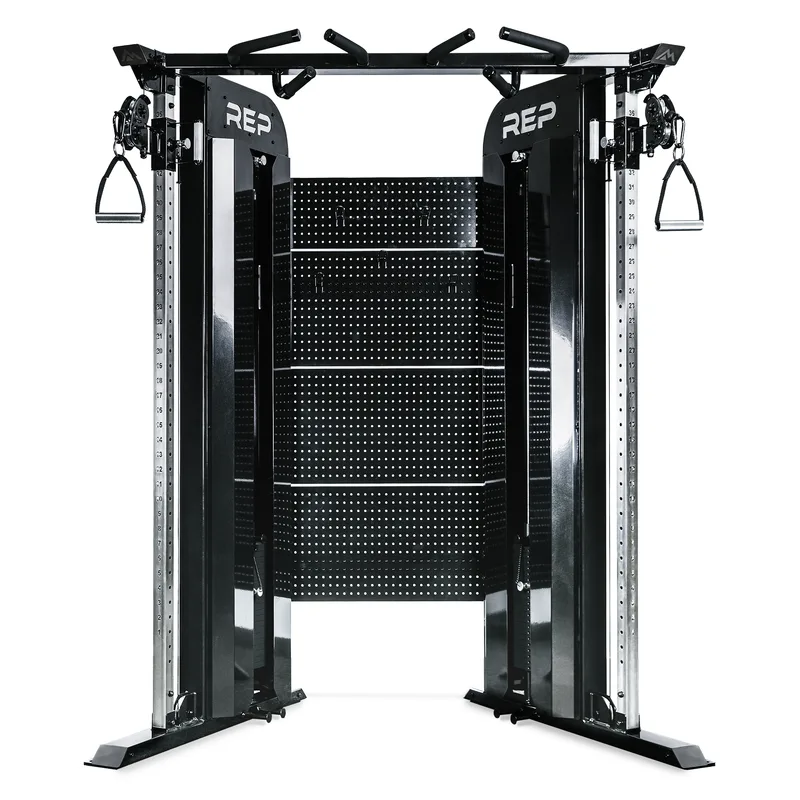
REP Arcadia Functional Trainer
Pros
- 32 height positions cover every angle from floor-level to overhead without gaps
- Smallest footprint in the dual-stack category at 13.75 sq ft — fits where others won't
- Aluminum pulley system rolls noticeably smoother than plastic pulleys on budget machines
- Arcadia upgrade path adds weight stacks, cable attachments, and storage without buying new hardware
- REP's in-house engineering means consistent tolerances and documented westside-hole-style compatibility
Cons
- Direct from REP only — no Amazon Prime, lead times can be 2-3 weeks
- At $2,199 it's the highest price on this list; premium feel justifies it for serious buyers
- 170 lb stacks feel light for experienced lifters doing heavy cable rows or lat pulldowns
- Assembly is moderate — plan for 2-3 hours with a helper
REP built the Arcadia from the ground up at their Colorado engineering facility — it’s not a rebadged import. The distinguishing characteristic is the aluminum pulley trolley system borrowed from REP’s Ares and Athena attachment lines. Pull a cable on the Arcadia and it rolls through the pulley without the scratchy stiction you feel on machines with cheaper nylon or plastic pulleys.
The 32-position cable height system covers angles that most functional trainers skip. You can anchor at floor level for sumo deadlift-style pulls, at ankle height for cable curls, at every mid-point for core work, and at full overhead for lat pressdowns and tricep work from above. According to owner feedback across REP’s community forums, the fine position increments are most valued for unilateral exercises where matching left-right cable angles precisely matters.
At 13.75 sq ft, the Arcadia is built for homes where space is real. You won’t find a dual 170 lb stack machine this compact anywhere else in the category.
The upgrade path is the long-term value story. REP sells weight stack upgrades that bring total resistance from 170 lb to 220 lb per side, plus dedicated cable attachment systems that expand exercise variety without buying a new machine. Buyers who start at $2,199 and add $324 in stack upgrades 18 months later are still below what competitors charge for a lesser machine out of the box.
The caveat: direct from REP only, with 2–3 week lead times depending on availability. For buyers who need equipment this week, that’s a limitation. For the right buyer, it’s worth the wait.
Titan Fitness Functional Trainer
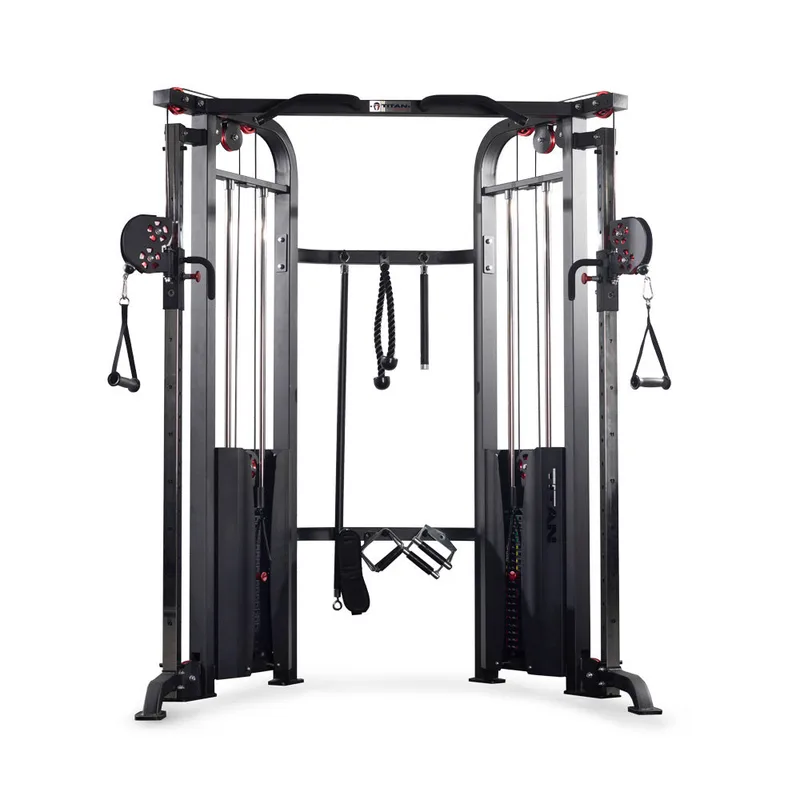
Titan Fitness Functional Trainer
Pros
- Heaviest stacks in this comparison at dual 200 lb — enough resistance for serious pulling work
- Ships with a full accessory kit (rope, D handles, bars) — no immediate add-ons needed
- 672 lb assembled weight means zero flex or wobble under load
- Strong Amazon reviews with documented assembly accuracy — plates are labeled consistently
- Commercial-grade cables rated for long-term home use without fraying
Cons
- 20 height positions is fewer than REP Arcadia (32) and Inspire FTX (30) — some angle gaps
- 19.5 sq ft footprint requires a dedicated space; tighter than REP Arcadia
- 1-year warranty is shorter than REP or Body-Solid lifetime frame coverage
- Assembly is complex — 3-4 hours, two people required
Titan built its reputation on delivering commercial-gym spec at home gym prices. The Functional Trainer delivers on that in two areas: weight stacks and structural weight. Dual 200 lb stacks with a 2:1 cable ratio give you 100 lbs of effective resistance per arm — enough for cable rows, single-arm lat pulldowns, and heavy cable presses that lighter stacks cap out on. The assembled 672 lb total weight means the frame doesn’t budge when you push through a heavy set.
The included accessory kit is a legitimate value add. Rope, D handles, two bar handles, and strap handles arrive with the machine — you’re not ordering $100 in accessories before your first workout. For buyers comparing total cost to train from day one, the Titan comes out ahead of more expensive machines that ship accessory-bare.
The 20-position height system is functional but shows the limitation relative to REP’s 32 positions. Standard exercise heights — low, mid-chest, shoulder, overhead — are all covered. The gaps show up in specialized angles like ankle-height pulls or very low overhead positions where you’d want 4–5 more stop points to dial in the angle precisely.
Owner reports on Amazon and Reddit’s r/homegym community consistently describe the Titan as “best functional trainer for the money.” The cable system holds up well through heavy use; quality issues in reviews center on shipping damage rather than manufacturing defects. For $1,799 with stacks included, it’s the strongest value position on this list.
Inspire FTX Functional Trainer
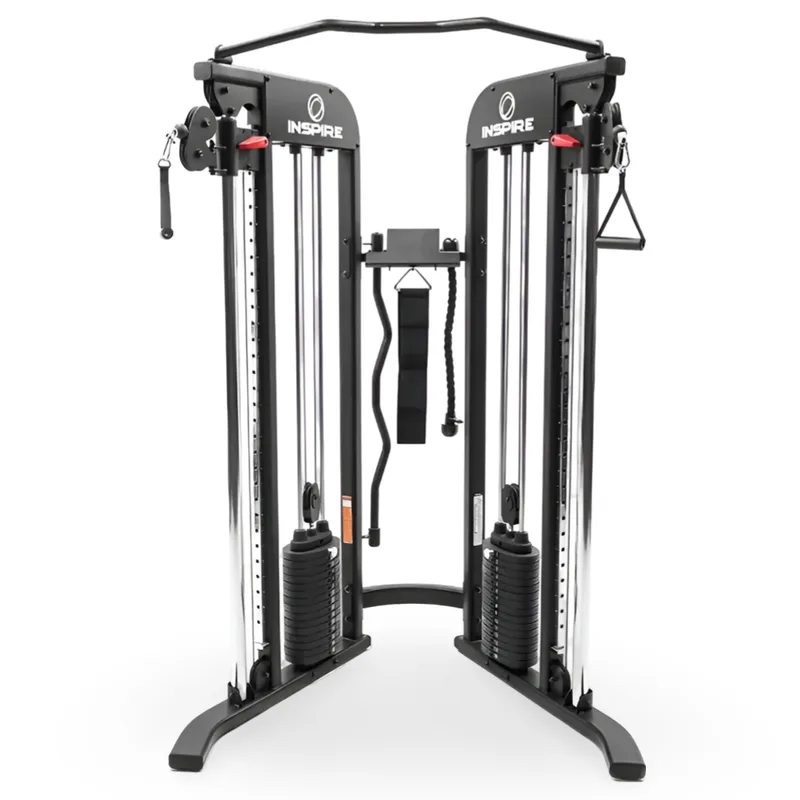
Inspire FTX Functional Trainer
Pros
- 180° swiveling pulleys allow cable angles that fixed-height machines cannot match
- 15 sq ft footprint is meaningfully smaller than the Titan — fits in tighter rooms
- Comes with four accessories including a curl bar and chin/dip belt out of the box
- Good 5-year parts warranty on top of lifetime frame coverage
- Rounded steel frame and chrome accents look more refined than most budget competitors
Cons
- 165 lb stacks are the lightest in this comparison — advanced pullers will hit the ceiling
- Amazon listing is the bundled kit version; standalone unit may require separate search
- Assembly instructions report mixed accuracy — some users needed to cross-reference online guides
- 180° rotation is a feature, but swiveling mechanism adds a wear point over long-term use
The Inspire FTX’s defining feature isn’t the weight stacks or the position count — it’s the 180° swiveling pulley system. Most functional trainers anchor the cable in a fixed direction relative to the frame. The FTX lets the cable anchor rotate 180°, which means you can run unilateral exercises at angles outside the machine’s footprint without the cable pulling diagonally across the stack.
In practical terms: standing rotational exercises, sport-specific cable work, and lateral movement patterns that require cables at oblique angles are more natural on the FTX than on fixed-pulley machines. Based on owner reports from fitness forums, this feature matters most for users doing physical therapy protocols, sport-specific training, or anyone who does a lot of lateral lunges, rotational rows, or cable woodchops.
The 15 sq ft footprint and 544 lb assembled weight make it the lightest and most compact machine on this list that ships with full stacks. The four included accessories (rope, two D handles, curl bar, chin/dip belt) cover the core cable exercises without add-on spending.
The 165 lb stacks are the practical limitation. Advanced lifters who cable row or cable pull 70+ lbs per arm will run out of resistance faster than on the Titan or REP Arcadia. For intermediate lifters and users primarily training in moderate rep ranges, 82.5 lb effective per arm is enough.
The Amazon listing is the bundled kit version with the Centr Fitness Essentials accessories. Verify you’re purchasing the correct SKU at checkout.
Body-Solid GDCC250B Cable Crossover
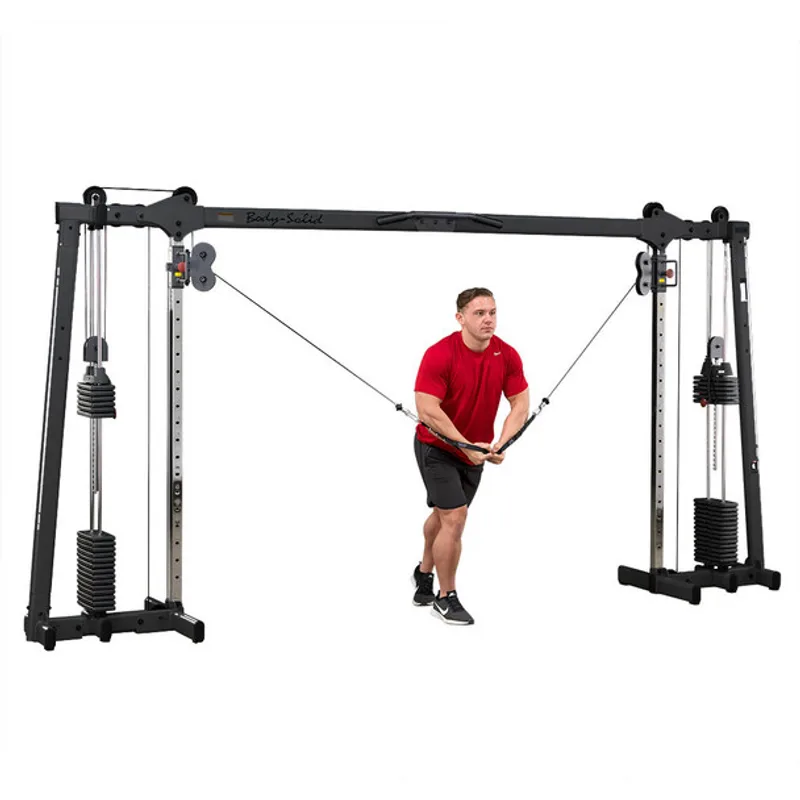
Body-Solid GDCC250B Cable Crossover
Pros
- Wide-frame design creates the standing space needed for true cable chest fly movements
- Lifetime warranty on frame, welds, weight plates, and guide rods — best coverage on this list
- 11-gauge 2"x4" oval tubing is commercial-grade — exceeds home gym structural requirements
- Dual pull-up bar positions double as a training station for bodyweight work
- Stacks upgrade to 210 lb without purchasing a new frame
Cons
- 164-inch length (13.7 feet) requires a large dedicated room — not practical for most garages
- 160 lb base stacks are the lowest on this list before upgrade
- Fixed-frame crossover design limits functional training range compared to dual-adjustable machines
- 29" width means you need arm clearance on both sides — actual room requirement is closer to 10 feet wide
The GDCC250B is what most people picture when they hear “cable crossover machine” — the wide-frame freestanding station with two towers, dual weight stacks, and cables meeting in the middle. Body-Solid has manufactured this design for decades, and the quality at the GDCC250B price point is commercial-grade by home gym standards.
The 11-gauge 2”×4” oval tubing is the same spec you’d find in a light commercial gym. The 4.8mm steel cables are rated beyond 2,500 lb — you will not cable this machine to failure. The lifetime warranty covers the frame, welds, weight plates, and guide rods with a 3-year extension on pulleys and bushings. No other machine on this list covers more failure points.
The wide frame creates what functional trainers replicate but can’t fully match: free bilateral arm movement through a cable fly arc. Standing inside the GDCC250B frame and performing cable chest flies, high-to-low cable crosses, or reverse fly patterns gives your arms full clearance with no stacks or frame intruding into the movement path. For chest fly training specifically, this is the machine.
The constraint is the footprint. 164 inches long means 13.7 feet of floor space dedicated to one machine, plus clearance for the operator on both sides. In a 2-car garage or a commercial space, this is fine. In most single-car garages or spare bedrooms, it simply doesn’t fit. If you have the room, the GDCC250B earns its floor space with long-term durability and genuine cable fly function. If you don’t, no amount of quality justifies forcing it into a space it doesn’t fit.
Buying Guide: How to Choose
Buy a functional trainer if: You have a room under 14 feet long, you want exercise variety beyond chest flies, you do unilateral strength work, or your training covers cardio/conditioning alongside traditional lifts. Functional trainers cover approximately 90% of what cable crossovers do in a fraction of the footprint.
Buy a cable crossover if: You have a large dedicated gym space (14+ feet long, 10+ feet wide), bodybuilding-style chest fly work is a training priority, and you want commercial-gym structure with the heaviest possible weight stacks over long-term use.
Budget vs premium: The Titan at $1,799 delivers more stack weight than the Inspire FTX and costs $400 less than the REP Arcadia. The premium for the Arcadia buys cable smoothness, compact design, and upgrade paths — worthwhile for buyers who are building a long-term space and want best-in-class hardware. For budget-focused buyers, the Titan is the rational pick.
Stack weight: Target at least 150 lb per stack (2:1 ratio = 75 lb effective per arm) for intermediate use. The Titan’s 200 lb stacks give the most headroom before you hit resistance limits.
Position count: More positions means finer angle adjustment. 30+ positions (Arcadia, FTX) cover specialized exercise programming better. 20 positions (Titan, Body-Solid) cover all standard exercises without gaps.
FAQ
Can a functional trainer replace a cable crossover completely? For most home gym users, yes. The only exercise where a cable crossover has a clear advantage is the standing cable chest fly — the wide frame gives your arms unobstructed arc. Functional trainers approximate this, but the frame limits how far the cables spread. If cable flies are a small part of your training, a functional trainer handles it. If they’re a priority, consider the crossover.
What cable ratio should I look for? Most home gym machines use a 2:1 ratio — a 200 lb stack feels like 100 lbs of resistance at the handle. Some premium machines use a 1:1 ratio, which doubles the effective resistance but also moves the stack twice as far per repetition. For most users, a 2:1 machine with heavy stacks (200 lb per side) covers the full range of training intensities.
How much space do I actually need for a functional trainer? The machine’s footprint plus 4 feet of operator clearance in front and 2 feet on each side. A compact functional trainer at 13–15 sq ft footprint fits in approximately a 10’ x 8’ room. A cable crossover with a 33 sq ft footprint (the Body-Solid GDCC250B at 164” long) needs a dedicated room at least 16’ x 10’.
Is REP Arcadia worth the price over Titan? For buyers who prioritize cable smoothness, compact footprint, and long-term upgrade paths — yes. The REP Arcadia’s aluminum pulley system and 32-position height range are measurably better than the Titan’s 20-position system. For buyers who prioritize maximum stack weight at minimum cost, the Titan wins on value. Both are excellent machines; the gap is in refinement vs. raw capacity.
Can these machines handle powerlifting-style cable work? Yes, with the right setup. Heavy cable rows, single-arm pulldowns, and cable RDLs respond well on any 200 lb stack machine. The limiting factor on most home functional trainers is stack weight, not structural integrity. If you regularly move 80–100 lb per arm on cable exercises, the Titan’s 200 lb stacks give more headroom than the 165 lb Inspire FTX.
Verdict
The REP Arcadia is the machine to buy if your room has space constraints and you want the most refined cable experience in the sub-$2,500 range. The Titan Fitness Functional Trainer is the value pick: more stack weight than anything else at $1,799, with enough accessory coverage to start training day one.
The Inspire FTX earns its place for buyers in tight spaces who value swiveling pulleys for rotational training. The Body-Solid GDCC250B is the right call if you have a large room, want lifetime warranty coverage, and specifically prioritize cable chest fly training with full arm clearance.
For most home gym buyers: go with a functional trainer. The cable crossover is a specialist machine that requires specialist space. The functional trainer handles 90% of the cable work in 40% of the footprint.