Basement home gyms reached mainstream territory in 2026. The Boston Globe ran a piece in April covering a designer who converted a small basement into a dedicated training room for marathon prep — and that kind of feature signals a broader shift from hobbyist project to standard home improvement priority. According to CivicScience’s 2026 fitness trend report, home equipment purchasing is accelerating, with free weights and home cardio machines among the top planned purchases this year.
The case for a basement gym is straightforward: stable temperature year-round, privacy, and usually the one room in the house that isn’t already optimized for something else. The specific challenges — low ceilings, concrete moisture, sound transmission, limited natural light — are real but solvable. Solve them correctly and a basement gym outperforms most commercial gym experiences. Ignore them and you’ll be fighting your environment every training session.
This guide covers five phases of a basement gym build, from concrete to cardio, with product recommendations calibrated for basement-specific constraints rather than generic home gym advice.
Before You Start: The Basement Checklist
Four things to confirm before any equipment arrives:
Ceiling height. Measure from the finished floor to the lowest obstruction — ductwork, beams, sprinkler heads, and light fixtures all count. A full-height power rack needs 7 ft of clearance minimum. The short-height racks covered in this guide (71”) need that same 7-foot minimum, plus an additional 6 inches above the rack for bar liftoff. A 7’6” ceiling is comfortable for everything in this guide. A 7-foot ceiling is workable for squatting and deadlifting but requires careful equipment selection.
Moisture. Before laying any flooring, run a concrete moisture test: tape a 12” square of plastic sheeting flat against the concrete with painter’s tape, seal all four edges, and check after 24 hours. Condensation under the plastic means active vapor transmission. Address it first — a dehumidifier running continuously during humid months is the standard solution for most basement gyms. Rubber flooring tolerates moisture, but mildew grows underneath if the concrete surface stays wet.
Electrical. A rowing machine or air bike runs without power. A treadmill or motorized machine typically needs a dedicated 20-amp circuit. Map your outlet locations now. Running an extension cord across a workout floor is a trip hazard that gets worse as a gym fills in.
Load distribution. Residential floors are generally rated for 40 lbs per square foot of live load. A fully loaded home gym — rack, barbell, 300 lbs of plates, bench — distributed across 150 sq ft is well under that threshold. The only scenario that approaches a problem is stacking all your equipment in one corner. Distribute gear around the space.
Phase 1: Flooring — Do This First
Rubber flooring is not optional in a basement gym. Bare concrete is slippery when wet, destroys iron plates on impact, and transmits vibration directly through the slab to the structure above. The right flooring addresses all three issues before a single piece of equipment arrives.
Interlocking rubber tiles work better than flat mats in basements because they configure around obstacles — support columns, floor drains, sump pump housings — without leaving gaps. The IncStores 3/4” tiles use a puzzle-edge interlocking system that holds position under loaded equipment without adhesive.
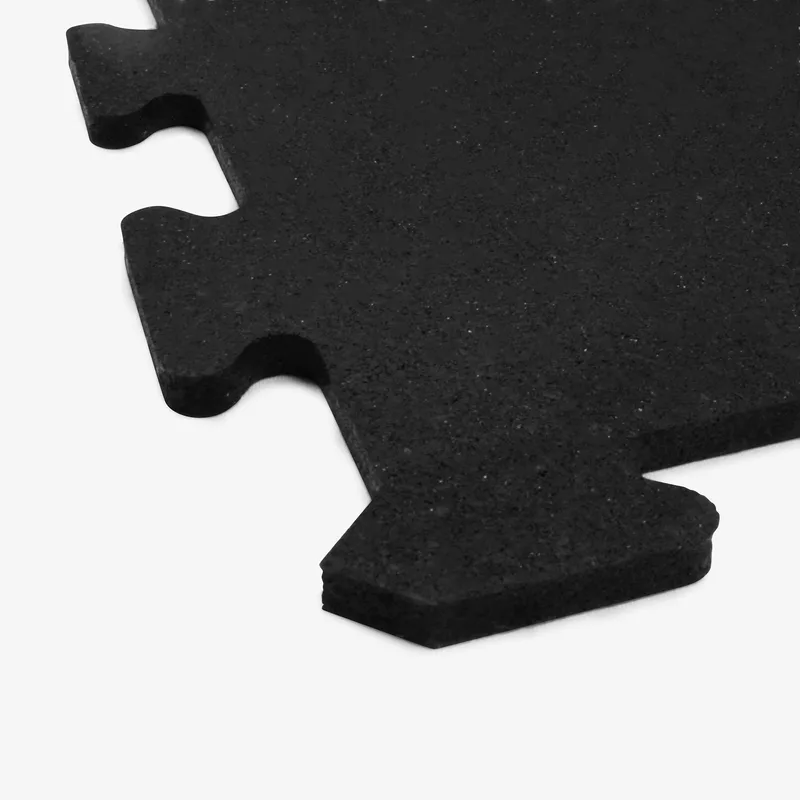
IncStores 3/4" Soft Rubber Interlocking Gym Tiles
Pros
- True 3/4" thickness handles dropped plates and heavy equipment impact
- Interlocking puzzle edges install without adhesive on bare concrete
- Dense rubber resists compression under rack and barbell feet
- Non-slip surface stays effective in humid basement conditions
- Expandable — buy additional packs as your gym grows
Cons
- Strong rubber odor when first unboxed (off-gases within a few days)
- Each 2×2 tile weighs 8–10 lbs — heavier to handle than foam tiles
- Edge curling possible if tiles are not fully interlocked during install
For a standard rack-plus-bench setup, plan on 100–120 sq ft of coverage. That covers the rack footprint, a deadlift pull zone in front of it, and bench press space on one side. Budget about $230–$260 for this area using the 20-tile packs.
Sound isolation note: 3/4” rubber absorbs plate drops and dumbbell impact well. It does not eliminate vibration from heavy deadlifts on a structural floor — that requires a second isolation layer. If your basement ceiling sits directly under a bedroom or living room, consider laying horse stall mats under the tiles in your primary lifting zone for additional vibration damping.
Phase 2: Power Rack — Low-Ceiling First
Standard full-height power racks run 83–90 inches tall. That’s 6’11” to 7’6” before accounting for bar liftoff clearance. Most finished basements with 7-foot ceilings cannot accommodate them without ductwork modifications.
The Titan T-2 Short solves this cleanly. At 71 inches overall height, it clears a 7-foot ceiling with a 12-inch buffer — enough room to set J-hooks comfortably and lift the bar off without contact. The four-post cage design with safety pins makes it genuinely safe for solo lifting, which open squat stands at similar prices do not provide.
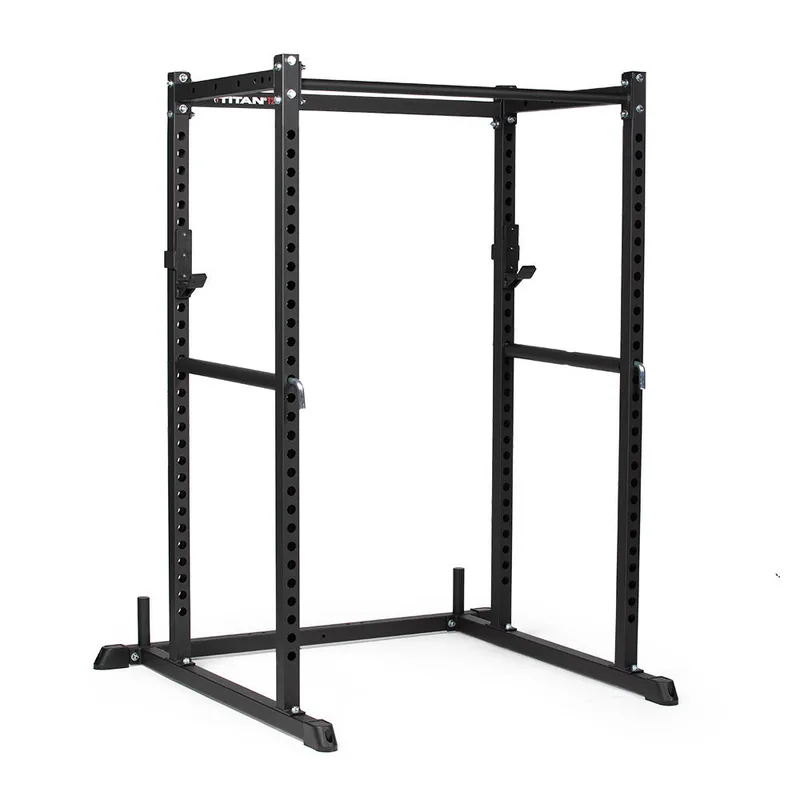
Titan Fitness T-2 Short Power Rack
Pros
- 71" height clears a standard 7-foot ceiling with 12" of buffer
- 850 lb rackable capacity handles any realistic home gym load
- Full 4-post cage with safety pins — safer than open squat stands
- Compatible with extensive T-2 accessory ecosystem (dip bars, cable attachments, band pegs)
- Powder-coat finish resists rust in high-humidity basement environments
Cons
- 2" × 2" uprights are smaller gauge than premium racks (3×3 steel)
- Wobbles during pull-ups without floor bolts — anchoring is recommended
- Pull-up bar at 71" is uncomfortably low for lifters taller than 6'1"
- Shorter warranty coverage than premium-tier competitors
The practical tradeoffs are real: the 2” × 2” upright system is smaller gauge than premium racks, and the pull-up bar height at 71” is restrictive for lifters over 6 feet. For squatting, benching inside the rack, and rack pulls, there’s no meaningful compromise. For pull-ups, expect a crouch at the top of every rep.
One Titan-direct alternative worth knowing: the Rogue RML-3W folding rack mounts to a wall stud and folds flat when not in use, freeing floor space entirely. It costs more and has longer lead times, but it’s the right answer for a basement under 180 sq ft that also needs to function as a non-gym space.
Installation note: Bolt the T-2 Short through the rubber mats into the concrete using sleeve anchors. A 71” rack bolted down is more stable than an 85” rack sitting loose — the shorter lever arm doesn’t forgive unsecured feet the same way a full-height rack does.
Phase 3: Adjustable Weight Bench
A bench converts the rack into a complete upper body training station. The REP Fitness AB-3000 occupies the best value position in the adjustable bench category because its specs — 11-gauge steel, 1,000 lb capacity, 8 back pad positions — are what premium benches delivered three years ago, now at a mid-range price.
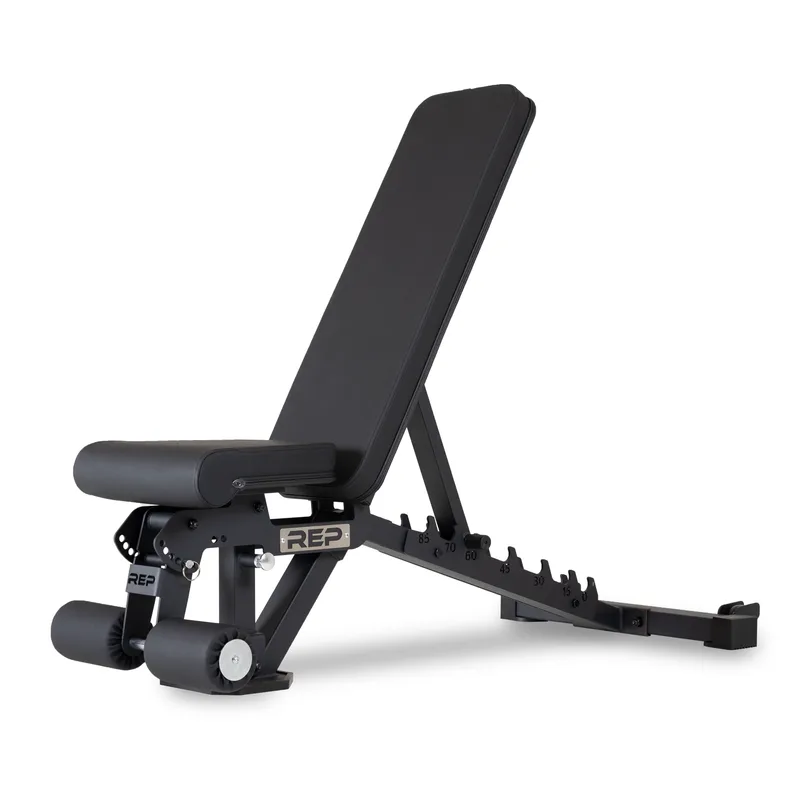
REP Fitness AB-3000 FID Adjustable Weight Bench
Pros
- 11-gauge steel frame and 1,000 lb capacity at under $330 — exceptional value
- 8 back pad positions cover flat, all incline angles, and true 85° upright
- Transport wheels make repositioning in a compact basement simple
- Dense, firm padding holds shape through years of consistent use
- Ships mostly pre-assembled — typically 15 minutes to complete setup
Cons
- At 85 lbs, carrying it upstairs is a two-person job
- Seat-to-back-pad gap is noticeable at certain incline settings
- Footprint is wider than budget benches — measure your rack interior before ordering
The 8 back pad positions cover the full training range: flat for bench press, low incline (15–30°) for incline dumbbell work, high incline (60–85°) for overhead pressing, and a -12° decline position. In a single-rack basement gym, this flexibility eliminates the need for multiple specialty benches.
Transport wheels matter more in a basement than in a larger space. Moving the bench out of the rack to create floor space for deadlifts, rows, or stretching is a daily routine in compact gyms. The AB-3000’s wheels make it a 5-second task.
Fitting check: At 54” long with the back pad flat, the bench needs approximately 5 feet of depth inside the rack to position the athlete properly under the bar. Measure your T-2 Short interior depth before assuming fit — it works, but verify.
Phase 4: Olympic Barbell
Every major compound movement runs through the barbell: squats, deadlifts, bench press, overhead press, bent-over rows. The CAP Barbell Classic 7-footer keeps the budget in range while covering all of them reliably.
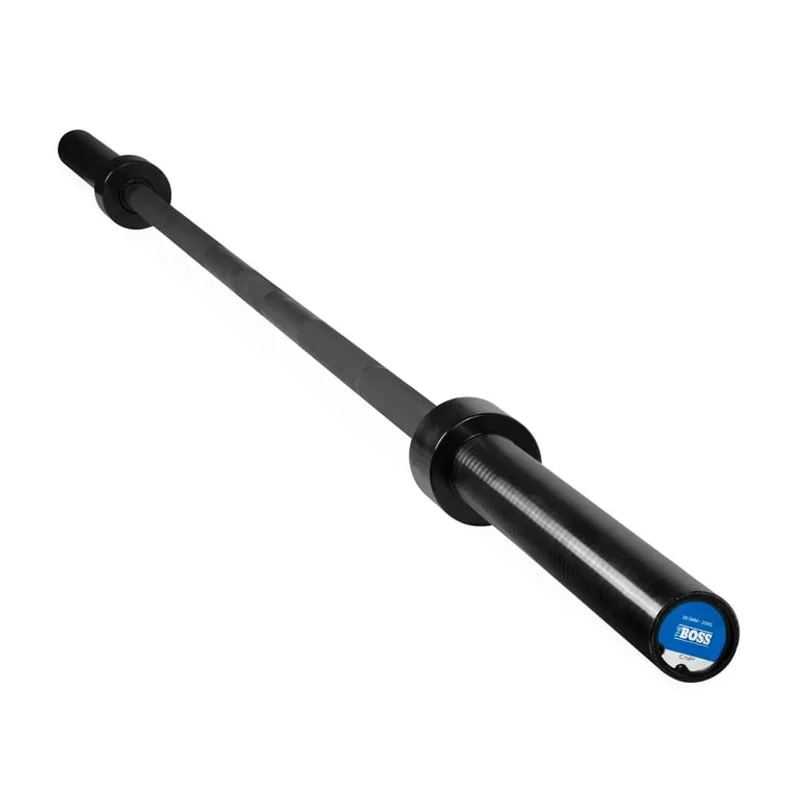
CAP Barbell Classic 7-Foot Olympic Bar
Pros
- Affordable entry point for Olympic barbell training
- Standard 2" Olympic sleeves fit all commonly sold weight plates
- Medium knurling provides grip security without tearing up palms
- Bushing sleeves provide consistent, smooth rotation for compound lifts
- Reliably in stock on Amazon — rarely backordered unlike many budget alternatives
Cons
- Bar weighs 35 lbs, not the standard 45 lbs — programming adjustments required
- 500 lb capacity is the hard ceiling, not a comfortable working weight
- Bushing (not bearing) sleeves — not appropriate for Olympic lifts dropped from overhead
- 30-day warranty is unusually short
One honest clarification: this bar weighs 35 lbs, not the standard 45 lbs. That difference matters when following structured programs. Starting Strength, StrongLifts 5x5, and most barbell programs assume a 45 lb bar. If you use this bar, track actual load rather than program-prescribed load, and adjust starting weights down to account for the lighter bar.
For plates: standard 2” Olympic diameter fits this bar. Cast iron plates are the most affordable option at $1.00–$1.50 per pound new. A 300 lb set covers beginner through intermediate programming for all compound lifts and runs $250–$350. Rubber-coated plates cost more but are gentler on flooring and reduce noise on unintentional contact with the rack.
Phase 5: Cardio Equipment
Basement gyms have one significant advantage for cardio: contained sound. Magnetic resistance machines produce almost no mechanical noise, which matters when the ceiling is someone’s kitchen floor. An air bike or treadmill in a basement is audible upstairs; a magnetic rower running at full effort is not.
The Sunny Health SF-RW5515 earns its place because it folds upright when not in use. A rower that reduces to a 19” wide floor footprint against a wall is a fundamentally different space calculus than a 50” wide air bike sitting permanently in the middle of the room.
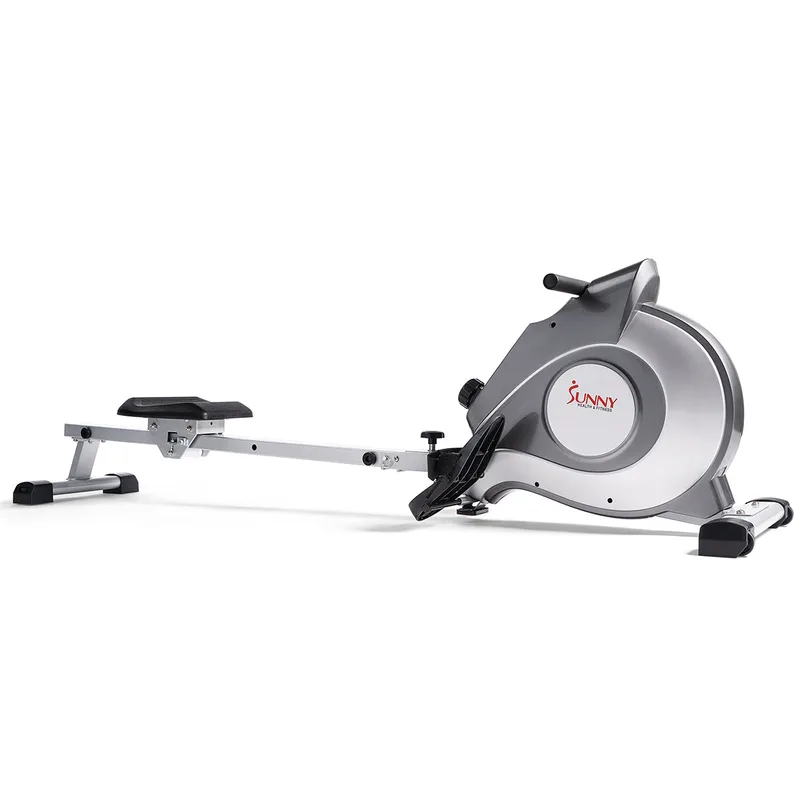
Sunny Health & Fitness SF-RW5515 Magnetic Rowing Machine
Pros
- Rail folds upright against the wall — negligible footprint when stored
- Magnetic resistance operates nearly silently — no noise transmission to upper floors
- 25,000+ Amazon reviews with a 4.5-star average across variants
- Runs without a power cord — purely mechanical operation
- Built-in transport wheels for easy repositioning
Cons
- 250 lb weight capacity excludes heavier users
- Basic LCD display — no Bluetooth, no app connectivity, no heart rate monitoring
- Resistance tops out at moderate intensity — advanced rowers will outgrow it
- Seat firmness becomes noticeable on sessions longer than 30 minutes
Rowing also avoids the ceiling clearance issues that make jump ropes and plyometric exercises impractical in a 7-foot basement. A full rowing stroke at seated height never approaches the ceiling. The same cannot be said for any overhead movement.
Capacity note: The SF-RW5515 is rated at 250 lbs. Heavier users should look at the Concept2 RowErg (rated at 500 lbs, direct from concept2.com) or the Sunny Health Obsidian Surge SF-RW5623 (rated at 350 lbs, available on Amazon).
What to Look For: Basement-Specific Equipment Criteria
Ceiling clearance. Beyond racks, standing cable machines, pull-up stations, and functional trainers all have height requirements. Check the assembled height of any standing piece of equipment against your measured clearance before ordering. Return shipping on oversized gym equipment is expensive and logistically difficult.
Moisture resistance. Powder-coated steel handles humidity better than bare metal but is not immune to rust if the basement stays consistently wet. A dehumidifier maintaining 45–55% relative humidity protects all metal equipment. Rubber-coated plates outlast bare iron in high-humidity environments.
Noise transmission. Magnetic resistance is the quietest category. Air resistance (fans) is moderate noise. Weight stacks on cable machines make mechanical noise. Barbell drops on bare concrete are the loudest event in any gym — rubber flooring and bumper plates reduce this significantly if the ceiling below a living space is a concern.
Compact storage footprint. Folding benches, rowers with fold-up rails, and wall-mounted folding racks all reduce the permanent floor claim of a gym. In a basement that also serves as storage or a secondary living space, this flexibility is worth the small premium over non-folding alternatives.
FAQ
How much space do I need for a basement home gym? A minimal setup — rack, bench, barbell, and flooring — fits in a 10’ × 10’ footprint (100 sq ft). A comfortable training space with room to load plates, move around equipment, and do floor work runs 12’ × 15’ (180 sq ft). Adding dedicated cardio equipment adds 20–30 sq ft. Most functional basement gyms occupy 150–300 sq ft.
What ceiling height do I need for a home gym? Seven feet is the practical minimum for a full power rack setup using low-profile short racks like the Titan T-2 Short (71”). You’ll need an additional 6” above the rack for bar liftoff, making 7’6” the comfortable target. Open squat stands and folding racks can work in 6’6”–7’. Overhead pressing inside a cage at any height requires that extra clearance above the bar’s topmost position — verify yours before ordering.
How do I control moisture in a basement gym? A dehumidifier sized for your space is the core solution. Target 45–55% relative humidity. Run it continuously during summer months in humid climates. Rubber flooring sits on concrete without trapping moisture the way foam can — it’s the right choice for basement applications. Wipe down equipment after sweaty sessions and keep bare metal surfaces dry to prevent rust.
Do I need a dedicated electrical circuit for basement gym equipment? For the setup in this guide — rack, bench, barbell, and magnetic rower — no dedicated circuit is required. The Sunny SF-RW5515 runs without electricity. If you add a treadmill or any motorized machine in the future, most manufacturers require a dedicated 20-amp 120V circuit. Check the equipment manual before plugging any motor-driven machine into a shared outlet on an existing circuit.
Is a heavy gym safe in a basement? For typical home gym setups, yes. Residential floors are rated for 40 lbs per square foot of live load. The full five-piece setup in this guide — rack (125 lbs), bench (85 lbs), barbell (35 lbs), 300 lbs of plates, rower (59 lbs) — totals about 600 lbs. Distributed across 150 sq ft, that’s 4 lbs per square foot — well under the load rating. Concentrating all equipment in a small corner is the only layout that creates concern. Distribute gear across the space.
Conclusion
The best basement gym builds work with the space’s constraints rather than against them. A 71” power rack chosen for your 7-foot ceiling is a better training tool than a standard-height rack jammed against ductwork. A magnetic rower that folds against the wall preserves floor space in a way a permanent air bike does not.
The five-piece setup in this guide — IncStores rubber tiles, Titan T-2 Short, REP AB-3000 bench, CAP Olympic bar, and Sunny rower — covers every major movement pattern: squat, hinge, push, pull, and conditioning. Add 300 lbs of Olympic plates ($250–$350) and the total build runs approximately $1,400, including flooring for a standard rack footprint.
Start with the rubber tiles. Every other phase builds on top of them.
Sources: