NordicTrack’s 2026 update to the Commercial 1750 expanded the touchscreen from 14 to 16 inches, added ActivePulse heart rate zone automation, and trimmed roughly four inches from the overall frame length — all while keeping the $2,499 price tag. The changes are incremental, but they address the two complaints that consistently showed up in owner feedback: the previous screen felt small for a $2,500 machine, and heart rate-based auto-adjustment required the iFIT subscription to function properly. Both are now standard on the 2026 model.
This review covers the full picture — motor, iFIT integration, decline capability, and what changes when you strip out the subscription — plus direct comparisons to the Sole F80 ($1,799) and Horizon 7.8 AT ($1,999), the two strongest competitors at lower price points.
Quick Comparison
| Spec | NordicTrack Commercial 1750 | Sole F80 | Horizon 7.8 AT |
|---|---|---|---|
| Rating | 9.2/10 | 8.9/10 | 8.7/10 |
| Price | Check price | Unavailable | $1,999 |
| Motor | 4.25 CHP | 3.5 CHP | 4.0 CHP |
| Speed | 0–12 MPH | 0–12 MPH | 0–12 MPH |
| Incline | -3% to 12% | 0–15% | 0–15% |
| Belt | 22" x 60" | 22" x 60" | 22" x 60" |
| Display | 16" HD touchscreen (pivots/tilts) | 10.1" touchscreen | — |
| Weight Capacity | 400 lbs | 350 lbs | 375 lbs |
| Machine Weight | 311.5 lbs | 274 lbs | 330 lbs |
| Folding | SpaceSaver EasyLift Assist | Yes (45" x 38" x 71.5" folded) | Yes (42" x 37" x 71") |
| Warranty | Lifetime motor / 10-yr frame / 2-yr parts / 1-yr labor | Lifetime frame & motor / 3-yr parts / 1-yr labor | Lifetime frame & motor / 3-yr parts / 1-yr labor |
| Assembly | Moderate (2–3 hours) | Moderate (2 hours, recommend 2 people) | Moderate |
| Check Price → | Check Price → | Check Price at Horizon Fitness → |
Prices change daily — tap Check Price for the current Amazon price. Numbers shown were verified on the "as of" date.
NordicTrack Commercial 1750
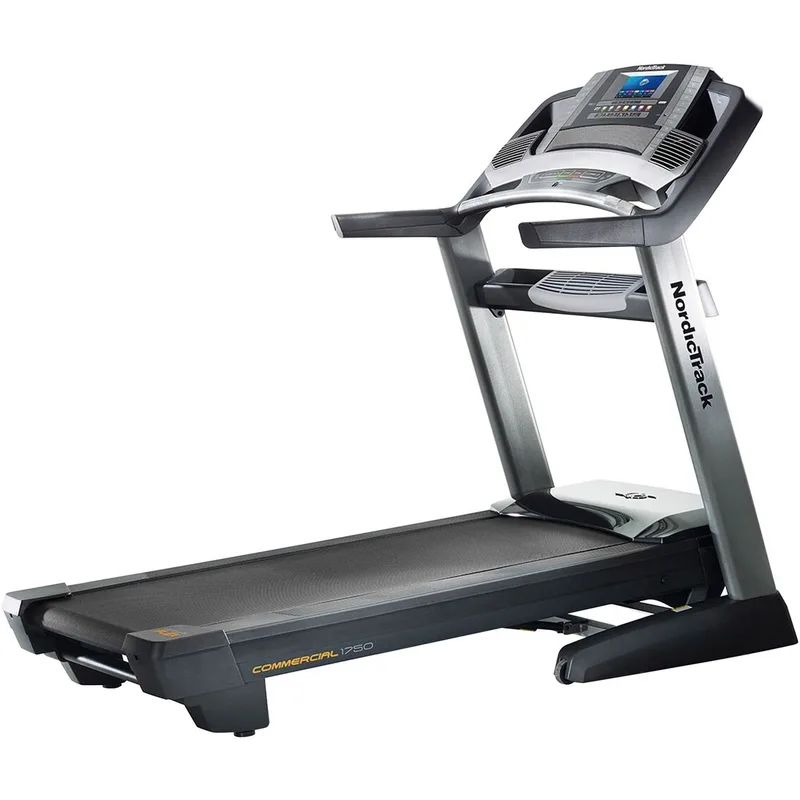
NordicTrack Commercial 1750
Pros
- 4.25 CHP motor handles sustained fast running without strain — quieter than most competitors at the price
- 400 lb weight capacity is exceptional for a folding treadmill in this class
- -3% decline adds genuine lower-leg variation that flat-incline-only machines cannot replicate
- 16" pivoting touchscreen swivels for floor workout use — practical, not just a spec
- SpaceSaver EasyLift Assist folds the deck with hydraulic assist — minimal effort required
- ActivePulse automatically adjusts speed and grade to maintain target heart rate zone
- iFIT library covers outdoor routes, studio runs, and strength workouts with trainer-controlled incline
Cons
- iFIT subscription costs $39/month ($469/year) for full content — a recurring cost to budget for
- 12% max incline is lower than the Sole F80 (15%) and Horizon 7.8 AT (15%)
- 311.5 lbs makes relocation a two-person job
- Assembly takes 2–3 hours and many owners recommend paying for professional setup
- Standalone console use without iFIT limits smart features significantly
The 1750 has been NordicTrack’s mid-range flagship for years, and it holds that position through a combination of specs that are genuinely difficult to match at the price: 4.25 CHP motor, 400 lb weight capacity, -3% decline, and a 16” touchscreen with full iFIT integration. No other folding treadmill in the $2,000–$2,600 range matches all four simultaneously.
Motor and Ride Quality
The 4.25 CHP motor is the key spec here. Most mid-range treadmills in this price range run 3.0–3.5 CHP, which handles jogging and moderate running but starts to strain under sustained high-speed intervals. The 1750’s motor pulls hard without generating heat buildup or belt drag — owner reports across running communities consistently note that the machine stays quiet even when the incline shifts during iFIT-controlled workouts.
The belt itself is 22” wide and 60” long, which accommodates runners up to around 6’5” comfortably. The cushioning system toggles between soft (engaged) and firm (disengaged) via a lever under the deck. Soft mode reduces joint impact noticeably — useful for recovery runs or lighter days. Firm mode gives a closer approximation of road feel for performance training.
The -3% Decline
Most home treadmill buyers overlook decline, but it’s the 1750’s most distinctive capability relative to comparably priced machines. A -3% decline puts the lower leg — specifically the anterior tibialis, calves, and peroneals — under eccentric load that flat or incline-only training completely skips. For runners who do hill repeats outdoors but train mostly on a flat treadmill, the missing downhill load creates a muscle imbalance that shows up in injury patterns.
The 1750’s decline doesn’t feel dramatic in use — -3% is subtle — but it’s real, it functions, and nothing else in this price class offers it. The Sole F80 and Horizon 7.8 AT are both incline-only. If decline matters to your training, the 1750 is the only option here.
iFIT Integration
The 1750 is designed around iFIT. With an active subscription ($39/month or $469/year), the 16” screen delivers trainer-led workouts where speed and incline shift automatically to match the workout design. Google Maps routes import so the treadmill tilts to simulate actual terrain. The ActivePulse feature adjusts pace and grade in real time to keep you in a target heart rate zone — useful for zone 2 training where staying within a narrow HR window actually requires constant adjustments.
Without iFIT, the 1750 still functions as a treadmill. Manual controls work. You can stream Netflix or Spotify directly through the screen. But the automatic trainer control, route simulation, and structured programming all require a paid subscription. A 30-day family iFIT membership is included with purchase; after that, the $469/year cost is a real line item.
Over five years, iFIT adds $2,345 to the machine’s total cost if you maintain the subscription. That math changes the value comparison against the Sole F80 significantly — a $700 purchase price difference narrows after about 18 months of iFIT fees.
Build and Assembly
At 311.5 lbs, the 1750 requires two people to move and position before assembly. Assembly itself takes 2–3 hours with the included instructions; NordicTrack’s assembly videos are clear but the process involves more steps than most competitors. Owner feedback on the Amazon listing suggests professional installation is worth the added cost for buyers who don’t enjoy the process. The EasyLift Assist hydraulic fold is genuinely convenient — one hand lifts the deck with minimal effort, which makes daily storage practical.
Sole F80
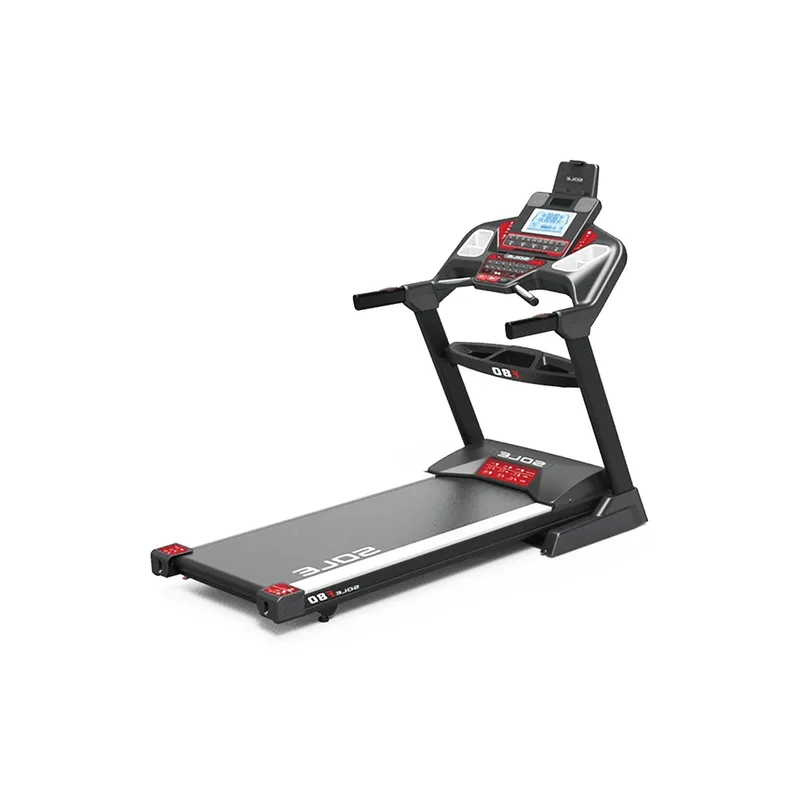
Sole F80
Pros
- No subscription required — functions fully without any app or ongoing fee
- Lifetime motor and frame warranty at a lower price point than NordicTrack's
- 15% incline surpasses the NordicTrack 1750's 12% ceiling
- Reversible deck doubles usable lifespan — unique feature in this class
- CushionFlex Whisper Deck reduces impact without feeling spongy underfoot
- 350 lb weight capacity handles most users comfortably
Cons
- No decline function — incline only, no -3% eccentric training option
- 10.1" display is significantly smaller than the 1750's 16" screen
- No automatic trainer control — all adjustments are manual
- No built-in structured class library
The Sole F80 is the strongest subscription-free alternative to the 1750. At $700 less, it matches the NordicTrack on belt size (22”x60”), approaches its motor output (3.5 vs 4.25 CHP), and exceeds its maximum incline (15% vs 12%). The trade-offs are real — no decline, smaller screen, no automatic trainer control — but for buyers who want a premium folding treadmill without any monthly fee, the F80 is hard to argue with.
What You Get for $1,799
The 3.5 CHP motor is commercially rated and built for sustained use. It’s not as powerful as the 1750’s 4.25 CHP, which shows under continuous high-speed running (above 9 MPH for extended intervals), but for most users running at 6–8 MPH, the difference is imperceptible. The 10.1” touchscreen connects to Bluetooth fitness apps — Peloton’s app, Zwift, Apple Fitness+ — via open Bluetooth, so you can use your preferred platform without a proprietary subscription.
The reversible deck is a feature that often gets overlooked. Flipping the deck after heavy use exposes a fresh surface, effectively doubling the deck’s functional lifespan before replacement is needed. In a machine designed for long-term ownership, that’s a meaningful value multiplier.
The lifetime motor and frame warranty is the F80’s biggest advantage over every competitor in the $1,600–$2,000 range. NordicTrack’s 10-year frame warranty is strong, but Sole’s lifetime coverage is better. For buyers planning to use the machine for 10+ years, that warranty difference matters.
The Subscription-Free Math
Without iFIT, the Sole F80 is a complete product. Every feature works on day one and continues working without any additional payment. Compared to a 1750 with iFIT over five years:
- Sole F80 total: $1,799
- NordicTrack 1750 + 5 years iFIT: $2,499 + $2,345 = $4,844
That’s a $3,045 difference over five years. Buyers who genuinely use iFIT consistently get significant value from it. Buyers who subscribe for the first year and then let it lapse get the worst outcome — they paid the hardware premium for features they stopped using.
Horizon 7.8 AT
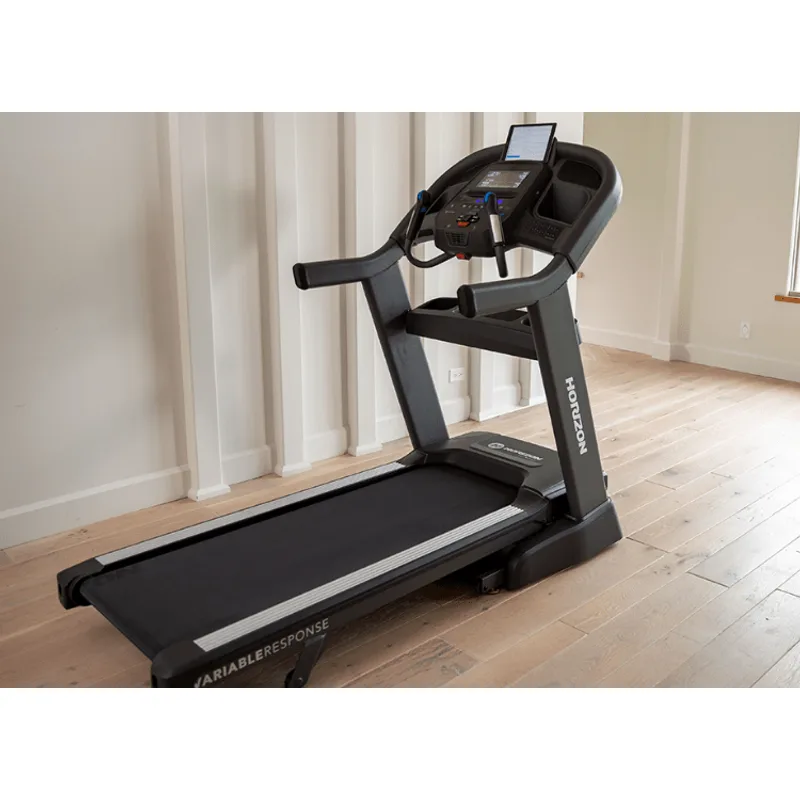
Horizon 7.8 AT
Pros
- No subscription required — open Bluetooth connects to Peloton app, Zwift, Apple Fitness+
- SPRINT8 HIIT protocol built directly into console — eight automated interval programs with no app
- 4.0 CHP motor outperforms the Sole F80 and approaches NordicTrack's 4.25 CHP
- 15% incline surpasses the NordicTrack 1750's 12% maximum
- 375 lb weight capacity sits between the 1750 (400 lbs) and F80 (350 lbs)
- Dial controls for speed and incline allow fast manual adjustments during workouts
Cons
- Only available direct from Horizon Fitness — no Amazon purchase option
- No decline function
- Display is smaller and less capable than the NordicTrack 1750's 16" screen
- SPRINT8 protocol cannot be customized beyond preset interval structure
The Horizon 7.8 AT sits at $1,999 and positions itself as a premium non-connected treadmill — more motor than the Sole F80, no subscription required, and open Bluetooth for any platform you choose. The SPRINT8 HIIT protocol built into the console is the headline differentiator: eight automated interval programs that cycle through high-intensity sprints and active recovery phases, all controlled by the machine itself without requiring an app.
SPRINT8 Protocol
SPRINT8 is a research-backed high-intensity interval training system designed by Phil Campbell. The protocol uses eight 30-second max-effort sprints with 90-second recovery intervals — a 20-minute session structured to maximize growth hormone response. It’s built directly into the Horizon console, which means you set the machine to SPRINT8 mode, select your intensity level, and the treadmill automatically adjusts speed throughout each interval. No app. No subscription. No manual adjustments mid-sprint.
For buyers who want structured HIIT programming without the connected fitness ecosystem, SPRINT8 delivers meaningful functionality at no ongoing cost. The NordicTrack 1750 requires iFIT for equivalent trainer-controlled programming.
Motor and Incline
The 4.0 CHP motor is closer to the NordicTrack 1750’s 4.25 CHP than the Sole F80’s 3.5 CHP. Under hard intervals and steep inclines, the difference between 3.5 and 4.0 CHP is more noticeable than the gap between 4.0 and 4.25 CHP. The 7.8 AT handles demanding training sessions without strain based on owner reports.
At 15% maximum incline, the 7.8 AT and Sole F80 both outperform the NordicTrack 1750’s 12% ceiling. For incline walking workouts or serious hill simulation, 15% makes a difference — 12% is steep, but 15% approaches the upper limit of what most users train at. Neither the 7.8 AT nor the F80 has decline functionality.
Availability Note
The Horizon 7.8 AT is sold directly through Horizon Fitness’s website and select authorized retailers. It’s not available on Amazon. Buyers who prefer Amazon’s return policies and fulfillment should factor that into the decision.
Buying Guide: Choosing Between These Three
Choose the NordicTrack Commercial 1750 if you plan to actively use iFIT programming, want the -3% decline capability, or need 400 lb weight capacity. The iFIT subscription is a real cost that changes the value equation, but buyers who use it consistently get structured, trainer-led workouts that improve adherence and variety. The 16” pivoting screen is also noticeably better than anything else in this price range.
Choose the Sole F80 if subscription-free operation and long-term ownership cost matter most. The lifetime motor and frame warranty is the best coverage available at this price. Bluetooth app connectivity means you’re not locked out of structured programming — you just choose your own platform. At $700 less than the 1750 with no ongoing fees, the F80 wins the total-cost comparison for most buyers.
Choose the Horizon 7.8 AT if you want structured HIIT programming without a subscription, and direct Horizon purchase is acceptable. SPRINT8 covers one specific training style exceptionally well. The 4.0 CHP motor and 15% incline match or exceed the NordicTrack 1750 on those dimensions at a $500 lower price.
Key Specs Side-by-Side
| Feature | NordicTrack 1750 | Sole F80 | Horizon 7.8 AT |
|---|---|---|---|
| Price | $2,499 | $1,799 | $1,999 |
| Motor | 4.25 CHP | 3.5 CHP | 4.0 CHP |
| Max Incline | 12% | 15% | 15% |
| Decline | -3% | None | None |
| Belt | 22” x 60” | 22” x 60” | 22” x 60” |
| Weight Capacity | 400 lbs | 350 lbs | 375 lbs |
| Display | 16” HD pivot | 10.1” | Basic console |
| Subscription | iFIT ($39/mo) | None | None |
| Warranty (motor) | Lifetime | Lifetime | Lifetime |
What to Look for in a Mid-Range Home Treadmill
Motor rating: CHP (continuous horsepower) is the relevant spec, not peak HP. 3.0+ CHP handles most users up to moderate running speeds. 3.5+ CHP is appropriate for sustained faster running. 4.0+ CHP handles heavy users or long high-intensity intervals without strain.
Deck size: 22” x 60” is the commercial standard and accommodates most runners, including tall ones. Shorter decks (18” x 55”) are acceptable for walking but feel cramped at running speeds over 6 MPH.
Weight capacity: More headroom is better. Running creates impact force beyond static body weight. A 200 lb runner generates significantly more impact than 200 lbs of static load. Extra capacity means longer motor and belt life under real use conditions.
Incline vs. decline: Incline training burns more calories and builds posterior chain strength. Decline training works the anterior lower leg in ways flat running doesn’t. If downhill running is part of your outdoor training, decline capability is worth specifically seeking out.
Subscription costs: Factor iFIT, JRNY, or Peloton subscription fees into the total price before comparing machines. A cheaper machine with an expensive subscription can easily exceed the cost of a more expensive subscription-free model over three to five years.
Folding: All three machines here fold for storage. The NordicTrack’s EasyLift Assist makes folding genuinely easy — meaningful if you use the fold daily. The Sole and Horizon folding mechanisms work but require more manual effort.
FAQ
Is the NordicTrack Commercial 1750 worth it in 2026? For buyers who plan to actively use iFIT, yes. The 4.25 CHP motor, 400 lb capacity, -3% decline, and 16” screen deliver genuine performance advantages at $2,499. For buyers who won’t use the subscription, the Sole F80 at $1,799 delivers more value with a better warranty and no ongoing fees.
What’s the difference between the NordicTrack 1750 and 2450? The 2450 adds a larger 22” HD screen, 3% more incline (up to 15%), and a higher maximum decline (-6% vs -3%). The 2450 retails around $3,299. The 1750 is the right choice for most buyers — the 2450’s advantages are real but not substantial enough to justify the price jump for everyday training.
Does the NordicTrack 1750 require iFIT? No. The machine operates fully without iFIT. You can use manual controls, stream Netflix or Spotify on the touchscreen, and connect third-party apps via Bluetooth. iFIT unlocks automatic trainer speed/incline control, Google Maps routes, and the full class library — but none of those are required to run on the treadmill.
How loud is the NordicTrack Commercial 1750? Quieter than most competitors at similar motor output. Owner reports consistently describe the motor as quiet even under load and during incline changes. The belt itself generates running noise, but the machine’s mechanical noise is minimal. Apartment use depends on floor construction — the impact noise of running transmits through floors regardless of motor noise.
Is the Sole F80 better than the NordicTrack 1750? Depends on your priorities. The Sole F80 wins on: total cost of ownership (no subscription), incline range (15% vs 12%), and warranty simplicity. The NordicTrack 1750 wins on: structured content ecosystem, decline capability (-3%), weight capacity (400 vs 350 lbs), and display quality. Neither is objectively better — it’s a values question about whether iFIT is worth the ongoing cost.
How hard is the NordicTrack 1750 to assemble? Moderate. Most owners report 2–3 hours solo, or 1.5 hours with two people. NordicTrack provides video instructions that are clearer than the printed guide. Many retailers offer optional professional assembly ($100–$150) that’s worth considering for the price. The machine weighs 311.5 lbs, so positioning it correctly before assembly begins matters.
Verdict
The NordicTrack Commercial 1750 is the best choice for buyers who want a premium connected treadmill with genuine decline capability and plan to actively use iFIT programming. At $2,499 with a $39/month subscription factored in, it’s a significant investment — but the hardware delivers legitimate performance that justifies the price for serious runners.
For buyers who don’t need the subscription ecosystem or decline functionality, the Sole F80 ($1,799) is the cleaner value proposition: same belt size, lifetime motor and frame warranty, 15% incline, and no recurring cost. The NordicTrack’s advantages don’t close the value gap unless iFIT is actively used.
The Horizon 7.8 AT ($1,999) lands in the middle — more motor than the Sole F80, SPRINT8 HIIT programming without any subscription, and a direct purchase experience from Horizon Fitness. It’s the right call for buyers who want structured interval automation without the connected fitness commitment.