In Q1 2026, Peloton pushed a software update that added AI-driven workout recommendations adapting to real-time heart rate data — the company’s clearest sign yet that the platform gap between connected bikes is narrowing. Then in March 2026, Peloton announced its Commercial Series, a gym-grade Bike and Tread built for high-traffic fitness facilities. That commercial push signals Peloton’s confidence in its platform, but it also raises a fair question for home gym buyers: is Peloton’s content ecosystem worth the premium over NordicTrack’s hardware advantages?
This comparison covers all four relevant bikes across both brands. The Peloton Bike and Bike+ sit on one side of the platform versus hardware divide. The NordicTrack S22i and S27i sit on the other. The right choice depends on what actually drives you to pedal consistently.
Quick Comparison
| Spec | Peloton Bike | NordicTrack Commercial S22i | Peloton Bike+ | NordicTrack Commercial S27i |
|---|---|---|---|---|
| Rating | 8.4/10 | 8.7/10 | 8.8/10 | 9.0/10 |
| Price | $1,445 | Check price | $2,695 | $2,199 |
| Display | 21.5" HD touchscreen (tilts, does not rotate) | 22" pivoting HD touchscreen | 23.8" HD rotating touchscreen (360°) | 27" pivoting HD touchscreen (largest on any exercise bike) |
| Resistance | 100 levels magnetic | 24 digital levels (auto-adjusts with iFIT) | 100 levels magnetic (Auto-Follow enabled) | 24 digital levels (auto-adjusts with iFIT) |
| Incline/Decline | None | -10% decline to +20% incline | None | -10% decline to +20% incline |
| Dimensions | 59" L × 23" W | 55" L × 29" W | 59" L × 22" W | 57" L × 28" W |
| Machine Weight | 135 lbs | 193.6 lbs | 140 lbs | 197 lbs |
| Weight Capacity | 297 lbs | 350 lbs | 297 lbs | 350 lbs |
| Pedals | Delta-compatible cleats required | Hybrid (SPD clips + adjustable toe cage) | Delta-compatible cleats required | Hybrid (SPD clips + adjustable toe cage) |
| Subscription | All-Access $44/month | iFIT at $39/month | All-Access $44/month | iFIT at $39/month |
| Warranty | 5-year frame / 12-month parts & labor | 10-year frame / 2-year parts / 1-year labor | 5-year frame / 12-month parts & labor | 10-year frame / 2-year parts / 1-year labor |
| Check Price at Peloton → | Check Price → | Check Price at Peloton → | Check Price at NordicTrack → |
Prices change daily — tap Check Price for the current Amazon price. Numbers shown were verified on the "as of" date.
Peloton Bike
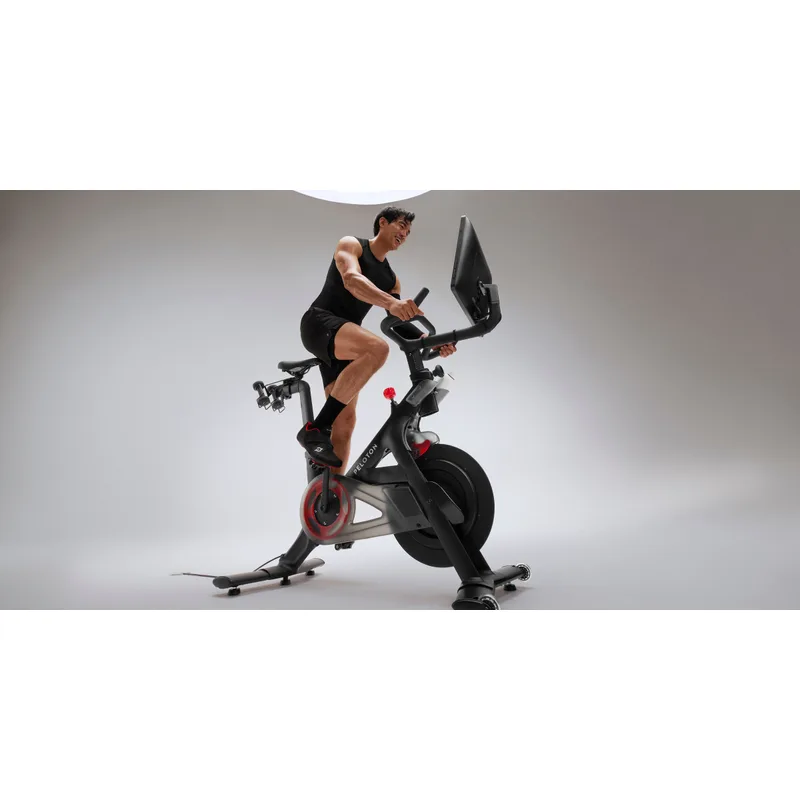
Peloton Bike
Pros
- Largest library of live and on-demand cycling classes of any connected bike
- Leaderboard and social features create genuine competition and accountability
- Compact footprint at 59" × 23" fits in tight spaces without sacrificing stability
- Simple setup — arrives mostly assembled, ready to ride within 30 minutes
- Q1 2026 software update added AI-driven workout recommendations based on heart rate
Cons
- No incline or decline capability — flat pedaling only
- Requires Delta-compatible cleats; flat-pedal riders need an adapter
- 297 lb weight capacity is the lowest of the four bikes compared here
- All-Access membership at $44/month adds $528/year to the cost of ownership
The original Peloton Bike built the connected fitness category and still holds the edge in one area that matters most to a certain type of buyer: live class energy. The leaderboard, the output metrics, the instructor shoutouts — none of that exists on NordicTrack. If you’ve been to a SoulCycle class and want that experience at home, the Peloton Bike delivers it. Nothing else comes close.
The Q1 2026 AI update is a genuine addition. The system now reads heart rate zones during rides and adjusts recommended output targets in real time, which reduces the guesswork for new riders trying to find their training zones. It’s not a reason to upgrade from a working bike, but it makes the entry point more useful for beginners.
The hardware limitations are real. No incline, no decline, flat pedaling only. The 21.5” screen tilts but doesn’t rotate, so strength and stretching content requires moving a separate device nearby. The 297 lb weight capacity is the lowest of the four bikes compared here. And those Delta pedals require purchasing cycling cleats separately — budget an additional $80-$120 for footwear if you’re starting from scratch.
NordicTrack Commercial S22i
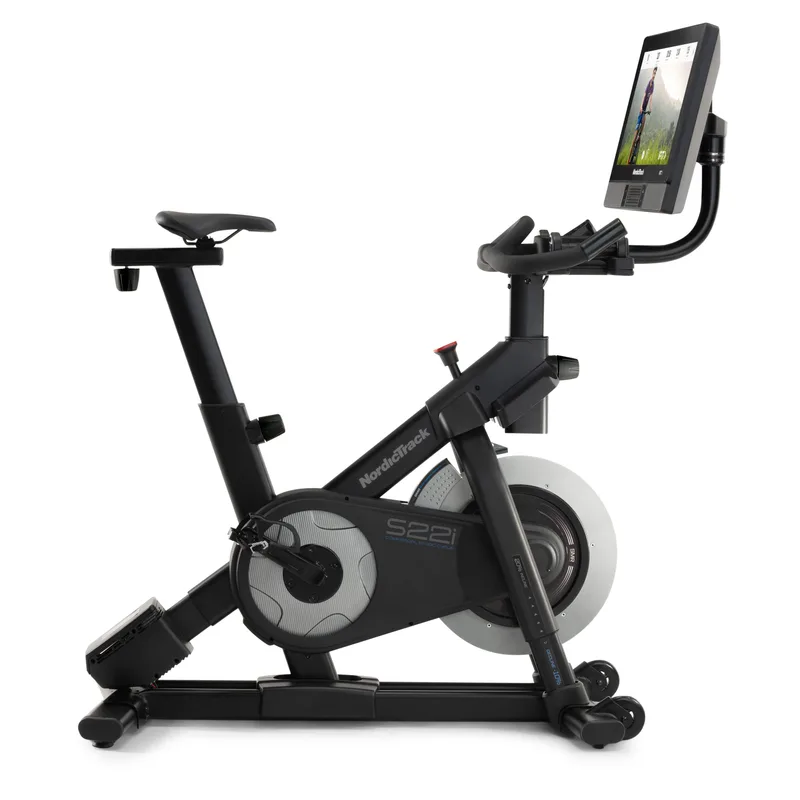
NordicTrack Commercial S22i
Pros
- Incline and decline from -10% to +20% simulates real outdoor terrain
- Hybrid pedals work with or without cycling cleats — no adapter needed
- 350 lb weight capacity significantly exceeds Peloton's 297 lb limit
- 10-year frame warranty versus Peloton's 5-year coverage
- iFIT subscription is $5/month less than Peloton All-Access ($39 vs $44)
Cons
- iFIT has fewer live classes than Peloton — on-demand content is the primary format
- Heavier machine at 193.6 lbs makes repositioning difficult without help
- Assembly requires two people and takes 60–90 minutes
- Touchscreen quality and app UI noticeably behind Peloton's polish
The S22i is the most hardware-competitive option at the Peloton Bike’s price point. The -10% to +20% incline/decline range transforms indoor cycling from a flat-resistance grind into a terrain simulation. iFIT trainers automatically adjust the bike’s incline and resistance to match routes filmed on real roads — from coastal California climbs to Swiss Alpine descents. That automatic trainer control is a feature the Peloton Bike does not offer at any price.
The hybrid pedals deserve mention because they eliminate a hidden cost. SPD clips on one side, adjustable toe cages on the other. Riders can use the S22i in standard athletic shoes on day one, then transition to cleats later if they choose. The Peloton Bike requires cleats or a separate pedal swap.
The 350 lb weight capacity covers a wider range of athletes than Peloton’s 297 lb limit. The 10-year frame warranty is double Peloton’s 5-year coverage. The iFIT subscription costs $5/month less — $39 versus $44 — which saves $180 over three years, though both subscriptions are required to get real value from the bike.
The honest drawback is the content. iFIT’s library is deep but heavily on-demand. The live class schedule is limited compared to Peloton’s constant stream of instructor-led rides. If the social energy of live classes is what keeps you consistent, the S22i will feel quieter.
Peloton Bike+
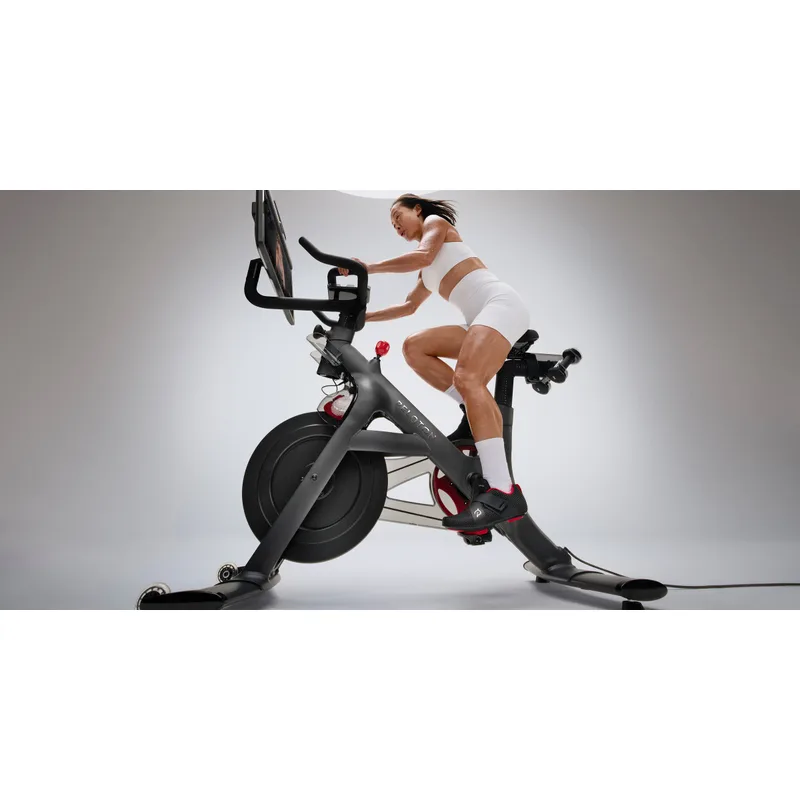
Peloton Bike+
Pros
- 23.8" rotating screen swivels 360° for off-bike strength and stretching classes
- Auto-Follow resistance adjusts automatically to instructor cues during class
- Upgraded four-speaker Bluetooth audio system with louder, cleaner output than original Bike
- Premium build quality — frame and components feel substantially more solid than entry-level competitors
- Full Peloton class library access including cycling, strength, yoga, and boot camp
Cons
- No incline or decline functionality — significant gap versus NordicTrack at a similar price point
- $2,695 price plus $44/month membership is the highest total cost of ownership here
- 297 lb weight capacity unchanged from the base Bike despite the price increase
- Cleats still required — flat-pedal riders must purchase Delta adapter pedals separately
The Bike+ addresses the original Bike’s primary hardware gap: the screen. The 23.8” rotating display turns 360 degrees, which means the entire Peloton class library — cycling, strength, yoga, stretching — is accessible from the bike itself without a secondary device. For buyers investing in the Peloton platform, that flexibility justifies part of the $1,250 price difference over the base Bike.
Auto-Follow is the other differentiator. When enabled, the bike automatically matches resistance to the instructor’s cadence and output cues during class. You stop thinking about what to dial up and just ride. It works well in structured rides with consistent coaching. In more freeform classes it’s less useful, but the option to turn it on or off mid-ride adds flexibility.
The audio upgrade from the base Bike is noticeable. Four speakers with improved Bluetooth connectivity make the ride experience less reliant on headphones. Small detail, but one that comes up consistently in long-term owner reviews.
The fundamental platform question still applies: the Bike+ offers no incline or decline. At $2,695 plus $44/month, you’re paying a significant premium for a platform advantage — better content, better screen, better audio — rather than hardware capability. The NordicTrack S27i offers more mechanical features at $496 less.
NordicTrack Commercial S27i
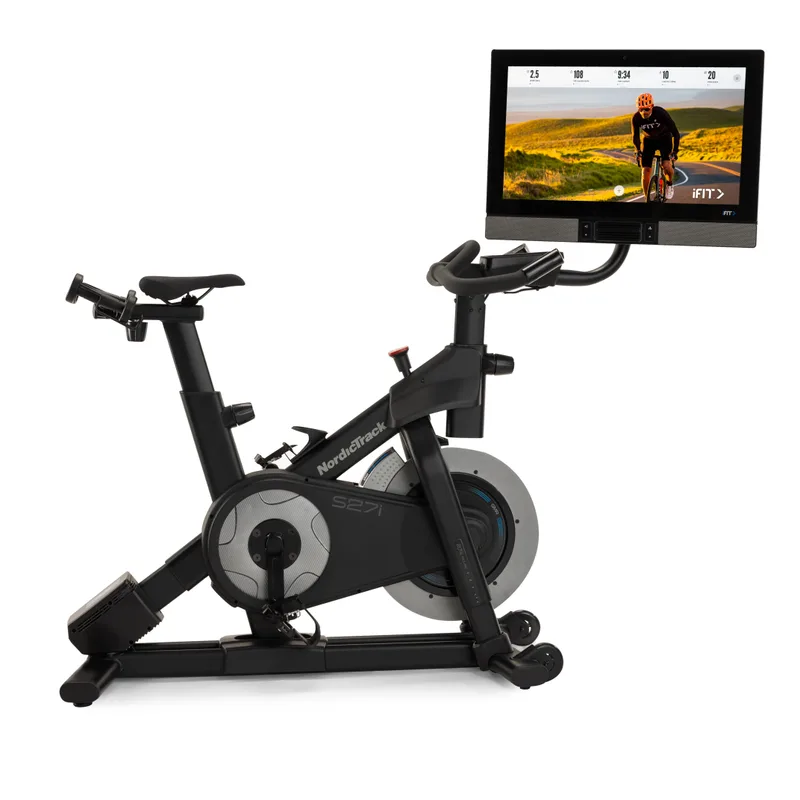
NordicTrack Commercial S27i
Pros
- 27" touchscreen is the largest display available on any connected exercise bike
- Full incline/decline range (-10% to +20%) for realistic outdoor terrain simulation
- Hybrid pedals accommodate cleats and flat-pedal users without any add-ons
- 350 lb weight capacity with 10-year frame warranty — most durable build in this comparison
- Currently $300 less than the Peloton Bike+ despite significantly more hardware features
Cons
- Only available direct from NordicTrack — no Amazon purchase option
- iFIT class library is smaller and less polished than Peloton's content ecosystem
- At 197 lbs, the heaviest bike in this comparison — requires two people to move
- Large 27" screen is impressive but overkill for riders who primarily listen to audio cues
The S27i is NordicTrack’s answer to the Bike+ — a premium connected bike that leans into hardware rather than platform. The 27” touchscreen is the largest available on any exercise bike, consumer or commercial. It pivots sideways and tilts vertically, though it doesn’t rotate 360 degrees like the Peloton Bike+‘s screen.
The full -10% to +20% incline/decline range is shared with the S22i, but the S27i adds improved gas-shock handlebar adjustment and better processor cooling for the larger display — practical refinements that make a real difference in everyday use. The dual 3-lb dumbbells included for upper-body work during cycling are a minor bonus.
At $2,199 — currently $300 on sale from the $2,499 MSRP — the S27i costs less than the Peloton Bike+ while offering more mechanical hardware. The 10-year frame warranty and 350 lb weight capacity put it ahead of either Peloton on durability metrics. The iFIT platform at $39/month costs $60/year less.
The honest tradeoff is the content library. Peloton’s instructor roster, live class frequency, and leaderboard culture are genuinely better developed. If you’ve used the Peloton app and love it, the S27i’s iFIT experience will feel like a downgrade in engagement even if the bike itself outperforms on specs.
Head-to-Head: What Actually Matters
Incline and Decline
NordicTrack wins decisively. Neither Peloton bike offers incline or decline at any price. Both NordicTrack bikes deliver -10% to +20% grade simulation with automatic trainer control. For outdoor cyclists training indoors or athletes who want variable effort loading, NordicTrack has no competition here.
Platform and Class Quality
Peloton wins. Peloton’s instructor quality, live class frequency, leaderboard engagement, and content variety are the best in the connected fitness space. If the live class experience is what makes you ride consistently, pay for Peloton.
Weight Capacity and Warranty
NordicTrack wins. 350 lbs vs 297 lbs. 10-year frame warranty vs 5-year. For larger athletes or buyers planning to keep the machine for a decade, NordicTrack’s durability specs are materially better.
Total Cost of Ownership (3 Years)
- Peloton Bike: $1,445 + ($44 × 36) = $3,029
- NordicTrack S22i: $1,499 + ($39 × 36) = $2,903
- Peloton Bike+: $2,695 + ($44 × 36) = $4,279
- NordicTrack S27i: $2,199 + ($39 × 36) = $3,603
Over three years, the NordicTrack S22i is the most affordable connected option. The Bike+ is the most expensive.
Pedal Compatibility
NordicTrack wins. Hybrid pedals on both S22i and S27i accept cleats or flat shoes out of the box. Peloton bikes require Delta-compatible cleats or a separate pedal swap — an additional cost and step.
Screen and Interface Polish
Peloton wins. Peloton’s touchscreen responsiveness, UI design, and app integration are consistently rated better than iFIT across independent reviews. The S27i’s 27” screen is larger but doesn’t compensate for the software gap.
Who Should Buy Which Bike
Buy the Peloton Bike if: You want the best live class experience, the leaderboard keeps you accountable, and you don’t need incline simulation. The most affordable Peloton entry point.
Buy the NordicTrack S22i if: You want incline/decline capability, hybrid pedals, a higher weight capacity, and a stronger warranty at the same price as the Peloton Bike. The best hardware value in this comparison.
Buy the Peloton Bike+ if: You’re committed to the Peloton platform long-term, the rotating screen for off-bike workouts matters, and you want Auto-Follow resistance. The best version of Peloton hardware.
Buy the NordicTrack S27i if: You want the largest screen on any exercise bike, full incline/decline capability, and NordicTrack’s best hardware — at $496 less than the Bike+. The editor pick for hardware-focused buyers.
Frequently Asked Questions
Can you use NordicTrack or Peloton without a subscription?
Both bikes function without a subscription, but the experience degrades significantly. On Peloton, you lose all live and on-demand classes and retain only basic metrics. On NordicTrack, iFIT cancellation removes trainer-controlled resistance and incline — the bike becomes a manual machine. For either purchase to make financial sense, budget the monthly subscription as part of the total cost.
Does NordicTrack’s incline feature make a real difference in workouts?
Yes, meaningfully. Incline increases glute, hamstring, and calf recruitment compared to flat cycling. Decline increases quad engagement and simulates descending hills. iFIT automatically adjusts grade during outdoor route workouts, which creates varied training stimulus that flat-resistance cycling cannot replicate. Riders who train for outdoor cycling or triathlons find this especially useful.
Which brand has better resale value?
Peloton generally holds resale value better due to higher brand recognition on the secondary market. A used Peloton Bike in good condition typically sells for 40–60% of original retail. NordicTrack bikes depreciate faster, particularly if the iFIT subscription history has lapsed.
Are Peloton cleats expensive?
Delta-compatible cycling shoes range from $80 for basic options to $300+ for premium footwear. Peloton sells its own brand shoes starting at $125. Alternatively, Delta pedal adapters cost around $20–$40 and allow flat-soled athletic shoes. NordicTrack’s hybrid pedals require no additional purchase.
Can I use the Peloton Bike+ screen for non-cycling workouts?
Yes. The 360-degree rotating screen displays Peloton’s full library — strength training, yoga, stretching, bootcamp, and meditation — while standing in front of the bike. This is the primary justification for the upgrade from the base Bike. NordicTrack’s S27i screen pivots but does not rotate to face away from the bike.
Which bike is better for apartment use?
Noise-wise, both brands use magnetic resistance, which is near-silent. The main noise from either bike is pedaling cadence and contact points. The Peloton Bike is lighter (135 lbs vs 193.6 lbs for the S22i), easier to move, and has a slightly smaller footprint. For strict apartment use without incline needs, the Peloton Bike is easier to manage logistically.
The Verdict
The NordicTrack S22i is the best value pick at $1,499. It delivers incline/decline, hybrid pedals, a higher weight capacity, and a stronger warranty at a nearly identical price to the Peloton Bike. For buyers who want hardware capability over platform polish, the S22i wins outright.
The Peloton Bike+ is the best pick for platform-first buyers. If Peloton’s live class ecosystem is the reason you ride consistently, the rotating screen and Auto-Follow resistance make the Bike+ a better long-term investment than the base Bike. The premium is real — $2,695 plus $44/month — but the platform justifies it for committed users.
The NordicTrack S27i earns the Editor Pick for buyers who want premium hardware without the Peloton tax. At $2,199 versus $2,695 for the Bike+, you get a larger screen, full incline/decline, better weight capacity, and a longer warranty. The iFIT content library trails Peloton, but for buyers who supplement with outdoor rides, coaching apps, or simply prefer terrain simulation over live classes, the S27i is the stronger machine.