Titan Fitness has spent several years upgrading its manufacturing — laser-cut holes replacing punched-out holes, robotic welders replacing inconsistent hand welds, and better powder coat coverage across the line. In 2026, that manufacturing maturity has made the gap between a Titan X-3 and a Rogue Monster Lite smaller than it’s ever been. The price gap, however, has not closed. The X-3 starts around $700. The Monster Lite starts above $1,000. The Monster Rack 2.0 starts at $2,625.
This comparison covers all four racks across the key dimensions: steel quality, weight capacity, attachment ecosystems, hole spacing, warranty, and long-term value. The goal is straightforward — figure out which rack makes sense for your specific build and budget.
Quick Comparison
| Spec | Titan T-3 Power Rack | Titan X-3 Power Rack | Rogue Monster Lite RML-490 | Rogue Monster Rack 2.0 (RM-6) |
|---|---|---|---|---|
| Rating | 8.5/10 | 8.9/10 | 9.1/10 | 9.3/10 |
| Price | Unavailable | $719.99as of Oct 18, 2026 | $1,010-$1,180 | $2,625+ |
| Steel | 2"×3" 11-gauge | 3"×3" 11-gauge | 3"×3" 11-gauge | 3"×3" 11-gauge |
| Rackable Capacity | 1,100 lb | 1,650 lb | — | — |
| Heights | 82" or 91" | 82" or 91" | 80" or 90" | 80", 90", 100", or 108" |
| Depths | 24" or 36" | — | — | 24", 30", or 43" |
| Interior Width | 42" | — | — | — |
| Hole Spacing | Westside (1" bench zone) | Westside (1" bench zone) | Westside (1" bench zone) | — |
| Hardware | 5/8" | — | 5/8" | 1" (oversized) |
| Assembly | Moderate (~2 hours) | Moderate (~3 hours) | Moderate (~2 hours) | — |
| Warranty | 1 year | 1 year | Lifetime (frame & welds) | Lifetime (frame & welds) |
| Footprint | — | 50"×48" | 53"×53" | 80"×53" |
| Inside Depth | — | 30" | — | — |
| Machine Weight | — | 280 lb | — | — |
| Made In | — | — | USA (Columbus, Ohio) | USA (Columbus, Ohio) |
| Pull-Up Bars | — | — | 43" fat/skinny + 43" skinny | — |
| Design | — | — | — | 6-column (no floor bolting required) |
| Attachments | — | — | — | 120+ compatible |
| Plate Storage | — | — | — | Up to 8 weight plates |
| Check Price → | Check Price → | Check Price at Rogue → | Check Price at Rogue → |
Prices change daily — tap Check Price for the current Amazon price. Numbers shown were verified on the "as of" date.
Titan T-3 Power Rack
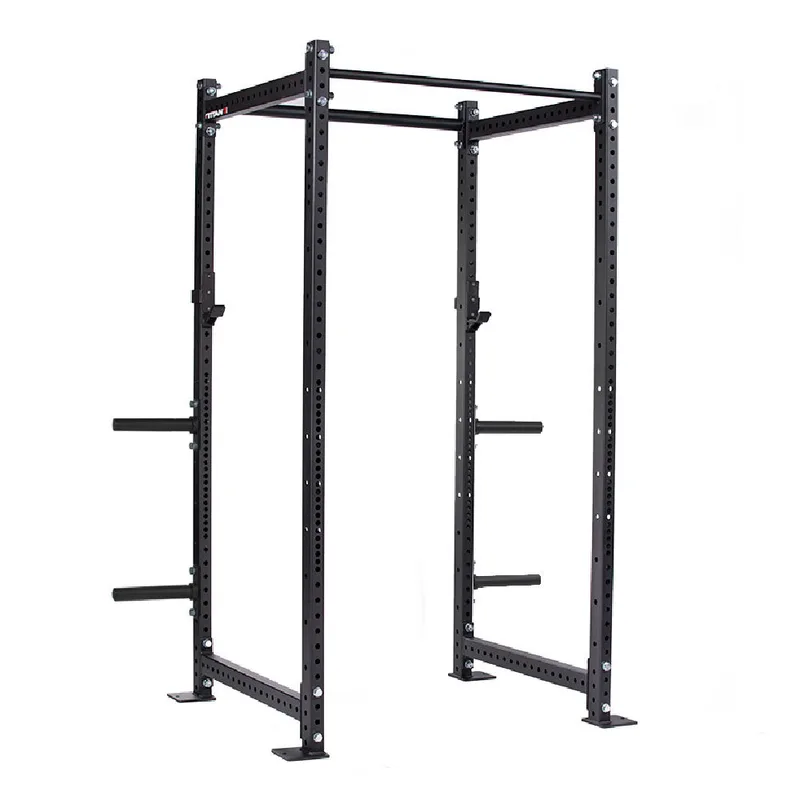
Titan T-3 Power Rack
Pros
- Laser-cut holes and robotic welds significantly improved quality over earlier generations
- 1,100 lb rackable capacity handles serious strength training loads
- Includes two pull-up bars (1.25" and 2"), J-hooks, weight holders, and band pegs
- Most affordable full power rack from a dedicated fitness brand
Cons
- 2"×3" uprights limit attachment compatibility compared to 3"×3" racks
- Holes are not numbered, making even J-cup and safety arm alignment tedious
- Documented J-hook and safety strap failures in earlier versions — Titan has improved them but concerns remain for very heavy lifters
- Bolt-down required for safe use without a platform anchor
The Titan T-3 is the entry point for serious home gym racks — real 11-gauge steel, Westside hole spacing, and a 1,100 lb rackable capacity at a price most gym members recoup in gym fees within 18 months. Its 2”×3” uprights are the main limitation. That upright size restricts attachment compatibility to the T-3’s own accessory line, which is considerably smaller than the 3”×3” ecosystem Titan and Rogue both support.
The manufacturing improvements Titan made to the T-3 are real. Earlier T-3 owners documented inconsistent powder coat, rough hole edges, and questionable weld lines. Current production uses laser-cut holes and robotic welding. The result is a rack that looks and feels considerably tighter than it did three or four years ago.
Two pull-up bars, J-hooks, safety arms, weight holders, and band pegs are all included. For most home gym builders running barbell work — squats, bench press, overhead press, deadlifts from the floor — the T-3 covers every base without requiring additional purchases.
The bolt-down requirement is the one genuinely inconvenient reality. Without anchoring the T-3 to a platform or concrete floor, the rack will shift under heavy eccentric loads. If you’re training on rubber flooring over concrete and plan to bolt down, this is a manageable one-time task. If you’re renting or need a freestanding setup, look at the X-3 instead.
Titan X-3 Power Rack
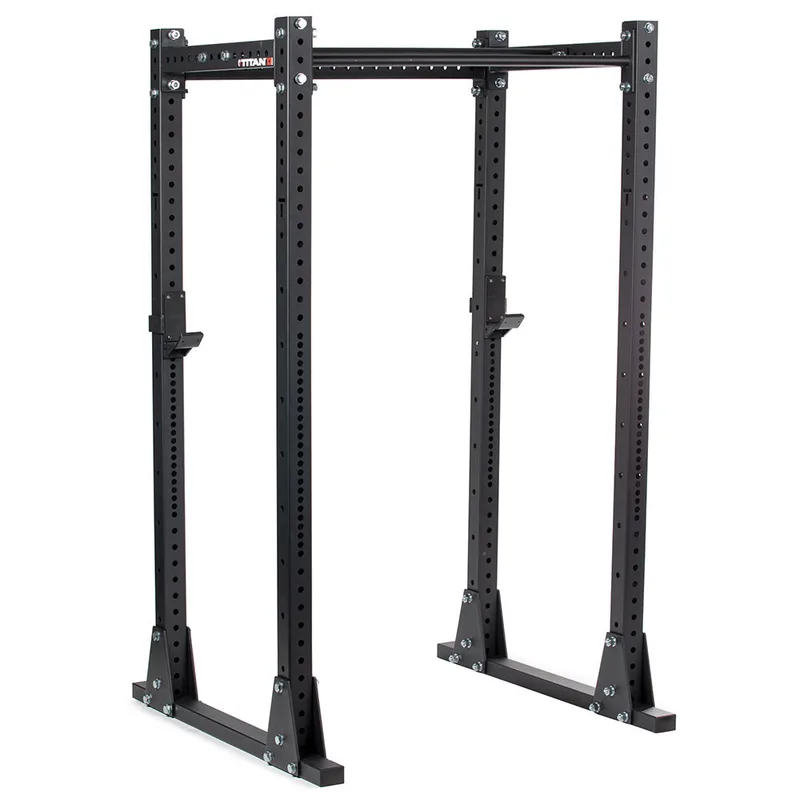
Titan X-3 Power Rack
Pros
- 3"×3" 11-gauge steel matches Rogue's upright size at roughly half the price
- 1,650 lb rackable capacity exceeds most home gym lifters' needs by a wide margin
- Does not require floor bolting — 280 lb frame is stable without anchor hardware
- Compatible with 3"×3" attachments from multiple brands, including many Rogue Monster Lite accessories
Cons
- Uprights are not numbered, making bilateral alignment a guessing game
- Assembly is lengthy — expect 2.5 to 3 hours with careful hardware torquing
- Powder coat on the pull-up bar is slippery — chalk or a bar cover helps
- 1-year warranty is short for a rack priced at $700
The X-3 is where Titan gets genuinely interesting for comparison against Rogue. Both use 3”×3” 11-gauge steel uprights. Both use Westside hole spacing through the bench and clean pull zone. The Titan X-3 has a 1,650 lb rackable capacity — 650 lbs more than the T-3 and higher than most Rogue equivalents at this price point. It doesn’t require floor bolting. Its 280 lb frame mass keeps it planted.
At $699–$749 versus $1,010–$1,180 for the Rogue RML-490, the X-3 saves $300 to $500 upfront for what is, structurally, a very similar rack. Both are 3”×3” 11-gauge steel. Both include two pull-up bars. Both use Westside spacing. The difference is where it comes from, what it comes with in terms of long-term warranty, and the attachment ecosystem you’re committing to.
The X-3’s downsides are concentrated in usability rather than structural quality. Unnumbered uprights mean you can’t use hole numbers to set bilateral J-cup height consistently — you measure visually or count holes by hand. Assembly takes roughly three hours and requires careful hardware torquing. The pull-up bar’s powder coat is noticeably slippery compared to Rogue’s knurled bar options.
The 1-year warranty is short for a $700 rack. Titan has honored warranty claims without major issues based on community reports, but the coverage window is a fraction of Rogue’s lifetime frame warranty.
Rogue Monster Lite RML-490
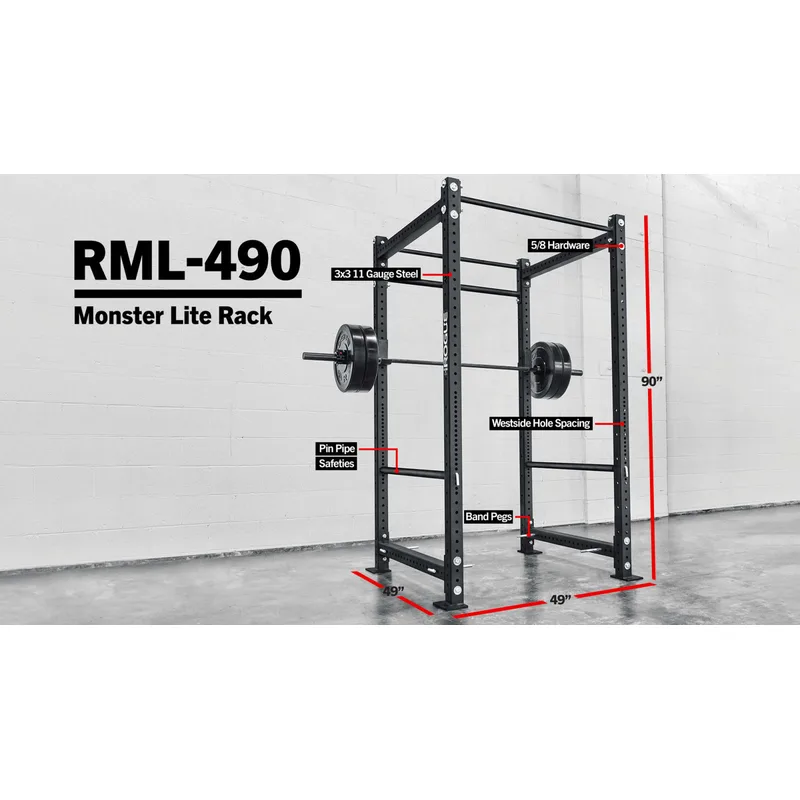
Rogue Monster Lite RML-490
Pros
- Built in Columbus, Ohio — consistent material quality and verified manufacturing standards
- Lifetime warranty on frame and welds — rare in this product category
- Westside hole spacing throughout gives precise J-cup and safety bar placement
- Two 43" pull-up bars included with extensive Monster Lite attachment compatibility
- Footprint of 53"×53" is workable in most two-car garage setups
Cons
- Only available direct from Rogue — no Amazon, no Prime shipping, lead times apply
- Priced at nearly twice the Titan X-3 for similar 3"×3" 11-gauge steel construction
- 5/8" hardware is lighter-duty than the Monster series' 1" hardware
- Cannot be upgraded to 6-column configuration — if you want that, you need the Monster series
The RML-490 is Rogue’s answer to the question most home gym builders eventually ask: “Is Rogue actually worth the premium?” For the Monster Lite line, the answer usually lands at “yes” — but the specifics matter.
The RML-490 uses the same 3”×3” 11-gauge steel as the Titan X-3. The difference is where that steel is sourced and processed. Every RML-490 is laser-cut, welded, and finished in Columbus, Ohio. Rogue publishes a lifetime warranty on frame and welds with no asterisks about which generation you bought. The two 43” pull-up bars come standard. The J-cups use a UHMW plastic liner that protects the barbell knurling — a detail that matters over years of use.
The Monster Lite attachment ecosystem is extensive: lat pulldown, cable pulley, plate storage, landmine, dip handles, and more. That means when you eventually want to expand the rack’s capabilities, the platform supports it without requiring a full rack replacement.
At $1,010–$1,180, the RML-490 is not cheap. But the lifetime warranty on a rack you might own for 20 years changes the math. The per-year amortized cost of a $1,100 rack with a lifetime warranty is lower than a $700 rack with a 1-year warranty that costs money to replace or repair in year three.
The one architecture note: the RML-490 uses 5/8” hardware throughout. That’s the Monster Lite specification. It’s strong, but it’s not the 1” hardware used in Rogue’s Monster series (RM-6 and above). If you’re training at loads well above 1,000 lbs or plan to hang very heavy cable stacks, the Monster Lite’s hardware specification is worth knowing.
Rogue Monster Rack 2.0 (RM-6)
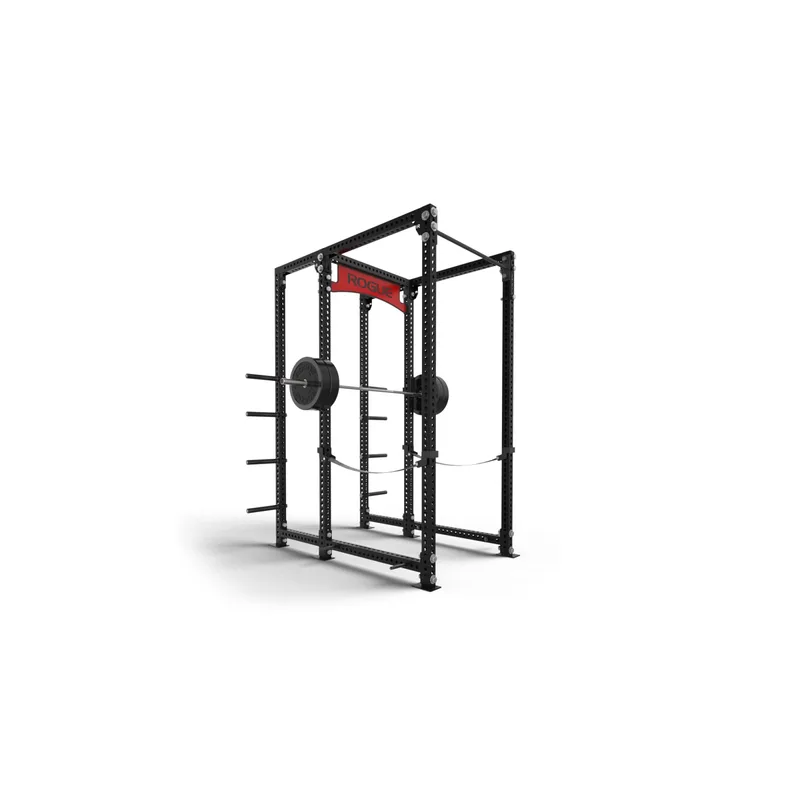
Rogue Monster Rack 2.0 (RM-6)
Pros
- Six-column design eliminates any need for floor bolting — the rack is stable by mass alone
- Reinforced 1" hardware throughout — significantly heavier-duty than Monster Lite's 5/8"
- 80"–108" height options accommodate high-pull and overhead bar configurations
- 120+ compatible attachments from Rogue — lat pulldown, leg press, landmine, dip bars, and more
- Integrated rear plate storage and multiple cable attachment points
Cons
- Starts at $2,625 — most home gym athletes do not need this level of equipment
- No Westside hole spacing — the standard 1" hole pattern throughout lacks the bench-zone precision some prefer
- Large 80"×53" footprint requires a minimum two-car garage or dedicated gym room
- Only available direct from Rogue — configure and wait; no instant purchase option
The RM-6 is not a home gym rack for most people. That’s not a criticism — it’s context. Starting at $2,625 and scaling upward depending on configuration, this rack is built for facilities, serious strength athletes, and home gym builders who want to purchase once and never revisit the decision for any reason in their lifetime.
Six columns make the RM-6 physically stable without floor anchors. The 1” hardware throughout — on J-cups, safety arms, pull-up bar mounts, everything — is significantly beefier than the 5/8” hardware used in the Monster Lite and the hardware used in Titan’s line. Heights extend to 108”, which accommodates high-pull bars and cable stack configurations that 80” or 90” uprights cannot. Over 120 Rogue attachments are compatible.
The absence of Westside hole spacing is worth noting because it stands out on a rack this expensive. Rogue’s Monster series uses standard 1” hole spacing throughout rather than the tighter bench-zone spacing used in Monster Lite and both Titan racks. For most lifters, this is irrelevant. For precise bench press J-cup placement, it means slightly coarser adjustments in the critical zone.
For a home gym, this rack makes sense in limited situations: you’re training at very high loads (consistently above 600–700 lbs), you want a facility-level attachment ecosystem, or you’re building a home gym you plan to use for decades and want to eliminate the variable of equipment replacement entirely. For everyone else, the RML-490 does the same structural job at less than half the cost.
Head-to-Head: Key Factors
Steel and Construction
Titan X-3 and Rogue Monster Lite tie on base steel specs (3”×3” 11-gauge). The T-3 steps down to 2”×3”, and the RM-6 uses the same 3”×3” with heavier 1” hardware. Rogue’s American manufacturing offers more consistent quality control across batches. Titan’s manufacturing improvements are real, but there’s less institutional data on long-term consistency.
Price
Titan wins across the board. T-3 at $379–$519, X-3 at $699–$749. Both are substantially cheaper than the RML-490 at $1,010–$1,180 and far cheaper than the RM-6 at $2,625+. The savings are real upfront money.
Warranty
Rogue wins decisively. Lifetime warranty on frame and welds covers the full lifespan of the rack. Titan’s 1-year warranty on both the T-3 and X-3 is short. If the rack develops a weld issue in year 2 or 3, Titan’s warranty won’t cover it.
Attachment Ecosystem
Rogue wins. Monster Lite and Monster series attachments number in the hundreds. Titan has a solid accessory line, but Rogue’s ecosystem is deeper and more established. If you plan to add lat pulldown, cable pulleys, plate storage, or specialty bars over time, Rogue’s platform has more options.
Availability
Titan wins. Both the T-3 and X-3 ship through Amazon with Prime availability. Rogue ships direct only — configure, order, and wait. For buyers who need a rack quickly or want purchase flexibility, Titan ships faster.
Long-Term Value
Rogue wins if you’re keeping the rack for 10+ years. Amortize the price difference over a decade of use and a lifetime warranty, and the Rogue RML-490 edges out. For shorter ownership timelines or tighter budgets, the Titan X-3’s structural quality at $700 is very difficult to argue against.
Who Should Buy Titan
- Home gym builders with a firm budget under $750
- Athletes who want 3”×3” steel without crossing $1,000
- Buyers who prefer Amazon Prime shipping and easy returns
- Lifters at intermediate loads (under 500 lbs on the bar) who don’t need a lifetime warranty
Who Should Buy Rogue
- Home gym builders planning to own the same rack for 10+ years
- Athletes who want the deepest attachment ecosystem without limits
- Serious strength athletes training at high loads who want verified hardware specifications
- Buyers who prioritize American manufacturing and a lifetime warranty over upfront savings
Frequently Asked Questions
Is the Titan X-3 as strong as a Rogue Monster Lite?
On raw structural specs — both use 3”×3” 11-gauge steel — yes. The Titan X-3’s 1,650 lb rackable capacity technically exceeds the Monster Lite’s rated capacity. The differences are in hardware grade (Rogue uses 5/8” bolts throughout the Monster Lite; Titan uses a mix of hardware grades), country of manufacturing, and long-term quality consistency data. For most home gym lifters, both racks handle the loads they’ll actually use.
Can Titan X-3 attachments work on a Rogue Monster Lite?
In theory, some 3”×3” accessories are cross-compatible, but Rogue and Titan use different hole patterns and hardware specs. Rogue Monster Lite attachments are designed and verified for Rogue uprights. Mixing brands works for simple accessories (J-cup style attachments) but creates compatibility uncertainties on more complex add-ons like cable pulley systems or lat pulldown stations.
Do Titan power racks require floor bolting?
The T-3 requires floor bolting for safe use under load. The X-3 does not require floor bolting — its 280 lb weight and wider footprint keep it stable without anchors. The Rogue RM-6 similarly does not require floor bolting due to its six-column design.
What’s the real difference between Rogue Monster Lite and Monster series?
The primary differences are hardware size (5/8” in Monster Lite, 1” in Monster series), upright column count (4 in Monster Lite, 6 in RM-6), and height options. Monster Lite racks top out at 90” uprights; Monster series extends to 108”. Both use the same 3”×3” 11-gauge steel. For most home gym athletes, Monster Lite is more than sufficient. Monster series is appropriate for facility use or unusually heavy training loads.
Is Rogue worth the price over Titan for a home gym?
It depends on your timeline and priorities. For most home gym builders on a budget, the Titan X-3 delivers 90% of the structural performance of the Rogue RML-490 at roughly 65% of the price. The gap closes over time if you factor in Rogue’s lifetime warranty versus Titan’s 1-year coverage. If you plan to own and train on the rack for 15+ years, Rogue’s total cost of ownership becomes more competitive. If you expect to upgrade or sell within five years, Titan’s upfront savings are hard to ignore.
The Verdict
For most home gym builders: Titan X-3. At $699–$749 with 3”×3” 11-gauge steel, 1,650 lb rackable capacity, and no floor bolting required, the X-3 delivers serious structural performance at a price point that leaves budget for a quality barbell, bumper plates, and flooring. The 1-year warranty is a genuine weakness, but it doesn’t change the structural reality of what you get.
For long-term home gym builders who want a forever rack: Rogue Monster Lite RML-490. At $1,010–$1,180 with a lifetime warranty, American manufacturing, and the deepest attachment ecosystem in its class, the RML-490 earns its price premium over a decade of ownership. If you’re building a garage gym you plan to train in for the next 20 years, the per-year cost difference between the X-3 and the RML-490 is smaller than it looks at purchase time.
The Rogue RM-6 is a commercial rack priced accordingly. Skip it unless you’re running a facility or training at loads that genuinely exceed what a four-column rack handles.
The Titan T-3 is the right answer if you’re under $500 and need a full power rack. Understand the 2”×3” upright limitation before buying — it restricts the attachment path if you plan to expand later.