In 2026, the Schwinn IC4 pairs directly with the Peloton app via Bluetooth — giving riders access to Peloton’s full class library on a bike that costs $546 less than Peloton hardware. Factor in subscription costs over three years, and the total ownership gap between these two bikes reaches $1,662. This comparison breaks down exactly what you get for that difference and who should pay it.
Quick Comparison
| Spec | Schwinn IC4 Indoor Cycling Bike | Peloton Bike |
|---|---|---|
| Rating | 8.7/10 | 8.5/10 |
| Price | $679.18-$795.99as of Oct 18, 2026 | $1,445 |
| Resistance | 100-level magnetic | Magnetic |
| Flywheel | 40 lbs | 38 lbs |
| Dimensions | 48.7" L × 21.2" W × 51.8" H | 59" L × 23" W × 53" H |
| Machine Weight | 106 lbs | 135 lbs |
| Weight Capacity | 330 lbs | 297 lbs |
| Drive | Belt | Belt |
| Display | Backlit LCD | 21.5" HD touchscreen |
| Bluetooth | Peloton app, Zwift, JRNY, and more | — |
| Included | Dumbbells + heart rate monitor | — |
| Warranty | 10-year frame / 3-year parts / 1-year labor | 5-year frame / 1-year parts and labor |
| Subscription | — | $44/month All-Access Membership |
| Check Price → | Check Price at Peloton → |
Prices change daily — tap Check Price for the current Amazon price. Numbers shown were verified on the "as of" date.
Schwinn IC4
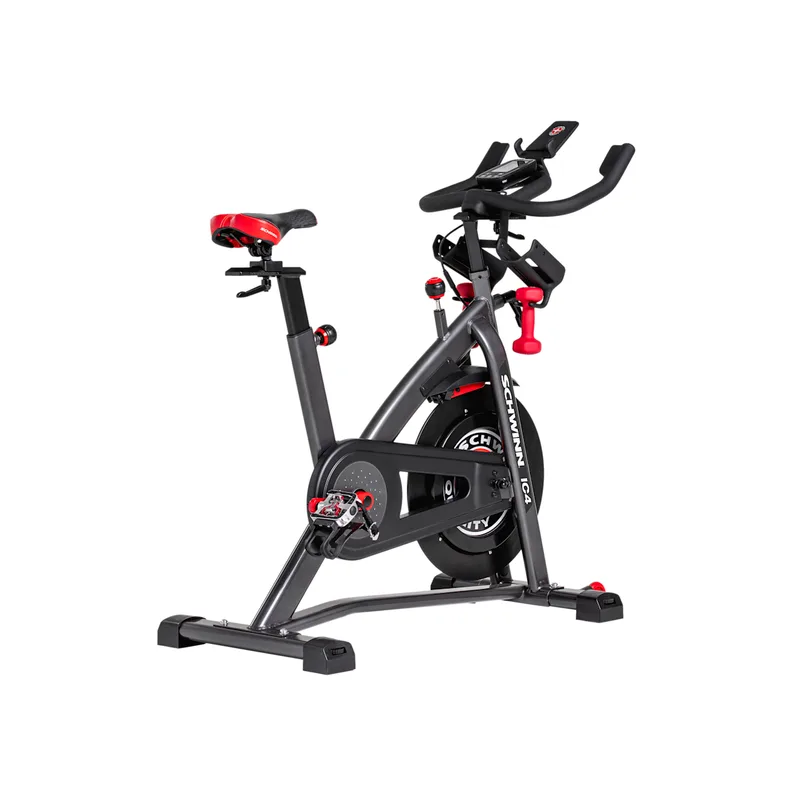
Schwinn IC4 Indoor Cycling Bike
Pros
- Pairs directly with the Peloton app via Bluetooth — access Peloton classes without paying Peloton hardware prices
- 330 lb weight capacity exceeds the Peloton Bike by 33 lbs
- Industry-leading 10-year frame warranty — double Peloton's 5-year coverage
- Works with Zwift, JRNY, Sufferfest, Rouvy, TrainerRoad, and other platforms simultaneously
Cons
- No built-in screen — requires mounting your own tablet or phone to stream classes
- Resistance requires manual knob adjustment — no auto-follow during instructor-led classes
- LCD display shows basic metrics only; detailed power output requires app connection
The Schwinn IC4 is the most capable indoor cycling bike in its price range. The 40 lb flywheel sits heavier than Peloton’s 38 lb unit, and 100 levels of magnetic resistance give fine-grained control across every intensity zone from easy recovery spins to threshold intervals. The belt drive runs near-silent — appropriate for apartment use and early-morning sessions without waking anyone.
Build quality holds up under scrutiny. The welded steel frame feels solid during aggressive standing climbs, and the 330 lb weight capacity covers a broader athlete range than the Peloton Bike. The dual-function pedals accept both SPD clips and standard athletic shoes, so dedicated cycling shoes aren’t mandatory from day one.
The display is the main trade-off. The backlit LCD shows time, RPM, distance, and estimated calories but doesn’t deliver real-time power output (watts) or resistance percentage without a connected app. Pairing the IC4 with a fitness app via Bluetooth solves this — the Schwinn JRNY app is included, and connecting to Zwift or the Peloton app on a mounted tablet delivers full metrics.
The Bluetooth Peloton app pairing is the IC4’s standout feature. Owner reports confirm that the IC4 connects reliably with the Peloton app, with cadence and heart rate data feeding into your ride metrics during class. You access Peloton’s class library at the digital membership rate rather than the All-Access hardware tier, cutting that line item significantly. Note that full auto-follow resistance and some leaderboard features are exclusive to Peloton’s own hardware.
The 10-year frame warranty is exceptional at $899. Peloton’s 5-year frame coverage on a machine that costs $546 more is a meaningful gap in long-term value.
Peloton Bike
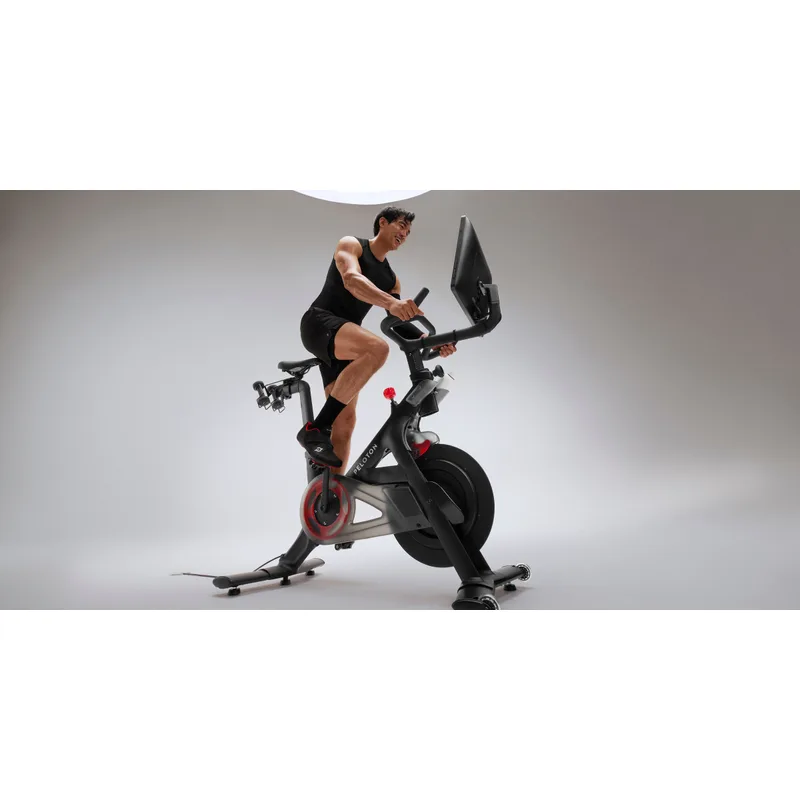
Peloton Bike
Pros
- Fully integrated 21.5" HD touchscreen with live and on-demand cycling classes
- Auto-follow resistance adjusts automatically to instructor cues during class
- Real-time watts, cadence, and output score displayed natively without app setup
- Large community with leaderboards, group rides, and milestone recognition built in
Cons
- All-Access Membership at $44/month adds $1,584 in subscription costs over 3 years
- 297 lb weight capacity is 33 lbs lower than the IC4
- Only sold directly from Peloton — no Amazon option, limited used-market availability
The Peloton Bike delivers the most polished indoor cycling experience available for home gyms. The 21.5” HD touchscreen runs live and on-demand classes from professional instructors, with production quality and music licensing that genuinely distinguishes it from streaming alternatives on a phone mount.
Auto-follow resistance is the feature that separates the Peloton from every third-party bike setup. During instructor-led classes, the bike’s resistance adjusts automatically to the cue — eliminating the manual knob turn that breaks concentration on a bike like the IC4. The integration between screen, resistance, and metrics creates a coherent training experience that apps on third-party hardware can approximate but not fully replicate.
The native metrics ecosystem is strong. Real-time power output in watts, cadence, resistance percentage, and heart rate display simultaneously on screen — calibrated to Peloton’s Output Score system that lets you compare effort across rides. All of this appears without app configuration, pairing steps, or device mounting.
Community is Peloton’s clearest advantage. Leaderboards, milestone rides, instructor shoutouts, and the ability to filter riders by age range and body weight create accountability mechanisms that drive session consistency. For buyers who train better with external motivation, this layer is a real differentiator — not a marketing claim.
The cost reality is straightforward. At $1,445 plus $44/month for the All-Access Membership, the Peloton Bike’s 3-year total cost reaches $3,029. Against the IC4 at $899 with the Peloton digital app, the 3-year figure lands near $1,367. The $1,662 difference buys auto-follow resistance, native watts tracking, and full leaderboard integration.
Head-to-Head: What Matters Most
Value and Total Cost
IC4 wins. At $899 versus $3,029 over three years (Peloton hardware + All-Access Membership), the IC4 delivers the core cycling experience at less than half the long-term cost. For buyers who use the Peloton digital app on the IC4, the 3-year savings reach $1,662.
Ride Experience and Auto-Follow
Peloton wins. The native integration between screen, instructor, and resistance eliminates friction during class. Auto-follow resistance works reliably; third-party app connections on the IC4 offer a similar experience but without automatic resistance adjustment.
Weight Capacity
IC4 wins. 330 lbs versus 297 lbs. The IC4’s higher ceiling matters for larger athletes evaluating long-term use.
Display and Metrics
Peloton wins. The 21.5” HD touchscreen with real-time watts, cadence, and resistance on one display is a superior experience compared to a mounted tablet feeding into a backlit LCD.
Warranty
IC4 wins. A 10-year frame warranty versus Peloton’s 5-year coverage, on a bike priced $546 lower. Schwinn’s warranty signals confidence in hardware durability.
Community and Accountability
Peloton wins. Leaderboards, group rides, and instructor recognition create real accountability. The IC4 with the Peloton digital app provides a version of this, but without complete leaderboard integration at the digital tier.
App Flexibility
IC4 wins. The IC4 pairs with Peloton, Zwift, JRNY, Sufferfest, Rouvy, TrainerRoad, and others. The Peloton Bike runs Peloton content natively — using Zwift requires a workaround.
Buying Guide: What to Evaluate Before Deciding
Subscription commitment: Before purchasing the Peloton Bike, model the 3-year ownership cost. At $44/month, the All-Access Membership adds $1,584 over 36 months on top of the $1,445 hardware cost. If subscription commitments feel uncertain, the IC4 with a digital membership is a lower-risk entry point into indoor cycling.
Auto-follow resistance: If instructor-led resistance cues are central to your training — you follow the class and don’t self-regulate intensity — the Peloton’s auto-follow provides a genuine quality-of-life advantage. Riders who prefer to set their own resistance during class won’t notice the difference.
Display preference: The Peloton’s 21.5” screen is a fundamentally different experience from a phone or tablet on a mount. Riders coming from spin studios where large screens are standard will find the Peloton’s display matches that reference point immediately.
Weight capacity: The 33 lb difference (330 vs. 297 lbs) doesn’t affect most buyers. For athletes at or above 275 lbs who plan extended daily use, the IC4 is the more conservative choice.
Resale value: Peloton bikes hold resale value in secondary markets because buyers can transfer the hardware subscription. The IC4 also resells reliably in used markets, making both low-risk purchases if training needs change.
Who Should Buy the Schwinn IC4
- Home gym builders who want capable indoor cycling without a long-term subscription commitment
- Riders who use Zwift, TrainerRoad, or other cycling platforms and want multi-app flexibility
- Athletes at or above 275 lbs who need the higher weight capacity
- Home gym owners who source their own programming — YouTube, coaching apps, or self-directed training
- New cyclists evaluating indoor training before committing to a premium connected platform
Who Should Buy the Peloton Bike
- Buyers who want the full Peloton experience — live classes, auto-follow resistance, and native leaderboards — on hardware built for it
- Riders who trained at Peloton studios and want to replicate that experience at home
- Athletes who train more consistently with community accountability and instructor recognition
- Buyers who prioritize zero app configuration — all metrics and content work immediately out of the box
- Long-term connected fitness users who value the $44/month membership as a training cost rather than a subscription overhead
Frequently Asked Questions
Can the Schwinn IC4 connect to the Peloton app?
Yes. The IC4 pairs with the Peloton app via Bluetooth and functions as a compatible third-party bike, with cadence and heart rate data feeding into your ride profile. You access Peloton classes at the digital membership rate. The key limitation: auto-follow resistance — Peloton’s automatic resistance adjustment during class — is exclusive to Peloton hardware and does not function on the IC4.
Is the Peloton Bike worth the subscription cost?
For consistent riders training 3-4 days per week, the class variety and instructor quality sustain long-term motivation that owner reports rate above most self-programmed alternatives. For occasional riders, the per-session cost at $44/month is difficult to justify. The Peloton digital app on a third-party bike at a lower monthly rate is a practical way to evaluate whether Peloton’s content drives enough consistency before committing to the full hardware investment.
How do the flywheels compare?
The IC4 has a 40 lb flywheel; the Peloton Bike has a 38 lb flywheel. Both deliver smooth, consistent resistance at normal training intensities. The 2 lb difference is not perceptible during typical sessions.
Does the Schwinn IC4 require professional assembly?
Assembly is rated moderate. The main frame arrives pre-assembled; you’ll attach the seat post, handlebars, and pedals using included tools. Most owners complete setup in 30-60 minutes. Peloton offers professional delivery and assembly for an additional fee.
What’s the difference between Peloton All-Access and the digital membership?
The All-Access Membership ($44/month) unlocks the Peloton Bike’s touchscreen — including live leaderboards, auto-follow resistance, and full metric integration for hardware users. The digital membership (lower monthly rate) provides access to the Peloton app on any device, including third-party bikes like the IC4, with core class library access. Some leaderboard and hardware-specific features are restricted to All-Access subscribers.
The Verdict
The Schwinn IC4 wins on value. At $899 with a 10-year frame warranty, 330 lb capacity, and Peloton app compatibility, it’s the right call for most home gym buyers. The 3-year ownership savings versus the Peloton Bike with All-Access Membership reach $1,662 — enough to buy a quality barbell set, a rubber floor, or several months of programming.
The Peloton Bike wins on experience. Auto-follow resistance, native watts tracking, and a fully integrated 21.5” screen make it the better training tool for riders who depend on community accountability and instructor cueing to stay consistent. If you ride 4+ days per week and the full Peloton ecosystem is what keeps you on the bike, the hardware and membership costs are defensible.
For most home gym builders: start with the IC4 and the Peloton digital app. If you find yourself constrained by manual resistance adjustment or want the complete leaderboard experience after a few months of riding, you’ll know whether upgrading to Peloton hardware is worth the difference to you specifically.