Home cardio equipment spending hit record levels in early 2026, according to retail reports tracking the post-pandemic fitness equipment market. Two machines account for the majority of home cardio purchases: treadmills and exercise bikes. Both do the same job — elevate your heart rate, burn calories, improve cardiovascular fitness. The question is which one fits your body, your goals, and your space better.
This isn’t a close call for everyone. If you have bad knees, the answer is almost certainly a bike. If you’re training for a 5K, the answer is almost certainly a treadmill. But for the large middle group — people who want consistent cardio and aren’t chasing a specific sport — the comparison is genuinely close, and the right machine depends on factors most buying guides gloss over.
Here’s the full breakdown, including two strong picks for each machine type across different budgets.
Quick Comparison
| Spec | Sole F80 Folding Treadmill | NordicTrack T 6.5 Si Treadmill | Schwinn IC4 Indoor Cycling Bike | Sunny Health & Fitness SF-B1423 Indoor Cycling Bike |
|---|---|---|---|---|
| Rating | 9.1/10 | 8.4/10 | 9.0/10 | 8.0/10 |
| Price | $1783.95as of Oct 18, 2026 | Check price | $679.18-$795.99as of Oct 18, 2026 | Unavailable |
| Motor | 3.5 CHP continuous-duty | 2.6 CHP continuous-duty | — | — |
| Speed | 0.5–12 MPH | 0–10 MPH | — | — |
| Incline | 0–15% (rack-and-pinion) | 0–12% | — | — |
| Belt Size | 22" × 60" | 20" × 55" | — | — |
| Weight Capacity | 350 lbs | 300 lbs | 330 lbs | 265 lbs |
| Folded Dimensions | 45" × 38" × 71.5" | — | — | — |
| Machine Weight | 274 lbs | — | 97 lbs | ~44 lbs |
| Display | 10.1" Android touchscreen | 10" Smart HD touchscreen | — | LCD (speed, time, distance, calories, odometer) |
| Warranty | Lifetime frame/motor/deck, 5-yr electronics, 2-yr labor | 10-yr frame, 2-yr parts, 1-yr labor | — | — |
| Folds | — | Yes (EasyLift Assist) | — | — |
| iFIT | — | Compatible (30-day free trial) | — | — |
| Resistance | — | — | 100-level magnetic (belt-drive) | Manual felt-pad (dial adjust) |
| Flywheel | — | — | 40 lbs | 40 lbs |
| Seat Adjustment | — | — | 4-way (up/down, fore/aft) | 2-way (up/down) |
| Handlebar Adjustment | — | — | 2-way | 2-way (up/down) |
| Pedals | — | — | Dual-sided (SPD clip-in + toe cage) | Toe cages (standard) |
| Connectivity | — | — | Bluetooth (Peloton, JRNY, Zwift compatible) | None (no Bluetooth) |
| Console | — | — | Backlit LCD (speed, RPM, distance, calories, heart rate) | — |
| Includes | — | — | 3 lb dumbbells, heart rate armband, JRNY 6-month trial | — |
| Check Price → | Check Price → | Check Price → | Check Price → |
Prices change daily — tap Check Price for the current Amazon price. Numbers shown were verified on the "as of" date.
The Treadmill Picks
Sole F80 Folding Treadmill
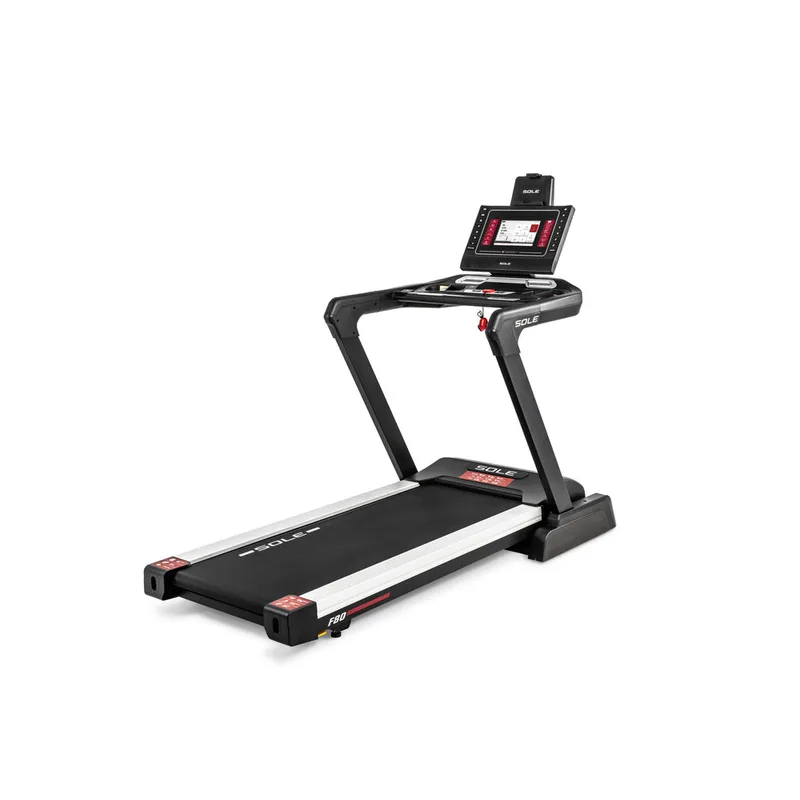
Sole F80 Folding Treadmill
Pros
- 22" × 60" commercial-width belt gives noticeably more room than budget competitors
- 3.5 CHP motor runs smooth and quiet even at sustained 8–10 MPH — owner reports confirm low vibration
- 350 lb weight capacity is among the highest in the home folding treadmill category
- Cushion Flex Whisper Deck absorbs impact well according to owner reviews — better joint comfort than flat-deck machines
- Lifetime frame and motor warranty is exceptional; 3-year parts coverage beats most mid-range competitors
- Folds upright with Easy Assist mechanism — footprint drops significantly for multi-use spaces
- Bluetooth connectivity and 10.1" touchscreen with 30+ built-in workout programs
Cons
- $1,799 is a significant investment — budget shoppers will need to look at entry-level options
- 274 lbs makes repositioning a two-person job
- No live connected fitness platform (iFIT, Peloton, etc.) — third-party apps only via Bluetooth
- Touchscreen interface is functional but not as polished as NordicTrack or Peloton displays
The Sole F80 is the treadmill to buy if you want commercial-adjacent build quality without going full commercial. The 22” × 60” belt is the same width used in mid-grade gym machines — noticeably larger than the 20” belts that define most sub-$1,000 home treadmills. For runners with longer strides or anyone over 6’, this difference is felt immediately.
The 3.5 CHP motor handles sustained running without the stuttering and speed lag that plagues budget machines at high intensity. Owner reports consistently describe it as quiet under load — an important factor if you’re running early morning or late at night in a shared living space. Cushion Flex Whisper Deck absorbs impact along the belt’s length, which manufacturer specifications describe as reducing deck stress and improving comfort during longer sessions.
The warranty is the headline specification here: lifetime frame and motor coverage, 3 years on parts and deck, 1 year on labor. At this price tier, that coverage is exceptional. Sole’s customer service reputation is solid in the treadmill community — a real consideration when buying a 274 lb machine you can’t easily return.
At $1,799, the Sole F80 asks for a significant budget commitment. It earns it through build quality, belt size, and warranty, but buyers who primarily walk or do light jogging can get 90% of the value at $899 with the NordicTrack.
NordicTrack T 6.5 Si Treadmill
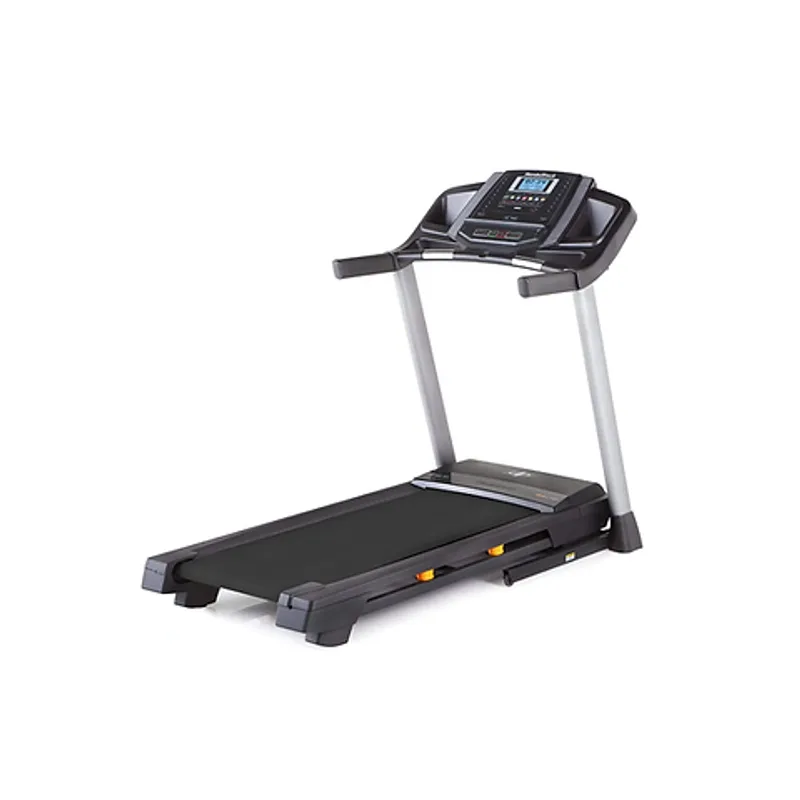
NordicTrack T 6.5 Si Treadmill
Pros
- 10" smart touchscreen with iFIT integration brings studio-quality guided workouts at a budget price
- EasyLift Assist folding makes storage effortless — good option for shared living spaces
- 10-year frame warranty at this price is excellent coverage
- iFIT auto-adjusts speed and incline during workouts — hands-free programming works well according to owner reports
- Compact enough for apartments and smaller rooms without sacrificing a usable belt area
- Strong resale market — NordicTrack machines hold value well on secondary market
Cons
- 2.6 CHP motor is adequate for walking and light jogging but can strain under sustained running — better suited for 6 MPH and under
- 20" × 55" belt is narrower and shorter than the Sole F80 — taller runners will notice the shorter deck
- 300 lb weight limit is lower than mid-range competitors
- iFIT subscription ($39/month or $396/year) required to fully use the connected features after the free trial
- 10 MPH top speed rules it out for anyone training at faster running paces
The NordicTrack T 6.5 Si is the value entry point for buyers who want a smart, connected treadmill without the Sole F80’s price tag. The 10” iFIT-integrated touchscreen brings guided trainer workouts directly to the machine — iFIT auto-adjusts speed and incline to match the on-screen program, removing the need to manually fiddle with controls during workout progressions.
For walkers, joggers, and anyone training at speeds under 8 MPH, the 2.6 CHP motor is entirely adequate. It handles consistent moderate-intensity sessions without strain. The 20” × 55” belt is on the narrower side, but the majority of home treadmill users never test those edges during normal use.
The EasyLift Assist folding mechanism is a genuine convenience feature — the deck folds up and locks with minimal effort, dropping the footprint significantly when the machine isn’t in use. For a guest room or shared-space gym, this matters.
The primary catch is the iFIT subscription. The T 6.5 Si includes a 30-day trial, but to continue using the connected features that justify buying this machine over a basic no-screen option, you’ll need to budget $39/month or $396/year. Over three years that’s ~$1,200 in subscription costs on top of the hardware price. For buyers who don’t want a recurring fitness subscription, the Sole F80’s one-time cost structure becomes more appealing.
The Exercise Bike Picks
Schwinn IC4 Indoor Cycling Bike
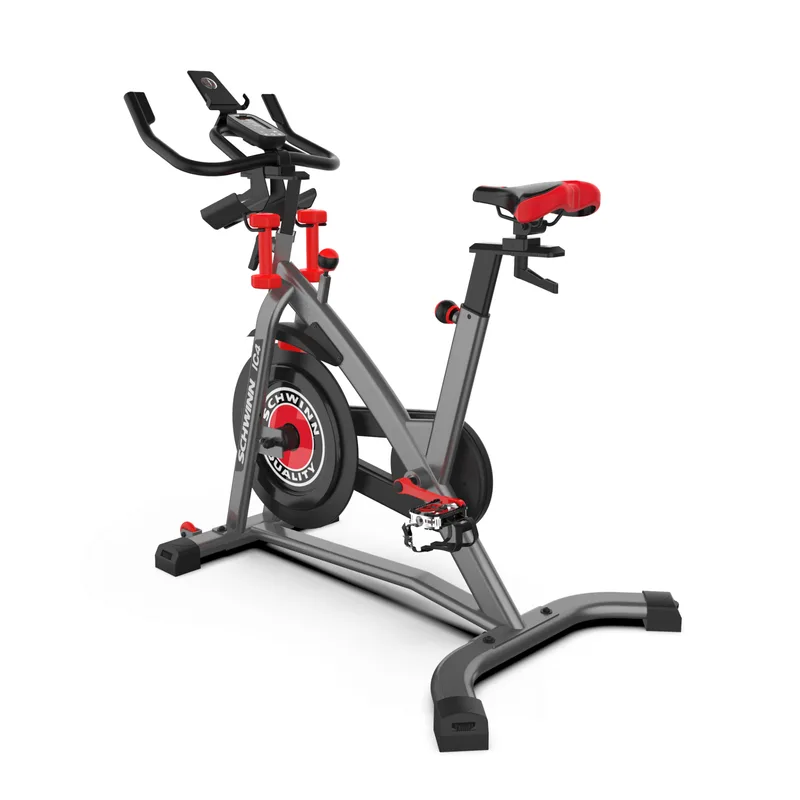
Schwinn IC4 Indoor Cycling Bike
Pros
- 100 magnetic resistance levels gives more fine-tuned control than most bikes in this price range
- Compatible with Peloton, Zwift, and JRNY apps — flexibility to use the platform of your choice without brand lock-in
- Dual-sided pedals accommodate both SPD cycling shoes and regular athletic footwear
- 40 lb flywheel produces a smooth, consistent pedal stroke — owner reports consistently praise the feel
- 330 lb weight capacity is solid for this price tier
- Includes 3 lb dumbbells and heart rate armband — useful add-ons at no extra cost
- 97 lbs machine weight — lighter than any treadmill in this guide, easier to move between rooms
Cons
- JRNY subscription ($19.99/month) required for full built-in content after free trial — or pay for a separate Peloton membership
- Saddle is firm by default — most owners upgrade to an aftermarket padded seat cover within a few weeks
- Screen is basic LCD only — no built-in touchscreen display; requires a phone, tablet, or separate screen for visual workouts
- Clip-in cycling shoes add cost if you don't already own SPD-compatible footwear
The Schwinn IC4 is the most versatile exercise bike in the sub-$1,000 category. The combination of 100 magnetic resistance levels, dual-sided pedals, and compatibility with Peloton, JRNY, and Zwift gives buyers a platform that can grow with them — from basic cardio sessions to structured virtual training — without forcing them into a single fitness ecosystem.
The 40 lb flywheel produces the smooth, momentum-driven pedal stroke that serious cyclists expect. Owner reviews on Amazon and cycling forums repeatedly note that the ride quality punches above the $899 price point. The 330 lb weight capacity is solid for this tier.
Dual-sided pedals deserve attention: the IC4 ships with SPD clip-in compatibility on one side and standard toe cages on the other. This means you can start with regular athletic shoes and upgrade to cycling shoes later without buying new pedals. Most bikes in this category force you to commit to one system immediately.
The screen is the machine’s clear limitation — the backlit LCD displays basic metrics but has no built-in touchscreen for workout content. You’ll need a tablet or phone mount (which the bike includes) to run Peloton or JRNY visually. For buyers accustomed to the integrated screen experience of a Peloton Bike, the IC4 requires more setup. For buyers who just want great hardware and app flexibility, it’s a genuine advantage — no locked-in platform, no mandatory monthly fee beyond whatever app you choose.
Sunny Health & Fitness SF-B1423 Indoor Cycling Bike
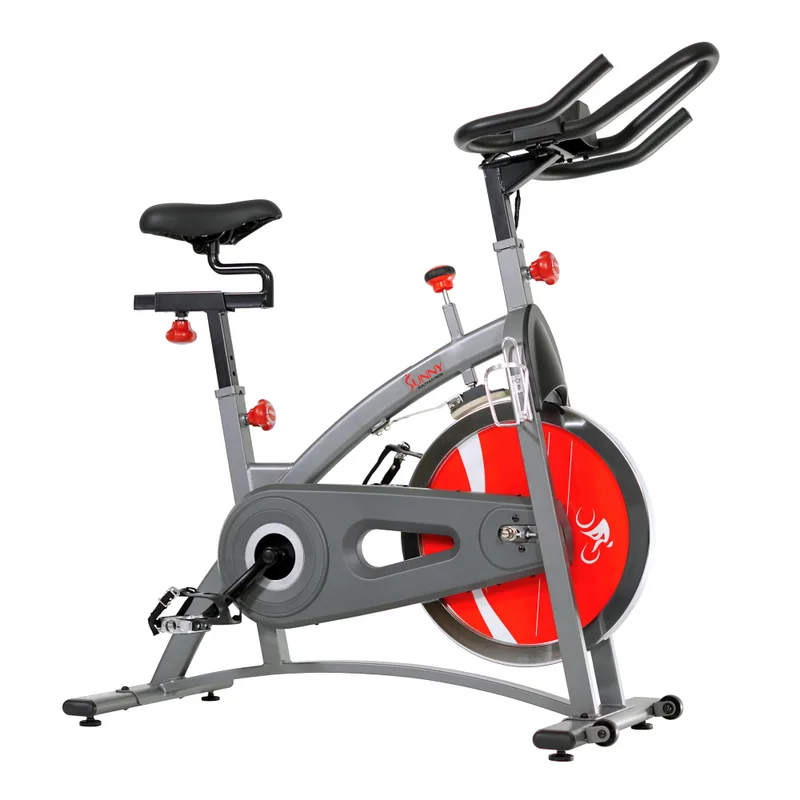
Sunny Health & Fitness SF-B1423 Indoor Cycling Bike
Pros
- $299 is the lowest-friction entry into serious cardio training — no subscription, no apps, just pedaling
- 40 lb flywheel produces smooth resistance at this price tier — well above typical sub-$300 competition
- 44 lbs machine weight makes it easily repositionable by one person
- No subscription costs ever — felt-pad resistance is fully manual with zero recurring fees
- Reliable LCD tracks all basic metrics without software dependency
- Strong owner satisfaction at price point — among the highest-rated sub-$400 indoor bikes on Amazon
Cons
- Manual felt-pad resistance has fewer micro-adjustment levels than magnetic resistance — harder to dial in exact intensity
- 265 lb weight capacity is the lowest in this guide
- No Bluetooth or app connectivity — no guided workouts, no metrics syncing
- Seat and handlebar adjustment range is narrower than the IC4 — taller or shorter riders may find fit limited
- Felt pads wear over time and require replacement (a minor but recurring cost)
The SF-B1423 makes the case for a different kind of exercise bike buyer: someone who wants effective cardio equipment with zero subscription costs, zero Bluetooth complexity, and zero recurring fees. Plug it in, adjust the felt-pad resistance dial, and ride. That simplicity is genuinely valuable for users who find app-connected fitness gear more friction than motivation.
Despite the $299 price, Sunny Health included a 40 lb flywheel — the same weight as the IC4. Flywheel weight determines pedal stroke smoothness and momentum at high speeds; a heavier flywheel is meaningfully better at sustained intensity. At this price most competing bikes use 20–28 lb flywheels. The SF-B1423 is a real outlier for the money.
The manual felt-pad resistance has a narrower range of fine adjustments than magnetic systems. For casual riders doing Zone 2 cardio at consistent effort, this is unimportant. For interval training or structured power-based workouts, the IC4’s 100-level magnetic system is noticeably more precise.
At 44 lbs, the SF-B1423 is light enough to move by yourself — a real convenience over any treadmill in this guide. For anyone on a tight budget who just wants to get more cardio done, this bike delivers.
Treadmill vs Exercise Bike: Head-to-Head
Joint Impact
Exercise bikes win clearly. Cycling is non-weight-bearing — your body weight stays on the seat, not your knees and ankles. Treadmill running generates ground-reaction forces roughly 2–3 times body weight per stride, which accumulates significantly over a 30-minute run.
For anyone with knee pain, hip arthritis, ankle injuries, or recovering from lower body surgery, the bike is almost always the right call. For healthy joints, the higher-impact treadmill training also offers greater bone density stimulus — which is a real benefit, particularly for older adults.
Calorie Burn
Treadmills generally burn more calories per unit of time at equivalent perceived effort, because running engages more muscle mass and requires your body to support its own weight. Research comparisons suggest running burns roughly 10–15% more calories than cycling at matched heart rate zones.
The gap narrows or disappears during high-intensity cycling (sprint intervals, threshold work). At low-to-moderate intensity, treadmills have a modest edge. For weight loss, the machine you’ll actually use consistently matters more than the 10% calorie differential.
Space Requirements
Exercise bikes require significantly less floor space. The IC4 occupies roughly 39” × 22” — about the footprint of a chair. The Sole F80 folded is 45” × 38”, and the NordicTrack T 6.5 Si is similar. Unfolded, either treadmill requires roughly 6–7 feet of floor length.
For apartment living or small rooms under 100 sq ft, an exercise bike is easier to accommodate. For garages and dedicated gym rooms, treadmills are easily manageable.
Noise
Exercise bikes are substantially quieter, especially magnetic-resistance models like the IC4. Magnetic resistance generates almost no mechanical sound. The SF-B1423’s felt pads produce a slight rubbing sound at high intensity, but nothing disruptive.
Treadmills generate motor noise, belt-on-deck noise, and foot-impact vibration. The Sole F80 is quiet among treadmills, but still audibly louder than any bike in this guide. For apartments with downstairs neighbors or shared living situations, bikes are the considerate choice.
Long-Term Consistency
This is the factor most guides skip. Bikes allow multitasking — watching TV, reading, working on a laptop — in a way that treadmill running doesn’t. Many buyers find this leads to longer and more consistent cardio sessions over time. If a 45-minute bike ride while watching a show replaces a 20-minute treadmill run you had to talk yourself into, the bike wins on results.
Price Range
Budget for budget, exercise bikes are cheaper. A quality indoor cycling bike starts around $299 (SF-B1423). A quality treadmill starts around $799 for something worth owning. The mechanical complexity of a motorized treadmill — motor, belt, controller, incline motor — simply costs more to manufacture.
Who Should Buy a Treadmill
- You’re training for running events (5K, 10K, half marathon) — there’s no substitute for running-specific training
- Your joints are healthy and you want the higher calorie burn and bone density benefits of weight-bearing exercise
- You prefer walking as your primary cardio modality — a treadmill at a brisk incline is highly effective for this
- Space is not a significant constraint in your gym setup
- You prefer a single machine that your entire household can use regardless of fitness level (walking to running is a wide range)
Who Should Buy an Exercise Bike
- You have knee pain, hip issues, ankle injuries, or any lower body condition that makes running uncomfortable
- You’re primarily focused on cardiovascular fitness and aren’t training for running-specific events
- You want to multitask during cardio sessions — read, watch content, work
- You live in an apartment or have noise/space constraints
- You’re on a tighter budget and want the most cardio quality per dollar
- You prefer high-cadence interval training (cycling handles short, sharp intervals well)
Buying Guide: What to Look for
For treadmills: motor size matters. For walking only, 2.0 CHP is sufficient. For jogging (up to 6 MPH), 2.5–3.0 CHP. For running at 7+ MPH sustained, look for 3.0 CHP or higher. The Sole F80’s 3.5 CHP handles heavy use without heat buildup.
For exercise bikes: flywheel weight determines feel. A 30 lb flywheel minimum for a smooth pedal stroke. 40 lbs (both bikes in this guide) is noticeably better. Heavier flywheels maintain momentum through the top and bottom of the pedal stroke, eliminating the choppy feel that budget bikes produce.
Check weight capacity before buying. Budget machines often cap at 250–265 lbs. If you’re near or above those limits, verify capacity before purchasing. The Sole F80 (350 lbs) and IC4 (330 lbs) are the highest in this guide.
Subscription costs are part of the total price. A $899 NordicTrack with $396/year iFIT subscription costs $2,087 over three years. The $1,799 Sole F80 with no mandatory subscription costs $1,799 over the same period. Run the math before buying the connected machine.
Try before you buy if possible. Most large sporting goods chains keep floor models of treadmills and spin bikes. Ten minutes on a machine tells you more about fit and comfort than any spec sheet.
Frequently Asked Questions
Is a treadmill or exercise bike better for losing weight? Neither is dramatically better. Treadmill running burns slightly more calories at equivalent effort (roughly 10–15% more). For weight loss, the machine you’ll use consistently — five days a week for months — will outperform the machine that burns more calories per session but collects dust. Choose the machine you’ll actually enjoy using.
Can I use an exercise bike if I have bad knees? Cycling is generally low-impact and well-tolerated by people with knee osteoarthritis, post-surgical knees, and general joint pain. However, saddle height matters significantly — a saddle set too low forces excessive knee flexion and can aggravate pain. Set the saddle so your knee has a slight bend (about 25–30 degrees) at the bottom of the pedal stroke. Consult a doctor or physiotherapist before starting any new exercise program if you have an active injury.
Do exercise bikes build leg muscle? Cycling develops muscular endurance in quads, hamstrings, glutes, and calves. For significant hypertrophy (muscle size), resistance training with progressive overload (barbell squats, leg press, etc.) is more effective. Cycling is primarily a cardiovascular training tool, though it does develop functional leg strength over time.
What’s a realistic budget for a quality home treadmill? For a treadmill worth owning long-term, budget $800–$1,200 minimum. Below $700, you’re looking at machines with underpowered motors, narrow belts, and limited warranties that tend to degrade under regular use. The NordicTrack T 6.5 Si at $899 and Sole F80 at $1,799 represent the budget and quality ends of the practical range.
Can I get a good cardio workout on a cheap exercise bike? Yes. The Sunny Health SF-B1423 at $299 provides legitimate cardiovascular training despite its low price. The 40 lb flywheel is the key — it produces a smooth pedal stroke that budget bikes with lighter flywheels don’t match. The limitation is training specificity (no power data, basic resistance adjustment) not training effectiveness.
Conclusion
Treadmills and exercise bikes both deliver effective cardiovascular fitness. The decision hinges on your body, not the machine.
Get a treadmill if your joints allow comfortable running, you’re training for running events, or you prefer walking as your primary cardio modality. The Sole F80 ($1,799) is the best home treadmill for regular use — 22” × 60” belt, 3.5 CHP motor, lifetime frame warranty. For a budget option with smart features, the NordicTrack T 6.5 Si ($899) delivers iFIT integration at a manageable price.
Get an exercise bike if you have joint concerns, want to multitask during cardio, live in an apartment, or are working with a tighter budget. The Schwinn IC4 ($899) is the best overall bike — 100-level magnetic resistance, app flexibility across multiple platforms, and a smooth 40 lb flywheel. For a no-subscription budget option, the Sunny Health SF-B1423 ($299) gets you the most cardio value per dollar in this entire guide.
If you have the space for both, a treadmill for high-intensity sessions and a bike for active recovery days is a genuinely excellent combination.