The chest press machine category picked up significant momentum heading into 2026. The primary driver is the shift toward independent converging arm designs — machines where each arm operates separately rather than as a fixed crossbar — which allow home gym athletes to address left-to-right strength imbalances the same way cable machines and dumbbells do. Multiple brands updated their plate-loaded chest press lineups in early 2026 to include this mechanism across price points that were previously limited to fixed-arm designs.
Chest press machines solve a real problem for solo home gym training: they let you press heavy loads without a spotter. A barbell bench press requires someone to pull the bar off your chest if a set goes wrong. A machine with built-in safeties, fixed press paths, and controlled end-range stops removes that dependency completely. The tradeoff is reduced range of motion and a fixed pressing path compared to free-weight pressing — but for consistent volume work and hypertrophy training at home, that tradeoff is acceptable for most athletes.
This roundup covers five machines from $259 to $2,780, including plate-loaded and selectorized designs. The ranking prioritizes build quality, adjustability, and realistic loading capacity for home gym use.
Quick Picks
Titan Fitness Plate-Loaded is the best overall at $679 — 1,000 lb capacity, includes an adjustable FID bench, 13 depth and 5 arm angle positions, 2” Olympic plate compatibility, and independent lever arms at a mid-range price that most home gym builders can justify.
Body-Solid LVBP is the best heavy-duty plate-loaded option at $1,099 — 2” × 3” 11-gauge commercial steel, sealed bearing pivot points, gas-assisted start position, and a 1,000 lb rated frame that matches commercial gym construction standards.
Gronk Fitness Seated Chest Press is the best seated design at $1,399 — commercial build quality, 220 lb per arm capacity, adjustable seat and handle positions, and a vertical pressing path that targets the mid-chest differently than incline plate-loaded designs.
Valor Fitness BF-47 is the best budget pick at $259 — independent converging arms, 9 adjustment positions, flat/incline/crunch function, and a 250 lb capacity that works for beginner to intermediate home gym athletes.
Body-Solid S2CP-2 is the best selectorized machine at $2,780 — 210 lb pin-select weight stack, lifetime frame warranty, fully shrouded weight stack, and commercial-grade construction for buyers who want a gym-floor machine at home.
Comparison
| Spec | Titan Fitness Plate-Loaded Chest Press Machine | Body-Solid ProClubLine LVBP Leverage Bench Press | Gronk Fitness Seated Plate-Loaded Chest Press | Valor Fitness BF-47 Adjustable Chest Press | Body-Solid Series II S2CP-2 Selectorized Chest Press |
|---|---|---|---|---|---|
| Rating | 9.0/10 | 8.7/10 | 8.4/10 | 7.8/10 | 8.2/10 |
| Price | $799.99as of Oct 18, 2026 | $1095.00as of Oct 18, 2026 | $1399.00as of Oct 18, 2026 | $329.98as of Oct 18, 2026 | $2780.00as of Oct 18, 2026 |
| Rated Capacity | 1,000 lb | 1,000 lb (500 lb per side) | — | — | — |
| Bench Positions | 13 depth + 5 arm angle positions | — | — | — | — |
| Plate Compatibility | 2" Olympic | — | — | — | — |
| Includes | Adjustable FID bench | — | — | — | — |
| Machine Weight | Approx. 200 lb assembled | 169 lb | — | — | — |
| Assembly | Moderate difficulty | — | Moderate difficulty | Easy | — |
| Frame | — | 2" × 3" 11-gauge high-tensile steel | — | — | — |
| Dimensions | — | 69"L × 53"W × 30"H | — | — | 55"L × 44"W × 69"H |
| Pivot Points | — | Sealed bearing construction | — | — | — |
| Start Position | — | Gas-assisted adjustment | — | — | — |
| Configuration | — | — | Seated upright chest press | — | — |
| Plate Capacity | — | — | 220 lb per arm (2" Olympic plates) | — | — |
| Adjustments | — | — | Adjustable seat height + handle positions | — | — |
| Build Classification | — | — | Light commercial / home gym | — | — |
| Target Muscles | — | — | Chest, shoulders, triceps | — | — |
| Max Plate Capacity | — | — | — | 250 lb total (125 lb per arm) | — |
| Adjustable Positions | — | — | — | 9 positions (8" range) | — |
| Functions | — | — | — | Flat press, incline press, ab crunch | — |
| Arm Design | — | — | — | Independent converging arms | — |
| Weight Rating | — | — | — | Standard-diameter plates (adapter for Olympic) | — |
| Weight Stack | — | — | — | — | 210 lb standard (310 lb upgrade available) |
| Assembled Weight | — | — | — | — | 450 lb |
| Seat Positions | — | — | — | — | 5 adjustable positions |
| Handle Positions | — | — | — | — | Multi-position |
| Warranty | — | — | — | — | Lifetime frame and welds; 3 years pulleys/bearings; 1 year cables |
| Check Price → | Check Price → | Check Price → | Check Price → | Check Price → |
Prices change daily — tap Check Price for the current Amazon price. Numbers shown were verified on the "as of" date.
Detailed Reviews
Titan Fitness Plate-Loaded Chest Press — Editor Pick
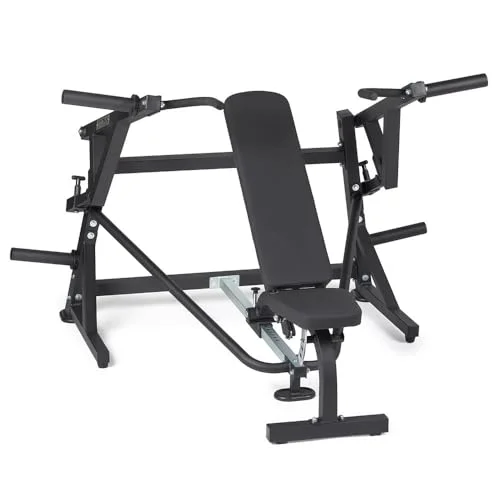
Titan Fitness Plate-Loaded Chest Press Machine
Pros
- 1,000 lb rated frame handles the heaviest loading any home gym athlete will realistically use on a chest press machine — the capacity is genuine structural headroom, not a marketing figure
- 13 bench depth positions and 5 distinct arm angle positions give exceptional range of fit for athletes of different heights and pressing preferences — more adjustment points than most machines in this price range
- Includes an adjustable FID bench, which is a standalone $300–$500 purchase on its own — the bundled value is meaningful compared to plate-loaded machines that require a separate bench
- Independent lever arms allow unilateral pressing — each arm operates independently, which is effective for addressing strength imbalances between the left and right sides
- 2" Olympic plate compatibility works with the most common home gym plate format — no adapter purchase required
- Converging press path follows a natural arc from wide to narrow rather than a fixed straight-line track, which reduces shoulder joint stress compared to a traditional barbell bench press
Cons
- Titan ships direct rather than via standard Amazon Prime — lead times on specialty machines can run 1–2 weeks beyond standard delivery expectations, so plan accordingly if timing matters
- 200 lb assembled weight and the machine's footprint require a dedicated floor zone — not compact enough for tight garage gym configurations without planning
- No weight stack included — plate loading means you need Olympic weight plates, which must be purchased separately if you don't already own them
The Titan Fitness plate-loaded chest press is the strongest value in this roundup for home gym athletes who want a complete, well-built pressing machine without paying a premium-brand markup. The 1,000 lb rated frame is built to handle serious loading — owner feedback across garage gym communities consistently describes the machine as stable and solid under heavy use rather than developing the frame flex that budget plate-loaded machines exhibit at higher loading levels.
The adjustment system is where this machine separates itself from competitors at a similar price. Thirteen bench depth positions and five distinct arm angle positions — 18 total adjustment points — let athletes of different heights and build proportions set the machine up correctly for their pressing geometry. Arm angle adjustment matters specifically because the pressing path affects which portion of the chest and how much shoulder involvement the movement demands. Having five discrete arm positions to choose from gives meaningful control over that variable.
The bundled FID bench is a significant included value. An adjustable bench capable of handling serious pressing loads sells for $300–$500 as a standalone purchase. The Titan chest press includes it — so the effective cost of just the frame and pressing mechanism is well below the $679 purchase price.
Independent lever arms handle one of the common limitations of fixed-crossbar chest press machines: if one arm is stronger, it carries more load and the weaker side coasts. With independent arms, each side must produce its own force through the full range of motion. Based on owner and coach reports, this setup is more effective for balanced development than a fixed-bar machine.
The primary tradeoff is delivery. Titan ships direct, not through Amazon Prime fulfillment, so plan for 1–2 week lead times on specialty equipment. For a machine that will spend the next decade in a home gym, that wait is minor.
Body-Solid ProClubLine LVBP — Best Heavy-Duty
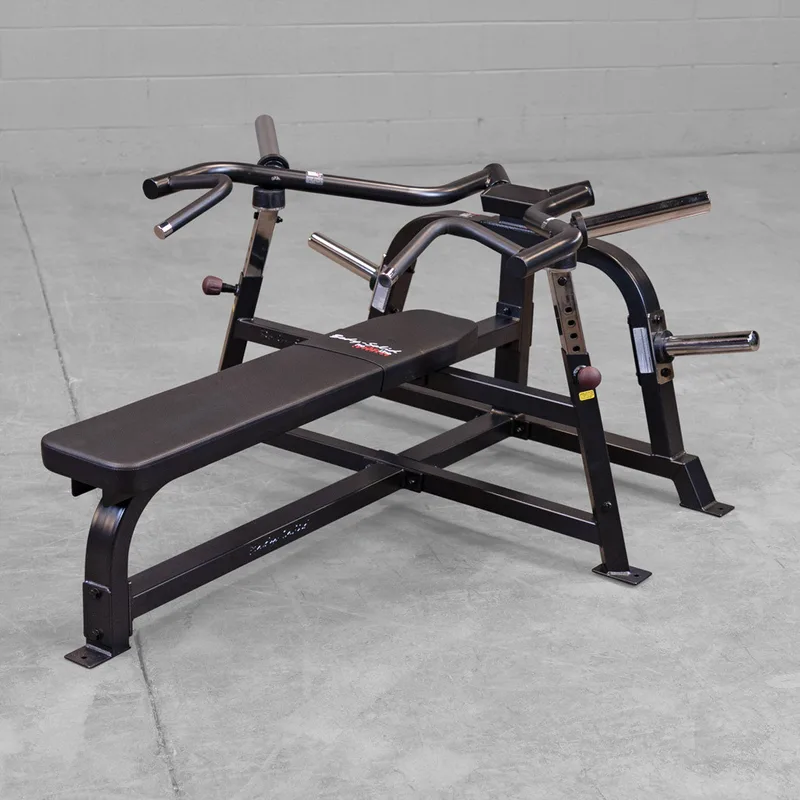
Body-Solid ProClubLine LVBP Leverage Bench Press
Pros
- 2" × 3" 11-gauge high-tensile steel construction matches the specification of commercial gym machines — the frame will not develop flex or joint loosening under consistent heavy use the way lighter-gauge alternatives do
- Sealed bearing pivot points provide smooth press arm movement and resist corrosion from sweat and humidity — more durable over a long ownership cycle than bushing-based pivot systems
- Gas-assisted start position adjustment lets the user set the exact starting point of the press without fighting spring tension — a detail that improves the solo-training experience for athletes working without a spotter
- Independent, unilateral arm action allows each arm to move separately — supports single-arm chest pressing for isolation work and direct comparison of left-to-right output
- Weight plate holders integrated into the frame keep plates organized and reduce the time between sets — a practical detail in a home gym where floor space is limited
- 1,000 lb rated capacity at 500 lb per side gives meaningful structural headroom for any realistic loading scenario in a home gym
Cons
- $1,099 price puts this machine at the high end of the plate-loaded home gym chest press market — best suited for athletes with consistent heavy pressing volumes who will fully utilize the commercial-grade construction
- At 169 lb assembled and 69" long, the LVBP requires a dedicated floor zone; it is not a machine that repositions easily once set up
- Plate loading requires purchasing Olympic weight plates separately — the machine arrives without any plates
The Body-Solid LVBP is the pick for home gym athletes who want a plate-loaded chest press built to commercial gym standards and who plan to train consistently at heavy loads for the long term. The 2” × 3” 11-gauge high-tensile steel frame is the same construction specification found in commercial gym equipment. Based on long-term owner reports, the LVBP does not develop the frame flex or joint loosening that characterizes lighter-gauge machines under repeated heavy loading.
The sealed bearing pivot points are a meaningful design detail. Bushing-based pivot systems — the alternative found in budget and mid-range machines — develop play at the pivot joint over time, particularly in humid garage gym environments. Sealed bearings resist moisture and contamination, maintain smooth press arm movement for the life of the machine, and do not require periodic replacement the way cables in selectorized machines do.
Gas-assisted start position adjustment is a functional solo-training detail that sounds minor but makes a practical difference. On plate-loaded machines without gas assistance, adjusting the arm start position means managing spring tension or a manual resistance that can be awkward to operate alone. The gas-assist system allows the user to set the exact starting press position — the point where the arms begin — without fighting mechanical resistance. For athletes training alone without a training partner to hold the arms in position during adjustment, this removes a friction point from every workout setup.
At 169 lb and 69” long in the extended position, the LVBP requires a permanent floor location. This is not a machine that repositions between workouts. Plan the floor zone in your gym layout before the machine arrives. At $1,099, it belongs in a home gym where the owner already trains heavy and consistently — the construction justifies the price for that use case.
Gronk Fitness Seated Plate-Loaded Chest Press — Best Seated Design
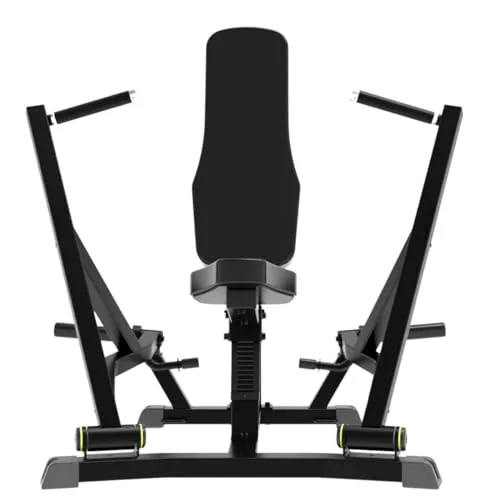
Gronk Fitness Seated Plate-Loaded Chest Press
Pros
- Seated upright configuration offers an alternative pressing path compared to incline-style plate-loaded machines — the vertical seat position changes the force angle on the pec and shoulder, which is useful for targeting the mid-chest and anterior deltoid more directly
- 220 lb per arm loading capacity provides headroom that intermediate and advanced athletes are unlikely to exceed in a seated chest press movement
- Commercial-grade construction translates to build quality designed for repeated daily use — frame stability holds under heavy loading without the wobble common in entry-level plate-loaded units
- Adjustable seat height and multiple handle positions accommodate different user heights and grip preferences without requiring tools to change
- Available on Amazon with standard shipping — accessible without navigating the direct-only brand ordering process
Cons
- $1,399 represents the highest plate-loaded price in this roundup — the premium reflects commercial build quality but requires a clear commitment to dedicated chest machine training to justify the investment
- Seated configuration trains the chest and shoulders in a different pattern than decline or incline variations — buyers who want a multi-angle pressing machine should evaluate whether a flat/incline design better matches their training
- No weight plates included — Olympic plates must be purchased separately
The Gronk Fitness seated chest press offers a different pressing geometry than the incline-style plate-loaded machines that dominate the home gym market. The upright seated configuration positions the athlete vertically rather than reclined, which shifts the force angle on the chest and anterior deltoid. Based on how seated chest press machines are used in commercial gym settings, the vertical seated press recruits the mid-chest and shoulder more directly than the typical 30–45 degree incline design — a different stimulus for athletes who are already training a lot of incline pressing volume.
The 220 lb per arm capacity is genuine loading headroom. Most intermediate home gym athletes pressing in the 135–185 lb range on a barbell will load this machine in the 80–140 lb per arm range — well below the 220 lb ceiling. This is not a machine athletes will outgrow quickly.
Commercial build quality means the frame is engineered for repeated high-volume use. Adjustable seat height and multiple handle position settings accommodate athletes of different heights and pressing styles without requiring tools to modify. The multiple grip positions are useful because grip width and angle affect where in the chest and shoulder the load is distributed — narrower grip concentrates more load on the triceps and inner chest, wider grip shifts more to the outer chest and shoulder.
At $1,399, this is the most expensive plate-loaded machine in the roundup. The price is appropriate for the build quality and capacity, but it requires clarity about why the seated design specifically serves your training better than an incline design at a lower cost. For athletes who already have significant incline and flat pressing volume from barbell and dumbbell work and want a machine that changes the angle of stimulus, the Gronk seated press is a justified investment.
Valor Fitness BF-47 — Best Budget
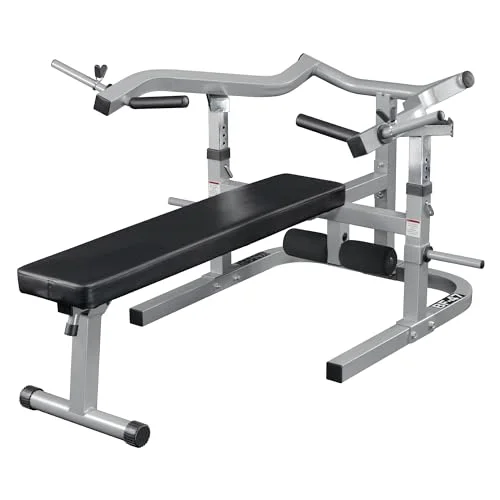
Valor Fitness BF-47 Adjustable Chest Press
Pros
- At $259, this is the most accessible dedicated chest press machine in this roundup — it provides independent arm pressing and 9 adjustable positions at a price that doesn't require a major budget commitment
- Independent converging arms function on the same mechanical principle as machines costing three to four times as much — each arm can be loaded independently for addressing left-to-right pressing strength differences
- 9 adjustable positions with an 8" range gives a reasonable fit adjustment for different user heights and preferred incline angles
- Multi-function design adds flat press, incline press, and ab crunch from the same structure — useful in a small home gym where each piece needs to serve more than one purpose
- Compact and light enough to reposition — appropriate for home gym setups where floor space flexibility is a priority
Cons
- 250 lb maximum plate capacity (125 lb per arm) will limit intermediate and advanced athletes — lifters already pressing in the 180–225 lb range on a barbell will approach the machine's ceiling and need to plan for an upgrade
- Standard-diameter plate compatibility requires an adapter for 2" Olympic plates — this is an additional purchase if your home gym plate collection is Olympic format
- Entry-level construction with lighter steel gauge than mid-range and premium machines — adequate for consistent moderate-load use but not built to the same long-term durability standard as the Titan or Body-Solid units
The Valor Fitness BF-47 is the accessible entry point into dedicated chest press machine training. At $259, it delivers the key functional feature — independent converging arms — that separates a chest press machine from a barbell bench press: each arm moves on its own, allowing the weaker side to develop without the stronger side compensating.
Nine adjustable positions across an 8” adjustment range gives a reasonable fit for different user heights and preferred press angles. The machine operates across three configurations — flat press, incline press, and ab crunch — which adds functional utility in a small home gym where each piece of equipment needs to justify its floor space by covering more than one movement pattern.
The 250 lb total capacity (125 lb per arm) is the primary limiting factor. Athletes currently using 80 lb per arm or more in a chest press movement will approach the ceiling within a training cycle or two. The BF-47 is the right machine for beginners building a foundation and for intermediate athletes who aren’t training at the heavier end of the plate-loaded chest press range. For athletes who are already strong and plan to continue progressing, the Titan or LVBP will serve better as a long-term investment.
The standard-diameter plate compatibility requires an Olympic adapter if your home gym plate collection uses 2” holes — factor that into the total cost if applicable. At $259, the total cost remains well below any other machine in this roundup even with an adapter.
Body-Solid Series II S2CP-2 — Best Selectorized
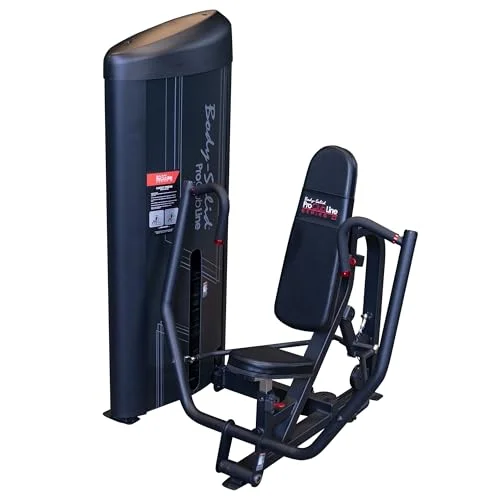
Body-Solid Series II S2CP-2 Selectorized Chest Press
Pros
- 210 lb selectorized weight stack with pin-select weight changes eliminates the time and friction of loading and unloading Olympic plates between sets — functionally identical to the chest press machines found in commercial gyms
- Fully shrouded weight stack protects the plates and guide rods from dust, sweat, and incidental damage — adds to the machine's long-term durability in a home gym environment
- Five-position adjustable seat and multi-position handles accommodate athletes of meaningfully different heights and pressing positions
- Lifetime warranty on the frame and welds is the strongest structural coverage in this roundup — Body-Solid backs this machine for the lifetime of the original purchaser
- Rated for full commercial use — the machine will withstand daily high-volume training across multiple users if the home gym transitions to a small training studio
- Optional 310 lb weight stack upgrade provides advanced loading for athletes who exhaust the standard 210 lb capacity
Cons
- $2,780 is well above the typical home gym budget for a single chest press machine — this investment is appropriate for buyers building a commercial-quality facility rather than a standard garage or basement gym
- 450 lb assembled weight and 55" × 44" × 69" dimensions require permanent floor placement — this machine does not move after installation
- Selectorized cable-and-stack system requires more maintenance than plate-loaded machines — cables and weight stack guides need periodic inspection and lubrication to maintain smooth operation
The Body-Solid S2CP-2 is the only machine in this roundup that uses a pin-select selectorized weight stack rather than plate loading, and it’s priced accordingly at $2,780. For buyers who specifically want the experience of a commercial selectorized chest press at home — where you pull the pin, set the weight, and press without loading plates — this is the machine that delivers that experience.
The 210 lb weight stack with pin-select adjustment allows weight changes in seconds rather than the 1–3 minutes it takes to strip and reload Olympic plates. For high-volume training with multiple sets at different loads, or for shared home gym use where two athletes of different strength levels alternate on the machine, the speed of selectorized weight changes is a practical quality-of-life improvement over plate loading.
The fully shrouded weight stack protects the plates, guide rods, and cables from sweat, dust, and incidental damage. Five-position seat adjustment and multi-position handles cover athletes of different heights and pressing preferences. The lifetime frame and weld warranty is the strongest structural coverage in this roundup — Body-Solid backs the machine for the life of the original purchaser, which matters when paying $2,780 for a single machine.
The 310 lb weight stack upgrade is available for advanced athletes who exhaust the standard 210 lb capacity.
At $2,780, this machine is clearly positioned at the premium end of home gym equipment. It belongs in a dedicated training space — a garage gym build with a real equipment budget, a personal training studio, or a home gym that has already covered the foundational equipment and is adding a commercial-grade isolation machine as a finishing touch. For most home gym athletes starting or mid-build, the Titan or LVBP will deliver better overall value.
Buying Guide: What to Look for in a Home Gym Chest Press Machine
Plate-Loaded vs. Selectorized
Plate-loaded chest press machines use Olympic or standard weight plates for resistance. They cost less upfront, require plates you may already own, and have no cables or weight stacks to maintain. The tradeoff is time — loading and unloading plates between sets adds time to training sessions.
Selectorized machines use a cable-and-weight-stack system with a pin to select resistance. They allow instant weight changes between sets. The tradeoff is cost — commercial selectorized chest presses start around $2,000 for home gym-quality options — and ongoing maintenance of cables and guide rods.
For most home gym athletes, plate-loaded is the practical choice. The loading time is a minor inconvenience, and the cost savings are significant.
Independent Arms vs. Fixed Crossbar
Independent arm machines let each arm move separately. This means each side of your chest must produce its own force through the full range of motion without the stronger side compensating for the weaker one. Fixed crossbar machines force both arms to move together, which can mask side-to-side strength imbalances.
For most home gym athletes — particularly those who train without a structured program that includes bilateral barbell work — independent arms are the better design for balanced chest development.
Weight Capacity
Entry-level machines cap at 250–300 lb total. Mid-range machines rate at 500–1,000 lb. Commercial machines rate at 1,000 lb and above.
For realistic home gym use, a 500–1,000 lb rated machine is more than adequate. The rating reflects frame construction standards — a 1,000 lb rated machine will not flex or develop joint play the way a 250 lb rated machine might under repeated use at 150–200 lb actual loading.
Adjustability
Look for machines with multiple seat depth positions, arm angle positions, and start position adjustability. The correct setup requires your pressing joint (shoulder) to align with the machine’s pivot point. Machines with fewer adjustment positions force athletes outside average height ranges into compromised positioning that reduces exercise quality.
Space and Footprint
Standalone chest press machines typically occupy 40” × 55” to 70” × 55” of floor space. Measure your available zone before purchasing — these machines are not compact and do not reposition easily once set up.
Frequently Asked Questions
Is a chest press machine better than a barbell bench press for home gym training?
For solo training without a spotter, a chest press machine is safer than a barbell bench press. A failed barbell rep requires either safeties on a rack or a training partner to pull the bar. A chest press machine has built-in end-range stops and a controlled press path that keeps the weight under control even if you fail a rep. If your home gym includes a power rack with proper safety bar setup, a barbell is equally viable. If not, a chest press machine removes a real safety risk from heavy pressing.
Can I use a chest press machine to replace dumbbell chest work?
A chest press machine covers the basic pushing pattern and adds loading volume for chest, shoulder, and tricep development. It does not replicate the stabilizer recruitment of dumbbell pressing, where each arm must independently balance the weight through the full range of motion. For comprehensive chest development, including machine pressing in your training alongside dumbbell pressing or barbell work gives you both the stabilizer stimulus and the capacity for heavier isolated loading.
Do I need to buy weight plates separately?
Yes — all plate-loaded machines in this roundup ship without weight plates. If your home gym already has a barbell and plate set, the plates are compatible with any machine that accepts 2” Olympic plates. If your plates are standard diameter (1”), verify compatibility before ordering. The Valor BF-47 uses standard-diameter plates by default with an Olympic adapter required for 2” plates.
How much floor space does a chest press machine require?
Expect to allocate a 5’ × 5’ to 6’ × 6’ floor zone for a standalone chest press machine, including space to load plates and move around the machine. The Valor BF-47 is the most compact option in this roundup. The Body-Solid LVBP and S2CP-2 require the most space. Measure your gym floor plan before purchasing — these machines are heavy and do not move easily after setup.
What is the maintenance requirement for a chest press machine?
Plate-loaded machines require minimal maintenance — periodically check bolts for tightness, wipe down upholstery, and apply a light lubricant to pivot points if movement stiffens. Selectorized machines (like the Body-Solid S2CP-2) require periodic cable inspection and replacement, weight stack guide rod lubrication, and shroud cleaning. Both types are low-maintenance compared to cardio machines, but selectorized machines have more components that require attention over a long ownership cycle.
Conclusion: Which Chest Press Machine Should You Buy?
For most home gym athletes, the Titan Fitness Plate-Loaded Chest Press at $679 is the right choice. The 1,000 lb rated capacity, 18 total adjustment positions, included FID bench, and independent lever arms deliver everything needed for serious chest pressing in a home gym at a mid-range price. The included bench alone offsets a significant portion of the cost compared to purchasing the frame separately.
Athletes training at consistently heavy loads who want commercial-grade construction should look at the Body-Solid LVBP at $1,099. The 11-gauge steel frame, sealed bearing pivots, and gas-assisted start position are details that matter over a 10+ year ownership cycle.
Budget-first buyers who want to get into machine pressing without a major investment start with the Valor Fitness BF-47 at $259 — independent arms, nine adjustment positions, and flat/incline functionality at an accessible entry price.
For pairs well with: a weight bench for dumbbell chest work, a cable machine for cable flyes and crossovers, and rubber gym flooring to protect your floor and reduce noise.