A humid garage or basement doesn’t just feel uncomfortable to train in — it rusts your barbell, pits your plates, and warps rubber flooring at the seams. 2026 buying guides for basement and garage dehumidifiers keep repeating the same warning: standard compressor units lose efficiency below 65°F and can ice up entirely below 40°F, which is exactly the temperature range an unheated garage gym hits for months in northern climates. A dehumidifier that can’t run in the cold is a dehumidifier that fails right when a closed-up winter garage needs it most.
This roundup covers five dehumidifiers sized and rated for garage and basement home gyms — from a compact, quiet 50-pint unit for a finished basement to a restoration-grade 180-pint machine for a genuinely damp two-car garage. Auto-defrost and cold-weather performance get called out specifically, since that’s the feature that separates a dehumidifier that survives a garage winter from one that quits in October.
Quick Picks
Waykar 80-Pint Energy Star Dehumidifier is the Editor Pick — temperature-sensing auto-defrost, 5,000 sq ft coverage, and Energy Star certification make it the best all-around fit for a garage gym that sees real temperature swings.
AlorAir 180 PPD Commercial Dehumidifier is the pick for large, genuinely wet garages or unfinished basements — restoration-grade capacity and a 6-year warranty, at a commercial price.
hOmeLabs 50-Pint WiFi Dehumidifier is the best smart option — app control and a built-in pump for basement gyms that stay above 65°F.
Midea Cube 50-Pint Dehumidifier is the best compact and quiet pick — smaller footprint and owner-reported quiet operation for gyms near living space.
Frigidaire FFAD5033W1 is the best value — a straightforward, Energy Star-certified 50-pint unit at the lowest price here.
Comparison
| Dehumidifier | Capacity | Coverage | Auto-Defrost | Price |
|---|---|---|---|---|
| Waykar 80-Pint | 80 pints/day | 5,000 sq ft | Yes | $201.88-$214.77 as of Sep 15, 2026 |
| AlorAir 180 PPD | 180 pints/day | 2,300 sq ft | LGR commercial design | $679.24-$799.11 as of Sep 15, 2026 |
| hOmeLabs 50-Pint WiFi | 50 pints/day | 7,500 sq ft (rated) | No | Unavailable |
| Midea Cube 50-Pint | 50 pints/day | 4,500 sq ft | No | $234.99-$249.99 as of Sep 15, 2026 |
| Frigidaire FFAD5033W1 | 50 pints/day | 4,500 sq ft | No | Unavailable |
Buying Guide: How to Choose a Dehumidifier for a Garage or Basement Gym
Why It Matters for a Home Gym Specifically
Humidity does damage in a home gym that it doesn’t do in a living room. Bare steel on barbells and plates rusts. Cable machine wire ropes corrode inside their housings. Rubber flooring seams can lift and warp when the slab underneath stays damp. Chrome and zinc plating on cheaper equipment pits faster in consistently high humidity. Keeping the space between 40% and 55% relative humidity protects the equipment investment, not just comfort.
Cold-Weather Performance Is the Feature That Matters Most for Garages
Standard compressor dehumidifiers are designed and tested around room-temperature conditions. Below about 65°F, efficiency drops. Below roughly 40°F, the evaporator coils can frost over entirely and the unit stops removing moisture — or worse, ices up and shuts down. An unheated garage in the fall, winter, and early spring routinely sits in that range overnight and on cold days.
Auto-defrost (sometimes called temperature-sensing mode) periodically runs a defrost cycle to clear ice before it builds up. The Waykar in this roundup calls this out specifically. If a garage gym isn’t heated, this feature isn’t optional — without it, the unit either shuts itself off in cold weather or keeps running while doing almost nothing.
A basement gym, by contrast, usually stays within a more stable 55–75°F range year-round because it’s below grade and often near heating ductwork. That’s why the hOmeLabs, Midea Cube, and Frigidaire — none of which advertise auto-defrost — are still reasonable picks for a basement even though they’d struggle in a cold garage.
Sizing: Pints per Day vs. Actual Space
Manufacturer capacity ratings (50, 80, 180 pints/day) are measured under specific lab conditions (usually 80°F, 60% RH under the old DOE standard, or 65°F, 90% RH under the newer 2019 standard) that rarely match a garage’s real environment. As a rough guide:
- Under 1,500 sq ft, moderate humidity: A 30–50 pint unit is usually sufficient
- 1,500–3,000 sq ft, or a garage with a history of dampness: Look at 50–80 pint units
- Large, uninsulated, or consistently wet spaces: Commercial-grade units like the AlorAir, rated well above residential capacity, are worth the higher cost
Buying undersized is the most common mistake — a unit that’s constantly running at maximum and still not hitting target humidity is undersized for the space, not defective.
Pump vs. Gravity Drain vs. Manual Bucket
Continuous operation without daily attention requires either a built-in pump (hOmeLabs, Midea Cube, AlorAir) or a gravity drain hose to a floor drain positioned lower than the unit’s outlet (Waykar, Frigidaire). A pump can push water uphill or across distance to reach a drain or window, which matters in garages where the floor drain, if one exists, isn’t conveniently placed. Manual bucket emptying works for lower-humidity basements but becomes a daily chore in a genuinely damp garage running at high capacity.
Noise Near a Training Space
All of these units run a compressor and fan continuously during active dehumidification, which puts them in a similar noise range to a window air conditioner. That’s a non-issue during a loud lifting session but noticeable during stretching, mobility work, or if the gym shares a wall with a bedroom or office. Owner reports point to the Midea Cube as quieter than average in this class; the AlorAir, built for job-site duty, is the loudest of the five.
Detailed Reviews
Waykar 80-Pint Energy Star Dehumidifier — Editor Pick
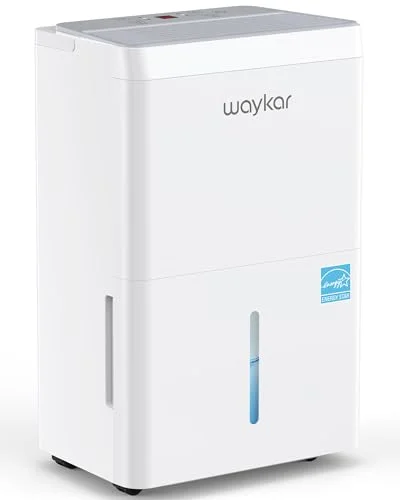
Waykar 80-Pint Energy Star Dehumidifier
Pros
- Automatic defrost with temperature-sensing auto mode keeps the coils from icing over in an unheated garage once nighttime temps drop into the 40s — a common failure point for cheaper compressor units
- 80-pint rated capacity and 5,000 sq ft coverage handle a two-car garage gym or finished basement without running two smaller units
- Continuous drain hose option means it can run unattended for days during humid stretches without emptying a tank
- Energy Star certification under the 2025 spec keeps operating cost reasonable for a unit that may run daily through summer
- Digital humidity readout and auto mode remove the guesswork of manual dial units
Cons
- At roughly 48 lbs, it's not a unit you want to move between rooms often
- Auto-swing louver and compressor produce enough hum to notice during quiet lifts like planks or stretching
- Tank is small relative to capacity, so continuous drainage is effectively required for garage use
The auto-defrost feature is the reason this is the top pick for a garage gym specifically. Temperature-sensing mode monitors the coil and runs a defrost cycle before ice can build up to the point of shutting the compressor down — the exact failure mode that plagues basic dehumidifiers left running in a garage through fall and winter.
At 80 pints/day rated capacity and coverage up to 5,000 sq ft, it’s sized for a full two-car garage gym or a larger unfinished basement, not just a single room. The 2025 Energy Star spec keeps it from being an efficiency drag if it’s running daily through a humid summer.
The tradeoffs are size and drainage. At around 48 lbs, repositioning it isn’t a one-handed job, and the internal tank is small enough that continuous drain hose setup is close to mandatory for garage-scale humidity loads rather than optional convenience.
AlorAir 180 PPD LGR Commercial Dehumidifier with Pump — Best for Large or Wet Garages
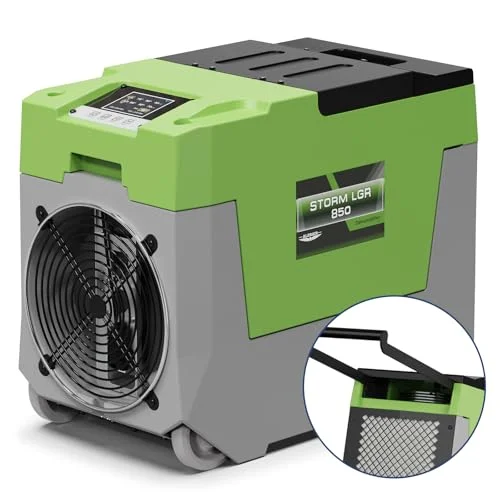
AlorAir 180 PPD LGR Commercial Dehumidifier with Pump
Pros
- Restoration-grade LGR (low grain refrigerant) design pulls moisture out faster than residential units in genuinely damp garages, unfinished basements, or spaces with a history of flooding
- Built-in condensate pump pushes water uphill or through a long hose run — useful when the nearest drain isn't at floor level
- 6-year limited warranty is well beyond what residential dehumidifier brands offer and reflects the commercial-duty components inside
- 210 CFM airflow actively circulates air through the space rather than just pulling moisture from whatever passes near the intake
- Compact footprint for its output compared to older commercial units of similar capacity
Cons
- Nearly 3x the price of the residential picks in this roundup — overkill for a dry, finished basement
- Louder than residential units under sustained operation; better suited to garages than a home gym adjacent to living space
- Industrial styling and size (roughly the footprint of a large shop vac) stand out in a finished space
This is restoration-grade equipment — the same class of dehumidifier used after water damage and flood cleanup — sized down into a unit a homeowner can run continuously in a garage. The LGR (low grain refrigerant) design extracts moisture more aggressively than a residential compressor at the same rated capacity, which matters in a garage with a real moisture source: a slab without a vapor barrier, seasonal groundwater, or a history of flooding.
The built-in condensate pump is a genuine convenience upgrade over gravity drainage, since it can push water through a hose run to wherever a drain actually exists rather than requiring the unit to sit above one. The 6-year limited warranty reflects components built for job-site duty cycles far beyond what a residential unit is designed to survive.
The price and size are the honest tradeoffs. At roughly $799, it costs more than three of the residential picks in this roundup combined, and its footprint and noise level are closer to job-site equipment than a home appliance. For a dry, finished basement, this is overkill. For a garage that’s genuinely damp — musty smell, visible condensation, or rust forming on tools — it’s the right tool.
hOmeLabs 50-Pint WiFi Dehumidifier with Pump — Best Smart Features
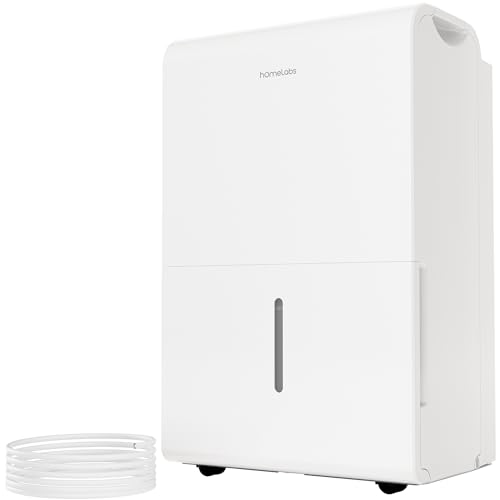
hOmeLabs 50-Pint WiFi Dehumidifier with Pump
Pros
- WiFi app control lets you check and adjust humidity remotely — useful for a garage gym you're not walking through daily
- Built-in pump handles continuous drainage without gravity-feeding to a floor drain, which matters in garages without one
- Turbo mode pulls moisture down quickly after a humid spell before a lifting session, then can drop to Comfort mode for quiet steady-state control
- Auto shut-off when the target humidity is reached avoids over-drying the space and running the compressor unnecessarily
- Digital display and simple mode selection are easy to operate without reading a manual
Cons
- The 7,500 sq ft coverage figure is a best-case rating; expect closer to 50-pint-class performance in a typical garage
- WiFi setup and app account add a step some buyers will skip and just run it on manual control
- No auto-defrost feature called out for low-temperature garage use — best suited to basements that stay above 65°F
The WiFi app control is the standout feature here — checking humidity and adjusting settings remotely is genuinely useful for a garage gym that isn’t visited daily, especially during a stretch of humid weather when you want to confirm the unit is keeping up without walking out to check.
The built-in pump removes the drainage constraint that limits gravity-fed units to spaces with a conveniently placed floor drain. Turbo mode pulls humidity down quickly, and Comfort mode then maintains it more quietly — a sensible two-stage approach for a space used for both loud training sessions and quieter recovery work.
The 7,500 sq ft coverage figure on the packaging is a best-case number; treat this as a solid 50-pint-class unit for a room in the 1,000–2,000 sq ft range under real garage or basement conditions. And without an auto-defrost feature specifically listed, this is a better fit for a basement that stays above 65°F than an unheated garage in winter.
Midea Cube 50-Pint Dehumidifier with Pump — Best Compact & Quiet
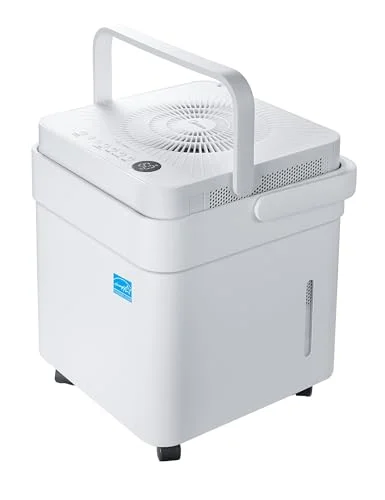
Midea Cube 50-Pint Dehumidifier with Pump
Pros
- Compact cube shape takes up less floor space than boxier competitors — a real consideration in a garage gym already tight on rack and bench clearance
- Owner feedback consistently calls out quieter operation than similarly rated 50-pint units, a plus if the gym shares a wall with living space
- Alexa compatibility and app control add convenience without a steep learning curve
- Energy Star certified, keeping year-round operating cost predictable
- Built-in pump handles drainage without manual bucket-emptying
Cons
- 4,500 sq ft coverage rating is optimistic for a large or poorly sealed garage
- Smaller footprint means a smaller internal tank as backup if the pump line gets kinked or blocked
- No dedicated low-temperature/auto-defrost mode — performance drops in an unheated garage below 65°F
The cube form factor genuinely saves floor space compared to the boxier units in this roundup — a real consideration when the same corner of the garage is competing with a rack, plate tree, and bench. Owner reports consistently mention quieter running than other 50-pint units, which is the deciding factor for anyone whose gym shares a wall with a bedroom or home office.
Energy Star certification and Alexa/app compatibility round out a unit built for a finished, temperature-stable space rather than raw capacity. The built-in pump handles drainage without manual bucket emptying, which matters for daily-use consistency.
Like the hOmeLabs, this unit doesn’t list a dedicated low-temperature or auto-defrost mode, so it’s the better fit for a basement gym than an unheated garage that regularly drops below 65°F.
Frigidaire FFAD5033W1 50-Pint Dehumidifier — Best Value
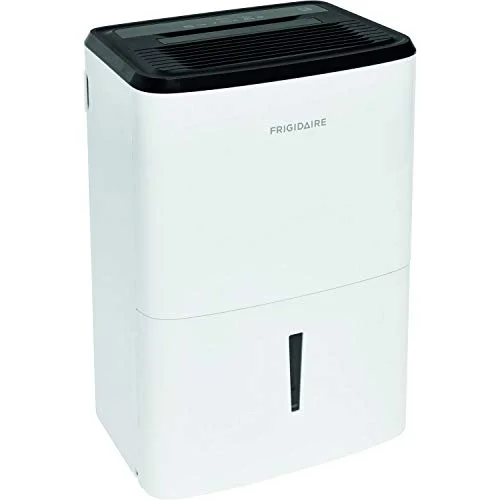
Frigidaire FFAD5033W1 50-Pint Dehumidifier
Pros
- Lowest price in this roundup for a name-brand, Energy Star-certified 50-pint unit — a reasonable entry point for a first garage or basement dehumidifier
- Removable bucket with handle and casters make emptying and repositioning straightforward
- Full-tank auto shut-off prevents overflow if you forget to check it for a few days
- Frigidaire's parts and service network is widely available if something needs repair
- Continuous drain option is included for buyers with a nearby floor drain
Cons
- No smart/WiFi control — this is a straightforward manual-and-dial unit
- No built-in pump, so continuous drainage requires gravity flow to a lower drain
- No auto-defrost feature; not the right choice for an unheated garage that drops below 65°F in winter
This is the straightforward, no-frills option — a name-brand, Energy Star-certified 50-pint unit at the lowest price in this roundup. No app, no WiFi, no built-in pump — just a dial, a digital readout, a removable bucket, and a continuous drain hose option for buyers with a nearby drain.
The casters and bucket handle make it easy enough to move and empty, and the full-tank auto shut-off is a practical safety net if a few days go by without checking it. Frigidaire’s wide service network is a genuine advantage if a part ever needs replacing.
It’s the right choice for a first dehumidifier purchase or a basement gym where the humidity problem is moderate rather than severe. It skips the auto-defrost feature entirely, so an unheated garage in winter isn’t the use case it’s built for.
FAQ
What humidity level should a home gym be kept at?
Between 40% and 55% relative humidity is the general target. Below 30% can dry out rubber flooring and grip surfaces over time; above 60% accelerates rust on barbells, plates, and cable machine hardware, and can promote mold growth on flooring and walls. Most of the units in this roundup include an auto mode that targets a set humidity percentage rather than requiring manual monitoring.
Do I need auto-defrost for a garage dehumidifier?
Yes, if the garage is unheated and regularly drops below 65°F, and especially if it drops below 40°F overnight in winter. Without auto-defrost, the evaporator coils can ice over and the unit either stops dehumidifying effectively or shuts down entirely. Basements that stay above 65°F year-round don’t need this feature as urgently.
Will a dehumidifier actually prevent rust on barbells and plates?
Keeping ambient humidity in the 40–55% range significantly slows oxidation on bare and lightly coated steel, but it doesn’t eliminate the need for basic maintenance. Wiping down a barbell after sweaty sessions and applying a light coat of oil periodically still matters — the dehumidifier reduces the rate of humidity-driven corrosion between those maintenance sessions.
How big of a dehumidifier do I need for a two-car garage gym?
A typical two-car garage runs 400–600 sq ft, but manufacturer coverage ratings assume ideal lab conditions that rarely match a garage. For a garage with noticeable dampness, look at 50–80 pint-rated units like the Waykar. For a garage with a persistent moisture problem — standing water history, no vapor barrier, visible mold — a commercial-grade unit like the AlorAir is worth the added cost.
Can I just run a dehumidifier occasionally instead of continuously?
Intermittent use works for mild seasonal humidity but won’t keep pace with a persistently damp space. Units with continuous drain hose options or built-in pumps are designed for extended unattended operation specifically because garage and basement humidity control is more effective as a steady-state process than an occasional intervention.
Conclusion
The Waykar 80-Pint Energy Star Dehumidifier is the best all-around pick for a garage gym, specifically because of its auto-defrost feature — the one capability that keeps a dehumidifier working through a cold garage winter instead of icing up and shutting down. For genuinely wet or oversized spaces, the AlorAir 180 PPD brings commercial-grade capacity and a 6-year warranty at a commercial price. For a basement gym that stays warm year-round, the hOmeLabs, Midea Cube, and Frigidaire FFAD5033W1 all deliver solid 50-pint performance at three different price and feature points — smart control, quiet compact design, and lowest price, respectively.