Garage gym owners spent this year’s summer fighting 100-degree heat and are about to spend the next few months fighting the opposite problem. A portable evaporative cooler paired with reflective door insulation and a drum fan can cut effective garage temperature by 20 to 30 degrees for under $400, while a basic ductless mini-split runs closer to $1,000 installed — the gap between “cheap and works” and “expensive and automatic” is wide, and most home gym owners land somewhere in between. On the cold side, the bigger risk isn’t discomfort — it’s the grease inside barbell sleeves thickening and seizing, and condensation forming on cold steel and turning a rack into a rust project.
None of this requires a full HVAC install. It requires picking the right combination of insulation, active heating or cooling, humidity control, and equipment that can handle the swings — and knowing which of those five categories actually matters for your climate and your garage.
Quick Picks
NASA TECH Reflective Insulation Kit is the foundation. It’s the cheapest way to blunt both summer heat gain and winter heat loss at the single biggest thermal leak in most garages — the door itself.
Mr. Heater Big Buddy is the pick for genuinely cold garages. It’s one of the few propane heaters actually rated safe for indoor use, and it can bring a cold garage up to a workable temperature in about 20 minutes.
Hessaire MC18M handles the opposite problem in dry climates — an evaporative cooler pulls real heat out of the air for a fraction of the power draw of a portable AC unit.
hOmeLabs 8 Pint Dehumidifier matters more than people expect. Garages swing in temperature constantly, and that swing creates condensation — the actual cause of rust on plates, bars, and rack uprights.
Rubber-Cal Recycled Rubber Flooring doesn’t crack in the cold or go soft in the heat the way cheaper foam tiles can, and it gets more slip-resistant, not less, when damp.
ThermoPro TP50 is a $10 problem-finder. Before spending money on the other four, put one of these on the wall and find out what your garage is actually doing.
| Spec | NASA TECH Reflective Garage Door Insulation Kit (16' x 8') | Mr. Heater 18,000 BTU Big Buddy PRO Series Heater | Hessaire MC18M Portable Evaporative Cooler | hOmeLabs 8 Pint Wi-Fi Dehumidifier | Rubber-Cal Recycled Rubber Home Gym Flooring (144 sq ft) | ThermoPro TP50 Digital Hygrometer & Indoor Thermometer |
|---|---|---|---|---|---|---|
| Rating | 8.4/10 | 8.6/10 | 8.0/10 | 8.2/10 | 8.3/10 | 8.5/10 |
| Price | $118.87as of Oct 11, 2026 | Unavailable | $191.57as of Oct 11, 2026 | Unavailable | $516.60as of Oct 11, 2026 | $10.99as of Oct 11, 2026 |
| Coverage | 16' wide x 8' high (2-car door) | Up to 450 sq ft | Up to 500 sq ft | Up to 1,800 sq ft | 144 sq ft (three 4' x 12' rolls) | — |
| R-Value | 8.0 | — | — | — | — | — |
| Material | Reflective foam core | — | — | — | 100% recycled rubber | — |
| Weatherproofing | Waterproof, fire-resistant | — | — | — | — | — |
| Install | Heavy-duty double-sided tape, tools included | — | — | — | Interlocking rolled edges, no glue required | — |
| BTU Output | — | 4,000 / 9,000 / 18,000 (adjustable) | — | — | — | — |
| Fuel | — | 1 lb propane bottles (20 lb tank adapter sold separately) | — | — | — | — |
| Safety | — | Low-oxygen sensor + tip-over shutoff | — | — | — | — |
| Rating | — | Indoor/outdoor safe | — | — | — | — |
| Airflow | — | — | 1,300 CFM | — | — | — |
| Noise Level | — | — | 53.4 dB on high | ~38 dB | — | — |
| Reservoir | — | — | 4.5 gallons (~3–4 hours on high) | — | — | — |
| Power | — | — | 110–120V, 2-speed fan | — | — | — |
| Capacity | — | — | — | 8 pints/day at 80°F/60% RH (up to 24 pints at 95°F/90% RH) | — | — |
| Drainage | — | — | — | Continuous 3.3 ft hose or manual tank | — | — |
| Connectivity | — | — | — | Wi-Fi app + auto shutoff | — | — |
| Thickness | — | — | — | — | 1/4 inch | — |
| Slip Resistance | — | — | — | — | Increases when wet | — |
| Accuracy | — | — | — | — | — | ±1°F temperature, ±2–3% relative humidity |
| Update Interval | — | — | — | — | — | Every 10 seconds |
| Mounting | — | — | — | — | — | Tabletop stand or magnetic back |
| Display | — | — | — | — | — | LCD, no backlight |
| Check Price → | Check Price → | Check Price → | Check Price → | Check Price → | Check Price → |
Prices change daily — tap Check Price for the current Amazon price. Numbers shown were verified on the "as of" date.
Detailed Reviews
NASA TECH Reflective Garage Door Insulation Kit — Editor’s Pick
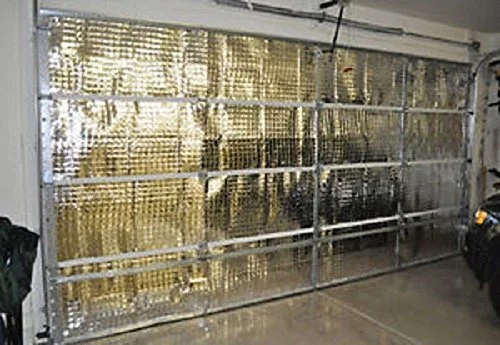
NASA TECH Reflective Garage Door Insulation Kit (16' x 8')
Pros
- R-8 reflective core cuts both summer heat gain and winter heat loss through the single biggest thermal leak in most garages — the door
- Doubles as sound dampening, useful for early-morning or late-night sessions
- Straightforward install with included tape and trimming tools
- Made in the USA with a durable, waterproof foam core
Cons
- Sized specifically for a 16' x 8' door — measure carefully or you'll be trimming a lot of excess
- Only treats the door; walls and ceiling still need separate insulation in unfinished garages
- Won't fully solve sustained sub-freezing or 100°F+ conditions on its own — pair with active heating or cooling
The garage door is the largest uninsulated surface in most garage gyms, and it’s usually the first thing to fix. The NASA TECH kit uses a reflective foam core rated at R-8, which does two jobs at once: it reflects radiant heat back into the garage in winter, and it reflects outside radiant heat away from the garage in summer. That’s a meaningful upgrade over an uninsulated steel or aluminum door, which transfers outside temperature almost directly inside.
Installation is a few hours with the included double-sided tape and trim tools — no contractor needed. The kit is sized for a standard 16-foot two-car door, so measure before ordering; odd-sized or sectional doors may need trimming or a different kit size.
The honest limit here: insulation slows heat transfer, it doesn’t generate heat or cooling. In a genuinely cold climate or a 100°F+ summer, this kit needs to be paired with the heater or cooler below. But as the first purchase in a temperature-control setup, it’s the one with the best cost-to-impact ratio.
Mr. Heater 18,000 BTU Big Buddy PRO Series — Best for Cold Garages
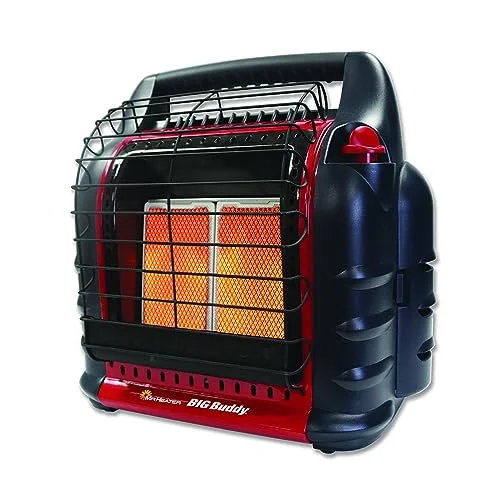
Mr. Heater 18,000 BTU Big Buddy PRO Series Heater
Pros
- Rated safe for indoor use, unlike most propane heaters, with no smoke or exhaust smell
- Radiant heat plus a built-in fan can bring a 20'x20' garage from the low 50s to the high 60s in about 20 minutes
- Automatic low-oxygen and tip-over shutoffs are essential safety features around barbells and racks
- Piezo ignition lights instantly with no matches or electrical hookup needed
Cons
- Burns through small 1 lb propane bottles fast under continuous use during a full session
- Radiant (non-forced-air) heat concentrates around the unit rather than evenly filling a large garage
- All-day comfort requires a 20 lb tank and hose adapter, an extra ~$40 not included in the box
Most propane heaters are outdoor-only for a reason — carbon monoxide buildup in an enclosed space is a real risk. The Big Buddy is one of the few built with a low-oxygen sensor and tip-over shutoff that make it rated safe for indoor use, which is the whole reason it shows up in garage gym setups instead of a construction-site torpedo heater.
At the top 18,000 BTU setting, owners report it can bring a 20-foot by 20-foot garage from the low 50s into the high 60s in around 20 minutes — fast enough that you’re not standing around shivering through a warmup set. The radiant heat pattern means it heats what’s directly in front of it more than it evenly fills a large space, so positioning matters: put it where you’re actually training, not in a corner.
Fuel cost is the real ongoing consideration. The small 1 lb bottles it ships to use are convenient but burn through quickly under sustained use — budget for a 20 lb tank and the separate hose adapter (about $40) if you’re heating a full session multiple times a week rather than just taking the edge off before a quick lift.
Hessaire MC18M Portable Evaporative Cooler — Best for Hot Garages
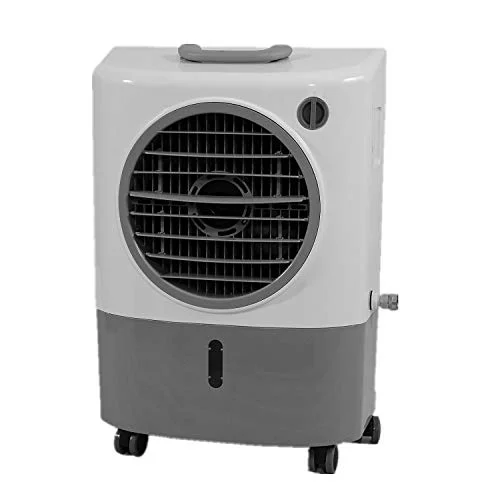
Hessaire MC18M Portable Evaporative Cooler
Pros
- Drops garage temperatures noticeably in dry climates for a fraction of a portable AC's power draw
- Compact and wheeled, so it's easy to reposition between a squat rack and a treadmill
- Quieter than expected on the low setting for a unit this size
- No refrigerant or complex install — fill the reservoir and plug it in
Cons
- Loses most of its cooling effect in humid climates, since evaporative cooling depends on dry air
- 4.5-gallon reservoir only lasts 3–4 hours on high before needing a refill
- No oscillation feature, so airflow stays pointed in one fixed direction
- Mineral buildup in the reservoir requires regular cleaning to keep it running efficiently
Evaporative (“swamp”) cooling works by pulling air through water-soaked pads, and it’s dramatically cheaper to run than a portable air conditioner because it skips the compressor entirely. The catch — and it’s a real one — is that it only works well in low-humidity climates. If you’re training somewhere hot and dry, the MC18M pulls real heat out of a 500 sq ft space; if you’re somewhere hot and humid, it barely helps and can make the air feel stickier.
For the climates where it’s a fit, it’s a strong value. The unit is compact and wheeled, quieter than its size suggests on the low setting, and needs nothing more than a water fill to run — no refrigerant, no professional install, no dedicated 240V outlet like some portable AC units require.
The 4.5-gallon reservoir is the main limitation for long sessions: on the high setting it runs dry in three to four hours, so plan on a midway refill for extended garage time, and budget for periodic tank cleaning to keep mineral buildup from reducing airflow over time.
hOmeLabs 8 Pint Wi-Fi Dehumidifier — Best for Humidity Control
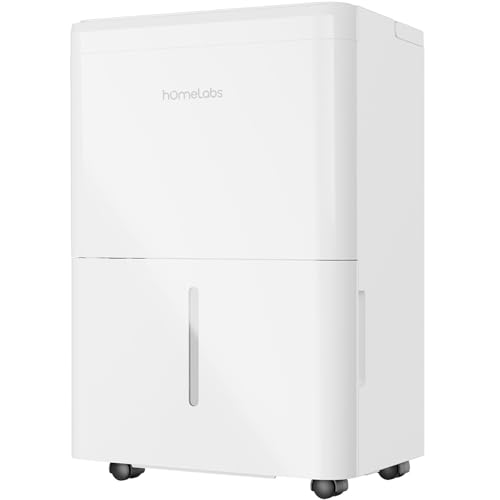
hOmeLabs 8 Pint Wi-Fi Dehumidifier
Pros
- Continuous drain hose means no manually emptying a tank in an unattended garage
- Quiet 38 dB operation won't drown out music or a rowing machine
- Wi-Fi app lets you check garage humidity remotely before condensation starts rusting barbells and plates
- Auto shutoff prevents overflow if the drain hose gets kinked
Cons
- 8-pint daily capacity is modest for genuinely humid climates or below-grade garages
- Some owners report durability issues developing after a couple of years of daily use
- Wi-Fi setup adds a setup step for buyers who just want a plug-and-run unit
Temperature swings are the actual mechanism behind most garage gym rust problems, not just cold air by itself. When a garage heats up during the day and cools at night — or when a propane heater or evaporative cooler changes the air quickly — condensation forms on cold steel. That moisture is what corrodes barbell sleeves, chrome plates, and rack uprights over a season, not the temperature reading on its own.
The hOmeLabs unit handles that with a continuous drain hose, so it doesn’t need to be checked and emptied daily the way tank-only dehumidifiers do. At 38 dB it runs quietly enough to sit in the corner during a session, and the Wi-Fi app lets you check garage humidity from inside the house before deciding whether a session is worth the drive out to a damp garage.
Its 8-pint daily rating is adequate for a typical single-car garage but modest for a genuinely humid basement-adjacent space — lifters in consistently muggy climates may find themselves wanting a higher-capacity unit. A handful of owners also report the unit’s durability tapering off after a couple of years of daily use, which is worth factoring into the price relative to a more industrial dehumidifier.
Rubber-Cal Recycled Rubber Flooring — Best Temperature-Tolerant Flooring
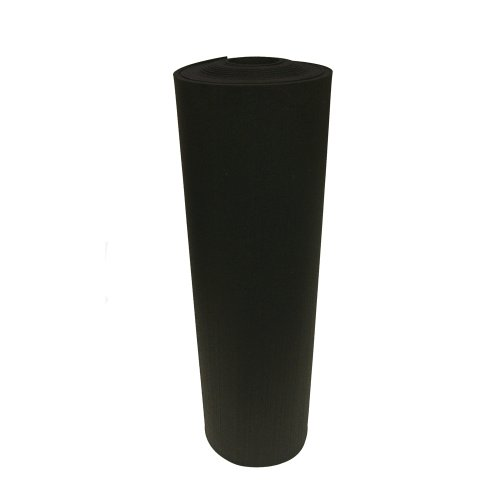
Rubber-Cal Recycled Rubber Home Gym Flooring (144 sq ft)
Pros
- Recycled rubber tolerates temperature swings without cracking, warping, or going brittle in the cold
- Gets more slip-resistant when damp, which matters in a condensation-prone garage
- Interlocking rolls install without adhesive or a full weekend of labor
- Dense 1/4" material absorbs impact from dropped plates and dumbbells
Cons
- Strong rubber odor for the first one to two weeks, worse in an enclosed, poorly ventilated garage
- Higher upfront cost than foam tiles for the same square footage
- Direct sunlight through garage windows can fade the black finish over time
Cheap foam interlocking tiles are the most common garage gym flooring, and they’re also the ones most likely to crack in the cold or go soft and dent-prone in extreme heat. Recycled rubber handles both ends of the range without the same structural breakdown — it stays flexible in the cold instead of turning brittle, and it holds its shape under a hot garage’s summer temperatures.
The bonus for a temperature-swing garage specifically: rubber gets more slip-resistant, not less, when it’s damp. In a garage prone to condensation, that’s a real safety upgrade over foam tile, which can get slick.
The trade-off buyers should plan for is odor. Recycled rubber off-gasses for the first one to two weeks after installation, and that smell is noticeably stronger in a fully enclosed garage with the door shut than in a well-ventilated one. Cracking the garage door for the first several days speeds up the process. It also costs meaningfully more than foam tile for the same square footage, and direct sun through garage windows will fade the black surface over years of exposure.
ThermoPro TP50 Digital Hygrometer — Best Value
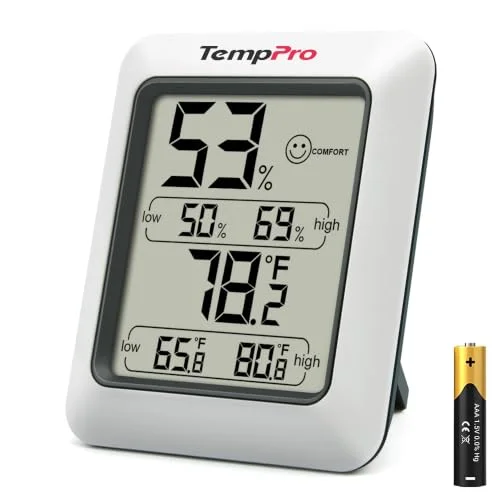
ThermoPro TP50 Digital Hygrometer & Indoor Thermometer
Pros
- Gives an at-a-glance read on whether the garage is actually in a safe range for training and for the equipment sitting in it
- Magnetic back and stand mount let it live on a steel rack upright or a metal door
- Updates every 10 seconds, fast enough to track a heater or cooler actually working
- Costs less than a single propane bottle for the heater above
Cons
- Humidity readings can drift a few percentage points off true value over time
- No outdoor sensor or app connectivity for remote monitoring
- Small LCD has no backlight, hard to read in a dim garage
This is the cheapest item on the list and arguably the most useful first purchase. Before spending $100-plus on a heater, cooler, or dehumidifier, a $10 hygrometer tells you what your garage is actually doing — what temperature it sits at overnight, how humid it gets after a hot day, whether a heater or cooler you already bought is making a measurable difference.
The TP50 updates every 10 seconds, which is fast enough to watch it respond in real time when a heater kicks on. It mounts with either a magnetic back — handy for sticking directly to a steel rack upright — or a small tabletop stand.
It’s not lab-grade equipment. Owners report humidity readings can drift a few percentage points from a true reference over time, and there’s no app or outdoor sensor for remote tracking the way the dehumidifier above offers. For the price, it’s still the easiest way to stop guessing about garage conditions.
Buying Guide: What to Actually Buy for Your Climate
Start With Insulation, Not Equipment
The instinct is to buy a heater or a cooler first. The better order is insulation first, because it reduces how hard any heating or cooling device has to work — and how much you spend running it. The garage door is the biggest opening; the NASA TECH kit or an equivalent reflective kit addresses it directly. Unfinished walls and ceilings lose more over time but cost more to fix properly, so they’re a phase-two project for most garage gym owners.
Match the Device to Your Actual Climate
Evaporative coolers only work in dry climates — humid-climate buyers should look at a standard portable or window AC unit instead, even though it costs more to run. Propane heaters like the Big Buddy work in any climate but need ventilation awareness and a fuel budget. There’s no single device that solves both hot and cold; most garage gym owners in seasonal climates end up owning both a heater and a cooling solution, used at different times of year.
Humidity Control Protects Your Equipment, Not Just Your Comfort
A dehumidifier doesn’t make training more pleasant the way a heater or cooler does — its job is protecting the steel you already own. Barbells, plates, and rack uprights left in a garage that swings 30-plus degrees between day and night will rust faster than the same equipment in a stable indoor gym. If you’ve already invested in a quality rack or barbell, a dehumidifier is cheap insurance on that purchase.
Flooring Choice Compounds Over Time
Foam tiles are the cheapest flooring option and they’re fine in a climate-controlled space. In a garage that swings from freezing to over 100°F seasonally, that temperature cycling is what eventually cracks foam tile at the seams. Recycled rubber costs more upfront but doesn’t have that failure mode, which matters more the longer you plan to train in that space.
Monitor Before You Spend More
A $10 hygrometer answers the question that determines everything else on this list: how bad is the problem, actually? A garage that dips to 45°F for a few weeks a year needs a different solution than one that sits below freezing for months. Measure first.
Frequently Asked Questions
Does cold weather actually damage home gym equipment?
Yes, indirectly. Extreme cold can thicken the grease inside barbell sleeves, making bars spin sluggishly or seize up. The bigger issue is condensation: when equipment warms and cools with the garage, moisture forms on cold steel and accelerates rust on bars, plates, and rack uprights. A dehumidifier and stable temperature control address the actual cause more than cold air alone.
Is a propane heater safe to use in an enclosed garage?
Most propane heaters are rated outdoor-only because of carbon monoxide risk in enclosed spaces. Models like the Mr. Heater Big Buddy are specifically built and rated for indoor use, with a low-oxygen sensor and automatic tip-over shutoff. Even with an indoor-rated heater, cracking a window or door for airflow is good practice during a session.
Will an evaporative cooler work in a humid climate?
No, not effectively. Evaporative cooling depends on dry air to work — it adds moisture to the air as it cools, which is a non-issue in a dry climate but makes a humid garage feel stickier without meaningfully lowering the temperature. Humid-climate buyers should look at a standard AC unit instead.
What’s the cheapest way to make a garage gym usable year-round?
Reflective garage door insulation is the lowest-cost, highest-impact first step, typically well under $150. Pair it with a $10 hygrometer to track actual conditions before deciding whether a heater, cooler, or dehumidifier is worth adding next.
Does garage gym flooring need to be temperature-rated?
Not strictly, but standard foam interlocking tiles are more prone to cracking and seam failure after repeated temperature cycling than recycled rubber. If you’re training in a garage that swings from near-freezing to over 100°F seasonally, rubber flooring holds up longer than foam over multiple years.
The Verdict
Start with the NASA TECH Reflective Insulation Kit — it’s the cheapest fix with the broadest impact, reducing the load on any heater or cooler you add later. Cold-climate lifters should add the Mr. Heater Big Buddy next; it’s one of the few propane heaters actually safe for indoor use and it works fast. Hot, dry-climate lifters should look at the Hessaire MC18M instead for a fraction of a portable AC’s running cost.
Regardless of climate, the hOmeLabs Dehumidifier is the purchase most likely to save you money long-term — it protects the barbell, plates, and rack you’ve already paid for from the condensation that actually causes rust. Round it out with Rubber-Cal rubber flooring if you’re replacing foam tile, and put the ThermoPro TP50 on the wall before buying anything else so you know exactly what problem you’re solving.