Most home gym buying guides assume a standard build: an 82” rack, a 55” treadmill deck, a bench sized for an average frame. None of that accounts for a buyer over 6’2”, where ceiling clearance, deck length, rail travel, and pad length stop being nice-to-haves and start being the difference between equipment that works and equipment you outgrow immediately. Ceiling height is the constraint that trips up the most buyers in 2026: most racks run 82” to 86” tall, and once you add 6” of pull-up clearance on top of that, you need at least 8 feet of usable ceiling before a standard rack with an integrated pull-up bar even fits — a number the average garage ceiling clears, but only barely.
This guide covers seven pieces of equipment picked specifically for fit rather than price or brand recognition: a low-footprint power rack that still hits 91” of height, a rower with enough rail travel for a long torso, a treadmill with a deck long enough for a real stride, an adjustable bench with an extended pad, a ceiling-mounted pull-up bar sized for a wider wingspan, and two complementary pieces — a barbell and adjustable dumbbells — that round out a rack-based setup.
Comparison
| Spec | Titan Fitness T-3 Series Wall Mounted Folding Power Rack (91") | Concept2 RowErg Model D with PM5 Monitor | Horizon Fitness 7.0 AT Treadmill | FLYBIRD WB5 Adjustable Weight Bench | Titan Fitness Ceiling Mounted Multi-Grip Pull-Up Bar | CAP The Boss 7ft Olympic Barbell (1,500 lb Capacity) | BowFlex Results Series 552 SelectTech Dumbbells (Pair) |
|---|---|---|---|---|---|---|---|
| Rating | 8.8/10 | 9.1/10 | 8.4/10 | 8.5/10 | 8.2/10 | 8.0/10 | 8.6/10 |
| Price | $449.99as of Oct 11, 2026 | Check price | Check price | $149.98as of Oct 11, 2026 | $166.99as of Oct 11, 2026 | $129.08-$160.00as of Oct 11, 2026 | $328.98as of Oct 11, 2026 |
| Height | 91" | — | — | — | — | — | — |
| Depth | 21" (folds flat against wall when not in use) | — | — | — | — | — | — |
| Steel | 2x3" 11-gauge uprights | — | — | — | — | — | — |
| Weight Capacity | 1,000 lbs | — | — | — | — | — | — |
| Pull-Up Bar | Included | — | — | — | — | — | — |
| Mounting | Wall-mounted, requires stud anchoring | — | — | — | Ceiling joists (16" or 24" spacing) | — | — |
| Rail | — | Aluminum I-beam monorail with stainless steel track | — | — | — | — | — |
| Seat Height | — | 14" | — | — | — | — | — |
| Monitor | — | PM5 Performance Monitor | — | — | — | — | — |
| Warranty | — | 2-year parts, 5-year frame | — | — | — | — | — |
| Footprint | — | Splits in two for storage | — | — | — | — | — |
| Track Record | — | Best-selling rowing machine worldwide for over 40 years | — | — | — | — | — |
| Deck | — | — | 60" x 20" — 5" longer than most consumer decks | — | — | — | — |
| Cushioning | — | — | 3-Zone Variable Response | — | — | — | — |
| Controls | — | — | QuickDial speed and incline adjustment | — | — | — | — |
| Connectivity | — | — | Bluetooth, Apple Watch sync, compatible with Peloton/Strava/Zwift apps | — | — | — | — |
| Speakers | — | — | Built-in | — | — | — | — |
| Weight Rating | — | — | — | 800 lbs, ASTM-certified | — | — | — |
| Backrest | — | — | — | 30" extended length | — | — | — |
| Angle Range | — | — | — | 90° to -30° (flat, incline, decline) | — | — | — |
| Adjustment | — | — | — | Spring-lock, 1-second angle change | — | — | Dial-based, dock-and-turn |
| Design | — | — | — | Foldable, reduces footprint by roughly 80% | — | — | — |
| Length | — | — | — | — | 50" | 7 ft (standard Olympic) | — |
| Ceiling Drop | — | — | — | — | 16" from the ceiling | — | — |
| Grip Options | — | — | — | — | Multiple, powder-coated knurled steel | — | — |
| Style | — | — | — | — | Monkey-bar / multi-grip | — | — |
| Capacity | — | — | — | — | — | 1,500 lbs | — |
| Series | — | — | — | — | — | Pro Series | — |
| Sleeves | — | — | — | — | — | Rotating | — |
| Use Case | — | — | — | — | — | Squats, deadlifts, bench, Olympic lifts, powerlifting | — |
| Weight Range | — | — | — | — | — | — | 5-52.5 lbs per dumbbell |
| Increments | — | — | — | — | — | — | 2.5 lb steps |
| Replaces | — | — | — | — | — | — | Up to 15 pairs of fixed dumbbells |
| Check Price → | Check Price → | Check Price → | Check Price → | Check Price → | Check Price → | Check Price → |
Prices change daily — tap Check Price for the current Amazon price. Numbers shown were verified on the "as of" date.
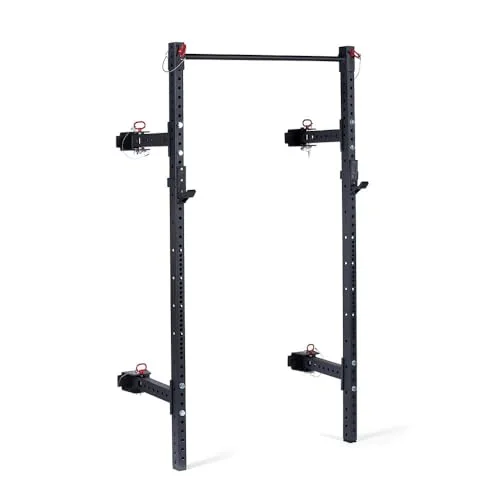
Titan Fitness T-3 Series Wall Mounted Folding Power Rack (91")
Pros
- 91" of usable height gives a 6'2"+ lifter real clearance for a strict overhead press without ducking under the top crossmember
- Folds flat against the wall in seconds, which matters more for tall lifters who tend to also need more floor space to move around the rack
- 11-gauge steel uprights are a genuine step up from the 14-gauge racks that dominate the entry-level bracket
- J-hooks and a pull-up bar ship in the box, so there's no separate attachment order before the first workout
- Wall-mounted design frees up floor space a taller lifter needs for setup room on deadlifts and rows
Cons
- Needs to land on wall studs rated for the anchoring hardware — not a fit for every garage wall
- 21" depth is shallow for a wide sumo stance or storing loaded bars against the rear uprights
- Folding hardware is one more moving part to maintain versus a fixed freestanding cage
- A pull-up bar built into a 91" rack still needs roughly 8' of ceiling height to avoid clipping the top on a dead hang
The T-3’s 91” height is the number that matters here — it’s 5” to 9” taller than the standard racks most buyers default to, and that gap is exactly what a 6’2”+ lifter needs to clear a strict overhead press or a kipping pull-up without the top crossmember getting in the way. Because it’s wall-mounted and folds flat, it also solves a problem tall lifters run into more than most: needing extra floor space to move around the rack during setup, not just extra height above it.
The tradeoff is depth. At 21”, this isn’t the rack for a wide sumo stance or storing loaded bars against the rear posts — it’s built to maximize vertical clearance in a footprint that folds away, not to be the deepest cage on the market. It also needs to land on studs rated for the anchor hardware, so confirm your wall construction before ordering.
One clearance note that applies regardless of which rack you buy: a 91” rack still needs roughly 8 feet of ceiling height to give a dead hang on the pull-up bar real room. Measure your ceiling, not just the rack’s box dimensions, before you commit.
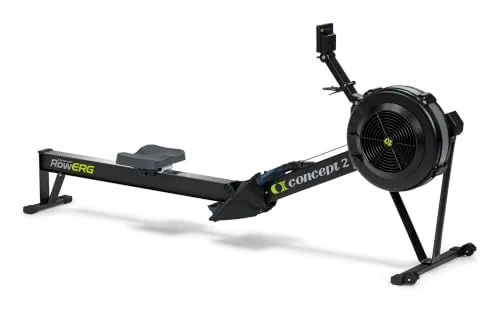
Concept2 RowErg Model D with PM5 Monitor
Pros
- The monorail seat travel is long enough that a 6'5"+ rower isn't compressing the catch position the way shorter rails force
- PM5 monitor tracks split times, distance, and calories with the accuracy competitive rowers train against
- 14" seat height and a stainless steel track keep the stroke smooth instead of gritty after months of sweat exposure
- Splits into two pieces for storage, which matters for a taller lifter's garage gym where floor space is already tight
- 5-year frame warranty reflects a design that's stayed functionally unchanged because it already works
Cons
- Amazon doesn't consistently show a live price on this listing — confirm current cost before ordering
- No incline or resistance curve customization beyond the flywheel's air resistance, unlike magnetic rowers
- Assembly takes real time even though it's straightforward — budget 30-45 minutes
- Flywheel air resistance means noise scales with effort, which is louder than a magnetic rower at max pace
Rowing machines get overlooked in most “tall lifter” equipment guides, but the catch position is one of the more cramped positions in a home gym for a long-legged athlete. The Model D’s aluminum monorail gives enough seat travel that a 6’5”+ rower isn’t compressing their catch the way a shorter rail forces, and the 14” seat height keeps the stroke mechanically sound rather than forcing an awkward knee angle.
The PM5 monitor is the same unit used in competitive rowing programs, which means the pace and split data you’re training against is accurate rather than an approximation. The frame’s 5-year warranty and 40-year production history aren’t marketing claims — this design has stayed functionally the same because the engineering already worked the first time.
The one catch: Amazon doesn’t consistently show a live price on Concept2 listings, so confirm current cost on the listing itself before ordering. It’s also worth budgeting real assembly time, even though the process itself is straightforward.
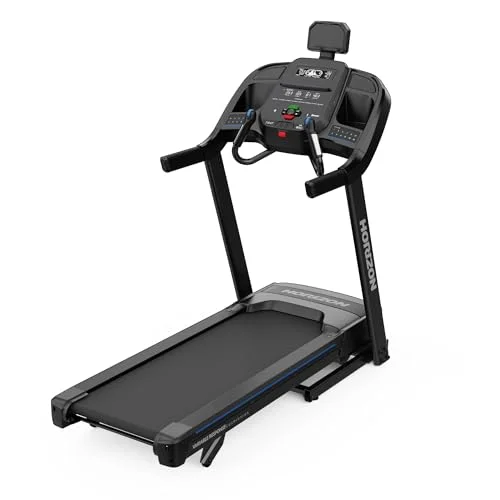
Horizon Fitness 7.0 AT Treadmill
Pros
- 60" deck length gives a long-strided runner real margin before their foot strike reaches the end of the belt
- QuickDial controls let you change speed or incline mid-stride without breaking cadence to hunt for a button
- 3-Zone Variable Response cushioning is tuned differently at the heel-strike zone than the push-off zone
- Apple Watch sync and app compatibility with Peloton, Strava, and Zwift means it slots into an existing training setup
- Built-in speakers remove one more cable or dongle from the equation for treadmill workouts
Cons
- Live Amazon pricing wasn't confirmed at publish — check the current listing before ordering
- 60" is longer than average but still tight for runners well over 6'6" at a full sprint stride
- Heavier and longer than a standard treadmill, so measure your doorway and stairwell before delivery
- App compatibility with Peloton, Strava, and Zwift requires separate subscriptions to those services
A 55” treadmill deck — the consumer standard — puts a tall runner’s foot strike uncomfortably close to the end of the belt at anything approaching a real stride. The Horizon 7.0 AT’s 60” x 20” deck buys back that margin, and the 3-Zone Variable Response cushioning is tuned differently at heel-strike than at push-off, which matters more the longer and heavier a stride gets.
QuickDial controls are a small detail that matters in practice: changing speed or incline mid-run without hunting for a button means a tall runner with a longer natural cadence isn’t breaking stride to make an adjustment. Bluetooth and Apple Watch sync, plus compatibility with Peloton, Strava, and Zwift, mean it slots into a training setup that already exists rather than forcing a new one.
Confirm live pricing before ordering — this listing doesn’t always show a current number — and measure doorways and stairwells before delivery, since a 60” deck comes with a longer, heavier unit than a standard treadmill.
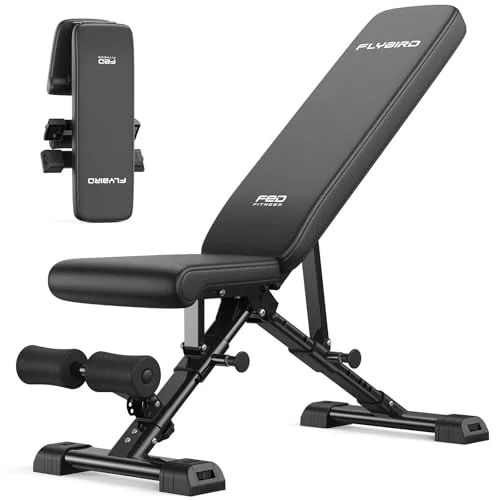
FLYBIRD WB5 Adjustable Weight Bench
Pros
- 30" extended backrest supports a taller lifter's shoulders and head through a full incline press set instead of running out of pad
- 800 lb ASTM-certified rating means the frame isn't the limiting factor even for a heavier tall lifter loading up dumbbells
- Spring-lock adjustment changes angle in about a second, which matters mid-superset when you're not stopping to fight a pin
- Folds down small enough to lean against a wall, useful once a tall power rack and treadmill have already claimed floor space
- 90° to -30° range covers flat, incline, and decline work from one bench instead of buying separate units
Cons
- Extended pad length still leaves the bench relatively narrow — wider-framed lifters may want more shoulder support
- Foldable hinge points are one more wear item versus a fixed, welded bench frame
- Vinyl upholstery over foam padding is common at this price point and wears faster than commercial-grade pads
- No leg extension or preacher curl attachment included
A short backrest is one of the more common ways an adjustable bench fails a taller lifter — the pad ends before your shoulders do, and a strict incline press turns into an awkward, unsupported movement. The WB5’s 30” extended backrest solves that directly, and the 800 lb ASTM-certified rating means the frame isn’t the limiting factor even loaded up with heavy dumbbells.
Spring-lock adjustment changes the angle in about a second, which is a real difference mid-superset compared to benches that need a pin fought into place. The fold-down design also matters once a tall rack and a long treadmill have already claimed most of the floor space — this bench can lean against a wall between sessions instead of permanently occupying square footage.
It’s a value-tier bench, not a commercial one: vinyl upholstery over foam wears faster than a commercial pad, and there’s no leg extension or preacher curl attachment if your programming calls for one.
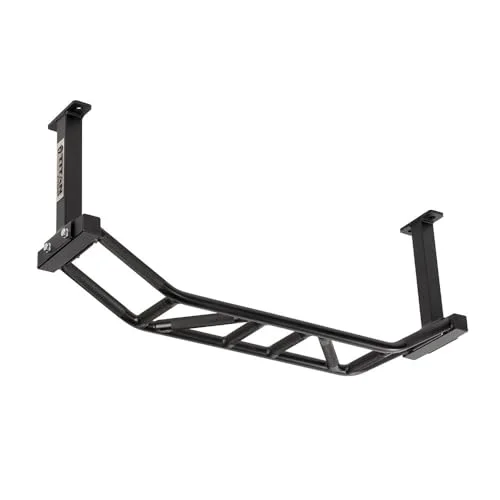
Titan Fitness Ceiling Mounted Multi-Grip Pull-Up Bar
Pros
- Mounting to the ceiling instead of a wall or rack gives a tall lifter a full dead hang without a floor-mounted frame in the way
- 50" bar length fits a wide grip that a taller wingspan actually needs, versus the narrower bars built into compact racks
- Multiple knurled grip positions let you rotate hand position across sets without re-gripping awkwardly
- Powder-coated steel holds up to sweat and chalk without the grip wearing smooth after a season of use
- Frees up the power rack for barbell work instead of tying it up for every pull-up set
Cons
- Requires exposed ceiling joists at the right spacing — finished ceilings need stud-finding and patchwork after install
- 16" ceiling drop plus your ceiling height determines your actual dead-hang clearance — measure before ordering
- Installation is a two-person job with a stud finder and lag bolts, not a five-minute assembly
- No adjustability once mounted — the drop height and position are fixed
Pull-up bars built into compact racks are almost always narrower than a taller lifter’s wingspan wants, which is the case for a ceiling-mounted bar instead. Titan’s version gives a 50” bar length — wide enough for a genuinely wide grip — and mounting it to the ceiling rather than a wall or rack frees up the power rack for barbell work instead of tying it up for every set of pull-ups.
The multi-grip knurled steel lets you rotate hand position across sets, which reduces the repetitive strain of doing every rep at one fixed grip width. It’s a two-person installation job, though — you need exposed ceiling joists at the right spacing, a stud finder, and lag bolts, and a finished ceiling means patchwork after mounting.
The math that matters before ordering: this bar drops 16” from the ceiling, so subtract that from your actual ceiling height to know what dead-hang clearance you’re really getting.
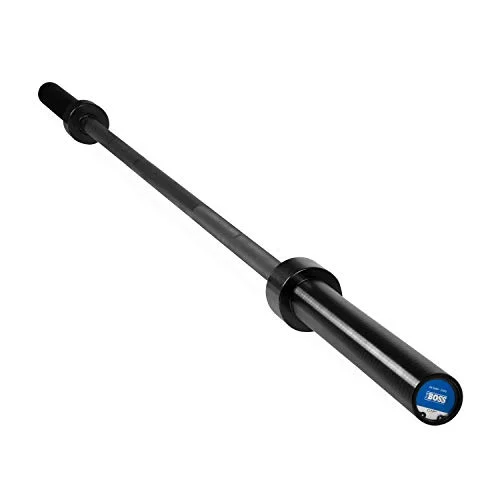
CAP The Boss 7ft Olympic Barbell (1,500 lb Capacity)
Pros
- Standard 7ft length gives a taller lifter the same full-width grip options as any commercial gym bar
- 1,500 lb capacity leaves headroom well past what a home gym barbell setup will realistically load
- Rotating sleeves reduce wrist stress on Olympic-style pulls compared to a fixed-sleeve bar
- Works with the T-3 rack above without any compatibility issues — standard Olympic sleeve diameter throughout
- Reasonable price point for a lifter who already spent on the rack and needs a bar that won't be the weak link
Cons
- Doesn't publish a tensile PSI rating the way premium competition bars do, so whip and rebound feel are more generic
- Finish is functional rather than premium — expect a workhorse bar, not a showpiece
- Rotating sleeve bushings aren't the same as ball bearings found on Olympic-lifting-specific bars
- Height doesn't actually change bar spec — this is the standard length every lifter uses, tall or not
A rack is only as good as the bar in it, and CAP’s 7ft Olympic bar is the practical, budget-conscious complement to the T-3 above. Standard Olympic length and sleeve diameter mean it works with the rack, the plates, and the collars you already own without any compatibility questions, and the 1,500 lb capacity leaves real headroom past anything a home gym setup will load onto it.
It doesn’t publish a tensile PSI rating the way premium competition bars do, so don’t expect the same whip and rebound feel as a $300+ bar — this is a workhorse, not a showpiece. Worth noting: bar length doesn’t scale with lifter height. A 7ft Olympic bar is the standard for every lifter, tall or not — what changes for a taller lifter is everything around the bar, not the bar itself.
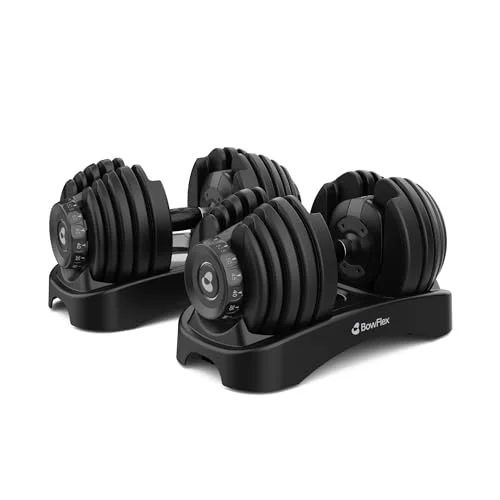
BowFlex Results Series 552 SelectTech Dumbbells (Pair)
Pros
- Dial adjustment swaps weight in seconds, which matters when a tall power rack and bench have already eaten most of the floor space
- 5 to 52.5 lb range covers warmup sets through heavy accessory work from one compact pair
- Replacing up to 15 pairs of fixed dumbbells solves the storage problem a tall lifter's larger equipment footprint creates
- Dock-and-turn mechanism doesn't require bending to swap plates the way manual adjustable dumbbells do
- Well-established design with a long track record and widely available replacement parts
Cons
- $399 is a real expense for a single pair of dumbbells versus a full fixed-weight rack
- Dial mechanism is a moving part that can wear or stick over years of heavy use
- Handle length and grip diameter are fixed — larger hands don't get a different size option
- 52.5 lb top end is a ceiling that stronger lifters will outgrow for compound dumbbell movements
The last piece of this build addresses a problem specific to tall lifters: once a 91” rack, a 60” treadmill, and a rowing machine have claimed the floor, there often isn’t room left for a full fixed-weight dumbbell rack. The BowFlex 552’s dial system replaces up to 15 pairs of dumbbells in the footprint of one, covering a 5 to 52.5 lb range in 2.5 lb increments without bending down to swap plates.
At $399 it’s a real expense for one pair of dumbbells, and the 52.5 lb top end is a ceiling that a stronger lifter doing heavy compound dumbbell work will eventually outgrow. For accessory work and warmups in a space-constrained tall-lifter setup, it’s the practical trade against a full rack of fixed weights.
What Actually Changes When You’re Buying Tall
Ceiling height governs the rack decision before anything else. Most racks run 82” to 86” tall; add roughly 6” for pull-up clearance and you need at least 8 feet of usable ceiling for a standard rack with an integrated bar. If your ceiling is under 8 feet, a shorter rack without a built-in pull-up bar — paired with a separate wall or ceiling-mounted bar — is the safer route than forcing a tall rack into a space that can’t clear it.
Deck and rail length matter more than horsepower on cardio equipment. A longer stride or a longer torso needs more physical distance to move through, full stop. Check the deck length spec on a treadmill and the rail travel on a rower before looking at motor power or resistance type — a underpowered machine with the right dimensions beats an overpowered one that’s too short to use properly.
Bench pad length is an easy spec to overlook. A short backrest doesn’t fail gracefully — it just stops supporting you mid-rep. Look for benches that specifically advertise an extended backrest length rather than assuming “adjustable” implies “long enough.”
Bar length doesn’t change with lifter height. A 7ft Olympic bar is the standard regardless of how tall you are — resist the urge to think you need a longer barbell. What actually needs to scale with height is the equipment you’re moving the bar through, not the bar itself.
Mounting location can substitute for rack height. A ceiling-mounted pull-up bar solves the same problem as a taller rack — full dead-hang clearance — without needing the rack itself to be taller, which is often the more practical fix in a space with limited ceiling height.
FAQ
How much ceiling height do I actually need for a home gym as a tall lifter?
At minimum 8 feet if you want a rack with an integrated pull-up bar — that’s roughly 82” to 86” of rack height plus 6” of dead-hang clearance. If your ceiling is under 8 feet, drop the built-in pull-up bar from your rack choice and add a separate ceiling or wall-mounted bar in a spot with more clearance, or skip overhead pull-up work at the rack entirely.
Do I need a longer barbell if I’m over 6’2”?
No. Standard Olympic bars are 7 feet regardless of lifter height — that length is set by grip width and loading needs, not by how tall you are. What should change for a taller lifter is the rack depth, bench length, and cardio equipment dimensions around the bar, not the bar itself.
Is a wall-mounted rack a worse choice than a freestanding one for a tall lifter?
Not inherently — it’s a tradeoff. A wall-mounted rack like the T-3 above gives you height without sacrificing floor space, which matters when a taller lifter’s other equipment (treadmill, rower, bench) is already competing for room. A freestanding rack typically offers more interior depth for a wide stance, so the right choice depends on whether your constraint is height, depth, or floor space.
How do I know if a rowing machine’s rail is long enough for my height?
Sit at full extension in the catch position on the spec sheet’s stated rail length or, better, test in person if possible. The Concept2 Model D accommodates most rowers up to roughly 6’6” comfortably because of its monorail length — if you’re notably taller than that, check the manufacturer’s specific height guidance before buying.
Should I buy a shorter rack and a separate pull-up bar instead of one tall rack?
If your ceiling is under 8 feet, yes — that combination is often the more practical fix than trying to fit a tall integrated rack into a space that can’t clear it. If your ceiling comfortably clears 8 feet, an integrated pull-up bar on a tall rack saves you a second mounting project.
Conclusion
The Titan T-3 91” rack earns the top spot because it solves the specific problem that trips up tall lifters first — ceiling clearance — without demanding a bigger floor footprint to do it. Pair it with the Concept2 Model D for cardio days that don’t compress a long torso into a cramped catch position, and the Horizon 7.0 AT’s 60” deck for running sessions where a standard-length belt would cut a real stride short.
Round out the setup with the FLYBIRD bench for a backrest long enough to actually support your shoulders through an incline press, the ceiling-mounted pull-up bar for a wider grip than any rack-integrated bar offers, and the CAP barbell and BowFlex dumbbells to fill in barbell and accessory work without eating more floor space than you have. None of these are the most expensive options in their categories — they’re the ones sized for a body the standard spec sheet doesn’t default to.