Research comparing cable and dumbbell training published in 2026 found equivalent muscle growth over eight weeks when training volume was matched. That result hit gym forums hard and reignited a debate most home gym builders face early: cable machine or free weights? The honest answer is that both produce results — the right choice depends on your training goals, available space, budget, and whether you train alone or with a partner.
This comparison breaks down what each setup does best, where each falls short, and recommends a top pick in each category.
Quick Comparison
| Spec | Titan Fitness Plate-Loaded Functional Trainer | REP Fitness Arcadia Functional Trainer | Rogue Ohio Bar (Black Oxide) | Bowflex SelectTech 552 Results Series |
|---|---|---|---|---|
| Rating | 8.7/10 | 9.2/10 | 9.3/10 | 9.0/10 |
| Price | $1029.99as of Oct 18, 2026 | $2,200 | $320 | Check price |
| Type | Plate-loaded functional trainer | Dual-stack functional trainer | — | — |
| Load Capacity | 660 lb | — | — | — |
| Cable Capacity | 1,540 lb | — | — | — |
| Machine Weight | 178 lb | — | — | — |
| Included Attachments | Lat bar, dual stirrups, low row bar, tricep rope, ankle strap | — | — | — |
| Pull-Up Bar | Multi-grip included | — | — | — |
| Warranty | 1 year | Lifetime frame | Lifetime | 3 years residential |
| Cable Positions | — | 32 | — | — |
| Weight Stacks | — | Dual 170 lb (2:1 ratio) | — | — |
| Carriage Rating | — | 1,000 lb | — | — |
| Cable Ratio | — | 2:1 | — | — |
| Adjustment | — | 32 vertical positions per side | — | — |
| Weight | — | — | 20 kg (44 lb) | — |
| Shaft Diameter | — | — | 28.5 mm | — |
| Finish | — | — | Black Oxide | — |
| Bushings | — | — | Bronze | — |
| Tensile Strength | — | — | 190,000 PSI | — |
| Knurl Marks | — | — | Dual (IPF + IWF) | — |
| Loadable Sleeve | — | — | 16.4" | — |
| Weight Range | — | — | — | 5–52.5 lb per hand |
| Weight Settings | — | — | — | 15 |
| Increments | — | — | — | 2.5 lb (up to 25 lb), 5 lb above |
| Construction | — | — | — | Metal plates with dial selector |
| Footprint | — | — | — | Replaces 15 pairs of dumbbells |
| Stand | — | — | — | Optional (sold separately) |
| Check Price → | Check Price at REP Fitness → | Check Price at Rogue → | Check Price → |
Prices change daily — tap Check Price for the current Amazon price. Numbers shown were verified on the "as of" date.
Cable Machines: What They Do Best
Cable machines deliver constant tension through the full range of motion. A free weight is most loaded at specific joint angles — a dumbbell curl peaks at 90 degrees of elbow flexion with near-zero resistance at the top and bottom of the movement. A cable maintains load throughout, which changes the training stimulus and shifts where fatigue accumulates in the muscle.
The difference shows most clearly on isolation movements. Cable flyes, face pulls, tricep pushdowns, and cable rows produce a different stimulus than their free-weight equivalents because the cable stays taut through the entire rep. Owner feedback across functional trainer reviews consistently notes improved muscle activation on pushing and pulling movements compared to free weights alone.
The solo training safety advantage is real. If you fail mid-rep on a cable machine, you release the handle and the weights return to the stack. There’s no barbell overhead, no dumbbell to drop. For home gym athletes training without a spotter, this removes meaningful risk from every pressing and pulling movement.
Where cables fall short: Entry cost is higher than free weights even at the budget end. A functional trainer starts at $875 and still doesn’t replace barbell squats or deadlifts. Most cable-first home gyms eventually add free weights to complete their programming.
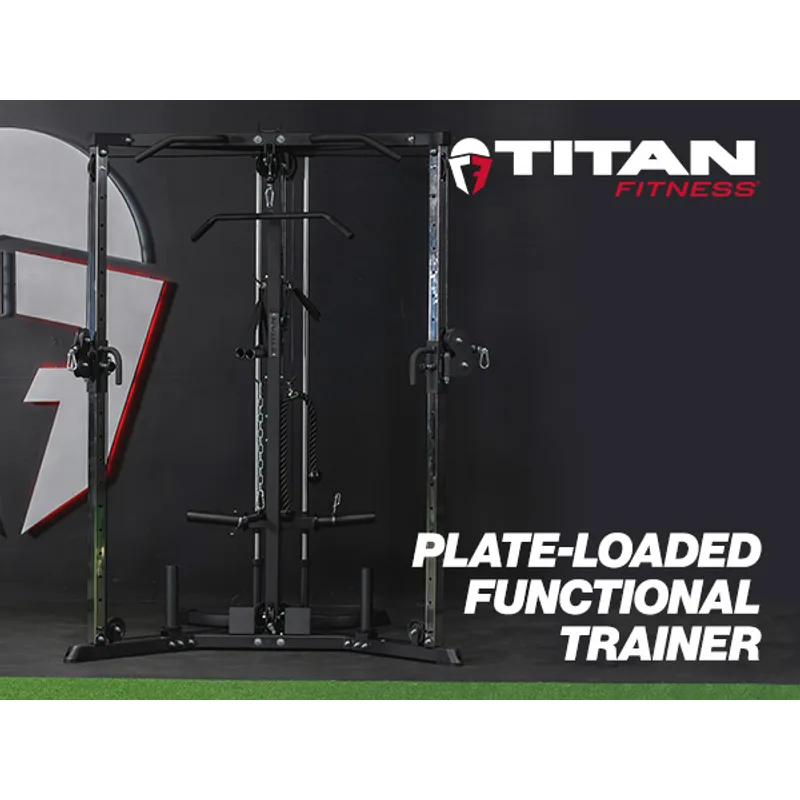
Titan Fitness Plate-Loaded Functional Trainer
Pros
- Plate-loaded design lets you match resistance to your strength level without hitting a stack ceiling
- 660 lb load capacity handles serious training without structural concerns
- Comes with six attachments — lat bar, stirrups, ankle strap, low row bar, tricep rope — ready to train immediately
- Integrated multi-grip pull-up bar adds a vertical pull station at no extra cost
- Under $900 on Amazon makes this the most accessible entry point for genuine cable training
Cons
- Weight plates sold separately — budget an extra $150-$300 depending on what you already own
- Plate changes between exercises require manual loading rather than a quick pin pull
- Assembly is time-consuming and benefits from a second person
- No weight stack markings means you need to track loaded weight yourself
The Titan Fitness Plate-Loaded Functional Trainer is the most accessible entry into cable training available on Amazon. At $875, it undercuts weight-stack functional trainers by $600 or more while covering most of the same exercise variety.
The plate-loaded design is a genuine tradeoff. You can load it as heavy as your available plates allow, and you’re not constrained by a manufacturer’s stack ceiling. The downside is manual weight changes between sets — no pin pull, just adding or removing plates. For straight-set strength work where you’re not changing weights mid-session, this is a non-issue. For supersets and drop sets, it creates friction.
Owner reports highlight the multi-grip pull-up bar as an unexpected value addition. Most functional trainers under $1,000 don’t include a dedicated pull-up station. The six included attachments — lat bar, stirrups, ankle strap, low row bar, tricep rope — cover the full range of cable movements without additional purchases at delivery.
The 178 lb assembled weight is reassuring without suggesting the unit will be difficult to position. At 660 lb rated load capacity and 1,540 lb cable capacity, this machine handles serious training demands.
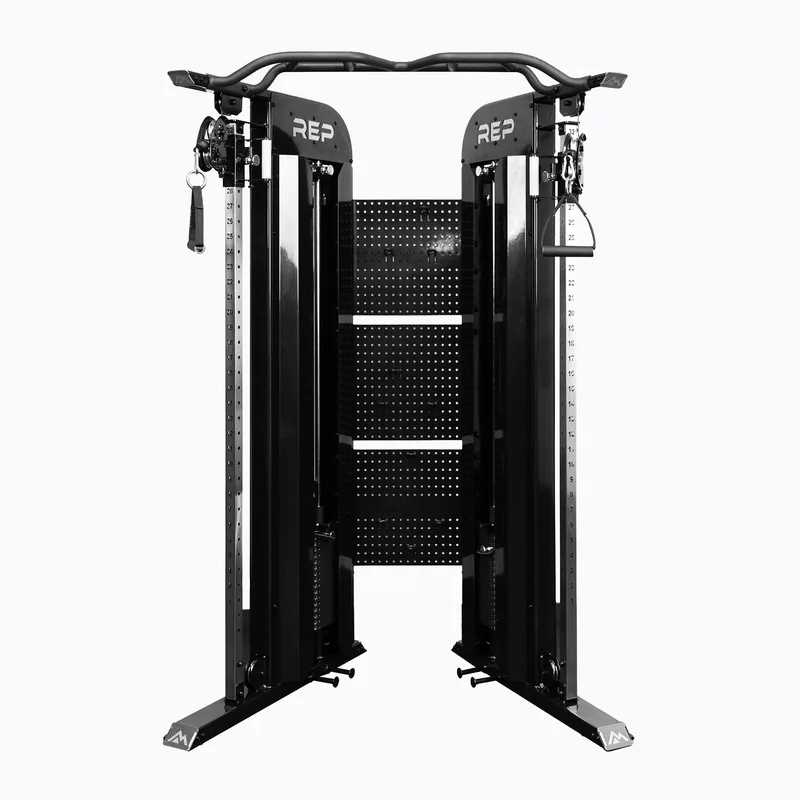
REP Fitness Arcadia Functional Trainer
Pros
- 32 cable positions allow angles no free weight can replicate — face pulls, cable flyes, woodchops, cable kickbacks
- Dual 170 lb stacks with 2:1 ratio cover a wide resistance range without plate swapping
- Weight selector pin makes rest-pause and drop sets fast — pull pin, set new weight, continue
- 1,000 lb carriage rating reflects commercial-grade structural integrity
- REP Fitness lifetime frame warranty covers the long-term investment
Cons
- Direct-only purchase through REP Fitness — no Amazon, no Prime delivery
- $2,200 is a significant commitment for a single piece of equipment
- Footprint requires careful space planning — allow for ceiling height and operator clearance
- Lead times can run several weeks depending on REP Fitness inventory
The REP Fitness Arcadia Functional Trainer is the cable machine choice for athletes who want a complete system without compromising on weight selection speed or range of motion variety. At $2,200, it costs significantly more than the Titan plate-loaded option, but the dual 170 lb weight stacks and 32 cable positions justify the premium for high-frequency cable training.
The 2:1 cable ratio means 85 lb of effective resistance per stack. That ceiling covers all isolation movements and most compound cable exercises for intermediate lifters. The 32 height positions cover floor-level cable work (kickbacks, low rows) through overhead positions (lat pulldowns, tricep extensions) with no dead zones between stations.
The pin-selector design makes drop sets and rest-pause training fast. Pull pin, insert at new weight, continue. For hypertrophy-focused programs where density and tempo drive results, that workflow matters.
REP Fitness’s lifetime frame warranty deserves specific mention. Most budget cable machines carry 1-year coverage. The lifetime frame warranty reflects confidence in the build quality and reduces the true long-term cost of ownership compared to cheaper alternatives that require replacement.
Purchase goes directly through REP Fitness. Lead times vary — if you have a target date for your gym build, order early.
Free Weights: What They Do Best
Free weights recruit more stabilizer muscle than cable machines. A barbell squat demands coordinated activation across quads, glutes, hamstrings, spinal erectors, and core to control the bar path. A cable-based squat alternative (if one exists in your setup) removes most of that stabilizer demand. For raw strength development and athletic carry-over, free weights outperform cable machines.
The cost-to-value ratio favors free weights for beginners. A 300 lb barbell and plate set runs $250-$300. Add a quality squat rack for $400-$600 and you have a complete strength training setup for under $1,000. A cable machine at the same budget still can’t touch barbell squats or deadlifts.
Adjustable dumbbells extend free weights training into rep ranges and movement patterns where barbells are awkward — unilateral work, high-rep conditioning, and any movement requiring each limb to work independently.
Where free weights fall short: Heavy barbell work requires a rack, safety arms, and ideally a training partner for max-effort sets. Attempting failure on bench press without a spotter or proper safeties is a real hazard. Free weights also provide minimal eccentric loading on the return phase of movements compared to cable resistance.
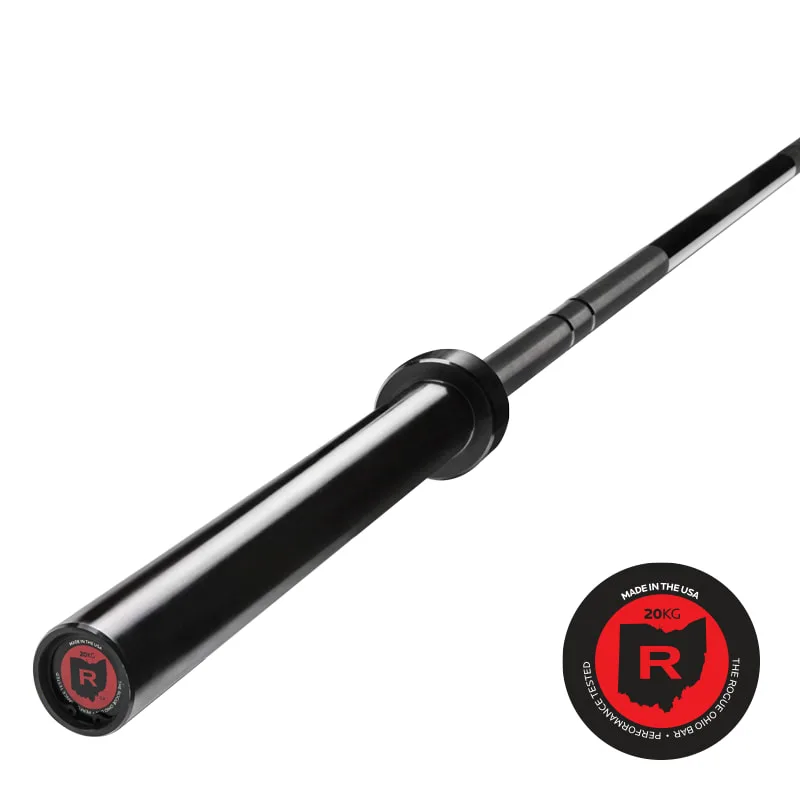
Rogue Ohio Bar (Black Oxide)
Pros
- 28.5 mm shaft is versatile across powerlifting and Olympic lifting movements
- Bronze bushings deliver reliable sleeve rotation without the cost of needle bearings
- 190,000 PSI tensile strength handles max-effort loads without bending or warping
- Dual knurl marks cover IPF powerlifting and IWF weightlifting grip widths on a single bar
- Lifetime warranty from Rogue — the bar can outlast every other piece in a home gym
Cons
- Requires a squat rack or power rack for squats and bench — significant additional cost
- Direct-only purchase through Rogue Fitness — plan for 2–4 week shipping
- Black oxide finish requires monthly oiling to prevent surface rust in humid environments
- Barbell training has a steeper safety and technique learning curve than machine-based training
The Rogue Ohio Bar anchors the free weights case. A barbell alone doesn’t complete a setup — you need weight plates and a rack — but bar quality determines the ceiling for your entire strength program.
At 190,000 PSI tensile strength, the Ohio Bar handles max-effort loads across the big compound movements without bending or warping under sustained use. Owner reports from garage gym athletes running high-frequency strength programs describe the bar holding up through years of heavy training with no performance change.
The 28.5 mm shaft sits in a practical middle ground. Dedicated powerlifting bars run 29 mm (harder to grip for Olympic movements), dedicated weightlifting bars run 28 mm (too much whip for heavy powerlifting). The Ohio Bar handles both without the tradeoffs of more specialized options.
For home gym builders whose primary goal is strength — squat, bench, deadlift, overhead press — the Ohio Bar anchors a program that a cable machine alone cannot replicate. A rack, this bar, and weight plates cover the four movements that produce the highest total muscle mass per training session.
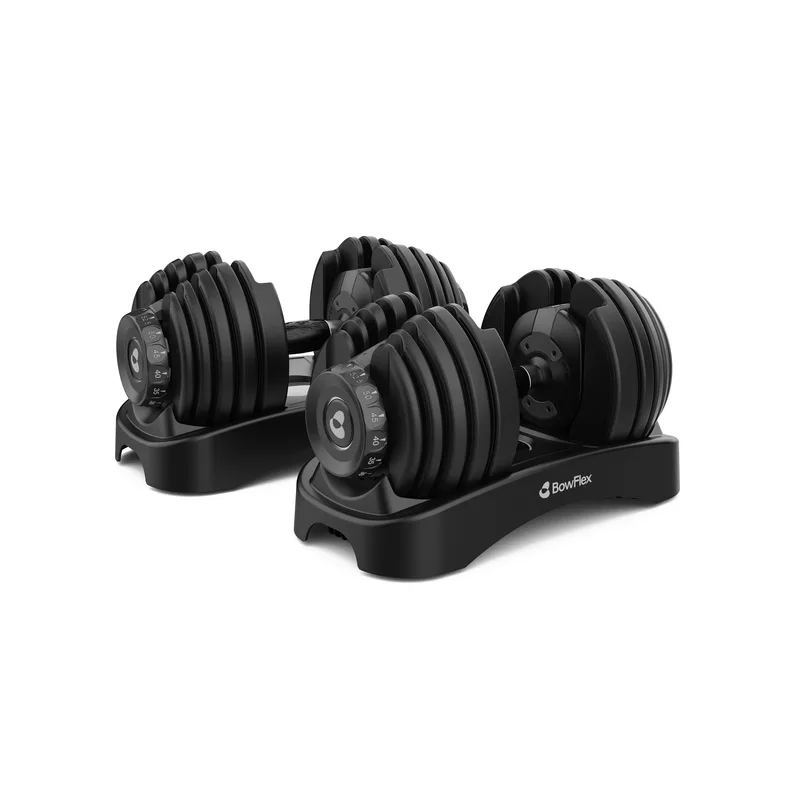
Bowflex SelectTech 552 Results Series
Pros
- Dial selector switches weight in under 3 seconds — fast enough for circuit training and supersets
- Metal plate construction in the Results Series resolves the durability issues of the original design
- 5 to 52.5 lb range handles warm-up through working weights across most upper-body movements
- Compact enough to store in a corner, under a bench, or in a closet between sessions
- Available immediately on Amazon with Prime shipping — no lead time, no direct-brand wait
Cons
- 52.5 lb maximum becomes a ceiling on heavy compound movements like dumbbell rows and split squats
- Dial mechanism requires careful handling — dropping from height can damage the adjustment system
- 5 lb jumps above 25 lb are coarser than ideal for precise shoulder and isolation progression
- Optional stand sold separately adds cost for off-floor storage
The Bowflex SelectTech 552 Results Series brings free weight versatility to training spaces where a full dumbbell rack isn’t practical. The 5 to 52.5 lb range covers warm-up through working weights on most upper-body movements, and the dial-selector format stores in under two square feet of floor space.
The Results Series naming reflects a meaningful update from the original 552. Metal plate components replace the plastic internals that generated durability complaints on the earlier design. Owner feedback on the Results Series is noticeably more positive on longevity, particularly from athletes using the dumbbells five or more days per week.
For lifters who are space-constrained, apartment-based, or adding dumbbells to an existing barbell setup, the SelectTech 552 covers a wide range of programming: pressing variations, single-arm rows, lateral raises, goblet squats, Bulgarian split squats, and hinge variations all stay under the 52.5 lb ceiling for most intermediate lifters.
The fast dial adjustment is the product’s defining feature for those running any style of superset or circuit training. Three seconds between weight changes is fast enough to maintain training density on most protocols.
Head-to-Head: The Key Tradeoffs
Cost
Free weights start cheaper. A 300 lb Olympic plate-and-bar set costs $250-$300; a quality squat rack adds $400-$600. Total: under $1,000 for a complete strength training foundation. A cable machine starts at $875 and still doesn’t cover barbell compound movements. Budget advantage: free weights.
Space
Both setups require a dedicated footprint. A functional trainer occupies roughly the same floor area as a power rack. Plan for a minimum 10×10 ft space for comfortable cable training. A barbell setup with a rack fits in an 8×10 ft area. Adjustable dumbbells alone require almost no dedicated space. Edge: free weights.
Exercise Variety
Cable machines win on isolation exercise variety. Adjustable cable angles allow movements that free weights cannot replicate at any price — cable flyes, face pulls, woodchops, cable kickbacks at any angle. Free weights dominate compound loading. Neither covers everything; both cover the most important movements in their respective categories.
Solo Training Safety
Cable machines win clearly. Stack weights return to resting position if you release mid-rep. Heavy barbell training to failure without a spotter or proper safeties carries real injury risk. Adjustable dumbbells are safer than barbells for solo pressing work but still require controlled handling.
Muscle Building
Current research shows equivalent hypertrophy at matched volumes regardless of implement. Long-term strength development favors free weights — more stabilizer activation, no ceiling on progressive overload. Isolation work and body composition training favor cables — constant tension, better loading through muscle-length positions.
Buying Guide
Choose a cable machine if:
- You train solo and want maximum safety on every movement
- Your primary goal is body composition, hypertrophy, or physique training
- You want maximum exercise variety from a single piece of equipment
- You already have free weights and want to expand capabilities
Choose free weights if:
- Your primary goal is strength on the big compound lifts
- You’re starting a home gym on a budget under $1,000
- You have a training partner or safety equipment for barbell work
- You want the highest return on investment per dollar for muscle and strength development
Choose both if:
- Your budget and space support a complete setup
- Your programming mixes heavy compound work with isolation and conditioning
- You train frequently enough to fully use both setups
FAQ
Can you build muscle with just free weights and no cable machine?
Yes. Free weights produce equivalent muscle growth to cable training at matched volumes. A barbell and dumbbell setup covers every major muscle group across pressing, pulling, and hinging movements. Cable machines add variety and constant tension but aren’t required for building muscle.
Can you build a complete physique with only a cable machine?
You can build substantial muscle and improve body composition with cable-only training. For maximal strength development — particularly squats and deadlifts — cable machines don’t replicate what a barbell and rack provide. A cable-only setup works well for hypertrophy and conditioning goals.
What’s the minimum budget for a complete free weights setup?
A functional starter setup runs $550–$800: a 300 lb Olympic set ($250–$300) plus a budget squat rack ($300–$500). Adding adjustable dumbbells pushes total cost toward $1,000 for a comprehensive setup covering both barbell and dumbbell movements.
Do cable machines and free weights build the same muscles?
Both build the same muscles, but the training stimulus differs. Cable machines load muscles through the full range of motion with constant tension, which can improve mind-muscle connection on isolation movements. Free weights produce higher stabilizer activation and allow unlimited progressive overload on compound movements. Both approaches produce results — the difference is in the training quality and feel, not in which muscles get worked.
Is a functional trainer worth it for a home gym?
For athletes who train alone, prioritize body composition, or want to replicate commercial gym cable movements at home, a functional trainer is worth the investment. If your primary focus is strength training on the big lifts, free weights offer better return on investment at lower cost.
Conclusion
For strength-focused training with a budget under $1,000, free weights deliver more return per dollar. A barbell, weight plates, and a rack cover the four compound lifts responsible for the most total muscle development. No cable machine in that budget range matches that programming capacity.
For solo training safety, body composition work, and isolation variety, a functional trainer is the more versatile choice. The REP Fitness Arcadia is the top cable machine pick for serious home gym athletes who want a complete system. For an accessible starting point, the Titan Plate-Loaded Functional Trainer delivers genuine cable training capability under $900.
The most capable home gyms eventually include both. Start with free weights if you’re building from zero. Add a cable machine once your programming calls for movements a barbell and dumbbells can’t cover.