Exercise bikes come in three real formats, and picking the wrong one is the most common reason a bike turns into a clothes rack. Upright, recumbent and spin-style bikes all turn pedals, but they put your body in different positions, load different muscles and suit different goals. In 2026 the price gap between formats has narrowed, with magnetic resistance and Bluetooth app support showing up on bikes that once cost far more, so the decision now comes down to fit and use rather than budget alone.
This guide covers how the three formats differ, which specs matter, and three example bikes. It is based on manufacturer specs and owner feedback. For ranked picks, see best exercise bikes for home, best recumbent exercise bikes and best smart exercise bikes.
Quick Comparison
| Spec | Schwinn IC4 Indoor Cycling Bike | Marcy ME-709 Recumbent Bike | YOSUDA Indoor Cycling Bike |
|---|---|---|---|
| Rating | 9.1/10 | 7.2/10 | 8.2/10 |
| Price | $899.00as of Oct 21, 2026 | $159.99as of Oct 21, 2026 | $269.99as of Oct 21, 2026 |
| Style | Indoor cycling (spin-style) | Recumbent | Indoor cycling (spin-style) |
| Resistance | Magnetic, 100 levels | 8 levels magnetic | Friction pad |
| Drive | Belt drive | — | Belt drive |
| Weight Capacity | 330 lbs | 300 lbs | 270 lbs |
| Connectivity | Bluetooth, ANT+ | — | — |
| Display | Backlit LCD | — | Basic LCD |
| Dimensions | — | 55.5" L × 25" W × 37.5" H | — |
| Machine Weight | — | 53 lbs | — |
| Assembly | — | Easy (1 person) | — |
| Flywheel | — | — | 35 lbs |
| Check Price → | Check Price → | Check Price → |
Prices change daily — tap Check Price for the current Amazon price. Numbers shown were verified on the "as of" date.
Upright vs Recumbent vs Spin: The Real Differences
Upright bikes
An upright bike looks like a regular bicycle: seat above the pedals, handlebars in front, torso mostly vertical. The saddle is usually wider and more padded than a spin saddle, and the console sits within easy reach. It is a middle-ground format for general fitness, light cardio and people who want something familiar. Space use is modest, and most models fold their footprint into roughly a yoga-mat-plus.
Recumbent bikes
A recumbent bike seats you in a reclined chair with a backrest, and the pedals sit out in front. The wide seat and back support spread your weight over more surface area, which owners often cite as the reason they can ride longer. It is the usual choice for lower-back discomfort, joint-friendly cardio, rehab-adjacent routines you have cleared with your clinician, and riders who want to read or watch a show. The trade-off is a longer footprint and less hip-hinge posture than upright riding.
Spin-style (indoor cycling) bikes
Spin bikes mimic a road bike: a heavy flywheel, a racing saddle, handlebars you can lean onto, and the ability to stand and sprint. They are built for intervals, class-style workouts and hard efforts. They reward you with the best workout intensity per square foot and cost less per unit of capability, but the aggressive posture and firmer saddle take getting used to.
Which format fits you
- Want intervals, standing climbs or class workouts: spin-style
- Want comfort, back support or long, easy sessions: recumbent
- Want a general-purpose bike that feels like a bicycle: upright
- Sharing with someone of very different height or mobility: recumbent or upright, both adjust more easily than most spin saddles
The Specs That Matter
Resistance type
Magnetic resistance uses magnets near the flywheel. It is quiet, has no contact parts to wear and adjusts in smooth steps. Friction resistance presses a pad against the flywheel. It is cheap and can go very hard, but the pad wears and needs replacing, and it makes more noise. Air resistance, as on an air bike, scales with how hard you pedal and suits conditioning work.
Flywheel weight
A heavier flywheel carries momentum through the pedal stroke and feels smoother. Spin bikes commonly run 30+ lbs. Recumbent and upright bikes often use lighter flywheels, which is fine for steady riding but feels choppy under hard effort.
Seat and fit adjustability
A bike you cannot fit to your body will not get ridden. Check seat height range, whether the seat also slides fore and aft, and handlebar adjustment. On recumbents, look for a seat rail that suits your inseam, since the leg-extension distance is the main fit variable.
Weight capacity
Always stay well under the rated limit. Capacities for bikes in this guide range from 270 to 330 lbs. Check the frame rating, not just the console claim.
Connectivity and subscriptions
Bluetooth and ANT+ let a bike feed cadence and power to apps such as Zwift, while many brand-name smart bikes lock their classes behind a monthly membership. If you want screen content without a subscription, a bike with a tablet holder and free-app compatibility is the cheaper route.
Footprint and noise
Measure the spot where the bike will live, plus clearance to mount and dismount. Belt drive plus magnetic resistance is the quietest combination.
The Three Bikes
Schwinn IC4: best spin-style bike
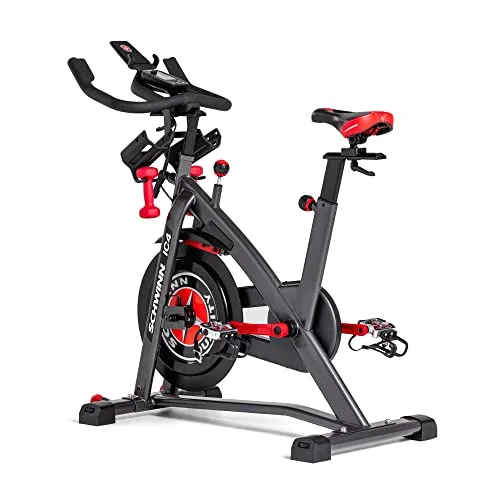
Schwinn IC4 Indoor Cycling Bike
Pros
- Magnetic resistance with 100 micro-adjustable levels gives fine control from warm-up to sprint
- Belt drive keeps noise low enough for apartments and shared rooms
- Bluetooth and ANT+ pair with Peloton, Zwift and other third-party apps
- 330 lb capacity is higher than most bikes in its class
Cons
- No built-in screen, so you supply a tablet or phone for classes
- Racing-style saddle draws comfort complaints from new owners
- Forward-leaning riding posture is not for everyone
The IC4 is the benchmark for a spin-style bike that works with outside apps instead of tying you to one. The magnetic, belt-driven setup is quiet, and the 330 lb capacity gives headroom. Plan on bringing your own screen.
Marcy ME-709: best budget recumbent
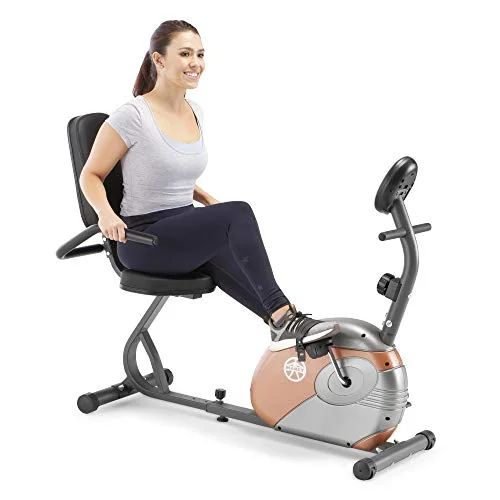
Marcy ME-709 Recumbent Bike
Pros
- Seated, reclined position takes pressure off the back and wrists
- 300 lb weight capacity is solid for the price
- At 53 lbs it is easy to move and store
- Tool-free seat adjustment lets users of different heights share it
Cons
- Only 8 resistance levels limit progression as fitness improves
- No Bluetooth, app connectivity or built-in workout programs
- Light flywheel gives a less smooth pedal feel than pricier bikes
The ME-709 delivers low-impact, seated cardio at a low price. It is basic, with no apps and few resistance steps, but if the goal is simply to pedal comfortably while watching TV, it does that job.
YOSUDA Indoor Cycling Bike: best budget spin-style
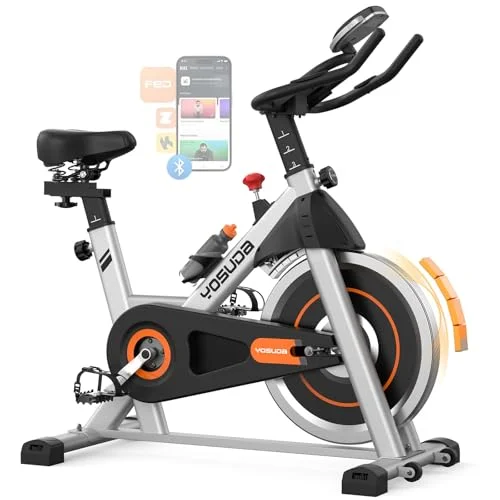
YOSUDA Indoor Cycling Bike
Pros
- 35 lb flywheel gives a smooth pedal motion at a budget price
- Compact frame fits small rooms
- Friction resistance can be turned up to a hard stop
- Fraction of the cost of connected bikes
Cons
- Friction pad wears over time and needs replacing
- No Bluetooth for app integration
- 270 lb capacity is the lowest of the three bikes here
The YOSUDA is the cheapest route into a spin-style ride, with a 35 lb flywheel that owners say rides smoothly for the cost. Expect to replace the friction pad eventually.
FAQ
Are recumbent bikes better than upright bikes?
Neither is better outright. Recumbents offer more back support and comfort for long sessions, while upright and spin-style bikes put you in a more active posture and make hard intervals easier.
Is a spin bike good for beginners?
Yes, if you are comfortable with a forward-leaning position. The firmer saddle takes a few weeks to get used to according to owner reports, and a heavier flywheel makes pedaling feel smooth from the start.
Magnetic or friction resistance?
Magnetic is quieter and needs less upkeep, and it is worth the extra money if you ride often or share walls. Friction is fine on a tight budget as long as you are ready to replace the pad.
Do I need a smart bike with a subscription?
No. A bike with Bluetooth and a tablet holder lets you use free or third-party apps. Subscription bikes charge for classes, so factor that cost in over a few years.
How much space does an exercise bike need?
Most uprights and spin bikes fit in about 4 by 2 feet. Recumbents run longer, often over 5 feet. Leave extra room on each side for mounting.
The Bottom Line
For most people who want a serious workout, the Schwinn IC4 is the pick: quiet, adjustable and compatible with the apps you already use. If comfort and back support come first, the Marcy ME-709 is the low-cost recumbent route. If budget is the only constraint and you want a spin-style ride, the YOSUDA gets you pedaling for the least money. Match the format to how you will actually ride, then fit and noise decide the rest.