Sole Fitness spent part of 2026 publishing guides calling out elliptical brands that bury full functionality behind monthly subscriptions — a sign of how much the connected-cardio pricing model has crept into a category that used to be a one-time purchase. Rowing machines have the same split: a Concept2 RowErg with zero subscription costs sits next to a Hydrow Wave that needs $44 a month to unlock its screen. Before you decide between an elliptical and a rowing machine, you need to decide what kind of buyer you are on that question alone — because it changes the real price of either machine by hundreds of dollars a year.
Past that, the elliptical-vs-rower debate comes down to three things: how much of your body the machine trains, how hard it is on your joints, and how much floor space you’re willing to give up. Here’s how they actually compare.
Quick Comparison
| Spec | Concept2 RowErg | NordicTrack AirGlide 14i | Hydrow Wave | Schwinn 490 Elliptical |
|---|---|---|---|---|
| Rating | 9.5/10 | 9.1/10 | 8.8/10 | 8.9/10 |
| Price | $990.00as of Oct 18, 2026 | $1,799 | Check price | Unavailable |
| Resistance Type | Air (flywheel) | — | Electromagnetic | — |
| Dimensions | 96" × 24" (244 × 61 cm) | — | 86" × 22" × 47" | — |
| Seat Height | 14" standard / 20" tall legs | — | — | — |
| Machine Weight | 57 lbs | — | 68 lbs | 187 lbs |
| Weight Capacity | 500 lbs | 300 lbs | 375 lbs | 330 lbs |
| Monitor | PM5 | — | — | — |
| Storage | Separates into 2 pieces | — | — | — |
| Warranty | 5-year frame, 2-year parts | 10-yr frame / 2-yr parts / 1-yr labor | 1-year standard | 10-yr frame / 2-yr parts / 1-yr electronics / 90-day labor |
| Stride Length | — | 17.8–18.5 inches (auto-adjusts with incline) | — | 20 inches |
| Incline Range | — | -5% decline to 15% incline | — | -5% to 15% motorized |
| Resistance Levels | — | 26 digital magnetic levels | — | 25 magnetic levels |
| Flywheel | — | 32 lbs (front-drive) | — | — |
| Display | — | 14-inch HD touchscreen | — | 7-inch LCD color |
| Footprint | — | 69"L × 25"W × 71"H | — | 58.1"L × 33.9"W × 68"H |
| Screen | — | — | 16" HD touchscreen | — |
| Bluetooth | — | — | Yes (headphones, heart rate monitors) | — |
| Membership | — | — | $44/month (required for streaming) | — |
| Check Price → | Check Price at NordicTrack → | Check Price → | Check Price → |
Prices change daily — tap Check Price for the current Amazon price. Numbers shown were verified on the "as of" date.
| Concept2 RowErg | NordicTrack AirGlide 14i | Hydrow Wave | Schwinn 490 | |
|---|---|---|---|---|
| Type | Rowing machine | Elliptical | Rowing machine | Elliptical |
| Price | $990 | $1,799 | $1,695 | $1,299 |
| Muscles Worked | Full body (legs, back, arms, core) | Lower body + arms | Full body (legs, back, arms, core) | Lower body + arms |
| Joint Impact | Zero-impact | Zero-impact | Zero-impact | Zero-impact |
| Footprint (in use) | 96” × 24” | 69” × 25” | 86” × 22” | 58” × 34” |
| Subscription | None | $39/mo (iFIT, optional) | $44/mo (required) | None for core features |
| Weight Capacity | 500 lbs | 300 lbs | 375 lbs | 330 lbs |
How a Rowing Machine Trains Your Body
Rowing is a full-body pull. Each stroke recruits the legs first (the drive), then the back and core (the finish), then the arms — roughly 65-70% lower body and 30-35% upper body and core per stroke, based on how the movement sequences through the posterior chain. No other piece of cardio equipment in a typical home gym trains that much muscle mass in one continuous motion.
That full-body recruitment is also why rowing machines tend to spike heart rate faster than an elliptical at the same perceived effort — you’re moving more total muscle, so the cardiovascular demand climbs quicker. It’s a legitimate advantage for anyone short on training time.
The trade-off is technique. Rowing well takes a real learning curve — sequencing legs, then back, then arms on the drive, and reversing the order on the recovery. Do it wrong and you either row less effectively or aggravate your lower back. It’s not a hard skill, but it’s not zero either, and it’s the single biggest reason some buyers default to an elliptical instead.
How an Elliptical Trains Your Body
An elliptical is a lower-body machine with an upper-body assist. The moving handles engage the arms, shoulders, and chest to a degree, but the primary work happens in the quads, glutes, hamstrings, and calves through a fixed elliptical foot path. There’s no learning curve — step on, start moving, and your body finds the pattern immediately.
That immediacy is the elliptical’s biggest strength for a mixed-experience household. A rowing machine rewards someone willing to learn the stroke. An elliptical works the same for a first-time user and an experienced one, which matters if more than one person in the house is using the machine.
Inclined and reverse-pedaling modes — like the AirGlide 14i’s -5% to 15% range — add variety that a fixed rowing stroke can’t replicate, shifting emphasis toward glutes and hamstrings on incline, and quads on decline.
The Rowing Machines
Concept2 RowErg
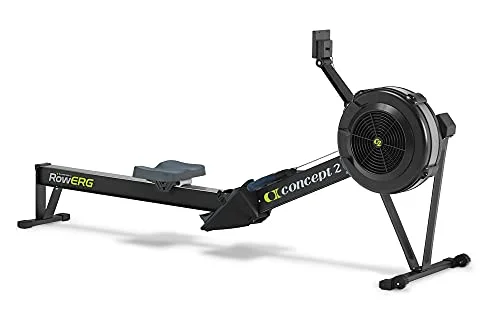
Concept2 RowErg
Pros
- Gold-standard PM5 monitor tracks pace, watts, calories, and stroke rate with competition-accurate data
- 500 lb weight capacity accommodates virtually any athlete
- Air resistance automatically scales to effort — pull harder, get more resistance
- Splits into two pieces for apartment-friendly storage in under 30 seconds
- Strong resale value — used RowErgs hold a significant portion of original price
Cons
- No touchscreen or streaming workouts — pure mechanical simplicity
- Air flywheel is audible during hard efforts — not ideal for shared-wall apartments
- Third-party app connectivity requires a separate device
The RowErg is the machine competitive rowers actually train on, and that pedigree shows up in the details home users benefit from too. The PM5 monitor is the same unit used in indoor rowing competitions worldwide, tracking pace, watts, calories, and stroke rate with a level of accuracy no elliptical console approaches. Air resistance scales automatically with effort — pull harder and the flywheel pushes back harder, with no dial to set.
At $990 with no subscription of any kind, it’s also the cheapest machine in this comparison by a wide margin, and the 500 lb weight capacity is unmatched here. The trade-off is the learning curve mentioned above, plus flywheel noise that’s noticeable during hard intervals — a real consideration in an apartment with shared walls.
Hydrow Wave
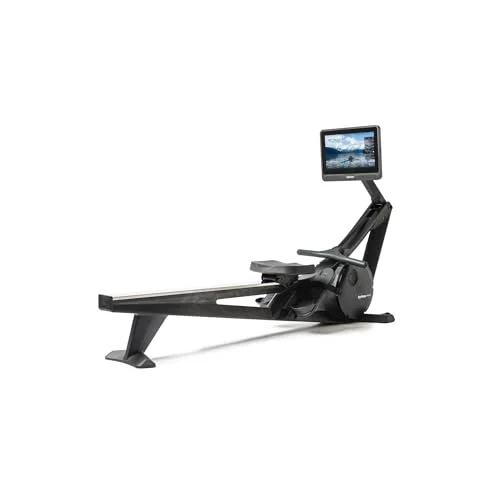
Hydrow Wave
Pros
- Near-silent electromagnetic resistance — roughly 40 dB during hard sessions
- 16-inch HD touchscreen streams live and on-demand workouts filmed on real waterways
- 22-inch width is the narrowest profile in the smart rower category
- Built-in Bluetooth connects to heart rate monitors and headphones
- Sleek profile fits modern living spaces as well as dedicated home gyms
Cons
- Membership required ($44/month) — hardware has limited utility without it
- 375 lb weight capacity is lower than the Concept2 RowErg
- 1-year warranty is shorter than competitors at this price point
The Hydrow Wave solves the rowing learning curve differently — through coaching rather than eliminating the skill requirement. Its 16-inch touchscreen streams instructor-led sessions filmed on actual water, with on-screen form cues that help new rowers self-correct in real time. Electromagnetic resistance keeps the machine close to silent, which is the opposite trade-off from the RowErg’s audible flywheel.
The catch is the $44/month membership. Without it, the touchscreen has little to offer — this is a connected fitness device first and a standalone rowing machine second. Factor the subscription into total cost: over two years, the Wave’s membership alone adds over $1,000 on top of the $1,695 hardware price.
The Ellipticals
NordicTrack AirGlide 14i
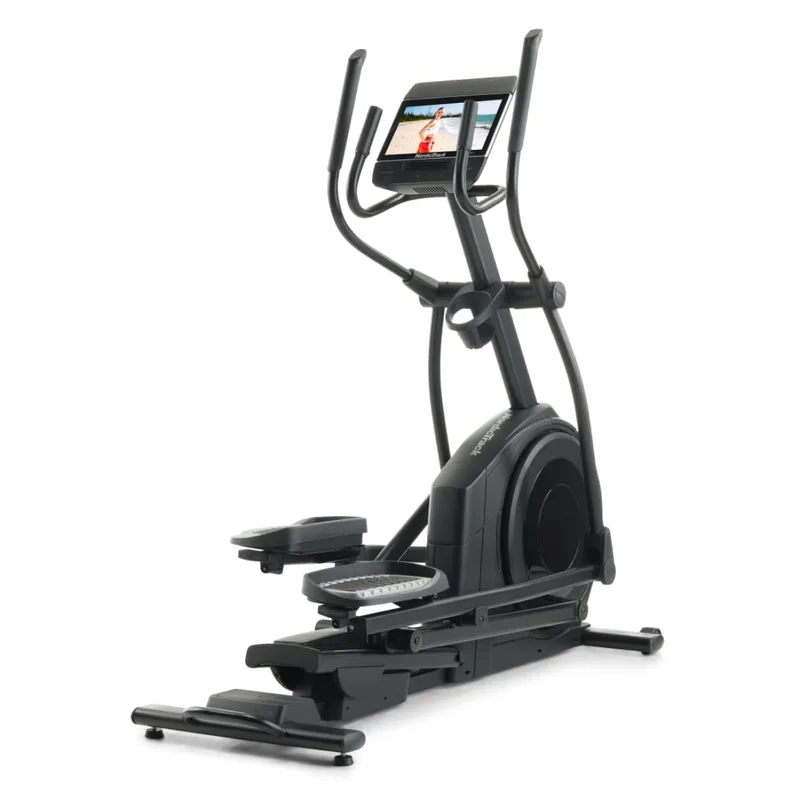
NordicTrack AirGlide 14i
Pros
- 14-inch touchscreen with iFIT delivers interactive terrain-based workouts that auto-adjust resistance and incline in real time
- 32 lb flywheel produces an exceptionally smooth, quiet stride for a front-drive machine
- Incline and decline capability (-5% to 15%) adds real programming variety beyond flat-terrain steady-state
- 26 digital resistance levels give fine-grained control for interval training
- Oversized, angle-adjustable pedals reduce foot numbness during longer sessions
Cons
- iFIT subscription required for interactive features ($39/month after a 30-day trial)
- 300 lb weight capacity is lower than the Concept2 RowErg's 500 lb rating
- Not sold on Amazon — purchase and delivery run direct through NordicTrack
The AirGlide 14i is the elliptical to buy if you want the machine to do more of the programming for you. iFIT’s terrain-based workouts adjust incline and resistance automatically as instructors lead you through real outdoor routes, and the 32 lb flywheel delivers a stride quality that’s smoother than most front-drive ellipticals at this price. The -5% to 15% incline range is genuinely useful — it’s the closest an elliptical gets to a rowing machine’s variability.
It’s also the most expensive machine here, isn’t sold on Amazon, and the 300 lb weight capacity is the lowest of the four. The iFIT subscription isn’t required to use the machine, but most of what makes the AirGlide worth the price lives behind that paywall.
Schwinn 490 Elliptical
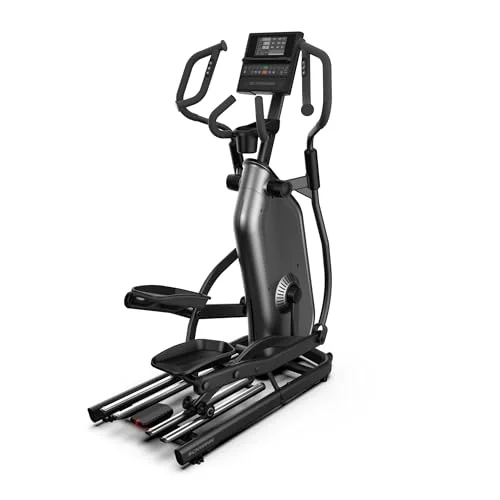
Schwinn 490 Elliptical
Pros
- JRNY adaptive fitness app delivers coach-guided workouts without a subscription wall for core features
- 20-inch stride accommodates taller users with a natural, full-extension stride pattern
- Motorized incline and decline (-5% to 15%) handles terrain simulation at a competitive price
- 25 resistance levels give more control than most ellipticals in this price range
- 187 lb assembled weight makes it noticeably easier to move than heavier competitors
Cons
- 7-inch display is small compared to touchscreen competitors
- 90-day labor warranty is short relative to the rest of the coverage
- Bluetooth speakers not included — audio requires headphones or an external speaker
The Schwinn 490 is the pick for buyers who want elliptical training without ongoing costs. The JRNY app includes coach-guided workouts and scenic routes without gating core functionality behind a subscription, and the 20-inch stride is long enough for taller users to get a full, natural extension. At 187 lbs assembled, it’s also dramatically easier to reposition than the 244 lb AirGlide.
The 7-inch display is small next to the AirGlide’s 14-inch touchscreen, and the 90-day labor warranty is short. But for a household that wants a no-subscription elliptical with a real incline range, it’s the more sustainable long-term cost.
Head-to-Head: The Factors That Actually Decide This
Calorie Burn and Cardiovascular Demand
Because rowing recruits significantly more total muscle mass per stroke, it tends to produce a higher heart rate response at a matched perceived exertion than an elliptical. For time-constrained training, that makes rowing machines the more efficient option — you can hit a comparable cardiovascular stimulus in less time. Ellipticals can close that gap through incline and resistance, but require more sustained effort to reach the same intensity.
Joint Impact
Both categories are zero-impact — feet or seat stay in continuous contact with the machine, with no ground-strike force like running produces. This makes both good options for anyone managing knee, hip, or lower-back sensitivity, though rowers with existing lower-back issues should be more careful about form, since poor rowing technique loads the spine in a way a fixed elliptical stride simply doesn’t.
Learning Curve
This is the clearest dividing line. Ellipticals require zero instruction. Rowing machines require learning a sequenced movement pattern, and doing it wrong reduces the workout’s effectiveness and can strain the lower back. If the machine needs to be usable by multiple household members with no coaching involved, the elliptical wins by default.
Total Cost of Ownership
Sticker price tells an incomplete story once subscriptions enter the picture. The Concept2 RowErg ($990, no subscription) and Schwinn 490 ($1,299, no required subscription) are genuinely one-time purchases. The Hydrow Wave ($1,695 hardware) and NordicTrack AirGlide 14i ($1,799 hardware) both lean on recurring membership fees to deliver their core value — $44/month and $39/month respectively — which can add more than $1,000 over two years of ownership.
Space and Footprint
The Schwinn 490 has the smallest footprint at 58” × 34”, followed by the Hydrow Wave’s narrow 22-inch width (though its 86-inch length is longer). The Concept2 RowErg folds in half and separates into two pieces, making it the easiest of the four to store against a wall or under a bed when not in use — a real advantage the elliptical’s fixed footprint can’t match.
Buying Guide: Which Should You Choose
Choose a rowing machine if: you want the most efficient full-body cardio workout per minute, you’re willing to spend a session or two learning proper stroke technique, and you value storage flexibility. The Concept2 RowErg is the default choice for anyone not sold on paying a monthly membership; the Hydrow Wave is the pick if instructor-led coaching and a quiet motor matter more than avoiding a subscription.
Choose an elliptical if: multiple people with different experience levels will use the machine, you want zero learning curve, or you specifically want incline/decline variety without a rowing stroke’s technical demands. The Schwinn 490 is the subscription-free option; the NordicTrack AirGlide 14i is the pick if you’re already planning to pay for iFIT and want the smoothest stride available.
Budget-first buyers: the Concept2 RowErg at $990 delivers the best combination of price, durability, and zero recurring cost of anything in this comparison.
Small-space buyers: the RowErg’s fold-and-separate design or the Schwinn 490’s compact footprint both beat the larger, fixed footprints of the two connected machines.
If your gym has room for both, pairing a subscription-free machine from each category — the RowErg and the Schwinn 490 — covers full-body and lower-body cardio without adding a single monthly bill.
Frequently Asked Questions
Is rowing or elliptical better for weight loss? Rowing generally burns more calories per minute at a matched effort level because it recruits more total muscle mass. Over a full week of consistent training, though, the machine that gets used more often wins — an elliptical you’ll actually hop on daily beats a rowing machine that intimidates you into skipping sessions.
Which is easier on the knees, a rowing machine or an elliptical? Both are zero-impact and easy on the knees compared to running. Ellipticals may feel slightly more forgiving for anyone with significant knee sensitivity because the motion is more fixed and predictable, while rowing places more emphasis on hip and lower-back mechanics during the drive phase.
Do I need a subscription for a rowing machine or elliptical? Not necessarily. The Concept2 RowErg and Schwinn 490 both function fully without any subscription. The Hydrow Wave requires its $44/month membership to access the touchscreen’s core value, and the NordicTrack AirGlide 14i works as a standalone elliptical but loses most of its interactive programming without iFIT.
Can a rowing machine build muscle, or is it just cardio? Rowing machines provide a cardio stimulus with a strength-endurance component, particularly for the back, glutes, and hamstrings. They won’t replace dedicated strength training for building maximal muscle size, but consistent rowing does build noticeable posterior-chain endurance and can complement a lifting program.
Which takes up less space, a rowing machine or an elliptical? It depends on the specific machine. The Concept2 RowErg folds and separates for compact storage despite its long 96-inch in-use footprint. The Schwinn 490 has the smallest fixed footprint of the four machines here. Fixed-footprint ellipticals like the NordicTrack AirGlide 14i take up permanent floor space regardless of use.
Conclusion
For most home gyms, the Concept2 RowErg is the strongest overall pick — the lowest price, the highest weight capacity, zero subscription costs, and a full-body stimulus that an elliptical can’t match minute for minute. It’s the machine to buy if you’re building a home gym around long-term value and don’t mind a short learning curve.
If a fixed, no-learning-curve motion matters more — for a shared household, a rehab situation, or simply a personal preference for elliptical training — the Schwinn 490 delivers real incline range and coach-guided programming without locking core features behind a subscription. The NordicTrack AirGlide 14i and Hydrow Wave are both excellent machines, but the right call for either one depends on whether a monthly membership is already part of the budget. If it is, they’re worth it. If it’s not, the RowErg and Schwinn 490 do the job without the recurring bill.
For a deeper look at each category, see our full breakdowns of the best rowing machines for home and the best ellipticals for home.