Space is the real constraint in most home gym builds — not budget, not motivation, not equipment selection. Get the spatial planning right first and the equipment choices become obvious.
The wall-mounted folding rack changed the equation for small-space gyms. A properly mounted folding rack reclaims your floor on days you’re not training. A spare bedroom, one-car garage, or basement corner can now support a complete strength setup — without permanently surrendering the room.
This guide covers five tools that make a small-space gym actually work. Three are wall-mounted racks at different price points. One hangs from a door. One fits in a storage cube. Combined, they represent the foundation of a functional home gym under 100 square feet.
Assess Your Space Before Buying Anything
Measure twice. Three times if you’re mounting anything to the wall.
Ceiling height is the first constraint. Folding squat racks that fold up (like the PRx Profile Pro) require 10+ feet of clearance. Fold-in racks like the REP PR-4100 need only standard 8-foot ceilings. Confirm clearance to the lowest obstruction — not just the ceiling itself. Garage door tracks, light fixtures, and storage shelves are common surprises.
Wall structure is the second. Wall-mounted racks bolt directly into studs or masonry. Standard drywall alone will not hold a loaded rack. Locate studs before ordering any wall-mount product. A concrete or masonry wall requires anchor bolts. Rental apartments with restrictions on wall penetration may not support wall-mounted racks at all — the TRX door-anchor and freestanding equipment are the workarounds.
Footprint vs. floor plan. A wall-mounted folding rack when deployed needs approximately 4–5 feet of depth from the wall, 4 feet of width, and 3 feet of clearance behind you for barbell movement. That’s roughly 7’×5’ of active training space — far less than a permanent power cage. A spare bedroom measuring 10’×10’ can support a complete folding-rack setup with a weight bench and dumbbell storage.
Wall-Mounted Folding Racks
PRx Performance Profile Pro — Best Premium Wall-Mount
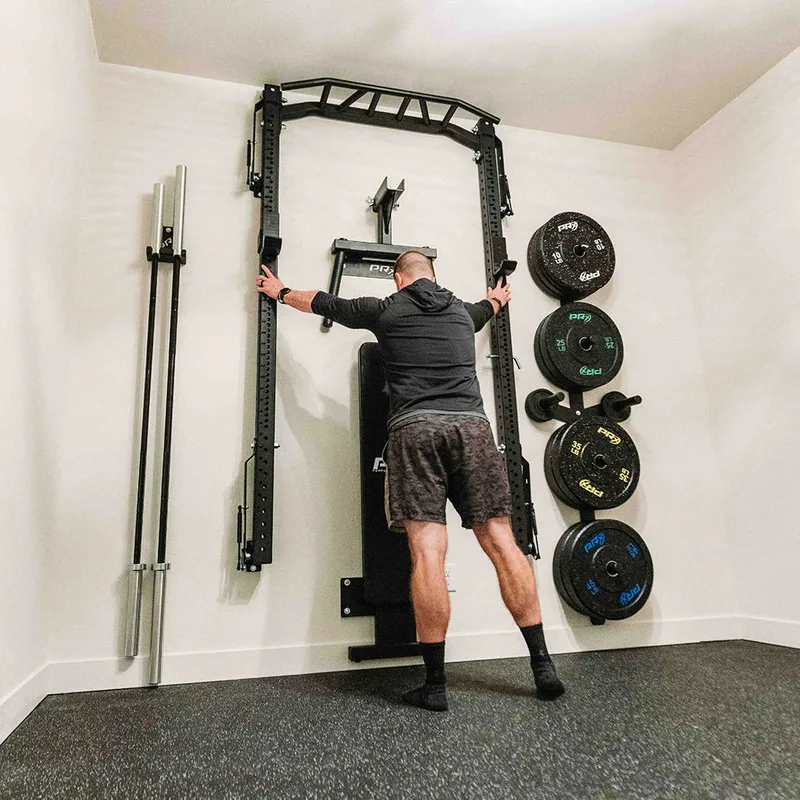
PRx Performance Profile Pro Folding Squat Rack
Pros
- Folds to just 4" from wall — disappears between sessions
- 3×3 11-gauge steel matches the build quality of premium full racks
- 1,000+ lb rated capacity handles any home gym load
- Fold-up design (not fold-in) needs only one motion to set up or stow
- Made in the USA with six color options
- Growing attachment ecosystem including cable and functional trainer upgrades
Cons
- Requires solid stud or masonry wall — not viable in all spaces
- Fold-up design demands extra ceiling clearance (10'+ recommended)
- Base model excludes pull-up bar (purchased separately at added cost)
- Premium price vs. other wall-mounted options
The PRx Profile Pro won the Garage Gym Lab’s 2026 Best Folding Squat Rack award for a reason: it’s the most refined folding rack available for home use. The fold-up design — where the rack lifts vertically against the wall rather than folding in on itself — requires one smooth motion to deploy and stow. When folded, the uprights sit 4 inches from the wall. In a two-car garage shared with vehicles, that’s the difference between the gym fitting and the gym not fitting.
The 3×3 11-gauge steel construction is the same spec found on premium freestanding racks like the Rogue R-3 and REP PR-4000. That matters because it means the PRx attachment ecosystem — cable systems, plate storage, functional trainer add-ons — is fully compatible. This isn’t a temporary beginner setup; it scales with your training.
The main ceiling clearance requirement is real. The Profile Pro needs the uprights to swing upward, which demands 10 feet or more of clearance in most configurations. Measure specifically to the open space above the rack’s installed position, including clearance for the bar on J-hooks. In a standard-height garage with door tracks mounted at 8 feet, this can be a dealbreaker.
The base price starts at $795 without a pull-up bar. Adding a straight pull-up bar or multi-grip bar brings the total to $895–$995. For a wall-mounted rack that matches the structural integrity of racks costing $1,500–$2,000 in freestanding form, that price is justified.
REP Fitness PR-4100 — Best Value Wall-Mount
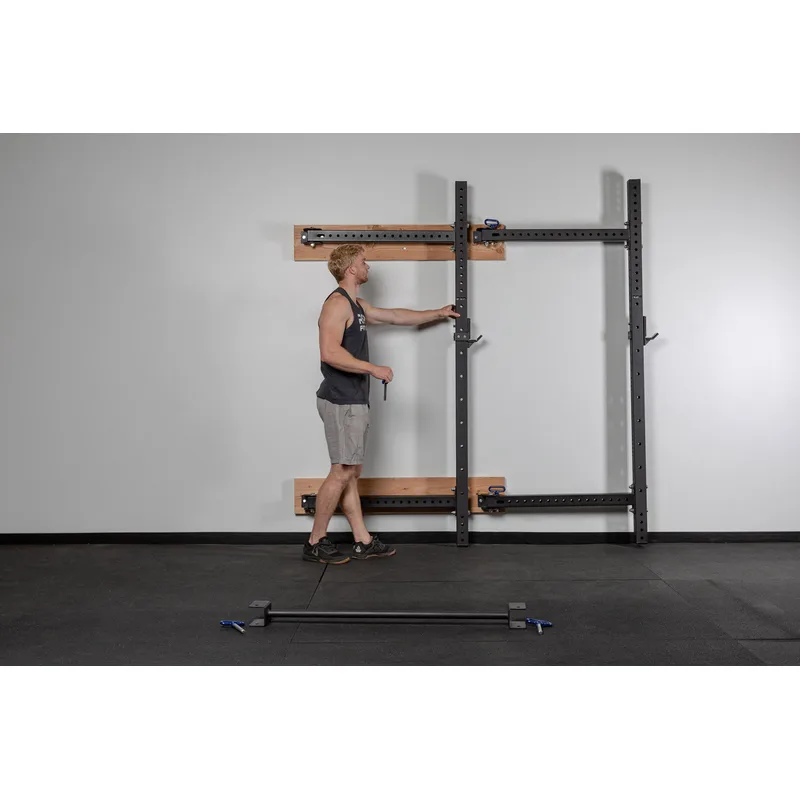
REP Fitness PR-4100 Folding Wall Mount Squat Rack
Pros
- 1,000 lb capacity at $499 — outstanding value for a wall-mount rack
- 21.5" model folds to 6" from wall
- 1" hole spacing in key zones for precise barbell height adjustments
- Compatible with REP 4000-Series attachments (lat pulldown, cable system, landmine)
- Two depth options (21.5" and 41") for different garage and room setups
Cons
- Sold direct from REP Fitness only — no Amazon Prime shipping
- Requires secure wall mounting into studs or concrete
- Assembly is a two-person job and takes 2–3 hours
The PR-4100 is the better choice when ceiling height is limited or budget is a real factor. It folds in on itself — the arms swing laterally — which means standard 8-foot ceilings are fine. The 21.5” depth model folds to 6 inches from the wall. The 41” depth model (for lifters who want more working room) folds to 24 inches, which is still workable in a garage or spare room.
The steel spec is identical to the PRx Profile Pro: 3×3 11-gauge. The 1,000 lb rated capacity is identical. The $499.99 starting price for the 21.5” model makes it roughly 40% cheaper than the entry PRx Profile Pro. The trade-off is a slightly more involved fold mechanism (fold-in vs. fold-up) and an attachment ecosystem that, while growing, is less mature than PRx’s.
The 1” hole spacing through the bench and squat zones is a genuine advantage. Most budget racks use 2” spacing throughout, which creates annoying quarter-inch adjustments that still put the bar at the wrong height. At 1” spacing, you can usually dial in the exact catch position for your proportions.
REP ships direct only — no Amazon. Lead times run 3–10 business days depending on inventory. If you’re in a hurry, the Valor BD-20 below ships Prime.
Valor Fitness BD-20 — Best Budget Wall-Mount
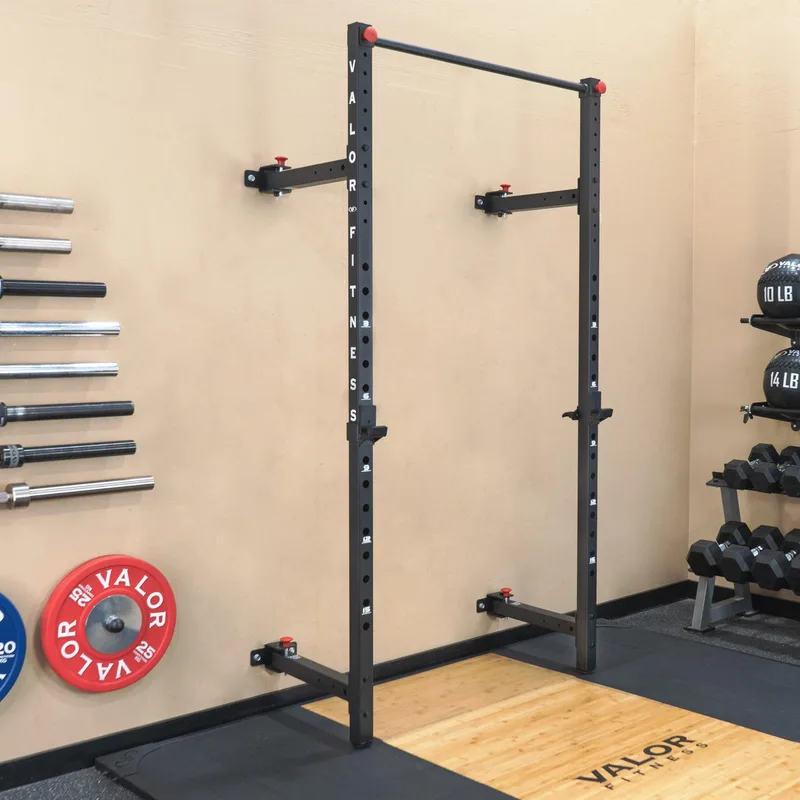
Valor Fitness BD-20 Wall-Mounted Folding Squat Rack
Pros
- Most affordable wall-mounted folding rack with verified Amazon availability
- Pull-up bar included — no extra purchase needed
- 750 lb rated capacity covers beginner through intermediate loads
- Ships via Amazon Prime
- 11-gauge steel at the budget price point
Cons
- 2.5×2.5" tubing is narrower than the 3×3" standard on premium racks
- 42.5" inside working space is tighter than competition-standard 46"
- Limited attachment compatibility vs. REP or PRx ecosystems
- Some reports of inconsistent hardware quality in user reviews
At $229 with Prime shipping, the BD-20 is the lowest-cost viable wall-mounted folding rack. The included pull-up bar is a genuine value add — that feature costs $100–$150 extra on competing racks. The 750 lb capacity rating handles beginner through intermediate training loads without issue.
The trade-offs are real but manageable. The 2.5×2.5” tubing is narrower than the 3×3” standard, which limits attachment compatibility and slightly reduces rigidity at high loads. The 42.5” inside working space is noticeably narrower than competition standard 46” — wider-grip bench pressing and overhead pressing with a competition barbell can feel constrained. Most lifters with shoulder-width grip never notice this; those with wide shoulders might.
For a first wall-mounted rack, or for a budget build where the priority is establishing a training space before investing in premium equipment, the BD-20 delivers. Upgrade to the REP or PRx when you’re regularly training near the BD-20’s limits.
Zero-Footprint Strength: TRX Suspension Trainer
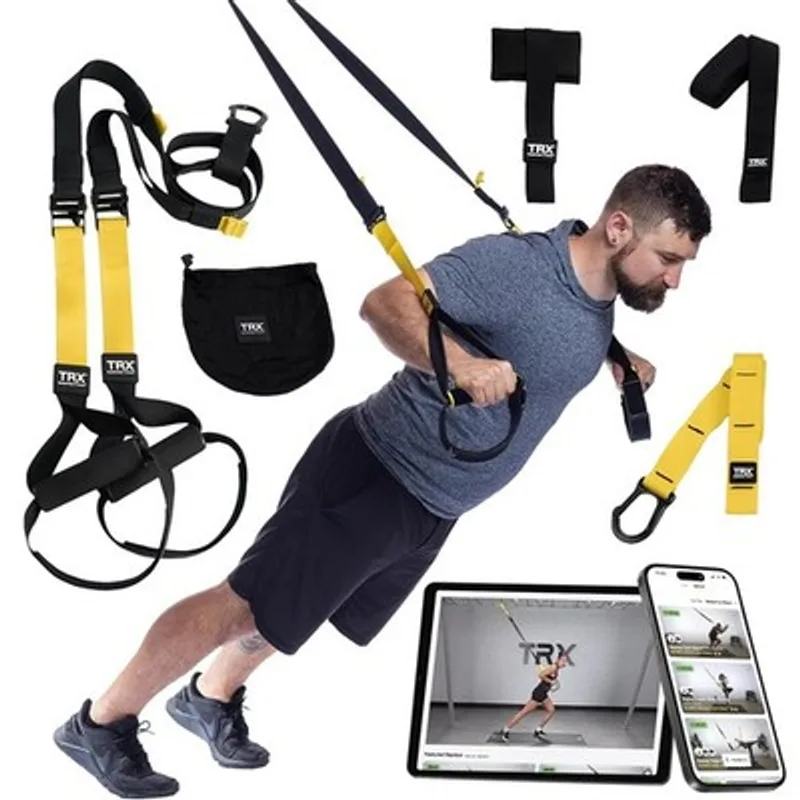
TRX All-in-One Suspension Trainer
Pros
- Zero floor space — hangs from any door, ceiling beam, or pull-up bar
- Over 300 exercise variations covering full-body strength and mobility
- Weighs under 2 lbs and stores in a single drawer
- 700 lb tested capacity handles substantial loading
- Works for total beginners through advanced trainees
Cons
- No meaningful progressive overload past intermediate bodyweight strength
- Door anchor can damage frames under repeated heavy use
- Cannot replace barbell compound movements for serious strength development
A suspension trainer is the one piece of strength equipment that genuinely occupies zero floor space. The door anchor takes 10 seconds to install and removes completely when not in use. The entire system weighs under 2 lbs and fits in its included mesh bag, which fits in a single kitchen drawer.
The TRX All-in-One has been the standard for suspension training because the build quality holds up to sustained use. The nylon straps don’t stretch, the rubber handles grip securely even with chalk, and the locking buckles adjust smoothly under load. The 700 lb tested weight capacity means the hardware won’t fail on you.
Where suspension training genuinely excels in small spaces: ring rows, body-saw planks, Bulgarian split squats, chest flies, and TRX rows all produce meaningful muscle stimulus with no external loading. For a lifter who has hit a rack or barbell but needs supplemental upper-back and core work, the TRX covers gaps without claiming any floor space.
The honest limitation: suspension training reaches a ceiling. Past a certain strength threshold — roughly pull-up and push-up standards — the exercise becomes too easy before the load becomes high enough for continued hypertrophy. Use the TRX as a complement to the folding rack, not a substitute.
Compact Weights: BowFlex Results Series 552
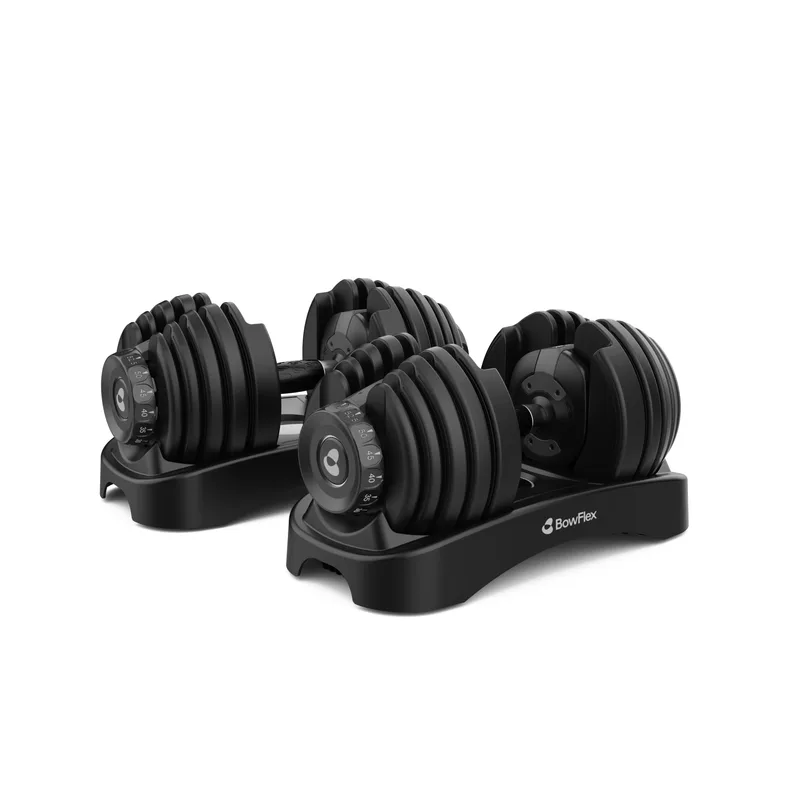
BowFlex Results Series 552 SelectTech Adjustable Dumbbells
Pros
- Replaces 15 pairs of fixed dumbbells in the footprint of two
- Dial selector changes weight in under 3 seconds
- 52.5 lb max per hand covers the majority of home gym training needs
- Updated Results Series design addresses the June 2025 recall of the original model
- Ships via Amazon Prime
Cons
- June 2025 recall affected the original model (ASIN B001ARYU58) — confirm you are ordering the Results Series
- Dial selector is slower than pin-style systems like PowerBlock
- Must return to tray between sets to change weight — no floor adjustment
- Plastic dial mechanism is the most likely failure point over time
The original BowFlex SelectTech 552 (ASIN B001ARYU58) was recalled in June 2025 due to weight plates potentially dislodging during use. If you own that model, stop using it and contact BowFlex for the recall resolution. The updated Results Series 552 (ASIN B0G6Z84TQM) is the current replacement model and is the version to buy.
In a small-space gym, adjustable dumbbells are the most space-efficient weight investment. The Results Series 552 pair replaces 15 sets of fixed dumbbells — from 5 lbs to 52.5 lbs — in the footprint of two standard dumbbells. That’s the entire dumbbell range most home gym lifters need, occupying roughly 2 square feet when stored.
The dial selector system works: rotate the dial, the selected weight locks, and you lift. The mechanism is slower than pin-style systems like PowerBlock, but for straight sets with a fixed weight, it’s fine. For rapid drop sets or super-sets with frequent weight changes, you’ll want PowerBlock’s U-Lock mechanism instead.
At $429, the Results Series is a significant purchase. The justification is math: 15 pairs of quality fixed hex dumbbells from 5 to 50 lbs costs $400–$700 and requires a full dumbbell tree or rack. The SelectTech pair requires a single storage tray included with purchase.
Complete Small-Space Setup
| Spec | PRx Performance Profile Pro Folding Squat Rack | REP Fitness PR-4100 Folding Wall Mount Squat Rack | Valor Fitness BD-20 Wall-Mounted Folding Squat Rack | TRX All-in-One Suspension Trainer | BowFlex Results Series 552 SelectTech Adjustable Dumbbells |
|---|---|---|---|---|---|
| Rating | 9.2/10 | 8.8/10 | 7.8/10 | 8.6/10 | 8.5/10 |
| Price | $795 | $499 | $499.98as of Oct 18, 2026 | $189.95as of Oct 18, 2026 | Check price |
| Steel | 3×3" 11-gauge | 3×3" 11-gauge | 2.5×2.5" 11-gauge | — | — |
| Footprint (in use) | ~48"W × 20"D | 21.5" or 41" deep, 48.5" wide | 23.5"W × 21.5"D × 94.5"H | — | — |
| Footprint (folded) | 4" from wall | 6" from wall (21.5" model) | — | — | — |
| Weight Capacity | 1,000+ lbs | 1,000 lbs | 750 lbs | 700 lbs (tested) | — |
| Height | 90" | 92" | — | — | — |
| Made In | USA | — | — | — | — |
| Hole Spacing | — | 1" bench/squat zone, 2" elsewhere | — | — | — |
| J-Hook Range | — | — | 13.75"–61" | — | — |
| Inside Working Space | — | — | 42.5" | — | — |
| Anchors | — | — | — | Door, overhead, outdoor anchor points | — |
| Strap Material | — | — | — | Heavy-duty nylon | — |
| Storage | — | — | — | Fits in included mesh bag | — |
| Exercise Variations | — | — | — | 300+ | — |
| Weight Range | — | — | — | — | 5–52.5 lbs per hand |
| Adjustment | — | — | — | — | Dial selector mechanism |
| Increment | — | — | — | — | 2.5 lbs (first 25 lbs), 5 lbs above |
| Footprint per Dumbbell | — | — | — | — | 15.75" × 7.9" |
| Replaces | — | — | — | — | 15 pairs of fixed dumbbells |
| Check Price at PRx Performance → | Check Price at REP Fitness → | Check Price → | Check Price → | Check Price → |
Prices change daily — tap Check Price for the current Amazon price. Numbers shown were verified on the "as of" date.
Buying Guide: What to Prioritize
Start with ceiling height and wall type
Before selecting any rack, confirm two things: your ceiling height and your wall construction. A 10-foot ceiling opens the PRx fold-up option. An 8-foot ceiling points you to the REP PR-4100 or Valor BD-20. A concrete or masonry wall means anchor bolts. A wood-framed wall means stud mounting.
Match the rack to your training goals
All three racks here support barbell squats, bench press, overhead press, and pull-ups. The differences are in ceiling compatibility, expansion potential, and budget. If you plan to add cable attachments or functional training accessories within 12–18 months, the PRx and REP attachment ecosystems are worth the price premium. If you want a clean, minimal setup with no expansion plans, the BD-20 handles core barbell training reliably.
Pair with adjustable dumbbells, not a full dumbbell set
Fixed hex dumbbell sets consume significant floor and shelf space. In a small gym, adjustable dumbbells (Bowflex, PowerBlock, or NordicTrack Select-A-Weight) reclaim that space. Budget $300–$450 for a quality pair covering the 5–50 lb range. See our full best adjustable dumbbells guide for the current comparison.
Flooring first — always
Regardless of space size, protect the floor before placing equipment. A single 4’×6’×¾” horse stall mat under the rack landing zone runs $45–$60 at farm supply stores and prevents concrete damage from any incidental drops. For wider coverage, our best gym flooring guide covers rubber tile and rolled rubber options.
Bench options for small spaces
A folding weight bench is essential for pressing movements when you’re working with a folding rack. Look for benches that fold to under 12” for wall storage. The Fitness Reality 1000 Super Max folds to 9” and costs $120–$160. Store it vertical against the wall next to the folded rack — total wall depth under 18”.
Frequently Asked Questions
Can I build a real home gym in an apartment?
Yes, with the right equipment choices. The hard limits are: no barbell dropping (noise and floor damage), no wall drilling if the lease prohibits it, and ceiling height. For apartments without drilling permission, freestanding equipment — adjustable dumbbells, resistance bands, a pull-up doorframe bar, and a TRX suspension trainer — covers most training goals. For apartments where wall mounting is permitted with proper patch-and-repair, a folding rack like the REP PR-4100 or PRx Profile Pro is viable.
How much floor space does a folding squat rack actually need?
When deployed, a wall-mounted folding rack typically extends 20–42 inches from the wall, depending on the model. Add 3 feet of clearance behind you for safe barbell movement, plus 2 feet on each side. A realistic active training footprint is 7–8 feet deep and 5–6 feet wide. When folded, the rack sits 4–6 inches from the wall and the floor is completely clear.
Do I need to mount a folding rack into studs or can I use drywall anchors?
Studs only — no exceptions. A loaded barbell and your bodyweight against the rack in a failed squat can put several hundred pounds of force on the mount points. Drywall anchors are not rated for this and will fail, usually at the worst moment. Locate studs with a stud finder, mount the rack with 3/8” or 1/2” lag bolts into solid lumber, and follow the manufacturer’s mounting instructions exactly. If your wall is concrete or masonry, use the appropriate masonry anchor hardware specified by the rack manufacturer.
What’s the minimum ceiling height for a folding squat rack?
The REP PR-4100 and Valor BD-20 use a fold-in mechanism and work with standard 8-foot ceilings. The PRx Profile Pro uses a fold-up mechanism and typically requires 10+ feet of clearance for full range of motion. Measure from the floor to the lowest obstruction directly above your planned rack location — ceiling height alone isn’t the reliable measurement.
Is a wall-mounted rack as safe as a freestanding power cage?
When properly installed into solid framing or masonry, a wall-mounted rack with safety spotter arms is fully safe for solo training to failure. The PRx and REP PR-4100 both support safety arms rated to stop failed lifts. The key word is “properly installed” — a rack bolted into studs with correct hardware is structurally sound. The risks come from improper mounting, not from the rack design.
The Bottom Line
A small space home gym in 2026 is a solved problem. The wall-mounted folding rack eliminates the primary objection — floor space — and the three options above cover every budget from $229 to $895. The TRX handles zero-footprint bodyweight and accessory work. The Results Series 552 handles the full dumbbell range in two square feet.
Sequence the build this way: protect the floor → mount the rack → add adjustable dumbbells → fill in accessories. Don’t buy the cardio equipment first, the dumbbell rack first, or the adjustable bench first. The mounted rack is the axis the rest of the gym organizes around.
For racks in a space without height limits: the PRx Profile Pro is the best-built folding rack available. For standard 8-foot ceiling rooms on a realistic budget: the REP PR-4100 at $499 matches premium steel specs and has the attachment ecosystem to grow with you. For Prime shipping on a tight budget: the Valor BD-20 at $229 covers the fundamentals without overcomplicating the decision.