Home gym review sites refreshed their squat rack roundups again in August, and the same pick keeps showing up at the top: REP Fitness’s rack lineup, prized for value more than raw specs. That’s telling. The real argument in 2026 isn’t which brand wins — it’s whether you need a full cage at all, or whether a rack half its size gets the job done in your space.
Every home gym builder hits this decision early. A power rack, a squat rack, and a squat stand all let you load a bar overhead and rack it safely. The differences come down to footprint, safety coverage, and how much of your garage or spare room you’re willing to give up. Get it wrong and you either overpay for cage space you never use, or you buy a stand that can’t catch a failed rep.
Quick Comparison
| Spec | Titan Fitness T-3 Series 24in Depth Power Rack | REP Fitness PR-4000 Power Rack | Titan Fitness T-3 Series Space-Saving Wall-Mounted Rack | Yes4All 1,000lb Folding Wall-Mounted Squat Rack | Rogue S-2 Squat Stand 2.0 | Yes4All Adjustable Squat Rack Stand |
|---|---|---|---|---|---|---|
| Rating | 8.7/10 | 9.0/10 | 8.3/10 | 7.8/10 | 9.1/10 | 7.5/10 |
| Price | Check price | $799.94 | $261.99as of Oct 18, 2026 | Unavailable | $485 | Check price |
| Steel | 2" x 3" 11-gauge | 3" x 3" 11-gauge | 2" x 3" 11-gauge | 2" x 2" 11-gauge | 2" x 3" 11-gauge | — |
| Weight Capacity | 1,100 lb rackable, 4,400 lb total | 1,000 lb | 1,100 lb | — | 1,000+ lb | 690 lb |
| Depth | 24" | — | 12" (mounted flush to wall) | — | — | — |
| Height | 82" (short model) | — | 82" | — | 92" | — |
| Hole Spacing | Westside pattern, 1" through bench zone | Westside pattern throughout | — | — | — | — |
| Assembly | Moderate, 2-3 hours with two people | Hard, plan a full afternoon | Moderate, requires bolting into studs or concrete | Moderate, wall-mounting hardware included | — | Easy, under an hour |
| Configuration | — | 4-post or 6-post | — | — | — | — |
| Colors | — | Six available finishes | — | — | — | — |
| Includes | — | — | J-hooks and pull-up bar | — | — | — |
| J-Hook Capacity | — | — | — | 1,000 lb | — | — |
| Pull-Up Bar Capacity | — | — | — | 300 lb | — | — |
| Landmine | — | — | — | 360-degree rotation, 327 lb rated | — | — |
| Mount Type | — | — | — | Wall-mounted, folds flat | — | — |
| Footprint | — | — | — | — | 48" x 48" | Freestanding, no wall mount needed |
| Weight | — | — | — | — | 146 lb | — |
| Made In | — | — | — | — | USA | — |
| Handle Height | — | — | — | — | — | 13 levels, 36.9" to 60.3" |
| Width Adjustment | — | — | — | — | — | 10 levels, 27.2" to 44.9" |
| Spotter Arms | — | — | — | — | — | 8-level height adjustment |
| Check Price → | Check Price at REP Fitness → | Check Price → | Check Price → | Check Price at Rogue → | Check Price → |
Prices change daily — tap Check Price for the current Amazon price. Numbers shown were verified on the "as of" date.
What’s Actually Different Between These Three
Power racks are fully enclosed four-post cages. Safety pins or arms run on all four posts, so a failed squat or bench rep gets caught no matter which direction the bar tips. They need the most floor space — typically 24-48 inches of depth plus clearance to walk in and out.
Squat racks (sometimes called half racks) trade the full enclosure for a smaller footprint. Wall-mounted versions bolt directly to studs or concrete and fold flat when not in use, cutting depth to as little as 12 inches. You still get J-hooks and often a pull-up bar, but safety coverage is usually front-only.
Squat stands are the smallest option: two independent (or lightly connected) posts with adjustable J-hooks and sometimes spotter arms. No enclosure, no wall mounting required in most cases. They’re the easiest to fit into a shared space and the easiest to sell if you move, but they offer the least fail-safe coverage.
Power Racks: Maximum Safety, Maximum Footprint
Titan Fitness T-3 Series 24in Depth Power Rack
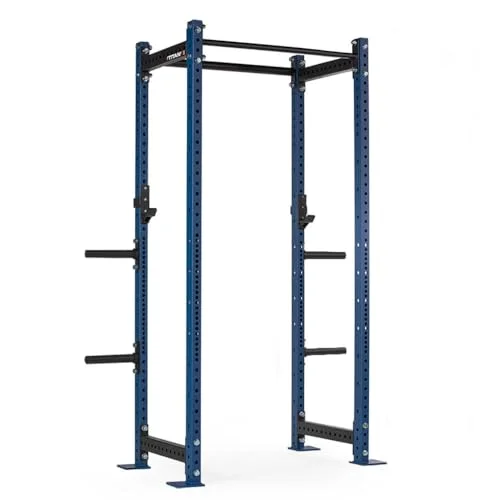
Titan Fitness T-3 Series 24in Depth Power Rack
Pros
- Full four-post cage with safety arms, so you can max out squats and bench without a spotter
- 1,100 lb rackable capacity is more than any home lifter will load onto a bar
- Westside hole spacing puts J-hooks and safeties exactly where you need them for bench and pin work
- Bolt-together design ships flat and doesn't require welding knowledge to assemble
Cons
- 24" depth plus clearance means you need close to 4 feet of wall space, more than a squat stand needs
- Base model ships without a lat pulldown or dip attachment — those cost extra
- Pull-up bar height maxes out around 82", tight for lifters over 6'2"
The T-3 is the rack most home gym builders land on first, and for good reason. The four-post cage with Westside hole spacing means you can dial in J-hooks and safety pins to the exact inch, which matters more than people expect once you’re benching inside the rack instead of just squatting in it. At 1,100 lb rackable capacity, it’s rated well beyond what any home lifter will put on a bar.
The tradeoff is space. A 24-inch depth cage plus the room to load plates and walk around it eats a real chunk of garage floor. If you’ve got a dedicated corner or a one-car garage you’re not parking in, this is the rack to buy. If you’re working with a shared multi-purpose room, look at the wall-mounted options below instead.
REP Fitness PR-4000 Power Rack
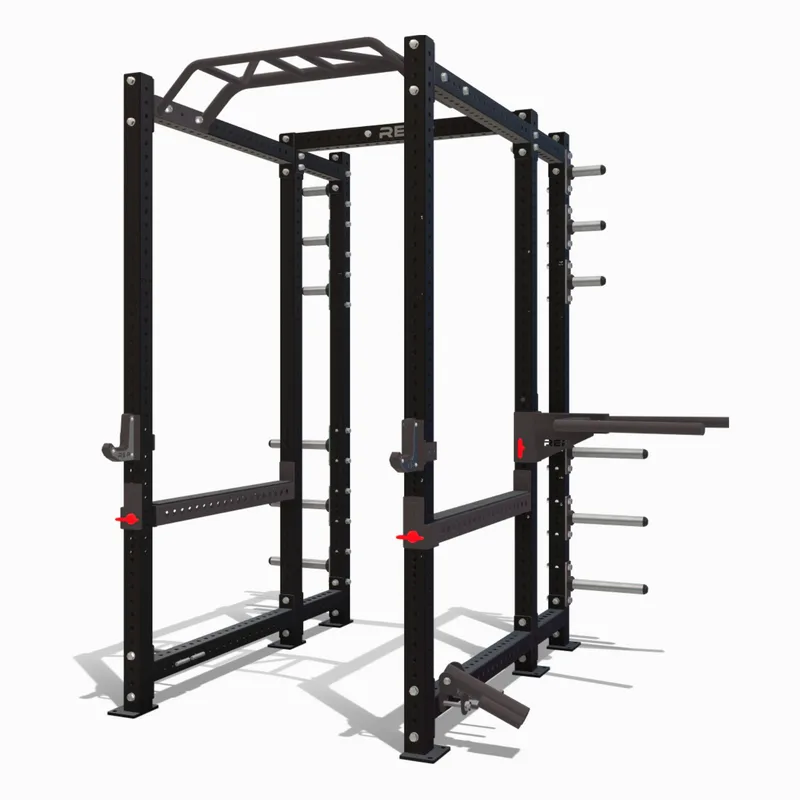
REP Fitness PR-4000 Power Rack
Pros
- 3" x 3" uprights step up from Titan's 2" x 3" tubing for a noticeably stiffer cage under heavy pin presses
- Six-post option adds a rear extension for cable attachments and band pegs without buying a second rack
- Full Westside spacing (not just the bench zone) makes micro-adjusting J-hooks easier on every lift
- REP's PR-4000 Builder configurator lets you price out exactly the attachments you'll actually use
Cons
- Sold direct from REP only, so factor in the standard freight-shipping window for a rack this size
- Base 4-post price climbs fast once you add a bar catch, dip attachment, or landmine
- Six-post configuration needs more depth than most one-car-garage layouts can spare
The PR-4000 steps up the steel gauge from 2”x3” to 3”x3”, and the difference shows under heavy pin presses — there’s noticeably less flex compared to lighter racks at this depth. Westside spacing runs the full length of the uprights here, not just the bench zone, which makes fine-tuning safety arm height easier on squats and overhead presses too.
The six-post configuration is the standout option if you want to add cable attachments or band pegs down the road without buying a second unit. It’s also the reason this rack costs more once you start building it out through REP’s configurator. Budget for the attachments you actually want before you check out — the base price climbs quickly.
Squat Racks: The Middle Ground
Titan Fitness T-3 Series Space-Saving Wall-Mounted Rack
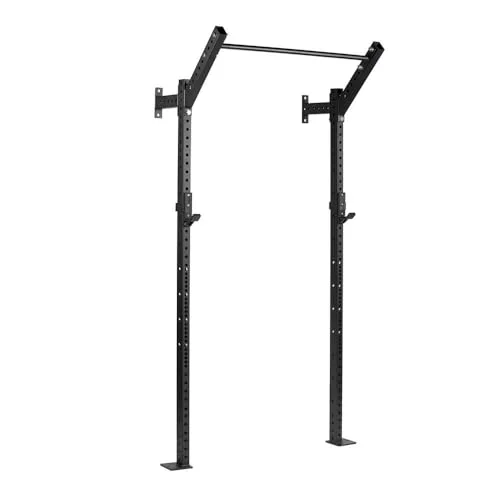
Titan Fitness T-3 Series Space-Saving Wall-Mounted Rack
Pros
- 12" depth against the wall frees up floor space a full cage can't match
- Still rated for 1,100 lb, so weight capacity isn't the tradeoff for the smaller footprint
- Pull-up bar and J-hooks come standard, unlike most stands in this price range
- Folds flat against the wall on some configurations when not in use
Cons
- Requires lag-bolting into studs or a concrete wall — this isn't a rack you can move once installed
- No enclosed cage means no rear or side safety catch, only front J-hooks and pins
- Depth options are limited compared to the full T-3 lineup
This is the rack for anyone whose garage also holds a car, a workbench, and a bike rack. At 12 inches of depth against the wall, it gives up almost nothing on weight capacity — still 1,100 lb — while returning most of the floor space a full cage would take. J-hooks and a pull-up bar come standard, which not every rack at this footprint includes.
The catch is permanence. This rack bolts into studs or a concrete wall, so you’re committing to a location before you commit to lifting. There’s also no side or rear catch since it’s open on three sides — plan your safety pin height carefully before you attempt a max squat.
Yes4All 1,000lb Folding Wall-Mounted Squat Rack
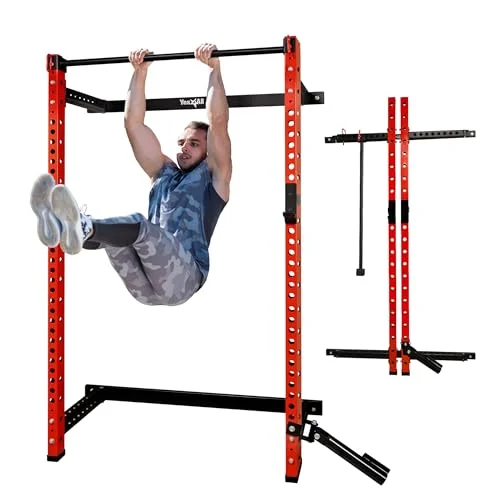
Yes4All 1,000lb Folding Wall-Mounted Squat Rack
Pros
- Lowest price of any rack in this guide that still includes a pull-up bar and landmine
- Folds flat against the wall, useful in a shared garage or multi-purpose room
- 360-degree landmine attachment adds rotational core and press work without extra gear
- 1,000 lb J-hook rating covers any raw lift a home gym owner will attempt
Cons
- 2" x 2" tubing flexes more under heavy pin presses than the 3" x 3" racks in this guide
- Owner reports on similar Yes4All rack models mention thinner paint finish that shows wear faster
- Pull-up bar's 300 lb rating is lower than the rack's own J-hook capacity — mind it during weighted pull-ups
This is the budget entry into wall-mounted racks, and it includes two things most stands at this price skip: a pull-up bar and a 360-degree landmine attachment. The 2”x2” steel is lighter gauge than the Titan and REP options above, so it flexes more under a heavy pin press, but the 1,000 lb J-hook rating still covers what a home lifter will actually load.
Owner reports on similar Yes4All rack models point to a thinner paint finish that shows scuffs and wear faster than the pricier options in this guide. For a first rack or a second station in a garage that already has a main rig, it’s a reasonable way to add squat and bench support without a big outlay.
Squat Stands: Smallest Footprint, Least Coverage
Rogue S-2 Squat Stand 2.0
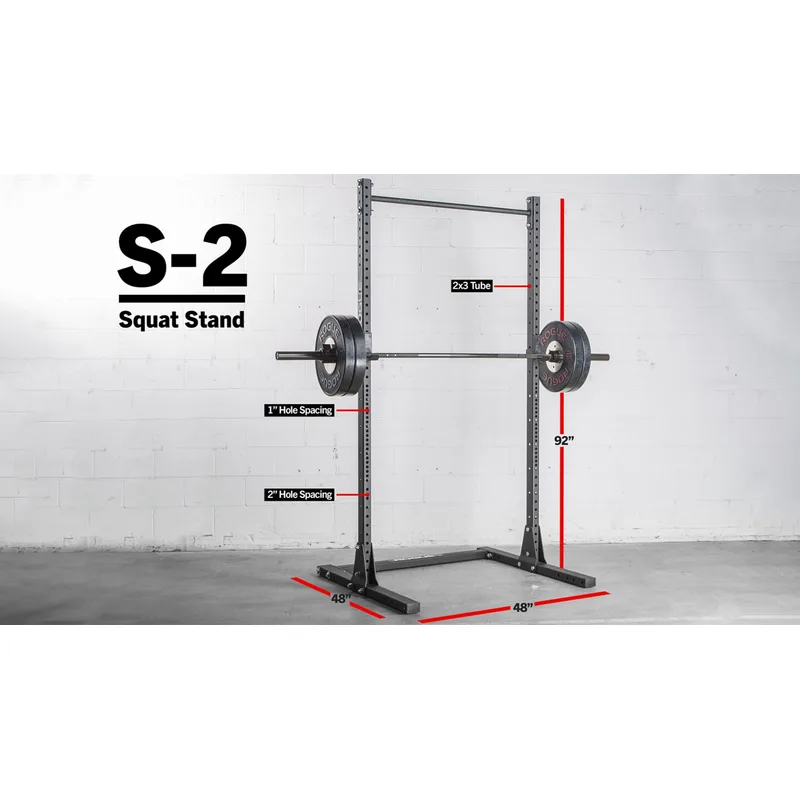
Rogue S-2 Squat Stand 2.0
Pros
- Adjustable fat/skinny pull-up bar options most squat stands in this price range skip entirely
- Made in the USA with the Westside hole spacing Rogue applies to its full rack lineup
- Compatible with Rogue's Infinity Series attachments, including safety spotter arms and landmines
- 92" height clears space for a proper dead-hang pull-up, not just a squat and rack
Cons
- $485 for a stand costs more than Titan's full enclosed cage in this guide
- No side or rear safety catch since it's an open two-post design, not a cage
- 146 lb shipped weight and 48" x 48" footprint still needs real floor space despite being a "stand"
The S-2 is proof that a “stand” doesn’t have to mean stripped-down. It ships with an adjustable fat/skinny pull-up bar, Westside hole spacing, and compatibility with Rogue’s Infinity Series attachments — safety spotter arms included, which most stands in this category don’t offer at all. Made in the USA, and the steel gauge matches Rogue’s full rack lineup.
At $485, it costs more than a full enclosed cage from Titan. You’re paying for the adjustable pull-up bar, the American manufacturing, and the attachment ecosystem — not for a smaller footprint, since the 48”x48” base still needs real floor space. This is the stand for someone who wants Rogue-grade steel without committing to a full cage.
Yes4All Adjustable Squat Rack Stand
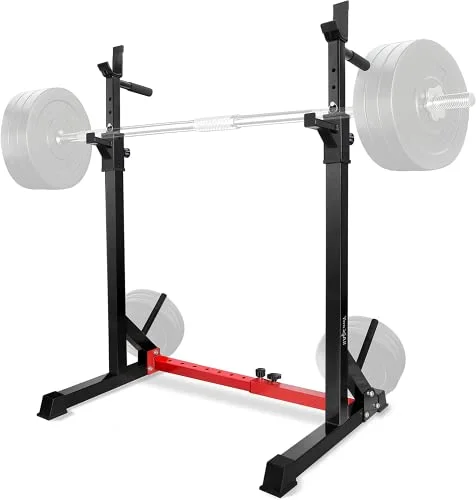
Yes4All Adjustable Squat Rack Stand
Pros
- Cheapest way into rack-supported squats and bench in this entire guide
- Freestanding design means no drilling into walls or studs, good for renters
- 13 handle-height and 10 width settings cover most home gym layouts and lifter heights
- Doubles as a bench press stand since it's not locked to one exercise like a wall mount
Cons
- 690 lb capacity is the lowest ceiling of any product here, fine for most but not max-effort powerlifters
- No pull-up bar and no landmine attachment, just squat and bench support
- Two independent posts instead of a connected frame means less stability under uneven loading
This is the cheapest way into rack-supported lifting in this entire guide, and it’s freestanding — no drilling into studs, no wall commitment, which matters if you’re renting. Thirteen handle-height settings and ten width settings cover most home gym layouts without needing tools to readjust between squat and bench sessions.
The 690 lb capacity is the lowest ceiling here, though it’s still more than the vast majority of home lifters will ever load onto a bar. There’s no pull-up bar and no landmine, and the two independent posts feel less stable under uneven loading than a connected frame. Treat it as a squat-and-bench-only tool, not an all-in-one rack replacement.
How to Actually Decide
Measure your ceiling first. Full power racks with pull-up bars often need 82-92 inches of clearance. If you’re in a basement with ductwork or a low garage ceiling, a squat stand without a tall pull-up bar option may be your only fit.
Measure your depth, not just your width. A wall-mounted squat rack at 12 inches deep and a power rack at 24+ inches deep can both fit a 4-foot-wide wall, but only one leaves room to walk around and load plates comfortably.
Decide if you lift alone. If you regularly max out squats or bench without a spotter, the enclosed safety of a full power rack is worth the footprint. If you’re training with lighter loads or always have a partner, a squat stand’s exposed sides matter less.
Renting changes the math. Wall-mounted racks require permanent bolting into studs or concrete. If you can’t drill into your walls, a freestanding squat stand or a full rack with its own footprint (no wall attachment needed) are your only realistic options.
Budget for attachments separately. None of the racks or stands here include a lat pulldown, dip station, or landmine unless specifically noted. Price those in before you compare totals across brands.
Frequently Asked Questions
Is a squat stand safe for heavy squats without a spotter?
Most squat stands include front safety arms or J-hooks rated for hundreds of pounds, which will catch a failed rep in most cases. What they lack is side and rear coverage that a full cage provides. For true max-effort attempts without a spotter, a fully enclosed power rack is the safer choice.
Can I add a pull-up bar to a squat stand that doesn’t include one?
Some stands, like the Rogue S-2, ship with one built in. Others require buying a separate pull-up bar attachment if the frame supports it — check the manufacturer’s accessory list before assuming compatibility, since not every stand frame is built to accept one.
Do wall-mounted squat racks work on drywall?
No. Wall-mounted racks need to be bolted into wall studs or a concrete wall to safely handle the load of a barbell and safety catches. Drywall alone won’t hold the weight. Confirm stud spacing or use concrete anchors before buying a wall-mounted rack.
How much floor space does a power rack actually need?
Budget the rack’s stated depth plus at least 3-4 feet of clearance in front for loading plates and walking in and out. A 24-inch-deep rack effectively needs 5-6 feet of usable floor space once you account for that clearance.
Is it worth paying more for a squat stand over a cheaper squat rack?
Only if you’re getting something the cheaper option lacks — an adjustable pull-up bar, spotter arm attachments, or steel gauge that will hold up to daily heavy use. Compare specs directly rather than assuming a higher price always means a better fit for your space.
The Verdict
If you have a dedicated garage bay and lift heavy without a spotter, the Titan Fitness T-3 Series Power Rack gives you full safety coverage at a price that doesn’t require a REP-level budget. If you want to build out attachments over time and can stretch the budget, the REP Fitness PR-4000 is worth the step up in steel gauge.
For anyone working with a shared space, the Titan T-3 Space-Saving Wall-Mounted Rack gets you real safety coverage in a fraction of the footprint. And if you’re renting or just starting out, the Yes4All Adjustable Squat Rack Stand gets you into rack-supported lifting for under $150 with nothing to bolt into a wall.
There’s no universal right answer here — only the right rack for your ceiling, your floor space, and whether you’ll be lifting alone.