Workout apps with AI-assisted progressive overload tracking surged in adoption during early 2026, with platforms like Jefit reporting a significant uptick in users logging micro-incremental weight increases. The reason: home gym athletes figure out quickly that without a coach watching over their shoulder, systematic progression has to be built into the process deliberately — and most people who plateau aren’t lacking motivation, they’re lacking a structured method.
Progressive overload is the single training principle that separates athletes who keep getting stronger from those who repeat the same workout indefinitely. Every other variable — exercise selection, program structure, nutrition timing — matters only as a delivery mechanism for this one core concept. Increase the demand on your muscles over time, and they adapt. Stop increasing it, and they stop adapting.
This guide covers what progressive overload actually means, all six methods for applying it, and specific strategies for home gym athletes who don’t have the cable stacks, weight tree variety, or coach feedback that commercial gyms provide.
What Progressive Overload Actually Means
Progressive overload is the gradual increase of stress placed on the body during training. When you lift a weight your body hasn’t encountered before, it responds by strengthening the muscles, tendons, and connective tissue involved. Once it has adapted, lifting the same weight produces no further adaptation — you’ve reached a new baseline.
The word “progressive” is doing a lot of work in this definition. The increase doesn’t need to be large. It doesn’t need to happen every session. It needs to be consistent over weeks, months, and years. Five pounds per session is unsustainable. Five pounds per month, compounded over two years, builds a genuinely strong athlete.
The principle was formalized in rehabilitation medicine by Dr. Thomas DeLorme in the 1940s after observing that patients recovering from injury made faster progress with systematic load increases than with static exercise protocols. Competitive powerlifters and Olympic weightlifters have applied the same logic for decades. The research base is large and consistent: muscles that are progressively challenged grow stronger; muscles that aren’t, don’t.
The Six Methods for Applying Progressive Overload
Most athletes default to one method — adding weight — and ignore the other five. All six work, and rotating between them is how experienced lifters keep progressing when a single method stalls.
1. Increase Load (Weight)
The most direct method. Add weight to the bar, dumbbell, or machine. The challenge at home is that standard plate increments — the smallest Olympic weight plate is typically 2.5 lbs per side — force a 5-lb jump per session. For experienced lifters pressing 135 lbs, a 5-lb jump is a 3.7% increase. For a lifter pressing 185 lbs, it’s 2.7%. Both are achievable. For a lifter pressing 85 lbs, 5 lbs is a 5.9% increase — too large to sustain weekly on most exercises. Fractional plates solve this problem directly.
2. Increase Reps
If adding weight isn’t feasible, adding a repetition counts as overload. Bench-pressing 185 lbs for 6 reps instead of 5 represents greater total volume and forces more adaptation. Many programs use rep-range targets (e.g., 3 sets of 5-8 reps) where you add weight only after reaching the top of the range. This is called double progression, and it’s especially effective at home where weight increments are limited.
3. Increase Sets
Moving from 3 sets to 4 sets of an exercise increases total volume. This method works well during phases where intensity needs to stay stable — deload periods, injury rehab, or when learning a new movement pattern. It’s the least efficient method for strength gains but valuable as a supplemental tool.
4. Manipulate Tempo
Slowing down the lowering (eccentric) phase of a movement increases time under tension without changing the load. Squatting with a 3-second descent instead of 1 second fundamentally changes the stimulus. Tempo manipulation is underused in home gym training and requires zero additional equipment.
5. Increase Range of Motion
Deepening a squat, extending a pull-up through a full dead hang, or pressing from a lower starting position all increase the range over which the muscle works. More range means more total work per rep. This method is especially relevant for athletes who cut ROM to handle more weight — improving form often provides overload equivalent to adding significant weight.
6. Reduce Rest Intervals
Completing the same workout in less time increases training density. This is a valid form of overload for conditioning and hypertrophy goals, though less effective for pure strength development. Reducing rest from 3 minutes to 2.5 minutes between heavy sets is a meaningful change that can be tracked precisely.
Why Home Gym Athletes Need a Different Approach
Commercial gyms have built-in progressive overload infrastructure: cable stacks with 10-lb increments, selectorized machines with 5-lb pin jumps, a dumbbell rack from 5 lbs to 150 lbs in 5-lb steps. Progression is built into the equipment.
A home gym typically has a barbell, fixed plate denominations, and whatever dumbbells fit the budget. The 5-lb plate jump that feels manageable on a cable machine becomes a real barrier on a barbell bench press for intermediate lifters. A home gym athlete pressing 175 lbs who can’t add less than 5 lbs per side (10 lbs total) either has to stall out, rely on reps-based progression alone, or solve the problem with fractional plates.
Fractional plates — small calibrated plates that weigh 0.25 lb to 2.5 lb each — are the most direct solution. They close the gap between what the body can handle and what the standard plate selection allows. They also enable what strength coaches call “micro-loading”: systematic 0.5-lb-to-1-lb increases that accumulate into significant strength gains over months without the plateaus that result from jumping too far too fast.
Fractional Plates: The Home Gym Progressive Overload Tool
A pair of 1.25-lb fractional plates adds 2.5 lbs total to a barbell — half the jump of the smallest standard plate. A pair of 0.5-lb plates adds 1 lb total. For any lift where a 5-lb increase would be too aggressive, fractional plates keep progress moving without forcing a failed rep or forcing a week-long stall.
Three products cover the range from essential to comprehensive for home gym use:
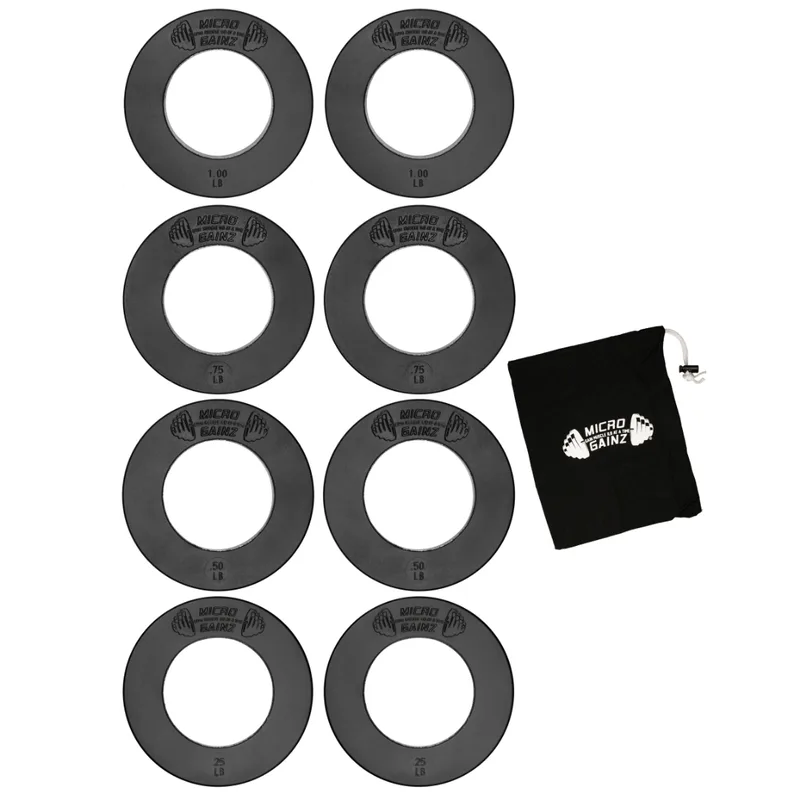
Micro Gainz 8-Piece Calibrated Fractional Weight Plates Set
Pros
- Smallest increments available — 0.25 lb per plate, 0.5 lb total added per session
- Sintered steel stays accurate and won't warp like cast iron alternatives
- 8-plate set covers every micro-loading scenario from 0.5 lb to 4 lb added total
- IPF-calibrated to ±5 grams — the most precise plates available for home use
- Includes a zippered carrying bag that keeps everything organized
Cons
- Premium price compared to rubber alternatives
- Steel construction can scratch floors or bars if mishandled
- Small 3.5" diameter means stacking against standard plates — verify collar clearance
The Micro Gainz 8-piece set is the most complete solution for barbell progressive overload. With plates from 0.25 lb to 1 lb included, you can add 0.5 lb, 1 lb, 1.5 lb, 2 lb, 2.5 lb, 3 lb, 3.5 lb, or 4 lb to any barbell — total increments of 0.5 to 4 lbs added across both sides. The sintered steel construction holds calibration precisely, which matters for lifters tracking PR attempts where the difference between 225 lbs and 225.5 lbs is meaningful. Made in Pennsylvania, with a zippered carry bag included. This is the first fractional plate purchase most home gym athletes should make.
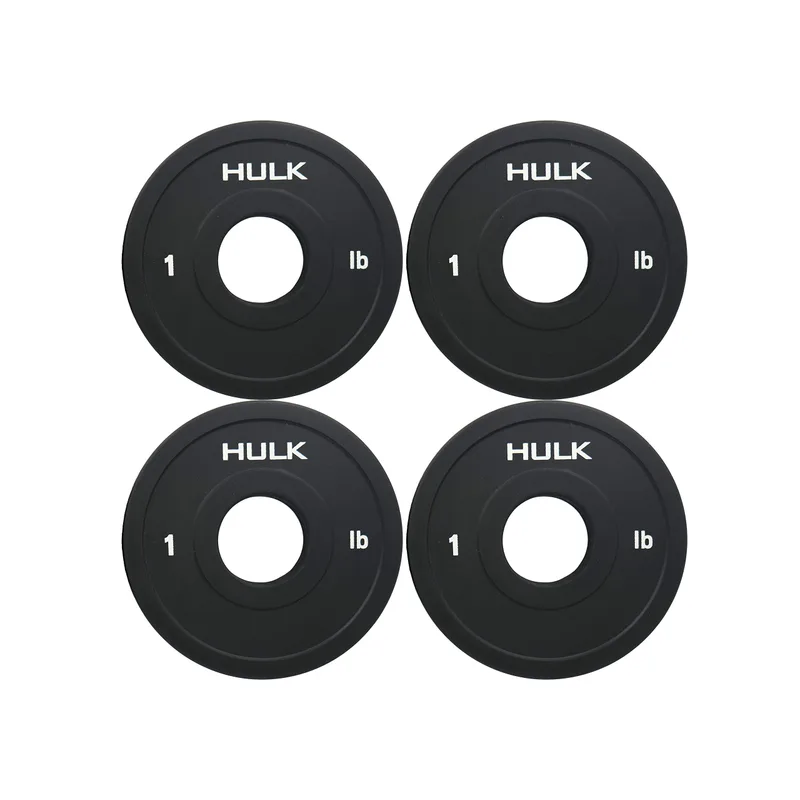
Hulk Rubber Olympic Fractional Weight Plates
Pros
- Rubber coating protects floors and reduces noise on contact
- Flexible configuration — use as four 1-lb plates or eight 0.5-lb plates
- Most affordable entry point for fractional plate training
- Rubber hold stays secure on the bar during heavy lifts
Cons
- Limited to two weight options (0.5 lb and 1 lb) — less versatile than Micro Gainz
- No carrying bag included
- Rubber can compress slightly over time, which may affect precision
The Hulk Rubber set handles the two most common fractional scenarios — adding 1 lb or 2 lbs total — at roughly half the price of the Micro Gainz set. The rubber coating is the key advantage: these won’t scratch a finished barbell sleeve the way steel plates can, and they sit quietly against standard plates without the metallic contact sound. For lifters who only need basic micro-loading and don’t require the full spectrum of increments, this set covers most use cases without the premium cost.
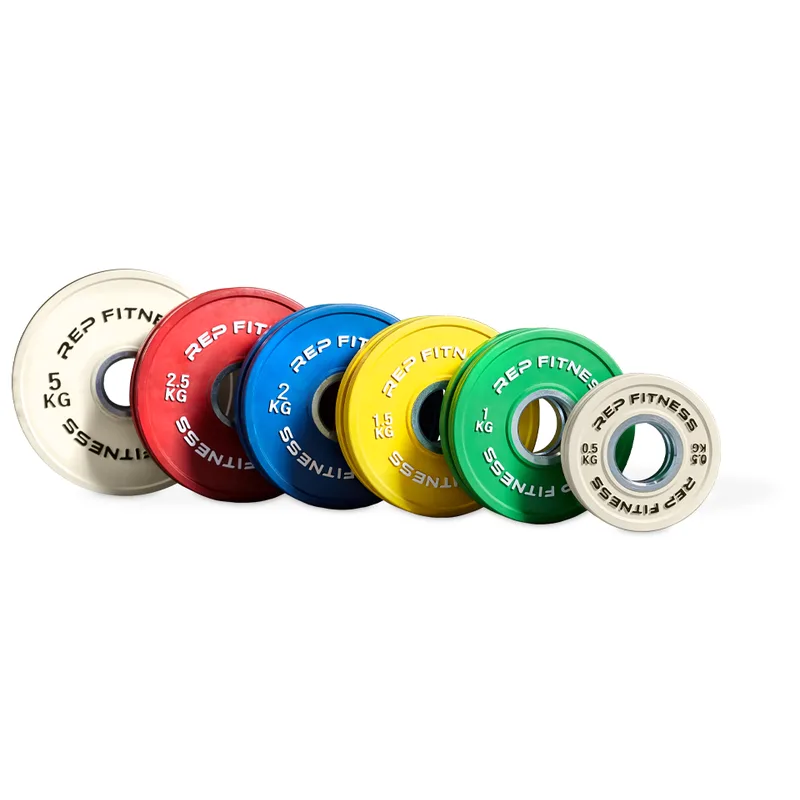
REP Fitness Change Plates for Olympic Weightlifting
Pros
- IWF-standard color coding makes plate selection fast and error-free
- Rubber coating adds durability and reduces bar noise
- 1% weight tolerance is accurate enough for serious strength tracking
- Available in kilogram increments that suit metric-based programming
- REP Fitness quality control is consistently reliable
Cons
- Kilogram sizing complicates mental math for US-based athletes programming in pounds
- Sold as individual pairs — collecting a full range adds up in cost
- Rubber coating is slightly thicker than competition-grade calibrated plates
The REP Fitness Change Plates are sized in kilograms and color-coded to IWF standards, which makes them natural companions for athletes following percentage-based programs written in metric units. A 0.5-kg plate (roughly 1.1 lbs) is a common increment in weightlifting programming. The rubber coating and 1% accuracy tolerance put these in the same performance tier as the Micro Gainz steel option, with the added benefit of a color system that eliminates plate identification errors when loading quickly.
Quick Comparison: Fractional Weight Plates
| Micro Gainz 8-Piece | Hulk Rubber 4lb Set | REP Fitness Change Plates | |
|---|---|---|---|
| Price | $44.99 | $22.99 | $29.99 |
| Smallest Increment | 0.25 lb | 0.5 lb | 0.5 kg (~1.1 lb) |
| Material | Sintered steel | Rubber coated | Rubber coated |
| Accuracy | ±5 grams (IPF) | Standard | 1% tolerance |
| Sizing System | Pounds | Pounds | Kilograms |
| Includes Bag | Yes | No | No |
| Best For | Maximum versatility | Budget entry | Metric programming |
Progressive Overload for Dumbbells
Fixed dumbbells in a home gym usually come in 5-lb or 10-lb jumps. Moving from 40-lb to 45-lb dumbbells on a press is manageable for some athletes; moving from 80-lb to 90-lb dumbbells is a significant jump that many can’t make cleanly for several weeks.
Three strategies work well here:
Tempo manipulation before weight increases. If you’re stuck between dumbbell sizes, slow your eccentric to 3-4 seconds per rep for 2-3 sessions. Once you’ve built control at the heavier tempo, switching back to a normal tempo with the same weight often reveals headroom for the next dumbbell jump.
Adjustable dumbbells. The Bowflex SelectTech 552 adjusts from 5 to 52.5 lbs in 2.5-lb increments up to 25 lbs and 5-lb increments above that. The PowerBlock Elite EXP uses 2.5-lb add-on kits. Both solve the dumbbell progression gap without requiring a full rack of fixed weights. See our best adjustable dumbbells guide for current recommendations.
Rep-range double progression. Set a target rep range of, say, 3 sets of 8-12 reps. Start at the weight where you can complete all three sets at 8 reps. Progress reps each session until you hit 12 on all three sets, then add weight and drop back to 8. This method extracts maximum development from each dumbbell pair.
Progressive Overload for Bodyweight Training
Bodyweight training has built-in progressive overload through movement difficulty scaling. The progression from ring push-ups to ring dips to weighted ring dips is a valid strength progression. The challenge is that each step is a larger jump than adding weight to a bar.
Standard progressions for home gym bodyweight athletes:
Pull-ups: Dead hang → Band-assisted → Bodyweight × reps → Add weight (belt or vest) → L-sit pull-up Push-ups: Elevated hands → Standard → Feet elevated → Ring push-up → Archer push-up → Ring dip Squats: Box squat → Goblet squat → Front squat → Back squat → Pause squat → Single-leg variations
The key for bodyweight progressive overload is treating movement progressions with the same discipline as weight increases. If you can do 20 push-ups, the next step isn’t doing 21 push-ups — it’s transitioning to a harder variation where you can only do 6-8 quality reps.
Tracking: The Non-Negotiable Foundation
Progressive overload without tracking is guesswork. Without a log, you genuinely cannot know whether this session is harder than last session. Every training session that goes unrecorded is a session that provides no useful data for planning the next one.
The minimum data to track per session:
- Exercise
- Weight used (including any fractional plates)
- Sets completed
- Reps per set
- Notes on form or how the weight felt (RPE 1-10 scale is useful)
This doesn’t require an app. A notebook works. A shared Google Sheet works. What doesn’t work is relying on memory — even experienced athletes misremember last week’s weights by 5-10 lbs regularly, which defeats the purpose entirely.
For home gym athletes specifically: keep your log in the gym, not in another room. A training log that requires leaving the rack to update gets updated less reliably.
How Often to Increase Load
Beginner athletes (under 6 months of consistent training) can add weight to most lifts every session — this is called linear progression, and programs like Starting Strength and StrongLifts 5×5 formalize it. If you’re a beginner, add weight every session until you can’t.
Intermediate athletes (6 months to 3 years) typically progress on a weekly or bi-weekly basis. The upper body lifts (bench press, overhead press) slow down faster than lower body lifts. Expect to add 5 lbs to the bench press once every 1-2 weeks; the squat and deadlift can sustain progress longer.
Advanced athletes (3+ years) often progress on a monthly basis or slower, organizing their training around periodization cycles that build toward peak attempts. At this stage, fractional plates become essential — adding 2.5 lbs to a 315-lb deadlift is a 0.8% increase, which is a realistic training stimulus; adding 5 lbs is 1.6%, which can exceed recovery capacity for a seasoned athlete.
A useful rule of thumb: if you’ve missed the same weight for three sessions in a row, you haven’t earned the next weight increase yet. Stay at the current load and address the stall through deloading, sleep, nutrition, or technique work before adding more.
Common Mistakes That Kill Progress
Skipping the log. Covered above. Non-negotiable.
Increasing weight before earning it. Adding weight because it feels like time, not because you’ve actually hit your target reps with good form, leads to form breakdown and injury. Let the reps drive the timeline.
Ignoring the other five methods. Lifters who only know how to add weight will stall every time adding weight becomes impossible. Building fluency in all six progression methods keeps development moving.
Treating deload weeks as failure. A planned deload — 1 week of reduced volume and intensity after 3-4 hard weeks — is part of the progression, not a break from it. Skipping deloads to keep adding weight is a reliable path to overtraining.
Changing exercises too frequently. Skill development is part of strength development. The deadlift gets stronger partly because the muscles get stronger and partly because the movement becomes more efficient. Switching exercises before strength accumulates wastes adaptation. Commit to core movements for at least 8-12 weeks before reassessing.
Buying Guide: Choosing Fractional Plates
Material: Steel plates hold calibration longer and are more compact. Rubber-coated plates protect floors and reduce bar noise but add a small amount of thickness. For most home gym athletes, either works well.
Increment range: If you’re just starting with fractional loading, a 1-lb pair covers most cases. If you want to cover every micro-loading scenario precisely, the Micro Gainz 8-piece set is the most comprehensive option available.
Pricing system (lbs vs kg): Unless your programming is written in kilograms, pound-based plates simplify mental math significantly. The REP Fitness kg plates are excellent but require conversion math during loading.
Quantity: A pair (2 plates) is the minimum — you need one for each side of the bar. A set of 4-8 plates gives you more flexibility to combine increments.
Most home gym athletes need one quality fractional plate set and nothing else. Start with the Micro Gainz 8-piece for maximum flexibility, or the Hulk Rubber set for a budget-friendly entry point.
FAQ
What is the smallest productive weight increase for a barbell? For most exercises, 1 lb total (0.5 lb per side) is the smallest increment that produces meaningful adaptation. Increases below 0.5 lb total exist and are used in some competitive programming, but for most home gym athletes, 1-2.5 lb total per session or per week is the practical sweet spot.
Can you build significant strength at home without fractional plates? Yes, but progress slows faster. Double progression (increasing reps before increasing weight) handles most of the gap, but at intermediate strength levels — especially on upper body pressing — the 5-lb-per-side jump becomes too large to sustain consistently. Fractional plates remove the barrier rather than working around it.
How long does progressive overload take to show visible results? Strength increases become measurable within 2-4 weeks. Visible muscle development typically requires 8-12 weeks of consistent, progressive training. Both timelines assume adequate protein intake (0.7-1g per pound of bodyweight) and enough sleep (7-9 hours). Progressive overload sets the stimulus; recovery converts that stimulus into adaptation.
What do you do when you stall completely on a lift? A 3-session stall usually means the load is right and recovery is inadequate — check sleep, nutrition, and total weekly volume. A stall lasting 2-3 weeks usually means the program needs adjustment: a planned deload, a technique review, or a temporary switch to volume accumulation before returning to intensity. Rarely, a stall indicates the need to test a different exercise variant.
Does progressive overload apply to cardio? Yes. Adding 0.5 mph to a treadmill pace, extending a rowing session by 2 minutes, or decreasing rest between sprint intervals are all forms of progressive overload. The physiological principle is identical — increase the stimulus until adaptation occurs, then increase it again.
Conclusion
Every strength gain you’ll make in a home gym traces back to one thing: doing slightly more than your muscles handled before. The method doesn’t matter as much as the consistency. Add 1 lb to the bar every week for a year and you’ve added 52 lbs to that lift — which is a meaningful transformation on any exercise.
The tools that make this possible at home are straightforward. A log to track where you are. A clear method for how you’ll progress each lift. And fractional plates for the moments when the standard 5-lb jump is too large to sustain.
Best overall fractional plate set: Micro Gainz 8-Piece Calibrated Set — the most precise and versatile option for home gym barbells.
Best budget pick: Hulk Rubber Olympic Fractional Plates — covers the two most common micro-loading scenarios at half the cost.
For equipment that enables progressive overload across all lift categories, see our best Olympic barbells guide and best power racks under $1,000.