Rowing machine buyer guides in 2026 — including one from Olympic gold medalist Xeno Müller — keep circling back to the same fork in the road: which resistance type should you actually buy? Most roundups rank rowers within a single category, air against air or water against water. That’s the wrong first question. Before you compare specific models, you need to know whether an air, water, or magnetic flywheel matches how and where you’ll actually train, because the resistance mechanism changes the feel, the noise, and the maintenance far more than any brand name does.
Here’s how the three types stack up, using one representative machine from each category.
Quick Comparison
| Spec | Concept2 RowErg | WaterRower Oak with S4 BLE Monitor | MERACH Q1S Magnetic Rowing Machine |
|---|---|---|---|
| Rating | 9.5/10 | 9.2/10 | 9.0/10 |
| Price | $990.00as of Oct 18, 2026 | Unavailable | Unavailable |
| Resistance Type | Air (flywheel) | Water (enclosed tank) | Magnetic, 16 levels |
| Dimensions | 96" × 24" (244 × 61 cm) | 84"L × 21"W × 22"H | — |
| Seat Height | 14" standard / 20" tall legs | — | — |
| Machine Weight | 57 lbs | 117 lbs (with water) | — |
| Weight Capacity | 500 lbs | 700 lbs | 350 lbs |
| Monitor | PM5 | S4 BLE (distance, speed, pace, calories, watts, heart rate) | — |
| Storage | Separates into 2 pieces | Upright vertical (21" × 22" footprint) | — |
| Warranty | 5-year frame, 2-year parts | 1-year standard (upgradeable to 5-yr frame / 3-yr parts) | — |
| Material | — | Solid American oak, hand-applied oil finish | — |
| Rail System | — | — | Dual slide rail |
| App Compatibility | — | — | MERACH app, Kinomap |
| Display | — | — | LCD monitor |
| Noise Level | — | — | Near-silent at all resistance levels |
| Check Price → | Check Price → | Check Price → |
Prices change daily — tap Check Price for the current Amazon price. Numbers shown were verified on the "as of" date.
How Each Resistance Type Actually Works
Air resistance uses a flywheel with fan blades that spin and displace air — the harder you pull, the more air gets pushed and the more resistance builds. There’s no dial to set; the machine matches whatever effort you put in, stroke by stroke. That’s why air rowers like the Concept2 RowErg feel most connected to actual on-water rowing at high intensity.
Water resistance suspends a paddle wheel inside a sealed tank, and pulling the handle spins the paddles through real water. Water has mass and inertia, so the catch loads up smoothly and the resistance builds and fades in a way that mimics an actual boat more closely than air can. It’s the reason wood water rowers like the WaterRower Oak get described as the closest indoor equivalent to rowing on a lake.
Magnetic resistance uses magnets positioned near a flywheel to create resistance without any physical contact. Instead of scaling automatically with effort, resistance is set to a fixed level — manually with a dial or electronically through a console. That makes the feel more stable and predictable stroke to stroke, which some users prefer for steady-state cardio, but it also means the machine won’t reward pulling harder the way air or water does.
The Rowers
Concept2 RowErg — Air Resistance
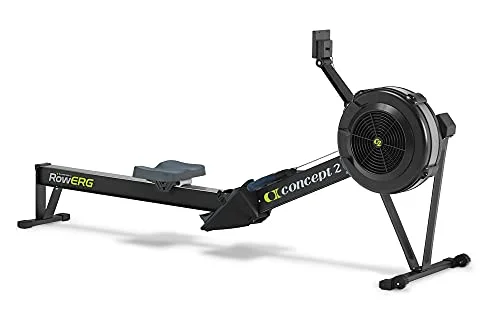
Concept2 RowErg
Pros
- Gold-standard PM5 monitor tracks pace, watts, calories, and stroke rate with competition-accurate data
- 500 lb weight capacity accommodates virtually any athlete
- Air resistance automatically scales to effort — pull harder, get more resistance
- Splits into two pieces for apartment-friendly storage in under 30 seconds
- Strong resale value — used RowErgs hold a significant portion of original price
Cons
- No touchscreen or streaming workouts — pure mechanical simplicity
- Air flywheel is audible during hard efforts — not ideal for shared-wall apartments
- Third-party app connectivity requires a separate device
The RowErg is the machine competitive rowers train on, and that pedigree is exactly why USRowing’s own coaching staff points home buyers toward it. The PM5 monitor tracks pace, watts, calories, and stroke rate with a level of accuracy no console at this price approaches, and the air flywheel’s self-scaling resistance means max effort always produces max resistance — nothing to adjust mid-workout. At $990 with a 500 lb weight capacity, it’s also the most durable value in this comparison.
The tradeoff is noise. The fan generates an audible whoosh that rises with intensity, which matters if you’re training early or late in an apartment with shared walls. It splits into two pieces for storage, but it isn’t a quiet-hours machine.
WaterRower Oak with S4 BLE Monitor — Water Resistance

WaterRower Oak with S4 BLE Monitor
Pros
- 700 lb weight capacity is the highest of any rower in this comparison
- Solid oak construction absorbs sound and vibration, making it one of the quietest rowers available
- Stores vertically against a wall in a 21" × 22" footprint
- Handcrafted in the USA — owner reports consistently praise the build quality and finish
- S4 BLE monitor tracks watts in real time for objective pacing
- 84" stroke length accommodates taller users up to roughly 6'5"
Cons
- $1,299 is a significant investment compared to budget rowers with similar cardio output
- S4 BLE monitor is data-only — no built-in content or coaching platform
- 117 lbs makes it heavy to reposition once filled
- 1-year base warranty is short given the price point
The WaterRower Oak is built for buyers who want the water-rowing feel without sacrificing quiet living space compatibility. Solid oak absorbs vibration the way a metal frame can’t, and the enclosed water tank produces a soft, ambient rush rather than a mechanical whir — noticeably gentler than an air flywheel at comparable effort. Owner reports consistently point to the 700 lb weight capacity and the ability to store the whole machine upright in a 21-inch-wide footprint as the two biggest wins.
At $1,299, it costs more than either alternative here, and the S4 BLE monitor is data-only — there’s no coached programming built in, so you’re rowing to your own plan or a third-party app. The 1-year base warranty is also the shortest of the three machines.
MERACH Q1S — Magnetic Resistance
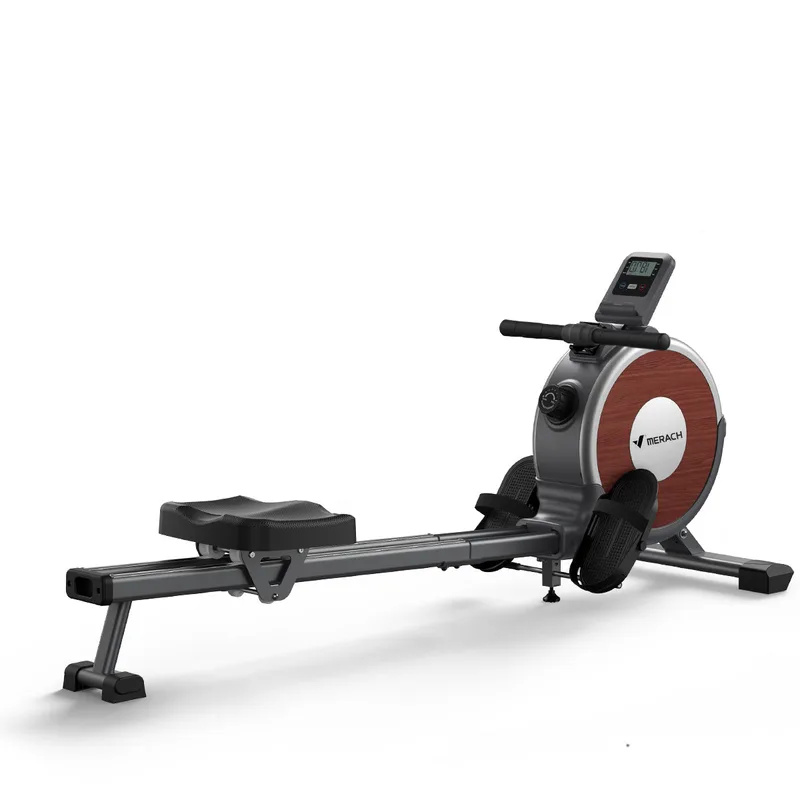
MERACH Q1S Magnetic Rowing Machine
Pros
- 16 magnetic resistance levels at $199 — more adjustment range than most budget rowers at twice the price
- 350 lb weight capacity is among the highest in the budget magnetic category
- Dual slide rail design delivers noticeably more lateral stability than single-rail competitors
- Compatible with the MERACH app and Kinomap for structured workouts without a subscription paywall
- Magnetic resistance is silent enough for early-morning sessions in a shared-wall apartment
Cons
- Lower resistance levels (roughly 1–8) feel similarly light — the meaningful jump in intensity starts around level 10
- MERACH app requires account creation; no anonymous offline-only mode
- Fixed resistance levels don't scale with effort the way air or water resistance does
The Q1S is the pick for buyers who want a rowing machine that disappears into the room and the budget. Magnetic resistance is close to silent at every one of its 16 levels, which makes it the only machine in this comparison genuinely suited to a shared-wall apartment at any hour. The dual slide rail keeps the seat stable side to side, a common complaint on cheaper single-rail rowers, and the MERACH app plus Kinomap compatibility cover structured training without a subscription requirement.
At $199 it’s a fraction of the other two prices, but the fixed resistance levels don’t scale with effort — pulling harder at level 8 doesn’t load you the way pulling harder on an air or water rower does. The lower levels also feel similarly light until you get to roughly level 10.
Head-to-Head: What Actually Decides This
Feel and Realism
Air and water resistance both scale with effort in real time, which is why rowers who care about stroke-by-stroke feedback tend to prefer them. Magnetic resistance is fixed per level, trading realism for predictability — a fair trade for steady-state cardio, less so for anyone training to a specific power output. If you’ve rowed on a boat or a team erg before, air and water will feel far more familiar than a magnetic machine’s level-locked resistance curve.
Noise
Magnetic is the quietest category by a clear margin, followed by water’s ambient rush, with air’s fan whoosh the loudest of the three — especially at high stroke rates. If shared walls or early-morning sessions are a factor, that ordering should drive the decision more than price.
Maintenance
Air rowers need occasional dust cleaning off the flywheel and chain lubrication, since the open fan housing pulls in ambient dust over months of use. Water rowers require periodic tank water treatment tablets and monitoring the water level as it evaporates over time — skip that and the water can go cloudy or start to smell. Magnetic rowers have no fluid or exposed mechanical flywheel to maintain, making them the lowest-upkeep option of the three and the easiest to store in a garage without worrying about temperature swings.
Price and Space
The MERACH Q1S at $199 is the clear budget pick. The Concept2 RowErg at $990 sits in the middle and folds into the smallest storage footprint of the three thanks to its two-piece separation. The WaterRower Oak at $1,299 costs the most but stores vertically in a compact 21” × 22” footprint, trading floor space for wall space.
Buying Guide: Which Resistance Type Should You Buy
Choose air resistance if: you want the machine competitive and CrossFit rowers actually train on, need the highest weight capacity, and don’t mind audible noise during hard efforts. The Concept2 RowErg is the default choice for anyone building a serious training tool without recurring costs.
Choose water resistance if: the rowing feel itself matters most to you, you want the quietest wood-frame option, and you’re willing to pay a premium for handcrafted construction and vertical storage.
Choose magnetic resistance if: noise is your top constraint — thin apartment walls, early mornings, shared living spaces — or you’re working with a tight budget and want a no-subscription option that still tracks workouts through an app.
If you’re not sure: most home gym buyers underestimate how much noise matters until they’re rowing at 6 a.m. next to a sleeping household. Weigh that before weight capacity or price.
Frequently Asked Questions
Is air or water resistance better for rowing technique? Both scale with effort and feel more like actual rowing than magnetic resistance does. Air responds slightly faster to changes in pull force; water has more inertia and a smoother catch-to-finish feel. Neither is objectively better for technique — it comes down to personal preference.
Which type of rowing machine is quietest? Magnetic resistance rowers are the quietest of the three types, followed by water rowers. Air rowers are the loudest, with fan noise that increases audibly at higher stroke rates and intensities.
Do magnetic rowing machines wear out faster than air or water rowers? Not necessarily. Magnetic rowers actually require less maintenance since there’s no exposed flywheel to clean or water tank to treat. Build quality and rail durability vary more by manufacturer and price point than by resistance type.
Can I get a full-body workout on a magnetic rowing machine? Yes. All three resistance types engage the same rowing stroke — legs, back, then arms on the drive. The difference is how resistance responds to effort, not which muscles are trained.
Is a water rower worth the extra cost over an air rower? Only if the quieter operation and handcrafted wood construction matter enough to justify roughly $300 more than a comparable air rower. Functionally, both deliver similar cardiovascular training; the RowErg’s PM5 monitor also offers more competition-standard data tracking than most water rower consoles.
Conclusion
For most home gyms, the Concept2 RowErg remains the strongest all-around pick — proven durability, the highest weight capacity, and a monitor serious enough for competitive training. If noise is the deciding factor, the MERACH Q1S delivers real magnetic-resistance quiet at a fraction of the price, and the WaterRower Oak is the machine to buy if the rowing feel and quiet wood construction are worth a premium to you.
For deeper single-category breakdowns, see our full picks for water rowing machines and budget rowing machines under $300.