Decline benches have two jobs, and most buyers only need one of them. A decline press bench tilts your head below your hips for chest work. A decline sit-up board anchors your feet for core training. Reviewers who updated their 2026 sit-up bench lists said they focused on stability, decline range, padding, and leg support, and those are the same filters we applied here. This list covers five options built from research into spec sheets and owner feedback, from a budget-friendly folding FID bench to a heavy-duty rack-ready one.
Most adjustable benches skip decline entirely. The picks below all go below flat, either as a full flat/incline/decline bench or as a dedicated ab board.
Comparison
| Spec | REP Fitness AB-3000 2.0 FID Adjustable Bench | Flybird WB5 Adjustable Folding Bench | XMark OX Series Adjustable FID Bench (XM-9010) | Body-Solid GFID31 Flat Incline Decline Bench | Body-Solid GAB60B Pro-Style Adjustable Ab Board |
|---|---|---|---|---|---|
| Rating | 9.2/10 | 8.8/10 | 8.6/10 | 8.1/10 | 8.2/10 |
| Price | Check price | $149.98as of Oct 18, 2026 | $315.00as of Oct 18, 2026 | $440.00as of Oct 18, 2026 | $360.00as of Oct 18, 2026 |
| Weight Capacity | 1,000 lb | 800 lb (ASTM-certified) | 1,500 lb | 600 lb | 400 lb |
| Back Positions | 8 (-12° to 85°) | 8 (-30° to 90°) | 7 (-20° to 85°) | 6 (ladder-style) | — |
| Seat Positions | 5 (0° to 20°) | 3 | 3 (0°, 15°, 30°) | 8 | — |
| Steel Gauge | 11-gauge | — | — | — | — |
| Bench Weight | 89 lb | 29 lb | 70 lb | — | — |
| Assembly | Moderate (two people recommended) | Easy | — | — | — |
| Design | — | Folds flat for storage | — | — | — |
| Frame | — | — | 11-gauge, 2" x 3" steel | — | Telescoping 2" x 2" steel beam |
| Pad Thickness | — | — | 3 in | — | — |
| Upholstery | — | — | — | DuraFirm commercial grade | — |
| Leg Hold-Down | — | — | — | T-bar included | — |
| Mobility | — | — | — | Integrated wheels | — |
| Adjustment Levels | — | — | — | — | 12 |
| Dimensions | — | — | — | — | 66" L x 24" W x 52" H |
| Weight | — | — | — | — | 39 lb |
| Foot Anchor | — | — | — | — | 8" foam rollers |
| Check Price → | Check Price → | Check Price → | Check Price → | Check Price → |
Prices change daily — tap Check Price for the current Amazon price. Numbers shown were verified on the "as of" date.
Quick Picks
REP Fitness AB-3000 2.0 is the best all-rounder: -12° decline, 1,000 lb rating, 11-gauge steel.
Flybird WB5 is the value pick and goes steepest at -30°, with a fold-flat design.
XMark OX Series is for heavy barbell work, with a -20° decline and a 1,500 lb rating.
Body-Solid GFID31 is the commercial-grade option with a leg hold-down included.
Body-Solid GAB60B is the best dedicated ab board.
Decline Bench Reviews
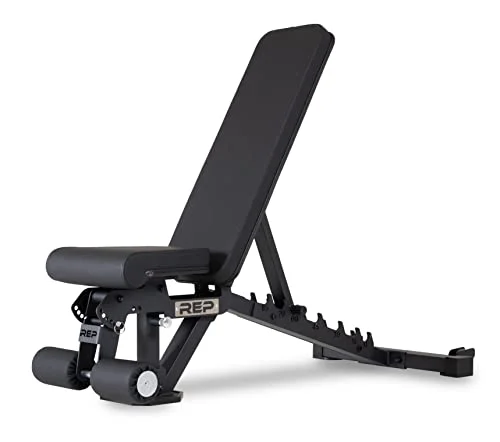
REP Fitness AB-3000 2.0 FID Adjustable Bench
Pros
- A true -12° decline sits inside an eight-position back range, so one bench covers decline press, flat, incline, and upright work
- 11-gauge steel and a 1,000 lb rating mean the frame stays planted during heavy decline pressing
- Five seat positions keep you from sliding when you move between decline and steep incline
- Adjustable leg rollers handle decline sit-ups for a wide range of heights, according to owner reports
Cons
- At 89 lb it is a permanent floor-space commitment — it does not fold
- The -12° decline is gentle; lifters who want a steeper 30° angle need a different bench
- Two-person assembly is recommended given the weight
The AB-3000 2.0 is the bench to buy if you want one frame for everything. The -12° decline is modest, but it is enough to change the pressing angle, and the 11-gauge steel stays rigid. Five seat positions keep you in place when you switch from decline to a steep incline. The tradeoff is size: 89 lb and no folding, so give it a permanent home.
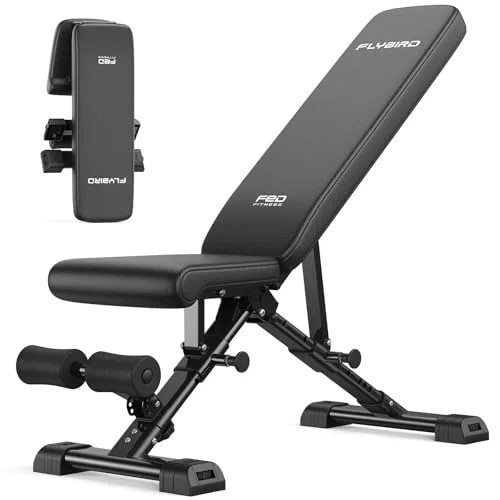
Flybird WB5 Adjustable Folding Bench
Pros
- Offers the steepest decline on this list at -30°, which is where decline sit-ups and decline dumbbell work start to feel different
- The ASTM-certified 800 lb rating is an independently verified figure rather than a spec-sheet claim
- At 29 lb it folds and stores under a bed or behind a door
- The lowest price of any full adjustable bench here
Cons
- The light frame shifts under very heavy barbell loads, according to owner feedback
- Pads are thinner than on premium benches
- Seat width is on the narrow side for broader lifters
The Flybird WB5 is the cheapest way into a real decline. At -30° it offers the steepest angle in the group, and it folds flat for storage. The cost is rigidity: owner reports say the light frame shifts under very heavy barbell loads. For decline dumbbell press and decline sit-ups it is a strong buy; for heavy barbell decline, step up to the XMark.
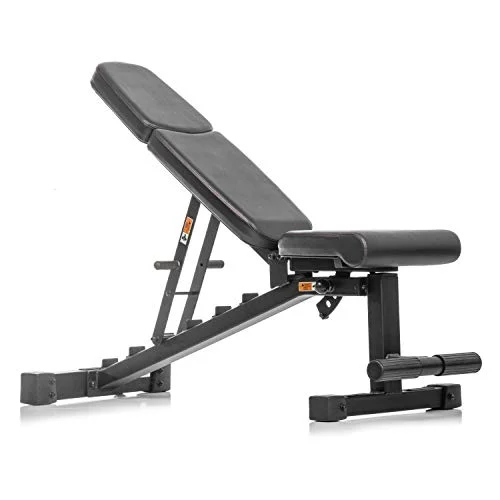
XMark OX Series Adjustable FID Bench (XM-9010)
Pros
- A -20° decline on an 11-gauge, 1,500 lb-rated frame is the strongest decline-press platform here
- Three-inch high-density padding is the thickest in the group
- Non-marking rubber feet protect flooring
- Fits inside most power racks for decline barbell work
Cons
- 70 lb makes it awkward to move or store
- Costs roughly double the Flybird for the same decline-capable concept
- Seven positions give less fine-tuning than the eight-position benches
The XMark OX Series is built for loading. A 1,500 lb rating, 11-gauge 2” x 3” steel, and 3-inch padding make it the most stable decline press platform here. The -20° decline is steep enough for dedicated chest work. At 70 lb it is not a bench you move daily.
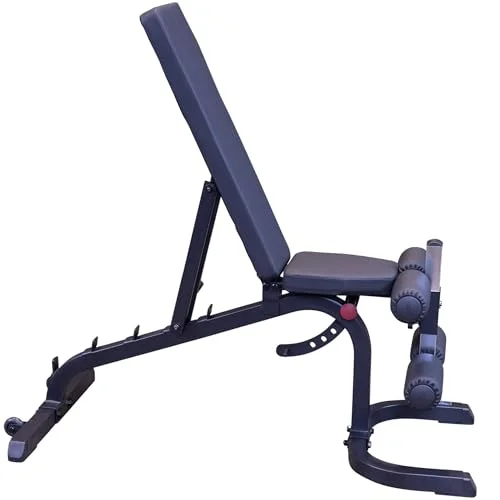
Body-Solid GFID31 Flat Incline Decline Bench
Pros
- Commercial upholstery resists compression, so the pad keeps its shape over years of use
- The included leg hold-down makes decline sit-ups possible without buying an extra attachment
- Compact frame is designed to fit inside Smith machines and power racks
- Eight seat positions help short and tall lifters keep their hips aligned on decline
Cons
- Highest price among the adjustable benches here
- The 600 lb rating is the lowest of the FID benches
- Ladder-style back adjustment is slower than a quick-release design
The GFID31 is for lifters who want it to last. The DuraFirm upholstery resists compression, the leg hold-down is included, and the compact frame fits inside racks and Smith machines. You pay a premium for that durability, and the 600 lb rating is the lowest of the full benches.
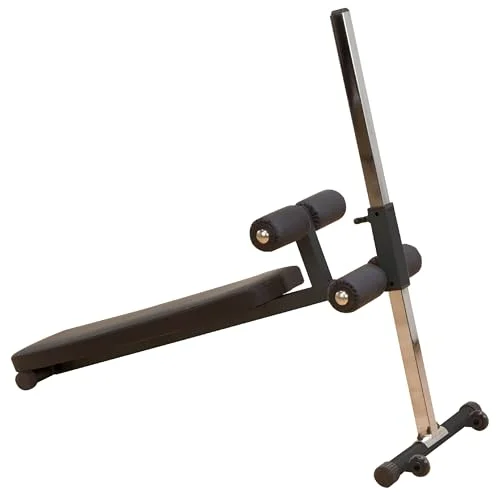
Body-Solid GAB60B Pro-Style Adjustable Ab Board
Pros
- Twelve decline levels let you progress from a gentle slope to a steep angle as your core gets stronger
- Wide, thick DuraFirm pad supports the back during long sets
- Transport wheels make it easy to roll away
- Commercial-style build for a dedicated ab station
Cons
- Only for decline sit-ups and core work — no pressing capability
- Expensive for a single-purpose station
- 66 in length takes real floor space when in use
The GAB60B is a dedicated decline station for core training. Twelve adjustment levels let you progress, and the wide pad supports your back. It cannot press, so it only makes sense if abs are a regular part of your program and you have the floor space.
Buying Guide: Choosing a Decline Bench
Press bench or ab board?
If you want decline chest press, you need a FID bench with a decline position and a frame rated well above your working loads. If you only want decline sit-ups, an ab board does the job without paying for a pressing frame.
Decline angle
Declines range from about -12° to -30° on the benches here. Shallower angles are easier to get on and off. Steeper angles shift more work to the lower chest and make sit-ups harder.
Frame and capacity
Capacity ratings include your body weight plus the bar. Thicker steel, such as the 11-gauge frames above, flexes less under load. ASTM certification means an independent lab verified the rating.
Leg support
A decline press needs a way to lock your legs in so you do not slide. Check for leg rollers or a hold-down, and adjustability for your height. The GFID31 includes a hold-down and the AB-3000 has adjustable leg rollers.
Safety
Decline pressing is the hardest bench variation to bail out of. Use safeties or a spotter, and consider setting up inside a rack. See our power rack guide if you do not have one yet.
Related Reading
For benches that do not go below flat, see our best adjustable weight benches. Short on space? Read our folding weight benches roundup, or our core workout equipment guide for more ab options.
FAQ
Is a decline bench worth it for a home gym?
If you want direct lower-chest work or decline sit-ups, yes. A FID bench with decline covers press, incline, and flat in one frame, so you do not need a separate station.
How much decline do I need?
A -12° to -20° decline is enough for pressing for most lifters. Steeper angles such as the Flybird’s -30° suit decline sit-ups and light dumbbell work.
Can I decline bench press safely at home?
Yes, with safeties or a spotter. Set the bench inside a rack with safety arms, because it is harder to bail out of a decline press than a flat one.
Are decline benches good for abs?
Decline sit-ups with feet anchored are a common core exercise. Ab boards like the GAB60B are built for it, and FID benches with a leg hold-down can do the same.
Do I need a separate decline bench if I own an adjustable bench?
Only if your bench stops at flat. Many popular adjustable benches do, so check the listed minimum back angle before assuming it declines.
Conclusion
The REP Fitness AB-3000 2.0 is our top pick for most home gyms: a real decline, a heavy-duty frame, and a wide range of other angles. On a budget, the Flybird WB5 goes steepest and folds away. For heavy decline barbell work, the XMark OX Series has the strongest build. If core training is the goal, choose the Body-Solid GAB60B for a full ab station.