More home gyms are going into basements and converted garages in 2026 than in dedicated bonus rooms, and both of those spaces come with the same problem: ceiling joists, ductwork, and finished drop ceilings that top out well under the 9-foot clearance a standard power rack assumes. A full-height cage with a tall pull-up bar simply doesn’t fit under a 7- to 8-foot ceiling, and forcing it in means grinding your knuckles on a joist every time you rack a bar overhead.
The equipment below is picked specifically for that constraint — every rack here is under 82” tall or mounts flush to a wall, and every accessory works without needing extra headroom above a standard barbell movement. None of it is a compromise version of a “real” home gym; it’s built for the ceiling you actually have.
Quick Comparison
| Spec | Titan Fitness T-3 Series 82" Wall-Mounted Folding Power Rack | Body-Solid GPR400 Power Rack | REP Fitness PR-1100 Power Rack | Mikolo Cable Crossover Machine | Titan Fitness Ceiling & Wall-Mount Pull-Up Bar |
|---|---|---|---|---|---|
| Rating | 9.0/10 | 8.8/10 | 8.7/10 | 8.3/10 | 8.7/10 |
| Price | $417.99as of Oct 11, 2026 | $840.00as of Oct 11, 2026 | Check price | $379.99as of Oct 11, 2026 | $89.99as of Oct 11, 2026 |
| Height | 82" (21" depth when extended) | 79" | 80.5" standard, ~82" with pull-up bar inverted for lower clearance | 82" | — |
| Folded Depth | About 5" from the wall | — | — | — | — |
| Steel | 2x3" 11-gauge uprights | — | 2x2" uprights, 2" hole spacing | — | — |
| Rackable Capacity | 1,100 lbs | — | 700 lbs | — | — |
| Includes | J-hooks + pull-up bar | — | Multi-grip pull-up bar, extended safeties, plastic-lined J-cups | — | — |
| Assembly | Moderate, bolts to wall studs | — | Moderate (2-person recommended) | Hard (2-person recommended) | Easy (30–45 min) |
| Steel Gauge | — | 11-gauge | — | 11-gauge, powder-coated | — |
| Weight Capacity | — | 1,000 lbs | — | — | 500 lbs |
| Pull-Up Bar | — | Integrated 1.25" diameter | — | — | — |
| Safeties | — | Pipe and pin | — | — | — |
| Warranty | — | Lifetime frame (Body-Solid standard) | — | — | — |
| Footprint | — | — | 48" × 47.5" (inside cage 44" × 45.5") | 52" × 56" | — |
| Adjustable Positions | — | — | — | 17 per side | — |
| Cable Rating | — | — | — | 2,200 lb tensile strength, nylon-coated | — |
| Length | — | — | — | — | 52" |
| Grip | — | — | — | — | 32mm smooth steel |
| Mount Options | — | — | — | — | Ceiling or wall stud |
| Drop Distance | — | — | — | — | Adjustable off the mounting surface |
| Check Price → | Check Price → | Check Price → | Check Price → | Check Price → |
Prices change daily — tap Check Price for the current Amazon price. Numbers shown were verified on the "as of" date.
| Product | Height | Type | Price | Best For |
|---|---|---|---|---|
| Titan T-3 Folding Rack | 82” (folds to ~5”) | Wall-mounted | $417.99 as of Oct 11, 2026 | Reclaiming floor space |
| Body-Solid GPR400 | 79” | Free-standing | $840.00 as of Oct 11, 2026 | No wall mounting available |
| REP PR-1100 | 80.5” (invertible bar) | Free-standing | Check price | Dialing in exact clearance |
| Mikolo Cable Crossover | 82” | Cable machine | $379.99 as of Oct 11, 2026 | Machine-based upper body work |
| Titan Ceiling Pull-Up Bar | N/A (mounts to ceiling) | Accessory | $89.99 as of Oct 11, 2026 | Adding pull-ups to any setup |
Titan Fitness T-3 Series 82” Wall-Mounted Folding Power Rack
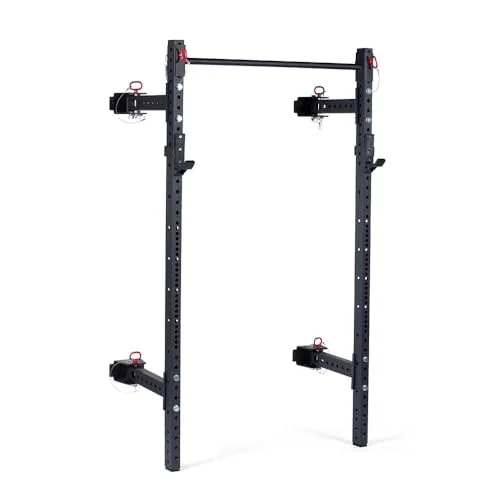
Titan Fitness T-3 Series 82" Wall-Mounted Folding Power Rack
Pros
- Folds flat to about 5" from the wall, giving the room back when you're not training
- 82" height clears most 8-foot basement and garage ceilings with room to spare
- 1,100 lb rackable capacity handles serious squat and bench work, not just light training
- 2x3" 11-gauge uprights match Titan's full-size rack strength in a space-saving footprint
- Compatible with Titan's wider attachment ecosystem (dip bars, landmine, lat pulldown)
Cons
- Must be lag-bolted into wall studs or a mounting board — not a free-standing option
- Folding hinge needs periodic hardware checks compared to a fixed rack
- 21" working depth is tighter than a full power cage for exercises done inside the rack
This is the rack to buy if the room needs to do double duty. Bolted to wall studs, it folds down to roughly 5” of depth when you’re done training, which matters in a basement that’s also laundry, storage, or a kids’ playroom. Extended, it gives you a real 21” working depth with 2x3” 11-gauge uprights rated for 1,100 lbs — that’s full-size-rack strength, not a scaled-down accessory frame.
At 82” tall it clears a standard 8-foot ceiling with headroom to spare, and because it mounts to the wall rather than standing free, it doesn’t eat floor space the way even a compact standing rack does. The trade-off is permanence: this isn’t something you move to a different wall on a whim, and the folding hinge is one more mechanical point to keep an eye on compared to a fixed frame. For a converted garage or basement corner where the rack needs to disappear between sessions, it’s the best-designed option in this roundup.
Body-Solid GPR400 Power Rack
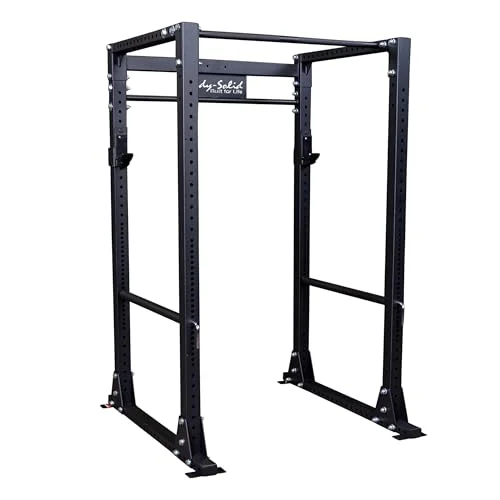
Body-Solid GPR400 Power Rack
Pros
- 79" height clears low ceilings while still functioning as a true free-standing power cage
- 1,000 lb capacity and 11-gauge steel match commercial-grade construction standards
- Integrated pull-up bar means no separate accessory purchase for chin-ups
- Pipe and pin safeties catch a failed rep without needing a spotter
- No wall mounting required — works in rented spaces or rooms without stud access
Cons
- $840 is the most expensive rack in this roundup
- At 79" tall and free-standing, it takes up permanent floor space unlike the folding option
- Heavier and more involved to assemble than the shorter, lighter racks here
Not every basement has open studs or a wall you’re allowed to drill into — rentals and finished spaces often rule out wall mounting entirely. The GPR400 solves the ceiling problem without needing a wall at all. At 79” tall with 11-gauge steel and a 1,000 lb rating, it’s a genuine free-standing power cage that happens to be short enough for low-clearance rooms, with an integrated pull-up bar so you’re not buying that separately.
It’s the priciest rack here at $840, and being free-standing means it holds its full footprint permanently rather than folding away. But for anyone who can’t mount to a wall — or who wants a rack they can eventually move to a different room — it’s the one true cage-style option that fits under a low ceiling.
REP Fitness PR-1100 Power Rack
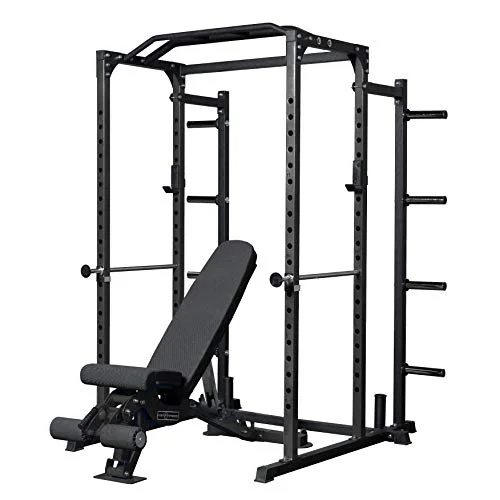
REP Fitness PR-1100 Power Rack
Pros
- Multi-grip pull-up bar mounts inverted to shave inches off total height for tighter ceilings
- Extended safeties accommodate rack pulls and hold a second barbell for accessory work
- 700 lb rackable capacity covers nearly all home lifters
- Plastic-lined J-cups protect barbell knurling over years of loading and unloading
- Sold on Amazon alongside the other Amazon-listed racks in this roundup
Cons
- Amazon doesn't always display a live price for this listing — check the current listing before buying
- 80.5" standard height still needs the pull-up bar inverted to clear the tightest 7-foot ceilings
- Free-standing 48" × 47.5" footprint holds permanent floor space, unlike the folding Titan rack
The PR-1100’s standard 80.5” height already clears most 8-foot ceilings, but the feature that earns it a spot here is the multi-grip pull-up bar itself: it mounts inverted, shaving real inches off the rack’s total height for rooms where every inch of clearance counts. Combined with extended safeties rated for rack pulls and a second barbell, and 700 lb rackable capacity, it’s a full-featured cage rather than a scaled-down one.
It’s a free-standing rack, so it holds its 48” × 47.5” footprint permanently rather than folding away like the Titan T-3. And because Amazon doesn’t always surface a live price on this listing, it’s worth checking current pricing on the listing itself before comparing it against the other racks here. For anyone who wants to fine-tune exact ceiling clearance rather than buy to a fixed shorter height, this is the rack that lets you do it.
Mikolo Cable Crossover Machine
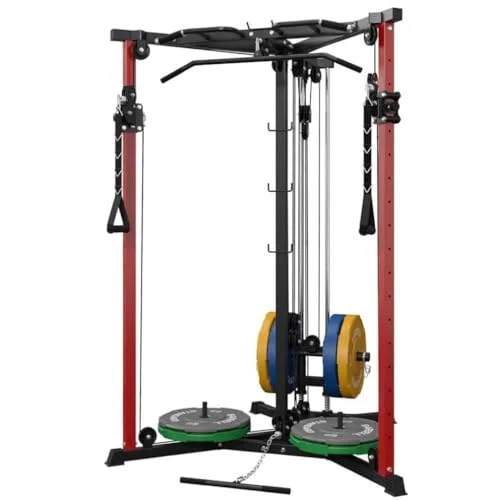
Mikolo Cable Crossover Machine
Pros
- 82" height fits rooms where a full functional trainer's 7–8 foot column won't
- 17 adjustable pulley positions per side cover lat pulldowns, rows, flyes, and curls
- Dual pulley system lets two people train different cables at once
- Meaningfully cheaper than name-brand functional trainers that require the same clearance
- Covers most machine-based upper body work a short rack physically can't replicate
Cons
- Owner reports flag the included plastic-coated plates as noticeably lower quality than steel
- Pin placement from the back of the weight stack is awkward mid-set compared to name-brand machines
- Newer entrant to the market, so long-term parts support isn't proven the way Titan or Rogue's is
Racks solve squats and bench work, but they don’t replace a cable stack for lat pulldowns, rows, and flyes — and most name-brand functional trainers need 7 to 8 feet of column height to work properly. The Mikolo Cable Crossover tops out at 82”, putting real cable-machine training within reach of the same rooms these racks fit into, with 17 adjustable pulley positions per side and a dual pulley system that lets two people load different exercises at once.
It’s not built to Titan or Rogue’s standard — owner reports consistently flag the included plastic-coated plates as the weak point, and loading pins from behind the stack is more awkward mid-set than on a premium machine. At roughly $400, though, it’s a legitimate way to add machine-based training to a low-ceiling gym without the four-figure price tag a branded functional trainer commands.
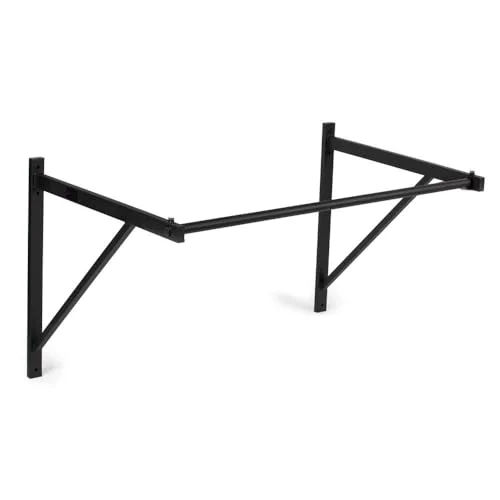
Titan Fitness Ceiling & Wall-Mount Pull-Up Bar
Titan Fitness Ceiling & Wall-Mount Pull-Up Bar
Pros
- Mounts to the ceiling instead of a rack, so it costs zero floor space and works alongside any other equipment here
- 500 lb capacity comfortably handles weighted pull-ups and dip belt attachments
- Ceiling mounting means you set the exact drop distance your ceiling height allows
- 32mm grip diameter matches standard bar feel rather than an undersized accessory bar
- Far cheaper than adding pull-up capability to a full rack purchase
Cons
- Requires exposed ceiling joists or a mounting board — finished drywall ceilings need reinforcement first
- No safeties or spotting arms, so it's pull-ups and hanging work only
- Fixed mounting point means no repositioning once installed
If you’re pairing any of the racks above with a low ceiling, a standing pull-up station usually won’t fit at all. The fix is mounting the bar to the structure itself. This 52” bar bolts to ceiling joists or a wall stud, holds 500 lbs, and lets you set the exact drop distance your specific ceiling allows — instead of being locked into whatever height a standing frame happens to be.
It costs nothing in floor space and, at $89.99, far less than building pull-up capability into a taller rack purchase. The limitation is real: it needs exposed joists or a mounting board (finished drywall ceilings need reinforcement first), there’s no spotting arm, and once it’s bolted in place, it’s not moving. For a dedicated pull-up solution that works around a ceiling constraint rather than against it, it’s the simplest option here.
Buying Guide: Measuring and Shopping for a Low-Ceiling Gym
Measure the actual clearance, not the room’s listed ceiling height. Measure from the finished floor to the lowest point in the room — a duct, a beam, or a light fixture — not the flattest section of ceiling. Then subtract the thickness of any rubber flooring or platform you’re planning to add. A room with an 8-foot ceiling and 3/4” rubber tile plus a 4” platform effectively has closer to 7’8” of usable height.
Leave headroom above the rack, not just at it. A rack that’s exactly your ceiling height with zero clearance doesn’t leave room for a barbell on the top pull-up bar or for standing fully upright underneath it. Aim for at least 4–6” of buffer above whatever rack you choose.
Decide wall-mounted versus free-standing before anything else. A folding rack like the Titan T-3 only works if you have accessible wall studs and permission to bolt into them — that rules it out for a lot of rental basements. If wall mounting isn’t an option, a free-standing rack like the GPR400 or PR-1100 is the only real path to a true power cage.
Swap overhead-dependent accessories for wall or ceiling mounts. Standing pull-up towers and tall lat pulldown attachments are usually the first thing that doesn’t fit a low ceiling. Mounting a pull-up bar directly to the structure, as above, sidesteps the problem instead of forcing a shorter accessory that compromises the movement.
Budget for reinforcement if you’re going wall- or ceiling-mounted. Older finished basements often have drywall over furring strips rather than exposed studs at consistent spacing. Confirm stud location and spacing before buying a wall-mounted rack or bar — a mounting board spanning multiple studs solves most of these situations.
FAQ
What’s the minimum ceiling height for a home gym? Most short racks and wall-mounted options in this roundup fit comfortably under an 8-foot ceiling. Below 7’6”, your options narrow to racks with an invertible or removable pull-up bar — like the REP PR-1100 — plus ceiling-mounted accessories, rather than any rack with a tall fixed pull-up bar attachment.
Can I still do overhead presses and pull-ups with a low ceiling? Yes, but plan around the clearance. A 72–82” rack still leaves room for standing overhead work under most 8-foot ceilings once you account for plate loading height. For pull-ups specifically, a ceiling-mounted bar set to your exact available drop distance works in rooms where a standing tower wouldn’t fit at all.
Is a wall-mounted folding rack as sturdy as a free-standing one? When properly lag-bolted into studs, a folding rack like the Titan T-3 holds a comparable rackable capacity to similarly-built free-standing racks — 1,100 lbs in this case. The sturdiness depends entirely on solid stud anchoring, not the folding mechanism itself.
Do I need a mounting board for a wall-mounted rack or pull-up bar? If your wall studs aren’t spaced to match the rack’s mounting holes, or if you’re mounting to a ceiling without exposed joists in the right spots, a plywood mounting board spanning multiple studs or joists is the standard fix. Confirm this before ordering — it’s a cheap addition that prevents a rack you can’t actually install.
Are short power racks less durable than full-height ones? No. Height doesn’t determine strength — steel gauge and upright thickness do. The REP PR-1100 and Body-Solid GPR400 in this roundup use the same gauge steel as their taller counterparts from the same brands; they’re simply built shorter for clearance, not to a lower standard.
Verdict
For most low-ceiling basements and garages, the Titan Fitness T-3 Wall-Mounted Folding Rack is the strongest overall pick — it clears an 8-foot ceiling, folds down to almost nothing when you’re not training, and holds 1,100 lbs. If wall mounting isn’t possible in your space, the Body-Solid GPR400 delivers the same short-ceiling clearance in a free-standing cage, and the REP Fitness PR-1100 is the move if you want to fine-tune exact clearance with an invertible pull-up bar. Add the Mikolo Cable Crossover for machine-based upper body work and the Titan ceiling-mounted pull-up bar to round out pull-ups without needing a single extra inch of ceiling height.
Pair any of these with a proper rubber gym floor — in a low-ceiling room, every fraction of an inch of platform thickness counts against your usable clearance, so it’s worth choosing flooring with that constraint in mind too.