Home gym builders are increasingly treating a lat pulldown machine as a non-negotiable — not a luxury. Garage Gym Reviews and Garage Gym Lab both updated their lat pulldown guides in early 2026, citing growing demand from lifters who want to replicate commercial cable training at home. The reason is straightforward: lat pulldowns, cable rows, and tricep pressdowns are the movements that suffer most when you train exclusively with free weights, and no amount of barbell rowing fully compensates for vertical pulling volume.
The good news is the category has expanded significantly. You can now get a functional plate-loaded lat tower for under $200, a heavy-duty mid-range machine for under $600, or a premium selectorized system that rivals commercial equipment. The range creates real tradeoffs around available plate inventory, footprint, cable quality, and budget.
Here are the five best lat pulldown machines for home gyms in 2026, covering every price point from $160 to $1,100.
Quick Picks
Bells of Steel Lat Pulldown Low Row is the best overall machine — aluminum pulleys, 550 lb cable capacity, selectorized stack upgrade option, and compatibility with the Bells of Steel attachment ecosystem. The premium is justified.
XMark XM-7618 is the best mid-range pick — 2”×3” 11-gauge steel frame, aircraft-quality cable, flip-up footplate, and integrated padded seat at $460–$560. The best combination of build quality and price in this category.
Titan Fitness Plate-Loaded LAT Tower is the best choice for heavy lifters with Olympic plates — 400 lb capacity, 120 lb machine weight for stability, and Titan’s commercial-grade construction.
Powerline by Body-Solid is the best compact option for small spaces — 48”×43” footprint, 10-year frame warranty, and nylon bushings at $280–$350.
GDLF Lat Pulldown is the best budget pick — under $200, 500 lb capacity, and compatibility with both standard and Olympic plates. The floor-row limitation is real but manageable.
Comparison
| Machine | Type | Capacity | Footprint | Weight | Price |
|---|---|---|---|---|---|
| Bells of Steel Lat Pulldown | Plate-loaded (stack upgrade) | 550 lb cable | 70”L × 41”W | — | $950–$1,100 |
| XMark XM-7618 | Plate-loaded | 400 lbs | 56.7”L × 48”W | — | Check price |
| Titan Fitness Plate-Loaded | Plate-loaded | 400 lbs | 47”W × 57”D | 120 lbs | $564.99 as of Oct 18, 2026 |
| Powerline Body-Solid | Plate-loaded (1” std) | 250 lbs | 48”L × 43”W | 69 lbs | Check price |
| GDLF Lat Pulldown | Plate-loaded | 500 lbs | 26”W × 59”D | 68 lbs | $179.99 as of Oct 18, 2026 |
Buying Guide: How to Choose a Lat Pulldown Machine
Plate-Loaded vs. Selectorized
Every machine in this roundup is plate-loaded except for the Bells of Steel stack upgrade option. For home gyms, plate-loaded has a key advantage: if you already own Olympic plates from a barbell setup, you have free resistance without buying a weight stack. The tradeoff is convenience — changing resistance on a selectorized machine takes two seconds with a pin; changing plates takes thirty seconds and involves actual effort.
If you’re building a home gym from scratch, budget plate-loaded machines are the smarter starting point. If you already have a complete setup and want the gym-like convenience of fast resistance changes, the Bells of Steel with a 310 lb stack upgrade is worth the premium.
One critical note on plate compatibility: The Powerline Body-Solid (B0FF36NGQW) uses 1” standard posts, not 2” Olympic. Most home gym owners have Olympic plates. Confirm what posts a machine uses before buying — this is the most common source of buyer regret in this category.
Weight Capacity
Don’t conflate machine weight capacity with cable capacity. The GDLF’s 500 lb weight capacity refers to how much you can load on the plate posts. The Bells of Steel’s 550 lb cable capacity refers to the tensile strength of the cable system — a different measurement. For practical purposes, both are more than sufficient for any home gym loading. The machines with lower capacity (the Body-Solid at 250 lb) are the ones to watch if you train heavy.
Footprint and Space
Lat pulldown machines are tall and have a meaningful floor footprint. A 47”×57” machine is just under 4 feet wide and nearly 5 feet deep — that’s a significant chunk of floor in a one- or two-car garage.
The narrowest machine in this roundup is the GDLF at 26” wide. The largest is the XMark at 56.7”L × 48”W. Measure your available space before ordering — these machines are heavy and difficult to return.
Also account for ceiling height. Most lat towers run 80–87” tall, which requires 9-foot ceilings for full range of motion. In a standard 8-foot garage ceiling, you’ll hit the ceiling on a straight-arm stretch at the top of the movement. Many users wall-mount or anchor the machines to compensate, but it’s worth verifying.
Cable Quality and Pulley Systems
The cable and pulley quality determines how the machine feels to train on. Budget machines use basic steel cables and plain nylon pulleys — functional but rough. Mid-range machines like the XMark use nylon-coated aircraft cables and stainless steel ball-bearing pulleys — noticeably smoother. The Bells of Steel uses aluminum pulleys, which is the premium standard and produces a cable path that feels closer to a commercial machine.
If you’re coming from training on a commercial gym’s cable station, the GDLF will feel rough by comparison. The XMark and Titan will feel acceptable. The Bells of Steel will feel right.
Integrated Seat vs. Floor Position
Several budget lat pulldown machines omit a built-in seat. The GDLF is the primary example — lat pulldown works from the included seat pad, but low row position requires sitting on the floor or pulling a separate bench up to the machine.
The XMark XM-7618, Titan Plate-Loaded, and Bells of Steel all include integrated padded seats with knee hold-down pads. This matters more for the seated low row than the lat pulldown — rowing from the floor is awkward and limits range of motion. If seated rows are a significant part of your training, prioritize a machine with a built-in seat.
Detailed Reviews
Bells of Steel Lat Pulldown Low Row Machine — Editor Pick
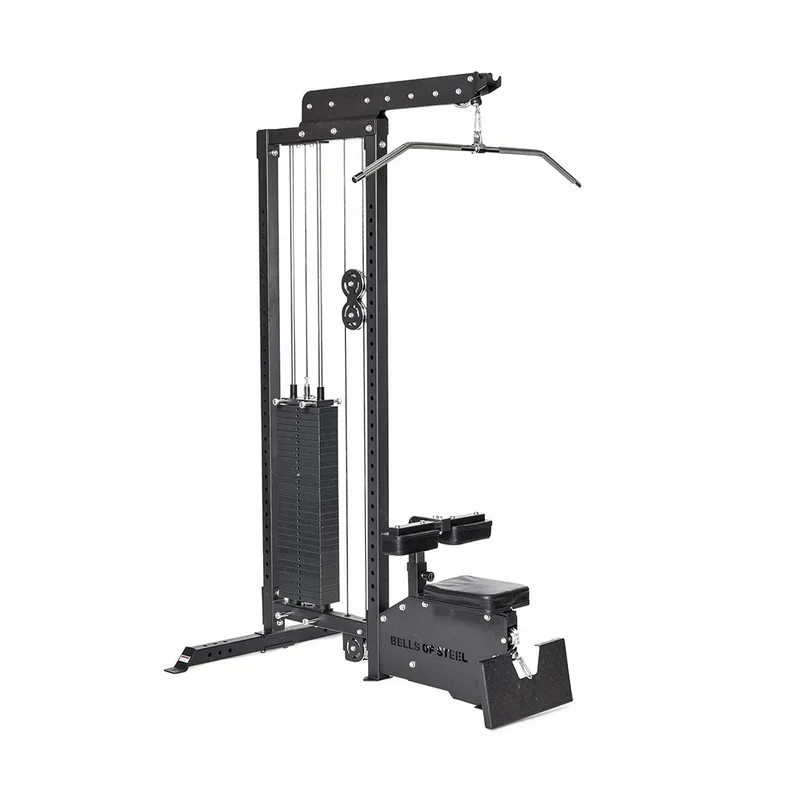
Bells of Steel Lat Pulldown Low Row Machine
Pros
- Aluminum pulleys produce the smoothest cable feel in this roundup — noticeably better movement quality than steel pulley machines
- 550 lb cable capacity handles any loading a home gym athlete would realistically use, with substantial headroom
- Compatible with Bells of Steel's rack attachment ecosystem (Y-Dip, Seal Row pad, landmine) — turns a standalone lat tower into a multi-function training station
- Adjustable seat pad, leg rollers, and low row footplate are all independently adjustable for optimal positioning
- Upgradeable to a 310 lb selectorized weight stack — unique in this category and eliminates the need to own plates entirely
Cons
- Only available direct from Bells of Steel — not on Amazon, no Prime shipping, longer lead times
- Plate-loaded base price ($950–$1,100) is the highest in this roundup; stack upgrade pushes total cost to ~$2,000
- 70" × 41" footprint requires dedicated space — not suitable for tight home gyms
The Bells of Steel Lat Pulldown Low Row Machine is the best home gym lat tower available in 2026. The aluminum pulley system produces a cable path that feels genuinely close to a commercial cable station — smooth, consistent, and quiet throughout the full range of motion. That quality difference is immediately apparent compared to nylon-pulley machines.
What makes the Bells of Steel stand out beyond cable feel is its modularity. The frame accepts 2.3” × 2.3” Bells of Steel rack attachments — you can add a Y-Dip, a Seal Row pad, or a landmine attachment to the upright. This transforms a standalone lat tower into a multi-movement training station without requiring additional floor space.
The 550 lb cable capacity and fully adjustable seat-and-roller system mean there’s no practical loading or positioning limitation for a home athlete. The seat pad, leg rollers, and low row footplate each adjust independently, which matters when setting up for heavy loading where proper alignment is critical.
The optional 310 lb selectorized weight stack upgrade is the most compelling feature at this price point. Loading plates is fine for lat pulldowns where you change weight infrequently. For cable rows, tricep pressdowns, and bicep curls — where you’re adjusting resistance set to set — a weight stack is genuinely more practical. The Bells of Steel is the only machine in this roundup where that upgrade path exists.
The primary limitation is availability. Bells of Steel sells direct only — no Amazon, no Prime shipping, and lead times can run 2–4 weeks depending on inventory. Budget accordingly.
XMark XM-7618 Lat Pulldown and Low Row Cable Machine — Best Mid-Range
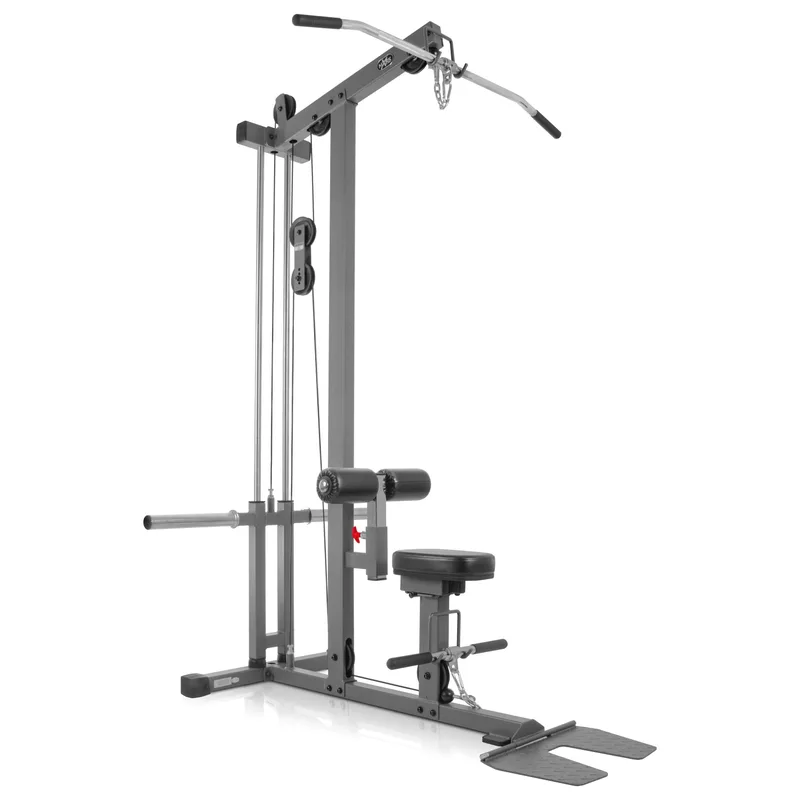
XMark XM-7618 Lat Pulldown and Low Row Cable Machine
Pros
- 2" × 3" 11-gauge steel frame is overbuilt for a home gym — the kind of structural integrity you typically find in commercial equipment
- Aircraft-quality 2,200 lb test cable with nylon coating produces smooth, controlled movement at all resistance levels
- 400 lb capacity and stainless steel ball-bearing pulleys make this machine genuinely capable for advanced training loads
- Flip-up footplate simplifies switching between lat pulldown and seated low row without repositioning the entire setup
- Integrated padded seat with knee hold-down pad provides proper positioning for pulldowns
Cons
- 48" wide footprint requires substantial dedicated floor space — not suited for tight gyms
- Assembly takes 2–3 hours and is challenging — reported as the most difficult assembly in this category
- No weight stack — requires owning standard or Olympic plates
The XMark XM-7618 is the best lat pulldown machine for most home gym builders. The 2” × 3” 11-gauge steel frame is a commercial-grade spec at a sub-$600 price — the kind of construction that handles daily heavy training without developing wobble over time. Combined with aircraft-quality cable and stainless steel ball-bearing pulleys, the training experience is meaningfully better than budget machines despite the similar plate-loaded design.
The flip-up footplate is a practical feature that gets overlooked in spec comparisons. In lat pulldown position, the footplate folds down so you don’t trip over it when sitting. For low rows, it flips up to brace your feet and stabilize the seated row position. It’s a small engineering decision that makes the machine notably more usable day-to-day.
The integrated padded seat with knee hold-down pads is well-designed. The knee pads lock you into position during heavy pulldowns — a function that directly affects performance on the movement since any upward body movement reduces the effective load.
Assembly is the legitimate complaint. Most users report 2–3 hours for a full setup, and the process involves multiple components that require careful alignment. Plan for a dedicated afternoon and have a second person available if possible.
The 48” width is the largest footprint in this roundup. In a small garage gym, that’s real estate worth accounting for. If space is tight, the Titan’s 47”×57” footprint is comparable in depth but narrower.
Titan Fitness Plate-Loaded LAT Tower — Best for Heavy Lifters
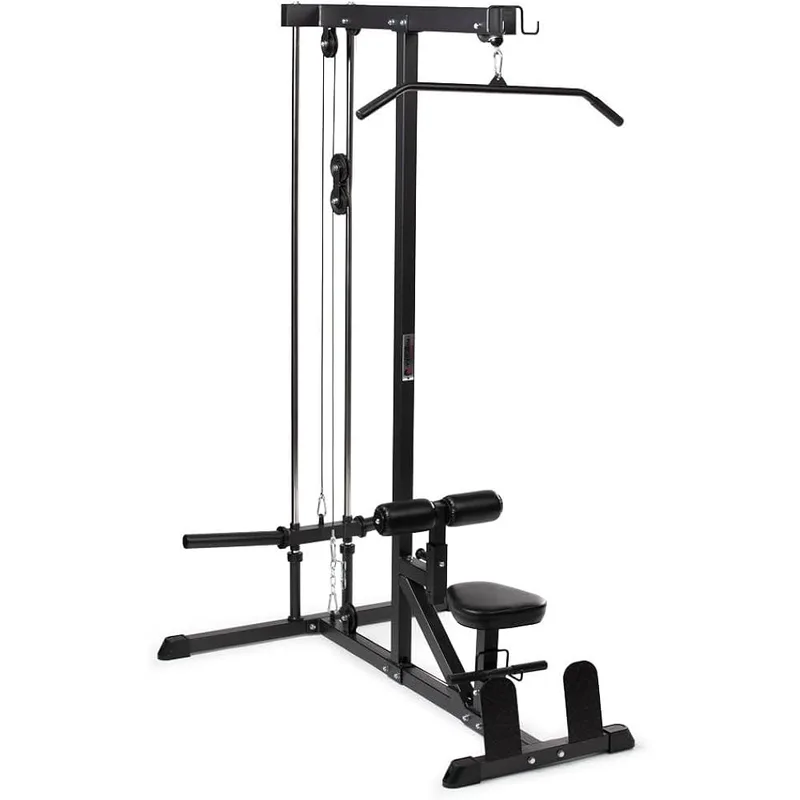
Titan Fitness Plate-Loaded LAT Tower
Pros
- Titan Fitness commercial-grade steel construction built for long-term heavy training — significantly more durable than budget machines
- 120 lb machine weight provides excellent stability under heavy plate loading that lighter machines can't match
- 47" × 57" footprint is more compact than the XMark while delivering the same 400 lb weight capacity
- Olympic plate-only design means the resistance potential is unlimited — load it as heavy as your plates allow
- Titan's established track record for value — commercial-quality construction at home gym prices
Cons
- Higher price than the XMark for a comparable plate-loaded machine — you're paying for Titan's build quality and brand reputation
- No weight stack; requires existing Olympic plate inventory
- Assembly is complex and time-intensive
The Titan Fitness Plate-Loaded LAT Tower is the right call for lifters who train heavy and prioritize structural integrity. At 120 lbs, it’s the heaviest machine frame in this roundup — and that weight translates directly to stability under load. Budget and mid-range lat towers develop a forward tilt as you load them heavier; the Titan stays anchored.
Titan’s construction quality is consistent with their power rack and barbell lineup: commercial-grade steel, solid welds, and hardware that doesn’t strip on first assembly. This is a machine built to outlast a decade of consistent training.
The 47” × 57” footprint is more compact than the XMark for the same 400 lb weight capacity. If you’re choosing between the two purely on space, the Titan has the edge. The 85” height requires at least a 9-foot ceiling for full overhead extension.
The Olympic plate-only design (no standard plate adapters) is appropriate for a machine at this price point — by the time you’re spending $600+, you should have Olympic plates. The 13” loadable sleeve accommodates substantial loading without requiring multiple plates per side.
The price differential over the XMark is primarily justified by construction quality and the Titan brand reputation. Both machines perform the same function at 400 lb capacity. If you’re planning long-term use in a permanent garage gym, the Titan is worth the premium. If you’re outfitting a temporary or rental space, the XMark delivers comparable performance at a lower cost.
Available on Amazon with Prime shipping.
Powerline by Body-Solid LAT Pull Down Machine — Best Compact
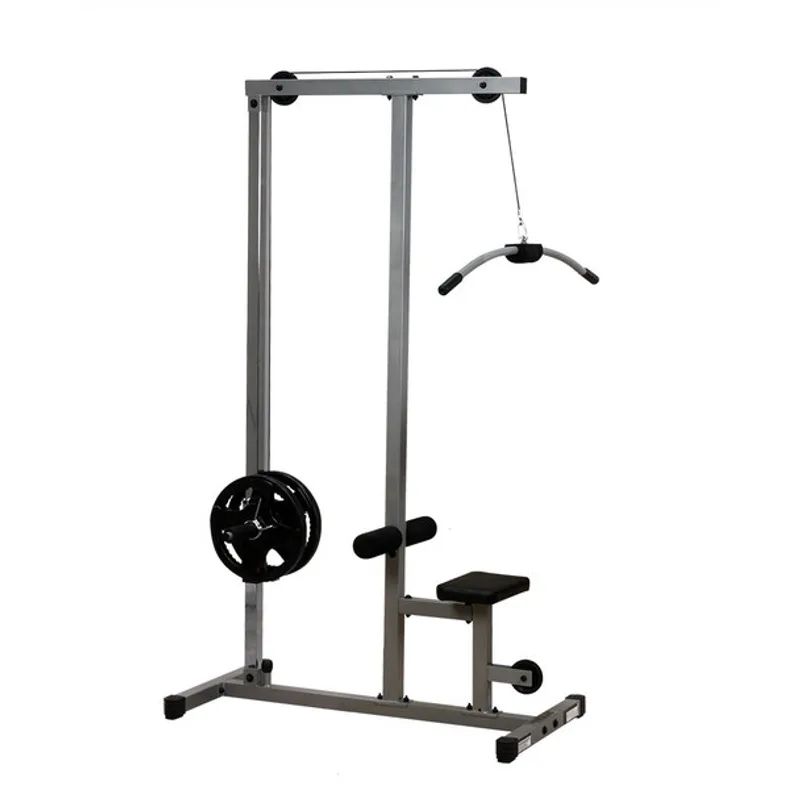
Powerline by Body-Solid LAT Pull Down Machine
Pros
- Compact 48" × 43" footprint is one of the smallest in this roundup — fits in apartments, small garages, or shared workout rooms
- 10-year frame warranty from Body-Solid is industry-leading coverage at this price point
- Patented nylon bushings produce significantly smoother cable action than the GDLF at a comparable size
- Dual 8" foam rollers hold the knees securely during pulldowns without shifting under load
- Includes both lat pulldown bar and low row bar — no additional accessories needed out of the box
Cons
- Only accepts 1" standard plates — incompatible with 2" Olympic plates most home gym owners already own
- 250 lb capacity is the lowest in this roundup and limits progression for intermediate-to-advanced lifters
- No padded seat — basic setup compared to machines with adjustable cushioned seats and knee pads
The Powerline Body-Solid is the lat pulldown machine for home gym builders who are genuinely constrained on space. The 48” × 43” footprint is the smallest in this roundup, and the 10-year frame warranty from Body-Solid represents real long-term confidence in the build.
The patented nylon bushing system produces smoother cable movement than the GDLF at a similar price point. The dual 8” foam knee rollers hold the legs firmly during pulldowns — a meaningful improvement over machines without them, particularly during heavy sets where body lift is a concern.
The limitation to understand upfront: the weight posts use a 1” diameter standard sleeve, not the 2” Olympic standard. If your plate collection is Olympic (which it likely is if you own a barbell setup), you cannot use those plates on this machine without 1”-to-2” adapters. This is the primary reason not to choose this machine for most home gym setups.
For a home gym where standard plates are the only inventory — a beginner setup, a basement gym built without a barbell, or a supplementary fitness room — the Powerline Body-Solid makes a strong case. The compact footprint, Body-Solid warranty, and build quality at $280–$350 is excellent for what it is. For everyone else, the GDLF or XMark are more practical choices.
GDLF LAT Pull Down Machine — Best Budget
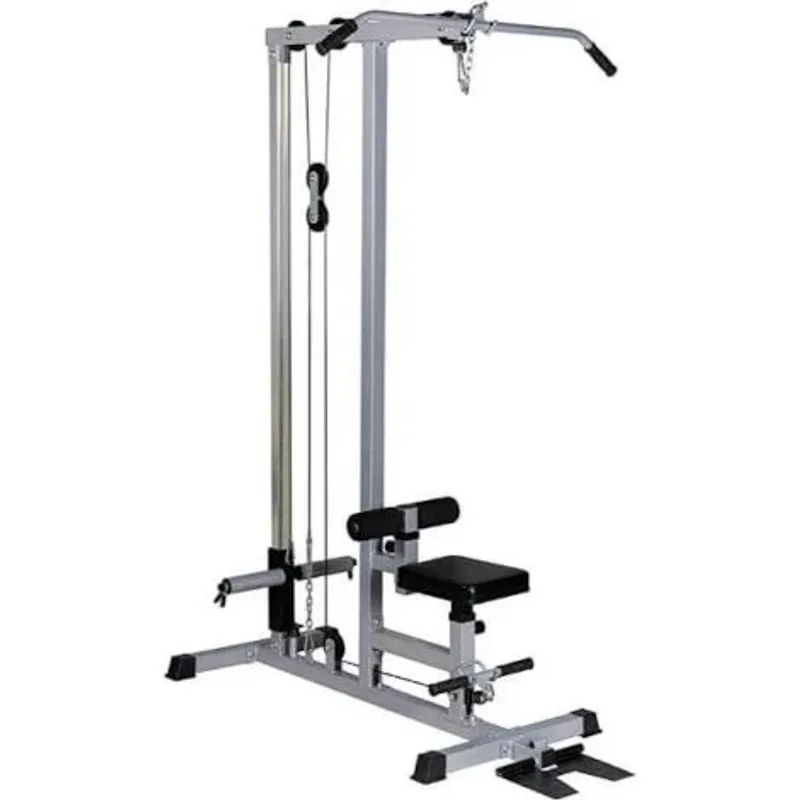
GDLF LAT Pull Down Machine
Pros
- 500 lb weight capacity outperforms most selectorized home gym machines at this price — handles heavy loading without instability
- Compatible with both 1" standard and 2" Olympic plates, so it works with whatever plate inventory you already own
- Dual pulley stations (high pulldown + low row) cover the two most critical cable back movements in a single machine
- Narrow 26" width footprint fits in tight home gym spaces where wider machines won't
- Best price point in the category — under $200 shipped for a functional lat machine
Cons
- No integrated seat — low row position requires sitting on the floor or on a separate bench pulled up to the machine
- Cable quality is basic; the movement feels adequate but noticeably rougher than machines with ball-bearing pulleys
- No weight stack included — requires owning plates to generate any resistance
The GDLF is a legitimate lat pulldown machine that costs under $200. That sentence is worth sitting with. For a lifter who owns plates and wants to add vertical pulling and cable rowing to their home gym without a major investment, this machine accomplishes both.
The 500 lb weight capacity is higher than the Powerline Body-Solid and — on paper — outperforms machines at twice the price. In practice, very few home gym athletes will load this machine anywhere near its limit, but the structural headroom prevents instability at realistic loads (80–150 lbs).
The dual-plate compatibility (both 1” standard and 2” Olympic) is a genuine advantage over the Body-Solid Powerline. Whatever plates you own, they work here.
The honest limitation: seated rows on the GDLF require sitting on the floor or pulling a separate bench into position. The lat pulldown position uses the included seat, but the low row position is not purpose-built. For lifters who prioritize cable rows as a primary movement, this is a real usability gap that the XMark or Titan solve with their integrated seat-and-footplate systems.
Cable feel is basic. The GDLF uses a standard steel cable without the nylon coating or ball-bearing pulleys found on mid-range machines. Movement is functional but not smooth. Lifters accustomed to commercial cable stations will notice the rougher feel.
At $160–$200, none of these are disqualifying. This is what budget looks like in the category.
FAQ
Do I need a lat pulldown machine if I have a pull-up bar?
Pull-up bars and lat pulldown machines are complementary, not interchangeable. Pull-ups are a bodyweight movement that’s fixed at your body weight — you can’t easily adjust resistance for warm-ups, dropsets, or assistance reps for beginners. Lat pulldowns let you adjust the cable load precisely, which matters for progressive overload programming, training around injuries, and exercises like tricep pressdowns, cable rows, and bicep curls that pull-up bars don’t offer. Most serious home gym setups benefit from having both.
How much space do I need for a lat pulldown machine?
Plan for at least 5–6 feet of floor space in every direction around the machine. The machine footprint itself ranges from 26”W × 59”D (GDLF) to 56.7”L × 48”W (XMark). Add 18–24 inches of clearance on each side. Ceiling height is equally important — most lat towers are 81–87” tall, and you need 9-foot ceilings for full overhead range of motion on pulldowns. In standard 8-foot garages, ceiling contact at full stretch is a common issue.
Plate-loaded vs. weight stack: which is better for a home gym?
Plate-loaded is better for most home gym setups if you already own Olympic plates. You’re not buying an additional weight system, and the machine cost is lower. Weight stacks are better for convenience — changing resistance takes two seconds and doesn’t require handling plates. If your training involves frequent resistance changes (circuit training, dropsets, supersets), a weight stack is meaningfully more practical. The Bells of Steel’s optional 310 lb stack upgrade is the only option in this roundup that lets you have both.
Can I do exercises other than lat pulldowns on these machines?
Yes — all five machines include a low row cable station in addition to the overhead pulldown position. On most machines, you can also perform tricep pressdowns, cable bicep curls, upright rows, and face pulls with the appropriate attachments. The XMark includes a lat bar, short bar, and extension chain. The Bells of Steel is the most versatile due to its ecosystem of attachments. The GDLF and Powerline Body-Solid are primarily lat pulldown and row machines with limited attachment options beyond the included bars.
Is a lat pulldown machine worth it for a home gym?
For intermediate-to-advanced lifters, yes. Vertical pulling volume — lat pulldowns, pull-ups, and cable row variations — is difficult to fully replicate with free weights alone. Adding a lat machine to a home gym that already has a barbell and power rack setup fills a genuine programming gap. At $160–$200 for the GDLF, the entry cost is low enough that the question becomes less about cost and more about available space.
Conclusion
The Bells of Steel Lat Pulldown Low Row Machine is the best overall home gym lat tower. The aluminum pulleys, 550 lb cable capacity, fully adjustable seat system, and optional weight stack upgrade produce a training experience that matches commercial equipment at a price that’s competitive for what it delivers. Available only direct from Bells of Steel.
For most buyers, the XMark XM-7618 is the right answer. The 2”×3” 11-gauge frame, aircraft cable, flip-up footplate, and integrated padded seat at $460–$560 is the strongest combination of build quality and price in the category. Available on Amazon.
Heavy lifters who want maximum stability should look at the Titan Fitness Plate-Loaded LAT Tower — the 120 lb frame weight and Titan’s commercial construction hold up under heavier loading than the XMark.
Space-constrained home gyms will find the Powerline Body-Solid compelling at 48”×43” with Body-Solid’s 10-year warranty — but confirm you own standard 1” plates before ordering.
Budget builders who own plates and need vertical pulling and row capability without a major investment: the GDLF at $160–$200 does the job.