The connected elliptical market shifted noticeably in 2026. Buyers no longer have to choose between a smooth, durable machine and one with a built-in screen — midrange options from Sole and NordicTrack now ship with HD displays and streaming app integration at sub-$1,500 price points. But the spec sheets have also gotten more complicated. Stride lengths vary from 14” to 32”. Drive positions — front, rear, center — change how the machine feels underfoot. Flywheel weights range from 10 lbs to 32 lbs and affect smoothness more than almost any other spec.
This guide covers what each spec actually means for your workout, which ones matter for your height and training goals, and three machines worth buying at different price points.
Already know what you want? Jump to best ellipticals for home in 2026 or, if space is tight, best mini ellipticals and under-desk pedal exercisers.
Quick Comparison
| Machine | Stride | Resistance | Incline | Capacity | Price |
|---|---|---|---|---|---|
| Sole E35 | 20” fixed | 20 levels | 20-level power | 350 lbs | $1,499 |
| Bowflex Max Trainer M6 | 15” fixed | 16 levels | None | 300 lbs | Unavailable |
| NordicTrack FS14i | Up to 32” auto | 26 levels | -10% to +10% | 375 lbs | Unavailable |
The 7 Specs That Actually Matter
1. Stride Length
Stride length is the distance your foot travels on a single revolution. It’s the most important spec on any elliptical and the one most buyers overlook until they’re on the machine.
General rule by height:
- Under 5’3”: 16”–18” stride works fine
- 5’3”–5’8”: 18”–20” is comfortable
- 5’8”–6’1”: 20”–22” minimum recommended
- 6’1”+: 22”+ or an auto-adjustable stride like the NordicTrack FS14i
A stride that’s too short forces an unnatural, choppy motion and puts extra stress on your knees. A stride that’s too long overextends at the hip. Most home ellipticals ship with a fixed 18”–20” stride. The Sole E35’s 20” is the sweet spot for most buyers up to about 6’1”.
If your household has users across a wide height range, an adjustable-stride machine — like the FS14i’s auto-adjusting 32” max — removes the compromise entirely.
2. Flywheel Weight
The flywheel stores rotational momentum. Heavier flywheels = smoother pedal feel because momentum carries the stride through the dead zones at the top and bottom of each revolution.
What to look for:
- Under 15 lbs: Noticeable resistance spikes and inconsistent feel — common in budget models under $400
- 18–22 lbs: Smooth and consistent — appropriate for midrange machines
- 25 lbs+: Premium feel with natural, fluid motion throughout the stride
The Sole E35’s 25 lb flywheel is the heaviest in this guide and the reason it stands out at its price point. The NordicTrack FS14i uses a 20 lb inertia-enhanced flywheel that performs well despite the lower weight.
3. Resistance Levels
More resistance levels mean more granular control over workout intensity. The difference between level 5 and level 6 on a 10-level machine can feel jarring. On a 20-level machine, each step up is smaller and more manageable.
Minimum recommendations:
- Casual users: 16+ levels
- Interval training: 20+ levels
- Advanced users: 24+ levels
All three machines in this guide clear the 16-level threshold. The NordicTrack FS14i’s 26-level SMR magnetic resistance system is the most granular of the three.
4. Drive Type: Front, Rear, or Center
The motor/flywheel position changes how the machine feels in motion.
Front-drive (NordicTrack FS14i, most NordicTrack models): Natural forward-leaning motion. Feels more like outdoor running. Longer footprint.
Rear-drive (Sole E35, most Sole models): Upright posture, oval pedal path. More comfortable for extended sessions. Generally smoother feel.
Center-drive (Bowflex Max Trainer, Octane): Compact footprint. More vertical movement — similar to stair-stepping. Best for small spaces but different motion pattern.
Neither is objectively better. It’s preference. If you can, try both types before buying — your local gym likely has at least one of each.
5. Incline and Decline
Power incline adds resistance by elevating the ramp angle, which shifts emphasis from quads to glutes and hamstrings. Decline does the opposite — useful for targeting the front of the thigh with a different motion path.
Basic ellipticals skip incline entirely. Most midrange models offer 10–20 levels of incline. Only premium machines (like the FS14i) offer both incline AND decline.
If glute development is a goal, prioritize an elliptical with at least 10 incline levels. If you’re using the machine primarily for cardio conditioning, flat-only works fine.
6. Weight Capacity
Weight capacities on home ellipticals range from 225 lbs on entry-level machines to 375+ lbs on commercial-grade units. The published capacity includes the user’s weight plus the force generated by vigorous exercise — typically 1.5–2× your body weight under load.
Practical guideline: Look for a machine with a capacity at least 100 lbs above your body weight.
The Sole E35 (350 lbs) and NordicTrack FS14i (375 lbs) both leave ample margin. The Bowflex M6’s 300 lb limit is the lowest in this guide.
7. Console and Connectivity
Standalone consoles display time, distance, speed, and resistance. Some add heart rate via grip sensors or chest strap. No subscription required. Sole E35 falls here — the 10.1” screen runs Netflix and Prime natively without a recurring fee.
Connected consoles stream instructor-led classes where resistance changes automatically based on the trainer’s commands. NordicTrack iFIT ($39/month after trial) and Bowflex JRNY ($149/year) are the two main platforms.
The connected experience genuinely improves adherence for many buyers — guided workouts are harder to skip than solo sessions. But the subscription cost adds $150–$500 per year on top of the purchase price. Factor that into your total budget.
Budget Tiers
Under $500: Entry-level machines with 10–14 resistance levels, plastic frames, 18” fixed stride, and 250 lb capacity limits. The Sunny Health & Fitness SF-E905 ($299) is serviceable for light use. Flywheel weights under 12 lbs create a noticeably choppy feel at higher resistance. These machines typically last 2–4 years under daily use.
$500–$1,000: Significant quality jump. Heavier flywheels (15–20 lbs), 20+ resistance levels, better stride feel. The Schwinn 430 ($600) and Horizon 7.0 AE ($800) land in this range. Good long-term value for regular users who don’t need connected classes.
$1,000–$2,000: Where daily-use durability and premium feel begin. Heavier flywheels, power incline, built-in screens. Both the Sole E35 ($1,499) and Bowflex M6 ($1,299) fall here. Expect 8–12 years of reliable use at this tier.
$2,000+: Auto-adjusting stride, commercial-grade frames, full HD touchscreens with connected training. The NordicTrack FS14i ($2,499) represents this tier. Built to last 10+ years. Higher commission on repairs, but warranty coverage is usually stronger.
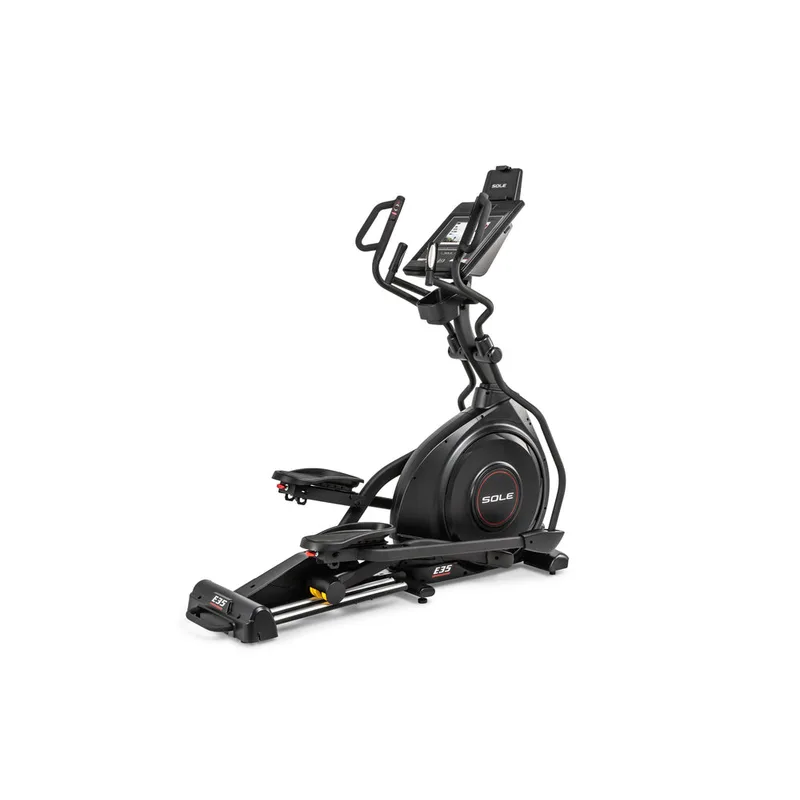
Sole E35 Elliptical
Pros
- 25 lb flywheel delivers noticeably smooth pedal feel at any resistance
- 20-level incline ramp adds real muscle variety without a subscription
- 10.1" HD screen with Netflix, Amazon Prime, and iOS mirroring built in
- 350 lb weight capacity is among the highest in the mid-range price tier
- Bluetooth audio output works with wireless headphones
Cons
- 20" stride length is fixed — not ideal for very tall users (6'3"+)
- Sold direct only — no Amazon listing, return handled through Sole
- Assembly takes 60-90 minutes with two people recommended
The Sole E35 is the most complete elliptical under $1,500 for most buyers. The 25 lb flywheel is heavier than machines costing $500 more from competing brands, and the 20-level incline ramp gives it range that basic rear-drive ellipticals lack. The 2026 model’s 10.1” HD screen runs Netflix, Amazon Prime, and other streaming apps natively — no subscription required. iOS screen mirroring also works over Bluetooth.
Sole sells direct from soletreadmills.com only. The return window is 30 days, and the warranty covers the frame for life, parts for 5 years, and labor for 2 years — strong coverage for the price tier. Assembly requires two people for roughly 60–90 minutes.
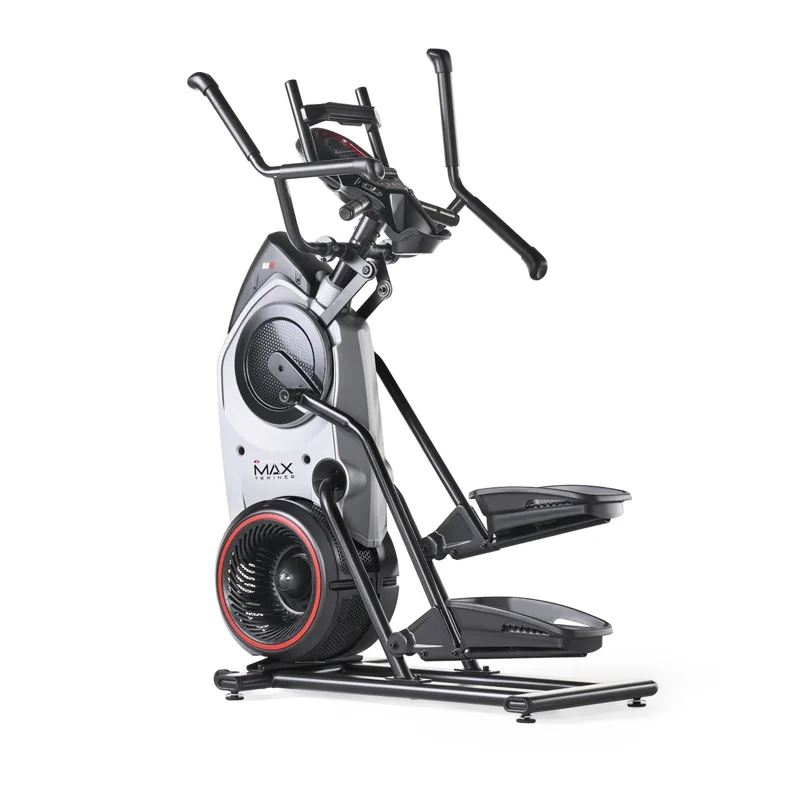
Bowflex Max Trainer M6
Pros
- Smallest footprint in its class at 46" × 26" — fits most apartment spaces
- Hybrid stair-stepper design burns more calories per minute than a standard elliptical
- 1-year JRNY app membership included — live and on-demand classes ready at setup
- Belt-and-fan magnetic resistance is near-silent
- Transport wheels make repositioning easy despite the 136 lb frame
Cons
- 15" stride is shorter than full-size ellipticals — stride length cannot be adjusted
- 300 lb weight capacity is lower than the Sole and NordicTrack options
- No incline adjustment — resistance is the only difficulty variable
- Tall users may feel cramped during the upright stepper motion
The Bowflex Max Trainer M6 isn’t a traditional elliptical — it’s a hybrid stair-stepper that combines the upward push of a stair climber with the arm engagement of an elliptical. The result is a machine that burns more calories per minute than most standard ellipticals at equivalent effort levels, in a 46” × 26” footprint that fits a studio apartment corner.
The 15” stride and 300 lb capacity are the two compromises you make for that footprint. Tall users (6’0”+) will feel the shorter range of motion. The included 1-year JRNY membership ($149 value) gives access to live and on-demand classes immediately — useful for buyers who want structure from day one.
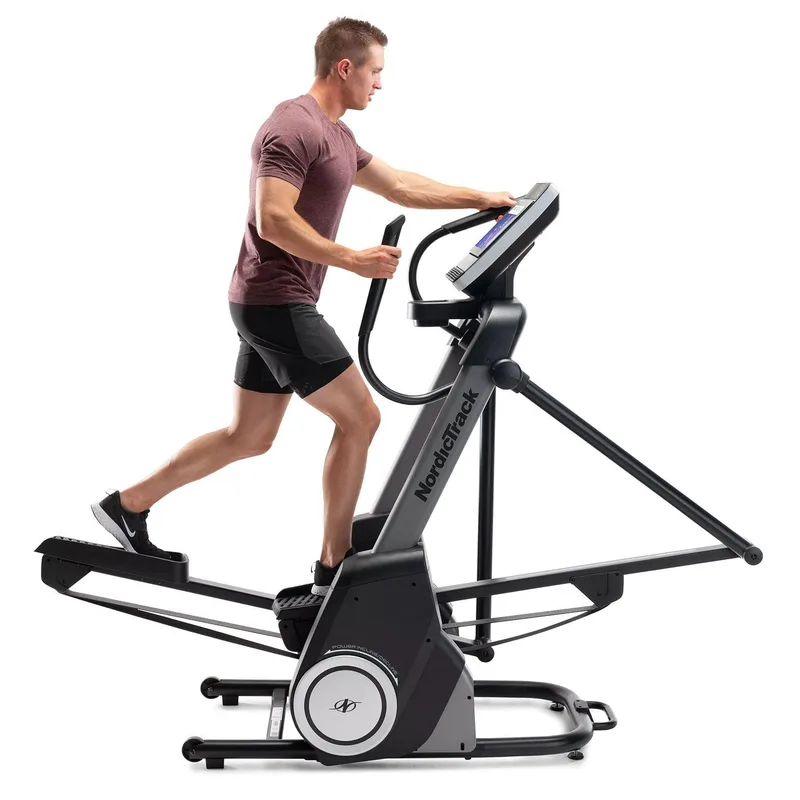
NordicTrack FS14i FreeStride Trainer
Pros
- Auto-adjusting stride up to 32" adapts to your natural gait without manual input
- Power incline AND decline (-10% to +10%) increases glute and hamstring engagement
- 14" HD touchscreen streams iFIT trainer-led sessions with automatic resistance changes
- 375 lb weight capacity — the highest of any machine in this guide
- 26 resistance levels provides more granular progression than budget options
Cons
- iFIT subscription required after the 30-day trial ($39/month or $396/year)
- Heaviest machine in this guide at 272 lbs — not easy to move without help
- Premium price point — this is a long-term commitment, not a casual purchase
- Some users report the auto-stride adjustment takes getting used to
The NordicTrack FS14i’s auto-adjusting stride is the feature that sets it apart. Most ellipticals force you to adapt your gait to the machine. The FS14i adapts to you — the stride length changes automatically during iFIT sessions based on the trainer’s instructions, and you can override it manually at any time. At up to 32”, it comfortably accommodates users well over 6’3”.
Power incline AND decline (-10% to +10%) makes this the most versatile cardio machine in this guide. Decline angles target the anterior tibialis and shift hip flexor engagement — motion patterns no other machine in this list can replicate. The 14” touchscreen streams iFIT sessions with automatic resistance changes. Note: iFIT is $39/month or $396/year after the 30-day trial.
Elliptical vs Other Cardio Equipment
Ellipticals fill a specific niche. Here’s how they compare to the alternatives:
Elliptical vs treadmill: Lower joint impact — studies consistently show ellipticals produce less ground-reaction force than running on a treadmill. Better choice for users with knee or hip issues, or anyone training high weekly mileage who needs active recovery days.
Elliptical vs exercise bike: Ellipticals engage both upper and lower body simultaneously, which increases caloric expenditure. Bikes isolate the lower body but allow easier reading or working during use. If knee tracking is an issue, bikes often cause less irritation.
Elliptical vs rowing machine: Rowing is more total-body and builds more back and core strength. Ellipticals are easier to learn and better for sustained moderate-intensity cardio over 30–60 minutes.
FAQ
What stride length do I need for my height?
The standard recommendation: your stride length should roughly equal half your height in inches. For a 5’10” user (70 inches), that’s a 35” stride — which is larger than any home elliptical offers. In practice, a 20”–22” stride works comfortably for most users up to 6’1”. The NordicTrack FS14i’s auto-adjusting 32” max is the closest home machine to a true natural stride for tall users.
Is a heavier flywheel always better?
Heavier flywheels create more consistent momentum and smoother feel. However, there’s a diminishing-returns curve. The jump from 12 lbs to 20 lbs is dramatic and easily felt. The jump from 25 lbs to 30 lbs is subtle. Anything above 20 lbs performs well for home use — focus your budget on resistance levels and incline range once you clear the 20 lb threshold.
Do I need a connected elliptical?
Not unless you want one. Connected classes improve adherence for many buyers, but the subscription adds $150–$400 per year on top of your purchase price. If you’re disciplined about training on your own or prefer listening to podcasts and music, a standalone machine with a built-in display — like the Sole E35 — delivers equivalent fitness results without the recurring cost.
Front-drive vs rear-drive: which is better?
Neither is objectively superior. Front-drive ellipticals feel more like outdoor running — a slightly forward lean and longer footprint. Rear-drive machines encourage an upright posture and generate a more oval pedal path. If you’ve used an elliptical at a commercial gym, it was likely rear-drive (most Precor and Life Fitness commercial units are rear-drive). If you’re buying your first machine, try both types at a gym before committing.
What maintenance do home ellipticals need?
Less than treadmills. Ellipticals have no deck to lubricate and no belt to replace. Basic maintenance involves: wiping down sweat-exposed surfaces after each session, checking pedal bolts every few months for tightness, and lubricating pivot points and ramps annually with a light machine oil. Magnetic resistance systems have no friction contacts to wear out — the main long-term failure points are sealed bearings, which typically last 8–12 years under home use.
The Bottom Line
For most buyers, the Sole E35 is the right machine. The 25 lb flywheel, 20-level incline, and 10.1” streaming display hit every meaningful spec without requiring a subscription.
If space is the primary constraint, the Bowflex Max Trainer M6 delivers an intense workout in a footprint smaller than most office chairs. The hybrid stair-stepper design burns more calories than a standard elliptical of the same size.
If you’re a serious athlete or want the most versatile cardio machine you’ll ever own, the NordicTrack FS14i’s auto-adjusting stride, power decline, and iFIT integration justify the premium price.
For more options at every price point, see our full best ellipticals for home in 2026 roundup.