The mid-range power rack market in 2026 has become the most competitive segment in home gym equipment. Manufacturers like Major Fitness and Titan have closed the construction gap on budget and mid-tier racks, while REP Fitness and Rogue continue to refine their flagship residential products. The result: buyers in the $650-$1,200 range can now get 3”×3” 11-gauge steel, Westside hole spacing, and flat-foot bases — features that used to require spending north of $1,500.
This roundup targets the buyer upgrading from a budget squat stand or entry-level rack. If you’ve been training on a 2”×2” bolt-together frame and want something that handles 400-lb squat sets without flex or wobble, every rack in this list is a legitimate upgrade. The differences between them come down to configuration options, attachment ecosystem, footprint, and whether you want cables included from day one.
Quick Picks
Titan X-3 Flat Foot is the best overall at $750 — 3”×3” 11-gauge steel, 1,650 lb rackable capacity, Westside hole spacing, and flat-foot stability in one Amazon-available package.
REP Fitness PR-4000 is the most configurable at $695+ — multiple height and depth options, UHMW-lined J-cups, and REP’s deep accessory ecosystem for buyers who want to customize.
Rogue RML-390F is the best premium build at $935 — Monster Lite attachment compatibility, 5/8” Westside hole spacing, and Rogue’s manufacturing quality for buyers who want the benchmark rack in this tier.
Major Fitness Drone1 is the best all-in-one at $799 — cable crossover and lat pulldown included, available on Amazon, ideal for buyers who want a complete cable and rack station without adding separate attachments.
Body-Solid GPR400 is the most commercially built at $725 — 11-gauge commercial-grade uprights, wide walk-in design, and Amazon availability for buyers prioritizing steel quality over configuration options.
Comparison
| Spec | Titan Fitness X-3 Flat Foot Power Rack | REP Fitness PR-4000 Power Rack | Rogue RML-390F Flat Foot Rack | Major Fitness Drone1 Power Cage | Body-Solid GPR400 Power Rack |
|---|---|---|---|---|---|
| Rating | 9.2/10 | 9.0/10 | 8.8/10 | 8.3/10 | 8.1/10 |
| Price | Check price | $695 | $935 | Check price | $840.00as of Oct 18, 2026 |
| Steel | 3" × 3" 11-gauge uprights | 3" × 3" 11-gauge | 3" × 3" 11-gauge | 2" × 2" 14-gauge | 11-gauge 3" × 3" uprights |
| Height | 82" | — | — | — | 80" |
| Depth | 30" | — | — | — | — |
| Rackable Capacity | 1,650 lbs | — | — | — | — |
| Hole Spacing | Westside spacing (bench and clean pull zone) | Westside spacing | 5/8" holes with Westside spacing | — | — |
| Pull-Up Bars | Skinny (1.25") + fat (2") included | — | — | — | — |
| Height Options | — | 80" or 93" | — | — | — |
| Depth Options | — | 24", 30", or 41" | — | — | — |
| Weight Capacity | — | 1,000 lbs | — | 1,500 lbs | 1,000 lbs |
| J-Cup Options | — | Standard, flat, or round sandwich | — | — | — |
| Dimensions | — | — | 50"W × 49"D × 92.3"H | 63"W × 66"D × 85"H | — |
| Attachment System | — | — | Monster Lite compatible | — | — |
| Base | — | — | Flat foot (no bolt-down required) | — | — |
| Weight | — | — | ~215 lbs assembled | — | — |
| Cable System | — | — | — | Dual cable crossover + lat pulldown included | — |
| Weight Stack | — | — | — | 100 lb integrated | — |
| Pull-Up Bar | — | — | — | Multi-grip included | — |
| Walk-In Design | — | — | — | — | Wide format |
| Safeties | — | — | — | — | Pipe & pin safeties included |
| J-Cups | — | — | — | — | Standard lift-offs included |
| Check Price → | Check Price at REP Fitness → | Check Price at Rogue → | Check Price → | Check Price → |
Prices change daily — tap Check Price for the current Amazon price. Numbers shown were verified on the "as of" date.
Detailed Reviews
Titan X-3 Flat Foot Power Rack — Editor Pick
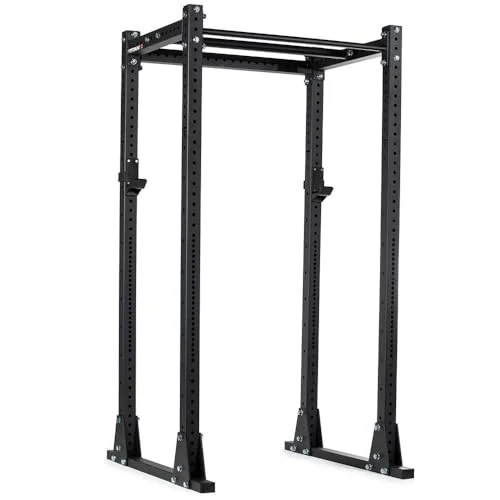
Titan Fitness X-3 Flat Foot Power Rack
Pros
- 3"×3" 11-gauge uprights match the construction quality of racks costing $400 more — the steel gauge is the primary differentiator between durable and budget racks
- 1,650 lb rackable capacity exceeds the REP PR-4000 and Body-Solid GPR400 by a meaningful margin, providing headroom for loaded barbells plus safeties under heavy compound lifts
- Westside hole spacing through the bench and clean pull zone allows precise J-hook and safety positioning across the full range of pressing and squatting heights — this matters more than raw hole count
- Flat foot base means no anchor bolts, no platform requirement — the rack sits stable on rubber flooring without modification to your floor
- Both a skinny pull-up bar (1.25") and fat grip pull-up bar (2") are included — most racks charge extra or include only one option
Cons
- 30" depth is fixed on this model — buyers who need a shallower footprint for space-constrained setups should look at the 24" Titan space-saver variant instead
- Attachment ecosystem is compatible with X-3 accessories but not cross-compatible with Rogue Monster Lite or REP attachments — you're locked into the Titan accessory line
- Assembly is moderately involved; most owners report 2-3 hours for a single person, and the instruction manual quality is average compared to REP Fitness documentation
The Titan X-3 Flat Foot is the benchmark for what a power rack should deliver at the $700-800 price point. The 3”×3” 11-gauge uprights match the construction spec of Rogue’s Monster Lite series and REP’s PR-4000 line — the same steel gauge used in racks that cost $200-400 more. Titan has consistently competed on steel quality at aggressive price points, and the X-3 Flat Foot represents that approach at its most refined.
The 1,650 lb rackable capacity rating is the highest in this roundup. In practical terms, that margin means the rack handles any realistic home gym loading — including heavy squats, bench press, and power cleans with bumper plates — with significant structural headroom above actual working loads. Owner reports from powerlifters squatting 500+ lbs consistently describe the X-3 as rigid and stable under load.
Westside hole spacing through the bench and clean pull zone is the detail that separates mid-tier from entry-level racks. Standard hole spacing places adjustment points every 2-3 inches through the entire upright. Westside spacing tightens the interval to 1-inch increments through the bench and squat zones — the range where precise J-hook and safety bar positioning matters most. The difference is most apparent when dialing in the exact bar height for a low-bar squat or a close-grip bench press.
The flat foot design deserves specific credit. Most racks in this price range require either anchor bolts through the floor or a wooden platform to prevent tipping. The X-3 Flat Foot’s wide base provides enough ballast for standard barbell training without either option — useful for renters, for concrete floors where drilling is undesirable, and for setups where the rack position needs to change periodically.
Included accessories represent genuine value: both a 1.25” skinny pull-up bar and a 2” fat grip bar are standard equipment. Most racks include one or the other. For grip variety and pull-up training, both options on day one without additional purchase is a practical benefit.
REP Fitness PR-4000 Power Rack — Most Customizable
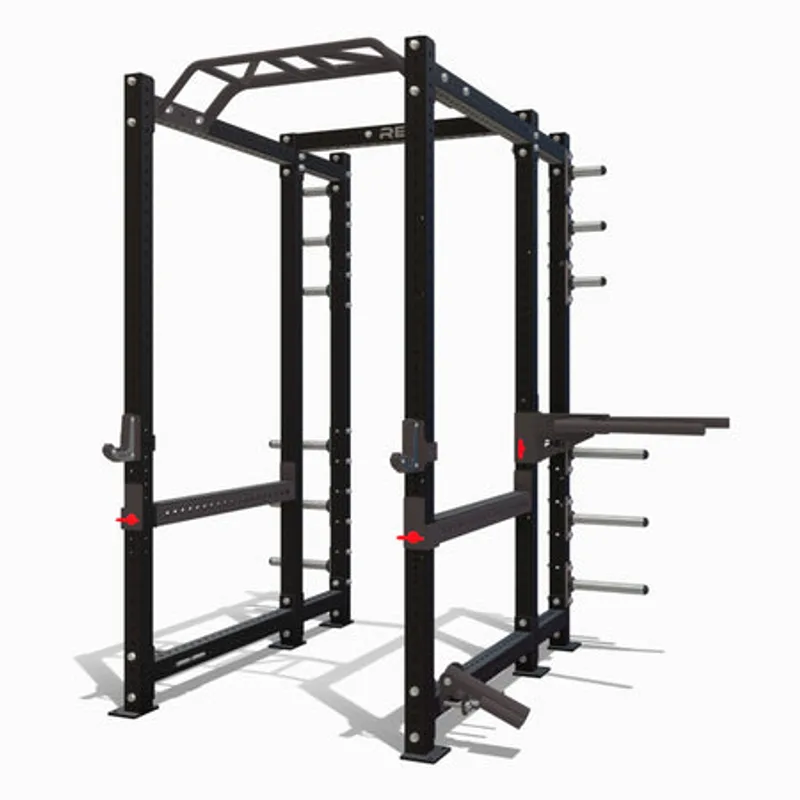
REP Fitness PR-4000 Power Rack
Pros
- Build-your-own configuration system lets you select height, depth, finish, J-cup style, and add-on attachments at the time of order — more configuration options at the $700-900 price point than any competitor
- Multiple depth options (24", 30", 41") mean buyers with tight garage setups can choose a rack footprint that actually fits rather than defaulting to a standard 30" depth that may not work
- Westside hole spacing with REP's proprietary UHMW-lined J-cups protects knurling during loading and unloading — a detail that matters for lifters who load heavy bars repeatedly
- REP's accessory ecosystem is one of the deepest available at this price tier — lat pulldown, cable pulley, dip attachment, and more can be added post-purchase as the gym grows
- 93" height option fits taller garage spaces and allows overhead pressing with a barbell without hitting the pull-up bar — the 80" model is more common but the tall option matters for overhead athletes
Cons
- Direct-only from repfitness.com — longer lead times than Amazon fulfillment, and return logistics require coordinating with REP directly rather than Amazon returns
- 1,000 lb rated capacity is lower than the Titan X-3's 1,650 lb rating, though the REP PR-4000 handles any realistic home gym loading scenario with significant margin
- Base price gets you the uprights and safeties; adding preferred J-cups, barbell holders, and accessories increases the final cost — buyers should configure carefully before ordering
The REP PR-4000 occupies a distinct position in this roundup: it is the only rack built around a configure-before-you-buy model. Rather than a fixed SKU, REP’s system lets buyers select height (80” or 93”), depth (24”, 30”, or 41”), finish color, J-cup style, and add-on accessories at the time of ordering. For buyers whose garage has specific dimensional constraints — a narrow bay, a low ceiling, a beam at a specific height — this matters more than any single spec.
The 11-gauge 3”×3” steel matches the Titan X-3 and Rogue RML-390F on frame construction. REP uses UHMW-lined J-cups as the standard option, which means no metal-on-metal contact between the bar and the J-hook surfaces. Repeated loading cycles on bare metal J-cups eventually damage knurling and wear the cup surface; the UHMW liner extends the life of both the bar and the hardware without requiring replacement liners every few months.
The 24” depth option is worth calling out specifically. The standard 30” power rack depth works in most garage setups, but a 24” depth configuration lets the PR-4000 fit into narrower spaces — a useful option for converted storage rooms, single-car garages with the car parked inside, or any setup where 6 additional inches of depth changes what’s possible.
REP’s accessory catalog is the deepest available at this price tier after Rogue. The lat pulldown, cable pulley kit, dip attachment, band pegs, and weight plate storage horns are all confirmed compatible with PR-4000 uprights — meaning the rack can grow incrementally as training needs expand without requiring a new frame purchase.
The direct-purchase model is the main trade-off. REP sells exclusively through repfitness.com, which means lead times are longer than Amazon Prime and returns require coordinating with REP’s customer service rather than initiating a self-service return. For a $700 purchase, most buyers who have confirmed the configuration they want find this manageable.
Rogue RML-390F Flat Foot Rack — Best Premium
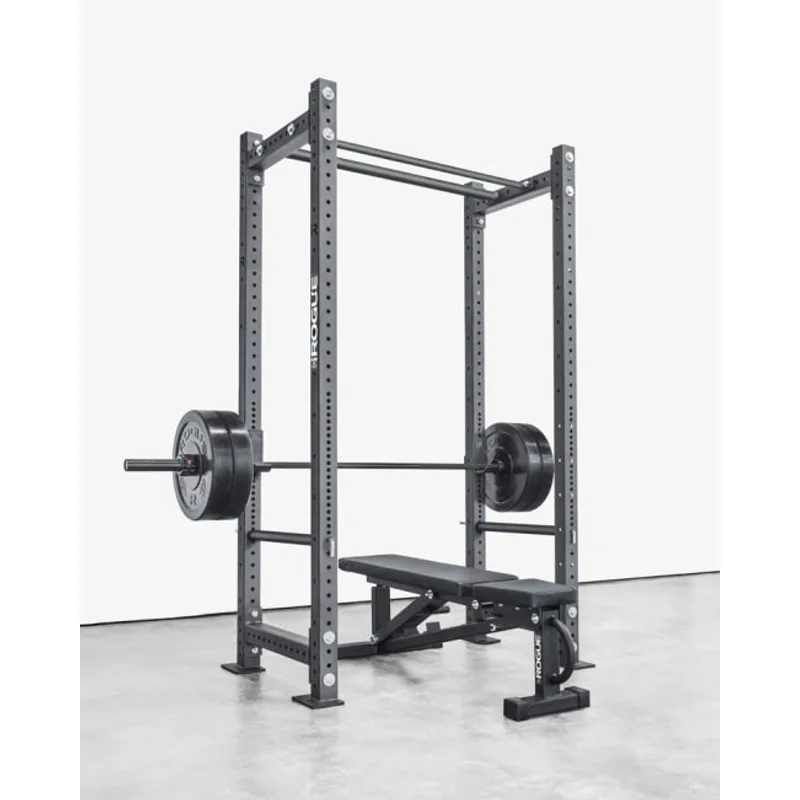
Rogue RML-390F Flat Foot Rack
Pros
- Monster Lite attachment compatibility is the largest premium rack accessory ecosystem in the home gym market — virtually every accessory Rogue makes for home gym owners fits this rack
- Flat foot base eliminates the platform or anchor requirement that comes with most bolt-down racks in this price range, making it deployable on rubber flooring without modifications
- 5/8" Westside hole spacing through the bench zone provides precise adjustment across every pressing and squatting height — the most refined hole pattern among the racks in this roundup
- Rogue's manufacturing quality, customer support infrastructure, and parts availability are the best available for a U.S.-based home gym equipment company — the rack comes with clear documentation and verified replacement parts
- At 92.3" tall, the RML-390F fits standard 8-foot garage ceilings with minimal clearance while accommodating a barbell during overhead press without obstruction
Cons
- $935 is the highest price in this roundup for a standalone power rack — the Titan X-3 and REP PR-4000 offer comparable steel quality and hole spacing for $150-250 less
- Direct-only from roguefitness.com — shipping lead times and return logistics are brand-managed rather than Amazon-fulfilled
- No cable system or pulldown attachment included — buyers wanting a complete training station need to budget separately for lat pulldown and cable accessories
The Rogue RML-390F costs more than the Titan X-3 and REP PR-4000. The reason buyers pay the premium is not the steel — all three use 3”×3” 11-gauge — it is the Monster Lite attachment ecosystem and the manufacturing precision that Rogue’s quality control produces.
The Monster Lite system is the largest residential rack attachment ecosystem available. Pull-up bar upgrades, multi-grip pull bars, band peg sets, dip attachments, spotter arms, barbell holders, and cable pulley systems all attach directly to Monster Lite uprights without adapter hardware. For a buyer who anticipates building out their rack over multiple years, this compatibility matters: every accessory purchased for the RML-390F will work on any future Rogue Monster Lite rack if you ever upgrade or change setups.
The 5/8” Westside hole pattern is the most refined in this comparison. Rogue’s hole sizing and spacing tolerances — the precision with which each hole is laser-cut and positioned — are tighter than what budget and mid-tier manufacturers produce. In practical terms, this means J-hooks seat flush and do not rattle, safeties sit at exact heights without wobble, and accessories mount without the slight misalignment that occasionally shows up on less precisely manufactured uprights.
The flat foot base at 92.3” is the feature that defines the Rogue RML-390F’s position in this roundup. At just under 93”, it clears a standard 8-foot ceiling with approximately 3 inches of headroom — enough to avoid contact during upright overhead press without requiring a 9-foot or 10-foot ceiling. Competing racks in this price range often come in at 82-84 inches, which limits overhead training for anyone over 6’1” pressing with their arms fully extended.
At $935 direct from Rogue, the RML-390F is the premium option in this roundup. It is not the best value per dollar. It is the rack to buy if you want the best-built version of the type and plan to invest in the Monster Lite accessory system over time.
Major Fitness Drone1 Power Cage — Best All-in-One
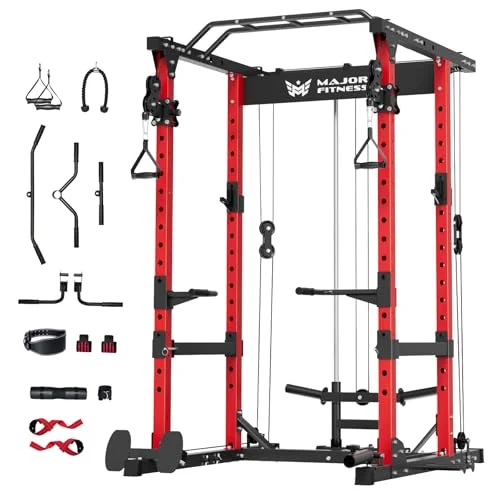
Major Fitness Drone1 Power Cage
Pros
- Integrated dual cable crossover and lat pulldown station is included at $799 — adding equivalent cable attachments to a standalone rack would cost $200-400 extra on the REP, Titan, or Rogue options
- 1,500 lb stated capacity exceeds the PR-4000 and GPR400 at comparable pricing, providing adequate structural margin for heavy compound lifts
- 100 lb integrated weight stack for the cable system means cable exercises are immediately usable without purchasing a weight plate stack separately
- All-in-one footprint of 63"×66" keeps cable training, power rack work, and lat pulldowns in a single station — reduces the total floor space requirement versus buying separate pieces
- $799 on Amazon with Prime shipping and straightforward return logistics makes this the most accessible purchase process of the five racks in this roundup
Cons
- 2"×2" 14-gauge steel uprights are meaningfully lighter construction than the 3"×3" 11-gauge steel used in the Titan X-3, REP PR-4000, and Rogue options — the frame is less rigid under heavy compound loading
- No Westside hole spacing — the adjustment positions are standard rather than optimized for the bench and squat zones, which limits precise safety bar and J-hook placement
- Cable system durability at this price point generates more mixed owner feedback than the standalone cable machine options from Body-Solid and REP; cables and pulleys may require inspection or adjustment after extended use
The Major Fitness Drone1 solves a specific problem: how to get power rack training, cable crossover work, and lat pulldowns in a single footprint without buying three separate pieces of equipment. At $799 on Amazon, the Drone1 includes an integrated dual cable crossover system and a 100 lb weight stack — a combination that adds $200-400 to the cost of a standalone power rack if purchased separately.
For home gym builders in the intermediate stage — enough space for one primary station but not enough for three separate pieces — the Drone1 makes a practical case. The 63”×66” footprint consolidates training variety that would otherwise require 150-200 square feet of separate equipment spread. Owner feedback consistently describes the station as a significant upgrade over basic power racks for anyone who does cable rows, lat pulldowns, tricep pushdowns, and crossover work as part of their regular programming.
The trade-off versus the Titan X-3, REP PR-4000, and Rogue RML-390F is structural. The Drone1’s 2”×2” 14-gauge steel uprights are lighter construction than the 3”×3” 11-gauge frames in the top three racks. Under moderate loads — which describes the majority of home gym use — the difference is not apparent. Under heavy compound lifts with 400+ lb barbells, the 3”×3” frames are more rigid. Buyers who plan to squat or deadlift with heavy loads regularly should factor this into the decision.
The cable system durability at this price point draws mixed owner reports. The pulleys, cables, and weight stack perform well during the first 12-18 months of regular use. Longer-term users report occasional cable fraying and pulley wear that requires inspection and part replacement — a normal maintenance reality for cable systems at this price tier, and one worth budgeting for.
For buyers whose primary need is training variety in a single station at under $1,000, the Drone1 is the answer. For buyers whose priority is maximum structural integrity for heavy powerlifting, the Titan X-3 or Rogue RML-390F serve that goal better.
Body-Solid GPR400 Power Rack — Best for Durability
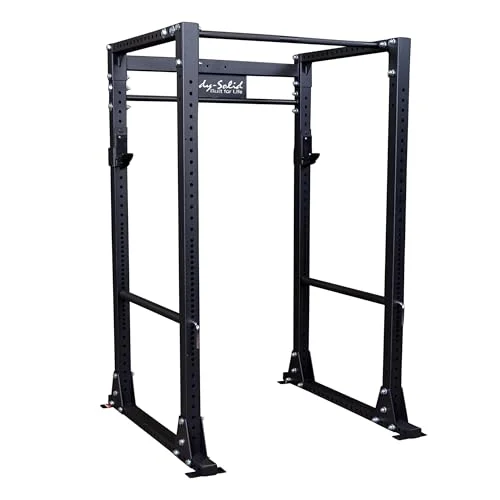
Body-Solid GPR400 Power Rack
Pros
- Body-Solid's commercial construction heritage shows in the GPR400's 11-gauge 3"×3" steel frame — built to spec sheet standards closer to light commercial than residential consumer equipment
- Wide walk-in design provides more lateral clearance inside the rack for exercises like dumbbell work, landmine rows, and barbell good mornings compared to narrower residential racks
- Body-Solid's extensive accessory catalog — including the GLA400 lat attachment, GPRDH dip handles, GPRTBR T-bar row, and band pegs — can expand the GPR400 into a full training station over time
- Available on Amazon with standard return policies — unlike the REP and Rogue options, purchasing and returns are handled through Amazon's infrastructure
- 273 lb machine weight and wide base provides the stability needed for heavy squats and bench pressing without anchor bolts, functioning reliably on solid rubber flooring
Cons
- No Westside hole spacing — standard hole placement limits fine-tuning of J-cup and safety positioning for low-bar squats and close-grip pressing compared to Westside-spaced racks
- No pull-up bar style options — the 1.25" integrated bar is fixed and cannot be upgraded to a fat-grip bar without purchasing a separate attachment
- 80" height limits overhead pressing clearance compared to the Rogue RML-390F's 92.3" — for athletes who overhead press standing, the 12-inch height difference is a real constraint
Body-Solid builds equipment to commercial specifications, and the GPR400 reflects that. The 11-gauge 3”×3” uprights are the same construction grade as the Titan X-3 and REP PR-4000. The 273 lb assembled weight is the heaviest in this roundup — more mass in the frame translates to more stability under dynamic loading without anchor bolts. Owner reports from gym owners who use the GPR400 in light commercial settings describe it as a rack that handles daily use across multiple users without structural fatigue.
The wide walk-in design provides interior clearance that goes beyond what most residential racks offer. The extra width accommodates dumbbell exercises inside the rack, allows comfortable movement for sumo deadlifts and wide-stance squats, and creates practical space for landmine work if a T-bar row attachment is added. Narrower racks — particularly sub-24” interior width models — can feel constrictive for exercises that require lateral arm movement or a wide stance.
Body-Solid’s GPR400 accessory catalog includes a lat pulldown attachment (GLA400), dip handles (GPRDH), T-bar row attachment (GPRTBR), weight horns, and band pegs — enough to build a comprehensive training station from the base rack. The attachments are sold separately, which means the base price of $725 covers only the rack itself, but the upgrade path is well-established and the accessories are consistently available.
The gaps versus the top-ranked racks are the hole spacing and height. Standard hole spacing limits precise J-hook positioning compared to Westside-spaced racks; this matters most for low-bar squatters and close-grip bench pressers who want fine-tuned bar height. The 80” height provides adequate overhead clearance for most users but limits standing overhead press headroom for taller athletes. For buyers whose priority is maximum frame durability and a wide training interior on Amazon with standard return policies, the GPR400 earns its place in this comparison.
Buying Guide: Power Rack Selection Under $1,500
Steel Grade and Upright Size
The most important structural specification in a power rack is the upright dimension and wall thickness. Three-inch-by-three-inch uprights with 11-gauge (approximately 0.120”) wall thickness represent the threshold between residential and light commercial construction. Every rack in this roundup except the Drone1 meets this standard. The Drone1’s 2”×2” 14-gauge uprights are adequate for moderate loads but flex more under heavy compound lifts.
Eleven-gauge steel is the minimum for a rack intended to handle 300+ lb squats regularly. Budget racks at 12 or 14 gauge feel noticeably less rigid when loaded and develop wobble faster over time.
Hole Spacing
Westside hole spacing concentrates adjustment positions within the bench press and squat zones — the range of heights where precise J-hook and safety bar placement matters most. Standard spacing places holes at uniform 2-3 inch intervals across the entire upright. Westside spacing tightens this to 1-inch increments through the middle section.
For most home gym lifters, standard spacing is sufficient. For competitive powerlifters or anyone who trains with very precise bar positioning, Westside spacing is the appropriate choice. Four of the five racks in this roundup offer it.
Attachment Ecosystem
A power rack is a long-term platform. The accessories that can attach to the uprights determine how the station evolves over time. Rogue’s Monster Lite system has the most accessories available, followed by REP Fitness, Titan, and Body-Solid. Major Fitness has a more limited attachment library.
Buyers who anticipate adding a lat pulldown, cable pulley, dip attachment, or specialty bars over the next few years should verify that their chosen rack’s ecosystem supports those additions before purchasing.
Footprint and Ceiling Height
Standard power racks run 82-93 inches tall and 30-41 inches deep (front to back). Ceiling clearance for a rack plus barbell during overhead press requires approximately 12-15 inches above the rack height — meaning a 93” rack needs a 105”+ ceiling to overhead press safely without striking the bar.
Depth choice affects how much floor space the rack occupies. A 30” deep rack with a 7-foot barbell and clear walking space on each side requires roughly 9-10 feet of floor depth minimum. Buyers with constrained spaces should measure carefully before ordering.
Flat Foot vs. Bolt-Down
Flat foot designs (Titan X-3, Rogue RML-390F) are stable on rubber flooring without anchor hardware. Bolt-down racks require either anchor bolts through the floor or a wooden platform base with the rack secured to it. For renters, concrete floors where drilling is undesirable, or setups where the rack position may need to change, flat foot bases are the practical choice.
FAQ
What is the best power rack under $1,500 for heavy powerlifting?
The Titan X-3 Flat Foot ($750) or REP Fitness PR-4000 ($695+) are the strongest structural choices under $1,000. Both use 3”×3” 11-gauge steel with Westside hole spacing. The Rogue RML-390F ($935) adds Monster Lite attachment compatibility and tighter manufacturing tolerances. All three handle powerlifting loads reliably. The Major Fitness Drone1 is not recommended for competitive powerlifters due to its lighter 2”×2” 14-gauge frame.
Do I need to bolt a power rack to the floor?
It depends on the rack design. The Titan X-3 and Rogue RML-390F use flat-foot bases that provide stability on rubber flooring without anchor bolts for standard home gym training. The REP PR-4000 and Body-Solid GPR400 can be used without anchoring for most training, but heavy overhead work or use near the rated capacity limits benefits from anchoring. Bolt-down racks are always more stable under maximum loads — flat-foot designs are a practical compromise for setups where drilling is not an option.
What’s the difference between 11-gauge and 14-gauge steel in power racks?
Gauge refers to wall thickness — lower gauge numbers mean thicker steel. Eleven-gauge steel (approximately 0.120” thick) provides more rigidity and a higher load ceiling than 14-gauge (approximately 0.075” thick). Under heavy compound lifts, 11-gauge uprights flex less, feel more solid, and maintain structural integrity for longer. At moderate home gym loads (under 300 lbs), the practical difference is smaller but still present — 11-gauge racks feel noticeably more stable during dynamic lifts.
Can I add a cable machine to a power rack?
Yes, most premium racks in this price range support cable pulley attachments. The REP PR-4000 and Body-Solid GPR400 have compatible cable and lat pulldown accessories available from their respective brands. The Rogue RML-390F supports the extensive Monster Lite cable system. The Major Fitness Drone1 includes cables as part of the base package. The Titan X-3 has compatible cable attachments within the Titan accessory line.
How much ceiling height do I need for a power rack?
Most power racks in this roundup stand 80-93 inches tall. Add approximately 12-15 inches for clearance during an overhead press with a 45 lb bumper plate on each end: a 93” rack needs roughly 105-108” of ceiling clearance for standing overhead press. If ceiling height is limited, the Titan X-3’s 82” profile or REP PR-4000’s 80” option allows overhead pressing in spaces with 8-foot ceilings. The Rogue RML-390F at 92.3” is tight in 8-foot ceilings but works.
Is a power rack better than a squat rack?
For most home gym builders, yes. A power rack (four-post cage) provides safety bar catch positions on both sides of the bar, allowing you to lift to failure without a spotter. A squat rack or half-rack provides J-hooks and a pull-up bar but typically lacks the full safety cage. If you train alone — which most home gym users do — a full power cage provides a safety margin that half-racks cannot replicate. The cost difference between a basic half-rack and a quality power cage has narrowed to $100-200 at the price point this roundup covers.
Conclusion
For most home gym builders in the $650-$1,500 range, the Titan X-3 Flat Foot is the strongest overall choice. The combination of 3”×3” 11-gauge steel, Westside hole spacing, 1,650 lb rackable capacity, flat-foot stability, and Amazon availability at $750 represents the most complete package in this tier.
Buyers who want maximum configuration options — particularly those with non-standard ceiling heights or tight garage dimensions — should start at the REP Fitness PR-4000. The ability to configure height, depth, and J-cup style before ordering is unique in this price range, and REP’s accessory ecosystem ensures the rack can grow with the gym.
For buyers who want the benchmark residential rack and plan to invest in accessories over time, the Rogue RML-390F at $935 is the right choice. The Monster Lite compatibility and Rogue manufacturing quality are worth the premium for serious lifters who will use the rack as the centerpiece of their training for the next decade.
If you want a cable system included from day one without a separate cable machine purchase, the Major Fitness Drone1 at $799 on Amazon delivers that in a single all-in-one station — with the understanding that the frame construction is lighter than the standalone rack options.