A home gym in a garage or basement can hit 95°F by noon in July. With summer 2026 bringing record heat across most of the U.S., gym owners are reporting cut-short workouts and damaged equipment — barbells surface-rusting from condensation, rubber flooring softening in extreme heat, and cardio machines overheating. The fix isn’t complicated, but it does require the right combination of airflow, cooling, and moisture control for your specific space.
This guide covers the three main tools: a high-output portable AC for serious cooling, a commercial-grade wall-mount fan for continuous airflow, and a 50-pint dehumidifier to protect equipment in basement setups. All three are available on Amazon and solve real problems — not just discomfort.
| Spec | Whynter ARC-14S 14,000 BTU Dual Hose Portable AC | Hurricane Pro Commercial Grade 20" Oscillating Wall Mount Fan | hOmeLabs 7,500 Sq. Ft. Energy Star Dehumidifier with Pump |
|---|---|---|---|
| Rating | 9.2/10 | 8.8/10 | 8.6/10 |
| Price | Unavailable | $98.23-$126.83as of Oct 18, 2026 | $309.99as of Oct 18, 2026 |
| BTU Output | 14,000 BTU (9,500 BTU SACC) | — | — |
| Coverage | Up to 500 sq ft | — | Up to 4,500 sq ft |
| Hose Type | Dual hose (more efficient) | — | — |
| Built-in Dehumidifier | Yes | — | — |
| Noise Level | ~52 dB | — | ~51 dB |
| Weight | 80 lbs | — | — |
| Blade Diameter | — | 20 inches | — |
| Airflow | — | 4,600 CFM | — |
| Speed Settings | — | 3 (Low / Medium / High) | — |
| Mount Type | — | Wall mount with adjustable tilt | — |
| Oscillation | — | Yes | — |
| Construction | — | All-metal with powder-coat finish | — |
| Capacity | — | — | 50 pint per day |
| Built-in Pump | — | — | Yes (continuous drainage) |
| Certification | — | — | Energy Star |
| Auto Shutoff | — | — | Yes |
| Check Price → | Check Price → | Check Price → |
Prices change daily — tap Check Price for the current Amazon price. Numbers shown were verified on the "as of" date.
Why Your Gym Temperature Matters More Than You Think
Training in heat above 85°F raises core body temperature faster than your body can compensate, cutting performance by 10–20% according to exercise physiology research. More practically: you fatigue faster, your grip suffers, and the risk of heat cramps goes up substantially.
For equipment, chronic humidity above 60% causes:
- Surface rust on uncoated barbell shafts and weight plates
- Premature degradation of rubber flooring adhesive
- Bearing corrosion in cardio machines (treadmill motors are particularly vulnerable)
- Mold growth in foam padding and upholstery
Controlling your gym’s environment protects your investment in equipment, not just your comfort.
The Three-Layer Approach
The most effective home gym climate setups use all three layers working together:
- Airflow first — A powerful fan keeps air moving and sweat evaporating faster. In a well-ventilated garage with doors open, a good fan alone may be sufficient from May through June.
- Cooling second — A portable AC or mini split actively lowers air temperature. Necessary for July through September in most U.S. climates.
- Dehumidification third — Especially for basement gyms where moisture seeps through concrete. A dehumidifier doesn’t cool your gym but keeps humidity at equipment-safe levels (40–55% RH).
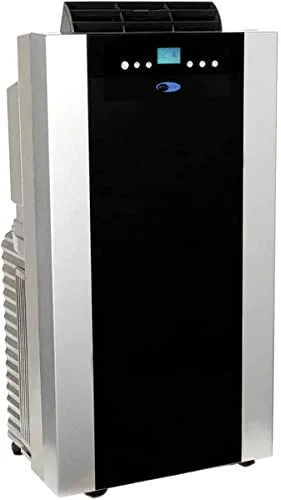
Whynter ARC-14S 14,000 BTU Dual Hose Portable AC
Pros
- Dual-hose design prevents negative pressure — doesn't pull hot air into the gym through door gaps
- 9,500 BTU SACC means it can actually cool a 1-car garage on most summer days
- Built-in dehumidifier function removes moisture while cooling
- Rolls on casters — easy to reposition between seasons
- Window exhaust kit included; works with standard garage side doors
Cons
- 80 lbs is heavy to lift onto a shelf or move up stairs
- Not a permanent solution — needs exhaust hose access to outside
- Struggles on 90°F+ days in an uninsulated 2-car garage
The Whynter ARC-14S is the go-to portable AC recommendation for garage gyms because of one critical design detail: it uses a dual-hose system. Single-hose portable ACs exhaust hot air outside but draw replacement air from inside the room — creating negative pressure that pulls hot attic or outside air through every gap and crack. A dual-hose unit draws its intake air from outside, making it far more efficient in a poorly-sealed space like a garage.
At 9,500 BTU SACC (the honest real-world number), it can reliably cool a 1-car garage on most summer days. In a 2-car garage (typically 400–500 sq ft), it holds up on days under 85°F but struggles when temps push past 90°F outdoors without some shade or insulation.
The built-in dehumidifier function runs simultaneously with cooling — a useful bonus for gym owners who don’t want to buy a separate unit. Setup takes about 20 minutes: roll it into position, attach the dual exhaust hoses, fit the window kit into the side door gap or a small cut-out, and power on.
Limitations to know upfront: you need access to an exterior wall or door for the exhaust hoses. If your only openings are the main roll-up garage door, it still works — but the window kit requires creative mounting or a DIY panel cut. Also plan for the condensate drain or run it in “auto” mode where it recycles moisture through the exhaust.
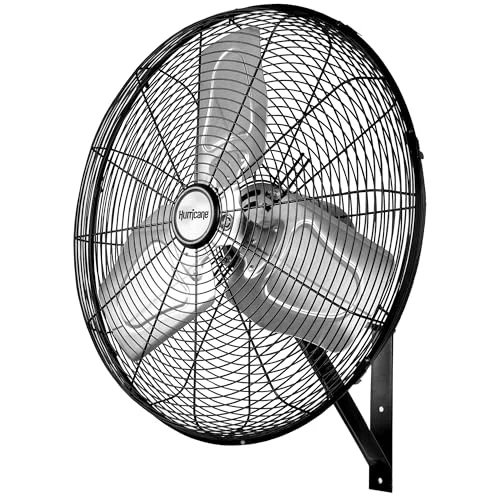
Hurricane Pro Commercial Grade 20" Oscillating Wall Mount Fan
Pros
- 4,600 CFM pushes serious air volume — noticeably better than box fans
- Wall-mount keeps the floor clear for equipment and walking paths
- All-metal construction holds up in hot, humid garage environments
- Oscillating head covers the entire training area, not just a fixed spot
- Three speeds handle everything from light warm-up to heavy-lift cool-down
Cons
- Fan moves air but doesn't lower actual air temperature — needs AC or open doors to work best
- Mounting into concrete or cinder block walls requires masonry anchors (not included)
- Louder on high than a residential ceiling fan
Air conditioning is seasonal and portable ACs make noise. For the majority of spring and fall training days, a high-output wall-mount fan is all you need — and the Hurricane Pro 20” Commercial Grade is the most practical option for a gym setting.
The all-metal housing holds up in garage environments where plastic fans crack and warp from UV and temperature swings. At 4,600 CFM, it moves significantly more air than typical 20” box fans (usually 2,000–2,500 CFM). The wall-mount configuration saves floor space — critical when you’re already managing a squat rack, bench, and pulling platform footprints.
Mount it 7–8 feet high on the wall opposite your main lifting area so it oscillates across the full training zone. Combined with an open roll-up door or side windows, this creates cross-ventilation that drops perceived temperature by 5–10°F through evaporative cooling on the skin.
The pull-chain controls are simple and durable. If that feels outdated, you can put it on a smart plug for remote speed control — but the basic three-speed setup works fine.
For a complete two-fan setup (recommended for 2-car garages), add a second unit on the opposite wall to create proper cross-ventilation instead of just circulating stale hot air.
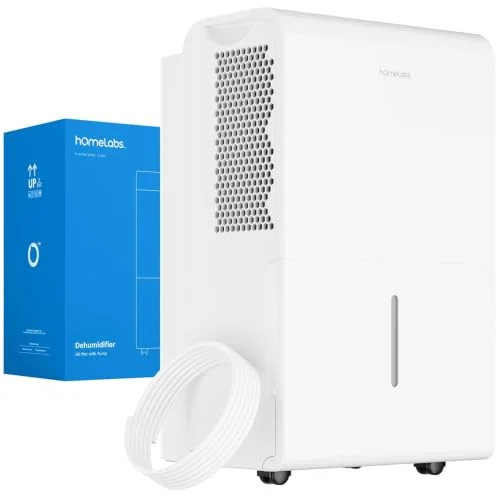
hOmeLabs 7,500 Sq. Ft. Energy Star Dehumidifier with Pump
Pros
- Built-in pump pushes water up and out — no bucket to empty every few hours
- Pulls 50 pints of moisture per day, enough for a damp basement gym
- Energy Star certified — cheaper to run than older non-certified models
- Auto-humidistat maintains your target humidity level without manual checks
- Handles temperatures as low as 41°F — works year-round, not just summer
Cons
- Covers humidity but does not cool air — pair with a fan for real temperature relief
- Pump hose runs about 16 feet — the drain destination must be reasonably close
- Runs continuously during humid seasons, which adds to electricity costs
Basement gyms have a different primary problem: moisture. Concrete walls and floors naturally wick groundwater, and during humid summer months a basement can hold 70–80% relative humidity — high enough that steel equipment starts rusting within weeks without protection.
The hOmeLabs 7,500 Sq. Ft. model handles 50 pints of moisture removal per day, enough for most basement gym setups. The built-in pump is the feature that makes this model worth the price premium over cheaper units: it pushes collected water through a drain hose up to 16 feet, allowing continuous operation without a bucket to empty every few hours mid-workout.
Set the target humidity to 45–50% RH for a gym. Below 40% and the air gets dry enough to irritate your throat during heavy breathing. Above 55% and you’re back in the rust and mold risk zone.
One thing this unit doesn’t do: cool the air. Dehumidifying actually slightly warms air (the refrigeration cycle generates a small amount of heat). Use it alongside a fan or portable AC for temperature control — don’t expect it to replace either.
Buying Guide: Choosing the Right Setup for Your Gym
Garage Gym (1-Car, Up to 250 sq ft)
Budget option: Hurricane Pro fan + open door. Sufficient for most spring/fall training and tolerable through early summer.
Full comfort setup: Hurricane Pro fan + Whynter ARC-14S portable AC. The fan keeps air moving when the AC isn’t running and supplements cooling when it is.
Estimated cost: $89–$530 depending on which components you add.
Garage Gym (2-Car, 400–600 sq ft)
Minimum: Two Hurricane Pro fans for cross-ventilation.
Serious solution: Two fans + Whynter ARC-14S for days above 85°F.
Best long-term: Mini split AC installation (2,000–2,500 BTU per 100 sq ft; a 12,000–18,000 BTU mini split covers a standard 2-car garage). Mini splits are more efficient, quieter, and permanent — but require professional installation, typically $1,500–$3,500 all-in.
Basement Gym
Always needed: hOmeLabs 7,500 dehumidifier. Basement moisture damages equipment regardless of season.
Add airflow: Hurricane Pro wall-mount fan for the training area.
Temperature control: Basements are naturally cooler in summer (typically 65–72°F), so many basement gyms don’t need AC. If yours runs hot, a window AC in the egress window is more efficient than a portable unit.
Key Specs to Compare When Shopping
| Feature | Portable AC | Wall Fan | Dehumidifier |
|---|---|---|---|
| Lowers air temp | Yes | No (perceived cooling) | No (slight warming) |
| Moves air | Yes | Yes | No |
| Removes humidity | Some | No | Yes |
| Requires exterior access | Yes (exhaust hose) | No | No |
| Installation effort | Easy (30 min) | Moderate (wall mount) | Easy |
| Seasonal | Yes (warm months) | Year-round | Year-round |
Ventilation Tips That Don’t Require Buying Anything
Before adding equipment, check these free fixes:
Garage door insulation kits — Foam panel kits install in the door panels and block radiant heat. A single panel kit ($30–$60) can drop garage temp by 10°F on a sunny day.
Door seals and weatherstripping — Gaps around the garage door let hot air pour in and cool air leak out. A quality bottom seal and side weatherstripping makes any cooling system more effective.
Thermal blackout curtains — For a window-facing wall, blackout curtain fabric blocks solar heat gain. Inexpensive and immediate.
Train at strategic times — Early morning (6–8 AM) before solar heat load builds, or after sundown. Even on a 95°F day, a 70°F morning workout is achievable.
FAQ
Q: Does a portable AC in a garage actually work, or does heat overwhelm it? It depends on garage insulation and size. An uninsulated 1-car garage can be cooled to 75–80°F on an 85°F day with a 14,000 BTU dual-hose unit. On 95°F+ days or in a 2-car garage without insulation, you’ll maintain tolerable temps (low 80s) but not full comfort. Adding garage door insulation panels and a fan dramatically improves portable AC effectiveness.
Q: What’s the difference between a single-hose and dual-hose portable AC? Single-hose units exhaust hot air outside but then draw new air in from inside the room — creating negative pressure that pulls hot air through every seal and crack. Dual-hose units draw intake air from outside directly, so they don’t create that negative pressure loop. In a leaky garage, a dual-hose unit can be 30–50% more efficient than a comparable single-hose model.
Q: Do I need a dehumidifier if I already have AC? For garage gyms: usually not — portable ACs dehumidify as part of the cooling process. For basement gyms: yes, even if you have AC. Basements have persistent moisture sources (groundwater, concrete wall vapor) that continue regardless of air temperature. An AC alone won’t prevent rust and mold in a basement gym.
Q: What humidity level should I target for my home gym? 40–55% relative humidity is the target range. Below 40% and the air feels uncomfortably dry during heavy exertion. Above 55% and equipment begins to corrode, rubber flooring adhesive softens, and mold risk increases. A dehumidifier with a humidistat handles this automatically once you set the target.
Q: Is a mini split AC worth it for a home gym? For serious home gym owners planning to use the space year-round, yes. A properly sized mini split (12,000–18,000 BTU for most garages) is quieter, more efficient, and more effective than a portable AC. The $1,500–$3,500 installation cost pays back in lower electricity bills and better performance over several summers. If you’re still in the “building out” phase of your gym, start with a portable unit and upgrade when the gym is fully set up.
Conclusion
The right cooling setup for your home gym depends on your space:
- Garage gym in moderate summer climates: Hurricane Pro 20” wall fan gets you through spring and fall. Add the Whynter ARC-14S when July hits.
- Garage gym in hot climates: Both immediately, and consider garage door insulation panels as a free force-multiplier.
- Basement gym: Start with the hOmeLabs dehumidifier — that’s the priority. Add a wall fan for airflow. Temperature is rarely the primary issue underground.
Heat is one of the top reasons home gym owners skip sessions. The Hurricane Pro fan costs less than two months of a commercial gym membership. Start there and add what your space needs.
For more ways to optimize your training space, check out our garage gym flooring installation guide and our basement home gym setup guide.